1
‫اطفال‬ ‫جراحة‬
Pediatric surgery
Principles of pediatric surgery and common Surgical Problems in
Infants and Children
Pyloric stenosis
 Hypertrophy of the gastric outlet
o 1:150 males, 1:750 females
o 2-12 weeks of age
 Repetitive vomiting
o Projectile
o Non-bilious
 Dehydration
o Hypochloremic alkalosis
 Exam
o Visible peristaltic wave
o Palpable “olive” to right of umbilicus
2
Pyloric stenosis: Diagnosis
Pyloric stenosis :treatment
Surgical treatment
3
Malrotation
o Failure of midgut to rotate into normal
anatomic position during development
- Colon and cecum in left
- Duodenum on right side
o Bilious vomiting
- Peritoneal (Ladd) bands cause partial
bowel obstruction
o High risk for...
Midgut volvulus
 Twisting of bowel around its mesentery and
vascular supply
• Leads to ischemia, infarction, perforation,
necrosis
• Presentation: lethargy, abdominal
distention, bloody stools
! SURGICAL EMERGENCY
MALROTATION
 Must consider in every infant with bilious
emesis
 30% present within first week of life
 50% within first month
 Midgut volvulus with necrosis disastrous
 Can lead to SBS, death
4
CLINICAL PRESENTATION of MALROTATION
 Sudden onset of bilious emesis in 95%
 Abdominal distention common
 Blood stool +
 Bloody vomitus or diarrhea in 30%
RADIOLOGIC DX of MALROTATION
 KUB:Gasless abdomen, SBO, “double
bubble”
 Contrast study: spiral or corkscrew
appearance
 UTS: reversed position of SMA/SMV
 Study MUST be expeditious
PREOPERATIVE PREPARATION:
MALROTATION WITH VOLVULUS
 Labs / unnecessary
 Mortality remains as high as 28%
 Preoperative preparation ?? NONE !! ...GO
TO OR…. QUICKLY
OPERATIVE CORRECTION of MALROTATION
 Ladd procedure
• Appendix potentially in LUQ 
Removed
 Role of second look operation
5
Duodenal atresia
 Obliteration of lumen
• Failure to recanalize
 Neonatal bilious vomiting
 Associations
• Prematurity
• Congenital heart defects
• Trisomy 21
! SURGICAL EMERGENCY
Meconium ileus
 CYSTIC FIBROSIS
• First manifestation in 15% of CF cases
• Thick meconium impacts
in ileum
• Abdominal distention
• Bilious vomiting
• Risk for
-Volvulus
-Perforation
! SURGICAL EMERGENCY
6
Intussusception
 Most common cause of intestinal obstruction between 3 mo -
6yrs
 2/3 cases occur <2 yrs
 Male/Female=4:1
 75-95% Ileocolic
 >90% idiopathic; Meckel’s, Peyer’s
patches, tumors, polyps
Telescoping of proximal bowel into distal (Terminal Ileum into Cecum
depicted in diagram)
 Telescoping of one segment of bowel into another
• Ileocolonic most common
• 6 mos – 3 years old
 Progressive course
• Intermittent acute abd. pain
• Vomiting
• Bloody stools (currant jelly)
• Fever, lethargy
• Palpable sausage-shaped mass in
upper abdomen
Intussusception: Presentation
 Abdominal pain, vomiting and rectal bleeding triad seen in < 1/3
of cases.
7
 85% display only colicky abdominal pain
often 1- 5minutes of crying and pain
separated by 3-30 minutes of nl behavior
 75% have vomiting (develops after 6-12
hrs)
 40% rectal bleeding
 Up to 10%: Lethargy only
Intussusception: Diagnosis
 Phys Exam: 25-89% may have variably tender
sausage shaped mass; Dance’s sign: empty RLQ
 U/S: target, pseudokidney, radiologist
dependent; if high suspicion, order the barium
enema.
Intussusception: Management
 Enema: diagnostic & therapeutic, “coiled
spring”
 Surgeon must be consulted prior to study.
 Barium vs. Air- 80% correction if within first 12- 24 hrs.
 Air Enema- safer if perforation
 5-10% recurrence rate in first 24-48h after barium enema
reduction
 If free air on films or signs of peritonitis, do not administer
barium, prepare child for surgery
U/S demonstrating target or donut sign
8
Intussusception Management
 Ultrasound : Hydrostatic
pressure reduces the
intussusception
 Surgeon must be involved
directly
 If enema reduction fails
 Small bowel intussusceptions require surgical reduction
Meckel’s diverticulum
• Remnant of omphalomesenteric duct
• Painless rectal bleeding
 Less commonly: intuss., volvulus, perforation
• Diagnosis
o CT scan
o Nuclear medicine scan
o Endoscopy
• Treatment
• Surgical resection
9
Appendicitis
 80,000 cases in children/year /in USA
 Rare in children < 2years
 20-40% misdiagnosed on initial exam
 50-70% perforation rate in pre-school
 Mortality Rates of 5% in perforated vs 0.1% in non-perforated
appendicitis
Hirschsprung’s disease
 Congenital absence of ganglion cells in
distal rectum- and varying distance
proximally
 Lack of peristalsis causes colonic
obstruction
 Abdominal distention
 Failure to pass meconium
 Fever and diarrhea suggest “toxic
megacolon”
! SURGICAL EMERGENCY
10
11
Hypospadias
 Abnormal low position of urethral meatus
 Absence of ventral foreskin
 Associations
o Undescended testes
o Urinary tract anomalies
 Management
o Avoid circumcision
o Refer to surgeon
Phimosis vs. Paraphimosis
12
Scrotal swelling
Cryptorchidism
 Undescended testicle(s)
o Spontaneous descent does not occur beyond age 1 yr
o Bilateral in 1/3 of cases
 Associations
o Inguinal hernia
o Hypospadias
o Higher incidence of
o Testicular torsion
o Infertility
o Cancer in cryptorchid testis
Testicular torsion
 Twisting of testis around spermatic cord
o Caused by abnormal fixation of testis to scrotum
o Vascular supply compromised
PAINLESS PAINFUL
Incarcerated hernia
13
 Acute painful scrotal swelling
o Severe tenderness
o Redness or dusky color
o Testis elevated
o Cremasteric reflex absent
! SURGICAL EMERGENCY
Abdominal wall defect & hernias in infancy & childhood
PROCESSUS VAGINALIS
Inguinoscrotal region is the commonest site for surgical conditions in
childhood.
The testis descended into scrotum during the
seventh month in utero inside a diverticulum of
peritoneum, the processes vaginalis. This begins
to obliterate shortly before birth and closure is
normally completed during the first year of life,
leaving only the tunica vaginalis surrounding the
testis
o Closes at 6-12 months of age .
o Doesn’t mean inguinal hernia
o Potential space
14
INGUINAL HERNIA
Failure of obliteration of the process vaginalis is
associated with several clinical conditions in
infancy and childhood: hernia, hydrocele and
encysted hydrocele of the cord.
Classification of Hernias in Children
common 
o Inguinal Hernia 
o Umbilical Hernia 
o Incisional Hernia 
less common 
o Epigastric, Lumber, Femoral and Spigellian 
Other abdominal wall defects 
o Omphalocele(exomphalos), Gastroschisis, :  Bladder extrophy
Inguinal Hernia In Boys
o Type: Indirect
o Content : intestine , omentum
o Bilateral 15%
o Diagnosis The child's mother
reports that there is an
intermittent swelling overlying the external inguinal ring. It is
usually painless but on occasions may cause discomforts
o Complications: irreducibility, testicular atrophy, strangulation,
obstruction, infection
15
o Operation : Unilateral herniotomy ,once detected
Incarcerated / strangulated inguinal hernia
 A loop of bowel becomes trapped in the hernial
sac usually at the external inguinal ring.
 The infant cries and become irritable; there may
be generalized colicky abdominal pain, vomiting,
abdominal distension and constipation when
complete intestinal obstruction supervenes.
There is a tense, tender swelling at the external
inguinal and no impulse on crying. With delay in
diagnosis, there may be redness, tenderness and
induration overlying the lump, or signs of peritonitis, suggesting bowel
ischaemia.
Inguinal Hernia In Girls
o Type : Indirect
o Content : Ovary
o Bilateral > boys
16
o Complication : Ovarian
affection
o Operation : Herniotomy
once detected
CONGENITAL HYDROCELE
o High incidence in
newborns
o Communicating type
o Conservative till 9-12
months
o Indication of surgery
:*Increase in size *With
hernia
ENCYSTED HYDROCELE OF THE CORD
o Encysted fluid
o Difficult dif. diagnosis from irreducible Hernia .
o Follow up for the younger age up to one year.
17
UMBILICAL HERNIA
o Umbilical defect covered by skin and contains
intestine.
o Incidence: 1 every 6 newborn 9 times more in
black.
o Spontaneous closure is the rule .
o Complications are rare.
o Herniotomy & Anatomical repair is indicated if it
persists beyond 3 yrs
o *Defect >2 cm-------2yrs
o Role of truss is uncertain.
o D.D. : Para-umbilical hernia.
OMPHALOCELE
Umbilical defect covered by
amniotic membrane and contains
intestine.
o Major: diameter more than
5cm and contains liver.
o Minor: diameter less than
5cm.
Congenital anomalies are
common especially
chromosomal and cardiac.
Antenatal diagnosis: U.S.
Preoperative management.
18
GASTROSCHISIS
o Abdominal wall defect 2 to 4cm in diameter
and is lateral (to the right) of the umbilical
cord. It has no sac .
o Intestine is thick and oedematous.
o Malrotation is usually present
o Associated congenital anomalies are rare.
o Needs emergency surgery: Primary closure.
Gradual reduction& delayed closure.
19
PRUNE BELLY SYNDROM
Abdominal muscle deficiency
Dilated urinary system
Bilateral undescended testes
EXTROPHY OF THE
URINARY BLADDER
20
 Stoma could be temporary or permanent according to its indication
 CA rectum in adult : permanent stoma
 Many cases in pediatric need temporary stoma like in case of
anorectal malformation , and this in turn classified as being high or low
type malformation ( like no anus )
 low lesion we do anoplasty
 high lesion need diverting stoma ----- > like sigmoid colostomy for
some months till we do pull through (return the rectum to its usual
place) then we close the stoma
 Hirschsprung disease : congenital aganglionosis of colon also called
congenital megacolon usually associated with Down’s syndrome
 1 st case : child with down’s syndrome he has constipation from birth
with history of delayed passage of meconium
 this should be differentiated from NOT passing meconium in which
there’s intestinal obstruction like atresia , while here this’s a functional
neurogenic cause since the lumen still patent ( propulsion of food need
proximal contraction with distal relaxation so the segment that lack
ganglia has neither contraction nor relaxation so there will be
mechanical obstruction of neurogenic type
 if the presentation in these patient not early we do one stage ( trans
anus ) without stoma
 if the case was delayed with huge dilatation of colon or during the
neonate period so we do diverting stoma
21
 by inspecting this case the abdomen was distended , move with
breathing , flat umbilicus with stoma at right upper quadrant
surrounded by excoriation of skin , also we should see if there’s visible
peristalsis , visible pulsation , previous scar
 it is not important to determine which type of stoma
 if it was at the right lower quadrant : it could be ileostomy or
colostomy
 while if it was at the left lower side : it could be sigmoid colostomy or
ileostomy in case of situs inversus
 in this patient since it locates at the upper quadrant so it is colostomy
rather than ileostomy
 if the discharge is thick material or hard stool : colostomy
 but if it’s fluid and bile stained : more with ileostomy
 although not a rule but most probably
 if the situation of the skin around the stoma has a lot of excoriation
with ulceration and redness : ileostomy
 if less : colostomy , although it’s not a rule , there may be excoriation
due to bad handling and cleaning of the area
 the patient presented with delayed passage of meconium ,it passed
after 48 h by PR , then loss of follow up , after that the child presented
with huge distended abdomen and bilious vomiting same as intestinal
obstruction with frequent enema and bowel irrigation the condition
22
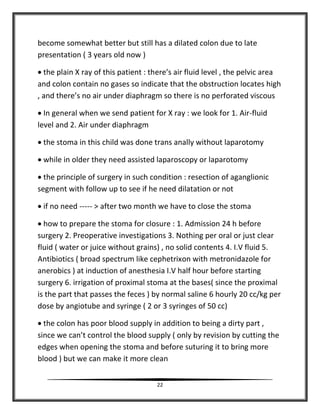
become somewhat better but still has a dilated colon due to late
presentation ( 3 years old now )
 the plain X ray of this patient : there’s air fluid level , the pelvic area
and colon contain no gases so indicate that the obstruction locates high
, and there’s no air under diaphragm so there is no perforated viscous
 In general when we send patient for X ray : we look for 1. Air-fluid
level and 2. Air under diaphragm
 the stoma in this child was done trans anally without laparotomy
 while in older they need assisted laparoscopy or laparotomy
 the principle of surgery in such condition : resection of aganglionic
segment with follow up to see if he need dilatation or not
 if no need ----- > after two month we have to close the stoma
 how to prepare the stoma for closure : 1. Admission 24 h before
surgery 2. Preoperative investigations 3. Nothing per oral or just clear
fluid ( water or juice without grains) , no solid contents 4. I.V fluid 5.
Antibiotics ( broad spectrum like cephetrixon with metronidazole for
anerobics ) at induction of anesthesia I.V half hour before starting
surgery 6. irrigation of proximal stoma at the bases( since the proximal
is the part that passes the feces ) by normal saline 6 hourly 20 cc/kg per
dose by angiotube and syringe ( 2 or 3 syringes of 50 cc)
 the colon has poor blood supply in addition to being a dirty part ,
since we can’t control the blood supply ( only by revision by cutting the
edges when opening the stoma and before suturing it to bring more
blood ) but we can make it more clean
23
 why? for the wound to be healed ------ > good blood supply , no
tension when suturing and sterile media or at least clean since
whatever we do this type of surgery remain contaminated surgery (45
% - 50 % risk) not like thyroid surgery
 this represent an important point in communicating skill when telling
the patient and his family before surgery that there is 45 % risk of
contamination even in best centers to protect ourselves and for more
confidence
 in thyroglossal cyst surgery with postoperative contamination ----- >
indicate something wrong in our work like remnant that need to be
excised
 in case 2 : the patient has symptomatic UTI and it differ according to
age , in infant and neonate usually non specific symptoms
 fever in upper tract ( pyelonephritis not cystitis) , excessive crying ,
irritability during urination or without it , vomiting , diarrhea
 when child grow , the voiding symptom become more specific like
dysuria , frequency , urgency , hesitancy
 so if the child symptomatic with recurrent UTI , we need to search for
organic cause : 40% of congenital cause is PUJ stenosis
 always compare both side of urinary tract when looking at KUB and
IVU
 PUJ stenosis : the contrast didn’t pass due to stenosis
 Not all stenosis need surgery , it may improve by itself with time
24
 Indication for surgery : symptomatic even with mild hydronephrosis /
progressive hydronephrosis in conservative management as it lead to
thinning of cortex / radioisotope scan ( mag 3) used to show drainage
system with function of kidneys to see if there is obstructive pattern ( if
one kidney is 40% the other is 60% ,,, or one is 80% the other will be
20% and so on …
 10% ----- > nephrectomy
 10% - 30% ------ > correction
 > 35% ------- > kidney still function only conservative no need for
surgery
 The form of surgery : pyloplasty (standard procedure) by drainage
with excision of stenotic part ( delicate surgery may need loops ‫عدسة‬ (
 60% of antenatally diagnosed hydronephrosis will resolve
spontaneously after one week , one or two months of life , while some
may need termination of pregnancy
 Any patient with PUJ stenosis we have to exclude reflux before
surgery
 Not all VUR need surgery , many cases may resolve spontaneously at
sixth months
 Pathophysiology of VUR : incompetent valve , ureter not placed
obliquely as it should be ------ > reflux that lead to stasis of urine ----- >
infection with febrile UTI ( upper rather than lower UTI) ------ >
indication for surgery
25
 Some patients need only conservative management : prophylactic
antibiotics daily, circumcision of child , good hydration
 If the patient is febrile in spite of antibiotic / increasing grading ( 2 and
become 3) / or he is already high grade VUR ----- > need surgery
 Note : Grades of VUR are from 1 – 5
 Renal scarring in isotope scan ( pyelonephritis lead to fibrosis then
end stage renal tissue disease ) ----- > also need surgery
 Two ways of interventions : 1. Injection of deflux by cystoscope or 2.
Reimplantation of ureter (open surgery or by laparoscope )
 Unfortunately there is a risk for recurrence 30% - 40% in first
approach
 Reimplantation could be intravesicle or extravesicle depend on
preference, success rate should be not less than 95% (it is so difficult
for redo surgery without squeal )
 As in herschsprung disease ----- > redo surgery can lead to
incontinence for life
 Case 3 : child presented with abdominal mass , solid ,large , extremely
adherent to the mesentery , so deep , not movable ----- > difficult to be
excised
 most probably a lymphoma ( non hokgin burrket lymphoma) , but in
biopsy it shows a rare fungal infection
 by inspecting abdomen there was wound dehiscense , tension suture
and fistula ( feces from wound)
26
 fistula : usually conservative unless there’s obstruction , foreign body
or intrapertoneal contamination ----- > need operation
 case 4 : if tenderness not obvious in right iliac fossa , we do Rovsing
sign , Obturator or Psoas sign
 when doing Rovsing sign , and patient shows discomfort -- -- > we
don’t know whether the pain in right or left iliac fossa , so we have to
ask the patient to localize the site of pain , otherwise we don’t ask the
patient we just look at facial expression
‫ﻣ‬
‫ﻼ‬
‫ﺣ‬
‫ظ‬
‫ﺔ‬
:
‫ا‬
‫ﻟ‬
‫ﺷ‬
‫ﻐ‬
‫ﻼ‬
‫ت‬
‫ا‬
‫ﻟ‬
‫ﻠ‬
‫ﻲ‬
‫ﺑ‬
‫ﺎ‬
‫ﻟ‬
‫ﺑ‬
‫و‬
‫ﻟ‬
‫د‬
‫ﻧ‬
‫ﻘ‬
‫ل‬
‫ﻣ‬
‫ن‬
‫ﺳ‬
‫ﻼ‬
‫ﯾ‬
‫د‬
‫ا‬
‫ت‬
‫ﻋ‬
‫ﻣ‬
‫ﻠ‬
‫و‬
‫ل‬
‫ا‬
‫ﻟ‬
‫ﺑ‬
‫ﺎ‬
‫ﻗ‬
‫ﻲ‬
‫ﺣ‬
‫ﻛ‬
‫ﻲ‬
‫د‬
‫ﻛ‬
‫ﺗ‬
‫و‬
‫ر‬
‫ﺑ‬
‫ﺳ‬
‫ﺎ‬
‫م‬
‫ﺑ‬
‫ﺎ‬
‫ﻟ‬
‫ﺳ‬
‫ﺷ‬
‫ن‬
/
‫ا‬
‫ﻟ‬
‫ﻠ‬
‫ﻲ‬
‫ﺑ‬
‫ﺎ‬
‫ﻟ‬
‫ﮭ‬
‫ﺎ‬
‫ﯾ‬
‫ﻼ‬
‫ﯾ‬
‫ت‬
‫ﻟ‬
‫ﻠ‬
‫ﺗ‬
‫و‬
‫ﺿ‬
‫ﯾ‬
‫ﺢ‬
‫ﻣ‬
‫ﺎ‬
‫ﺣ‬
‫ﻛ‬
‫ﺎ‬
‫ه‬
‫ا‬
‫ﻟ‬
‫د‬
‫ﻛ‬
‫ﺗ‬
‫و‬
‫ر‬
Invertogram
• After 18-24 hours of life
• To differentiate between high and low type in cases without fistula
(more than 1.5 cm we are dealing with high type)
(If there is fistula it could be cutaneous—> meconium from skin this indicate low type)
(If the fistula per urethra—->meconium pass through urethra indicate high type)
If there is no Fistula and we couldn’t differentiate between high and low type then we wait for 18
to 24 hours wait for gases to arrive to rectum to avoid false high
• A fistula opening on to the skin of the perineum or penis indicate a low lesion
• Meconium in the urine indicates a high lesion with a fistula to urinary tract (urethra or bladder)
• Low type lesions have good prognosis. Surgical reconstruction is much simpler and continence
is usually normal. Colostomy is not required.
• High type The prognosis is not always good Colostomy done at the neonatal period.
Diagnosis: Sacro-coccygeal teratoma Problems:
1-obstructed labor.
2-ruptur so bleeding that cannot be controlled .
3- Malignancy (if neglected for 2-3 months) 90% becomes malignant after 1 year while 10%
are malignant at birth
Dx : clinically by PR and by CT.
Treatment: surgery + remove the mass and the coccyx to prevent recurrence and prevent
malignancy because the coccyx is the origin of the mass
Before surgery do : tumor marker (alpha feto protein ) after surgery it will decrease if
increase means recurrent.
During surgery : be careful because injury to the nerve supply to the anus and bladder .
• Cleft lip and palate
• Lip 3 months
• Palate 1 year
Age of operation is rule of 10 in lip
1. 10 weeks
2. hemoglobin 10
3. 10 pounds
• Tracheoesoghagealfistula (esophageal atresia)
• Respiratory distress,,,frothy mouth secretion
• Proximal atresia and distal fistula
• VACTREL association
• Hernia,,,hydrocel,,,
• Reducibility,,,get above it,,,traslumination test
• Surgery
• Hernia once diagnosed , Hydrocele persist after 1year •
•Doudenal atresia (double bubble gas sign)
• Vomiting after birth
• Diamond duodenostomy
Omphalocele
● Risk are : Hypothermia,dehydration,bowel ischemia
● Treatment : Usually is surgery reduction and cover but in this case its too huge so we
couldn’t do surgery we paint the membrane with sulfadiazine cream and it may turn to skin
after he begins 4 to 5 year when the abdominal cavity is bigger then we could do repair we
called it ventral hernia( we called it hernia Because it’s an open fascia just skin ,hernia
always mean fascial defect)we use dual mesh to avoid increase intraabdominal press.
Which will lead to respiratory distress and we use dual type to avoid adhesions
● High type imperforate anus with rectourinary fistula
● Genito urinary,cardiac,esophageal atresia
● colostomy Then post.saggital anoplasty
● Hypospadias
● Recommend not to do circumcision
● 6-18 months
● Thyroglossal cyst
● Dermoid ,,goitre,,submental lymph node
● Infection,,fistula,,malignant
● Surgery(sistrunk operation—->excision of cyst with central part of hyoid bone)
● Hirschsprung disease (contrast enema)
● Rectal biopsy of negative ganglion
● Genito urinary,,cardiac,,,down syndrom,,
● Surgery pull through of ganglionic segment
● 80% is rectosigmoid
● could involve all colon or even the small bowl
● Rectal prolapse
● Intussusception no colic stable no space (in prolapse its 1.5 between the prolapsing
rectum and anal curve)
● Conservative in acute for example injection,,, surgery in chronic
● MCU showing Recto urethral fistula represent 90% and just need posterior sagittal
anorectoplasty (PSARP)
● Usually when we do colostomy in case of imperforate anus we do distal colostogram to
see fistula
● 10% it’s open on the bladder it’s called rectovesical it’s need laparotomy
● Pyloric stenosis
● Time of presentation Usually not since birth(2-4 WEEK AFTER BIRTH WITH FAILURE TO
THRIVE)
● If Diagnosed early and thriving well it’s a positive sign
● Signs of examination is dilated left upper quadrant area (mass) , peristalsis from left to
right during feeding
● If you feel the mass then it’s a definitive diagnosis we don’t need a contrast study
● Treatment : Correct electrolyte before surgery(comes with hyponatremic hypokalemic and
metabolic alkalosis)
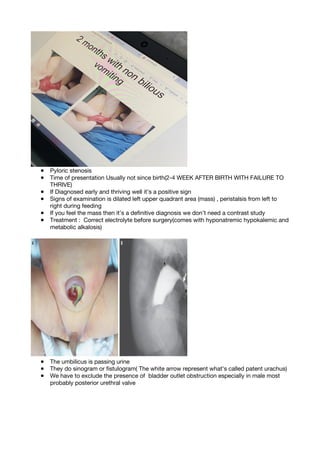
● The umbilicus is passing urine
● They do sinogram or fistulogram( The white arrow represent what's called patent urachus)
● We have to exclude the presence of bladder outlet obstruction especially in male most
probably posterior urethral valve
● Torsion of testicular appendix most common cause of acute scrotum in pediatric age
group
● Mega esophagus mostly is achalasia cardia(failure to relaxation of the lower esophageal
sphincter)
● Most important test is esophageal manometry
● Bilateral stone
● CT of chest represent pulmonary hydatid cyst
● Pneumoperitoneum
● Sternocleidomastoid torticollis (tumor)
● Mother May come with a history of obstructed labor which can lead to this condition
● TEF —->pouch like due to severe obstruction
● We should use water soluble contrast
● Conjoined twin
● Afalia(child born without penis)
● Very rare 1/30 million
● Could be meconium ileus or total hirschsprung disease
● Probably its meconium ileus because there is no air fluid level bcz meconium is sticky and
thick so there is no space for the air to cause air fluid level
● Cystic hygroma
● Hypertranslucency in the left side,shifting of mediastinum with respiratory distress
● Diaphragm intact so its not hernia
● Dx:lobar emphysema cause compression on contralateral lung and ipsilateral lung if there
is normal lobe
● differentiate from pneumothorax by jumping lobe(across midline)
● Small omphalocele
Pediatric surgery – Session 1 Dr. Obay
Case1: Failure to pass meconium in neonate (age is 1 day) even after
frequent PR stimulation. There was a huge abdominal distension with
visible bowel loops at that time.
DDx for Failure to pass meconium (or delayed to pass meconium):
DDx for neonatal intestinal obstruction:
1. Hirschsprung disease
2. Meconium plug syndrome
3. Meconium ileus – more severe type
4. Imperforated anus (congenital absence of anal opening)
5. Intestinal atresia
Meconium plug syndrome: Thick distal 2cm of meconium in the distal
rectum that causes obstruction.
PR can be done to get it out and then it resolves.
Meconium ileus: The length of the meconium that should be
disimpacted is too long (even thicker and stickier than
normal meconium) and occupying the distal ileum.
PR here is not helpful.
‫ﻻ‬
‫ن‬
‫ﻣ‬
‫ﺎ‬
‫ﻋ‬
‫د‬
‫ﻧ‬
‫ﺎ‬
segment
‫ﺻ‬
‫ﻐ‬
‫ﯾ‬
‫ﻎ‬
‫و‬
‫ﺑ‬
‫س‬
‫د‬
‫ﻧ‬
‫ﺳ‬
‫ﺣ‬
‫ﺑ‬
‫ﺎ‬
‫ﻣ‬
‫ﺛ‬
‫ل‬
‫ا‬
‫و‬
‫ل‬
‫ﺣ‬
‫ﺎ‬
‫ﻟ‬
‫ﺔ‬
.
Hirschsprung disease pathophysiology: presence of aganglionic distal
Segment. The absence of ganglion cells causes the muscles in the
bowels to lose their ability to move stool through the intestine
(peristalsis). Bowel content will stop at this level which leads to
obstruction.
‫ﻣ‬
‫ﺎ‬
‫ﻣ‬
‫ﻌ‬
‫ﻘ‬
‫و‬
‫ﻟ‬
‫ﻲ‬
‫ﺑ‬
‫ﺎ‬
‫ﻟ‬
‫ﺑ‬
‫د‬
‫ا‬
‫ﯾ‬
‫ﺔ‬
‫و‬
‫أ‬
‫و‬
‫ل‬
‫ﺧ‬
‫ط‬
‫و‬
‫ة‬
‫ا‬
‫ﻧ‬
‫و‬
‫ﻧ‬
‫ﻘ‬
‫ص‬
‫ھ‬
‫ذ‬
‫ا‬
‫ا‬
‫ﻟ‬
‫ﺟ‬
‫ز‬
‫ء‬
‫و‬
‫ا‬
‫ﻟ‬
‫ط‬
‫ﻔ‬
‫ل‬
‫ﻋ‬
‫ﻣ‬
‫ﻐ‬
‫و‬
‫ﯾ‬
‫و‬
‫م‬
‫ا‬
‫و‬
‫ﯾ‬
‫و‬
‫ﻣ‬
‫ﯾ‬
‫ن‬
First step in treating Hirschsprung: A temporary procedure is done
called diverting stoma.
We have two opening in the stoma, proximal opening for stool and
other distal opening for mucus and there is continuity of bowel
between them. This is called loop colostomy.
Types of stoma:
• Loop colostomy
‫ﻓ‬
‫ﺗ‬
‫ﺣ‬
‫ﺗ‬
‫ﯾ‬
‫ن‬
‫و‬
‫ﺣ‬
‫د‬
‫ي‬
‫ﯾ‬
‫م‬
‫ا‬
‫ﻟ‬
‫ﺦ‬
‫و‬
‫ا‬
‫ﻟ‬
‫ـ‬
mucosa
‫ﻣ‬
‫ﺣ‬
‫و‬
‫ط‬
‫ﺗ‬
‫م‬
.
‫ﻧ‬
‫ﻌ‬
‫ﻣ‬
‫ل‬
transverse section
‫و‬
‫ﻧ‬
‫ط‬
‫ﻠ‬
‫ﻊ‬
loop of bowel
‫ﻧ‬
‫ﻔ‬
‫ﺗ‬
‫ﺢ‬
‫ا‬
‫ﻟ‬
‫ـ‬
anterior surface
‫ﻣ‬
‫ﺎ‬
‫ﻟ‬
‫ﺗ‬
‫ﮭ‬
‫ﺎ‬
‫و‬
‫ﻧ‬
‫ﺛ‬
‫ﺑ‬
‫ﺗ‬
‫ﺎ‬
‫ﻋ‬
‫ﻠ‬
‫ﻰ‬
‫ا‬
‫ﻻ‬
‫ﺑ‬
‫د‬
‫و‬
‫ﻣ‬
‫ن‬
,
posteriorly
‫ﻏ‬
‫ﺎ‬
‫ح‬
‫ﺗ‬
‫ظ‬
‫ل‬
in continuity with bowel
.
• Double barrel colostomy
‫ﻓ‬
‫ﺗ‬
‫ﺣ‬
‫ﺗ‬
‫ﯾ‬
‫ن‬
‫و‬
‫ﺑ‬
‫ﯾ‬
‫ﻧ‬
‫ﺎ‬
‫ﺗ‬
‫م‬
skin
• End tube colostomy (single opening)
End stoma can be either an End stoma or Hartmann colostomy
Ex: in infants, a disease called Necrotizing enterocolitis (necrosis of
bowel) so the bowel is diseased and perforation may occur so to
preserve it as much as possible so a proximal diversion stoma for
collecting stool is done and the distal segment is clamped (proximal out
and distal clamped – this is Hartmann)
‫ﻣ‬
‫ن‬
‫ﺑ‬
‫ﻐ‬
‫ﺎ‬
‫ﯾ‬
‫ﺑ‬
‫ﯾ‬
‫ﻧ‬
‫و‬
‫ن‬
‫ﻧ‬
‫ﻔ‬
‫س‬
‫ا‬
‫ﻟ‬
‫ﺷ‬
‫ﻲ‬
‫ا‬
‫ﻟ‬
‫ـ‬
end colostomy
Complication of stoma:
- Peristomal excoriation or rash (infection)
- Prolapse is common (especially in loop colostomy)
- Improper fixation leads to parastomal hernia (bowel protrude
between the stiches)
Second step in treating Hirschsprung (Pull-Through): Excise the
aganglionic segment and pull the normal ganglionic segment down to
the anal verge above the dentate line.
We should preserve the dentate line(it is 1-2 cm above anal verge,
which is the junction between ano-cutaneous mucosa and internal
visceral mucosa). Why?
Because it is one of the important determinants of sensation, it is very
sensitive and important for voluntary defecation cuz it is rich with
sensory nerve endings.
How to confirm diagnosis of Hirschsprung disease?
Biopsy – to confirm that there is no ganglion. We take biopsy from two
sites, cone segment and spastic segment.
**If the pt. has a colicky pain in nature and intermittent so we think of
on-off obstruction. But if there is continuous pain, maybe it is just a UTI
with no relation to GIT system.
**In appendix, extreme of age is important. In very young u can’t take
proper history & have undeveloped omentum. In old age they have
chronic diseases like DM & they take medication.
Abdominal examination in recently operated patient:
Inspection: moving with respiration important
Also mention the drain and its type (passive tube drain), draining fluid
mixed with blood in contaminated surgery.
Dressing for midline wound
Types of passive drain:
1. close tube drain
2. open corrugate drain (more chance for infection)
We choose depending on the surgery
Types of suturing techniques:
1. Simple ‫ﻧ‬
‫د‬
‫ﺧ‬
‫ل‬
‫و‬
‫ﻧ‬
‫ط‬
‫ﻠ‬
‫ﻊ‬
‫و‬
‫ﻧ‬
‫ﻌ‬
‫ﻘ‬
‫د‬
2. Mattress (interrupted) ‫ﻧ‬
‫د‬
‫ﺧ‬
‫ل‬
‫و‬
‫ﻧ‬
‫ط‬
‫ﻠ‬
‫ﻊ‬
‫و‬
‫ﻧ‬
‫ر‬
‫ﺟ‬
‫ﻊ‬
‫ﻧ‬
‫د‬
‫ﺧ‬
‫ل‬
‫و‬
‫ﻧ‬
‫ﻌ‬
‫ﻘ‬
‫د‬
We put tension sutures between them (double support for wound)
when we suspect delay healing or wound complications or wound
dehiscence in malnourished and elderly patients or repeated surgery
Material of sutures
1. Black silk
2. Blue nylon
Both are non-absorbable
Palpation: superficial Palpation away from the site of the wound to
check if there is tenderness because of leak or bleeding
Never do deep Palpation in recently operated patient (very painful)
Percussion: also, never in recently operated patient
Auscultation: important for bowel sound
Sites of auscultation
1. ileocecal valve McBurney point
2. Sigmoid colon left iliac fossa
Constipation: inability to pass stool but still pass flatus
Obstipation: no bowel movement and no flatus (severe complete
obstruction)
• Gallstone in infants we think of hereditary spherocytosis
• In toddlers think about hereditary hypercholesterolemia or
congenital abnormality lead to stenosis and stasis
• Avoid doing cholecystectomy in paediatric because its side effects
(suffering after fatty meals and steatorrhea, bloating and irritable
bowel syndrome)
• Zollinger-Ellison syndrome: over secretion of gastrin.
Case of intussusception ‫ﺗ‬
‫د‬
‫ا‬
‫ﺧ‬
‫ل‬
‫ا‬
‫ﻻ‬
‫ﻣ‬
‫ﻌ‬
‫ﺎ‬
‫ء‬
Most common site ileocecal valve (ileocecal colic)
Presentation: signs and symptoms of intestinal obstruction
Triad of intussusception: important
1. Screaming attacks (severe pain because of ischemia), bending
forward and lifting his legs and knees upward to his abdomen ‫ﻟ‬
‫و‬
‫ﯾ‬
‫ﺔ‬
At first it comes every 15 minutes but then the interval between attacks
decrease and the period of attack increase and he will be tired from
pain and vomiting (dehydration).
2. red currant jelly stool: stool mixed with blood and mucus (late
sign after 3 days of intussusception).
3. Feeling mass in examination.
Maybe not all of them are present
In surgery we repair the intussusception and remove appendix.
Classical explorative incision in paediatric is transverse supraumbilical
In adult midline incision
Because in adult the abdomen elongated, in children shorter and
broader.
X-ray showing gasless abdomen, the neonate had repeated vomiting
with failure to pass meconium.
Basically, when there is any obstruction in the
GIT, gas will be present proximal to it. The more
distal the obstruction, more gas will be present all
over the abdomen. However, if the obstruction is
proximal, gas will be minimum and the distal part
will be gasless.
This x-ray only shows fundal gas shadow, which
may indicate pyloric or proximal duodenal atresia.
This is a case of neonatal intestinal obstruction.
This patient had abdominal distention, a supra-
umbilical transverse incision to the right (which is
the main explorative incision in neonates) and a corrugate drain.
The incision was simple interrupted suturing, silk (black).
Each atresia type has a specific treatment:
• Duodenal atresia = diamond
duodenoduodenostomy
• Jejunal & ileal atresia = excise the atretic
segment with end-to-end anastomosis
Analysis of a “Mass” in examination
Feces from a wound or drain site = Fecal fistula
When there is cough usually the next step is
chest x-ray.
Chest x-ray showing a nearly circular soft-tissue
mass with a fluid level. No tracheal deviation. So,
at 4 years of age, this is mostly a hydatid cyst
mass.
This is a simple cyst (complicated cyst when
there is water lily sign). When it ruptures to the
bronchial tree there will be coughing of the
contents. When it ruptures to the pleura, hydropneumothorax will
develop and empyema if presented late.
Next step is ultrasound of the liver to exclude liver hydatid cyst.
Liver + Lung hydatid cyst = CT of brain to exclude brain involvement.
Uncommon sites: chest wall, retro-peritoneum of RIF (may be mistaken
for appendicitis).
If we have bilateral, same size involvement of the lung, we remove the
left side first to reduce the pressure on the heart. If the left sided is
smaller, we remove the right side first.
Liver + lung = priority of removal for the lung
Liver + lung + brain = priority of removal for the brain
Causative organism = Echinococcus granuloses.
Left photo:
Diagnosis: eventration of diaphragm
Description: mild dextrocardia – recurrent chest infection – diaphragm is present
mild distress - 7 months age baby – less number of intestinal loops in the chest
there is lung tissue in the chest - Paradoxical movement of the diaphragm.
Treatment: plication of the hemi-diaphragm (through thoracic approach).
Right photo:
Diagnosis: congenital diaphragmatic hernia
Description: more dextrocardia – diaphragm not present – there is nasogastric tube
severe distress – very tired - 1 day age baby – more number of intestinal loops in
the chest - there is no lung tissue in the chest.
Treatment: pull the intestine ad close the hernia (through abdominal approach).
Left photo:
Diagnosis: pure atresia
Description: radiolucent abdomen (no gases) + failure of nasogastric tube passage.
right photo:
Diagnosis: TEF (with fistula)
Description: pass of gases to the abdomen + failure of nasogastric tube passage.
Diagnosis: TEF (atresia with fistula)
Benefits of X-ray:
1- to see the failure of nasogastric tube passage.
2- to determine the type of TEF
3- to check the condition of the lung
4- diagnose the associated anomalies (aortic arch – vertebra – ribs)
5- to measure the length of the defect (1-2-3 cm or more)
Diagnosis:
left photo  upper bowel obstruction // right photo  lower bowel obstruction
Description:
double bubble sign
Causes of duodenal obstruction
1- stenosis
2- duodenal atresia
3- annular pancreas
4- mal-rotation of bowel
Cardinal symptoms of bowel obstruction
1- mild abdominal distention (epigastric distention) and pain
2- failure if pass of meconium and delay pass of meconium .
3- bile stain vomiting
Note:
In pediatric we cannot say small or large bowel obstruction but we say upper or lower bowel obstruction .
Description: Thick sticky meconium in the ileum.
Signs of abdominal obstruction ,Abdominal doughy mass (in RT . iliac fossa) ,No A/F level in x-ray
Causes: cystic fibrosis
Treatment: surgery by excision and re-anastomosis
Before sugary  do gasrtograffine enema  it could treat the condition (( conservative rx )).
Description: Small bowel atresia (( Proximal dilated bowel with distal thin atretic bowel )).
Dx : X-ray show multiple A/F level
Treated by surgery  resection with end to end anastomosis
Hirschprungs disease
Description:
Two years old child
The photos show : Ba-enema test  show dilatation of the sigmoid and narrowing of Recto-sigmoid junction
and filled with material due to a ganglionic segment of bowel lead to spasm.
Causes in :
Neonate  delay to pass meconium – intestinal obstruction
Old child  chronic constipation – complications like enterocolitis (diarrhea) and perforation.
Treatment: Surgery called pull-through ((resect the a ganglionic segment and pull the normal through the anus
and anastomose it with anus)).
Diagnosis: omphalocele
Description: Huge dilatation in the abdomen , Central umbilicus and Liver is present .
Treatment: It is not emergency condition
If major : (( Cover ,Incubation ,Give fluid , Use silo bag with gradual twisting to reduce the liver into abdomen
slowly)).
If minor : (( Cover ,Incubation ,Give fluid and treated primarily by reduction and closure)) .
Omphalocele Associated Anomalies
1) Chromosomal abnormalities (50%) (( Trisomies 13, 18, 21)) .
2) Congenital heart disease (50%).
3) Neural tube defects (40%).
Left photo:
Diagnosis: Gastroschisis.
Description: exposed bowel Not covered by sac , Right to the umbilicus .
Treatment: It is emergency condition by (( Reduction and Closing of the defect )) and sometimes we also may
use silo bag to reduce the bowel gradually.
Associated with less congenital anomalies.
Right photo:
Diagnosis: meningomeylocele
Note: It is associated with hydrocephalus and paralysis of lower limbs
Left photos: Lateral invertogram . Right photo : Lateral invertogram (( Supine type of view)).
The procedure of x- ray : upside position with mark.
Used to : Differentiate between high and low imperforated anus
SHOWING :
 Pubococcegeal line (below or above gas bubble ) means lower or upper type of anorectal atresia
respectively.
 mark gas distance.
 well formed anal dumble associated with low type.
Diagnosis: hypospadias
proximal hypospadias (( penoscrotal )).
Distal hypospadias (( Subcoronal )).
Complication :
• Severe type
• Psychological problems
• Infection (UTI)
• Sterility
• Retrograde ejaculation
Treatment: By surgery
• Before or At first year unless there is no contraindication. or a before going to school .
Diagnosis: hemangioma
Typical history: the condition start as small red point then within few months it become larger and after one or
two years it may resolve spontaneously
Complications: 1) Bleeding . 2) Ulceration . 3) Pressure may affect vision or hearing . 4) Bleeding tendency in
huge hemangioma
Treatment: Spontaneous resolve or by Surgery .
On exam: compressibility, can be compressed and refill after removal of pressure.
Cleft lip and palate 1) could be uni or bi lateral . 2) complete or incomplete .
Problems:
• Aspiration during feeding
• Nasal speech
• Cosmetic problems
• Affect the hearing (glue ear) and otitis media
• Lead to recurrent chest infection
Surgery: (( Milard surgery ))
• In 6 months to 1 year for cleft palate
• In 3 months for cleft lip ( because after this time the muscles will become more powerful) .
Feeding: to prevent Aspiration
• Use special bottle tit
• In setting position
Enumerate role of Ten : 1) 10 pounds. 2) 10 g/dl Hb . 3) 10 week of age (6-12 week).
Left photo:
Diagnosis: thyroglossal cyst
Problems: Lead to (( infection , fistula )) and Could convert to malignancy.
Need surgery ((cistran operation))  remove the fistula tract + remove the middle third of hyoid bone or
completely to prevent recurrence.
Right photo:
Diagnosis: cystic hygroma
Notes:
It is due to lymphatic obstruction
Common at the sites ( cervical region, axilla, groin ) .
Treatment : By surgery
Indication of surgery
presence of complications like compression, infection (( lead to abscess )), bleeding (child become pale and shock).
During surgery : be careful not to injure certain structure like :
hypoglossal never, spinal accessory nerve, mandibular branch of facial nerve and cervical neve .
Diagnosis:
Left photo : sternocleidomastoid torticollis
Right photo : sternocleidomastoid mass
Notes: Ask about breech presentation and obstructed labor etc …
Complication : lead to mid face hyperplasia .
Treatment : If not treat the mass it could be converted to torticollis
1) Treatment of mass is by physiotherapy by twisting the chin and movement of ear and massage  90% will
disappear  if not treated do surgery by cutting the mass and muscle.
2) Treatment of torticollis is by surgery (by cutting muscle) + physiotherapy.
Diagnosis: External angular dermoid
Treated by surgery  excision and complete removal of the cyst to prevent recurrence.
complication infection, trauma ( rupture ) , cosmetic.
Diagnosis: remnant of second branchial arch  branchial cyst , sinus or fistula.
Site: anterior border of sternocleidomastoid muscle between tonsil and lower two third of sternomastoid muscle.
History of : whitish sticky discharge.
Problems: infection – malignancy
Treatment: surgery when baby is one year, excision of the total tract till you reach the tonsil, be careful about
hypoglossal nerve and carotid artery.
Left photo :
Diagnosis: umbilical hernia
Treatment: could resolve spontaneously or by surgery ((after 3 or 4 years or if it has complications.)).
Right photo :
Omphalo-mesenteric duct  connection between umbilicus and bowel
Meckel's diverticulum:
IT is true diverticulum
Role of 2 :
 2 inch in length
 2 feet from ileocecal valve
 2 percent of population
 2 ectopic tissue (gastric or pancreatic)
 2 common complication (ulceration and bleeding)
Presentation:
• Bleeding per rectum (painless – bright red – profuse)
• Infection (lead to abdominal pain)
Complication  intestinal obstruction, volvulus, intussusception.
DX : Incidental finding
1-Istotope scan : to check for ectopic gastric tissue, by giving special dye that is absorbed by the parietal cells.
2-Laproscopy : diagnostic and therapeutic.
Diagnosis: pyloric stenosis
Presentation:
• Projectile non bilious vomiting (not present in first two weeks)
• Olive mass in the epigastric reagion.
• Positive feeding test ( positive peristalsis from left to right to over come obstruction ).
• Failure to thrive .
Diagnosis: 1) Clinically and Ultrasound
2) Ba-meal  dilated stomach – failure of barium to pass to intestine – string sign. (( repeated after 4 hr)).
Treatment: surgery  pyloromyotomy .
Diagnosis: achalasia cardia
Presentation:
• Hailtosis
• Vomiting (not projectile)
• Wheezing
• Chest infection
DX : Ba-swallow  dilatation of esophagus with narrowing of lower part (( bird peak sign )).
Treatment  cardiomyotomy.
5 years child, presented with mass in the flank.
DDx of mass in the flank:
1- Wilms tumor
2- Neuroblastoma
3- Neglected PUJ obstruction
Presentation:
1- Mass
2- hematuria
3- hypertension
Treatment by surgery complete removal of the kidney + post operative chemotherapy .
Left photo : neuroblastoma in the adrenal gland .
Right photo :
Diagnosis: non-Hodgkin lymphoma in cervical region .
Presentation:
1- Mass
2- Intussusception
Investigation: FNA
Treatment: chemotherapy (for one year) and surgery (( it emergency due to rapid growth )).
Diagnosis: Sacro-coccygeal teratoma
Problems:
1-obstructed labor.
2-ruptur so bleeding that cannot be controlled .
3- Malignancy (if neglected for 2-3 months) .
Dx : clinically by PR and by CT.
Treatment: surgery + remove the mass and the coccyx to prevent recurrence and prevent malignancy .
Before surgery do : tumor marker (alpha feto protein ) after surgery it will decrease if increase means recurrent.
During surgery : be careful because injury to the nerve supply to the anus and bladder .
TIME OF SURGERY :
Left photo: Diagnosis: rectal prolapse
Causes:
• Constipation or diarrhea
• Weak pelvic muscles
• Worm (trichuris trichiura)
Grades:
• Grade1  ‫ويرجع‬ ‫يطلع‬  conservative treatment by taping
• Grade2  ‫للدخول‬ ‫دفع‬ ‫الى‬ ‫ويحتاج‬ ‫يطلع‬  surgery (Therach operation)
• Grade3  ‫ابد‬ ‫يرجع‬ ‫وما‬ ‫يطلع‬  surgery (Therach operation)
Central photo
Diagnosis: Perianal fistula
Treatment: surgery (fistulectomy or fistulotomy).
:
right photo
Diagnosis: rectal polyp ( Prolapsing strawberry mass)
Cause in infection of the crypts of Lieberkuhn.
Red-bleed mass + bleeding per rectum
Treatment: excision (use sigmoidoscopy).
Diagnosis: undescended testes
If unilateral (( undesended testis )) , and , if bilateral (( cryptorichidsm ))
Problems: (( Tumor , Sterility , Infection may confuse with appendicitis ))
Treatment:
• If palpable  do fixation(( orchidopexy )) Time (( during 1st
year of life ))
• If not palpable  do laparoscopy If not present Do nothing and if present
Do (( laproorecheopexy )).
Elevation of the diaphragm:
It is due to paralysis of the diaphragm., Present in 4-5 months.
X- diaphragm is elevated, lung is present.
Treated by
Bowel obstruction:
 Upper obstruction
 Lower obstruction
 X- upper obstruction (multiple small air/fluid level), lower obstruction (few large air/fluid level).
Pneumoperitoneum:
It is air in the peritoneum, Lead to distension of the abdomen.
Percussion tympanic.
Complication : Gastric perforation lead to massive Pneumoperitoneum.
X-ray
Necrotizing enterocolitis (NEC):
Pneumatosis intestinalis sign : presence of gas in the wall of the bowel. It is disease of pre-mature baby.
Treatment : 1) conservative (I.V fluid, antibiotics, monitoring).
2) If complication occur do surgery.
Meconium ileus:
Presence of stick, thick, tenosious meconium.
Complication : Lead to bowel obstruction.
Cause : abnormality in exocrine secretion (like cystic fibrosis).
Bowel atresia:
Description : Huge dilated bowel with Blind end and Distal part of the intestine is small in size.
Treatment
Presented as intestinal obstruction.
Ectopia vesica:
It is anterior abdominal wall defect.
Complication : Lead to urine dripping and incontinence.
Treated by surgery.
Spina bifida:
Types (spinal dysraphism):
 Meningeocele.
 Meningomylocele.
 Lipomeningomylocele.
Associated with hydrocephalus.
Complication : Lead to paralysis.
RX :
Imperforated anus:
Sometimes with fistula : lead to pass of meconium through urethra or skin (low type).
There is anal dimple.
In female :single opening (chloaeca) or vestibular fistula (opening in the vaginal vestibule).
Rx:
Branchial cyst or fistula:
Description : Open in the neck with white sticky secretion And Have tract from the neck to the tonsils.
Complication : Lead to infection (abscess), malignancy.
Surgery : remove the tract completely (be careful for bifurcation of aorta and hypoglossal nerve).
Intussusception:
Primary (congenital) : screaming, put his feet on his abdomen, bleeding per-rectum (red current jelly stool),
sausage mass (big mass to the right of the umbilicus).
Secondary (in older children) : due to tumor, mass, bleeding, polyp.
Dx : Do Ultrasound and barium enema (spring coil sing).
Treatment : hydrostatic reduction by barium, pneumatic reduction by air, surgery (push).
Wilms tumor:
It is the commonest tumor in pediatric.
Complication : lead to abdominal pain, mass, hypertension.
Treated by : chemotherapy and nephrectomy.
Nephroplastoma:
Second most common tumor in pediatric arise form adrenal medulla.
Treated by surgery and chemotherapy.
Left photo : inguinal hernia .
Description : swelling in the inguinal region with reddish area .
Rx by surgery : herniorhaphy or hernioplasty or laproscopically . TIME : within one week from diagnosis .
Most Dangerous complication : strangulation .
Differential diagnosis : Femoral hernia, Epididymitis, Testicular torsion, Lymph node Swelling ..ETC
Right photo : is a varicocele.
جراحة اطفال more informatffffion to your

جراحة اطفال more informatffffion to your

  • 1.
    1 ‫اطفال‬ ‫جراحة‬ Pediatric surgery Principlesof pediatric surgery and common Surgical Problems in Infants and Children Pyloric stenosis  Hypertrophy of the gastric outlet o 1:150 males, 1:750 females o 2-12 weeks of age  Repetitive vomiting o Projectile o Non-bilious  Dehydration o Hypochloremic alkalosis  Exam o Visible peristaltic wave o Palpable “olive” to right of umbilicus
  • 2.
    2 Pyloric stenosis: Diagnosis Pyloricstenosis :treatment Surgical treatment
  • 3.
    3 Malrotation o Failure ofmidgut to rotate into normal anatomic position during development - Colon and cecum in left - Duodenum on right side o Bilious vomiting - Peritoneal (Ladd) bands cause partial bowel obstruction o High risk for... Midgut volvulus  Twisting of bowel around its mesentery and vascular supply • Leads to ischemia, infarction, perforation, necrosis • Presentation: lethargy, abdominal distention, bloody stools ! SURGICAL EMERGENCY MALROTATION  Must consider in every infant with bilious emesis  30% present within first week of life  50% within first month  Midgut volvulus with necrosis disastrous  Can lead to SBS, death
  • 4.
    4 CLINICAL PRESENTATION ofMALROTATION  Sudden onset of bilious emesis in 95%  Abdominal distention common  Blood stool +  Bloody vomitus or diarrhea in 30% RADIOLOGIC DX of MALROTATION  KUB:Gasless abdomen, SBO, “double bubble”  Contrast study: spiral or corkscrew appearance  UTS: reversed position of SMA/SMV  Study MUST be expeditious PREOPERATIVE PREPARATION: MALROTATION WITH VOLVULUS  Labs / unnecessary  Mortality remains as high as 28%  Preoperative preparation ?? NONE !! ...GO TO OR…. QUICKLY OPERATIVE CORRECTION of MALROTATION  Ladd procedure • Appendix potentially in LUQ  Removed  Role of second look operation
  • 5.
    5 Duodenal atresia  Obliterationof lumen • Failure to recanalize  Neonatal bilious vomiting  Associations • Prematurity • Congenital heart defects • Trisomy 21 ! SURGICAL EMERGENCY Meconium ileus  CYSTIC FIBROSIS • First manifestation in 15% of CF cases • Thick meconium impacts in ileum • Abdominal distention • Bilious vomiting • Risk for -Volvulus -Perforation ! SURGICAL EMERGENCY
  • 6.
    6 Intussusception  Most commoncause of intestinal obstruction between 3 mo - 6yrs  2/3 cases occur <2 yrs  Male/Female=4:1  75-95% Ileocolic  >90% idiopathic; Meckel’s, Peyer’s patches, tumors, polyps Telescoping of proximal bowel into distal (Terminal Ileum into Cecum depicted in diagram)  Telescoping of one segment of bowel into another • Ileocolonic most common • 6 mos – 3 years old  Progressive course • Intermittent acute abd. pain • Vomiting • Bloody stools (currant jelly) • Fever, lethargy • Palpable sausage-shaped mass in upper abdomen Intussusception: Presentation  Abdominal pain, vomiting and rectal bleeding triad seen in < 1/3 of cases.
  • 7.
    7  85% displayonly colicky abdominal pain often 1- 5minutes of crying and pain separated by 3-30 minutes of nl behavior  75% have vomiting (develops after 6-12 hrs)  40% rectal bleeding  Up to 10%: Lethargy only Intussusception: Diagnosis  Phys Exam: 25-89% may have variably tender sausage shaped mass; Dance’s sign: empty RLQ  U/S: target, pseudokidney, radiologist dependent; if high suspicion, order the barium enema. Intussusception: Management  Enema: diagnostic & therapeutic, “coiled spring”  Surgeon must be consulted prior to study.  Barium vs. Air- 80% correction if within first 12- 24 hrs.  Air Enema- safer if perforation  5-10% recurrence rate in first 24-48h after barium enema reduction  If free air on films or signs of peritonitis, do not administer barium, prepare child for surgery U/S demonstrating target or donut sign
  • 8.
    8 Intussusception Management  Ultrasound: Hydrostatic pressure reduces the intussusception  Surgeon must be involved directly  If enema reduction fails  Small bowel intussusceptions require surgical reduction Meckel’s diverticulum • Remnant of omphalomesenteric duct • Painless rectal bleeding  Less commonly: intuss., volvulus, perforation • Diagnosis o CT scan o Nuclear medicine scan o Endoscopy • Treatment • Surgical resection
  • 9.
    9 Appendicitis  80,000 casesin children/year /in USA  Rare in children < 2years  20-40% misdiagnosed on initial exam  50-70% perforation rate in pre-school  Mortality Rates of 5% in perforated vs 0.1% in non-perforated appendicitis Hirschsprung’s disease  Congenital absence of ganglion cells in distal rectum- and varying distance proximally  Lack of peristalsis causes colonic obstruction  Abdominal distention  Failure to pass meconium  Fever and diarrhea suggest “toxic megacolon” ! SURGICAL EMERGENCY
  • 10.
  • 11.
    11 Hypospadias  Abnormal lowposition of urethral meatus  Absence of ventral foreskin  Associations o Undescended testes o Urinary tract anomalies  Management o Avoid circumcision o Refer to surgeon Phimosis vs. Paraphimosis
  • 12.
    12 Scrotal swelling Cryptorchidism  Undescendedtesticle(s) o Spontaneous descent does not occur beyond age 1 yr o Bilateral in 1/3 of cases  Associations o Inguinal hernia o Hypospadias o Higher incidence of o Testicular torsion o Infertility o Cancer in cryptorchid testis Testicular torsion  Twisting of testis around spermatic cord o Caused by abnormal fixation of testis to scrotum o Vascular supply compromised PAINLESS PAINFUL Incarcerated hernia
  • 13.
    13  Acute painfulscrotal swelling o Severe tenderness o Redness or dusky color o Testis elevated o Cremasteric reflex absent ! SURGICAL EMERGENCY Abdominal wall defect & hernias in infancy & childhood PROCESSUS VAGINALIS Inguinoscrotal region is the commonest site for surgical conditions in childhood. The testis descended into scrotum during the seventh month in utero inside a diverticulum of peritoneum, the processes vaginalis. This begins to obliterate shortly before birth and closure is normally completed during the first year of life, leaving only the tunica vaginalis surrounding the testis o Closes at 6-12 months of age . o Doesn’t mean inguinal hernia o Potential space
  • 14.
    14 INGUINAL HERNIA Failure ofobliteration of the process vaginalis is associated with several clinical conditions in infancy and childhood: hernia, hydrocele and encysted hydrocele of the cord. Classification of Hernias in Children common  o Inguinal Hernia  o Umbilical Hernia  o Incisional Hernia  less common  o Epigastric, Lumber, Femoral and Spigellian  Other abdominal wall defects  o Omphalocele(exomphalos), Gastroschisis, :  Bladder extrophy Inguinal Hernia In Boys o Type: Indirect o Content : intestine , omentum o Bilateral 15% o Diagnosis The child's mother reports that there is an intermittent swelling overlying the external inguinal ring. It is usually painless but on occasions may cause discomforts o Complications: irreducibility, testicular atrophy, strangulation, obstruction, infection
  • 15.
    15 o Operation :Unilateral herniotomy ,once detected Incarcerated / strangulated inguinal hernia  A loop of bowel becomes trapped in the hernial sac usually at the external inguinal ring.  The infant cries and become irritable; there may be generalized colicky abdominal pain, vomiting, abdominal distension and constipation when complete intestinal obstruction supervenes. There is a tense, tender swelling at the external inguinal and no impulse on crying. With delay in diagnosis, there may be redness, tenderness and induration overlying the lump, or signs of peritonitis, suggesting bowel ischaemia. Inguinal Hernia In Girls o Type : Indirect o Content : Ovary o Bilateral > boys
  • 16.
    16 o Complication :Ovarian affection o Operation : Herniotomy once detected CONGENITAL HYDROCELE o High incidence in newborns o Communicating type o Conservative till 9-12 months o Indication of surgery :*Increase in size *With hernia ENCYSTED HYDROCELE OF THE CORD o Encysted fluid o Difficult dif. diagnosis from irreducible Hernia . o Follow up for the younger age up to one year.
  • 17.
    17 UMBILICAL HERNIA o Umbilicaldefect covered by skin and contains intestine. o Incidence: 1 every 6 newborn 9 times more in black. o Spontaneous closure is the rule . o Complications are rare. o Herniotomy & Anatomical repair is indicated if it persists beyond 3 yrs o *Defect >2 cm-------2yrs o Role of truss is uncertain. o D.D. : Para-umbilical hernia. OMPHALOCELE Umbilical defect covered by amniotic membrane and contains intestine. o Major: diameter more than 5cm and contains liver. o Minor: diameter less than 5cm. Congenital anomalies are common especially chromosomal and cardiac. Antenatal diagnosis: U.S. Preoperative management.
  • 18.
    18 GASTROSCHISIS o Abdominal walldefect 2 to 4cm in diameter and is lateral (to the right) of the umbilical cord. It has no sac . o Intestine is thick and oedematous. o Malrotation is usually present o Associated congenital anomalies are rare. o Needs emergency surgery: Primary closure. Gradual reduction& delayed closure.
  • 19.
    19 PRUNE BELLY SYNDROM Abdominalmuscle deficiency Dilated urinary system Bilateral undescended testes EXTROPHY OF THE URINARY BLADDER
  • 20.
    20  Stoma couldbe temporary or permanent according to its indication  CA rectum in adult : permanent stoma  Many cases in pediatric need temporary stoma like in case of anorectal malformation , and this in turn classified as being high or low type malformation ( like no anus )  low lesion we do anoplasty  high lesion need diverting stoma ----- > like sigmoid colostomy for some months till we do pull through (return the rectum to its usual place) then we close the stoma  Hirschsprung disease : congenital aganglionosis of colon also called congenital megacolon usually associated with Down’s syndrome  1 st case : child with down’s syndrome he has constipation from birth with history of delayed passage of meconium  this should be differentiated from NOT passing meconium in which there’s intestinal obstruction like atresia , while here this’s a functional neurogenic cause since the lumen still patent ( propulsion of food need proximal contraction with distal relaxation so the segment that lack ganglia has neither contraction nor relaxation so there will be mechanical obstruction of neurogenic type  if the presentation in these patient not early we do one stage ( trans anus ) without stoma  if the case was delayed with huge dilatation of colon or during the neonate period so we do diverting stoma
  • 21.
    21  by inspectingthis case the abdomen was distended , move with breathing , flat umbilicus with stoma at right upper quadrant surrounded by excoriation of skin , also we should see if there’s visible peristalsis , visible pulsation , previous scar  it is not important to determine which type of stoma  if it was at the right lower quadrant : it could be ileostomy or colostomy  while if it was at the left lower side : it could be sigmoid colostomy or ileostomy in case of situs inversus  in this patient since it locates at the upper quadrant so it is colostomy rather than ileostomy  if the discharge is thick material or hard stool : colostomy  but if it’s fluid and bile stained : more with ileostomy  although not a rule but most probably  if the situation of the skin around the stoma has a lot of excoriation with ulceration and redness : ileostomy  if less : colostomy , although it’s not a rule , there may be excoriation due to bad handling and cleaning of the area  the patient presented with delayed passage of meconium ,it passed after 48 h by PR , then loss of follow up , after that the child presented with huge distended abdomen and bilious vomiting same as intestinal obstruction with frequent enema and bowel irrigation the condition
  • 22.
    22 become somewhat betterbut still has a dilated colon due to late presentation ( 3 years old now )  the plain X ray of this patient : there’s air fluid level , the pelvic area and colon contain no gases so indicate that the obstruction locates high , and there’s no air under diaphragm so there is no perforated viscous  In general when we send patient for X ray : we look for 1. Air-fluid level and 2. Air under diaphragm  the stoma in this child was done trans anally without laparotomy  while in older they need assisted laparoscopy or laparotomy  the principle of surgery in such condition : resection of aganglionic segment with follow up to see if he need dilatation or not  if no need ----- > after two month we have to close the stoma  how to prepare the stoma for closure : 1. Admission 24 h before surgery 2. Preoperative investigations 3. Nothing per oral or just clear fluid ( water or juice without grains) , no solid contents 4. I.V fluid 5. Antibiotics ( broad spectrum like cephetrixon with metronidazole for anerobics ) at induction of anesthesia I.V half hour before starting surgery 6. irrigation of proximal stoma at the bases( since the proximal is the part that passes the feces ) by normal saline 6 hourly 20 cc/kg per dose by angiotube and syringe ( 2 or 3 syringes of 50 cc)  the colon has poor blood supply in addition to being a dirty part , since we can’t control the blood supply ( only by revision by cutting the edges when opening the stoma and before suturing it to bring more blood ) but we can make it more clean
  • 23.
    23  why? forthe wound to be healed ------ > good blood supply , no tension when suturing and sterile media or at least clean since whatever we do this type of surgery remain contaminated surgery (45 % - 50 % risk) not like thyroid surgery  this represent an important point in communicating skill when telling the patient and his family before surgery that there is 45 % risk of contamination even in best centers to protect ourselves and for more confidence  in thyroglossal cyst surgery with postoperative contamination ----- > indicate something wrong in our work like remnant that need to be excised  in case 2 : the patient has symptomatic UTI and it differ according to age , in infant and neonate usually non specific symptoms  fever in upper tract ( pyelonephritis not cystitis) , excessive crying , irritability during urination or without it , vomiting , diarrhea  when child grow , the voiding symptom become more specific like dysuria , frequency , urgency , hesitancy  so if the child symptomatic with recurrent UTI , we need to search for organic cause : 40% of congenital cause is PUJ stenosis  always compare both side of urinary tract when looking at KUB and IVU  PUJ stenosis : the contrast didn’t pass due to stenosis  Not all stenosis need surgery , it may improve by itself with time
  • 24.
    24  Indication forsurgery : symptomatic even with mild hydronephrosis / progressive hydronephrosis in conservative management as it lead to thinning of cortex / radioisotope scan ( mag 3) used to show drainage system with function of kidneys to see if there is obstructive pattern ( if one kidney is 40% the other is 60% ,,, or one is 80% the other will be 20% and so on …  10% ----- > nephrectomy  10% - 30% ------ > correction  > 35% ------- > kidney still function only conservative no need for surgery  The form of surgery : pyloplasty (standard procedure) by drainage with excision of stenotic part ( delicate surgery may need loops ‫عدسة‬ (  60% of antenatally diagnosed hydronephrosis will resolve spontaneously after one week , one or two months of life , while some may need termination of pregnancy  Any patient with PUJ stenosis we have to exclude reflux before surgery  Not all VUR need surgery , many cases may resolve spontaneously at sixth months  Pathophysiology of VUR : incompetent valve , ureter not placed obliquely as it should be ------ > reflux that lead to stasis of urine ----- > infection with febrile UTI ( upper rather than lower UTI) ------ > indication for surgery
  • 25.
    25  Some patientsneed only conservative management : prophylactic antibiotics daily, circumcision of child , good hydration  If the patient is febrile in spite of antibiotic / increasing grading ( 2 and become 3) / or he is already high grade VUR ----- > need surgery  Note : Grades of VUR are from 1 – 5  Renal scarring in isotope scan ( pyelonephritis lead to fibrosis then end stage renal tissue disease ) ----- > also need surgery  Two ways of interventions : 1. Injection of deflux by cystoscope or 2. Reimplantation of ureter (open surgery or by laparoscope )  Unfortunately there is a risk for recurrence 30% - 40% in first approach  Reimplantation could be intravesicle or extravesicle depend on preference, success rate should be not less than 95% (it is so difficult for redo surgery without squeal )  As in herschsprung disease ----- > redo surgery can lead to incontinence for life  Case 3 : child presented with abdominal mass , solid ,large , extremely adherent to the mesentery , so deep , not movable ----- > difficult to be excised  most probably a lymphoma ( non hokgin burrket lymphoma) , but in biopsy it shows a rare fungal infection  by inspecting abdomen there was wound dehiscense , tension suture and fistula ( feces from wound)
  • 26.
    26  fistula :usually conservative unless there’s obstruction , foreign body or intrapertoneal contamination ----- > need operation  case 4 : if tenderness not obvious in right iliac fossa , we do Rovsing sign , Obturator or Psoas sign  when doing Rovsing sign , and patient shows discomfort -- -- > we don’t know whether the pain in right or left iliac fossa , so we have to ask the patient to localize the site of pain , otherwise we don’t ask the patient we just look at facial expression
  • 27.
    ‫ﻣ‬ ‫ﻼ‬ ‫ﺣ‬ ‫ظ‬ ‫ﺔ‬ : ‫ا‬ ‫ﻟ‬ ‫ﺷ‬ ‫ﻐ‬ ‫ﻼ‬ ‫ت‬ ‫ا‬ ‫ﻟ‬ ‫ﻠ‬ ‫ﻲ‬ ‫ﺑ‬ ‫ﺎ‬ ‫ﻟ‬ ‫ﺑ‬ ‫و‬ ‫ﻟ‬ ‫د‬ ‫ﻧ‬ ‫ﻘ‬ ‫ل‬ ‫ﻣ‬ ‫ن‬ ‫ﺳ‬ ‫ﻼ‬ ‫ﯾ‬ ‫د‬ ‫ا‬ ‫ت‬ ‫ﻋ‬ ‫ﻣ‬ ‫ﻠ‬ ‫و‬ ‫ل‬ ‫ا‬ ‫ﻟ‬ ‫ﺑ‬ ‫ﺎ‬ ‫ﻗ‬ ‫ﻲ‬ ‫ﺣ‬ ‫ﻛ‬ ‫ﻲ‬ ‫د‬ ‫ﻛ‬ ‫ﺗ‬ ‫و‬ ‫ر‬ ‫ﺑ‬ ‫ﺳ‬ ‫ﺎ‬ ‫م‬ ‫ﺑ‬ ‫ﺎ‬ ‫ﻟ‬ ‫ﺳ‬ ‫ﺷ‬ ‫ن‬ / ‫ا‬ ‫ﻟ‬ ‫ﻠ‬ ‫ﻲ‬ ‫ﺑ‬ ‫ﺎ‬ ‫ﻟ‬ ‫ﮭ‬ ‫ﺎ‬ ‫ﯾ‬ ‫ﻼ‬ ‫ﯾ‬ ‫ت‬ ‫ﻟ‬ ‫ﻠ‬ ‫ﺗ‬ ‫و‬ ‫ﺿ‬ ‫ﯾ‬ ‫ﺢ‬ ‫ﻣ‬ ‫ﺎ‬ ‫ﺣ‬ ‫ﻛ‬ ‫ﺎ‬ ‫ه‬ ‫ا‬ ‫ﻟ‬ ‫د‬ ‫ﻛ‬ ‫ﺗ‬ ‫و‬ ‫ر‬ Invertogram • After 18-24hours of life • To differentiate between high and low type in cases without fistula (more than 1.5 cm we are dealing with high type) (If there is fistula it could be cutaneous—> meconium from skin this indicate low type) (If the fistula per urethra—->meconium pass through urethra indicate high type) If there is no Fistula and we couldn’t differentiate between high and low type then we wait for 18 to 24 hours wait for gases to arrive to rectum to avoid false high • A fistula opening on to the skin of the perineum or penis indicate a low lesion • Meconium in the urine indicates a high lesion with a fistula to urinary tract (urethra or bladder) • Low type lesions have good prognosis. Surgical reconstruction is much simpler and continence is usually normal. Colostomy is not required. • High type The prognosis is not always good Colostomy done at the neonatal period.
  • 28.
    Diagnosis: Sacro-coccygeal teratomaProblems: 1-obstructed labor. 2-ruptur so bleeding that cannot be controlled . 3- Malignancy (if neglected for 2-3 months) 90% becomes malignant after 1 year while 10% are malignant at birth Dx : clinically by PR and by CT. Treatment: surgery + remove the mass and the coccyx to prevent recurrence and prevent malignancy because the coccyx is the origin of the mass Before surgery do : tumor marker (alpha feto protein ) after surgery it will decrease if increase means recurrent. During surgery : be careful because injury to the nerve supply to the anus and bladder . • Cleft lip and palate • Lip 3 months • Palate 1 year Age of operation is rule of 10 in lip 1. 10 weeks 2. hemoglobin 10 3. 10 pounds
  • 29.
    • Tracheoesoghagealfistula (esophagealatresia) • Respiratory distress,,,frothy mouth secretion • Proximal atresia and distal fistula • VACTREL association • Hernia,,,hydrocel,,, • Reducibility,,,get above it,,,traslumination test • Surgery • Hernia once diagnosed , Hydrocele persist after 1year •
  • 30.
    •Doudenal atresia (doublebubble gas sign) • Vomiting after birth • Diamond duodenostomy
  • 31.
    Omphalocele ● Risk are: Hypothermia,dehydration,bowel ischemia ● Treatment : Usually is surgery reduction and cover but in this case its too huge so we couldn’t do surgery we paint the membrane with sulfadiazine cream and it may turn to skin after he begins 4 to 5 year when the abdominal cavity is bigger then we could do repair we called it ventral hernia( we called it hernia Because it’s an open fascia just skin ,hernia always mean fascial defect)we use dual mesh to avoid increase intraabdominal press. Which will lead to respiratory distress and we use dual type to avoid adhesions
  • 32.
    ● High typeimperforate anus with rectourinary fistula ● Genito urinary,cardiac,esophageal atresia ● colostomy Then post.saggital anoplasty ● Hypospadias ● Recommend not to do circumcision ● 6-18 months
  • 33.
    ● Thyroglossal cyst ●Dermoid ,,goitre,,submental lymph node ● Infection,,fistula,,malignant ● Surgery(sistrunk operation—->excision of cyst with central part of hyoid bone) ● Hirschsprung disease (contrast enema) ● Rectal biopsy of negative ganglion ● Genito urinary,,cardiac,,,down syndrom,, ● Surgery pull through of ganglionic segment ● 80% is rectosigmoid ● could involve all colon or even the small bowl
  • 34.
    ● Rectal prolapse ●Intussusception no colic stable no space (in prolapse its 1.5 between the prolapsing rectum and anal curve) ● Conservative in acute for example injection,,, surgery in chronic ● MCU showing Recto urethral fistula represent 90% and just need posterior sagittal anorectoplasty (PSARP) ● Usually when we do colostomy in case of imperforate anus we do distal colostogram to see fistula ● 10% it’s open on the bladder it’s called rectovesical it’s need laparotomy
  • 35.
    ● Pyloric stenosis ●Time of presentation Usually not since birth(2-4 WEEK AFTER BIRTH WITH FAILURE TO THRIVE) ● If Diagnosed early and thriving well it’s a positive sign ● Signs of examination is dilated left upper quadrant area (mass) , peristalsis from left to right during feeding ● If you feel the mass then it’s a definitive diagnosis we don’t need a contrast study ● Treatment : Correct electrolyte before surgery(comes with hyponatremic hypokalemic and metabolic alkalosis) ● The umbilicus is passing urine ● They do sinogram or fistulogram( The white arrow represent what's called patent urachus) ● We have to exclude the presence of bladder outlet obstruction especially in male most probably posterior urethral valve
  • 36.
    ● Torsion oftesticular appendix most common cause of acute scrotum in pediatric age group ● Mega esophagus mostly is achalasia cardia(failure to relaxation of the lower esophageal sphincter) ● Most important test is esophageal manometry
  • 37.
    ● Bilateral stone ●CT of chest represent pulmonary hydatid cyst ● Pneumoperitoneum
  • 38.
    ● Sternocleidomastoid torticollis(tumor) ● Mother May come with a history of obstructed labor which can lead to this condition ● TEF —->pouch like due to severe obstruction ● We should use water soluble contrast ● Conjoined twin
  • 39.
    ● Afalia(child bornwithout penis) ● Very rare 1/30 million ● Could be meconium ileus or total hirschsprung disease ● Probably its meconium ileus because there is no air fluid level bcz meconium is sticky and thick so there is no space for the air to cause air fluid level ● Cystic hygroma
  • 40.
    ● Hypertranslucency inthe left side,shifting of mediastinum with respiratory distress ● Diaphragm intact so its not hernia ● Dx:lobar emphysema cause compression on contralateral lung and ipsilateral lung if there is normal lobe ● differentiate from pneumothorax by jumping lobe(across midline) ● Small omphalocele
  • 41.
    Pediatric surgery –Session 1 Dr. Obay Case1: Failure to pass meconium in neonate (age is 1 day) even after frequent PR stimulation. There was a huge abdominal distension with visible bowel loops at that time. DDx for Failure to pass meconium (or delayed to pass meconium): DDx for neonatal intestinal obstruction: 1. Hirschsprung disease 2. Meconium plug syndrome 3. Meconium ileus – more severe type 4. Imperforated anus (congenital absence of anal opening) 5. Intestinal atresia Meconium plug syndrome: Thick distal 2cm of meconium in the distal rectum that causes obstruction. PR can be done to get it out and then it resolves. Meconium ileus: The length of the meconium that should be disimpacted is too long (even thicker and stickier than normal meconium) and occupying the distal ileum. PR here is not helpful. ‫ﻻ‬ ‫ن‬ ‫ﻣ‬ ‫ﺎ‬ ‫ﻋ‬ ‫د‬ ‫ﻧ‬ ‫ﺎ‬ segment ‫ﺻ‬ ‫ﻐ‬ ‫ﯾ‬ ‫ﻎ‬ ‫و‬ ‫ﺑ‬ ‫س‬ ‫د‬ ‫ﻧ‬ ‫ﺳ‬ ‫ﺣ‬ ‫ﺑ‬ ‫ﺎ‬ ‫ﻣ‬ ‫ﺛ‬ ‫ل‬ ‫ا‬ ‫و‬ ‫ل‬ ‫ﺣ‬ ‫ﺎ‬ ‫ﻟ‬ ‫ﺔ‬ . Hirschsprung disease pathophysiology: presence of aganglionic distal Segment. The absence of ganglion cells causes the muscles in the bowels to lose their ability to move stool through the intestine (peristalsis). Bowel content will stop at this level which leads to obstruction. ‫ﻣ‬ ‫ﺎ‬ ‫ﻣ‬ ‫ﻌ‬ ‫ﻘ‬ ‫و‬ ‫ﻟ‬ ‫ﻲ‬ ‫ﺑ‬ ‫ﺎ‬ ‫ﻟ‬ ‫ﺑ‬ ‫د‬ ‫ا‬ ‫ﯾ‬ ‫ﺔ‬ ‫و‬ ‫أ‬ ‫و‬ ‫ل‬ ‫ﺧ‬ ‫ط‬ ‫و‬ ‫ة‬ ‫ا‬ ‫ﻧ‬ ‫و‬ ‫ﻧ‬ ‫ﻘ‬ ‫ص‬ ‫ھ‬ ‫ذ‬ ‫ا‬ ‫ا‬ ‫ﻟ‬ ‫ﺟ‬ ‫ز‬ ‫ء‬ ‫و‬ ‫ا‬ ‫ﻟ‬ ‫ط‬ ‫ﻔ‬ ‫ل‬ ‫ﻋ‬ ‫ﻣ‬ ‫ﻐ‬ ‫و‬ ‫ﯾ‬ ‫و‬ ‫م‬ ‫ا‬ ‫و‬ ‫ﯾ‬ ‫و‬ ‫ﻣ‬ ‫ﯾ‬ ‫ن‬
  • 42.
    First step intreating Hirschsprung: A temporary procedure is done called diverting stoma. We have two opening in the stoma, proximal opening for stool and other distal opening for mucus and there is continuity of bowel between them. This is called loop colostomy. Types of stoma: • Loop colostomy ‫ﻓ‬ ‫ﺗ‬ ‫ﺣ‬ ‫ﺗ‬ ‫ﯾ‬ ‫ن‬ ‫و‬ ‫ﺣ‬ ‫د‬ ‫ي‬ ‫ﯾ‬ ‫م‬ ‫ا‬ ‫ﻟ‬ ‫ﺦ‬ ‫و‬ ‫ا‬ ‫ﻟ‬ ‫ـ‬ mucosa ‫ﻣ‬ ‫ﺣ‬ ‫و‬ ‫ط‬ ‫ﺗ‬ ‫م‬ . ‫ﻧ‬ ‫ﻌ‬ ‫ﻣ‬ ‫ل‬ transverse section ‫و‬ ‫ﻧ‬ ‫ط‬ ‫ﻠ‬ ‫ﻊ‬ loop of bowel ‫ﻧ‬ ‫ﻔ‬ ‫ﺗ‬ ‫ﺢ‬ ‫ا‬ ‫ﻟ‬ ‫ـ‬ anterior surface ‫ﻣ‬ ‫ﺎ‬ ‫ﻟ‬ ‫ﺗ‬ ‫ﮭ‬ ‫ﺎ‬ ‫و‬ ‫ﻧ‬ ‫ﺛ‬ ‫ﺑ‬ ‫ﺗ‬ ‫ﺎ‬ ‫ﻋ‬ ‫ﻠ‬ ‫ﻰ‬ ‫ا‬ ‫ﻻ‬ ‫ﺑ‬ ‫د‬ ‫و‬ ‫ﻣ‬ ‫ن‬ , posteriorly ‫ﻏ‬ ‫ﺎ‬ ‫ح‬ ‫ﺗ‬ ‫ظ‬ ‫ل‬ in continuity with bowel . • Double barrel colostomy ‫ﻓ‬ ‫ﺗ‬ ‫ﺣ‬ ‫ﺗ‬ ‫ﯾ‬ ‫ن‬ ‫و‬ ‫ﺑ‬ ‫ﯾ‬ ‫ﻧ‬ ‫ﺎ‬ ‫ﺗ‬ ‫م‬ skin • End tube colostomy (single opening) End stoma can be either an End stoma or Hartmann colostomy
  • 43.
    Ex: in infants,a disease called Necrotizing enterocolitis (necrosis of bowel) so the bowel is diseased and perforation may occur so to preserve it as much as possible so a proximal diversion stoma for collecting stool is done and the distal segment is clamped (proximal out and distal clamped – this is Hartmann) ‫ﻣ‬ ‫ن‬ ‫ﺑ‬ ‫ﻐ‬ ‫ﺎ‬ ‫ﯾ‬ ‫ﺑ‬ ‫ﯾ‬ ‫ﻧ‬ ‫و‬ ‫ن‬ ‫ﻧ‬ ‫ﻔ‬ ‫س‬ ‫ا‬ ‫ﻟ‬ ‫ﺷ‬ ‫ﻲ‬ ‫ا‬ ‫ﻟ‬ ‫ـ‬ end colostomy Complication of stoma: - Peristomal excoriation or rash (infection) - Prolapse is common (especially in loop colostomy) - Improper fixation leads to parastomal hernia (bowel protrude between the stiches)
  • 44.
    Second step intreating Hirschsprung (Pull-Through): Excise the aganglionic segment and pull the normal ganglionic segment down to the anal verge above the dentate line. We should preserve the dentate line(it is 1-2 cm above anal verge, which is the junction between ano-cutaneous mucosa and internal visceral mucosa). Why? Because it is one of the important determinants of sensation, it is very sensitive and important for voluntary defecation cuz it is rich with sensory nerve endings. How to confirm diagnosis of Hirschsprung disease? Biopsy – to confirm that there is no ganglion. We take biopsy from two sites, cone segment and spastic segment. **If the pt. has a colicky pain in nature and intermittent so we think of on-off obstruction. But if there is continuous pain, maybe it is just a UTI with no relation to GIT system. **In appendix, extreme of age is important. In very young u can’t take proper history & have undeveloped omentum. In old age they have chronic diseases like DM & they take medication.
  • 45.
    Abdominal examination inrecently operated patient: Inspection: moving with respiration important Also mention the drain and its type (passive tube drain), draining fluid mixed with blood in contaminated surgery. Dressing for midline wound Types of passive drain: 1. close tube drain 2. open corrugate drain (more chance for infection) We choose depending on the surgery Types of suturing techniques: 1. Simple ‫ﻧ‬ ‫د‬ ‫ﺧ‬ ‫ل‬ ‫و‬ ‫ﻧ‬ ‫ط‬ ‫ﻠ‬ ‫ﻊ‬ ‫و‬ ‫ﻧ‬ ‫ﻌ‬ ‫ﻘ‬ ‫د‬ 2. Mattress (interrupted) ‫ﻧ‬ ‫د‬ ‫ﺧ‬ ‫ل‬ ‫و‬ ‫ﻧ‬ ‫ط‬ ‫ﻠ‬ ‫ﻊ‬ ‫و‬ ‫ﻧ‬ ‫ر‬ ‫ﺟ‬ ‫ﻊ‬ ‫ﻧ‬ ‫د‬ ‫ﺧ‬ ‫ل‬ ‫و‬ ‫ﻧ‬ ‫ﻌ‬ ‫ﻘ‬ ‫د‬
  • 46.
    We put tensionsutures between them (double support for wound) when we suspect delay healing or wound complications or wound dehiscence in malnourished and elderly patients or repeated surgery Material of sutures 1. Black silk 2. Blue nylon Both are non-absorbable Palpation: superficial Palpation away from the site of the wound to check if there is tenderness because of leak or bleeding Never do deep Palpation in recently operated patient (very painful) Percussion: also, never in recently operated patient Auscultation: important for bowel sound Sites of auscultation 1. ileocecal valve McBurney point 2. Sigmoid colon left iliac fossa Constipation: inability to pass stool but still pass flatus Obstipation: no bowel movement and no flatus (severe complete obstruction) • Gallstone in infants we think of hereditary spherocytosis • In toddlers think about hereditary hypercholesterolemia or congenital abnormality lead to stenosis and stasis • Avoid doing cholecystectomy in paediatric because its side effects (suffering after fatty meals and steatorrhea, bloating and irritable bowel syndrome) • Zollinger-Ellison syndrome: over secretion of gastrin. Case of intussusception ‫ﺗ‬ ‫د‬ ‫ا‬ ‫ﺧ‬ ‫ل‬ ‫ا‬ ‫ﻻ‬ ‫ﻣ‬ ‫ﻌ‬ ‫ﺎ‬ ‫ء‬ Most common site ileocecal valve (ileocecal colic) Presentation: signs and symptoms of intestinal obstruction
  • 47.
    Triad of intussusception:important 1. Screaming attacks (severe pain because of ischemia), bending forward and lifting his legs and knees upward to his abdomen ‫ﻟ‬ ‫و‬ ‫ﯾ‬ ‫ﺔ‬ At first it comes every 15 minutes but then the interval between attacks decrease and the period of attack increase and he will be tired from pain and vomiting (dehydration). 2. red currant jelly stool: stool mixed with blood and mucus (late sign after 3 days of intussusception). 3. Feeling mass in examination. Maybe not all of them are present In surgery we repair the intussusception and remove appendix. Classical explorative incision in paediatric is transverse supraumbilical In adult midline incision Because in adult the abdomen elongated, in children shorter and broader.
  • 48.
    X-ray showing gaslessabdomen, the neonate had repeated vomiting with failure to pass meconium. Basically, when there is any obstruction in the GIT, gas will be present proximal to it. The more distal the obstruction, more gas will be present all over the abdomen. However, if the obstruction is proximal, gas will be minimum and the distal part will be gasless. This x-ray only shows fundal gas shadow, which may indicate pyloric or proximal duodenal atresia. This is a case of neonatal intestinal obstruction. This patient had abdominal distention, a supra- umbilical transverse incision to the right (which is the main explorative incision in neonates) and a corrugate drain. The incision was simple interrupted suturing, silk (black). Each atresia type has a specific treatment: • Duodenal atresia = diamond duodenoduodenostomy • Jejunal & ileal atresia = excise the atretic segment with end-to-end anastomosis Analysis of a “Mass” in examination Feces from a wound or drain site = Fecal fistula
  • 49.
    When there iscough usually the next step is chest x-ray. Chest x-ray showing a nearly circular soft-tissue mass with a fluid level. No tracheal deviation. So, at 4 years of age, this is mostly a hydatid cyst mass. This is a simple cyst (complicated cyst when there is water lily sign). When it ruptures to the bronchial tree there will be coughing of the contents. When it ruptures to the pleura, hydropneumothorax will develop and empyema if presented late. Next step is ultrasound of the liver to exclude liver hydatid cyst. Liver + Lung hydatid cyst = CT of brain to exclude brain involvement. Uncommon sites: chest wall, retro-peritoneum of RIF (may be mistaken for appendicitis). If we have bilateral, same size involvement of the lung, we remove the left side first to reduce the pressure on the heart. If the left sided is smaller, we remove the right side first. Liver + lung = priority of removal for the lung Liver + lung + brain = priority of removal for the brain Causative organism = Echinococcus granuloses.
  • 50.
    Left photo: Diagnosis: eventrationof diaphragm Description: mild dextrocardia – recurrent chest infection – diaphragm is present mild distress - 7 months age baby – less number of intestinal loops in the chest there is lung tissue in the chest - Paradoxical movement of the diaphragm. Treatment: plication of the hemi-diaphragm (through thoracic approach). Right photo: Diagnosis: congenital diaphragmatic hernia Description: more dextrocardia – diaphragm not present – there is nasogastric tube severe distress – very tired - 1 day age baby – more number of intestinal loops in the chest - there is no lung tissue in the chest. Treatment: pull the intestine ad close the hernia (through abdominal approach). Left photo: Diagnosis: pure atresia Description: radiolucent abdomen (no gases) + failure of nasogastric tube passage. right photo: Diagnosis: TEF (with fistula) Description: pass of gases to the abdomen + failure of nasogastric tube passage.
  • 51.
    Diagnosis: TEF (atresiawith fistula) Benefits of X-ray: 1- to see the failure of nasogastric tube passage. 2- to determine the type of TEF 3- to check the condition of the lung 4- diagnose the associated anomalies (aortic arch – vertebra – ribs) 5- to measure the length of the defect (1-2-3 cm or more) Diagnosis: left photo  upper bowel obstruction // right photo  lower bowel obstruction Description: double bubble sign Causes of duodenal obstruction 1- stenosis 2- duodenal atresia 3- annular pancreas 4- mal-rotation of bowel Cardinal symptoms of bowel obstruction 1- mild abdominal distention (epigastric distention) and pain 2- failure if pass of meconium and delay pass of meconium . 3- bile stain vomiting Note: In pediatric we cannot say small or large bowel obstruction but we say upper or lower bowel obstruction .
  • 52.
    Description: Thick stickymeconium in the ileum. Signs of abdominal obstruction ,Abdominal doughy mass (in RT . iliac fossa) ,No A/F level in x-ray Causes: cystic fibrosis Treatment: surgery by excision and re-anastomosis Before sugary  do gasrtograffine enema  it could treat the condition (( conservative rx )). Description: Small bowel atresia (( Proximal dilated bowel with distal thin atretic bowel )). Dx : X-ray show multiple A/F level Treated by surgery  resection with end to end anastomosis Hirschprungs disease Description: Two years old child The photos show : Ba-enema test  show dilatation of the sigmoid and narrowing of Recto-sigmoid junction and filled with material due to a ganglionic segment of bowel lead to spasm. Causes in : Neonate  delay to pass meconium – intestinal obstruction Old child  chronic constipation – complications like enterocolitis (diarrhea) and perforation. Treatment: Surgery called pull-through ((resect the a ganglionic segment and pull the normal through the anus and anastomose it with anus)).
  • 53.
    Diagnosis: omphalocele Description: Hugedilatation in the abdomen , Central umbilicus and Liver is present . Treatment: It is not emergency condition If major : (( Cover ,Incubation ,Give fluid , Use silo bag with gradual twisting to reduce the liver into abdomen slowly)). If minor : (( Cover ,Incubation ,Give fluid and treated primarily by reduction and closure)) . Omphalocele Associated Anomalies 1) Chromosomal abnormalities (50%) (( Trisomies 13, 18, 21)) . 2) Congenital heart disease (50%). 3) Neural tube defects (40%). Left photo: Diagnosis: Gastroschisis. Description: exposed bowel Not covered by sac , Right to the umbilicus . Treatment: It is emergency condition by (( Reduction and Closing of the defect )) and sometimes we also may use silo bag to reduce the bowel gradually. Associated with less congenital anomalies. Right photo: Diagnosis: meningomeylocele Note: It is associated with hydrocephalus and paralysis of lower limbs
  • 54.
    Left photos: Lateralinvertogram . Right photo : Lateral invertogram (( Supine type of view)). The procedure of x- ray : upside position with mark. Used to : Differentiate between high and low imperforated anus SHOWING :  Pubococcegeal line (below or above gas bubble ) means lower or upper type of anorectal atresia respectively.  mark gas distance.  well formed anal dumble associated with low type. Diagnosis: hypospadias proximal hypospadias (( penoscrotal )). Distal hypospadias (( Subcoronal )). Complication : • Severe type • Psychological problems • Infection (UTI) • Sterility • Retrograde ejaculation Treatment: By surgery • Before or At first year unless there is no contraindication. or a before going to school .
  • 55.
    Diagnosis: hemangioma Typical history:the condition start as small red point then within few months it become larger and after one or two years it may resolve spontaneously Complications: 1) Bleeding . 2) Ulceration . 3) Pressure may affect vision or hearing . 4) Bleeding tendency in huge hemangioma Treatment: Spontaneous resolve or by Surgery . On exam: compressibility, can be compressed and refill after removal of pressure. Cleft lip and palate 1) could be uni or bi lateral . 2) complete or incomplete . Problems: • Aspiration during feeding • Nasal speech • Cosmetic problems • Affect the hearing (glue ear) and otitis media • Lead to recurrent chest infection Surgery: (( Milard surgery )) • In 6 months to 1 year for cleft palate • In 3 months for cleft lip ( because after this time the muscles will become more powerful) . Feeding: to prevent Aspiration • Use special bottle tit • In setting position Enumerate role of Ten : 1) 10 pounds. 2) 10 g/dl Hb . 3) 10 week of age (6-12 week).
  • 56.
    Left photo: Diagnosis: thyroglossalcyst Problems: Lead to (( infection , fistula )) and Could convert to malignancy. Need surgery ((cistran operation))  remove the fistula tract + remove the middle third of hyoid bone or completely to prevent recurrence. Right photo: Diagnosis: cystic hygroma Notes: It is due to lymphatic obstruction Common at the sites ( cervical region, axilla, groin ) . Treatment : By surgery Indication of surgery presence of complications like compression, infection (( lead to abscess )), bleeding (child become pale and shock). During surgery : be careful not to injure certain structure like : hypoglossal never, spinal accessory nerve, mandibular branch of facial nerve and cervical neve . Diagnosis: Left photo : sternocleidomastoid torticollis Right photo : sternocleidomastoid mass Notes: Ask about breech presentation and obstructed labor etc … Complication : lead to mid face hyperplasia . Treatment : If not treat the mass it could be converted to torticollis 1) Treatment of mass is by physiotherapy by twisting the chin and movement of ear and massage  90% will disappear  if not treated do surgery by cutting the mass and muscle. 2) Treatment of torticollis is by surgery (by cutting muscle) + physiotherapy.
  • 57.
    Diagnosis: External angulardermoid Treated by surgery  excision and complete removal of the cyst to prevent recurrence. complication infection, trauma ( rupture ) , cosmetic. Diagnosis: remnant of second branchial arch  branchial cyst , sinus or fistula. Site: anterior border of sternocleidomastoid muscle between tonsil and lower two third of sternomastoid muscle. History of : whitish sticky discharge. Problems: infection – malignancy Treatment: surgery when baby is one year, excision of the total tract till you reach the tonsil, be careful about hypoglossal nerve and carotid artery. Left photo : Diagnosis: umbilical hernia Treatment: could resolve spontaneously or by surgery ((after 3 or 4 years or if it has complications.)). Right photo : Omphalo-mesenteric duct  connection between umbilicus and bowel
  • 58.
    Meckel's diverticulum: IT istrue diverticulum Role of 2 :  2 inch in length  2 feet from ileocecal valve  2 percent of population  2 ectopic tissue (gastric or pancreatic)  2 common complication (ulceration and bleeding) Presentation: • Bleeding per rectum (painless – bright red – profuse) • Infection (lead to abdominal pain) Complication  intestinal obstruction, volvulus, intussusception. DX : Incidental finding 1-Istotope scan : to check for ectopic gastric tissue, by giving special dye that is absorbed by the parietal cells. 2-Laproscopy : diagnostic and therapeutic. Diagnosis: pyloric stenosis Presentation: • Projectile non bilious vomiting (not present in first two weeks) • Olive mass in the epigastric reagion. • Positive feeding test ( positive peristalsis from left to right to over come obstruction ). • Failure to thrive . Diagnosis: 1) Clinically and Ultrasound 2) Ba-meal  dilated stomach – failure of barium to pass to intestine – string sign. (( repeated after 4 hr)). Treatment: surgery  pyloromyotomy .
  • 59.
    Diagnosis: achalasia cardia Presentation: •Hailtosis • Vomiting (not projectile) • Wheezing • Chest infection DX : Ba-swallow  dilatation of esophagus with narrowing of lower part (( bird peak sign )). Treatment  cardiomyotomy. 5 years child, presented with mass in the flank. DDx of mass in the flank: 1- Wilms tumor 2- Neuroblastoma 3- Neglected PUJ obstruction Presentation: 1- Mass 2- hematuria 3- hypertension Treatment by surgery complete removal of the kidney + post operative chemotherapy .
  • 60.
    Left photo :neuroblastoma in the adrenal gland . Right photo : Diagnosis: non-Hodgkin lymphoma in cervical region . Presentation: 1- Mass 2- Intussusception Investigation: FNA Treatment: chemotherapy (for one year) and surgery (( it emergency due to rapid growth )). Diagnosis: Sacro-coccygeal teratoma Problems: 1-obstructed labor. 2-ruptur so bleeding that cannot be controlled . 3- Malignancy (if neglected for 2-3 months) . Dx : clinically by PR and by CT. Treatment: surgery + remove the mass and the coccyx to prevent recurrence and prevent malignancy . Before surgery do : tumor marker (alpha feto protein ) after surgery it will decrease if increase means recurrent. During surgery : be careful because injury to the nerve supply to the anus and bladder . TIME OF SURGERY :
  • 61.
    Left photo: Diagnosis:rectal prolapse Causes: • Constipation or diarrhea • Weak pelvic muscles • Worm (trichuris trichiura) Grades: • Grade1  ‫ويرجع‬ ‫يطلع‬  conservative treatment by taping • Grade2  ‫للدخول‬ ‫دفع‬ ‫الى‬ ‫ويحتاج‬ ‫يطلع‬  surgery (Therach operation) • Grade3  ‫ابد‬ ‫يرجع‬ ‫وما‬ ‫يطلع‬  surgery (Therach operation) Central photo Diagnosis: Perianal fistula Treatment: surgery (fistulectomy or fistulotomy). : right photo Diagnosis: rectal polyp ( Prolapsing strawberry mass) Cause in infection of the crypts of Lieberkuhn. Red-bleed mass + bleeding per rectum Treatment: excision (use sigmoidoscopy). Diagnosis: undescended testes If unilateral (( undesended testis )) , and , if bilateral (( cryptorichidsm )) Problems: (( Tumor , Sterility , Infection may confuse with appendicitis )) Treatment: • If palpable  do fixation(( orchidopexy )) Time (( during 1st year of life )) • If not palpable  do laparoscopy If not present Do nothing and if present Do (( laproorecheopexy )).
  • 62.
    Elevation of thediaphragm: It is due to paralysis of the diaphragm., Present in 4-5 months. X- diaphragm is elevated, lung is present. Treated by Bowel obstruction:  Upper obstruction  Lower obstruction  X- upper obstruction (multiple small air/fluid level), lower obstruction (few large air/fluid level). Pneumoperitoneum: It is air in the peritoneum, Lead to distension of the abdomen. Percussion tympanic. Complication : Gastric perforation lead to massive Pneumoperitoneum. X-ray
  • 63.
    Necrotizing enterocolitis (NEC): Pneumatosisintestinalis sign : presence of gas in the wall of the bowel. It is disease of pre-mature baby. Treatment : 1) conservative (I.V fluid, antibiotics, monitoring). 2) If complication occur do surgery. Meconium ileus: Presence of stick, thick, tenosious meconium. Complication : Lead to bowel obstruction. Cause : abnormality in exocrine secretion (like cystic fibrosis). Bowel atresia: Description : Huge dilated bowel with Blind end and Distal part of the intestine is small in size. Treatment Presented as intestinal obstruction.
  • 64.
    Ectopia vesica: It isanterior abdominal wall defect. Complication : Lead to urine dripping and incontinence. Treated by surgery. Spina bifida: Types (spinal dysraphism):  Meningeocele.  Meningomylocele.  Lipomeningomylocele. Associated with hydrocephalus. Complication : Lead to paralysis. RX : Imperforated anus: Sometimes with fistula : lead to pass of meconium through urethra or skin (low type). There is anal dimple. In female :single opening (chloaeca) or vestibular fistula (opening in the vaginal vestibule). Rx:
  • 65.
    Branchial cyst orfistula: Description : Open in the neck with white sticky secretion And Have tract from the neck to the tonsils. Complication : Lead to infection (abscess), malignancy. Surgery : remove the tract completely (be careful for bifurcation of aorta and hypoglossal nerve). Intussusception: Primary (congenital) : screaming, put his feet on his abdomen, bleeding per-rectum (red current jelly stool), sausage mass (big mass to the right of the umbilicus). Secondary (in older children) : due to tumor, mass, bleeding, polyp. Dx : Do Ultrasound and barium enema (spring coil sing). Treatment : hydrostatic reduction by barium, pneumatic reduction by air, surgery (push). Wilms tumor: It is the commonest tumor in pediatric. Complication : lead to abdominal pain, mass, hypertension. Treated by : chemotherapy and nephrectomy.
  • 66.
    Nephroplastoma: Second most commontumor in pediatric arise form adrenal medulla. Treated by surgery and chemotherapy. Left photo : inguinal hernia . Description : swelling in the inguinal region with reddish area . Rx by surgery : herniorhaphy or hernioplasty or laproscopically . TIME : within one week from diagnosis . Most Dangerous complication : strangulation . Differential diagnosis : Femoral hernia, Epididymitis, Testicular torsion, Lymph node Swelling ..ETC Right photo : is a varicocele.