Childhood intestinal obstruction
Dr.VLakshman
AssociateProfessor,GeneralSurgery
JIMSH
Topics -
1. Rotation of gut and related anomaly
2. DUODENAL ATRESIA
3. Meconium ileus
4. Congenital Hypertrophic Pyloric Stenosis
5. Intussusception
6. Hirschsprung disease
Basics regarding Rotation of Gut
• Gut tube is derived from endoderm of yolk sac.
• Fore gut – up to Major papilla at D2 – supplied by Celiac trunk
• Mid gut – beyond the Major papilla at D2 to right 2/3rd of transverse
colon – supplied by Superior mesenteric artery
• Hind gut – rest of the gut- supplied by Inferior mesenteric artery
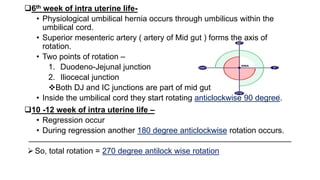
6th week of intra uterine life-
• Physiological umbilical hernia occurs through umbilicus within the
umbilical cord.
• Superior mesenteric artery ( artery of Mid gut ) forms the axis of
rotation.
• Two points of rotation –
1. Duodeno-Jejunal junction
2. Iliocecal junction
Both DJ and IC junctions are part of mid gut
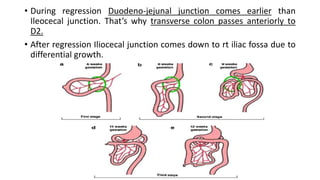
• Inside the umbilical cord they start rotating anticlockwise 90 degree.
10 -12 week of intra uterine life –
• Regression occur
• During regression another 180 degree anticlockwise rotation occurs.
So, total rotation = 270 degree antilock wise rotation
• During regression Duodeno-jejunal junction comes earlier than
Ileocecal junction. That’s why transverse colon passes anteriorly to
D2.
• After regression Iliocecal junction comes down to rt iliac fossa due to
differential growth.
Defective Mid Gut Rotation
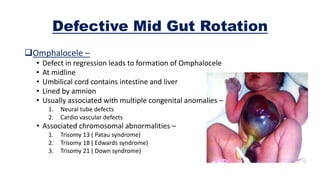
Omphalocele –
• Defect in regression leads to formation of Omphalocele
• At midline
• Umbilical cord contains intestine and liver
• Lined by amnion
• Usually associated with multiple congenital anomalies –
1. Neural tube defects
2. Cardio vascular defects
• Associated chromosomal abnormalities –
1. Trisomy 13 ( Patau syndrome)
2. Trisomy 18 ( Edwards syndrome)
3. Trisomy 21 ( Down syndrome)
MALROTATION OF GUT
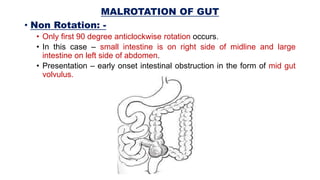
• Non Rotation: -
• Only first 90 degree anticlockwise rotation occurs.
• In this case – small intestine is on right side of midline and large
intestine on left side of abdomen.
• Presentation – early onset intestinal obstruction in the form of mid gut
volvulus.
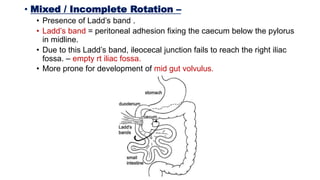
• Mixed / Incomplete Rotation –
• Presence of Ladd’s band .
• Ladd’s band = peritoneal adhesion fixing the caecum below the pylorus
in midline.
• Due to this Ladd’s band, ileocecal junction fails to reach the right iliac
fossa. – empty rt iliac fossa.
• More prone for development of mid gut volvulus.
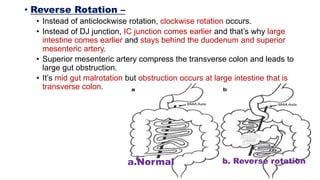
• Reverse Rotation –
• Instead of anticlockwise rotation, clockwise rotation occurs.
• Instead of DJ junction, IC junction comes earlier and that’s why large
intestine comes earlier and stays behind the duodenum and superior
mesenteric artery.
• Superior mesenteric artery compress the transverse colon and leads to
large gut obstruction.
• It’s mid gut malrotation but obstruction occurs at large intestine that is
transverse colon.
a.Normal b. Reverse rotation
DUODENAL ATRESIA
• Commonest site of intestinal atresia.
• Usually a complete stenosis of the second part of duodenum at
the level of ampulla of Vater.
• Due to defective fusion of foregut and midgut with failure of
recanalization.
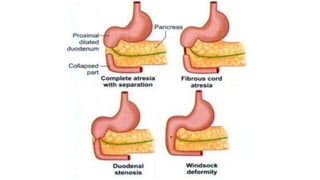
• Types –
1. Complete atresia with separation
2. Fibrinous cord atresia
3. Duodenal atresia
4. Windsock deformity
• Associations –
• Anular pancreas
• Down syndrome
• Anorectal malformation
• Features -
• Jaundice.
• Bilious/nonbilious vomiting immediately after birth.
• Features of gastric outlet obstruction.
• Dehydration.
• Electrolyte changes are common.
• Growth retardation of newborn due to deprived nutrition (by swallowed
amniotic fluid in fetus).
• Investigations –
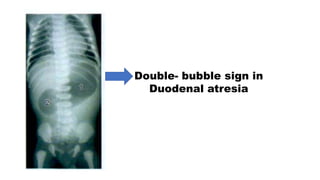
• Plain X-ray shows classic double-bubble sign with absence of air in the
distal part.
Double- bubble sign in
Duodenal atresia
• Surgical managements –
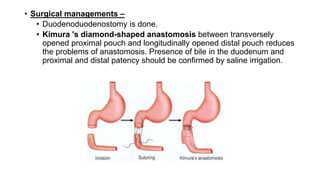
• Duodenoduodenostomy is done.
• Kimura 's diamond-shaped anastomosis between transversely
opened proximal pouch and longitudinally opened distal pouch reduces
the problems of anastomosis. Presence of bile in the duodenum and
proximal and distal patency should be confirmed by saline irrigation.
Meconium ileus
• Thick meconium, which is viscid and paste like, gets collected in the
terminal ileum. Because of inspissation it forms a firm bolus leading to
obstruction of the ileum.
• There is hypertrophy and dilatation of the proximal ileum containing thick,
viscid, tenacious dark green meconium. Distal ileum and colon are narrow
and contracted having grayish meconium pellets. Meconium gets calcified
very rapidly. Gangrene, perforation, volvulus can occur in 50% of cases.
• Intrauterine perforation causes fetal meconium peritonitis which leads to
dense adhesions and calcification in peritoneum. Fetal meconium
peritonitis is sterile.
• Investigations –
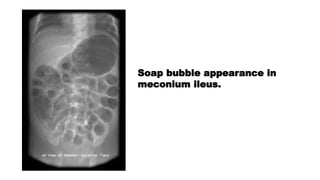
• Plain X-ray shows calcified meconium pellets with multiple air fluid
levels which appear as 'soap-bubbles' (Neuhauser sign).
• Treatment –
• Nonoperative measures-
1. Dissolution through enema can be tried using gastrografin which
is hyperosmolar and contains Tween 80 as dissolving agent.
Gastrografin is diatrizoate meglamine with Tween 80 (polysorbate
80) as dissolving agent. N acetylcysteine 10% also can be used
for irrigation per-anally.
2. N acetylcysteine 10% wash through nasogastric tube also can be
used-5-10 ml 6th hourly.
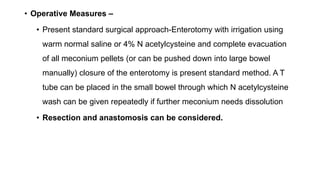
• Operative Measures –
• Present standard surgical approach-Enterotomy with irrigation using
warm normal saline or 4% N acetylcysteine and complete evacuation
of all meconium pellets (or can be pushed down into large bowel
manually) closure of the enterotomy is present standard method. A T
tube can be placed in the small bowel through which N acetylcysteine
wash can be given repeatedly if further meconium needs dissolution
• Resection and anastomosis can be considered.
Soap bubble appearance in
meconium ileus.
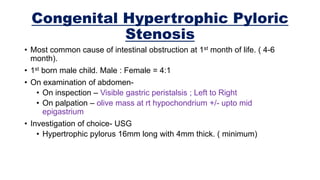
Congenital Hypertrophic Pyloric
Stenosis
• Most common cause of intestinal obstruction at 1st month of life. ( 4-6
month).
• 1st born male child. Male : Female = 4:1
• On examination of abdomen-
• On inspection – Visible gastric peristalsis ; Left to Right
• On palpation – olive mass at rt hypochondrium +/- upto mid
epigastrium
• Investigation of choice- USG
• Hypertrophic pylorus 16mm long with 4mm thick. ( minimum)
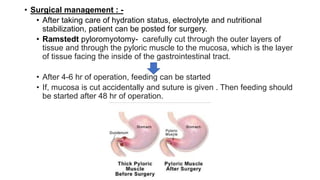
• Surgical management : -
• After taking care of hydration status, electrolyte and nutritional
stabilization, patient can be posted for surgery.
• Ramstedt pyloromyotomy- carefully cut through the outer layers of
tissue and through the pyloric muscle to the mucosa, which is the layer
of tissue facing the inside of the gastrointestinal tract.
• After 4-6 hr of operation, feeding can be started
• If, mucosa is cut accidentally and suture is given . Then feeding should
be started after 48 hr of operation.
Intussusception
• Most common type ileocolic.
• Most common intestinal obstruction at age group 6 month to 1 year of age.
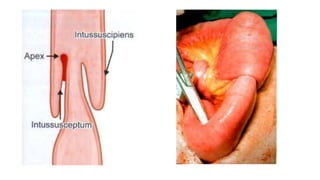
• Apex is the one which advances
• lntussuscipiens is the one which receives (outer sheath)
• lntussusceptum are the tubes which advance (middle and inner sheath)
• Apex and inner tubes will have compromised blood supply which leads to
gangrene.
• Because of ischaemia, apex sloughs off and bleeds, which mixes with the mucus to
produce the classic red-currant Jelly that is passed per anum.
• Gangrene which sets in leads to perforation and peritonitis.
• Red currant jelly is not commonly observed in ISS in adult, but it can occur.
• Common in males (3:2).
• Common in spring and winter, coinciding with the gastroenteritis and
respiratory infections in respective periods.
• Initial colicky abdominal pain (75%) which eventually becomes severe
and persistent.
• Often ISS is recurrent, when it gets reduced, child automatically
becomes asymptomatic (Mother often complains "Bachha rotha he,
Bachha sotha he". It means child cries during an episode and sleeps
peacefully once it gets reduced).
• • On examination, a mass is felt either on the left or right of the
umbilicus which is sausage shaped with concavity towards umbilicus,
smooth, firm, resonant, not moving with respiration, mobile,
contracts under the palpating fingers. Often mass appears and
disappears.
• After 24-48 hours, abdominal distension appears and increases
progressively with features of intestinal obstruction.
• Features of intestinal obstruction with step-ladder peristalsis.
• Blood-stained stool is often obvious on digital examination.
• Investigations –
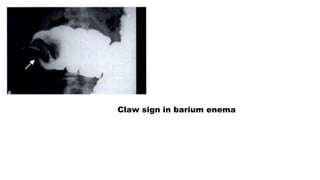
• Barium enema shows typical claw sign or coiled spring sign (Pincer
end).
• Ultrasound shows target sign or pseudokidney sign or bull's eye sign,
which is diagnostic.
• Doppler may show mass with doughnut sign and is useful to check
blood supply of bowel.
• Plain X-ray abdomen shows multiple air fluid levels.
• CT abdomen is needed.
Claw sign in barium enema
• Treatment –
• Initial management:- Ryle's tube aspiration; IV fluids; Antibiotics;
Catheterisation.
• Specific management:-
A. Non operative management – Reduction by hydrostatic pressure
using either warm saline or microbarium sulphate solution or air
(popular in China). Barium or saline is infused into the rectum
through a catheter (Foley's catheter). Under fluoroscopy, reduction
can be observed. Child will pass large quantity of air and faeces.
Rare complication is perforation of colon.
• Surgical management :-
Cape's method: If reduction does not occur, laparotomy is done under G/A. By
gently milking out the intussusception with warm packs, it is reduced. After
reduction, viability of the bowel is checked carefully. If manual reduction is not
possible, it is understood that the bowel is likely to be gangrenous which
requires resection and anastomosis. In case of viable bowel, often terminal
ileum is anchored to the ascending colon and Jackson veil band is cut.
Milking from distal to proximal never pull the proximal segment.
If intussusception persists for more than 48 hours or intussusception requires
resection
Hirschsprung disease
• Failure of migration of the Neural crest cells to form Auerbach plexus
and Meissner plexus ( responsible for gut peristaltic movements ).
• Absence of ganglion cells and that portion becomes narrow.
• Features –
• Habitual to severe form of constipation . ( not obstipation)
• Site –
• Rectum is the most common site
• Investigations –
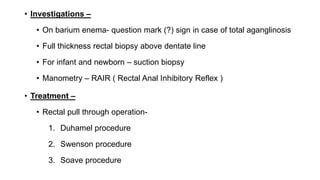
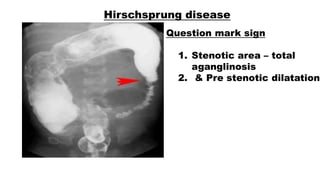
• On barium enema- question mark (?) sign in case of total aganglinosis
• Full thickness rectal biopsy above dentate line
• For infant and newborn – suction biopsy
• Manometry – RAIR ( Rectal Anal Inhibitory Reflex )
• Treatment –
• Rectal pull through operation-
1. Duhamel procedure
2. Swenson procedure
3. Soave procedure
Question mark sign
1. Stenotic area – total
aganglinosis
2. & Pre stenotic dilatation
Hirschsprung disease
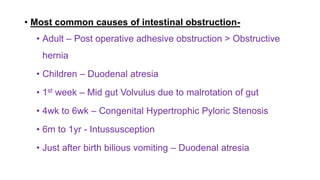
• Most common causes of intestinal obstruction-
• Adult – Post operative adhesive obstruction > Obstructive
hernia
• Children – Duodenal atresia
• 1st week – Mid gut Volvulus due to malrotation of gut
• 4wk to 6wk – Congenital Hypertrophic Pyloric Stenosis
• 6m to 1yr - Intussusception
• Just after birth bilious vomiting – Duodenal atresia
childhood intestinal obstruction.pptx

childhood intestinal obstruction.pptx

  • 1.
  • 2.
    Topics - 1. Rotationof gut and related anomaly 2. DUODENAL ATRESIA 3. Meconium ileus 4. Congenital Hypertrophic Pyloric Stenosis 5. Intussusception 6. Hirschsprung disease
  • 3.
    Basics regarding Rotationof Gut • Gut tube is derived from endoderm of yolk sac. • Fore gut – up to Major papilla at D2 – supplied by Celiac trunk • Mid gut – beyond the Major papilla at D2 to right 2/3rd of transverse colon – supplied by Superior mesenteric artery • Hind gut – rest of the gut- supplied by Inferior mesenteric artery
  • 4.
    6th week ofintra uterine life- • Physiological umbilical hernia occurs through umbilicus within the umbilical cord. • Superior mesenteric artery ( artery of Mid gut ) forms the axis of rotation. • Two points of rotation – 1. Duodeno-Jejunal junction 2. Iliocecal junction Both DJ and IC junctions are part of mid gut • Inside the umbilical cord they start rotating anticlockwise 90 degree. 10 -12 week of intra uterine life – • Regression occur • During regression another 180 degree anticlockwise rotation occurs. So, total rotation = 270 degree antilock wise rotation
  • 5.
    • During regressionDuodeno-jejunal junction comes earlier than Ileocecal junction. That’s why transverse colon passes anteriorly to D2. • After regression Iliocecal junction comes down to rt iliac fossa due to differential growth.
  • 6.
    Defective Mid GutRotation Omphalocele – • Defect in regression leads to formation of Omphalocele • At midline • Umbilical cord contains intestine and liver • Lined by amnion • Usually associated with multiple congenital anomalies – 1. Neural tube defects 2. Cardio vascular defects • Associated chromosomal abnormalities – 1. Trisomy 13 ( Patau syndrome) 2. Trisomy 18 ( Edwards syndrome) 3. Trisomy 21 ( Down syndrome)
  • 7.
    MALROTATION OF GUT •Non Rotation: - • Only first 90 degree anticlockwise rotation occurs. • In this case – small intestine is on right side of midline and large intestine on left side of abdomen. • Presentation – early onset intestinal obstruction in the form of mid gut volvulus.
  • 8.
    • Mixed /Incomplete Rotation – • Presence of Ladd’s band . • Ladd’s band = peritoneal adhesion fixing the caecum below the pylorus in midline. • Due to this Ladd’s band, ileocecal junction fails to reach the right iliac fossa. – empty rt iliac fossa. • More prone for development of mid gut volvulus.
  • 9.
    • Reverse Rotation– • Instead of anticlockwise rotation, clockwise rotation occurs. • Instead of DJ junction, IC junction comes earlier and that’s why large intestine comes earlier and stays behind the duodenum and superior mesenteric artery. • Superior mesenteric artery compress the transverse colon and leads to large gut obstruction. • It’s mid gut malrotation but obstruction occurs at large intestine that is transverse colon. a.Normal b. Reverse rotation
  • 10.
    DUODENAL ATRESIA • Commonestsite of intestinal atresia. • Usually a complete stenosis of the second part of duodenum at the level of ampulla of Vater. • Due to defective fusion of foregut and midgut with failure of recanalization. • Types – 1. Complete atresia with separation 2. Fibrinous cord atresia 3. Duodenal atresia 4. Windsock deformity
  • 12.
    • Associations – •Anular pancreas • Down syndrome • Anorectal malformation • Features - • Jaundice. • Bilious/nonbilious vomiting immediately after birth. • Features of gastric outlet obstruction. • Dehydration. • Electrolyte changes are common. • Growth retardation of newborn due to deprived nutrition (by swallowed amniotic fluid in fetus). • Investigations – • Plain X-ray shows classic double-bubble sign with absence of air in the distal part.
  • 13.
    Double- bubble signin Duodenal atresia
  • 14.
    • Surgical managements– • Duodenoduodenostomy is done. • Kimura 's diamond-shaped anastomosis between transversely opened proximal pouch and longitudinally opened distal pouch reduces the problems of anastomosis. Presence of bile in the duodenum and proximal and distal patency should be confirmed by saline irrigation.
  • 15.
    Meconium ileus • Thickmeconium, which is viscid and paste like, gets collected in the terminal ileum. Because of inspissation it forms a firm bolus leading to obstruction of the ileum. • There is hypertrophy and dilatation of the proximal ileum containing thick, viscid, tenacious dark green meconium. Distal ileum and colon are narrow and contracted having grayish meconium pellets. Meconium gets calcified very rapidly. Gangrene, perforation, volvulus can occur in 50% of cases.
  • 16.
    • Intrauterine perforationcauses fetal meconium peritonitis which leads to dense adhesions and calcification in peritoneum. Fetal meconium peritonitis is sterile. • Investigations – • Plain X-ray shows calcified meconium pellets with multiple air fluid levels which appear as 'soap-bubbles' (Neuhauser sign). • Treatment – • Nonoperative measures- 1. Dissolution through enema can be tried using gastrografin which is hyperosmolar and contains Tween 80 as dissolving agent. Gastrografin is diatrizoate meglamine with Tween 80 (polysorbate 80) as dissolving agent. N acetylcysteine 10% also can be used for irrigation per-anally. 2. N acetylcysteine 10% wash through nasogastric tube also can be used-5-10 ml 6th hourly.
  • 17.
    • Operative Measures– • Present standard surgical approach-Enterotomy with irrigation using warm normal saline or 4% N acetylcysteine and complete evacuation of all meconium pellets (or can be pushed down into large bowel manually) closure of the enterotomy is present standard method. A T tube can be placed in the small bowel through which N acetylcysteine wash can be given repeatedly if further meconium needs dissolution • Resection and anastomosis can be considered.
  • 18.
    Soap bubble appearancein meconium ileus.
  • 19.
    Congenital Hypertrophic Pyloric Stenosis •Most common cause of intestinal obstruction at 1st month of life. ( 4-6 month). • 1st born male child. Male : Female = 4:1 • On examination of abdomen- • On inspection – Visible gastric peristalsis ; Left to Right • On palpation – olive mass at rt hypochondrium +/- upto mid epigastrium • Investigation of choice- USG • Hypertrophic pylorus 16mm long with 4mm thick. ( minimum)
  • 20.
    • Surgical management: - • After taking care of hydration status, electrolyte and nutritional stabilization, patient can be posted for surgery. • Ramstedt pyloromyotomy- carefully cut through the outer layers of tissue and through the pyloric muscle to the mucosa, which is the layer of tissue facing the inside of the gastrointestinal tract. • After 4-6 hr of operation, feeding can be started • If, mucosa is cut accidentally and suture is given . Then feeding should be started after 48 hr of operation.
  • 21.
    Intussusception • Most commontype ileocolic. • Most common intestinal obstruction at age group 6 month to 1 year of age. • Apex is the one which advances • lntussuscipiens is the one which receives (outer sheath) • lntussusceptum are the tubes which advance (middle and inner sheath) • Apex and inner tubes will have compromised blood supply which leads to gangrene. • Because of ischaemia, apex sloughs off and bleeds, which mixes with the mucus to produce the classic red-currant Jelly that is passed per anum. • Gangrene which sets in leads to perforation and peritonitis. • Red currant jelly is not commonly observed in ISS in adult, but it can occur.
  • 23.
    • Common inmales (3:2). • Common in spring and winter, coinciding with the gastroenteritis and respiratory infections in respective periods. • Initial colicky abdominal pain (75%) which eventually becomes severe and persistent. • Often ISS is recurrent, when it gets reduced, child automatically becomes asymptomatic (Mother often complains "Bachha rotha he, Bachha sotha he". It means child cries during an episode and sleeps peacefully once it gets reduced). • • On examination, a mass is felt either on the left or right of the umbilicus which is sausage shaped with concavity towards umbilicus, smooth, firm, resonant, not moving with respiration, mobile, contracts under the palpating fingers. Often mass appears and disappears.
  • 24.
    • After 24-48hours, abdominal distension appears and increases progressively with features of intestinal obstruction. • Features of intestinal obstruction with step-ladder peristalsis. • Blood-stained stool is often obvious on digital examination. • Investigations – • Barium enema shows typical claw sign or coiled spring sign (Pincer end). • Ultrasound shows target sign or pseudokidney sign or bull's eye sign, which is diagnostic. • Doppler may show mass with doughnut sign and is useful to check blood supply of bowel. • Plain X-ray abdomen shows multiple air fluid levels. • CT abdomen is needed.
  • 25.
    Claw sign inbarium enema
  • 26.
    • Treatment – •Initial management:- Ryle's tube aspiration; IV fluids; Antibiotics; Catheterisation. • Specific management:- A. Non operative management – Reduction by hydrostatic pressure using either warm saline or microbarium sulphate solution or air (popular in China). Barium or saline is infused into the rectum through a catheter (Foley's catheter). Under fluoroscopy, reduction can be observed. Child will pass large quantity of air and faeces. Rare complication is perforation of colon.
  • 27.
    • Surgical management:- Cape's method: If reduction does not occur, laparotomy is done under G/A. By gently milking out the intussusception with warm packs, it is reduced. After reduction, viability of the bowel is checked carefully. If manual reduction is not possible, it is understood that the bowel is likely to be gangrenous which requires resection and anastomosis. In case of viable bowel, often terminal ileum is anchored to the ascending colon and Jackson veil band is cut. Milking from distal to proximal never pull the proximal segment. If intussusception persists for more than 48 hours or intussusception requires resection
  • 28.
    Hirschsprung disease • Failureof migration of the Neural crest cells to form Auerbach plexus and Meissner plexus ( responsible for gut peristaltic movements ). • Absence of ganglion cells and that portion becomes narrow. • Features – • Habitual to severe form of constipation . ( not obstipation) • Site – • Rectum is the most common site
  • 29.
    • Investigations – •On barium enema- question mark (?) sign in case of total aganglinosis • Full thickness rectal biopsy above dentate line • For infant and newborn – suction biopsy • Manometry – RAIR ( Rectal Anal Inhibitory Reflex ) • Treatment – • Rectal pull through operation- 1. Duhamel procedure 2. Swenson procedure 3. Soave procedure
  • 30.
    Question mark sign 1.Stenotic area – total aganglinosis 2. & Pre stenotic dilatation Hirschsprung disease
  • 31.
    • Most commoncauses of intestinal obstruction- • Adult – Post operative adhesive obstruction > Obstructive hernia • Children – Duodenal atresia • 1st week – Mid gut Volvulus due to malrotation of gut • 4wk to 6wk – Congenital Hypertrophic Pyloric Stenosis • 6m to 1yr - Intussusception • Just after birth bilious vomiting – Duodenal atresia