By;
Mr. Adeel ABBAS
 The First Sign of Life is Cry…
 Timely Passage Of The First Stool Is A Hallmark Of
The Well-being Of The Newborn Infant.
 Meconium is the First Stool Passed by New-Born.
 What is the Identity of Meconium?
 Meconium is;
 Thick.
 Sticky.
 Blackish-Green.
 Timming of Passing Meconium?
 In Full-term?
 99% Pass Within 24 Hours.
 All Pass Within 48 Hours.
 In Pre-term?
 37% Pass Within 24 Hours.
 All Pass Upto 9 Days.
 Failure Of A Full-term Newborn To Pass Meconium
Within The First 24 Hours Should Raise A Suspicion
Of Intestinal Obstruction.
 FAILURE TO PASS MECONIUM…
 Is It A Problem?
 YES…
 Failure To Pass Meconium Is A Problem.
 Is Breathing Problems caused by Inhaling Meconium
Serious?
 Breathing Problems Caused By The Baby Inhaling
Meconium Are Usually Not Serious.
Clinical Presentation
 A 3.5 Kg male infant was born after 40 weeks' gestation.
There were no complications during the pregnancy and
delivery. He did not pass meconium after birth, and he
had the onset of bilious vomiting. His abdomen is
distended, with palpable loops of bowel. The infant was
not able to feed.
What’s the Diagnosis?
 Diagnosis is Neonatal Intestinal Obstruction.
Differential Diagnosis (of I. Obs:)
 Duodenal Atresia,
 Malrotation And Volvulus,
 Jejunoileal Atresia,
 Meconium Ileus And
 Meconium Peritonitis.
Clinical Presentation
 A 3.5 Kg Male Infant Was Born After 40 Weeks' Gestation.
There Were No Complications During The Pregnancy &
Delivery. He Did Not Pass Meconium After Birth, & He Had
The Onset Of Vomiting On The First Day. His Abdomen
Became Mildly Distended. The Infant Was Not Able To
Feed, And Abdominal Distention Increased.
 DRE reveals Tight Anus.
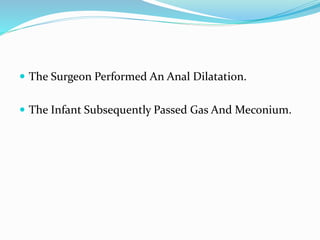
 On the second day…
 The Surgeon Performed An Anal Dilatation.
 The Infant Subsequently Passed Gas And Meconium.
 After Discharge From The Hospital, The Infant's
Mother Continued Performing Periodic Anal
Dilatation Because He Had Difficulties Moving His
Bowel.
 Digital Rectal Examination By The Physician When
The Infant Was Five Weeks Of Age Revealed A Tight
Anus And Liquid Stool But No Impaction.
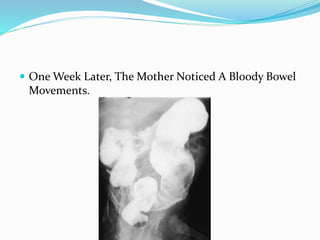
 One Week Later, The Mother Noticed A Bloody Bowel
Movements.
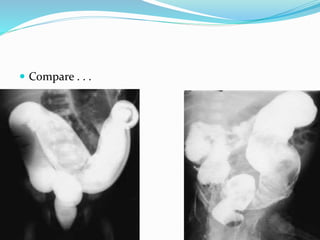
 Compare . . .
 What’s Your Diagnosis?
 Diagnosis is;
 “ Hirschsprung's Disease “.
Hirschsprung's Disease
 Congenital Aganglionic Megacolon.
 Overall Incidence Of 1 In 4,000 Live Births.
 20 To 25% Of The Cases Of Neonatal Bowel
Obstruction.
 Male to Female Ratio 4:1.
 8% Have Down Syndrome.
 Common Presentation Of Hirschsprung's Disease;
 Newborn.
 Failure To Pass Meconium During The First Few Days Of
Life.
 Subsequent Passage Of A Meconium Plug Followed By
Sparse Bowel Movements.
 Gastrointestinal Bleeding And Diarrhea Are DANGER
SIGNS  Enterocolitis.
 How Will You Proceed?
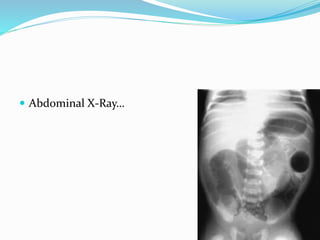
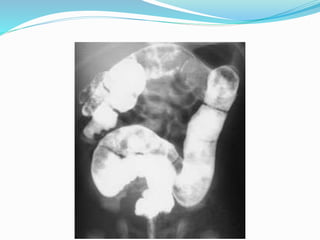
 Abdominal X-Ray…
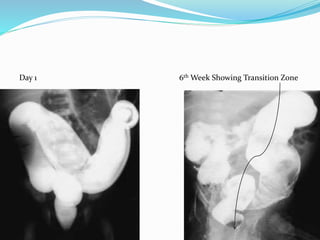
 Barium Enema…
Day 1 6th Week Showing Transition Zone
 The Presence Of Barium In The 24-hour Delayed Film
Also Suggests Hirschsprung's Disease.
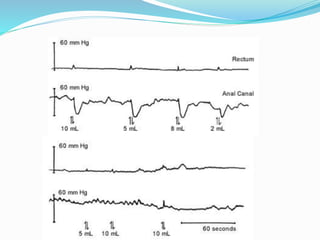
 Ano-Rectal Manometry…
TREATMENT
 Surgery… … …
 To Remove Or Bypass The Diseased Bowel.
 Initially Colostomy.
 Corrective Surgery In Three To Six Months.
Clinical Presentation
 A 3.5 Kg Male Infant Was Born After 40 Weeks' Gestation.
There Were No Complications During The Pregnancy &
Delivery. He Did Not Pass Meconium After Birth, & He Had
The Onset Of Vomiting On The First Day. His Abdomen
Became Mildly Distended. The Infant Was Not Able To
Feed, And Abdominal Distention Increased.
 DRE reveals Normal Anus.
 What is the Diagnosis?
 Hint:
 Contrast Enema Is Diagnostic, And Also Therapeutic …
 Meconium Plug Syndrome
Meconium Plug Syndrome
 Mildest & Most Common Form Of Functional Distal
Obstruction In The Newborn.
 Obstruction Caused By Inspissated, Immobile
Meconium.
 Incidence 1 Case In 500 To 1,000 Neonates.1
 Etiology Is Unclear.
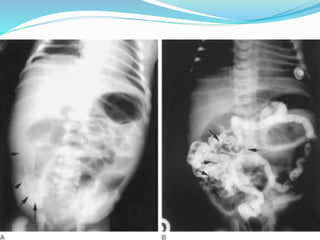
Clinical Presentation
 A 3.5 Kg Male Infant Was Born After 40 Weeks' Gestation.
There Were No Complications During The Pregnancy &
Delivery. He Did Not Pass Meconium After Birth.
Abdominal Distention Is Present At Birth. Within Hours,
The Distention Increases, & The Infant Vomits Bile-stained
Material. Bowel Loops Are Visible Through The Abdominal
Wall. Rectal Examination Is Difficult.
 What Is The Diagnosis?
 Meconium Ileus.
 What’s Most Common Underlying Cause of
Meconium Ileus?
 Cystic fibrosis …
 Cystic Fibrosis Is The Underlying Disorder In 95%
Infants With Meconium Ileus.
 Meconium Ileus Occurs In 15% Of Patients With
Cystic Fibrosis.
Treatment ?
 Simple Meconium Ileus 
 Gastrografin Enema And
 Plenty Of Intravenous Fluids.
 If The Gastrografin Enema Is Unsuccessful…!...?
 Operative Evacuation Of The Obstructing Meconium By
Irrigation…
Clinical Presentation
 A 3.5 Kg Male Infant Was Born After 40 Weeks' Gestation.
There Were No Complications During The Pregnancy &
Delivery. He Did Not Pass Meconium After Birth. Within
Hours, The Distention Increases. Perineal Inspection
Reveals The Absent Anus…
 What Is The Diagnosis?
 High Type..?
 Rectum Ends Above The Levator Muscle.
 Low Type..?
 Rectum Partially Descends Through Levator Muscle.
 Often, The Rectum Ends In A Fistula.
 Treatment … ?
 Anal Atresia Requires Surgery.
 Goal Of Surgery Is To Preserve Bowel, Urinary &
Sexual Function.
 Colostomy Is Initially Performed In Neonates With
High Anal Atresia.
 Followed by Elective Pull-Through Surgery.
 Fistula Can Be Gently Dilated To Allow The Gas &
Meconium To Pass.
 Fistula Can Be Corrected Electively When The Infant's
Condition Is Stable.
NewBorn Who Fails to Pass Meconium - Final Year Lecture

NewBorn Who Fails to Pass Meconium - Final Year Lecture

  • 1.
  • 2.
     The FirstSign of Life is Cry…
  • 3.
     Timely PassageOf The First Stool Is A Hallmark Of The Well-being Of The Newborn Infant.
  • 4.
     Meconium isthe First Stool Passed by New-Born.
  • 5.
     What isthe Identity of Meconium?
  • 6.
     Meconium is; Thick.  Sticky.  Blackish-Green.
  • 7.
     Timming ofPassing Meconium?
  • 8.
     In Full-term? 99% Pass Within 24 Hours.  All Pass Within 48 Hours.  In Pre-term?  37% Pass Within 24 Hours.  All Pass Upto 9 Days.
  • 9.
     Failure OfA Full-term Newborn To Pass Meconium Within The First 24 Hours Should Raise A Suspicion Of Intestinal Obstruction.
  • 10.
     FAILURE TOPASS MECONIUM…  Is It A Problem?
  • 11.
     YES…  FailureTo Pass Meconium Is A Problem.
  • 12.
     Is BreathingProblems caused by Inhaling Meconium Serious?
  • 13.
     Breathing ProblemsCaused By The Baby Inhaling Meconium Are Usually Not Serious.
  • 14.
    Clinical Presentation  A3.5 Kg male infant was born after 40 weeks' gestation. There were no complications during the pregnancy and delivery. He did not pass meconium after birth, and he had the onset of bilious vomiting. His abdomen is distended, with palpable loops of bowel. The infant was not able to feed. What’s the Diagnosis?
  • 15.
     Diagnosis isNeonatal Intestinal Obstruction.
  • 16.
    Differential Diagnosis (ofI. Obs:)  Duodenal Atresia,  Malrotation And Volvulus,  Jejunoileal Atresia,  Meconium Ileus And  Meconium Peritonitis.
  • 17.
    Clinical Presentation  A3.5 Kg Male Infant Was Born After 40 Weeks' Gestation. There Were No Complications During The Pregnancy & Delivery. He Did Not Pass Meconium After Birth, & He Had The Onset Of Vomiting On The First Day. His Abdomen Became Mildly Distended. The Infant Was Not Able To Feed, And Abdominal Distention Increased.  DRE reveals Tight Anus.
  • 18.
     On thesecond day…
  • 19.
     The SurgeonPerformed An Anal Dilatation.  The Infant Subsequently Passed Gas And Meconium.
  • 20.
     After DischargeFrom The Hospital, The Infant's Mother Continued Performing Periodic Anal Dilatation Because He Had Difficulties Moving His Bowel.
  • 21.
     Digital RectalExamination By The Physician When The Infant Was Five Weeks Of Age Revealed A Tight Anus And Liquid Stool But No Impaction.
  • 22.
     One WeekLater, The Mother Noticed A Bloody Bowel Movements.
  • 23.
  • 24.
  • 25.
     Diagnosis is; “ Hirschsprung's Disease “.
  • 26.
    Hirschsprung's Disease  CongenitalAganglionic Megacolon.  Overall Incidence Of 1 In 4,000 Live Births.  20 To 25% Of The Cases Of Neonatal Bowel Obstruction.  Male to Female Ratio 4:1.  8% Have Down Syndrome.
  • 27.
     Common PresentationOf Hirschsprung's Disease;  Newborn.  Failure To Pass Meconium During The First Few Days Of Life.  Subsequent Passage Of A Meconium Plug Followed By Sparse Bowel Movements.  Gastrointestinal Bleeding And Diarrhea Are DANGER SIGNS  Enterocolitis.
  • 28.
     How WillYou Proceed?
  • 29.
  • 30.
  • 31.
    Day 1 6thWeek Showing Transition Zone
  • 32.
     The PresenceOf Barium In The 24-hour Delayed Film Also Suggests Hirschsprung's Disease.
  • 33.
  • 35.
    TREATMENT  Surgery… ……  To Remove Or Bypass The Diseased Bowel.  Initially Colostomy.  Corrective Surgery In Three To Six Months.
  • 36.
    Clinical Presentation  A3.5 Kg Male Infant Was Born After 40 Weeks' Gestation. There Were No Complications During The Pregnancy & Delivery. He Did Not Pass Meconium After Birth, & He Had The Onset Of Vomiting On The First Day. His Abdomen Became Mildly Distended. The Infant Was Not Able To Feed, And Abdominal Distention Increased.  DRE reveals Normal Anus.
  • 38.
     What isthe Diagnosis?
  • 39.
     Hint:  ContrastEnema Is Diagnostic, And Also Therapeutic …
  • 40.
  • 41.
    Meconium Plug Syndrome Mildest & Most Common Form Of Functional Distal Obstruction In The Newborn.  Obstruction Caused By Inspissated, Immobile Meconium.  Incidence 1 Case In 500 To 1,000 Neonates.1  Etiology Is Unclear.
  • 42.
    Clinical Presentation  A3.5 Kg Male Infant Was Born After 40 Weeks' Gestation. There Were No Complications During The Pregnancy & Delivery. He Did Not Pass Meconium After Birth. Abdominal Distention Is Present At Birth. Within Hours, The Distention Increases, & The Infant Vomits Bile-stained Material. Bowel Loops Are Visible Through The Abdominal Wall. Rectal Examination Is Difficult.
  • 44.
     What IsThe Diagnosis?
  • 45.
  • 46.
     What’s MostCommon Underlying Cause of Meconium Ileus?  Cystic fibrosis …
  • 47.
     Cystic FibrosisIs The Underlying Disorder In 95% Infants With Meconium Ileus.  Meconium Ileus Occurs In 15% Of Patients With Cystic Fibrosis.
  • 48.
    Treatment ?  SimpleMeconium Ileus   Gastrografin Enema And  Plenty Of Intravenous Fluids.
  • 49.
     If TheGastrografin Enema Is Unsuccessful…!...?  Operative Evacuation Of The Obstructing Meconium By Irrigation…
  • 50.
    Clinical Presentation  A3.5 Kg Male Infant Was Born After 40 Weeks' Gestation. There Were No Complications During The Pregnancy & Delivery. He Did Not Pass Meconium After Birth. Within Hours, The Distention Increases. Perineal Inspection Reveals The Absent Anus…  What Is The Diagnosis?
  • 51.
     High Type..? Rectum Ends Above The Levator Muscle.  Low Type..?  Rectum Partially Descends Through Levator Muscle.  Often, The Rectum Ends In A Fistula.
  • 52.
  • 53.
     Anal AtresiaRequires Surgery.  Goal Of Surgery Is To Preserve Bowel, Urinary & Sexual Function.
  • 54.
     Colostomy IsInitially Performed In Neonates With High Anal Atresia.  Followed by Elective Pull-Through Surgery.
  • 55.
     Fistula CanBe Gently Dilated To Allow The Gas & Meconium To Pass.  Fistula Can Be Corrected Electively When The Infant's Condition Is Stable.