Wechsler Individual  Achievement Test - 3 rd  Ed. (WIAT-III)  Dr. Edward M. Petrosky Licensed Psychologist (917) 520 – 4444  www.toolsforstudents.info A Primer (c) Dr. Edward M. Petrosky, 2009.  Tags:  WIAT-3, psychoeducation; evaluation; Queens, NY
A Word on the Presenter Licensed psychologist Background in school & clinical psychology Specializations include:  Dyslexia / Learning Disability Testing Neuropsychological Evaluations Evaluations of Behavioral and Emotional Problems  Workshops to parents, teachers, & students on academic and emotional growth Evaluations help answer questions such as: What is the problem?  What is causing it?  What can be done to help? Facebook page:  “Dr. Edward M. Petrosky” www.toolsforstudents.info (c) Dr. Edward M. Petrosky, 2009.  Tags:  WIAT-3, psychoeducation; evaluation; Queens, NY
Overall, I think the WIAT-III is a significant improvement from the WIAT-II, including the addition of a measure of oral reading fluency and shorter administration time for many subtests. (c) Dr. Edward M. Petrosky, 2009.  Tags:  WIAT-3, psychoeducation; evaluation; Queens, NY
The following is an excerpt from my WIAT-III school-staff in-service training workshop. Enjoy! (c) Dr. Edward M. Petrosky, 2009.  Tags:  WIAT-3, psychoeducation; evaluation; Queens, NY
Important Preface This presentation is meant to be a helpful aid in gaining an overview of the WIAT-III, but is not a substitute for reading the test manual. (c) Dr. Edward M. Petrosky, 2009.  Tags:  WIAT-3, psychoeducation; evaluation; Queens, NY
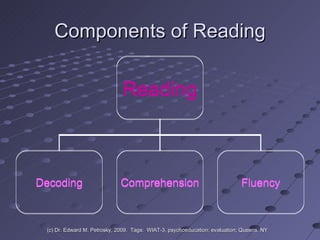
Components of Reading (c) Dr. Edward M. Petrosky, 2009.  Tags:  WIAT-3, psychoeducation; evaluation; Queens, NY Reading Decoding Comprehension Fluency Reading Decoding Comprehension Fluency
Reading  Readiness Skills Cognitive abilities necessary for decoding (c) Dr. Edward M. Petrosky, 2009.  Tags:  WIAT-3, psychoeducation; evaluation; Queens, NY
Reading Readiness Early Reading Skills subtest  Items require the student to: Identify letters and letter sounds Identify and produce rhyming words Segment words – identifying beginning and ending sounds Blend sounds Identify consonant blends Do a small amount of basic sight word recognition (c) Dr. Edward M. Petrosky, 2009.  Tags:  WIAT-3, psychoeducation; evaluation; Queens, NY
Reading Decoding Determining what a word is (c) Dr. Edward M. Petrosky, 2009.  Tags:  WIAT-3, psychoeducation; evaluation; Queens, NY
Reading Decoding Skills Word Reading Subtest  Student reads individual words Assesses  Overall decoding skills Natural decoding rate (c) Dr. Edward M. Petrosky, 2009.  Tags:  WIAT-3, psychoeducation; evaluation; Queens, NY
Reading Decoding Skills Pseudoword Decoding Subtest:  Student reads individual nonsense words Assesses phonics skills Because the words are made up the student has never seen them before and thus cannot rely on memorization to decode them.  Therefore, assess phonics skill Natural decoding rate (of unfamiliar words) (c) Dr. Edward M. Petrosky, 2009.  Tags:  WIAT-3, psychoeducation; evaluation; Queens, NY
Reading Fluency The accuracy, rate, ease, and rhythm with which a person reads. (c) Dr. Edward M. Petrosky, 2009.  Tags:  WIAT-3, psychoeducation; evaluation; Queens, NY
Reading Fluency Oral Reading Fluency subtest  Student reads two passages aloud and answers a question about each passage Assesses  Speed Accuracy Rhythm (Qualitatively) (c) Dr. Edward M. Petrosky, 2009.  Tags:  WIAT-3, psychoeducation; evaluation; Queens, NY
Reading Comprehension Understanding what one reads (c) Dr. Edward M. Petrosky, 2009.  Tags:  WIAT-3, psychoeducation; evaluation; Queens, NY
Reading Comprehension Reading Comprehension subtest  Student reads passages and then answers questions about them. Passage remains visible while questions are being read. Much shorter administration time than the same subtest on the WIAT-2! (c) Dr. Edward M. Petrosky, 2009.  Tags:  WIAT-3, psychoeducation; evaluation; Queens, NY
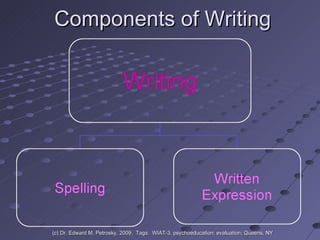
Components of Writing (c) Dr. Edward M. Petrosky, 2009.  Tags:  WIAT-3, psychoeducation; evaluation; Queens, NY
Spelling Spelling subtest  Student spells dictated words (c) Dr. Edward M. Petrosky, 2009.  Tags:  WIAT-3, psychoeducation; evaluation; Queens, NY
Written Expression Alphabet Writing Fluency Subtest Student writes down letters of the alphabet as fast as he or she can. (c) Dr. Edward M. Petrosky, 2009.  Tags:  WIAT-3, psychoeducation; evaluation; Queens, NY
Written Expression Sentence Composition subtest Sentence Combining portion  Student is to take two or more separate sentences and write one good sentence that means the same thing. (c) Dr. Edward M. Petrosky, 2009.  Tags:  WIAT-3, psychoeducation; evaluation; Queens, NY
Written Expression Sentence Composition subtest Sentence Building portion  Student is to write a sentence using a target word (c) Dr. Edward M. Petrosky, 2009.  Tags:  WIAT-3, psychoeducation; evaluation; Queens, NY
Written Expression Essay Composition subtest Student is to write an essay about his or her favorite game, including 3 reasons why (c) Dr. Edward M. Petrosky, 2009.  Tags:  WIAT-3, psychoeducation; evaluation; Queens, NY
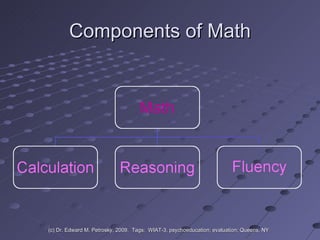
Components of Math (c) Dr. Edward M. Petrosky, 2009.  Tags:  WIAT-3, psychoeducation; evaluation; Queens, NY
Mathematical Calculation Conducting mathematical computations (c) Dr. Edward M. Petrosky, 2009.  Tags:  WIAT-3, psychoeducation; evaluation; Queens, NY
Mathematical Calculation Numerical Operations subtest  Student solves math problems, ranging from addition, subtraction, multiplication, and division, to geometry and algebra.  (c) Dr. Edward M. Petrosky, 2009.  Tags:  WIAT-3, psychoeducation; evaluation; Queens, NY
Mathematical Reasoning The ability to identify what a problem is asking for and to select and successfully implement the correct solution.  Ability to apply math to real-world, practical problems. (c) Dr. Edward M. Petrosky, 2009.  Tags:  WIAT-3, psychoeducation; evaluation; Queens, NY
Mathematical Reasoning Math Problem Solving subtest  Student solves math word problems, involving areas such as the basic operations, time, money, and interpreting graphs.  (c) Dr. Edward M. Petrosky, 2009.  Tags:  WIAT-3, psychoeducation; evaluation; Queens, NY
Mathematical Fluency The speed and automaticity with which a student can perform basic mathematical calculations.  (c) Dr. Edward M. Petrosky, 2009.  Tags:  WIAT-3, psychoeducation; evaluation; Queens, NY
Mathematical Fluency Math Fluency - Addition subtest Math Fluency – Subtraction subtest Math Fluency – Multiplication subtest  Student solves as many simple problems as s/he can in each of the respective areas in 1 minute (per subtest).  (c) Dr. Edward M. Petrosky, 2009.  Tags:  WIAT-3, psychoeducation; evaluation; Queens, NY
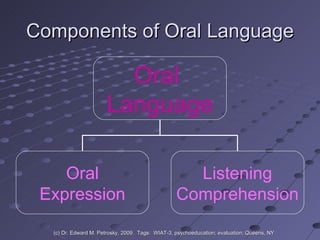
Components of Oral Language (c) Dr. Edward M. Petrosky, 2009.  Tags:  WIAT-3, psychoeducation; evaluation; Queens, NY Oral  Language Oral Expression Listening Comprehension
Listening Comprehension The ability to understand spoken language.  Receptive language.  (c) Dr. Edward M. Petrosky, 2009.  Tags:  WIAT-3, psychoeducation; evaluation; Queens, NY
Listening Comprehension Listening Comprehension subtest Receptive Vocabulary portion  Student listens to single words and points to the picture that matches the word.  (c) Dr. Edward M. Petrosky, 2009.  Tags:  WIAT-3, psychoeducation; evaluation; Queens, NY
Listening Comprehension Listening Comprehension subtest Oral Discourse portion  Student listens to a CD of spoken sentences and answers questions about what s/he heard.  Includes dialogue and advertisement like narratives. Return to a portion that was on original WIAT-II More closely matches real life listening comprehension tasks CD recording increases reliability of findings Includes speech as naturally spoken (e.g. a child with imperfect articulation)  (c) Dr. Edward M. Petrosky, 2009.  Tags:  WIAT-3, psychoeducation; evaluation; Queens, NY
Oral Expression The ability to produce spoken language.  Expressive language.  (c) Dr. Edward M. Petrosky, 2009.  Tags:  WIAT-3, psychoeducation; evaluation; Queens, NY
Oral Expression Oral Expression subtest Expressive Vocabulary portion  Student looks at a picture, listens to a definition, and the states the word that matches the picture and definition. For the WIAT-2 this was on the Listening Comprehension subtest (c) Dr. Edward M. Petrosky, 2009.  Tags:  WIAT-3, psychoeducation; evaluation; Queens, NY
Oral Expression Oral Expression subtest Oral Word Fluency portion  Student names as many objects from certain categories as s/he can in 60 seconds (a hypothetical example of which would be naming as many hobbies as one can in a minute).  Category selection an improvement from WIAT-2; on WIAT-2 one of the categories was frequently misunderstood by students.  (c) Dr. Edward M. Petrosky, 2009.  Tags:  WIAT-3, psychoeducation; evaluation; Queens, NY
Oral Expression Oral Expression subtest Sentence Repetition portion  Student listens to the examiner state a sentence and has to repeat it back verbatim. (c) Dr. Edward M. Petrosky, 2009.  Tags:  WIAT-3, psychoeducation; evaluation; Queens, NY
Thank you very much! If your school or organization would like a comprehensive training on  administering ,  scoring , and  interpreting  the WIAT-III please call 917-520-4444 (c) Dr. Edward M. Petrosky, 2009.  Tags:  WIAT-3, psychoeducation; evaluation; Queens, NY

WIAT-III A Primer

  • 1.
    Wechsler Individual Achievement Test - 3 rd Ed. (WIAT-III) Dr. Edward M. Petrosky Licensed Psychologist (917) 520 – 4444 www.toolsforstudents.info A Primer (c) Dr. Edward M. Petrosky, 2009. Tags: WIAT-3, psychoeducation; evaluation; Queens, NY
  • 2.
    A Word onthe Presenter Licensed psychologist Background in school & clinical psychology Specializations include: Dyslexia / Learning Disability Testing Neuropsychological Evaluations Evaluations of Behavioral and Emotional Problems Workshops to parents, teachers, & students on academic and emotional growth Evaluations help answer questions such as: What is the problem? What is causing it? What can be done to help? Facebook page: “Dr. Edward M. Petrosky” www.toolsforstudents.info (c) Dr. Edward M. Petrosky, 2009. Tags: WIAT-3, psychoeducation; evaluation; Queens, NY
  • 3.
    Overall, I thinkthe WIAT-III is a significant improvement from the WIAT-II, including the addition of a measure of oral reading fluency and shorter administration time for many subtests. (c) Dr. Edward M. Petrosky, 2009. Tags: WIAT-3, psychoeducation; evaluation; Queens, NY
  • 4.
    The following isan excerpt from my WIAT-III school-staff in-service training workshop. Enjoy! (c) Dr. Edward M. Petrosky, 2009. Tags: WIAT-3, psychoeducation; evaluation; Queens, NY
  • 5.
    Important Preface Thispresentation is meant to be a helpful aid in gaining an overview of the WIAT-III, but is not a substitute for reading the test manual. (c) Dr. Edward M. Petrosky, 2009. Tags: WIAT-3, psychoeducation; evaluation; Queens, NY
  • 6.
    Components of Reading(c) Dr. Edward M. Petrosky, 2009. Tags: WIAT-3, psychoeducation; evaluation; Queens, NY Reading Decoding Comprehension Fluency Reading Decoding Comprehension Fluency
  • 7.
    Reading ReadinessSkills Cognitive abilities necessary for decoding (c) Dr. Edward M. Petrosky, 2009. Tags: WIAT-3, psychoeducation; evaluation; Queens, NY
  • 8.
    Reading Readiness EarlyReading Skills subtest Items require the student to: Identify letters and letter sounds Identify and produce rhyming words Segment words – identifying beginning and ending sounds Blend sounds Identify consonant blends Do a small amount of basic sight word recognition (c) Dr. Edward M. Petrosky, 2009. Tags: WIAT-3, psychoeducation; evaluation; Queens, NY
  • 9.
    Reading Decoding Determiningwhat a word is (c) Dr. Edward M. Petrosky, 2009. Tags: WIAT-3, psychoeducation; evaluation; Queens, NY
  • 10.
    Reading Decoding SkillsWord Reading Subtest Student reads individual words Assesses Overall decoding skills Natural decoding rate (c) Dr. Edward M. Petrosky, 2009. Tags: WIAT-3, psychoeducation; evaluation; Queens, NY
  • 11.
    Reading Decoding SkillsPseudoword Decoding Subtest: Student reads individual nonsense words Assesses phonics skills Because the words are made up the student has never seen them before and thus cannot rely on memorization to decode them. Therefore, assess phonics skill Natural decoding rate (of unfamiliar words) (c) Dr. Edward M. Petrosky, 2009. Tags: WIAT-3, psychoeducation; evaluation; Queens, NY
  • 12.
    Reading Fluency Theaccuracy, rate, ease, and rhythm with which a person reads. (c) Dr. Edward M. Petrosky, 2009. Tags: WIAT-3, psychoeducation; evaluation; Queens, NY
  • 13.
    Reading Fluency OralReading Fluency subtest Student reads two passages aloud and answers a question about each passage Assesses Speed Accuracy Rhythm (Qualitatively) (c) Dr. Edward M. Petrosky, 2009. Tags: WIAT-3, psychoeducation; evaluation; Queens, NY
  • 14.
    Reading Comprehension Understandingwhat one reads (c) Dr. Edward M. Petrosky, 2009. Tags: WIAT-3, psychoeducation; evaluation; Queens, NY
  • 15.
    Reading Comprehension ReadingComprehension subtest Student reads passages and then answers questions about them. Passage remains visible while questions are being read. Much shorter administration time than the same subtest on the WIAT-2! (c) Dr. Edward M. Petrosky, 2009. Tags: WIAT-3, psychoeducation; evaluation; Queens, NY
  • 16.
    Components of Writing(c) Dr. Edward M. Petrosky, 2009. Tags: WIAT-3, psychoeducation; evaluation; Queens, NY
  • 17.
    Spelling Spelling subtest Student spells dictated words (c) Dr. Edward M. Petrosky, 2009. Tags: WIAT-3, psychoeducation; evaluation; Queens, NY
  • 18.
    Written Expression AlphabetWriting Fluency Subtest Student writes down letters of the alphabet as fast as he or she can. (c) Dr. Edward M. Petrosky, 2009. Tags: WIAT-3, psychoeducation; evaluation; Queens, NY
  • 19.
    Written Expression SentenceComposition subtest Sentence Combining portion Student is to take two or more separate sentences and write one good sentence that means the same thing. (c) Dr. Edward M. Petrosky, 2009. Tags: WIAT-3, psychoeducation; evaluation; Queens, NY
  • 20.
    Written Expression SentenceComposition subtest Sentence Building portion Student is to write a sentence using a target word (c) Dr. Edward M. Petrosky, 2009. Tags: WIAT-3, psychoeducation; evaluation; Queens, NY
  • 21.
    Written Expression EssayComposition subtest Student is to write an essay about his or her favorite game, including 3 reasons why (c) Dr. Edward M. Petrosky, 2009. Tags: WIAT-3, psychoeducation; evaluation; Queens, NY
  • 22.
    Components of Math(c) Dr. Edward M. Petrosky, 2009. Tags: WIAT-3, psychoeducation; evaluation; Queens, NY
  • 23.
    Mathematical Calculation Conductingmathematical computations (c) Dr. Edward M. Petrosky, 2009. Tags: WIAT-3, psychoeducation; evaluation; Queens, NY
  • 24.
    Mathematical Calculation NumericalOperations subtest Student solves math problems, ranging from addition, subtraction, multiplication, and division, to geometry and algebra. (c) Dr. Edward M. Petrosky, 2009. Tags: WIAT-3, psychoeducation; evaluation; Queens, NY
  • 25.
    Mathematical Reasoning Theability to identify what a problem is asking for and to select and successfully implement the correct solution. Ability to apply math to real-world, practical problems. (c) Dr. Edward M. Petrosky, 2009. Tags: WIAT-3, psychoeducation; evaluation; Queens, NY
  • 26.
    Mathematical Reasoning MathProblem Solving subtest Student solves math word problems, involving areas such as the basic operations, time, money, and interpreting graphs. (c) Dr. Edward M. Petrosky, 2009. Tags: WIAT-3, psychoeducation; evaluation; Queens, NY
  • 27.
    Mathematical Fluency Thespeed and automaticity with which a student can perform basic mathematical calculations. (c) Dr. Edward M. Petrosky, 2009. Tags: WIAT-3, psychoeducation; evaluation; Queens, NY
  • 28.
    Mathematical Fluency MathFluency - Addition subtest Math Fluency – Subtraction subtest Math Fluency – Multiplication subtest Student solves as many simple problems as s/he can in each of the respective areas in 1 minute (per subtest). (c) Dr. Edward M. Petrosky, 2009. Tags: WIAT-3, psychoeducation; evaluation; Queens, NY
  • 29.
    Components of OralLanguage (c) Dr. Edward M. Petrosky, 2009. Tags: WIAT-3, psychoeducation; evaluation; Queens, NY Oral Language Oral Expression Listening Comprehension
  • 30.
    Listening Comprehension Theability to understand spoken language. Receptive language. (c) Dr. Edward M. Petrosky, 2009. Tags: WIAT-3, psychoeducation; evaluation; Queens, NY
  • 31.
    Listening Comprehension ListeningComprehension subtest Receptive Vocabulary portion Student listens to single words and points to the picture that matches the word. (c) Dr. Edward M. Petrosky, 2009. Tags: WIAT-3, psychoeducation; evaluation; Queens, NY
  • 32.
    Listening Comprehension ListeningComprehension subtest Oral Discourse portion Student listens to a CD of spoken sentences and answers questions about what s/he heard. Includes dialogue and advertisement like narratives. Return to a portion that was on original WIAT-II More closely matches real life listening comprehension tasks CD recording increases reliability of findings Includes speech as naturally spoken (e.g. a child with imperfect articulation) (c) Dr. Edward M. Petrosky, 2009. Tags: WIAT-3, psychoeducation; evaluation; Queens, NY
  • 33.
    Oral Expression Theability to produce spoken language. Expressive language. (c) Dr. Edward M. Petrosky, 2009. Tags: WIAT-3, psychoeducation; evaluation; Queens, NY
  • 34.
    Oral Expression OralExpression subtest Expressive Vocabulary portion Student looks at a picture, listens to a definition, and the states the word that matches the picture and definition. For the WIAT-2 this was on the Listening Comprehension subtest (c) Dr. Edward M. Petrosky, 2009. Tags: WIAT-3, psychoeducation; evaluation; Queens, NY
  • 35.
    Oral Expression OralExpression subtest Oral Word Fluency portion Student names as many objects from certain categories as s/he can in 60 seconds (a hypothetical example of which would be naming as many hobbies as one can in a minute). Category selection an improvement from WIAT-2; on WIAT-2 one of the categories was frequently misunderstood by students. (c) Dr. Edward M. Petrosky, 2009. Tags: WIAT-3, psychoeducation; evaluation; Queens, NY
  • 36.
    Oral Expression OralExpression subtest Sentence Repetition portion Student listens to the examiner state a sentence and has to repeat it back verbatim. (c) Dr. Edward M. Petrosky, 2009. Tags: WIAT-3, psychoeducation; evaluation; Queens, NY
  • 37.
    Thank you verymuch! If your school or organization would like a comprehensive training on administering , scoring , and interpreting the WIAT-III please call 917-520-4444 (c) Dr. Edward M. Petrosky, 2009. Tags: WIAT-3, psychoeducation; evaluation; Queens, NY