











Behavioral Intervention: 
Supporting Families and Children with ADHD, ODD, ASD, and 
Behavior Challenges 
Meg Kincaid, Ph.D. 
Licensed Clinical Psychologist
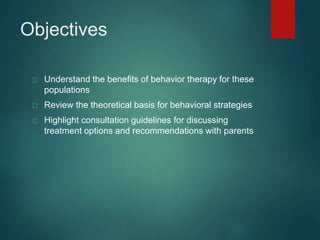
Objectives 
Understand the benefits of behavior therapy for these 
populations 
Review the theoretical basis for behavioral strategies 
Highlight consultation guidelines for discussing 
treatment options and recommendations with parents
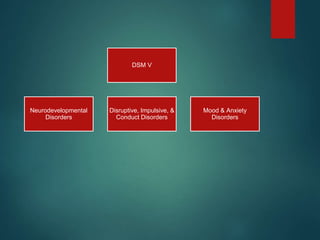
DSM V 
Neurodevelopmental 
Disorders 
Disruptive, Impulsive, & 
Conduct Disorders 
Mood & Anxiety 
Disorders
Neurodevelopmental 
Disorders including 
Autism Spectrum Disorder 
ADHD 
Communication Disorders 
Intellectual Disabilities 
Specific Learning Disorders
Disruptive, Impulse-Control, 
and Conduct Disorders 
ODD 
Intermittent Explosive Disorder 
Conduct Disorder
Mood and Anxiety Disorders
Co-occurring Disorders
Prevalence, Risk, & Course
Common Behavior 
Challenges across 
Disorders: 
Non-compliance 
Tantrums 
Aggression 
Difficulties in self regulation
Early Intervention is Critical 
Children at the greatest risk of engaging in substance 
abuse or delinquent behavior in adolescence exhibit 
ODD and CD at a young age 
Risk of later problems increased if 
Child associates with deviant peers 
Child’s parents engage in harsh and inconsistent discipline 
Child’s parents have difficulty monitoring their child’s 
activities 
Child has academic failure and poor relationships at school 
(Webster-Stratton, C., & Taylor, 
T. , 2001)
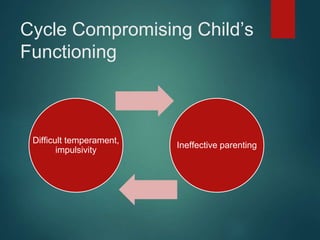
Cycle Compromising Child’s 
Functioning 
Difficult temperament, 
impulsivity 
Ineffective parenting
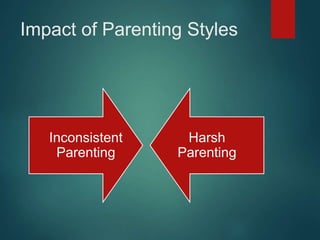
Impact of Parenting Styles 
Harsh 
Parenting 
Inconsistent 
Parenting
Parental stress & negative 
parenting 
Parents of preschool children displaying ADHD and 
ODD symptoms report higher levels of stress and 
more frequent use of negative parenting strategies 
(e.g. coercive discipline) than do other parents (Burke, 
Loeber, & Birmhaher, 2002) 
Negative parenting practices may contribute to co-occurring 
diagnoses of ADHD and ODD. May also lead 
to more severe impairment in school, social, and home 
arenas in children with ADHD and play a direct role in 
the development of ODD (McMenamy, Sheldrick, & 
Perrin, 2011).
Webster-Stratton & Taylor 
(2001) 
“…cascading domains of risk factors make it 
imperative to start prevention programs as early as 
possible in order to ‘nip problems in the bud’ before 
they create secondary school and peer risk factors and 
in order to provide adequate fertilization for building 
protective factors that guard against substance abuse 
and violent behavior.”
Challenges and adaptation 
to school 
“Key developmental issues for high-risk children at school 
entry are the control of aggressive behavior; the 
acquisition and use of prosocial skills with peers; positive 
relationships with peers, parents, and teachers; and the 
development of a positive interest in school."
Pathways to Help 
“Pediatric providers are likely to be the first health 
professionals with whom parents will discuss concerns 
regarding their preschool age children’s behaviors, and 
they're capable of playing a key role in deciding whether 
or not to take early action.” 
(Glasco & Macias,2003)
Lavigne, et al. (1993) 
Pediatricians were less likely to indicate that 
preschool-age children had an emotional or behavioral 
problem compared to psychologists who conducted 
psychological assessments of children 
Greater that 50% of preschool children who had 
emotional problems based on a psychologist’s 
evaluation did not receive counseling, medication, or 
mental health referral from their pediatrician.
Preschool parent -pediatrician 
consultations and predictive 
referral patterns for problematic 
behaviors 
(Fanton, MacDonald, and Harvey, 2008) 
In this longitudinal study, parents were asked whether 
they consulted with their pediatric providers about 
disruptive behavioral problems.
Transient vs Persistent 
Behavior Problems 
Pediatricians were able to distinguish between transient 
versus persistent behavioral problems in preschoolers. 
Providers did not over-refer at age 4. 
Parental reports of early behavioral concerns signal 
persistent behavior problems. Parents are able to 
discriminate problems that were likely to persist. 
No evidence for over-referral. Very few children with 
transient behavior problems were referred as 
preschoolers.
Problem of Under-referral 
∙Of those diagnosed with a behavior disorder at age 6, 
56% were not referred at age 4. 
∙Only 22% of children whose parents consulted with their 
pediatricians later outgrew their problems (vs 59% of 
children whose parents did not consult later improved).
Reasons for Under-referral 
Under-referring due to… 
Stigma? 
Lack of awareness of services? 
Training? 
Parents’ descriptions? 
Inadequate screening or follow up from screening?
Importance of Consultation 
“Children of parents who consulted with pediatricians 
were much more likely to ultimately receive medication 
or psychosocial treatment compared to children of 
parents who did not consult with pediatricians.”
Parents’ Perspectives
Key Terms During 
Consultation
AAP: When to involve 
specialists 
Child is younger than 5 years and problems don’t 
respond to primary care intervention 
Family is not able to maintain a safe environment 
Child’s behaviors are injurious 
Child is experiencing depression, anxiety, or severe 
dysfunction in any domain 
Problems at school are interfering with academic 
functioning or with relationships
Efficacy Studies and 
Practice Guidelines
AAP Guidance on Disruptive 
Behavior and Aggression 
Guidance from AAP-based on recommendations from 
WHO 
Evidence-Based and Evidence -Informed interventions 
for Disruptive behavior and Aggression Psychological 
interventions: 
Level 1(Best Support) 
Includes Parent Management Training
ASD 
Early intensive behavioral intervention is the only well 
established treatment for young children with ASD (Le 
Blanc & Gillis, 2012)
Parent Training & ADHD 
Meta-analysis (Lee, et al., 2012) examining effects of 
parent training on child and parental outcomes for 
children with ADHD. 
Parenting competence was the only outcome that had 
a large effect, which decreased to moderate effect size 
at follow-up 
Conclusion: Parent training in behavioral management 
is an effective intervention for children with ADHD.
AAP Care for Children 
with Disruptive Behavior 
or Aggression 
“All children manifesting disruptive or aggressive 
behaviors require intervention…” 
Engage child and family in care 
“Without engagement, most families will not seek or 
persist in care. Process may require multiple primary 
care visits”
AHRQ Review 
Effective parent programs help parents develop a 
positive relationship with their child, teach them about 
how children develop, and help them manage behavior 
with positive discipline.
Jo Ann Loper, Director of 
Parent Education @ TC 
INTRODUCTION
AAP Plan of Care 
Reinforce compliant behavior with parental attention 
“Catch them being good!” Praise and rewards for 
target behaviors 
Ignore some inappropriate behaviors 
Avoid positive reinforcement of disruptive behaviors 
Give clear commands 
Provide consistent consequences 
Consider parenting classes
Components of Effective 
Parenting Programs
Components of Parent/Child 
Training @ Tuesday’s Child
https://drive.google.com/a/tuesdayschildchicago.org/file/d/0BzAPhqzC2P2rX3NtemVYc 
3g1Wm8/edit?usp=sharing
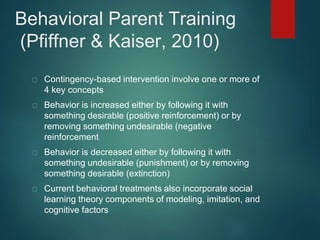
Behavioral Parent Training 
(Pfiffner & Kaiser, 2010) 
Contingency-based intervention involve one or more of 
4 key concepts 
Behavior is increased either by following it with 
something desirable (positive reinforcement) or by 
removing something undesirable (negative 
reinforcement 
Behavior is decreased either by following it with 
something undesirable (punishment) or by removing 
something desirable (extinction) 
Current behavioral treatments also incorporate social 
learning theory components of modeling, imitation, and 
cognitive factors
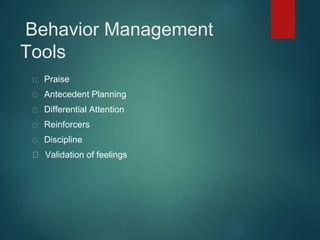
Behavior Management 
Tools 
Praise 
Antecedent Planning 
Differential Attention 
Reinforcers 
Discipline 
Validation of feelings
Techniques, Population 
Served, Peer Mentoring
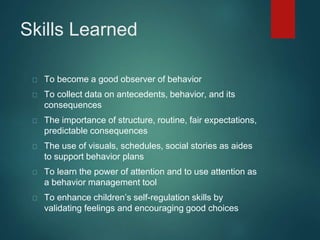
Skills Learned 
To become a good observer of behavior 
To collect data on antecedents, behavior, and its 
consequences 
The importance of structure, routine, fair expectations, 
predictable consequences 
The use of visuals, schedules, social stories as aides 
to support behavior plans 
To learn the power of attention and to use attention as 
a behavior management tool 
To enhance children’s self-regulation skills by 
validating feelings and encouraging good choices
Behavioral Intervention for ADHD, ASD, ODD and General Behavior Issues

Behavioral Intervention for ADHD, ASD, ODD and General Behavior Issues

  • 1.
    Behavioral Intervention: SupportingFamilies and Children with ADHD, ODD, ASD, and Behavior Challenges Meg Kincaid, Ph.D. Licensed Clinical Psychologist
  • 2.
    Objectives Understand thebenefits of behavior therapy for these populations Review the theoretical basis for behavioral strategies Highlight consultation guidelines for discussing treatment options and recommendations with parents
  • 3.
    DSM V Neurodevelopmental Disorders Disruptive, Impulsive, & Conduct Disorders Mood & Anxiety Disorders
  • 4.
    Neurodevelopmental Disorders including Autism Spectrum Disorder ADHD Communication Disorders Intellectual Disabilities Specific Learning Disorders
  • 5.
    Disruptive, Impulse-Control, andConduct Disorders ODD Intermittent Explosive Disorder Conduct Disorder
  • 6.
  • 7.
  • 8.
  • 9.
    Common Behavior Challengesacross Disorders: Non-compliance Tantrums Aggression Difficulties in self regulation
  • 10.
    Early Intervention isCritical Children at the greatest risk of engaging in substance abuse or delinquent behavior in adolescence exhibit ODD and CD at a young age Risk of later problems increased if Child associates with deviant peers Child’s parents engage in harsh and inconsistent discipline Child’s parents have difficulty monitoring their child’s activities Child has academic failure and poor relationships at school (Webster-Stratton, C., & Taylor, T. , 2001)
  • 11.
    Cycle Compromising Child’s Functioning Difficult temperament, impulsivity Ineffective parenting
  • 12.
    Impact of ParentingStyles Harsh Parenting Inconsistent Parenting
  • 13.
    Parental stress &negative parenting Parents of preschool children displaying ADHD and ODD symptoms report higher levels of stress and more frequent use of negative parenting strategies (e.g. coercive discipline) than do other parents (Burke, Loeber, & Birmhaher, 2002) Negative parenting practices may contribute to co-occurring diagnoses of ADHD and ODD. May also lead to more severe impairment in school, social, and home arenas in children with ADHD and play a direct role in the development of ODD (McMenamy, Sheldrick, & Perrin, 2011).
  • 14.
    Webster-Stratton & Taylor (2001) “…cascading domains of risk factors make it imperative to start prevention programs as early as possible in order to ‘nip problems in the bud’ before they create secondary school and peer risk factors and in order to provide adequate fertilization for building protective factors that guard against substance abuse and violent behavior.”
  • 15.
    Challenges and adaptation to school “Key developmental issues for high-risk children at school entry are the control of aggressive behavior; the acquisition and use of prosocial skills with peers; positive relationships with peers, parents, and teachers; and the development of a positive interest in school."
  • 16.
    Pathways to Help “Pediatric providers are likely to be the first health professionals with whom parents will discuss concerns regarding their preschool age children’s behaviors, and they're capable of playing a key role in deciding whether or not to take early action.” (Glasco & Macias,2003)
  • 17.
    Lavigne, et al.(1993) Pediatricians were less likely to indicate that preschool-age children had an emotional or behavioral problem compared to psychologists who conducted psychological assessments of children Greater that 50% of preschool children who had emotional problems based on a psychologist’s evaluation did not receive counseling, medication, or mental health referral from their pediatrician.
  • 18.
    Preschool parent -pediatrician consultations and predictive referral patterns for problematic behaviors (Fanton, MacDonald, and Harvey, 2008) In this longitudinal study, parents were asked whether they consulted with their pediatric providers about disruptive behavioral problems.
  • 19.
    Transient vs Persistent Behavior Problems Pediatricians were able to distinguish between transient versus persistent behavioral problems in preschoolers. Providers did not over-refer at age 4. Parental reports of early behavioral concerns signal persistent behavior problems. Parents are able to discriminate problems that were likely to persist. No evidence for over-referral. Very few children with transient behavior problems were referred as preschoolers.
  • 20.
    Problem of Under-referral ∙Of those diagnosed with a behavior disorder at age 6, 56% were not referred at age 4. ∙Only 22% of children whose parents consulted with their pediatricians later outgrew their problems (vs 59% of children whose parents did not consult later improved).
  • 21.
    Reasons for Under-referral Under-referring due to… Stigma? Lack of awareness of services? Training? Parents’ descriptions? Inadequate screening or follow up from screening?
  • 22.
    Importance of Consultation “Children of parents who consulted with pediatricians were much more likely to ultimately receive medication or psychosocial treatment compared to children of parents who did not consult with pediatricians.”
  • 23.
  • 24.
    Key Terms During Consultation
  • 25.
    AAP: When toinvolve specialists Child is younger than 5 years and problems don’t respond to primary care intervention Family is not able to maintain a safe environment Child’s behaviors are injurious Child is experiencing depression, anxiety, or severe dysfunction in any domain Problems at school are interfering with academic functioning or with relationships
  • 26.
    Efficacy Studies and Practice Guidelines
  • 27.
    AAP Guidance onDisruptive Behavior and Aggression Guidance from AAP-based on recommendations from WHO Evidence-Based and Evidence -Informed interventions for Disruptive behavior and Aggression Psychological interventions: Level 1(Best Support) Includes Parent Management Training
  • 28.
    ASD Early intensivebehavioral intervention is the only well established treatment for young children with ASD (Le Blanc & Gillis, 2012)
  • 29.
    Parent Training &ADHD Meta-analysis (Lee, et al., 2012) examining effects of parent training on child and parental outcomes for children with ADHD. Parenting competence was the only outcome that had a large effect, which decreased to moderate effect size at follow-up Conclusion: Parent training in behavioral management is an effective intervention for children with ADHD.
  • 30.
    AAP Care forChildren with Disruptive Behavior or Aggression “All children manifesting disruptive or aggressive behaviors require intervention…” Engage child and family in care “Without engagement, most families will not seek or persist in care. Process may require multiple primary care visits”
  • 31.
    AHRQ Review Effectiveparent programs help parents develop a positive relationship with their child, teach them about how children develop, and help them manage behavior with positive discipline.
  • 32.
    Jo Ann Loper,Director of Parent Education @ TC INTRODUCTION
  • 34.
    AAP Plan ofCare Reinforce compliant behavior with parental attention “Catch them being good!” Praise and rewards for target behaviors Ignore some inappropriate behaviors Avoid positive reinforcement of disruptive behaviors Give clear commands Provide consistent consequences Consider parenting classes
  • 35.
    Components of Effective Parenting Programs
  • 36.
    Components of Parent/Child Training @ Tuesday’s Child
  • 37.
  • 38.
    Behavioral Parent Training (Pfiffner & Kaiser, 2010) Contingency-based intervention involve one or more of 4 key concepts Behavior is increased either by following it with something desirable (positive reinforcement) or by removing something undesirable (negative reinforcement Behavior is decreased either by following it with something undesirable (punishment) or by removing something desirable (extinction) Current behavioral treatments also incorporate social learning theory components of modeling, imitation, and cognitive factors
  • 39.
    Behavior Management Tools Praise Antecedent Planning Differential Attention Reinforcers Discipline Validation of feelings
  • 40.
  • 41.
    Skills Learned Tobecome a good observer of behavior To collect data on antecedents, behavior, and its consequences The importance of structure, routine, fair expectations, predictable consequences The use of visuals, schedules, social stories as aides to support behavior plans To learn the power of attention and to use attention as a behavior management tool To enhance children’s self-regulation skills by validating feelings and encouraging good choices