Dr.P.Ravichandran,
M.Com., M.B.A., M.A (Astrology)., M.Phil., Ph.d.,
D.C.P., D.L.L & A.L., P.G.D.C.A., P.G.D.P.M & I.R.,
Associate Professor of Commerce,
Commerce Research Centre,
S.B.K.College, Aruppukottai.
e-mail id : prcapk@gmail.com
Mobile: 9443424090 & 9080030090
Excise Duty - Registration
Registration
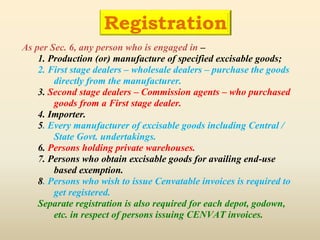
As per Sec. 6, any person who is engaged in –
1. Production (or) manufacture of specified excisable goods;
2. First stage dealers – wholesale dealers – purchase the goods
directly from the manufacturer.
3. Second stage dealers – Commission agents – who purchased
goods from a First stage dealer.
4. Importer.
5. Every manufacturer of excisable goods including Central /
State Govt. undertakings.
6. Persons holding private warehouses.
7. Persons who obtain excisable goods for availing end-use
based exemption.
8. Persons who wish to issue Cenvatable invoices is required to
get registered.
Separate registration is also required for each depot, godown,
etc. in respect of persons issuing CENVAT invoices.
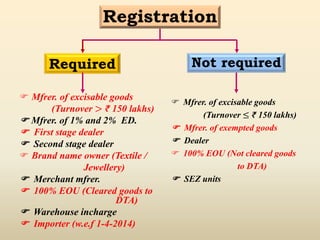
 Mfrer. of excisable goods
(Turnover > ₹ 150 lakhs)
 Mfrer. of 1% and 2% ED.
 First stage dealer
 Second stage dealer
 Brand name owner (Textile /
Jewellery)
 Merchant mfrer.
 100% EOU (Cleared goods to
DTA)
 Warehouse incharge
 Importer (w.e.f 1-4-2014)
 Mfrer. of excisable goods
(Turnover ≤ ₹ 150 lakhs)
 Mfrer. of exempted goods
 Dealer
 100% EOU (Not cleared goods
to DTA)
 SEZ units
Registration
Required Not required
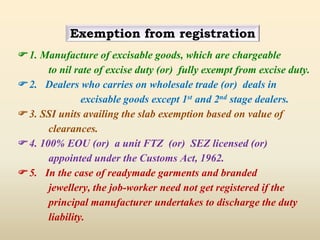
Exemption from registration
 1. Manufacture of excisable goods, which are chargeable
to nil rate of excise duty (or) fully exempt from excise duty.
 2. Dealers who carries on wholesale trade (or) deals in
excisable goods except 1st and 2nd stage dealers.
 3. SSI units availing the slab exemption based on value of
clearances.
 4. 100% EOU (or) a unit FTZ (or) SEZ licensed (or)
appointed under the Customs Act, 1962.
 5. In the case of readymade garments and branded
jewellery, the job-worker need not get registered if the
principal manufacturer undertakes to discharge the duty
liability.
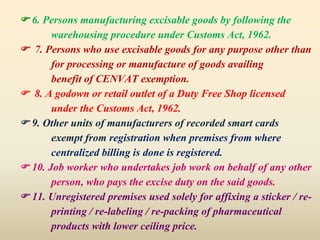
 6. Persons manufacturing excisable goods by following the
warehousing procedure under Customs Act, 1962.
 7. Persons who use excisable goods for any purpose other than
for processing or manufacture of goods availing
benefit of CENVAT exemption.
 8. A godown or retail outlet of a Duty Free Shop licensed
under the Customs Act, 1962.
 9. Other units of manufacturers of recorded smart cards
exempt from registration when premises from where
centralized billing is done is registered.
 10. Job worker who undertakes job work on behalf of any other
person, who pays the excise duty on the said goods.
 11. Unregistered premises used solely for affixing a sticker / re-
printing / re-labeling / re-packing of pharmaceutical
products with lower ceiling price.
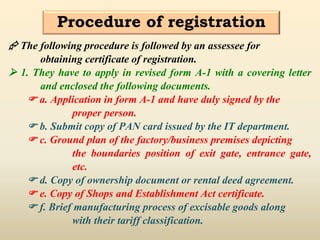
Procedure of registration
 The following procedure is followed by an assessee for
obtaining certificate of registration.
 1. They have to apply in revised form A-1 with a covering letter
and enclosed the following documents.
 a. Application in form A-1 and have duly signed by the
proper person.
 b. Submit copy of PAN card issued by the IT department.
 c. Ground plan of the factory/business premises depicting
the boundaries position of exit gate, entrance gate,
etc.
 d. Copy of ownership document or rental deed agreement.
 e. Copy of Shops and Establishment Act certificate.
 f. Brief manufacturing process of excisable goods along
with their tariff classification.
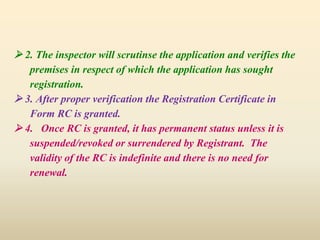
 2. The inspector will scrutinse the application and verifies the
premises in respect of which the application has sought
registration.
 3. After proper verification the Registration Certificate in
Form RC is granted.
 4. Once RC is granted, it has permanent status unless it is
suspended/revoked or surrendered by Registrant. The
validity of the RC is indefinite and there is no need for
renewal.
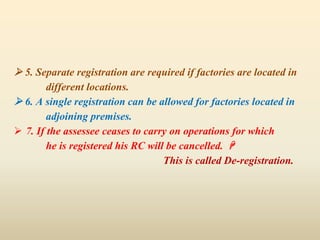
 5. Separate registration are required if factories are located in
different locations.
 6. A single registration can be allowed for factories located in
adjoining premises.
 7. If the assessee ceases to carry on operations for which
he is registered his RC will be cancelled. 
This is called De-registration.
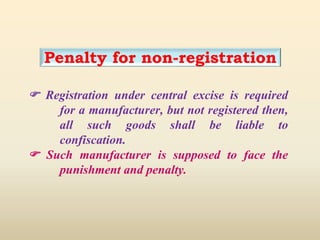
Penalty for non-registration
 Registration under central excise is required
for a manufacturer, but not registered then,
all such goods shall be liable to
confiscation.
 Such manufacturer is supposed to face the
punishment and penalty.
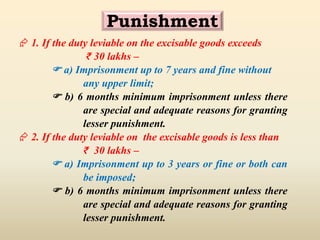
Punishment
 1. If the duty leviable on the excisable goods exceeds
₹ 30 lakhs –
 a) Imprisonment up to 7 years and fine without
any upper limit;
 b) 6 months minimum imprisonment unless there
are special and adequate reasons for granting
lesser punishment.
 2. If the duty leviable on the excisable goods is less than
₹ 30 lakhs –
 a) Imprisonment up to 3 years or fine or both can
be imposed;
 b) 6 months minimum imprisonment unless there
are special and adequate reasons for granting
lesser punishment.
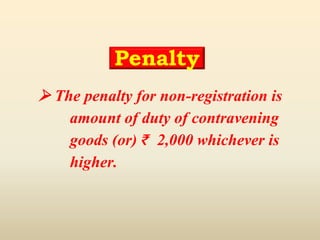
Penalty
 The penalty for non-registration is
amount of duty of contravening
goods (or) ₹ 2,000 whichever is
higher.
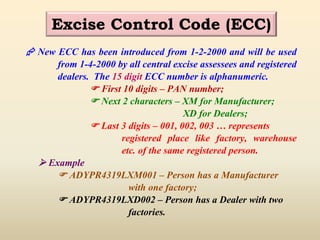
Excise Control Code (ECC)
 New ECC has been introduced from 1-2-2000 and will be used
from 1-4-2000 by all central excise assessees and registered
dealers. The 15 digit ECC number is alphanumeric.
 First 10 digits – PAN number;
 Next 2 characters – XM for Manufacturer;
XD for Dealers;
 Last 3 digits – 001, 002, 003 … represents
registered place like factory, warehouse
etc. of the same registered person.
 Example
 ADYPR4319LXM001 – Person has a Manufacturer
with one factory;
 ADYPR4319LXD002 – Person has a Dealer with two
factories.

Excise duty registration

  • 1.
    Dr.P.Ravichandran, M.Com., M.B.A., M.A(Astrology)., M.Phil., Ph.d., D.C.P., D.L.L & A.L., P.G.D.C.A., P.G.D.P.M & I.R., Associate Professor of Commerce, Commerce Research Centre, S.B.K.College, Aruppukottai. e-mail id : prcapk@gmail.com Mobile: 9443424090 & 9080030090 Excise Duty - Registration
  • 2.
    Registration As per Sec.6, any person who is engaged in – 1. Production (or) manufacture of specified excisable goods; 2. First stage dealers – wholesale dealers – purchase the goods directly from the manufacturer. 3. Second stage dealers – Commission agents – who purchased goods from a First stage dealer. 4. Importer. 5. Every manufacturer of excisable goods including Central / State Govt. undertakings. 6. Persons holding private warehouses. 7. Persons who obtain excisable goods for availing end-use based exemption. 8. Persons who wish to issue Cenvatable invoices is required to get registered. Separate registration is also required for each depot, godown, etc. in respect of persons issuing CENVAT invoices.
  • 3.
     Mfrer. ofexcisable goods (Turnover > ₹ 150 lakhs)  Mfrer. of 1% and 2% ED.  First stage dealer  Second stage dealer  Brand name owner (Textile / Jewellery)  Merchant mfrer.  100% EOU (Cleared goods to DTA)  Warehouse incharge  Importer (w.e.f 1-4-2014)  Mfrer. of excisable goods (Turnover ≤ ₹ 150 lakhs)  Mfrer. of exempted goods  Dealer  100% EOU (Not cleared goods to DTA)  SEZ units Registration Required Not required
  • 4.
    Exemption from registration 1. Manufacture of excisable goods, which are chargeable to nil rate of excise duty (or) fully exempt from excise duty.  2. Dealers who carries on wholesale trade (or) deals in excisable goods except 1st and 2nd stage dealers.  3. SSI units availing the slab exemption based on value of clearances.  4. 100% EOU (or) a unit FTZ (or) SEZ licensed (or) appointed under the Customs Act, 1962.  5. In the case of readymade garments and branded jewellery, the job-worker need not get registered if the principal manufacturer undertakes to discharge the duty liability.
  • 5.
     6. Personsmanufacturing excisable goods by following the warehousing procedure under Customs Act, 1962.  7. Persons who use excisable goods for any purpose other than for processing or manufacture of goods availing benefit of CENVAT exemption.  8. A godown or retail outlet of a Duty Free Shop licensed under the Customs Act, 1962.  9. Other units of manufacturers of recorded smart cards exempt from registration when premises from where centralized billing is done is registered.  10. Job worker who undertakes job work on behalf of any other person, who pays the excise duty on the said goods.  11. Unregistered premises used solely for affixing a sticker / re- printing / re-labeling / re-packing of pharmaceutical products with lower ceiling price.
  • 6.
    Procedure of registration The following procedure is followed by an assessee for obtaining certificate of registration.  1. They have to apply in revised form A-1 with a covering letter and enclosed the following documents.  a. Application in form A-1 and have duly signed by the proper person.  b. Submit copy of PAN card issued by the IT department.  c. Ground plan of the factory/business premises depicting the boundaries position of exit gate, entrance gate, etc.  d. Copy of ownership document or rental deed agreement.  e. Copy of Shops and Establishment Act certificate.  f. Brief manufacturing process of excisable goods along with their tariff classification.
  • 7.
     2. Theinspector will scrutinse the application and verifies the premises in respect of which the application has sought registration.  3. After proper verification the Registration Certificate in Form RC is granted.  4. Once RC is granted, it has permanent status unless it is suspended/revoked or surrendered by Registrant. The validity of the RC is indefinite and there is no need for renewal.
  • 8.
     5. Separateregistration are required if factories are located in different locations.  6. A single registration can be allowed for factories located in adjoining premises.  7. If the assessee ceases to carry on operations for which he is registered his RC will be cancelled.  This is called De-registration.
  • 9.
    Penalty for non-registration Registration under central excise is required for a manufacturer, but not registered then, all such goods shall be liable to confiscation.  Such manufacturer is supposed to face the punishment and penalty.
  • 10.
    Punishment  1. Ifthe duty leviable on the excisable goods exceeds ₹ 30 lakhs –  a) Imprisonment up to 7 years and fine without any upper limit;  b) 6 months minimum imprisonment unless there are special and adequate reasons for granting lesser punishment.  2. If the duty leviable on the excisable goods is less than ₹ 30 lakhs –  a) Imprisonment up to 3 years or fine or both can be imposed;  b) 6 months minimum imprisonment unless there are special and adequate reasons for granting lesser punishment.
  • 11.
    Penalty  The penaltyfor non-registration is amount of duty of contravening goods (or) ₹ 2,000 whichever is higher.
  • 12.
    Excise Control Code(ECC)  New ECC has been introduced from 1-2-2000 and will be used from 1-4-2000 by all central excise assessees and registered dealers. The 15 digit ECC number is alphanumeric.  First 10 digits – PAN number;  Next 2 characters – XM for Manufacturer; XD for Dealers;  Last 3 digits – 001, 002, 003 … represents registered place like factory, warehouse etc. of the same registered person.  Example  ADYPR4319LXM001 – Person has a Manufacturer with one factory;  ADYPR4319LXD002 – Person has a Dealer with two factories.