

Dr.P.Ravichandran,
M.Com., M.B.A., M.A (Astrology)., M.Phil., Ph.d.,
D.C.P., D.L.L & A.L., P.G.D.C.A., P.G.D.P.M & I.R.,
Associate Professor of Commerce,
Commerce Research Centre,
S.B.K.College, Aruppukottai.
e-mail id : prcapk@gmail.com
Mobile: 9443424090 & 9080030090
Offences & Appeals in Central Excise
Penalties, offences
and punishments
Penalties
Penalties can be imposed if –
1. Any duty of excise has not been levied or
paid;
2. Any duty of excise has been short levied or
short paid;
3. Erroneously refunded by reasons of fraud;
4. Not accounting for any excisable goods
manufactured, produced or stored;
5. Engaging in the manufacture, production or
storage of any excisable goods without registration
certificate;
6. Contravening any of the provisions of these
rules with intent to evade payment of duty.
Provisions for penalty
1. Penalty may be imposed which shall be
equal to the excise duty payable on such
goods or ` 5,000 whichever is higher.
2. Penalty equal to 50% of the duty – if
there was a fraud, suppression, willful
misstatement, but transactions were recorded
in specified records penalty will be equal to
50% of the duty.
3. Penalty equal to 25% of the duty – if the
tax payer pays such duty and interest payable
thereon within 30 days from the date of
receipt of order of the determining the duty.
Offences
Whoever commits the following offences may
punished:
1. Evades the payment of any duty payable under this
Act.
2. Removes any excisable goods in contravention of
any of the provisions of this Act.
3. Acquires or deals with any excisable goods which he
knows that the goods are liable to confiscation.
4. Contravenes any of the provisions of this Act in
relation to credit of any duty allowed.
5. Fails to supply any information which he is required
to supply or supplies false information.
6. Attempts to commit the commission of offences.
7. Fails to procure registration where it is so required.
8. Keeping goods (Tobacco) in excess of the
determined quantity.
Punishments
1. If the duty payable on excisable goods exceeds
` 1,00,000 then a minimum imprisonment of 6 months
and a maximum of 7 years may be awarded. In addition
fine shall also be imposed.
2. In other cases an imprisonment upto 3 years or a
fine or both may be imposed.
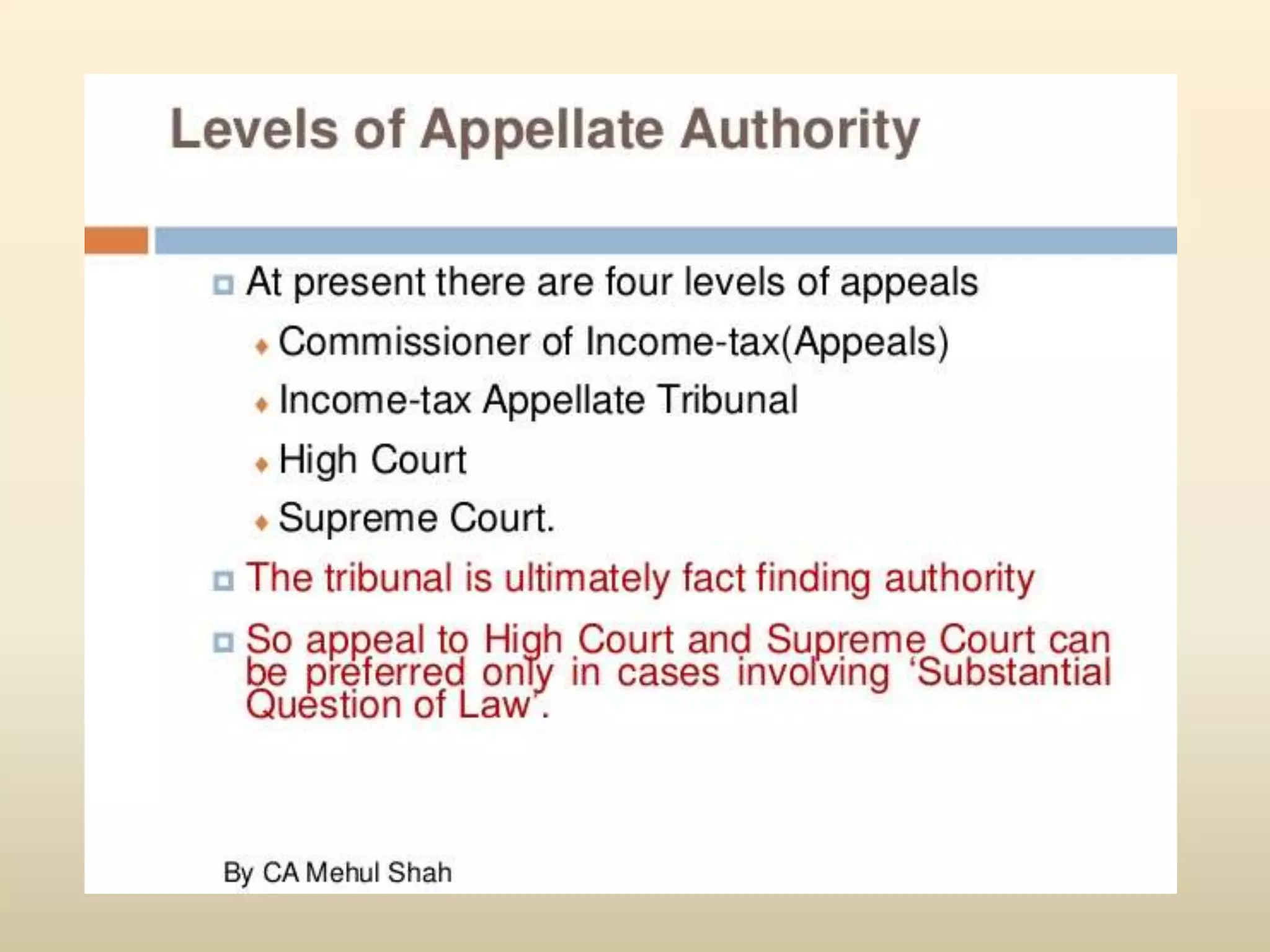
Appeals
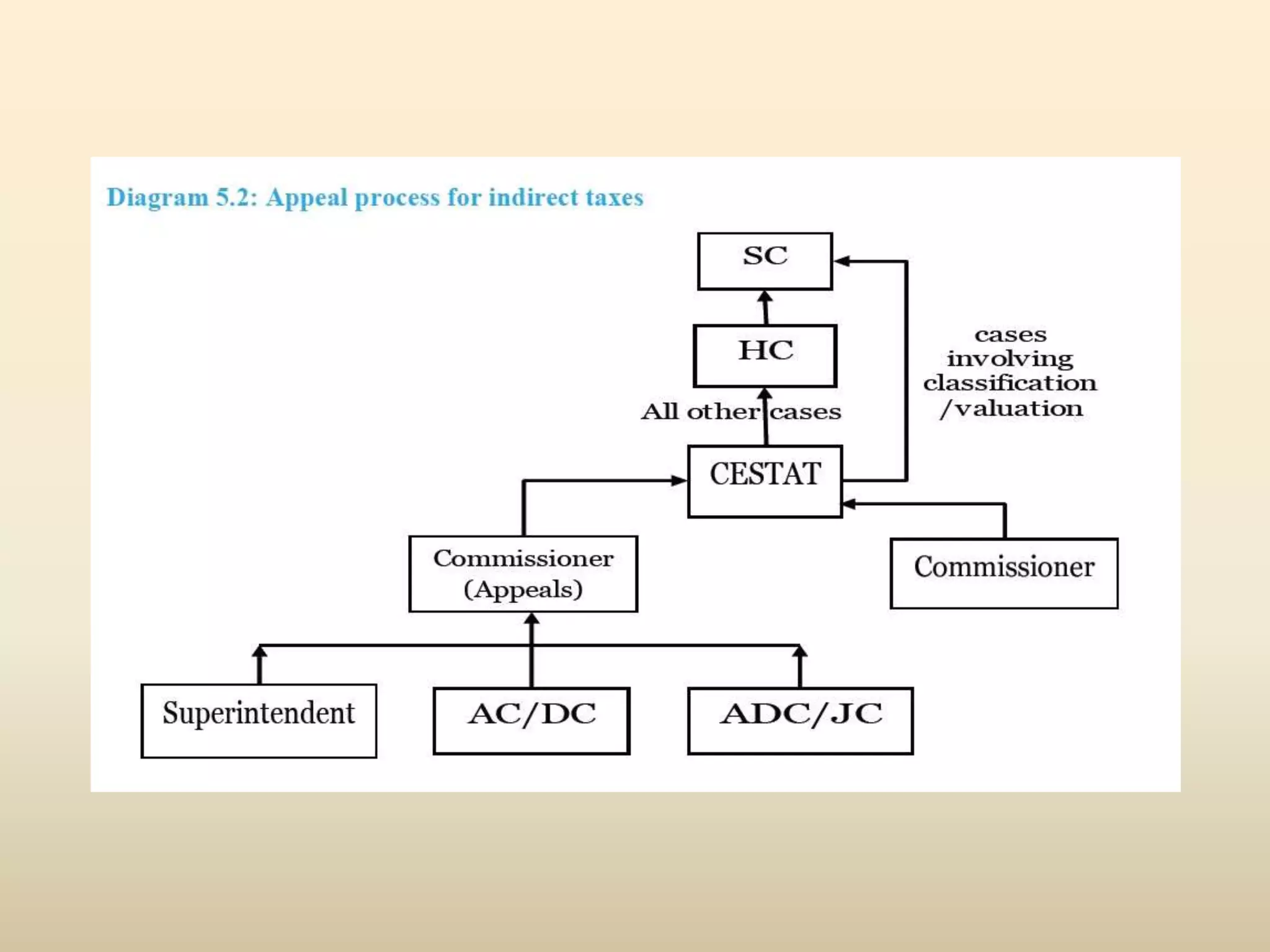
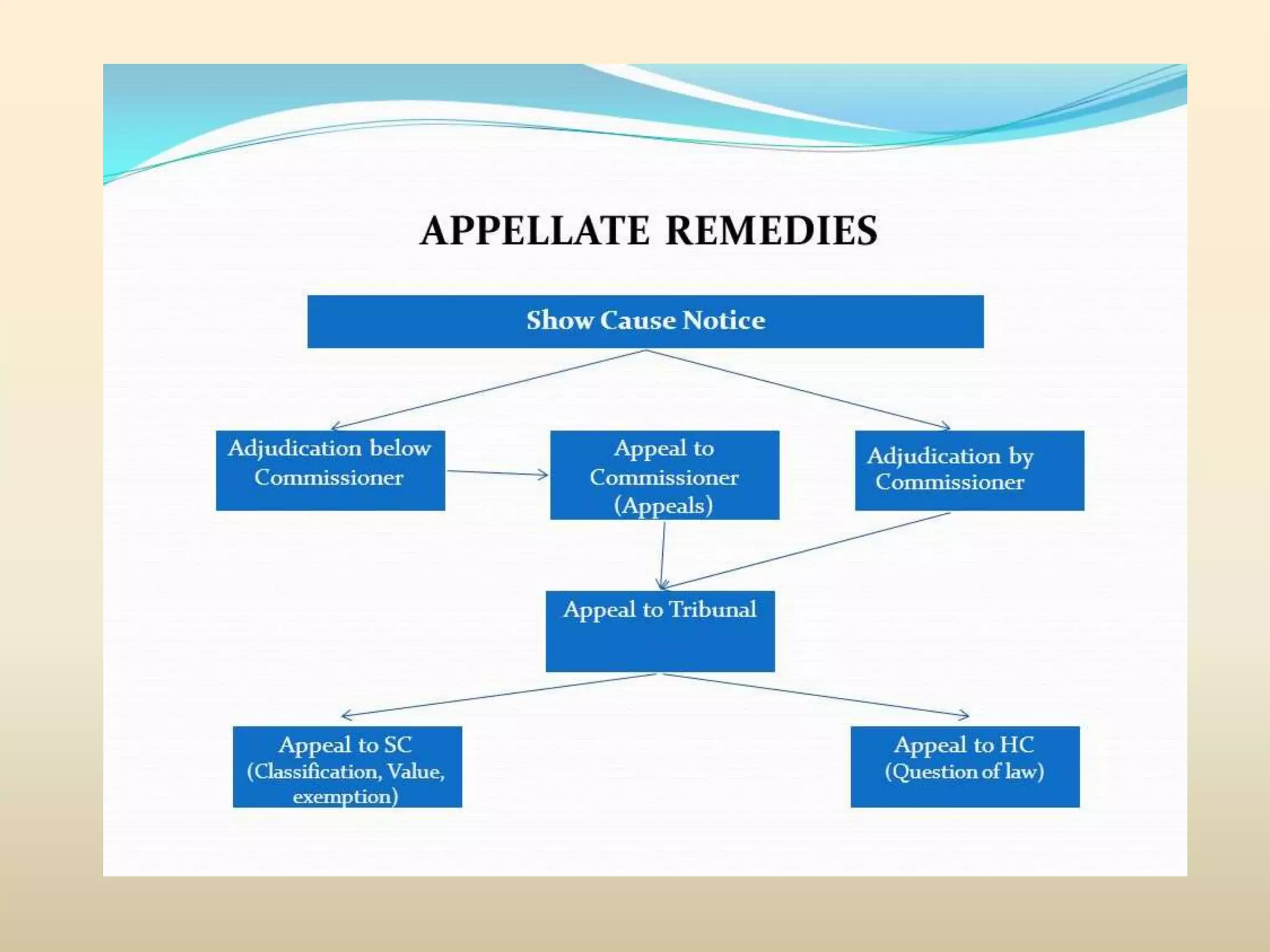
A person who is not satisfied with the
order of the Adjudicating Officer (AO)
can appeal against this order to the
following persons –
1. Commissioner (Appeals)
2. Appellate Tribunal (AT) or CESTAT
3. High Court
4. Supreme Court
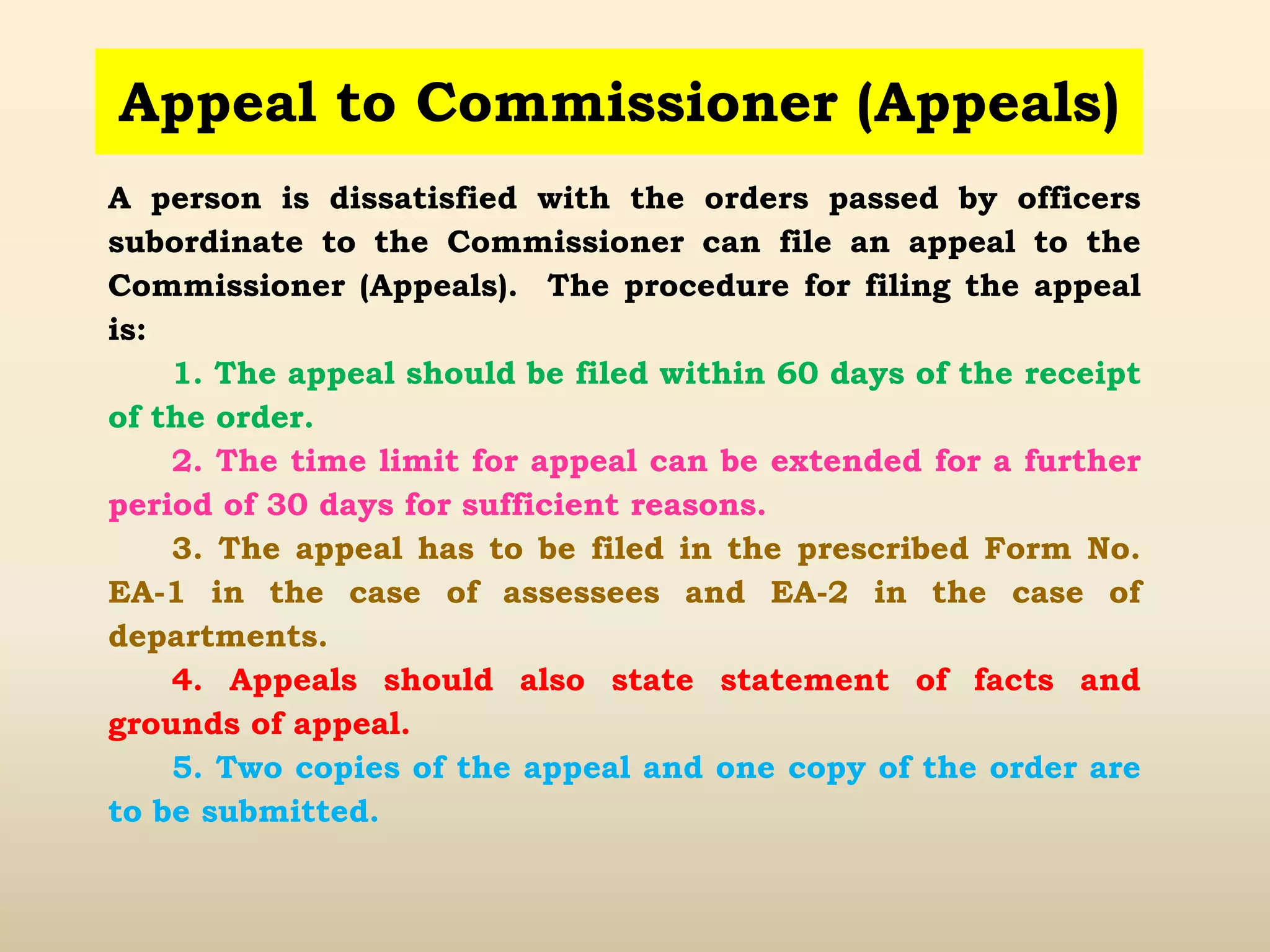
Appeal to Commissioner (Appeals)
A person is dissatisfied with the orders passed by officers
subordinate to the Commissioner can file an appeal to the
Commissioner (Appeals). The procedure for filing the appeal
is:
1. The appeal should be filed within 60 days of the receipt
of the order.
2. The time limit for appeal can be extended for a further
period of 30 days for sufficient reasons.
3. The appeal has to be filed in the prescribed Form No.
EA-1 in the case of assessees and EA-2 in the case of
departments.
4. Appeals should also state statement of facts and
grounds of appeal.
5. Two copies of the appeal and one copy of the order are
to be submitted.
Procedure to be followed by Commissioner (Appeal)
1. He shall give an opportunity to the appellant to
be heard.
2. At the hearing of an appeal, allow an appellant to
go into any ground of appeal not specified in the
grounds of appeal.
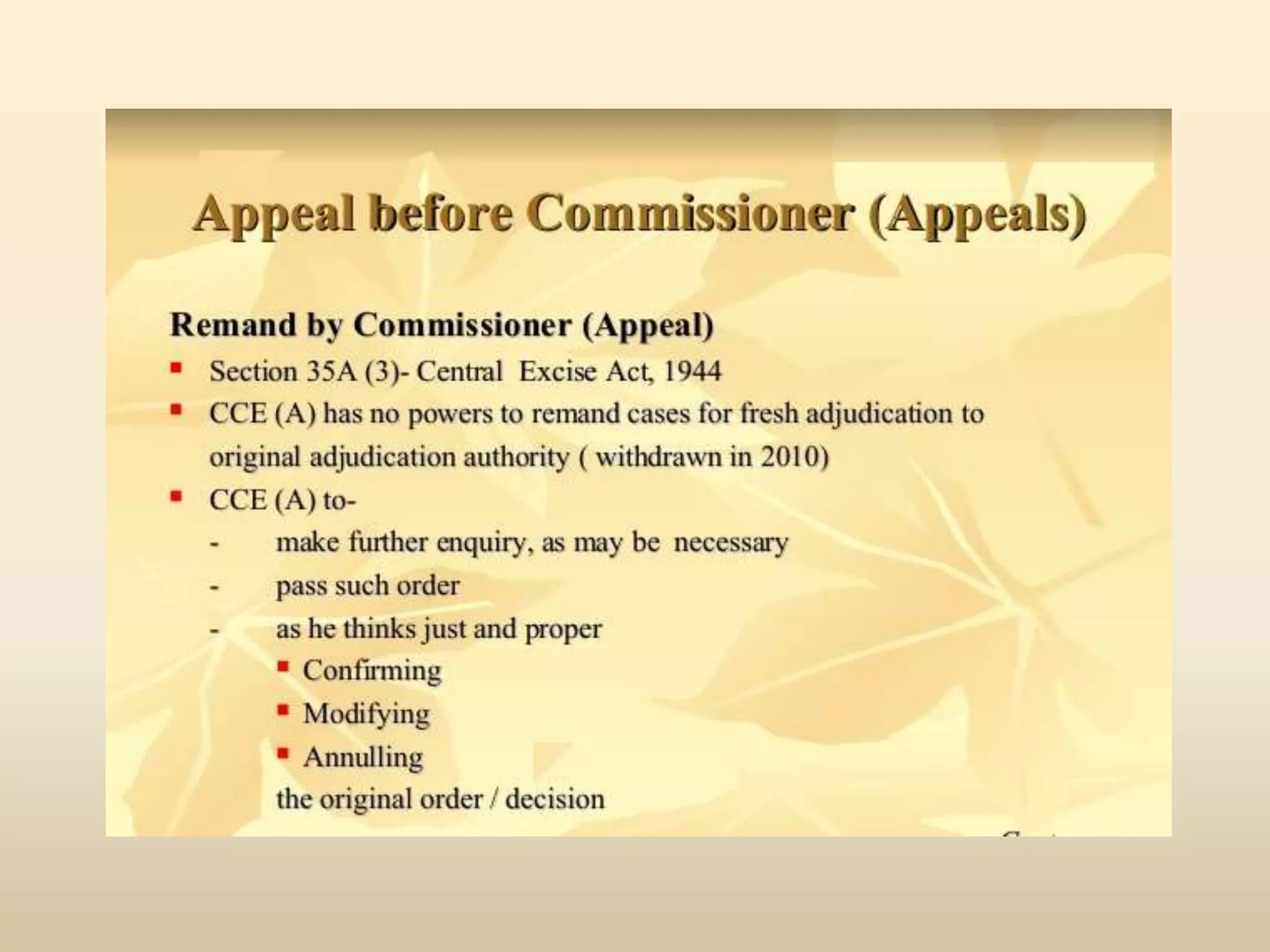
3. After making enquiry he may pass such order as
he thinks just and proper confirming or modifying the
decision.
4. All appeals should be finalized within 6 months
from the date on which it is filed.
5. The order of the appeal shall be in writing and
state the points for determination, the decision
thereon and the reasons for the decision.
6. He shall communicate the order passed by him to
the appellant, the adjudicating authority and the
Commissioner of Central Excise.
Appeals to the Appellate Tribunal / CESTAT
The Central Govt. has constituted an Appellate
Tribunal to be called the Customs, Excise and
Service Tax Appellate Tribunal (CESTAT)
consisting of as many judicial and technical
members to exercise the powers and discharge
the functions under the Act. CESTAT is final
fact finding authority.
Any person aggrieved by the order passed by
the Commissioner of Central Excise as an
adjudicating authority and Commissioner
(Appeals) may appeal to the Appellate Tribunal
(AT).
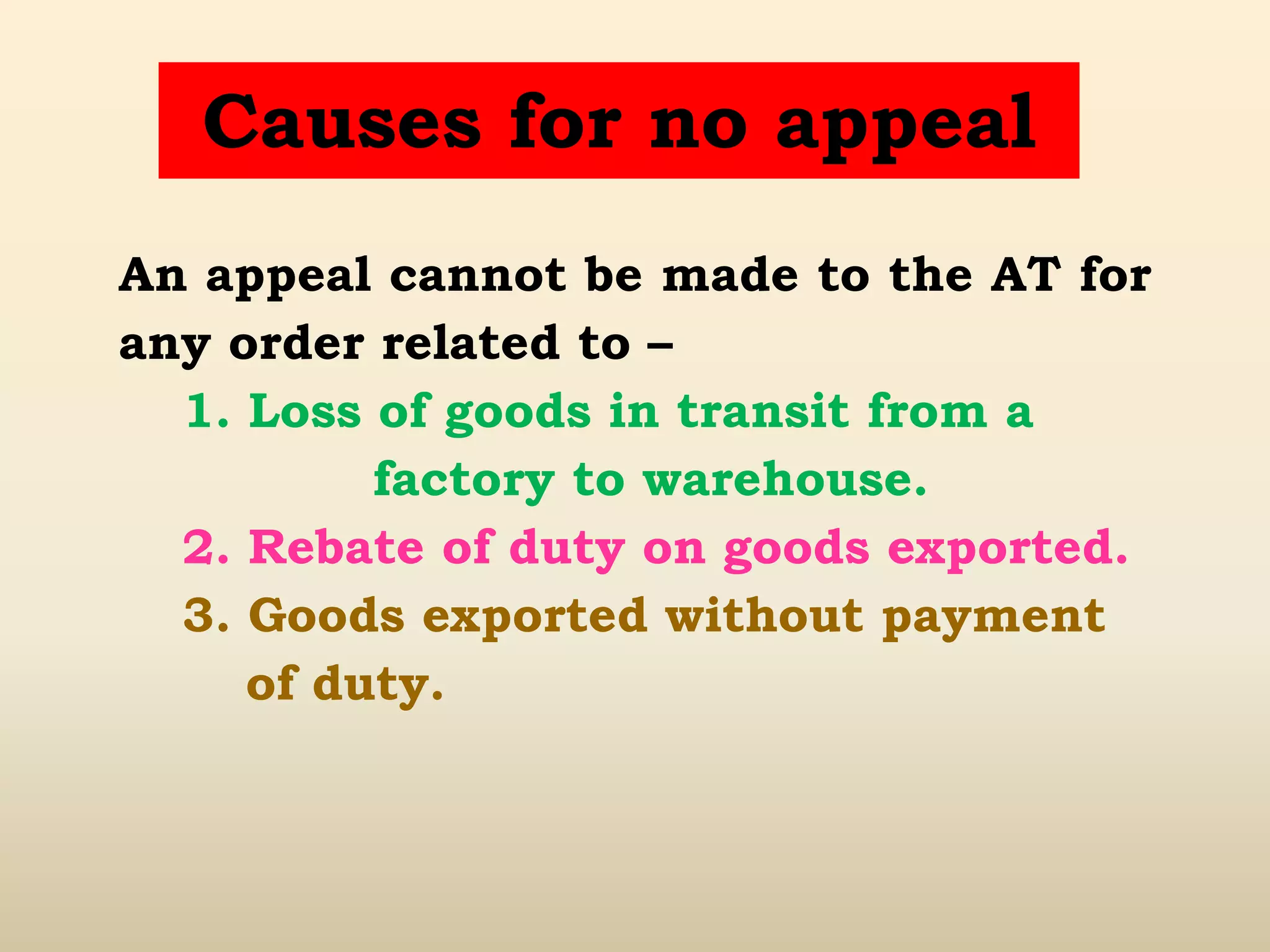
Causes for no appeal
An appeal cannot be made to the AT for
any order related to –
1. Loss of goods in transit from a
factory to warehouse.
2. Rebate of duty on goods exported.
3. Goods exported without payment
of duty.
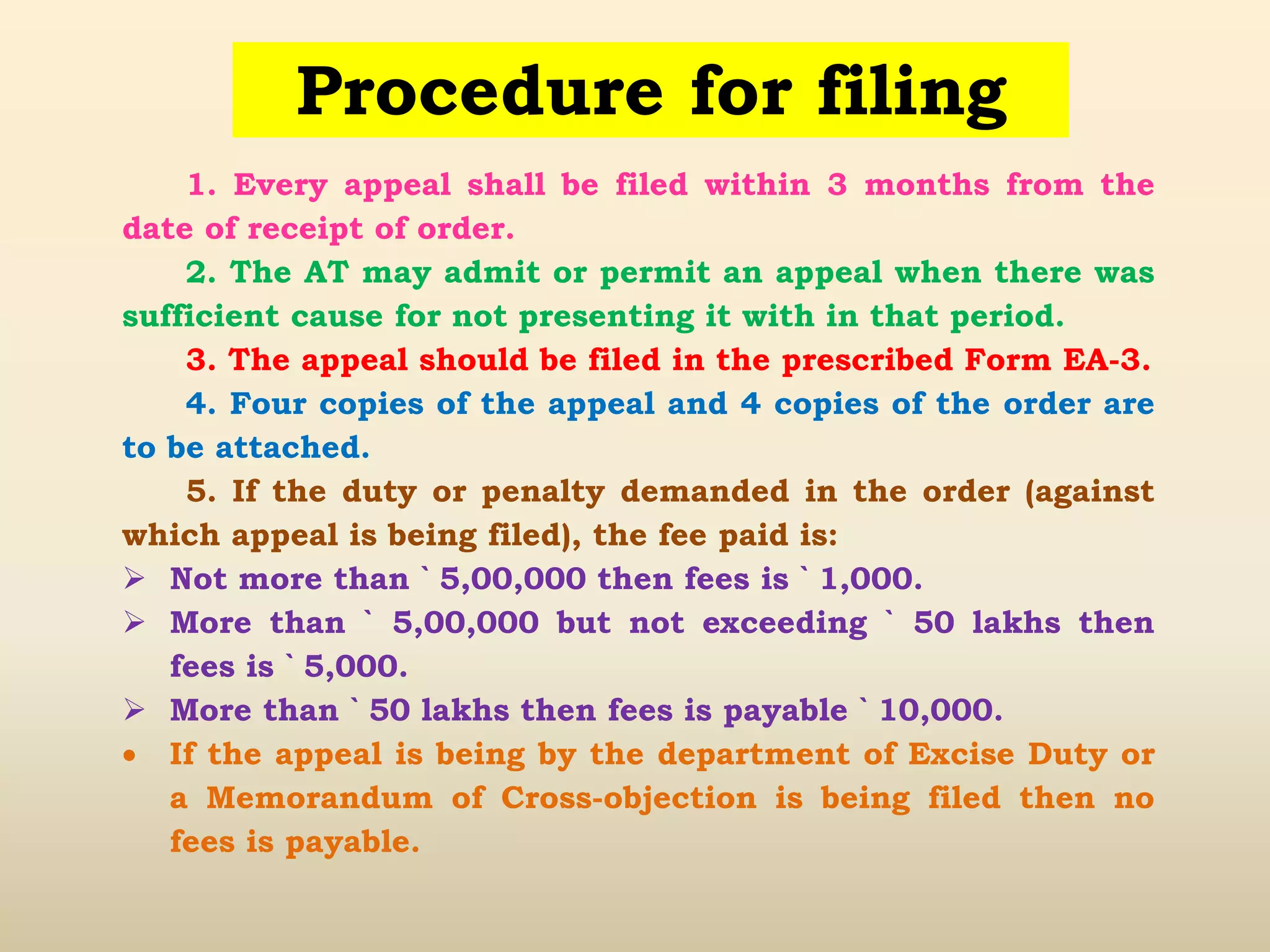
Procedure for filing
1. Every appeal shall be filed within 3 months from the
date of receipt of order.
2. The AT may admit or permit an appeal when there was
sufficient cause for not presenting it with in that period.
3. The appeal should be filed in the prescribed Form EA-3.
4. Four copies of the appeal and 4 copies of the order are
to be attached.
5. If the duty or penalty demanded in the order (against
which appeal is being filed), the fee paid is:
 Not more than ` 5,00,000 then fees is ` 1,000.
 More than ` 5,00,000 but not exceeding ` 50 lakhs then
fees is ` 5,000.
 More than ` 50 lakhs then fees is payable ` 10,000.
 If the appeal is being by the department of Excise Duty or
a Memorandum of Cross-objection is being filed then no
fees is payable.
Procedure followed by AT / CESTAT
1. CESTAT hears appeals against orders of Commissioner
(Appeals).
2. The Tribunal shall hear and decide every appeal with in a
period of 3 years.
3. If stay is granted by Tribunal for recovery, appeal shall be
decided within 180 days.
4. After being heard the AT may pass the following orders:
 Confirm the order appealed against (i.e. can reject the
appeal).
 Modify the order.
 Cancel (Annul) the order.
 Refer the case back to the Authority which passed the
order. This is called remand.
 Any other order it may deem fit.
5. The AT shall send a copy of every order passed to the
Commissioner of Central Excise and the party to the appeal.
Appeal to High Court
An appeal to the High Court involves
substantial question of law i.e. point relating
to interpretation of statute, applicability of
law etc.
An appeal can be made to High Court within
180 days from the date of order of Tribunal
received.
However, no appeal will be made to the High
Court for determining the –
a) Rate of duty of excise or service tax; and
b) Valuation or classification of the goods for
purpose of assessment.
Appeal to Supreme Court
An appeal shall made to the Supreme Court –
a) If High Court certifies it to be a fit case for appeal to
Supreme Court.
b) If High Court does not certify by Special Leave
Petition can appeal to Supreme Court.
c) Order of CESTAT relating to rate of excise duty can
make an appeal directly to the Supreme Court.
d) Appeal to the Supreme Court should be presented
within 60 days from the date the order is
communicated.
e) Once National Tax Tribunal (NTT) is made
operational, appeal against order of CESTAT can be
made only to NTT.
Conceived by
Dr. P.Ravichandran
M.COM., M.B.A., M.A(Astrology)., M.Phil., Ph.D.,
D.C.P., D.L.L & A.L., P.G.D.C.A., P.G.D.P.M & I.R.,
Associate Professor of Commerce,
Commerce Research Centre,
S.B.K.College,
Aruppukottai.
E-mail id: prcapk@gmail.com
Mobile: 9443424090 & 9080030090

Appeals in excise duty

  • 1.
    Dr.P.Ravichandran, M.Com., M.B.A., M.A(Astrology)., M.Phil., Ph.d., D.C.P., D.L.L & A.L., P.G.D.C.A., P.G.D.P.M & I.R., Associate Professor of Commerce, Commerce Research Centre, S.B.K.College, Aruppukottai. e-mail id : prcapk@gmail.com Mobile: 9443424090 & 9080030090 Offences & Appeals in Central Excise
  • 2.
  • 3.
    Penalties Penalties can beimposed if – 1. Any duty of excise has not been levied or paid; 2. Any duty of excise has been short levied or short paid; 3. Erroneously refunded by reasons of fraud; 4. Not accounting for any excisable goods manufactured, produced or stored; 5. Engaging in the manufacture, production or storage of any excisable goods without registration certificate; 6. Contravening any of the provisions of these rules with intent to evade payment of duty.
  • 4.
    Provisions for penalty 1.Penalty may be imposed which shall be equal to the excise duty payable on such goods or ` 5,000 whichever is higher. 2. Penalty equal to 50% of the duty – if there was a fraud, suppression, willful misstatement, but transactions were recorded in specified records penalty will be equal to 50% of the duty. 3. Penalty equal to 25% of the duty – if the tax payer pays such duty and interest payable thereon within 30 days from the date of receipt of order of the determining the duty.
  • 5.
    Offences Whoever commits thefollowing offences may punished: 1. Evades the payment of any duty payable under this Act. 2. Removes any excisable goods in contravention of any of the provisions of this Act. 3. Acquires or deals with any excisable goods which he knows that the goods are liable to confiscation. 4. Contravenes any of the provisions of this Act in relation to credit of any duty allowed. 5. Fails to supply any information which he is required to supply or supplies false information. 6. Attempts to commit the commission of offences. 7. Fails to procure registration where it is so required. 8. Keeping goods (Tobacco) in excess of the determined quantity.
  • 6.
    Punishments 1. If theduty payable on excisable goods exceeds ` 1,00,000 then a minimum imprisonment of 6 months and a maximum of 7 years may be awarded. In addition fine shall also be imposed. 2. In other cases an imprisonment upto 3 years or a fine or both may be imposed.
  • 13.
    Appeals A person whois not satisfied with the order of the Adjudicating Officer (AO) can appeal against this order to the following persons – 1. Commissioner (Appeals) 2. Appellate Tribunal (AT) or CESTAT 3. High Court 4. Supreme Court
  • 17.
    Appeal to Commissioner(Appeals) A person is dissatisfied with the orders passed by officers subordinate to the Commissioner can file an appeal to the Commissioner (Appeals). The procedure for filing the appeal is: 1. The appeal should be filed within 60 days of the receipt of the order. 2. The time limit for appeal can be extended for a further period of 30 days for sufficient reasons. 3. The appeal has to be filed in the prescribed Form No. EA-1 in the case of assessees and EA-2 in the case of departments. 4. Appeals should also state statement of facts and grounds of appeal. 5. Two copies of the appeal and one copy of the order are to be submitted.
  • 18.
    Procedure to befollowed by Commissioner (Appeal) 1. He shall give an opportunity to the appellant to be heard. 2. At the hearing of an appeal, allow an appellant to go into any ground of appeal not specified in the grounds of appeal. 3. After making enquiry he may pass such order as he thinks just and proper confirming or modifying the decision. 4. All appeals should be finalized within 6 months from the date on which it is filed. 5. The order of the appeal shall be in writing and state the points for determination, the decision thereon and the reasons for the decision. 6. He shall communicate the order passed by him to the appellant, the adjudicating authority and the Commissioner of Central Excise.
  • 20.
    Appeals to theAppellate Tribunal / CESTAT The Central Govt. has constituted an Appellate Tribunal to be called the Customs, Excise and Service Tax Appellate Tribunal (CESTAT) consisting of as many judicial and technical members to exercise the powers and discharge the functions under the Act. CESTAT is final fact finding authority. Any person aggrieved by the order passed by the Commissioner of Central Excise as an adjudicating authority and Commissioner (Appeals) may appeal to the Appellate Tribunal (AT).
  • 21.
    Causes for noappeal An appeal cannot be made to the AT for any order related to – 1. Loss of goods in transit from a factory to warehouse. 2. Rebate of duty on goods exported. 3. Goods exported without payment of duty.
  • 22.
    Procedure for filing 1.Every appeal shall be filed within 3 months from the date of receipt of order. 2. The AT may admit or permit an appeal when there was sufficient cause for not presenting it with in that period. 3. The appeal should be filed in the prescribed Form EA-3. 4. Four copies of the appeal and 4 copies of the order are to be attached. 5. If the duty or penalty demanded in the order (against which appeal is being filed), the fee paid is:  Not more than ` 5,00,000 then fees is ` 1,000.  More than ` 5,00,000 but not exceeding ` 50 lakhs then fees is ` 5,000.  More than ` 50 lakhs then fees is payable ` 10,000.  If the appeal is being by the department of Excise Duty or a Memorandum of Cross-objection is being filed then no fees is payable.
  • 23.
    Procedure followed byAT / CESTAT 1. CESTAT hears appeals against orders of Commissioner (Appeals). 2. The Tribunal shall hear and decide every appeal with in a period of 3 years. 3. If stay is granted by Tribunal for recovery, appeal shall be decided within 180 days. 4. After being heard the AT may pass the following orders:  Confirm the order appealed against (i.e. can reject the appeal).  Modify the order.  Cancel (Annul) the order.  Refer the case back to the Authority which passed the order. This is called remand.  Any other order it may deem fit. 5. The AT shall send a copy of every order passed to the Commissioner of Central Excise and the party to the appeal.
  • 25.
    Appeal to HighCourt An appeal to the High Court involves substantial question of law i.e. point relating to interpretation of statute, applicability of law etc. An appeal can be made to High Court within 180 days from the date of order of Tribunal received. However, no appeal will be made to the High Court for determining the – a) Rate of duty of excise or service tax; and b) Valuation or classification of the goods for purpose of assessment.
  • 27.
    Appeal to SupremeCourt An appeal shall made to the Supreme Court – a) If High Court certifies it to be a fit case for appeal to Supreme Court. b) If High Court does not certify by Special Leave Petition can appeal to Supreme Court. c) Order of CESTAT relating to rate of excise duty can make an appeal directly to the Supreme Court. d) Appeal to the Supreme Court should be presented within 60 days from the date the order is communicated. e) Once National Tax Tribunal (NTT) is made operational, appeal against order of CESTAT can be made only to NTT.
  • 28.
    Conceived by Dr. P.Ravichandran M.COM.,M.B.A., M.A(Astrology)., M.Phil., Ph.D., D.C.P., D.L.L & A.L., P.G.D.C.A., P.G.D.P.M & I.R., Associate Professor of Commerce, Commerce Research Centre, S.B.K.College, Aruppukottai. E-mail id: prcapk@gmail.com Mobile: 9443424090 & 9080030090