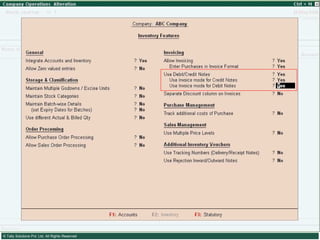
Excise for Maunfacturer in Tally.ERP 9 Presentation by Ateeq,TIPL Chennai (Apr – 2009).
Excise Duty or Duty on Excise is a tax on goods manufactured or produced in India and intended for domestic consumption i.e. sale in India. The Excise Duty is payable at the time of production or manufacture, however, for administrative convenience duty is paid at the time of removal of goods. Excise Duty
Excise Duty is an indirect tax.  The liability of payment of Excise Duty is of manufacturers or producers (which is passed on to the ultimate consumer).  The levy and collection of duty of Excise is provided under authority of the Central Excise Act, 1944 at the rates specified Central Excise Tariff Act, 1985. Excise Duty
Scope and Applicability Excise Duty can be levied, only on the fulfilment of the below mentioned conditions… The Duty is on Goods. The Goods must be excisable. The goods must be manufactured or produced. Manufacture and Production must be in India.
Manufacturer Manufacturer is a person who actually manufactures or produces excisable goods, i.e. one that actually brings into existence new and identifiable product.
Excisable Goods Excisable Goods means goods specified in the schedule to the Central Excise Tariff Act, 1985 as being subject to a duty of Excise. The Basic requirements to be satisfied are  : Goods must be movable. Goods must be marketable i.e. the goods must be such that it is known in the market and is capable of being bought or sold.
Types of Excise Duties 1.  Basic Excise Duty : This is the duty charged under section 3 of the Central Excises and Salt Act,1944 on all excisable goods other than salt which are produced or manufactured in India. Basic Excise Duty [also known as Central Value Added Tax (CENVAT)] is levied at the rates specified in Central Excise Tariff Act. 2.  Special Excise Duty : As per the Section 37 of the Finance Act,1978 Special excise Duty was attracted on all excisable goods on which there is a levy of Basic excise Duty under the Central Excises and Salt Act,1944. Special Excise Duty is levied at the rates specified in the Second Schedule to Central Excise Tariff Act, 1985.
Types of Excise Duties 3.Education Cess on Excise Duty : Section 93 of Finance (No. 2) Act, 2004 states that education Cess is 'duty of excise', to be calculated on aggregate of all duties of excise including special excise duty or any other duty of excise, but excluding education Cess on excisable goods.
4.  Excise duty in case of clearances by EOU : The EOU units are expected to export all their production. However, if they clear their final product in DTA (domestic tariff area), the rate of excise duty will be equal to customs duty on like article if imported in India. 5.  National Calamity contingent Duty (NCCD) :  A 'National Calamity Contingent Duty' (NCCD) has been imposed vide section 136 of Finance Act, 2001 [clause 129 of Finance Bill, 2001, w.e.f. 1.3.2001]. This duty is imposed on pan masala, chewing tobacco and cigarettes. Types of Excise Duties…
6.  Duties under other Acts : Some duties and cesses are levied on manufactured products under other Acts. The administrative machinery of central excise is used to collect those taxes. Provisions of Central Excise Act and Rules have been made applicable for levy and collection of these duties / cesses. Types of Excise Duties…
Types of Excise Duties… 7.  Additional Duty on goods of special importance   - Some goods of special importance are levied Additional Excise under Additional Duties of Excise (Goods of Special Importance) Act, 1957.  The 'Additional Duty' is in addition to excise duty. This scheme was introduced based on the suggestion made by the manufacturers to Government, that multiple level taxes and duties should be avoided. Levy and collection of all taxes at one stage by single authority will be con- venient for payment and administration. Hence, by agreement between Central and State Governments, it was decided to make a beginning in 1957, by selecting some items where additional duty will be collected instead of sales tax and such additional duty will be distributed among various States.
Types of Excise Duties… 8.  Duty on Medical and Toilet preparations : A duty of excise is imposed on medical preparations under Medical and Toilet Preparations (Excise Duties) Act, 1955. 9.  Additional duty on mineral products   - Additional duty on mineral products (like motor spirit, kerosene, diesel and furnace oil) is payable under Mineral Products (Additional Duties of Excise and Customs) Act, 1958. 10. Additional Customs Duty commonly known as countervailing Duty (CVD) :  Countervailing duty (CVD) is imposed on the Imports.
Types of Excise Duties… 11. Special Additional Duty of Customs (Special CVD) :  Special CVD is being imposed on items bound under the Information Technology Agreement (except information technology software), and also on specified inputs/raw materials for manufacture of electronics/IT goods. 12.  Additional Duties of Excise (Textiles and Textile  Articles) [AED (TTA)] 13.  Additional Duty of Excise (Tea and Tea Waste) [AED (TTW)] 14.  Secondary Higher Education Cess
Valuation Methods Value of the excisable goods has to be necessarily determined to levy the duty on the goods.  Under the Central Excise Act, 1944, the following methods of valuation of goods are considered for the assessment of Duty…
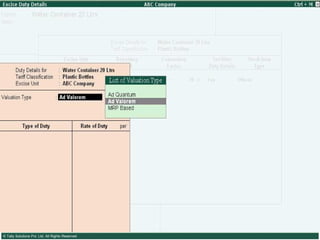
Valuation Methods    1.  Ad valorem /  Transaction Value : Transaction value means the value of goods which are sold at the time and place of removal and includes in addition to the amount charged as price, any amount that the buyer is liable to pay to, including any amount charged for, or to make provision for, advertising or publicity, marketing and selling, organization expenses, storage, outward handling, servicing, warranty, commission or any other matter.
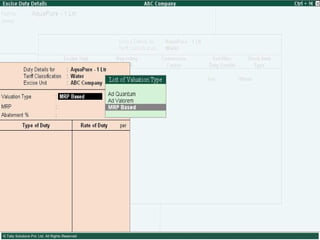
Valuation Methods      2.  Ad Quantum :  In case of Ad Quantum the duty is payable on the basis of certain unit Like Weight, Length, volume etc. For Example : Duty on cigarette is payable on the basis of length of the cigarette, duty on Sugar is based on per Kg.
Valuation Methods      3. Value determined on the basis of M R P :   Retail sale price means the maximum price at which the excisable goods in packaged form may be sold to the ultimate consumer and includes all taxes local or otherwise, freight, transport charges, commission payable to dealers, and all charges towards advertisement, delivery, packing, forwarding and the like, as the case may be, and the price is the sole consideration for such sale.
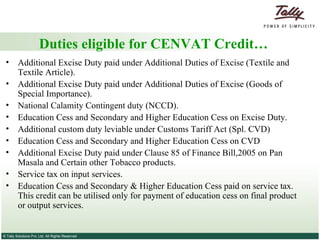
Duties eligible for CENVAT Credit… A manufacturer or producer of final product is allowed to take CENVAT credit of duties specified in the Cenvat Credit Rules, 2002. The duties specified under Cenvat Credit Rules, 2002 are: Basic Excise Duty on inputs specified in the First Schedule to Central Excise tariff Act (corresponding CVD on imported goods is allowable). Special Excise Duty on goods specified in the Second Schedule to the Tariff Act (corresponding CVD on imported goods is allowable).
Duties eligible for CENVAT Credit… Additional Excise Duty paid under Additional Duties of Excise (Textile and Textile Article). Additional Excise Duty paid under Additional Duties of Excise (Goods of Special Importance). National Calamity Contingent duty (NCCD). Education Cess and Secondary and Higher Education Cess on Excise Duty. Additional custom duty leviable under Customs Tariff Act (Spl. CVD) Education Cess and Secondary and Higher Education Cess on CVD Additional Excise Duty paid under Clause 85 of Finance Bill,2005 on Pan Masala and Certain other Tobacco products. Service tax on input services. Education Cess and Secondary & Higher Education Cess paid on service tax. This credit can be utilised only for payment of education cess on final product or output services.
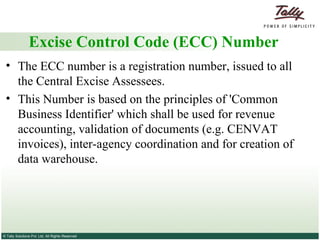
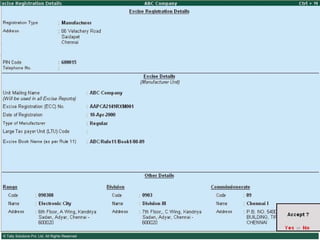
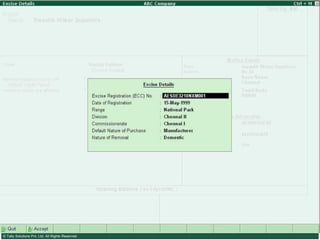
Excise Control Code (ECC) Number The ECC number is a registration number, issued to all the Central Excise Assessees.  This Number is based on the principles of 'Common Business Identifier' which shall be used for revenue accounting, validation of documents (e.g. CENVAT invoices), inter-agency coordination and for creation of data warehouse.
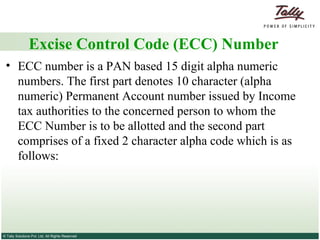
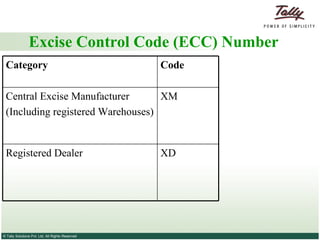
Excise Control Code (ECC) Number ECC number is a PAN based 15 digit alpha numeric numbers. The first part denotes 10 character (alpha numeric) Permanent Account number issued by Income tax authorities to the concerned person to whom the ECC Number is to be allotted and the second part comprises of a fixed 2 character alpha code which is as follows:
Excise Control Code (ECC) Number XD Registered Dealer XM Central Excise Manufacturer (Including registered Warehouses) Code  Category
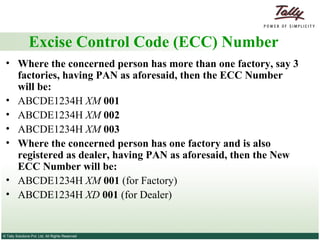
Excise Control Code (ECC) Number Where the concerned person has more than one factory, say 3 factories, having PAN as aforesaid, then the ECC Number will be: ABCDE1234H  XM  001 ABCDE1234H  XM  002 ABCDE1234H  XM  003 Where the concerned person has one factory and is also registered as dealer, having PAN as aforesaid, then the New ECC Number will be: ABCDE1234H  XM  001  (for Factory) ABCDE1234H  XD  001  (for Dealer)
Central Excise Invoice System An invoice is the document under cover of which the excisable goods are to be cleared by the manufacturer.  This is also the document which indicates the assessment of the goods to duty. No excisable goods can be cleared except under an invoice.
Removals only on invoice Rule 11 of the Central Excise (No.2) Rules, 2001 provides that no excisable goods shall be removed from a factory or a warehouse except under an invoice signed by the owner of the factory or his authorised agent.
Serially numbered invoice The invoice shall be serially numbered and shall contain the registration number, description, classification, time and date of removal, rate of duty, quantity and value, of goods and the duty payable thereon. The serial number shall commence from 1st April every year [beginning of a financial year]. The serial number can be given at the time of printing or by using franking machine. But  when the invoice book is authenticated in the manner specified in sub-rule (5) of rule 11, each leaf should contain serial number. Hand written serial number shall not be accepted.
Serially numbered invoice In case of computer-generated invoice, the serial number may be allowed to be generated and printed by computer at the time of preparation of invoice ONLY IF the software is such that computer automatically generates the number and same number cannot be generated more than once. For this purpose, the Central Excise Officers may check the system/software from time to time.
Number of Invoice copies The invoice shall be prepared in triplicate: The original copy being marked as  Original For Buyer The duplicate copy being marked as  Duplicate For Transporter The triplicate copy being marked as  Triplicate For Assessee The above requirement is mainly for Central Excise purposes. However, the assessee may make more than three copies for his other requirements. But such copies shall be prominently marked  Not For Cenvat Purposes .
Number of Invoice book The rule 11of the Central Excise (No.2) Rules, 2001 provides that only one invoice book shall be in use at a time, unless otherwise allowed by the Deputy/Assistant Commissioner of Central Excise in the special facts and circumstances of each case. The Board has decided that where assessee requires two different invoice books for the purposes of removals for home-consumption, and removals for export they may do so by intimating the jurisdictional Deputy/Assistant Commissioner of Central Excise.
Number of Invoice book Wherever, an assessee is allowed to keep more than one invoice book, he should be asked to keep different numerical serial numbers for the different sets. In case of running stationary used in computers, the bound book shall not be insisted upon provided the stationary is pre-printed with distinctive names and marks of the assessee. After the invoices are prepared, the triplicate copy shall be retained in bound-book form. Where invoices are to be typed written, the leafs have to be first taken out from the book for typing. In such cases also the triplicate copy shall be retained in bound-book form.
Authentication of Invoices The rule provides that owner or working partner or Managing Director or Company Secretary shall authenticate each foil of the invoice book, before being brought into use. However, in order to facilitate the trade it has been decided that any person duly authorised in this regard by the Company, owner or working partner may also authenticate invoices. Copy of the letter of authority should be submitted to the Range office.
Intimation of serial numbers Before making use of the invoice book, the serial numbers of the same shall be intimated to the Superintendent of Central Excise having jurisdiction over the factory of the assessee. This can be done in writing by post/e-mail/fax/hand delivery or any other similar means.
Rounding off of duty in invoice The amount of duty being shown in invoices issued under rule 11 of the Central Excise (No.2) Rules, 2001 be rounded off to the nearest rupee as provided for under Section 37D of the Central Excise Act, 1944 and the duty amount so rounded off should be indicated both in words as well as in figures.
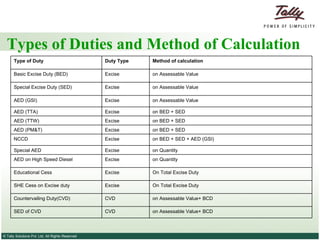
Types of Duties and Method of Calculation on Assessable Value+ BCD  CVD  SED of CVD  on Assessable Value+ BCD  CVD  Countervailing Duty(CVD)  On Total Excise Duty  Excise  SHE Cess on Excise duty  On Total Excise Duty  Excise  Educational Cess  on Quantity  Excise  AED on High Speed Diesel  on Quantity  Excise  Special AED  on BED + SED + AED (GSI)  Excise  NCCD  on BED + SED  Excise  AED (PM&T)  on BED + SED  Excise  AED (TTW)  on BED + SED  Excise  AED (TTA)  on Assessable Value  Excise  AED (GSI)  on Assessable Value  Excise  Special Excise Duty (SED)  on Assessable Value  Excise  Basic Excise Duty (BED)  Method of calculation  Duty Type  Type of Duty
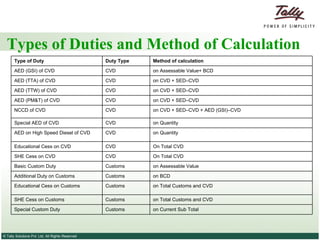
Types of Duties and Method of Calculation on Current Sub Total  Customs  Special Custom Duty  on Total Customs and CVD  Customs  SHE Cess on Customs  on Total Customs and CVD  Customs  Educational Cess on Customs  on BCD  Customs  Additional Duty on Customs  on Assessable Value  Customs  Basic Custom Duty  On Total CVD  CVD  SHE Cess on CVD  On Total CVD  CVD  Educational Cess on CVD  on Quantity  CVD  AED on High Speed Diesel of CVD  on Quantity  CVD  Special AED of CVD  on CVD + SED–CVD + AED (GSI)–CVD  CVD  NCCD of CVD  on CVD + SED–CVD  CVD  AED (PM&T) of CVD  on CVD + SED–CVD  CVD  AED (TTW) of CVD  on CVD + SED–CVD  CVD  AED (TTA) of CVD  on Assessable Value+ BCD  CVD  AED (GSI) of CVD  Method of calculation  Duty Type  Type of Duty
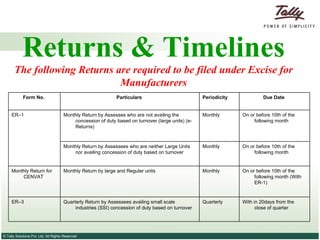
Returns & Timelines The following Returns are required to be filed under Excise for Manufacturers With in 20days from the close of quarter  Quarterly  Quarterly Return by Assessees availing small scale industries (SSI) concession of duty based on turnover  ER–3  On or before 10th of the following month (With ER-1)  Monthly  Monthly Return by large and Regular units  Monthly Return for CENVAT  On or before 10th of the following month  Monthly  Monthly Return by Assessees who are neither Large Units nor availing concession of duty based on turnover    On or before 10th of the following month  Monthly  Monthly Return by Assesses who are not availing the concession of duty based on turnover (large units) (e-Returns)  ER–1  Due Date  Periodicity  Particulars  Form No.
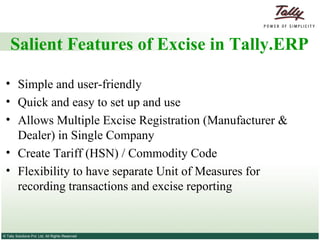
Salient Features of Excise in Tally.ERP  Simple and user-friendly  Quick and easy to set up and use  Allows Multiple Excise Registration (Manufacturer & Dealer) in Single Company  Create Tariff (HSN) / Commodity Code  Flexibility to have separate Unit of Measures for  recording transactions and excise reporting
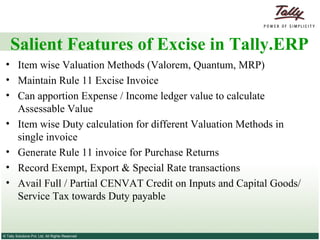
Salient Features of Excise in Tally.ERP  Item wise Valuation Methods (Valorem, Quantum, MRP)  Maintain Rule 11 Excise Invoice  Can apportion Expense / Income ledger value to calculate Assessable Value  Item wise Duty calculation for different Valuation Methods in single invoice  Generate Rule 11 invoice for Purchase Returns  Record Exempt, Export & Special Rate transactions  Avail Full / Partial CENVAT Credit on Inputs and Capital Goods/ Service Tax towards Duty payable
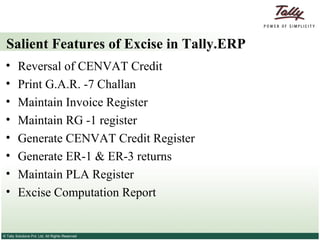
Salient Features of Excise in Tally.ERP   Reversal of CENVAT Credit  Print G.A.R. -7 Challan  Maintain Invoice Register  Maintain RG -1 register  Generate CENVAT Credit Register  Generate ER-1 & ER-3 returns  Maintain PLA Register  Excise Computation Report
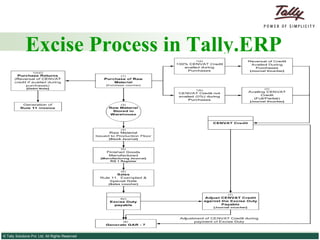
Excise Process in Tally.ERP
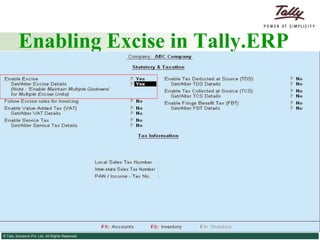
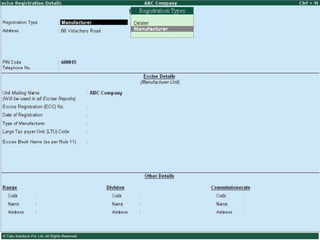
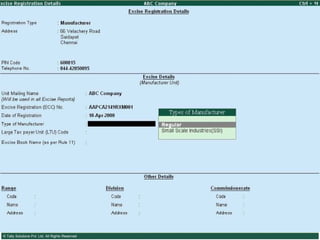
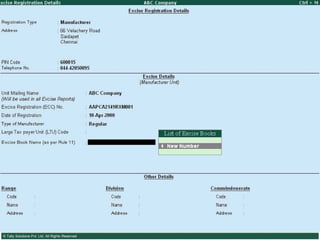
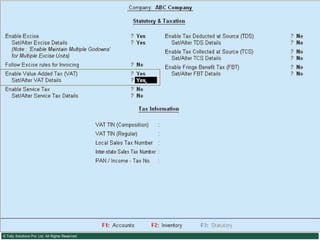
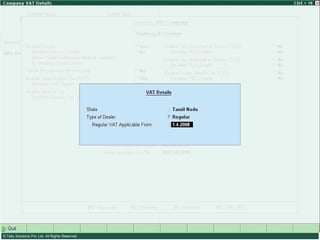
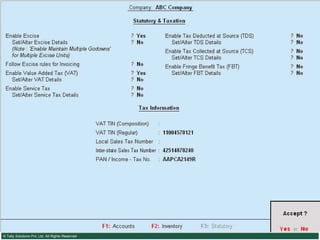
Enabling Excise in Tally.ERP Lesson 1: Enabling Excise in Tally.ERP


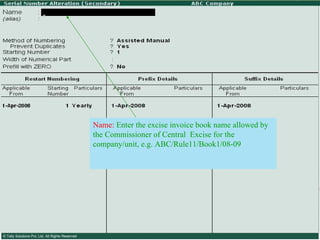
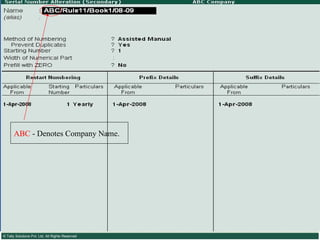
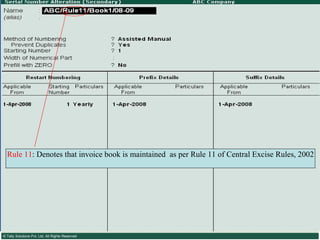
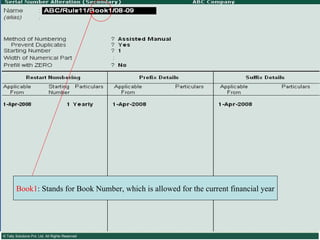
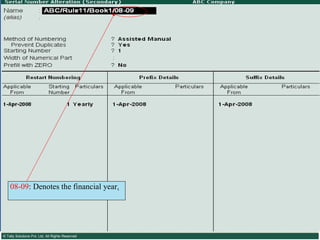
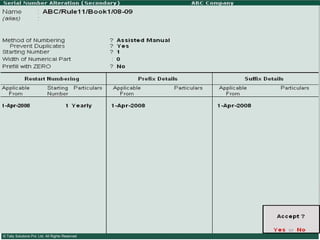
Name:  Enter the excise invoice book name allowed by the Commissioner of Central  Excise for the company/unit, e.g. ABC/Rule11/Book1/08-09
ABC  - Denotes Company Name.
Rule 11 : Denotes that invoice book is maintained  as per Rule 11 of Central Excise Rules, 2002
Book1 : Stands for Book Number, which is allowed for the current financial year
08-09 : Denotes the financial year. 


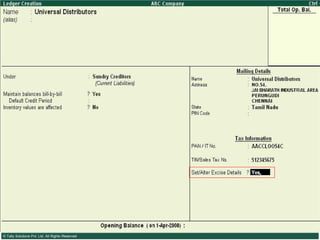
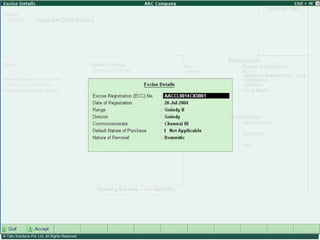
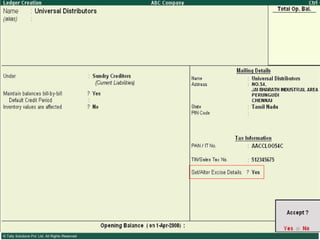
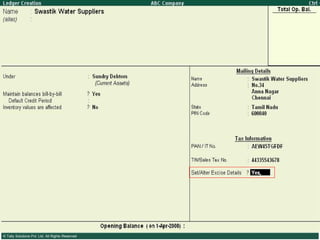
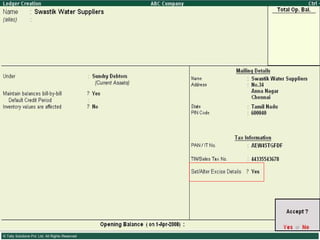
Creating Ledgers… 1. Creating a  Supplier   Ledger


Creating Ledgers… 1 Creating a Supplier   Ledger 2  Creating a  Customer   Ledger


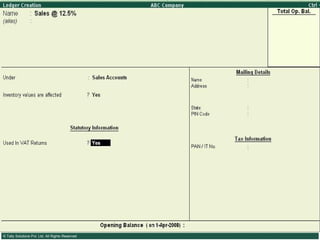
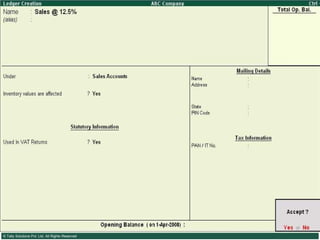
Creating Ledgers… 1 Creating a Supplier   Ledger 2  Creating a Customer   Ledger 3   Creating a  Sales  Ledger


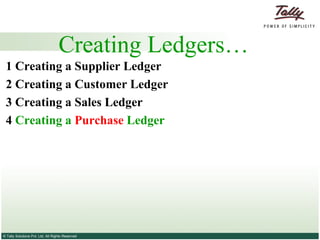
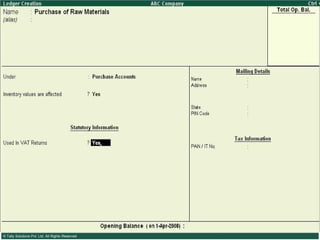
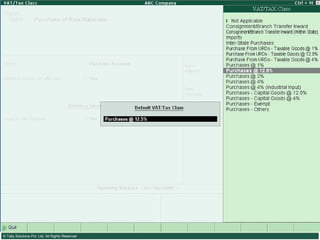
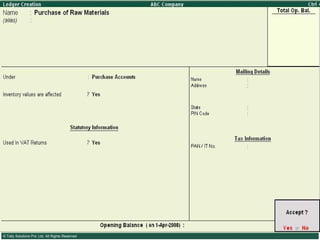
Creating Ledgers… 1 Creating a Supplier   Ledger 2  Creating a Customer   Ledger 3   Creating a Sales Ledger   4   Creating a  Purchase  Ledger


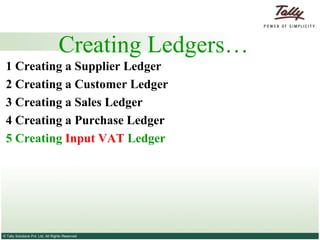
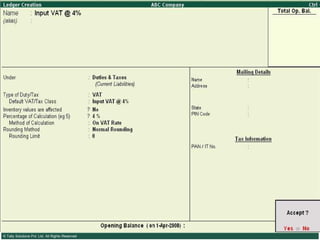
Creating Ledgers… 1 Creating a Supplier   Ledger 2  Creating a Customer   Ledger 3   Creating a Sales Ledger   4   Creating a Purchase Ledger   5 Creating  Input VAT  Ledger
 
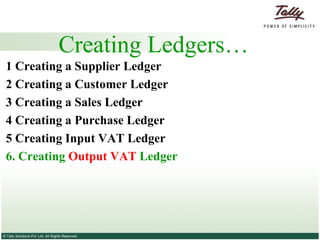
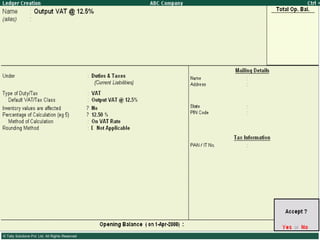
Creating Ledgers… 1 Creating a Supplier   Ledger 2  Creating a Customer   Ledger 3   Creating a Sales Ledger   4   Creating a Purchase Ledger   5 Creating Input VAT Ledger 6. Creating  Output VAT  Ledger
 
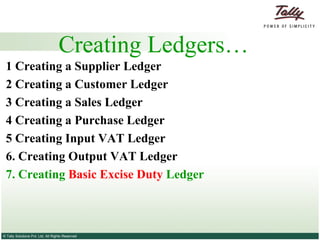
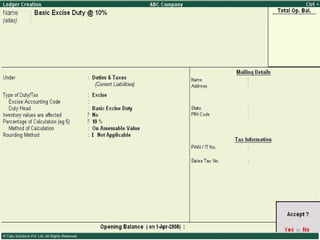
Creating Ledgers… 1 Creating a Supplier   Ledger 2  Creating a Customer   Ledger 3   Creating a Sales Ledger   4   Creating a Purchase Ledger   5 Creating Input VAT Ledger 6. Creating Output VAT Ledger 7. Creating  Basic Excise Duty  Ledger
 
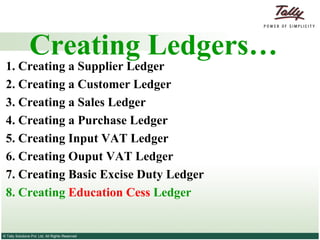
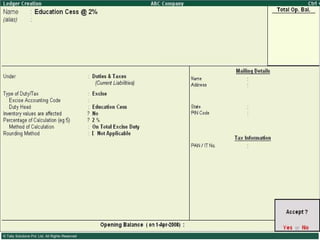
Creating Ledgers… 1. Creating a Supplier   Ledger 2.  Creating a Customer   Ledger 3.   Creating a Sales Ledger   4.   Creating a Purchase Ledger   5. Creating Input VAT Ledger 6. Creating Ouput VAT Ledger 7. Creating Basic Excise Duty Ledger 8. Creating  Education Cess  Ledger
 
 
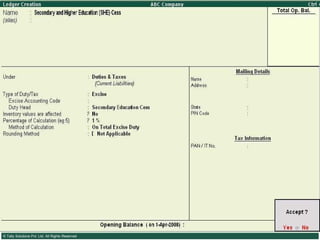
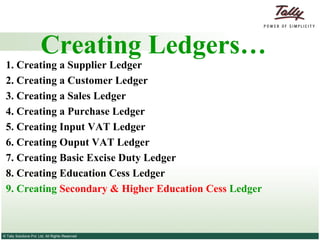
Creating Ledgers… 1. Creating a Supplier   Ledger 2.  Creating a Customer   Ledger 3.   Creating a Sales Ledger   4.   Creating a Purchase Ledger   5. Creating Input VAT Ledger 6. Creating Ouput VAT Ledger 7. Creating Basic Excise Duty Ledger 8. Creating Education Cess Ledger 9. Creating  Secondary & Higher Education Cess  Ledger
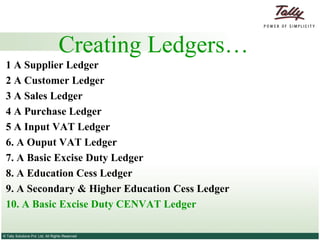
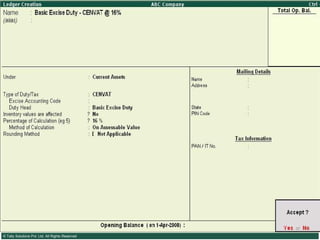
Creating Ledgers… 1 A Supplier   Ledger 2 A  Customer   Ledger 3   A Sales Ledger   4   A Purchase Ledger   5 A Input VAT Ledger 6. A Ouput VAT Ledger 7. A Basic Excise Duty Ledger 8. A Education Cess Ledger 9. A Secondary & Higher Education Cess Ledger 10. A Basic Excise Duty CENVAT Ledger
 
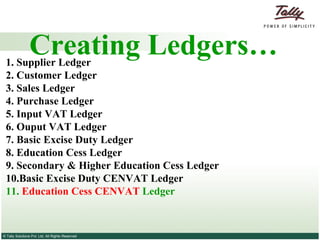
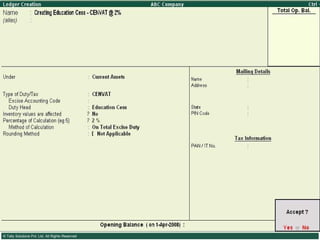
Creating Ledgers… 1. Supplier   Ledger 2.  Customer   Ledger 3.   Sales Ledger   4.   Purchase Ledger   5. Input VAT Ledger 6. Ouput VAT Ledger 7. Basic Excise Duty Ledger 8. Education Cess Ledger 9. Secondary & Higher Education Cess Ledger 10.Basic Excise Duty CENVAT Ledger 11.  Education Cess CENVAT  Ledger
 
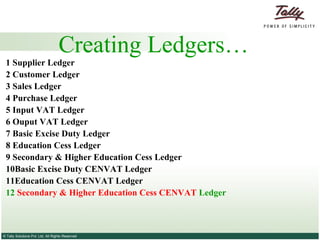
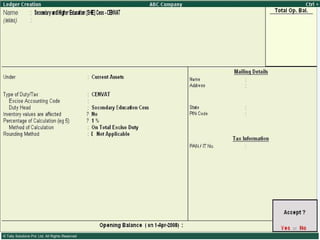
Creating Ledgers… 1 Supplier   Ledger 2  Customer   Ledger 3   Sales Ledger   4   Purchase Ledger   5 Input VAT Ledger 6 Ouput VAT Ledger 7 Basic Excise Duty Ledger 8 Education Cess Ledger 9 Secondary & Higher Education Cess Ledger 10Basic Excise Duty CENVAT Ledger 11Education Cess CENVAT Ledger 12  Secondary & Higher Education Cess CENVAT  Ledger
 
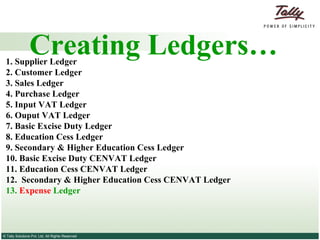
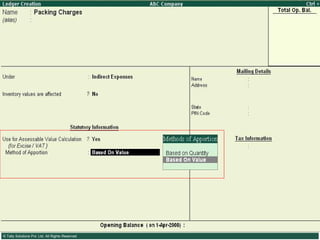
Creating Ledgers… 1. Supplier   Ledger 2.  Customer   Ledger 3.   Sales Ledger   4.   Purchase Ledger   5. Input VAT Ledger 6. Ouput VAT Ledger 7. Basic Excise Duty Ledger 8. Education Cess Ledger 9. Secondary & Higher Education Cess Ledger 10. Basic Excise Duty CENVAT Ledger 11. Education Cess CENVAT Ledger 12.  Secondary & Higher Education Cess CENVAT Ledger  13.  Expense  Ledger
 
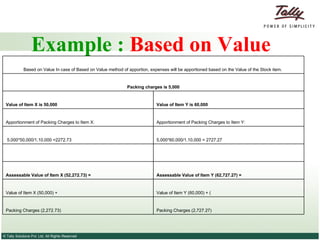
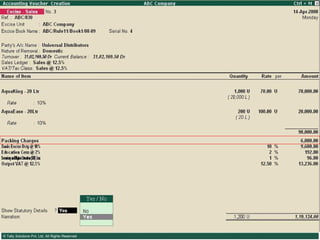
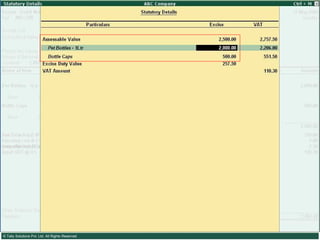
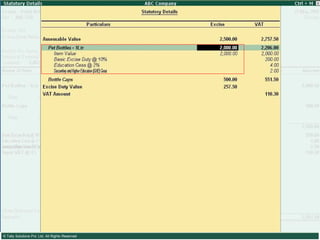
Example :  Based on Value   Packing Charges (2,727.27) Packing Charges (2,272.73)  Value of Item Y (60,000) + ( Value of Item X (50,000) + Assessable Value of Item Y (62,727.27) = Assessable Value of Item X (52,272.73) =      5,000*60,000/1,10,000 = 2727.27  5,000*50,000/1,10,000 =2272.73 Apportionment of Packing Charges to Item Y: Apportionment of Packing Charges to Item X: Value of Item Y is 60,000  Value of Item X is 50,000 Packing charges is 5,000 Based on Value In case of Based on Value method of apportion, expenses will be apportioned based on the Value of the Stock item.
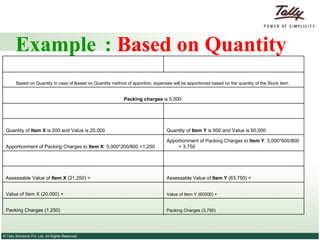
Example  :  Based on Quantity   Packing Charges (3,750)  Packing Charges (1,250)  Value of Item Y (60000) + Value of Item X (20,000) + Assessable Value of  Item Y  (63,750) =  Assessable Value of  Item X  (21,250) =      Apportionment of Packing Charges to  Item Y : 5,000*600/800 = 3,750  Apportionment of Packing Charges to  Item X : 5,000*200/800 =1,250  Quantity of  Item Y  is 600 and Value is 60,000  Quantity of  Item X  is 200 and Value is 20,000      Packing charges  is 5,000  Based on Quantity In case of Based on Quantity method of apportion, expenses will be apportioned based on the quantity of the Stock item.   
Creating Excise Voucher Types… 1. Excise  Purchase Voucher  Type
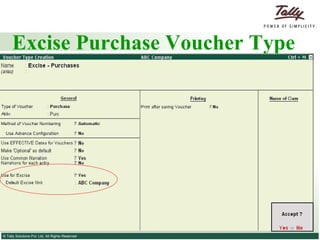
Excise Purchase Voucher Type
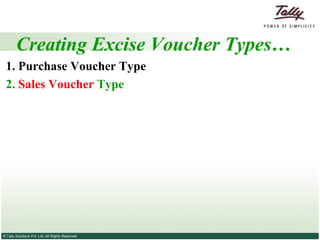
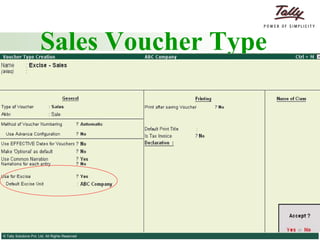
Creating Excise Voucher Types… 1. Purchase Voucher Type 2.  Sales Voucher  Type
Sales Voucher Type
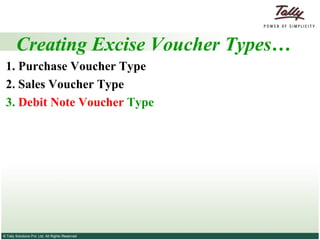
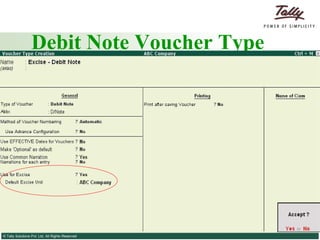
Creating Excise Voucher Types… 1. Purchase Voucher Type 2. Sales Voucher Type 3.  Debit Note Voucher  Type
Debit Note Voucher Type
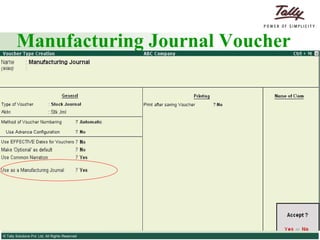
Manufacturing Journal Voucher  Manufacturing Journal  is used to account…     the  issue of raw materials  to production floor and    for the  receipt of finished goods .
Manufacturing Journal Voucher
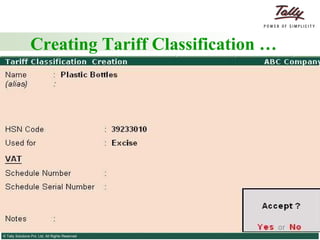
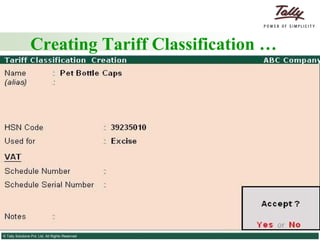
Creating Tariff Classification  … Each and every goods manufactured or produced have to be classified for finding out the rate of duty applicable. Accordingly, Central Excise Tariff Act 1985 classifies all the goods under 91 chapters and specific code is assigned to each item.  This code is called  Tariff Classification code ,  which consists of  8 digits .  First 4 digits  represent Chapter and heading a Next 2 digit  represents sub-heading and  The last 2 digit  represents sub-sub heading.
HSN CODE The  Harmonized Commodity Description and Coding System  (HS)  of tariff nomenclature popularly known as  Harmonised System of Nomenclature (HSN) ,  is an internationally standardized system of names and numbers for classifying traded products developed and maintained by the World Customs Organization.
Creating Tariff Classification … 1. Plastic Bottles
Creating Tariff Classification …
Creating Tariff Classification … 1. Plastic Bottles 2. Plastic Bottle Caps
Creating Tariff Classification …
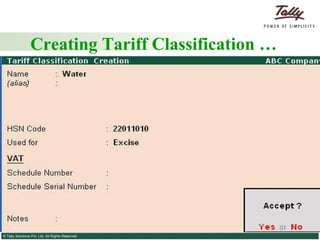
Creating Tariff Classification … 1. Plastic Bottles 2. Plastic Bottle Caps 3. Water
Creating Tariff Classification …
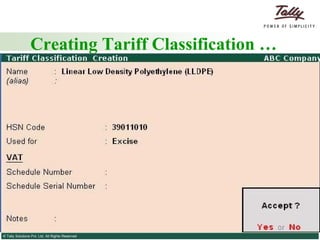
Creating Tariff Classification … 1. Plastic Bottles 2. Plastic Bottle Caps 3. Water 4. Linear Low Density Polyethylene (LLDPE)
Creating Tariff Classification …
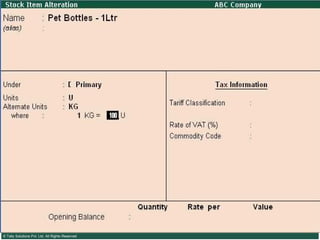
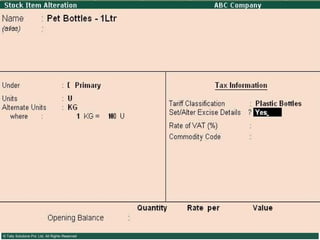
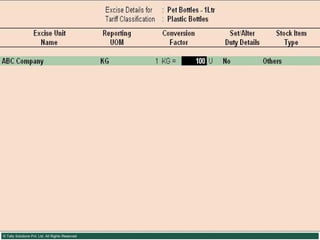
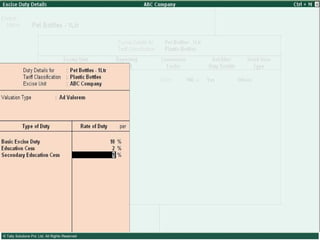
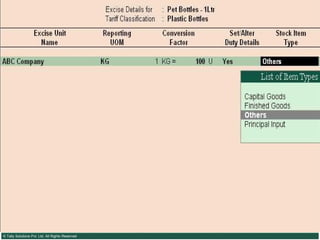
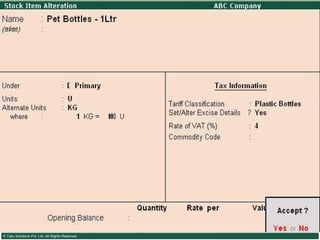
Creating Stock Item - Raw materials  1. Pet Bottles - 1Ltr


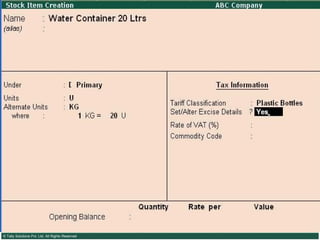
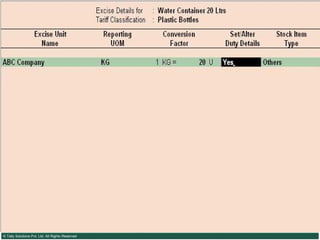
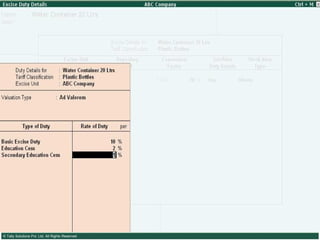
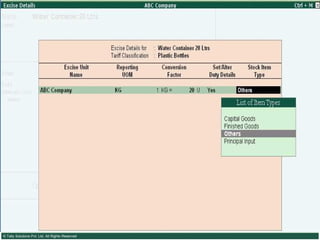
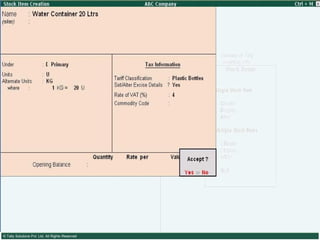
Creating Stock Item - Raw materials  1. Pet Bottles - 1Ltr  2. Water Container 20 Ltrs


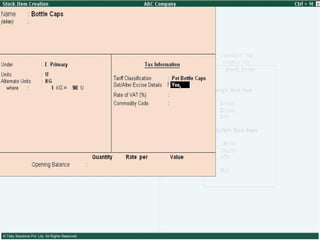
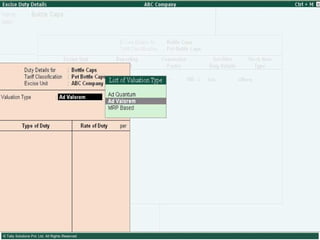
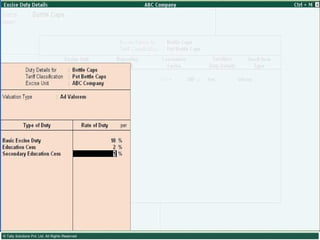
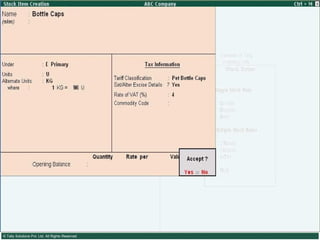
Creating Stock Item - Raw materials  1. Pet Bottles - 1Ltr   2. Water Container 20 Ltrs 3. Bottle Caps


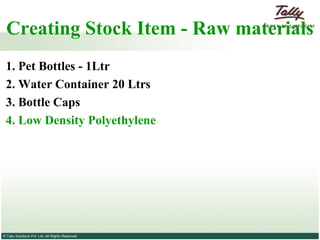
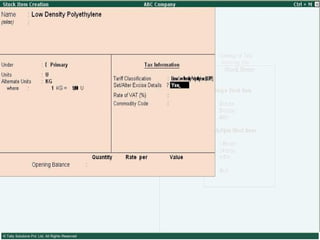
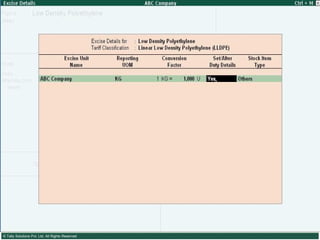
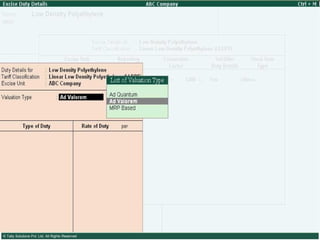
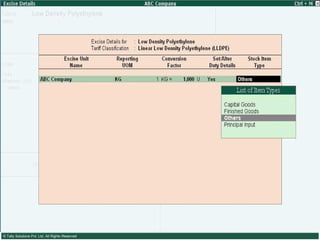
Creating Stock Item - Raw materials  1. Pet Bottles - 1Ltr   2. Water Container 20 Ltrs 3. Bottle Caps 4. Low Density Polyethylene


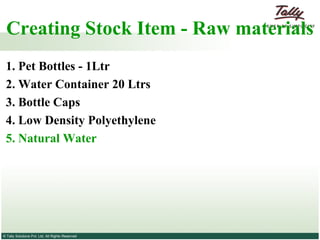
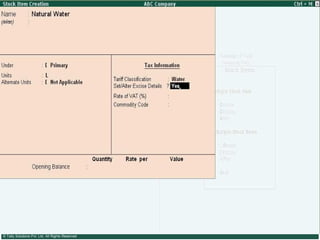
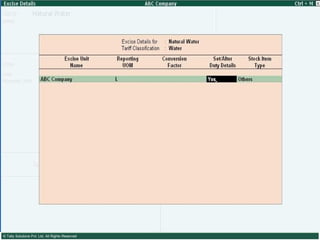
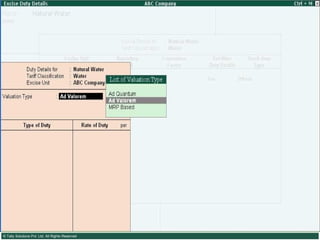
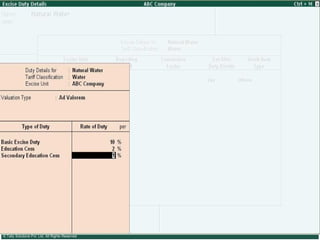
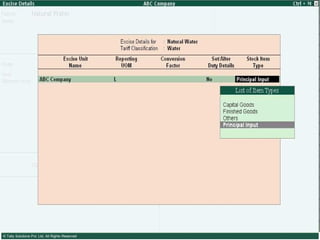
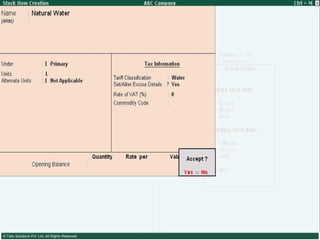
Creating Stock Item - Raw materials  1. Pet Bottles - 1Ltr   2. Water Container 20 Ltrs 3. Bottle Caps 4. Low Density Polyethylene  5. Natural Water


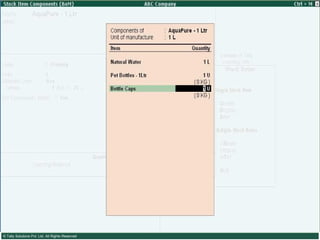
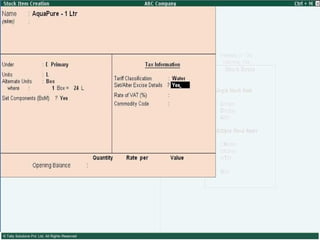
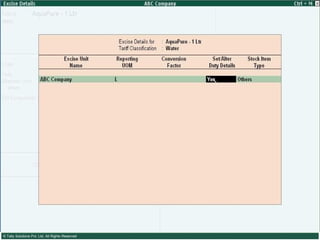
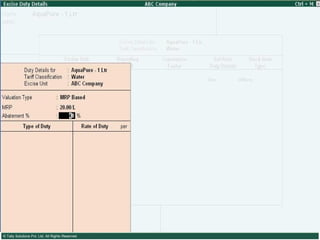
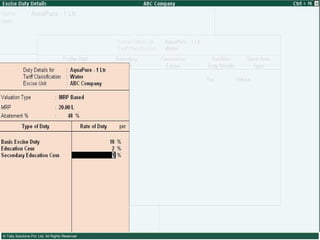
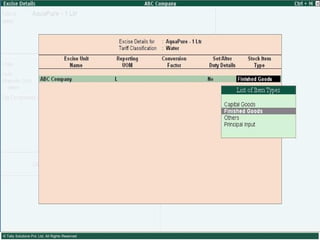
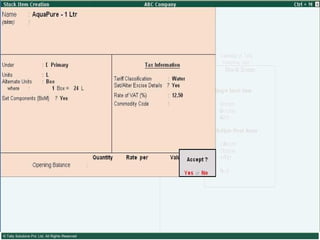
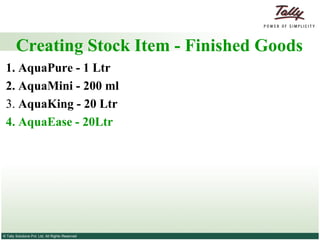
Creating Stock Item - Finished Goods    1. AquaPure - 1 Ltr


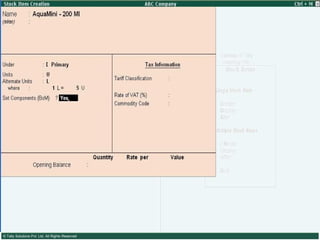
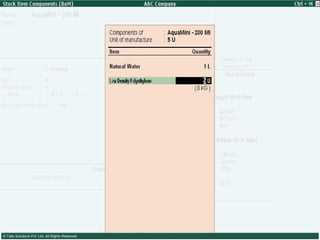
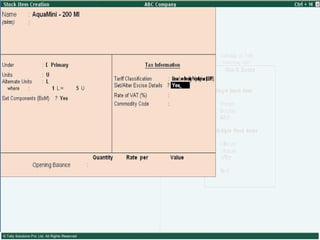
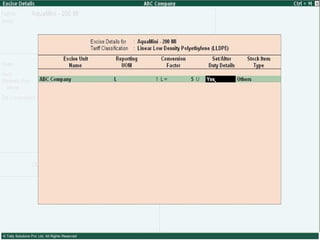
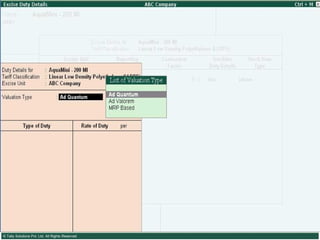
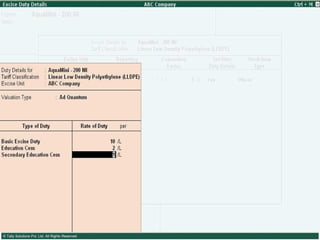
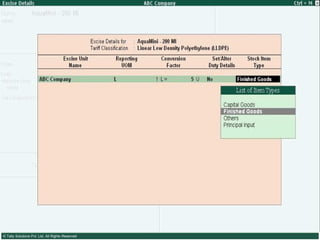
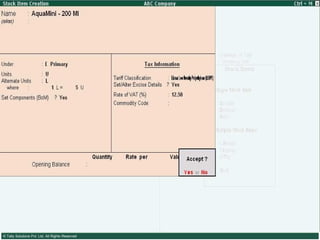
Creating Stock Item - Finished Goods    1. AquaPure - 1 Ltr 2. AquaMini - 200 ml


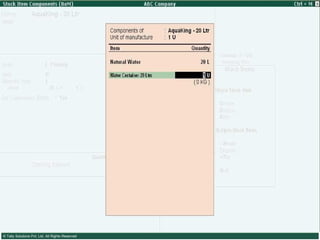
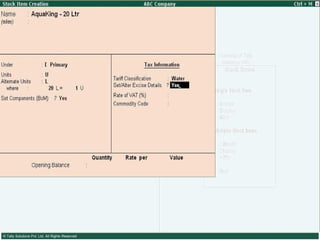
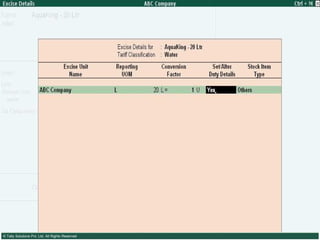
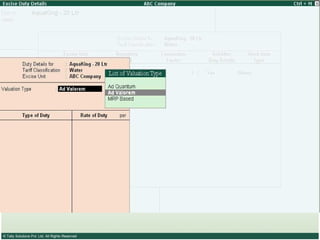
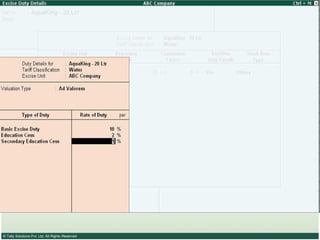
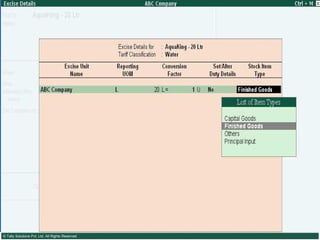
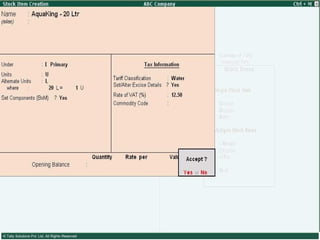
Creating Stock Item - Finished Goods    1. AquaPure - 1 Ltr 2. AquaMini - 200 ml   3.  AquaKing - 20 Ltr


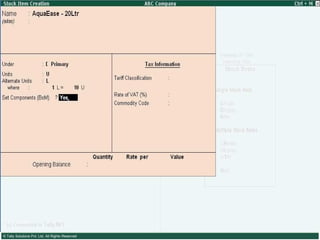
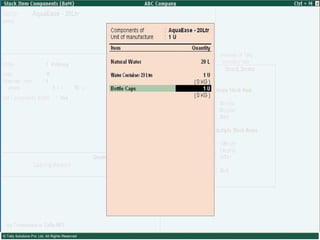
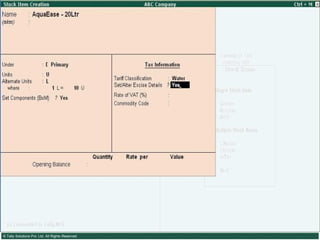
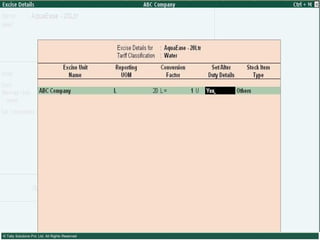
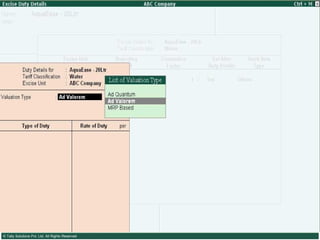
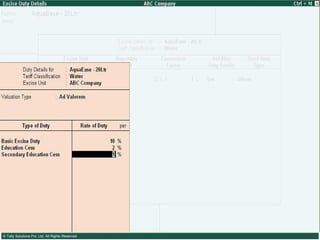
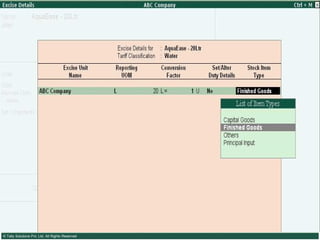
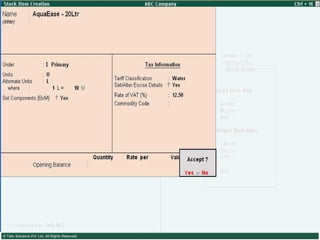
Creating Stock Item - Finished Goods    1. AquaPure - 1 Ltr 2. AquaMini - 200 ml   3.  AquaKing - 20 Ltr   4. AquaEase - 20Ltr


Transactions
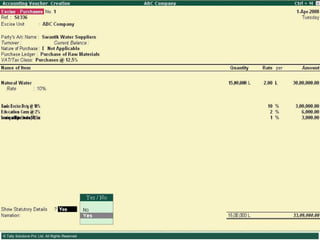
Creating a Excise Purchase Voucher  Not Availing CENVAT Credit


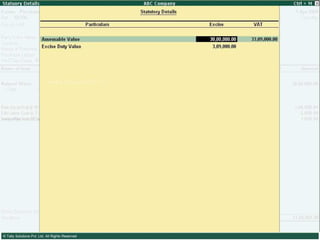
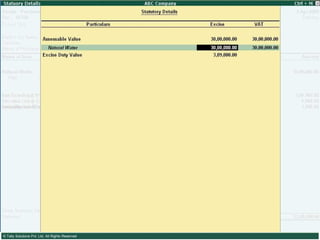
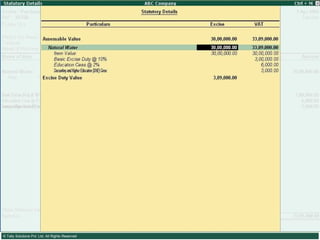
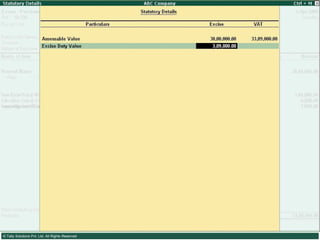
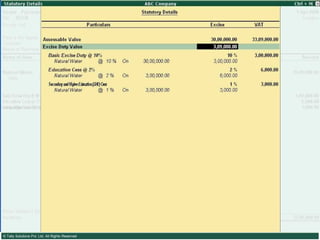
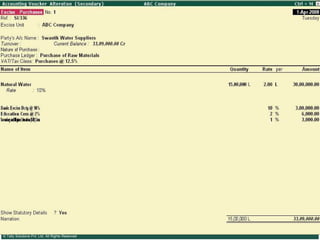
When the CENVAT Credit is not availed The Duty Legers selected won't display the ledger balance and  duty amount  will be apportioned to the Stock Item cost.


Creating a Excise Purchase Voucher  Availing CENVAT Credit
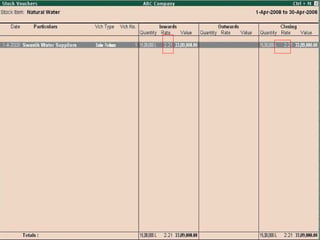
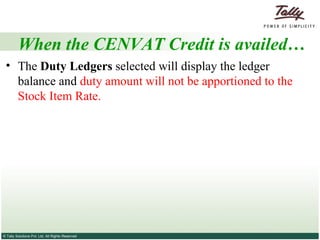
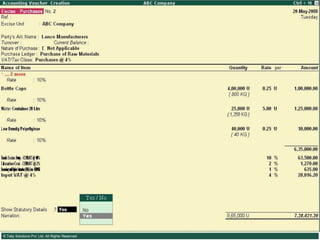
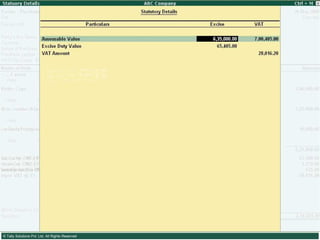
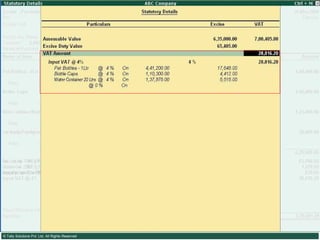
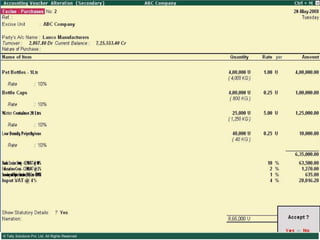
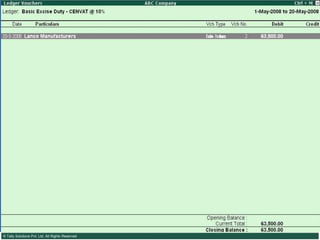
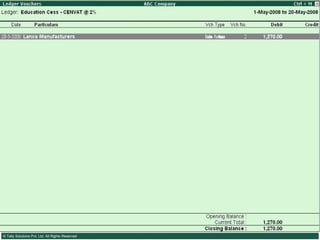
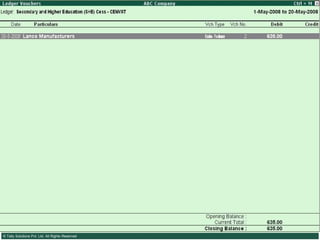
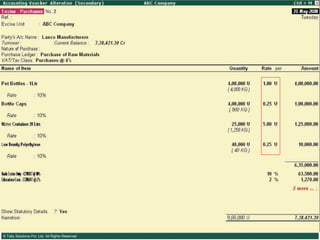
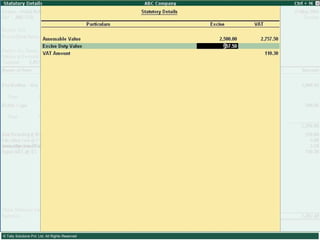
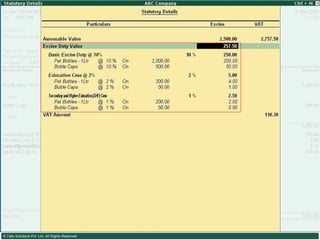
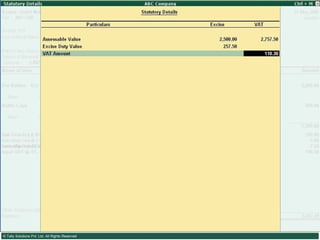
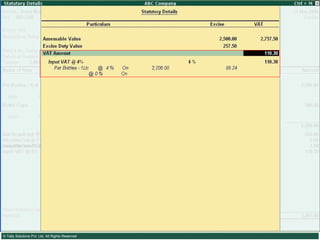
When the CENVAT Credit is availed… The  Duty Ledgers  selected will display the ledger balance and  duty amount will not be apportioned to the Stock Item Rate.


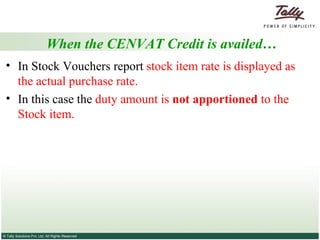
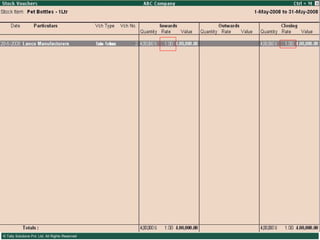
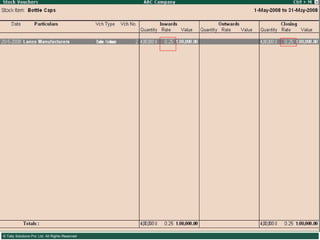
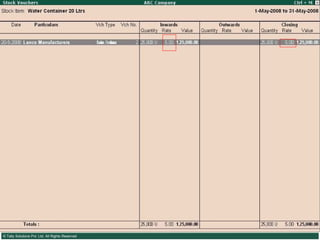
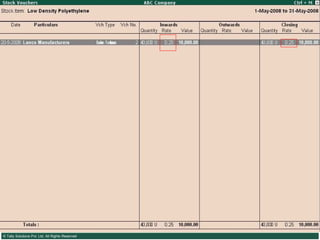
When the CENVAT Credit is availed… In Stock Vouchers report  stock item rate is displayed as   the actual purchase rate.  In this case the  duty amount is  not apportioned  to the Stock item.


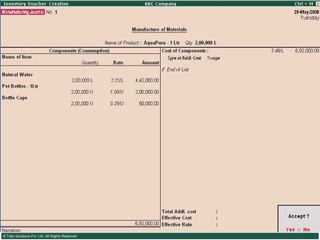
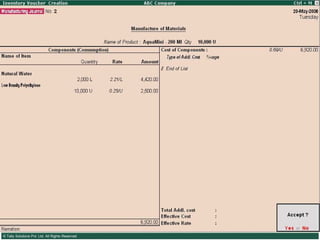
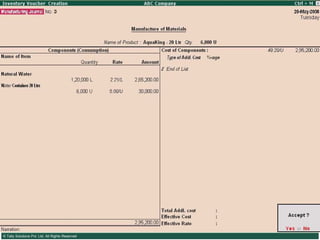
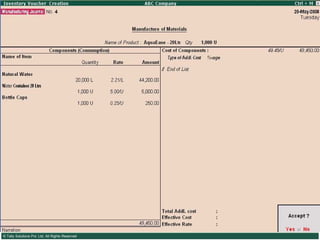
Creating a Manufacturing Voucher Manufacturing of Packed Drinking Water being a Process Industry, Manufacturing Journal is used to account the issue of raw materials to production floor and for the receipt of finished goods.  In case of discrete industries, Stock Journal can be used to account the issue of Raw materials to production floor and for the receipt of finished goods
Creating a Manufacturing Voucher… To Manufacture >  AquaPure - 1Ltr  using Manufacturing Journal
 
Creating a Manufacturing Voucher… To Manufacture  10,000 U  >  AquaMini - 200 ml  using Manufacturing Journal
 
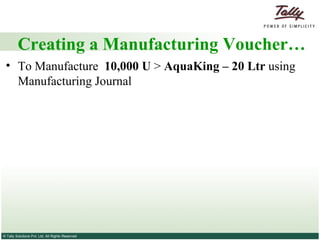
Creating a Manufacturing Voucher… To Manufacture  10,000 U  >  AquaKing – 20 Ltr  using Manufacturing Journal
 
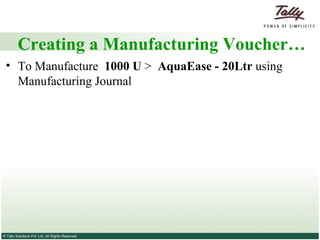
Creating a Manufacturing Voucher… To Manufacture  1000 U  >  AquaEase - 20Ltr  using Manufacturing Journal
 
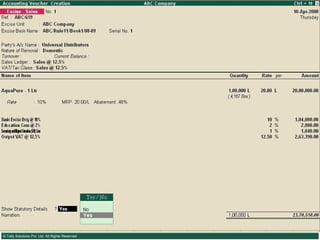
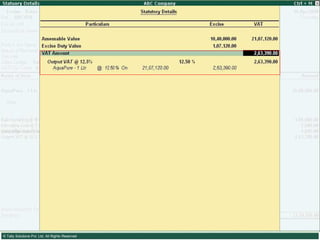
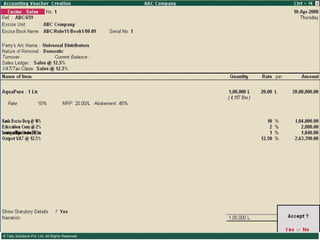
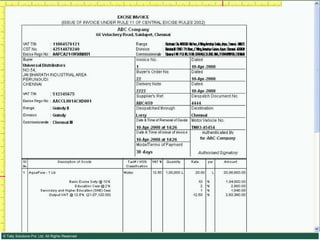
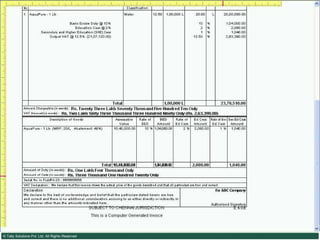
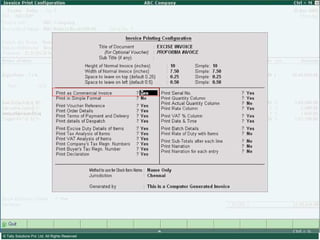
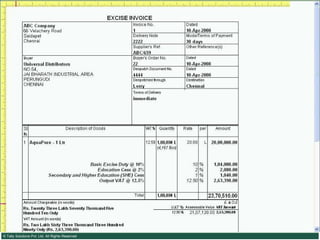
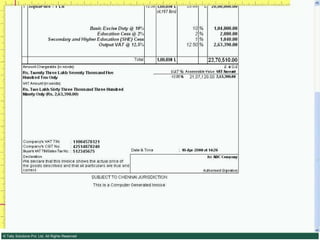
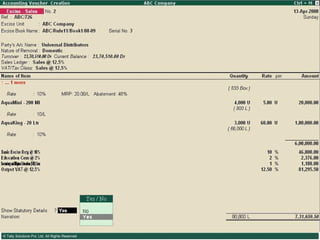
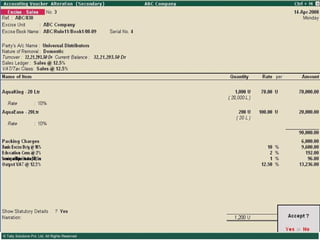
Creating a  Excise Sales Voucher_ Rule 11 Invoice


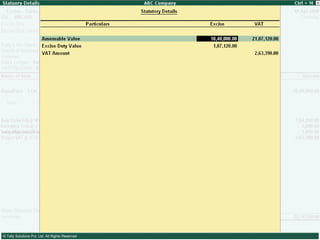
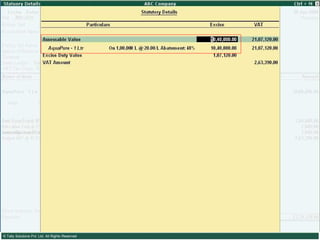
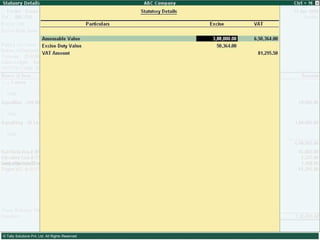
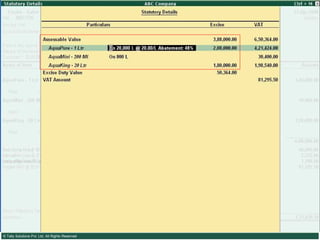
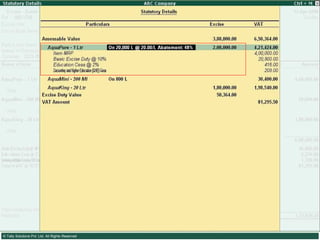
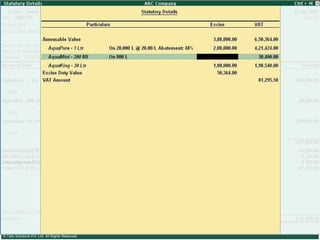
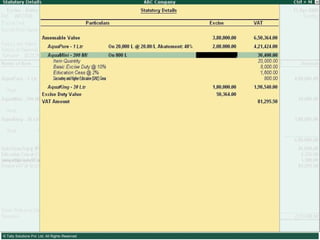
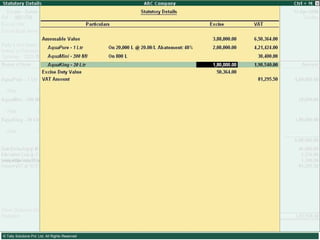
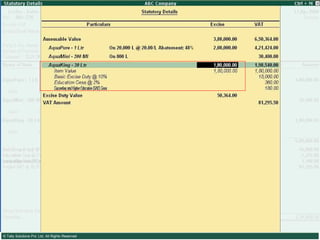
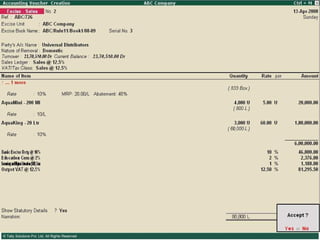
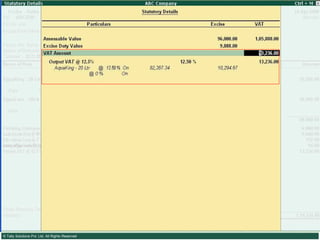
Rule 11 Invoice for   Stock Items Falling Under Different Valuation Type


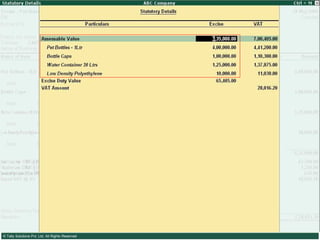
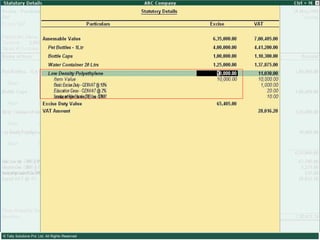
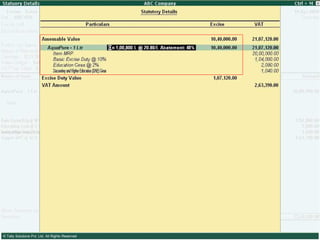
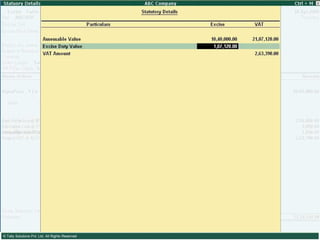
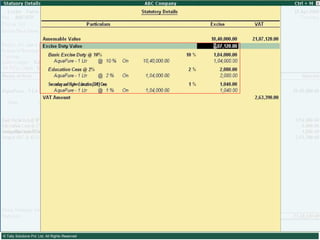
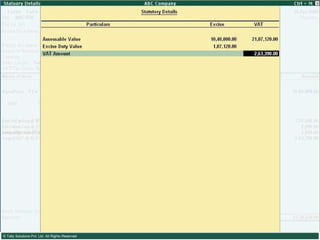
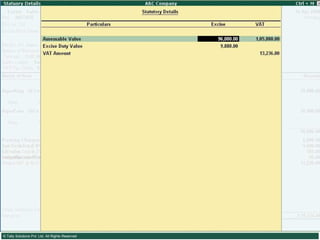
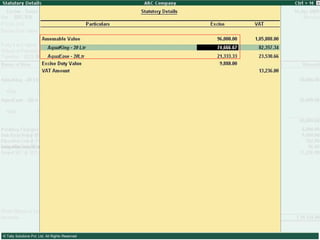
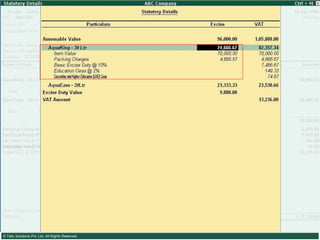
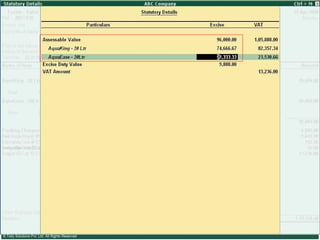
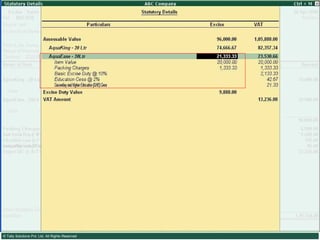
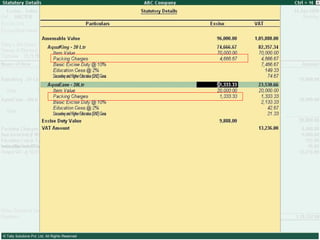
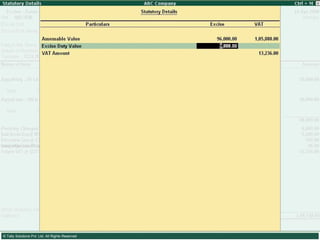
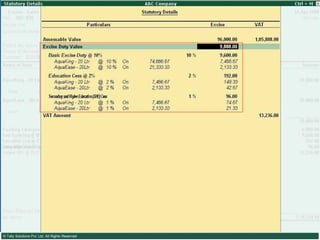
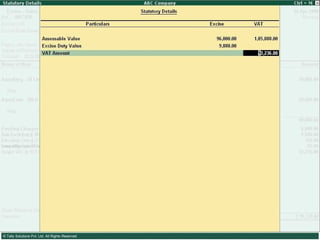
Rule 11 Invoice   for Stock Items with Expenses


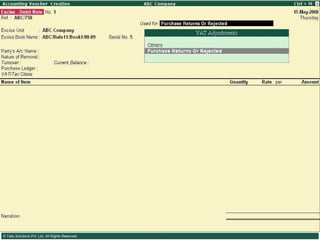
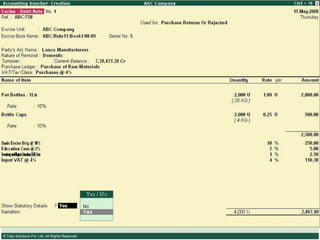
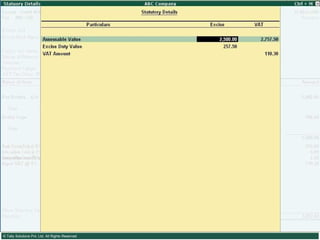
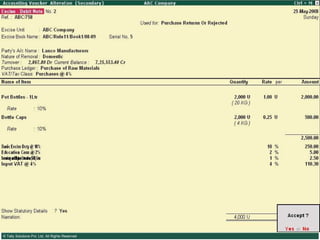
Creating a Debit Note (Purchase Returns) _ Rule 11 invoice As per Rule 11 of the Central Excise (No.2) Rules, 2001 provides that no excisable goods shall be removed from a factory or a warehouse except under an invoice signed by the owner of the factory or his authorised agent.  The invoice shall be serially numbered and shall contain the registration number, description, classification, time and date of removal, rate of duty, quantity and value, of goods and the duty payable thereon.
Creating a  Debit Note  (Purchase Returns) _ Rule 11 invoice Invoicing under Rule 11 of the Central Excise (No.2) Rules, 2001 is applicable even for Purchase Returns. In case of purchase returns goods are removed from factory or warehouse to return the goods to the supplier.


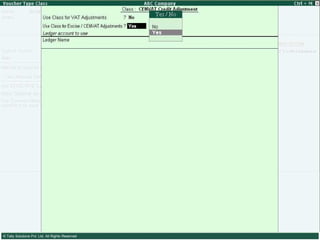
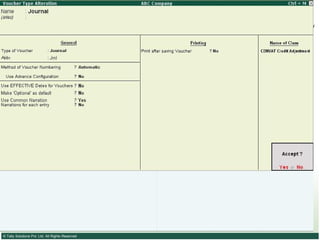
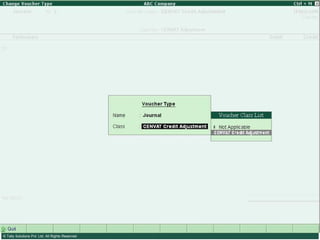
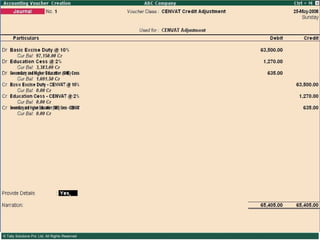
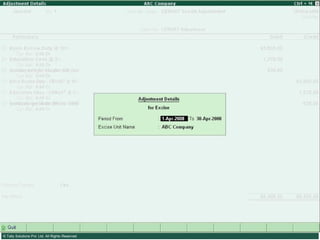
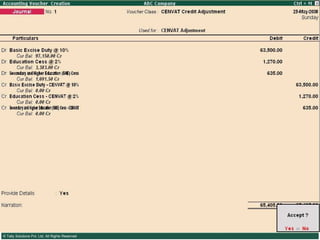
Creating a  Journal Voucher_CENVAT Credit Adjustment   CENVAT Credit available to a Unit will be adjusted towards the Duty Payable to arrive at the Net Duty Payable to the Government.
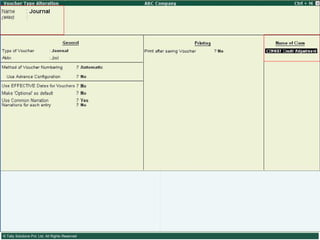
Creating a  Journal Voucher_CENVAT Credit Adjustment   In Tally.ERP to record the adjustment, CENVAT Duty and Excise Duty accounts are Credited and Debited, respectively to nullify their balances and the net balance in the Excise Duty ledgers will be paid to the Government.  CENVAT Credit Adjustment entry is recorded at the end of Every month or Quarter depending on the type of Manufacturer.


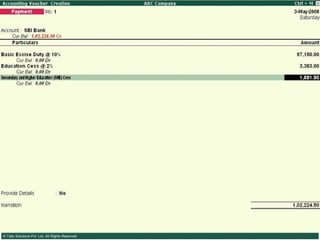
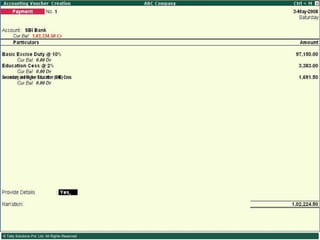
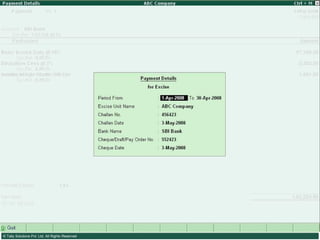
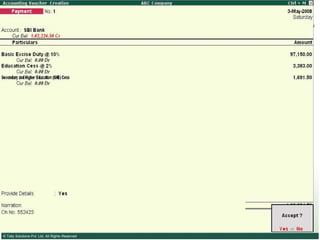
Creating a Payment Voucher_ GAR 7 Payment


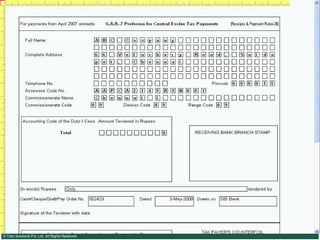
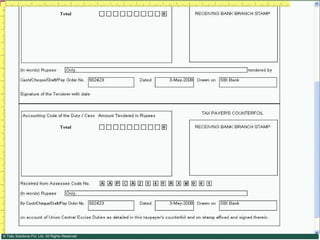
Printing  G.A.R.–7 Challan
 
 
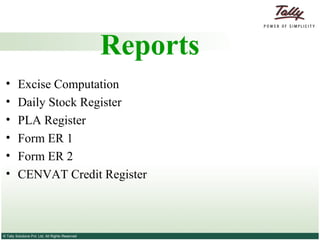
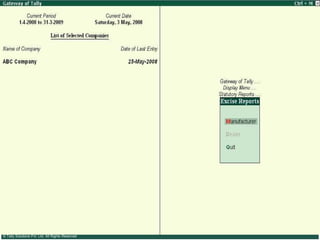
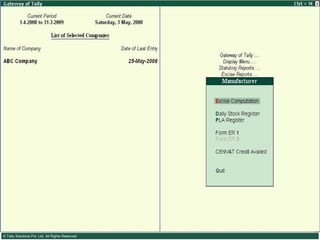
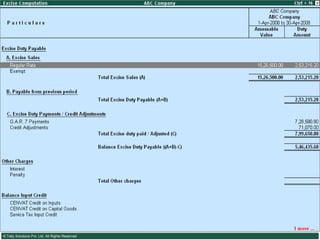
Reports   Excise Computation  Daily Stock Register  PLA Register  Form ER 1  Form ER 2  CENVAT Credit Register


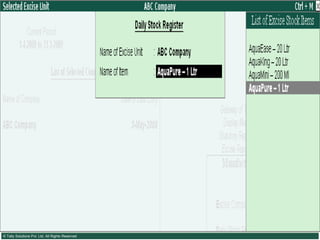
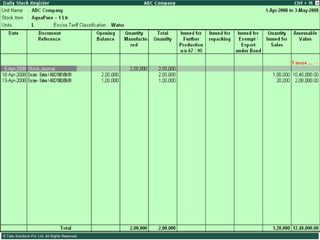
Daily Stock Register Daily Stock Register is a record of stock maintained on daily basis.  A daily stock has to be maintained by every assessee.  This report contains details about Description of goods manufactured/produced, opening balance, Quantity manufactured or produced, Total quantity, Quantity removed, Assessable value, Amount of duty payable and details regarding amount of Duty actually paid.
 
 
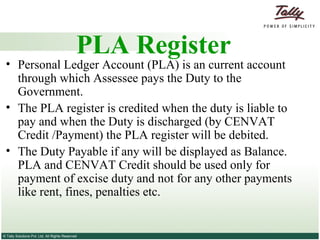
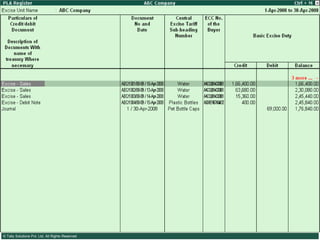
PLA Register Personal Ledger Account (PLA) is an current account through which Assessee pays the Duty to the Government.  The PLA register is credited when the duty is liable to pay and when the Duty is discharged (by CENVAT Credit /Payment) the PLA register will be debited.  The Duty Payable if any will be displayed as Balance. PLA and CENVAT Credit should be used only for payment of excise duty and not for any other payments like rent, fines, penalties etc.
 
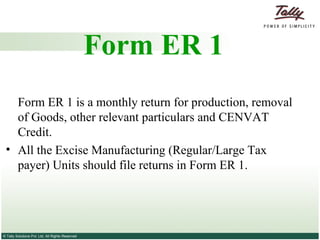
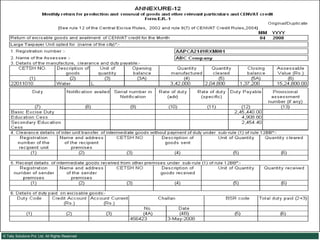
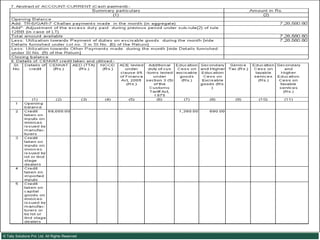
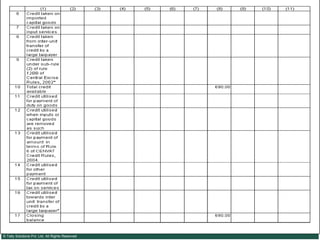
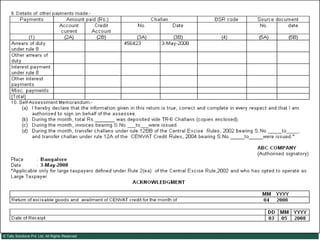
Form ER 1 Form ER 1 is a monthly return for production, removal of Goods, other relevant particulars and CENVAT Credit.  All the Excise Manufacturing (Regular/Large Tax payer) Units should file returns in Form ER 1.


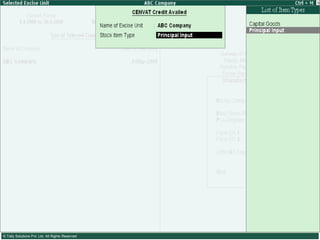
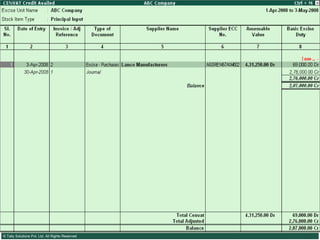
CENVAT Credit Availed CENVAT Credit Availed report displays…   the details of CENVAT credit availed of Principal Input or Capital Goods.
CENVAT Credit Availed
 
Please send in your comments/suggestions/feedbacks/queries on this presentation to [email_address]
Thank you…

Excise Ver 2.0

  • 1.
    Excise for Maunfacturerin Tally.ERP 9 Presentation by Ateeq,TIPL Chennai (Apr – 2009).
  • 2.
    Excise Duty orDuty on Excise is a tax on goods manufactured or produced in India and intended for domestic consumption i.e. sale in India. The Excise Duty is payable at the time of production or manufacture, however, for administrative convenience duty is paid at the time of removal of goods. Excise Duty
  • 3.
    Excise Duty isan indirect tax. The liability of payment of Excise Duty is of manufacturers or producers (which is passed on to the ultimate consumer). The levy and collection of duty of Excise is provided under authority of the Central Excise Act, 1944 at the rates specified Central Excise Tariff Act, 1985. Excise Duty
  • 4.
    Scope and ApplicabilityExcise Duty can be levied, only on the fulfilment of the below mentioned conditions… The Duty is on Goods. The Goods must be excisable. The goods must be manufactured or produced. Manufacture and Production must be in India.
  • 5.
    Manufacturer Manufacturer isa person who actually manufactures or produces excisable goods, i.e. one that actually brings into existence new and identifiable product.
  • 6.
    Excisable Goods ExcisableGoods means goods specified in the schedule to the Central Excise Tariff Act, 1985 as being subject to a duty of Excise. The Basic requirements to be satisfied are : Goods must be movable. Goods must be marketable i.e. the goods must be such that it is known in the market and is capable of being bought or sold.
  • 7.
    Types of ExciseDuties 1. Basic Excise Duty : This is the duty charged under section 3 of the Central Excises and Salt Act,1944 on all excisable goods other than salt which are produced or manufactured in India. Basic Excise Duty [also known as Central Value Added Tax (CENVAT)] is levied at the rates specified in Central Excise Tariff Act. 2. Special Excise Duty : As per the Section 37 of the Finance Act,1978 Special excise Duty was attracted on all excisable goods on which there is a levy of Basic excise Duty under the Central Excises and Salt Act,1944. Special Excise Duty is levied at the rates specified in the Second Schedule to Central Excise Tariff Act, 1985.
  • 8.
    Types of ExciseDuties 3.Education Cess on Excise Duty : Section 93 of Finance (No. 2) Act, 2004 states that education Cess is 'duty of excise', to be calculated on aggregate of all duties of excise including special excise duty or any other duty of excise, but excluding education Cess on excisable goods.
  • 9.
    4. Exciseduty in case of clearances by EOU : The EOU units are expected to export all their production. However, if they clear their final product in DTA (domestic tariff area), the rate of excise duty will be equal to customs duty on like article if imported in India. 5. National Calamity contingent Duty (NCCD) : A 'National Calamity Contingent Duty' (NCCD) has been imposed vide section 136 of Finance Act, 2001 [clause 129 of Finance Bill, 2001, w.e.f. 1.3.2001]. This duty is imposed on pan masala, chewing tobacco and cigarettes. Types of Excise Duties…
  • 10.
    6. Dutiesunder other Acts : Some duties and cesses are levied on manufactured products under other Acts. The administrative machinery of central excise is used to collect those taxes. Provisions of Central Excise Act and Rules have been made applicable for levy and collection of these duties / cesses. Types of Excise Duties…
  • 11.
    Types of ExciseDuties… 7. Additional Duty on goods of special importance - Some goods of special importance are levied Additional Excise under Additional Duties of Excise (Goods of Special Importance) Act, 1957. The 'Additional Duty' is in addition to excise duty. This scheme was introduced based on the suggestion made by the manufacturers to Government, that multiple level taxes and duties should be avoided. Levy and collection of all taxes at one stage by single authority will be con- venient for payment and administration. Hence, by agreement between Central and State Governments, it was decided to make a beginning in 1957, by selecting some items where additional duty will be collected instead of sales tax and such additional duty will be distributed among various States.
  • 12.
    Types of ExciseDuties… 8. Duty on Medical and Toilet preparations : A duty of excise is imposed on medical preparations under Medical and Toilet Preparations (Excise Duties) Act, 1955. 9. Additional duty on mineral products - Additional duty on mineral products (like motor spirit, kerosene, diesel and furnace oil) is payable under Mineral Products (Additional Duties of Excise and Customs) Act, 1958. 10. Additional Customs Duty commonly known as countervailing Duty (CVD) : Countervailing duty (CVD) is imposed on the Imports.
  • 13.
    Types of ExciseDuties… 11. Special Additional Duty of Customs (Special CVD) : Special CVD is being imposed on items bound under the Information Technology Agreement (except information technology software), and also on specified inputs/raw materials for manufacture of electronics/IT goods. 12. Additional Duties of Excise (Textiles and Textile Articles) [AED (TTA)] 13. Additional Duty of Excise (Tea and Tea Waste) [AED (TTW)] 14. Secondary Higher Education Cess
  • 14.
    Valuation Methods Valueof the excisable goods has to be necessarily determined to levy the duty on the goods. Under the Central Excise Act, 1944, the following methods of valuation of goods are considered for the assessment of Duty…
  • 15.
    Valuation Methods  1. Ad valorem / Transaction Value : Transaction value means the value of goods which are sold at the time and place of removal and includes in addition to the amount charged as price, any amount that the buyer is liable to pay to, including any amount charged for, or to make provision for, advertising or publicity, marketing and selling, organization expenses, storage, outward handling, servicing, warranty, commission or any other matter.
  • 16.
    Valuation Methods  2. Ad Quantum : In case of Ad Quantum the duty is payable on the basis of certain unit Like Weight, Length, volume etc. For Example : Duty on cigarette is payable on the basis of length of the cigarette, duty on Sugar is based on per Kg.
  • 17.
    Valuation Methods  3. Value determined on the basis of M R P : Retail sale price means the maximum price at which the excisable goods in packaged form may be sold to the ultimate consumer and includes all taxes local or otherwise, freight, transport charges, commission payable to dealers, and all charges towards advertisement, delivery, packing, forwarding and the like, as the case may be, and the price is the sole consideration for such sale.
  • 18.
    Duties eligible forCENVAT Credit… A manufacturer or producer of final product is allowed to take CENVAT credit of duties specified in the Cenvat Credit Rules, 2002. The duties specified under Cenvat Credit Rules, 2002 are: Basic Excise Duty on inputs specified in the First Schedule to Central Excise tariff Act (corresponding CVD on imported goods is allowable). Special Excise Duty on goods specified in the Second Schedule to the Tariff Act (corresponding CVD on imported goods is allowable).
  • 19.
    Duties eligible forCENVAT Credit… Additional Excise Duty paid under Additional Duties of Excise (Textile and Textile Article). Additional Excise Duty paid under Additional Duties of Excise (Goods of Special Importance). National Calamity Contingent duty (NCCD). Education Cess and Secondary and Higher Education Cess on Excise Duty. Additional custom duty leviable under Customs Tariff Act (Spl. CVD) Education Cess and Secondary and Higher Education Cess on CVD Additional Excise Duty paid under Clause 85 of Finance Bill,2005 on Pan Masala and Certain other Tobacco products. Service tax on input services. Education Cess and Secondary & Higher Education Cess paid on service tax. This credit can be utilised only for payment of education cess on final product or output services.
  • 20.
    Excise Control Code(ECC) Number The ECC number is a registration number, issued to all the Central Excise Assessees. This Number is based on the principles of 'Common Business Identifier' which shall be used for revenue accounting, validation of documents (e.g. CENVAT invoices), inter-agency coordination and for creation of data warehouse.
  • 21.
    Excise Control Code(ECC) Number ECC number is a PAN based 15 digit alpha numeric numbers. The first part denotes 10 character (alpha numeric) Permanent Account number issued by Income tax authorities to the concerned person to whom the ECC Number is to be allotted and the second part comprises of a fixed 2 character alpha code which is as follows:
  • 22.
    Excise Control Code(ECC) Number XD Registered Dealer XM Central Excise Manufacturer (Including registered Warehouses) Code Category
  • 23.
    Excise Control Code(ECC) Number Where the concerned person has more than one factory, say 3 factories, having PAN as aforesaid, then the ECC Number will be: ABCDE1234H XM 001 ABCDE1234H XM 002 ABCDE1234H XM 003 Where the concerned person has one factory and is also registered as dealer, having PAN as aforesaid, then the New ECC Number will be: ABCDE1234H XM 001 (for Factory) ABCDE1234H XD 001 (for Dealer)
  • 24.
    Central Excise InvoiceSystem An invoice is the document under cover of which the excisable goods are to be cleared by the manufacturer. This is also the document which indicates the assessment of the goods to duty. No excisable goods can be cleared except under an invoice.
  • 25.
    Removals only oninvoice Rule 11 of the Central Excise (No.2) Rules, 2001 provides that no excisable goods shall be removed from a factory or a warehouse except under an invoice signed by the owner of the factory or his authorised agent.
  • 26.
    Serially numbered invoiceThe invoice shall be serially numbered and shall contain the registration number, description, classification, time and date of removal, rate of duty, quantity and value, of goods and the duty payable thereon. The serial number shall commence from 1st April every year [beginning of a financial year]. The serial number can be given at the time of printing or by using franking machine. But when the invoice book is authenticated in the manner specified in sub-rule (5) of rule 11, each leaf should contain serial number. Hand written serial number shall not be accepted.
  • 27.
    Serially numbered invoiceIn case of computer-generated invoice, the serial number may be allowed to be generated and printed by computer at the time of preparation of invoice ONLY IF the software is such that computer automatically generates the number and same number cannot be generated more than once. For this purpose, the Central Excise Officers may check the system/software from time to time.
  • 28.
    Number of Invoicecopies The invoice shall be prepared in triplicate: The original copy being marked as Original For Buyer The duplicate copy being marked as Duplicate For Transporter The triplicate copy being marked as Triplicate For Assessee The above requirement is mainly for Central Excise purposes. However, the assessee may make more than three copies for his other requirements. But such copies shall be prominently marked Not For Cenvat Purposes .
  • 29.
    Number of Invoicebook The rule 11of the Central Excise (No.2) Rules, 2001 provides that only one invoice book shall be in use at a time, unless otherwise allowed by the Deputy/Assistant Commissioner of Central Excise in the special facts and circumstances of each case. The Board has decided that where assessee requires two different invoice books for the purposes of removals for home-consumption, and removals for export they may do so by intimating the jurisdictional Deputy/Assistant Commissioner of Central Excise.
  • 30.
    Number of Invoicebook Wherever, an assessee is allowed to keep more than one invoice book, he should be asked to keep different numerical serial numbers for the different sets. In case of running stationary used in computers, the bound book shall not be insisted upon provided the stationary is pre-printed with distinctive names and marks of the assessee. After the invoices are prepared, the triplicate copy shall be retained in bound-book form. Where invoices are to be typed written, the leafs have to be first taken out from the book for typing. In such cases also the triplicate copy shall be retained in bound-book form.
  • 31.
    Authentication of InvoicesThe rule provides that owner or working partner or Managing Director or Company Secretary shall authenticate each foil of the invoice book, before being brought into use. However, in order to facilitate the trade it has been decided that any person duly authorised in this regard by the Company, owner or working partner may also authenticate invoices. Copy of the letter of authority should be submitted to the Range office.
  • 32.
    Intimation of serialnumbers Before making use of the invoice book, the serial numbers of the same shall be intimated to the Superintendent of Central Excise having jurisdiction over the factory of the assessee. This can be done in writing by post/e-mail/fax/hand delivery or any other similar means.
  • 33.
    Rounding off ofduty in invoice The amount of duty being shown in invoices issued under rule 11 of the Central Excise (No.2) Rules, 2001 be rounded off to the nearest rupee as provided for under Section 37D of the Central Excise Act, 1944 and the duty amount so rounded off should be indicated both in words as well as in figures.
  • 34.
    Types of Dutiesand Method of Calculation on Assessable Value+ BCD CVD SED of CVD on Assessable Value+ BCD CVD Countervailing Duty(CVD) On Total Excise Duty Excise SHE Cess on Excise duty On Total Excise Duty Excise Educational Cess on Quantity Excise AED on High Speed Diesel on Quantity Excise Special AED on BED + SED + AED (GSI) Excise NCCD on BED + SED Excise AED (PM&T) on BED + SED Excise AED (TTW) on BED + SED Excise AED (TTA) on Assessable Value Excise AED (GSI) on Assessable Value Excise Special Excise Duty (SED) on Assessable Value Excise Basic Excise Duty (BED) Method of calculation Duty Type Type of Duty
  • 35.
    Types of Dutiesand Method of Calculation on Current Sub Total Customs Special Custom Duty on Total Customs and CVD Customs SHE Cess on Customs on Total Customs and CVD Customs Educational Cess on Customs on BCD Customs Additional Duty on Customs on Assessable Value Customs Basic Custom Duty On Total CVD CVD SHE Cess on CVD On Total CVD CVD Educational Cess on CVD on Quantity CVD AED on High Speed Diesel of CVD on Quantity CVD Special AED of CVD on CVD + SED–CVD + AED (GSI)–CVD CVD NCCD of CVD on CVD + SED–CVD CVD AED (PM&T) of CVD on CVD + SED–CVD CVD AED (TTW) of CVD on CVD + SED–CVD CVD AED (TTA) of CVD on Assessable Value+ BCD CVD AED (GSI) of CVD Method of calculation Duty Type Type of Duty
  • 36.
    Returns & TimelinesThe following Returns are required to be filed under Excise for Manufacturers With in 20days from the close of quarter Quarterly Quarterly Return by Assessees availing small scale industries (SSI) concession of duty based on turnover ER–3 On or before 10th of the following month (With ER-1) Monthly Monthly Return by large and Regular units Monthly Return for CENVAT On or before 10th of the following month Monthly Monthly Return by Assessees who are neither Large Units nor availing concession of duty based on turnover   On or before 10th of the following month Monthly Monthly Return by Assesses who are not availing the concession of duty based on turnover (large units) (e-Returns) ER–1 Due Date Periodicity Particulars Form No.
  • 37.
    Salient Features ofExcise in Tally.ERP Simple and user-friendly Quick and easy to set up and use Allows Multiple Excise Registration (Manufacturer & Dealer) in Single Company Create Tariff (HSN) / Commodity Code Flexibility to have separate Unit of Measures for recording transactions and excise reporting
  • 38.
    Salient Features ofExcise in Tally.ERP Item wise Valuation Methods (Valorem, Quantum, MRP) Maintain Rule 11 Excise Invoice Can apportion Expense / Income ledger value to calculate Assessable Value Item wise Duty calculation for different Valuation Methods in single invoice Generate Rule 11 invoice for Purchase Returns Record Exempt, Export & Special Rate transactions Avail Full / Partial CENVAT Credit on Inputs and Capital Goods/ Service Tax towards Duty payable
  • 39.
    Salient Features ofExcise in Tally.ERP Reversal of CENVAT Credit Print G.A.R. -7 Challan Maintain Invoice Register Maintain RG -1 register Generate CENVAT Credit Register Generate ER-1 & ER-3 returns Maintain PLA Register Excise Computation Report
  • 40.
  • 41.
    Enabling Excise inTally.ERP Lesson 1: Enabling Excise in Tally.ERP
  • 42.
  • 43.
  • 44.
  • 45.
    Name: Enterthe excise invoice book name allowed by the Commissioner of Central Excise for the company/unit, e.g. ABC/Rule11/Book1/08-09
  • 46.
    ABC -Denotes Company Name.
  • 47.
    Rule 11 :Denotes that invoice book is maintained as per Rule 11 of Central Excise Rules, 2002
  • 48.
    Book1 : Standsfor Book Number, which is allowed for the current financial year
  • 49.
    08-09 : Denotesthe financial year. 
  • 50.
  • 51.
  • 52.
  • 53.
  • 54.
  • 55.
    Creating Ledgers… 1.Creating a Supplier Ledger
  • 56.
  • 57.
  • 58.
  • 59.
    Creating Ledgers… 1Creating a Supplier Ledger 2 Creating a Customer Ledger
  • 60.
  • 61.
  • 62.
  • 63.
    Creating Ledgers… 1Creating a Supplier Ledger 2 Creating a Customer Ledger 3 Creating a Sales Ledger
  • 64.
  • 65.
  • 66.
  • 67.
    Creating Ledgers… 1Creating a Supplier Ledger 2 Creating a Customer Ledger 3 Creating a Sales Ledger 4 Creating a Purchase Ledger
  • 68.
  • 69.
  • 70.
  • 71.
    Creating Ledgers… 1Creating a Supplier Ledger 2 Creating a Customer Ledger 3 Creating a Sales Ledger 4 Creating a Purchase Ledger 5 Creating Input VAT Ledger
  • 72.
  • 73.
    Creating Ledgers… 1Creating a Supplier Ledger 2 Creating a Customer Ledger 3 Creating a Sales Ledger 4 Creating a Purchase Ledger 5 Creating Input VAT Ledger 6. Creating Output VAT Ledger
  • 74.
  • 75.
    Creating Ledgers… 1Creating a Supplier Ledger 2 Creating a Customer Ledger 3 Creating a Sales Ledger 4 Creating a Purchase Ledger 5 Creating Input VAT Ledger 6. Creating Output VAT Ledger 7. Creating Basic Excise Duty Ledger
  • 76.
  • 77.
    Creating Ledgers… 1.Creating a Supplier Ledger 2. Creating a Customer Ledger 3. Creating a Sales Ledger 4. Creating a Purchase Ledger 5. Creating Input VAT Ledger 6. Creating Ouput VAT Ledger 7. Creating Basic Excise Duty Ledger 8. Creating Education Cess Ledger
  • 78.
  • 79.
  • 80.
    Creating Ledgers… 1.Creating a Supplier Ledger 2. Creating a Customer Ledger 3. Creating a Sales Ledger 4. Creating a Purchase Ledger 5. Creating Input VAT Ledger 6. Creating Ouput VAT Ledger 7. Creating Basic Excise Duty Ledger 8. Creating Education Cess Ledger 9. Creating Secondary & Higher Education Cess Ledger
  • 81.
    Creating Ledgers… 1A Supplier Ledger 2 A Customer Ledger 3 A Sales Ledger 4 A Purchase Ledger 5 A Input VAT Ledger 6. A Ouput VAT Ledger 7. A Basic Excise Duty Ledger 8. A Education Cess Ledger 9. A Secondary & Higher Education Cess Ledger 10. A Basic Excise Duty CENVAT Ledger
  • 82.
  • 83.
    Creating Ledgers… 1.Supplier Ledger 2. Customer Ledger 3. Sales Ledger 4. Purchase Ledger 5. Input VAT Ledger 6. Ouput VAT Ledger 7. Basic Excise Duty Ledger 8. Education Cess Ledger 9. Secondary & Higher Education Cess Ledger 10.Basic Excise Duty CENVAT Ledger 11. Education Cess CENVAT Ledger
  • 84.
  • 85.
    Creating Ledgers… 1Supplier Ledger 2 Customer Ledger 3 Sales Ledger 4 Purchase Ledger 5 Input VAT Ledger 6 Ouput VAT Ledger 7 Basic Excise Duty Ledger 8 Education Cess Ledger 9 Secondary & Higher Education Cess Ledger 10Basic Excise Duty CENVAT Ledger 11Education Cess CENVAT Ledger 12 Secondary & Higher Education Cess CENVAT Ledger
  • 86.
  • 87.
    Creating Ledgers… 1.Supplier Ledger 2. Customer Ledger 3. Sales Ledger 4. Purchase Ledger 5. Input VAT Ledger 6. Ouput VAT Ledger 7. Basic Excise Duty Ledger 8. Education Cess Ledger 9. Secondary & Higher Education Cess Ledger 10. Basic Excise Duty CENVAT Ledger 11. Education Cess CENVAT Ledger 12. Secondary & Higher Education Cess CENVAT Ledger 13. Expense Ledger
  • 88.
  • 89.
    Example : Based on Value Packing Charges (2,727.27) Packing Charges (2,272.73) Value of Item Y (60,000) + ( Value of Item X (50,000) + Assessable Value of Item Y (62,727.27) = Assessable Value of Item X (52,272.73) =     5,000*60,000/1,10,000 = 2727.27 5,000*50,000/1,10,000 =2272.73 Apportionment of Packing Charges to Item Y: Apportionment of Packing Charges to Item X: Value of Item Y is 60,000 Value of Item X is 50,000 Packing charges is 5,000 Based on Value In case of Based on Value method of apportion, expenses will be apportioned based on the Value of the Stock item.
  • 90.
    Example : Based on Quantity Packing Charges (3,750) Packing Charges (1,250) Value of Item Y (60000) + Value of Item X (20,000) + Assessable Value of Item Y (63,750) = Assessable Value of Item X (21,250) =     Apportionment of Packing Charges to Item Y : 5,000*600/800 = 3,750 Apportionment of Packing Charges to Item X : 5,000*200/800 =1,250 Quantity of Item Y is 600 and Value is 60,000 Quantity of Item X is 200 and Value is 20,000     Packing charges is 5,000 Based on Quantity In case of Based on Quantity method of apportion, expenses will be apportioned based on the quantity of the Stock item.  
  • 91.
    Creating Excise VoucherTypes… 1. Excise Purchase Voucher Type
  • 92.
  • 93.
    Creating Excise VoucherTypes… 1. Purchase Voucher Type 2. Sales Voucher Type
  • 94.
  • 95.
    Creating Excise VoucherTypes… 1. Purchase Voucher Type 2. Sales Voucher Type 3. Debit Note Voucher Type
  • 96.
  • 97.
    Manufacturing Journal Voucher Manufacturing Journal is used to account…  the issue of raw materials to production floor and  for the receipt of finished goods .
  • 98.
  • 99.
    Creating Tariff Classification … Each and every goods manufactured or produced have to be classified for finding out the rate of duty applicable. Accordingly, Central Excise Tariff Act 1985 classifies all the goods under 91 chapters and specific code is assigned to each item. This code is called Tariff Classification code , which consists of 8 digits . First 4 digits represent Chapter and heading a Next 2 digit represents sub-heading and The last 2 digit represents sub-sub heading.
  • 100.
    HSN CODE The Harmonized Commodity Description and Coding System (HS) of tariff nomenclature popularly known as Harmonised System of Nomenclature (HSN) , is an internationally standardized system of names and numbers for classifying traded products developed and maintained by the World Customs Organization.
  • 101.
    Creating Tariff Classification… 1. Plastic Bottles
  • 102.
  • 103.
    Creating Tariff Classification… 1. Plastic Bottles 2. Plastic Bottle Caps
  • 104.
  • 105.
    Creating Tariff Classification… 1. Plastic Bottles 2. Plastic Bottle Caps 3. Water
  • 106.
  • 107.
    Creating Tariff Classification… 1. Plastic Bottles 2. Plastic Bottle Caps 3. Water 4. Linear Low Density Polyethylene (LLDPE)
  • 108.
  • 109.
    Creating Stock Item- Raw materials 1. Pet Bottles - 1Ltr
  • 110.
  • 111.
  • 112.
  • 113.
  • 114.
  • 115.
  • 116.
    Creating Stock Item- Raw materials 1. Pet Bottles - 1Ltr 2. Water Container 20 Ltrs
  • 117.
  • 118.
  • 119.
  • 120.
  • 121.
  • 122.
  • 123.
    Creating Stock Item- Raw materials 1. Pet Bottles - 1Ltr 2. Water Container 20 Ltrs 3. Bottle Caps
  • 124.
  • 125.
  • 126.
  • 127.
  • 128.
  • 129.
    Creating Stock Item- Raw materials 1. Pet Bottles - 1Ltr 2. Water Container 20 Ltrs 3. Bottle Caps 4. Low Density Polyethylene
  • 130.
  • 131.
  • 132.
  • 133.
  • 134.
    Creating Stock Item- Raw materials 1. Pet Bottles - 1Ltr 2. Water Container 20 Ltrs 3. Bottle Caps 4. Low Density Polyethylene 5. Natural Water
  • 135.
  • 136.
  • 137.
  • 138.
  • 139.
  • 140.
  • 141.
    Creating Stock Item- Finished Goods 1. AquaPure - 1 Ltr
  • 142.
  • 143.
  • 144.
  • 145.
  • 146.
  • 147.
  • 148.
  • 149.
  • 150.
    Creating Stock Item- Finished Goods 1. AquaPure - 1 Ltr 2. AquaMini - 200 ml
  • 151.
  • 152.
  • 153.
  • 154.
  • 155.
  • 156.
  • 157.
  • 158.
  • 159.
    Creating Stock Item- Finished Goods 1. AquaPure - 1 Ltr 2. AquaMini - 200 ml 3. AquaKing - 20 Ltr
  • 160.
  • 161.
  • 162.
  • 163.
  • 164.
  • 165.
  • 166.
  • 167.
    Creating Stock Item- Finished Goods 1. AquaPure - 1 Ltr 2. AquaMini - 200 ml 3. AquaKing - 20 Ltr 4. AquaEase - 20Ltr
  • 168.
  • 169.
  • 170.
  • 171.
  • 172.
  • 173.
  • 174.
  • 175.
  • 176.
  • 177.
    Creating a ExcisePurchase Voucher Not Availing CENVAT Credit
  • 178.
  • 179.
  • 180.
  • 181.
  • 182.
  • 183.
  • 184.
    When the CENVATCredit is not availed The Duty Legers selected won't display the ledger balance and duty amount will be apportioned to the Stock Item cost.
  • 185.
  • 186.
  • 187.
  • 188.
  • 189.
  • 190.
    Creating a ExcisePurchase Voucher Availing CENVAT Credit
  • 191.
    When the CENVATCredit is availed… The Duty Ledgers selected will display the ledger balance and duty amount will not be apportioned to the Stock Item Rate.
  • 192.
  • 193.
  • 194.
  • 195.
  • 196.
  • 197.
  • 198.
  • 199.
  • 200.
  • 201.
  • 202.
  • 203.
  • 204.
  • 205.
  • 206.
  • 207.
    When the CENVATCredit is availed… In Stock Vouchers report stock item rate is displayed as the actual purchase rate. In this case the duty amount is not apportioned to the Stock item.
  • 208.
  • 209.
  • 210.
  • 211.
  • 212.
  • 213.
    Creating a ManufacturingVoucher Manufacturing of Packed Drinking Water being a Process Industry, Manufacturing Journal is used to account the issue of raw materials to production floor and for the receipt of finished goods. In case of discrete industries, Stock Journal can be used to account the issue of Raw materials to production floor and for the receipt of finished goods
  • 214.
    Creating a ManufacturingVoucher… To Manufacture > AquaPure - 1Ltr using Manufacturing Journal
  • 215.
  • 216.
    Creating a ManufacturingVoucher… To Manufacture 10,000 U > AquaMini - 200 ml using Manufacturing Journal
  • 217.
  • 218.
    Creating a ManufacturingVoucher… To Manufacture 10,000 U > AquaKing – 20 Ltr using Manufacturing Journal
  • 219.
  • 220.
    Creating a ManufacturingVoucher… To Manufacture 1000 U > AquaEase - 20Ltr using Manufacturing Journal
  • 221.
  • 222.
    Creating a Excise Sales Voucher_ Rule 11 Invoice
  • 223.
  • 224.
  • 225.
  • 226.
  • 227.
  • 228.
  • 229.
  • 230.
  • 231.
  • 232.
  • 233.
  • 234.
  • 235.
  • 236.
  • 237.
    Rule 11 Invoicefor Stock Items Falling Under Different Valuation Type
  • 238.
  • 239.
  • 240.
  • 241.
  • 242.
  • 243.
  • 244.
  • 245.
  • 246.
  • 247.
  • 248.
  • 249.
  • 250.
  • 251.
    Rule 11 Invoice for Stock Items with Expenses
  • 252.
  • 253.
  • 254.
  • 255.
  • 256.
  • 257.
  • 258.
  • 259.
  • 260.
  • 261.
  • 262.
  • 263.
  • 264.
    Creating a DebitNote (Purchase Returns) _ Rule 11 invoice As per Rule 11 of the Central Excise (No.2) Rules, 2001 provides that no excisable goods shall be removed from a factory or a warehouse except under an invoice signed by the owner of the factory or his authorised agent. The invoice shall be serially numbered and shall contain the registration number, description, classification, time and date of removal, rate of duty, quantity and value, of goods and the duty payable thereon.
  • 265.
    Creating a Debit Note (Purchase Returns) _ Rule 11 invoice Invoicing under Rule 11 of the Central Excise (No.2) Rules, 2001 is applicable even for Purchase Returns. In case of purchase returns goods are removed from factory or warehouse to return the goods to the supplier.
  • 266.
  • 267.
  • 268.
  • 269.
  • 270.
  • 271.
  • 272.
  • 273.
  • 274.
  • 275.
  • 276.
  • 277.
  • 278.
  • 279.
    Creating a Journal Voucher_CENVAT Credit Adjustment CENVAT Credit available to a Unit will be adjusted towards the Duty Payable to arrive at the Net Duty Payable to the Government.
  • 280.
    Creating a Journal Voucher_CENVAT Credit Adjustment In Tally.ERP to record the adjustment, CENVAT Duty and Excise Duty accounts are Credited and Debited, respectively to nullify their balances and the net balance in the Excise Duty ledgers will be paid to the Government. CENVAT Credit Adjustment entry is recorded at the end of Every month or Quarter depending on the type of Manufacturer.
  • 281.
  • 282.
  • 283.
  • 284.
  • 285.
  • 286.
  • 287.
  • 288.
    Creating a PaymentVoucher_ GAR 7 Payment
  • 289.
  • 290.
  • 291.
  • 292.
  • 293.
  • 294.
  • 295.
  • 296.
    Reports Excise Computation Daily Stock Register PLA Register Form ER 1 Form ER 2 CENVAT Credit Register
  • 297.
  • 298.
  • 299.
  • 300.
  • 301.
    Daily Stock RegisterDaily Stock Register is a record of stock maintained on daily basis. A daily stock has to be maintained by every assessee. This report contains details about Description of goods manufactured/produced, opening balance, Quantity manufactured or produced, Total quantity, Quantity removed, Assessable value, Amount of duty payable and details regarding amount of Duty actually paid.
  • 302.
  • 303.
  • 304.
    PLA Register PersonalLedger Account (PLA) is an current account through which Assessee pays the Duty to the Government. The PLA register is credited when the duty is liable to pay and when the Duty is discharged (by CENVAT Credit /Payment) the PLA register will be debited. The Duty Payable if any will be displayed as Balance. PLA and CENVAT Credit should be used only for payment of excise duty and not for any other payments like rent, fines, penalties etc.
  • 305.
  • 306.
    Form ER 1Form ER 1 is a monthly return for production, removal of Goods, other relevant particulars and CENVAT Credit. All the Excise Manufacturing (Regular/Large Tax payer) Units should file returns in Form ER 1.
  • 307.
  • 308.
  • 309.
  • 310.
  • 311.
    CENVAT Credit AvailedCENVAT Credit Availed report displays…  the details of CENVAT credit availed of Principal Input or Capital Goods.
  • 312.
  • 313.
  • 314.
    Please send inyour comments/suggestions/feedbacks/queries on this presentation to [email_address]
  • 315.