Text Functions in Excel How to make sense out of downloaded text files in Excel 2003 By Kevin McLogan [email_address] [email_address] facebook.com/kmclogan linkedin.com/in/kevinmclogan www.kevinmclogan.com
Course Objectives: After you complete this course to will be able to: Analyze text and manage downloaded lists. Make a list functional for mailing, emailing, or walking. Format the contents   of a worksheet Create spreadsheets that amaze your friends and strike fear into the hearts of your enemies
For this class, I am making the following assumptions, and it is critical that you are honest  That you can copy and paste data  That you can open Excel by using the Start Menu or by opening files  That you know how to identify the active cell That you know how to move from sheet to sheet  That you can fill rows and columns of cells That you have a basic familiarity with Excel 2003 and that this is the version you are using That you understand and use common Windows elements
In order for us to make this an outstanding experience Ask questions if you are not clear on a concept  If you have a problem with a file, let us know so that you can reload it.  I will talk really fast if you let me-slow me down if I get ahead of you. If you need help, please let us know-if you can help, please do. This is a hands-on lesson, so you will learn by doing-you might want to take some notes.
Text Functions Text functions help you manage the text data in your spreadsheets. 
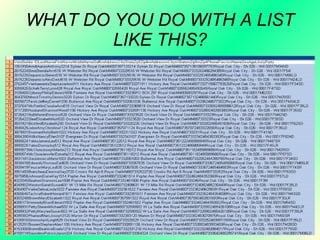
WHAT DO YOU DO WITH A LIST LIKE THIS?
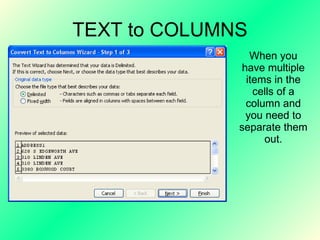
TEXT to COLUMNS When you have multiple items in the cells of a column and you need to separate them out.
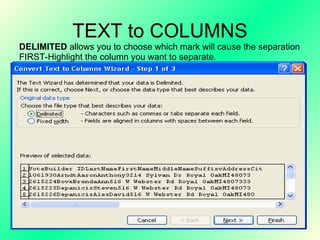
TEXT to COLUMNS DELIMITED  allows you to choose which mark will cause the separation FIRST-Highlight the column you want to separate.
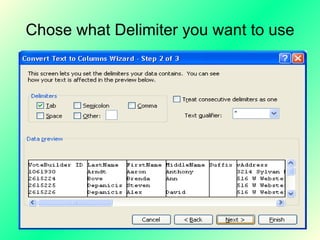
Chose what Delimiter you want to use
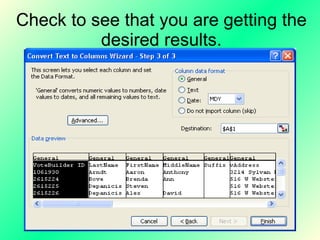
Check to see that you are getting the desired results.
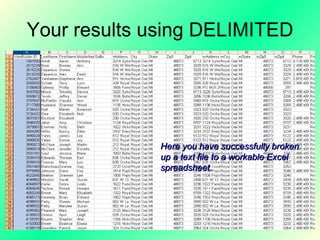
Your results using DELIMITED Here you have successfully broken up a text file to a workable Excel spreadsheet.
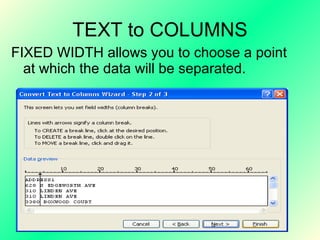
TEXT to COLUMNS FIXED WIDTH allows you to choose a point at which the data will be separated.
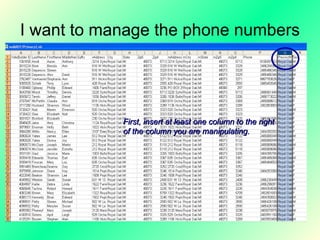
I want to manage the phone numbers First, insert at least one column to the right of the column you are manipulating.
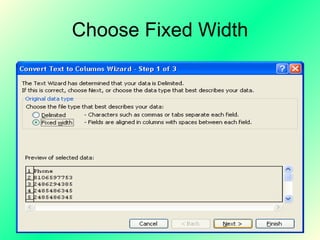
Choose Fixed Width
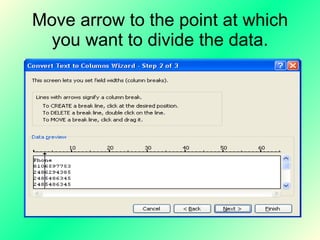
Move arrow to the point at which you want to divide the data.
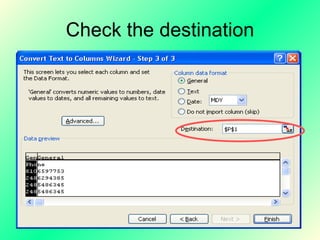
Check the destination
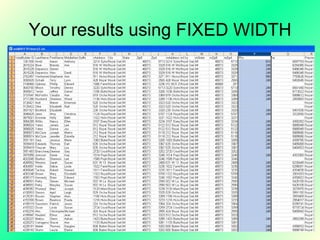
Your results using FIXED WIDTH
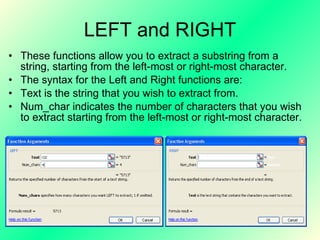
LEFT and RIGHT These functions allow you to extract a substring from a string, starting from the left-most or right-most character.  The syntax for the Left and Right functions are:  Text is the string that you wish to extract from.  Num_char indicates the number of characters that you wish to extract starting from the left-most or right-most character. 
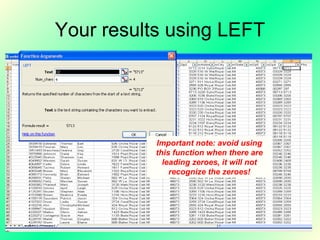
Your results using LEFT Important note: avoid using this function when there are leading zeroes, it will not recognize the zeroes!
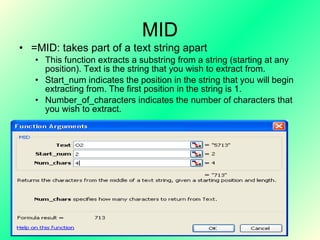
MID =MID: takes part of a text string apart This function extracts a substring from a string (starting at any position). Text is the string that you wish to extract from.  Start_num indicates the position in the string that you will begin extracting from. The first position in the string is 1.  Number_of_characters indicates the number of characters that you wish to extract. 
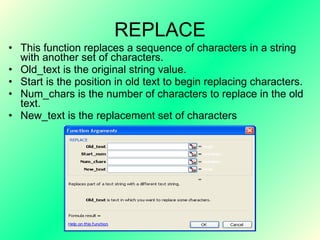
REPLACE This function replaces a sequence of characters in a string with another set of characters.  Old_text is the original string value.  Start is the position in old text to begin replacing characters.  Num_chars is the number of characters to replace in the old text.  New_text is the replacement set of characters 
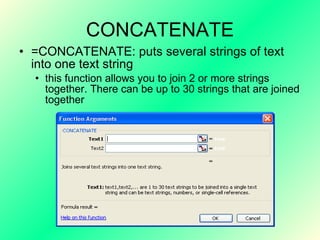
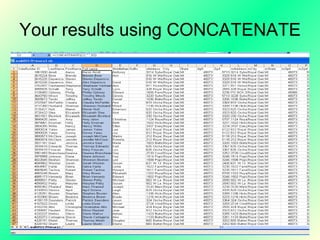
CONCATENATE =CONCATENATE: puts several strings of text into one text string this function allows you to join 2 or more strings together. There can be up to 30 strings that are joined together 
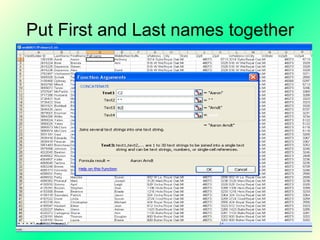
Put First and Last names together
Your results using CONCATENATE
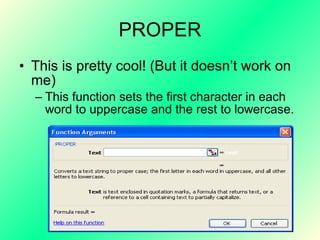
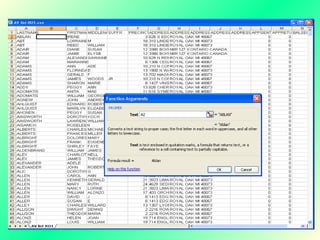
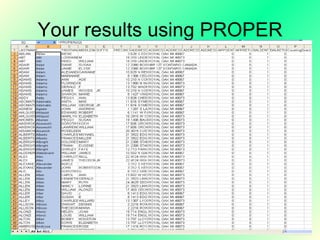
PROPER This is pretty cool! (But it doesn’t work on me) This function sets the first character in each word to uppercase and the rest to lowercase.
 
Your results using PROPER
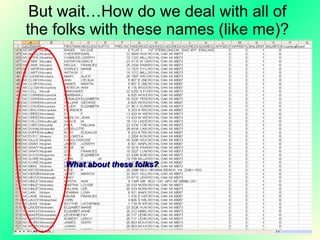
But wait…How do we deal with all of the folks with these names (like me)? What about these folks?
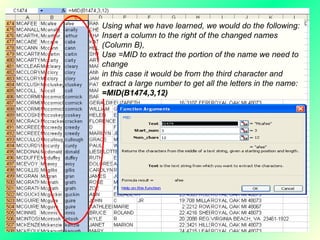
Using what we have learned, we would do the following: Insert a column to the right of the changed names (Column B),  Use =MID to extract the portion of the name we need to change  in this case it would be from the third character and extract a large number to get all the letters in the name:   =MID(B1474,3,12)
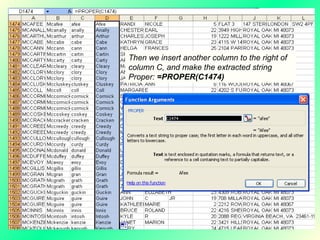
Then we insert another column to the right of column C, and make the extracted string Proper:  =PROPER(C1474)
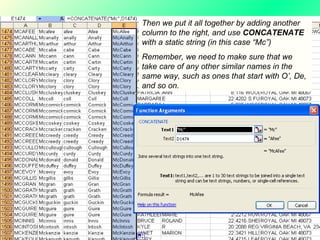
Then we put it all together by adding another column to the right, and use  CONCATENATE  with a static string (in this case “Mc”) Remember, we need to make sure that we take care of any other similar names in the same way, such as ones that start with O’, De, and so on.
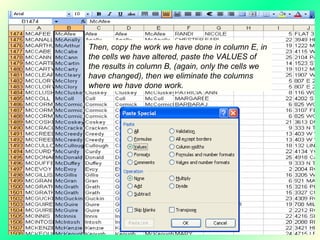
Then, copy the work we have done in column E, in the cells we have altered, paste the VALUES of the results in column B, (again, only the cells we have changed), then we eliminate the columns where we have done work.
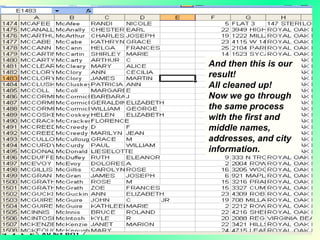
And then this is our result! All cleaned up! Now we go through the same process with the first and middle names, addresses, and city information.
I leave you with this: SAVE YOUR WORK! Thank you for participating, happy spread sheeting!

Excel text functions

  • 1.
    Text Functions inExcel How to make sense out of downloaded text files in Excel 2003 By Kevin McLogan [email_address] [email_address] facebook.com/kmclogan linkedin.com/in/kevinmclogan www.kevinmclogan.com
  • 2.
    Course Objectives: Afteryou complete this course to will be able to: Analyze text and manage downloaded lists. Make a list functional for mailing, emailing, or walking. Format the contents of a worksheet Create spreadsheets that amaze your friends and strike fear into the hearts of your enemies
  • 3.
    For this class,I am making the following assumptions, and it is critical that you are honest That you can copy and paste data That you can open Excel by using the Start Menu or by opening files That you know how to identify the active cell That you know how to move from sheet to sheet That you can fill rows and columns of cells That you have a basic familiarity with Excel 2003 and that this is the version you are using That you understand and use common Windows elements
  • 4.
    In order forus to make this an outstanding experience Ask questions if you are not clear on a concept If you have a problem with a file, let us know so that you can reload it. I will talk really fast if you let me-slow me down if I get ahead of you. If you need help, please let us know-if you can help, please do. This is a hands-on lesson, so you will learn by doing-you might want to take some notes.
  • 5.
    Text Functions Textfunctions help you manage the text data in your spreadsheets. 
  • 6.
    WHAT DO YOUDO WITH A LIST LIKE THIS?
  • 7.
    TEXT to COLUMNSWhen you have multiple items in the cells of a column and you need to separate them out.
  • 8.
    TEXT to COLUMNSDELIMITED allows you to choose which mark will cause the separation FIRST-Highlight the column you want to separate.
  • 9.
    Chose what Delimiteryou want to use
  • 10.
    Check to seethat you are getting the desired results.
  • 11.
    Your results usingDELIMITED Here you have successfully broken up a text file to a workable Excel spreadsheet.
  • 12.
    TEXT to COLUMNSFIXED WIDTH allows you to choose a point at which the data will be separated.
  • 13.
    I want tomanage the phone numbers First, insert at least one column to the right of the column you are manipulating.
  • 14.
  • 15.
    Move arrow tothe point at which you want to divide the data.
  • 16.
  • 17.
    Your results usingFIXED WIDTH
  • 18.
    LEFT and RIGHTThese functions allow you to extract a substring from a string, starting from the left-most or right-most character. The syntax for the Left and Right functions are: Text is the string that you wish to extract from. Num_char indicates the number of characters that you wish to extract starting from the left-most or right-most character. 
  • 19.
    Your results usingLEFT Important note: avoid using this function when there are leading zeroes, it will not recognize the zeroes!
  • 20.
    MID =MID: takespart of a text string apart This function extracts a substring from a string (starting at any position). Text is the string that you wish to extract from. Start_num indicates the position in the string that you will begin extracting from. The first position in the string is 1. Number_of_characters indicates the number of characters that you wish to extract. 
  • 21.
    REPLACE This functionreplaces a sequence of characters in a string with another set of characters. Old_text is the original string value. Start is the position in old text to begin replacing characters. Num_chars is the number of characters to replace in the old text. New_text is the replacement set of characters 
  • 22.
    CONCATENATE =CONCATENATE: putsseveral strings of text into one text string this function allows you to join 2 or more strings together. There can be up to 30 strings that are joined together 
  • 23.
    Put First andLast names together
  • 24.
    Your results usingCONCATENATE
  • 25.
    PROPER This ispretty cool! (But it doesn’t work on me) This function sets the first character in each word to uppercase and the rest to lowercase.
  • 26.
  • 27.
  • 28.
    But wait…How dowe deal with all of the folks with these names (like me)? What about these folks?
  • 29.
    Using what wehave learned, we would do the following: Insert a column to the right of the changed names (Column B), Use =MID to extract the portion of the name we need to change in this case it would be from the third character and extract a large number to get all the letters in the name: =MID(B1474,3,12)
  • 30.
    Then we insertanother column to the right of column C, and make the extracted string Proper: =PROPER(C1474)
  • 31.
    Then we putit all together by adding another column to the right, and use CONCATENATE with a static string (in this case “Mc”) Remember, we need to make sure that we take care of any other similar names in the same way, such as ones that start with O’, De, and so on.
  • 32.
    Then, copy thework we have done in column E, in the cells we have altered, paste the VALUES of the results in column B, (again, only the cells we have changed), then we eliminate the columns where we have done work.
  • 33.
    And then thisis our result! All cleaned up! Now we go through the same process with the first and middle names, addresses, and city information.
  • 34.
    I leave youwith this: SAVE YOUR WORK! Thank you for participating, happy spread sheeting!

Editor's Notes

  • #2 Introduce-background
  • #3 I want this class (can we say that-is that term MARVIN approved?) to be unlike any other that you have experienced, because it is about how you can get this awesome tool work for you-and
  • #4 Let me know if these assumptions are not correct-I can adjust
  • #35 Jesus and Satan were having an ongoing argument about who was better on his computer. They had been going at it for days, and God was tired of hearing all of the bickering. Finally God said, "Cool it. I am going to set up a test> that you will do for two hours and I will judge who does the better job." So down Satan and Jesus sat at the keyboards and typed away. They moused, they did spreadsheets, they wrote reports they sent faxes, they sent e-mail, they sent out e-mail with attachments, they downloaded, they did some genealogy reports. They made card and label files. They did every known job that could be> done on a PC, but ten minutes before their time was up, lightning suddenly flashed across the sky, thunder rolled, the rain poured and, of course, the electricity went off. Satan stared at his blank screen and screamed every curse word known in the underworld. Jesus just sighed. The electricity finally flickered back on, and each of them restarted their computers. Satan started searching frantically, screaming, "It's gone! It's all gone! I lost everything when the power went out!" Meanwhile, Jesus quietly started> printing out all of his files and processed his E-mail from the past two hours. Satan observed this and became irate. "Wait! He cheated. How did he do it?" God shrugged and said: "Jesus saves"