

Presented by
Jason Wong
Email : jasonwcc_my@hotmail.com
Contact : +6012-273-6143
Microsoft Excel 2003
Intermediate Level
Section 1 : Working with
Functions and Formulas
1.1 Using Formulas
1.2 Exploring Excel Functions
1.3 Using Functions
1.4 Working with Names and Ranges
1.5 Working with Array Formulas
Microsoft Excel 2003 Intermediate Level
Using Formulas
Microsoft Excel 2003 Intermediate Level
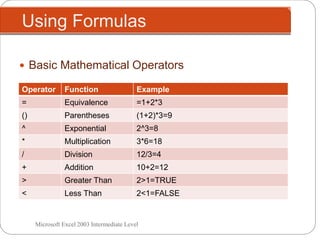
 Basic Mathematical Operators
Operator Function Example
= Equivalence =1+2*3
() Parentheses (1+2)*3=9
^ Exponential 2^3=8
* Multiplication 3*6=18
/ Division 12/3=4
+ Addition 10+2=12
> Greater Than 2>1=TRUE
< Less Than 2<1=FALSE
=10-5+2
Examples of Formulas
Microsoft Excel 2003 Intermediate Level
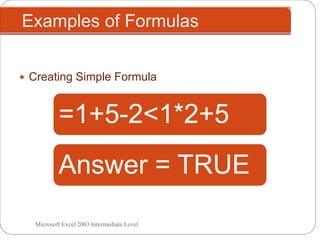
 Creating Simple Formula
=100-5*6=(100-5)*4=2*2^3=(3+3)/2=((4+6)*2)^2=10>2=10-9>2=2+2*3<6+6/3=1+5-2<1*2+5
Answer = 7Answer = 70Answer = 380Answer = 16Answer = 3Answer = 400Answer = TRUEAnswer = FALSEAnswer = FALSEAnswer = TRUE
Excel Formulas
Microsoft Excel 2003 Intermediate Level
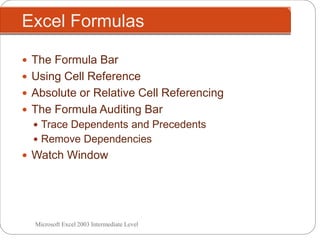
 The Formula Bar
 Using Cell Reference
 Absolute or Relative Cell Referencing
 The Formula Auditing Bar
 Trace Dependents and Precedents
 Remove Dependencies
 Watch Window
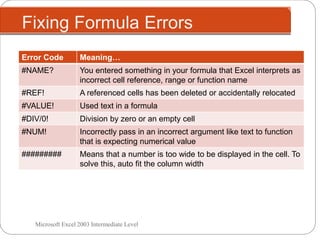
Fixing Formula Errors
Microsoft Excel 2003 Intermediate Level
Error Code Meaning…
#NAME? You entered something in your formula that Excel interprets as
incorrect cell reference, range or function name
#REF! A referenced cells has been deleted or accidentally relocated
#VALUE! Used text in a formula
#DIV/0! Division by zero or an empty cell
#NUM! Incorrectly pass in an incorrect argument like text to function
that is expecting numerical value
######### Means that a number is too wide to be displayed in the cell. To
solve this, auto fit the column width
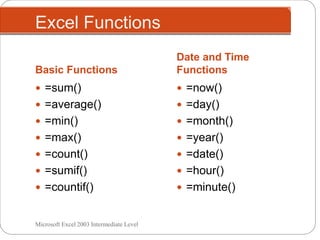
Excel Functions
Basic Functions
Date and Time
Functions
Microsoft Excel 2003 Intermediate Level
 =sum()
 =average()
 =min()
 =max()
 =count()
 =sumif()
 =countif()
 =now()
 =day()
 =month()
 =year()
 =date()
 =hour()
 =minute()
Microsoft Excel 2003 Intermediate Level
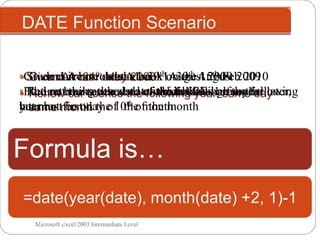
 Given A1=24th May 2008
 Renew car license the following year, same day
same month
Formula is…
=date(year(A1)+1,month(A1),day(A1
))
•Given License date A1=30th August 2009
•Find out the renewal dates which falls on the following
year but first day of the month
=date(year(a1)+1,month(a
1),1)
•Given current road tax on A1=30th August 2009
•Find out the renewal date which falls half a year later,
but must be on the 10th of the month
=date(year(date),
month(date)+6, 10)
• Student A borrowed a book on the 15th Feb 2010
• The returning due date of the book is 1 month
later
=date(year(date),
month(date)+1,day(date))
• Student A borrowed a book on the 15th Feb 2010
• Return book at the end of the following month
=date(year(date), month(date) +2, 1)-1
DATE Function Scenario
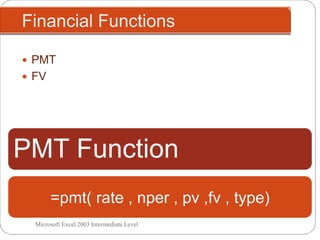
Financial Functions
Microsoft Excel 2003 Intermediate Level
 PMT
 FV
PMT Function
Arguments
=pmt( rate , nper , pv ,fv , type)
PMT – Example 1
Microsoft Excel 2003 Intermediate Level
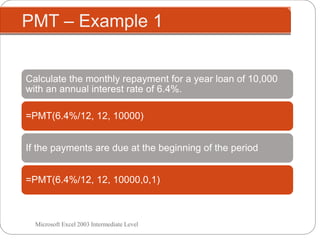
Calculate the monthly repayment for a year loan of 10,000
with an annual interest rate of 6.4%.
=PMT(6.4%/12, 12, 10000)
If the payments are due at the beginning of the period
=PMT(6.4%/12, 12, 10000,0,1)
PMT – Example 2 : Saving Account
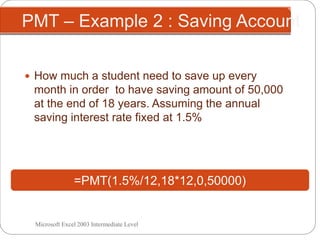
 How much a student need to save up every
month in order to have saving amount of 50,000
at the end of 18 years. Assuming the annual
saving interest rate fixed at 1.5%
=PMT(1.5%/12,18*12,0,50000)
Microsoft Excel 2003 Intermediate Level
PMT – Example 3: EPF saving
Microsoft Excel 2003 Intermediate Level
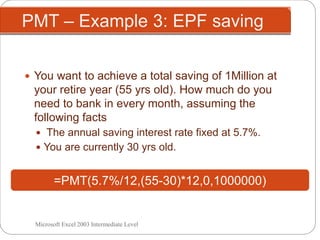
 You want to achieve a total saving of 1Million at
your retire year (55 yrs old). How much do you
need to bank in every month, assuming the
following facts
 The annual saving interest rate fixed at 5.7%.
 You are currently 30 yrs old.
=PMT(5.7%/12,(55-30)*12,0,1000000)
Financial Functions
Microsoft Excel 2003 Intermediate Level
 PMT
 FV
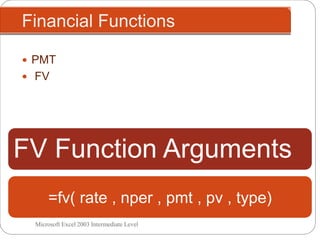
FV Function Arguments
=fv( rate , nper , pmt , pv , type)
FV – Example 1 : Fixed Deposit
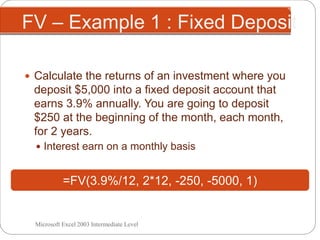
 Calculate the returns of an investment where you
deposit $5,000 into a fixed deposit account that
earns 3.9% annually. You are going to deposit
$250 at the beginning of the month, each month,
for 2 years.
 Interest earn on a monthly basis
=FV(3.9%/12, 2*12, -250, -5000, 1)
Microsoft Excel 2003 Intermediate Level
FV – Example 2 Mutual Fund
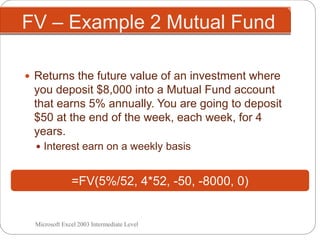
 Returns the future value of an investment where
you deposit $8,000 into a Mutual Fund account
that earns 5% annually. You are going to deposit
$50 at the end of the week, each week, for 4
years.
 Interest earn on a weekly basis
=FV(5%/52, 4*52, -50, -8000, 0)
Microsoft Excel 2003 Intermediate Level
FV – Example 3 Fixed Deposit
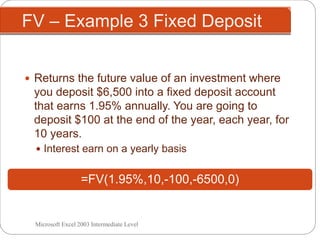
 Returns the future value of an investment where
you deposit $6,500 into a fixed deposit account
that earns 1.95% annually. You are going to
deposit $100 at the end of the year, each year, for
10 years.
 Interest earn on a yearly basis
=FV(1.95%,10,-100,-6500,0)
Microsoft Excel 2003 Intermediate Level
IF Function
Microsoft Excel 2003 Intermediate Level
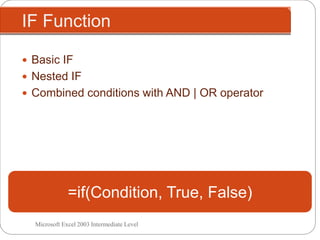
 Basic IF
 Nested IF
 Combined conditions with AND | OR operator
=if(200*2>300, “Answer is Higher”, “Answer is
Lower”)
A1=“James”
=if(A1=“James”,”Is The Boss”, “Is a Staff”)=if(Condition, True, False)
Working with Array Formulas
Microsoft Excel 2003 Intermediate Level
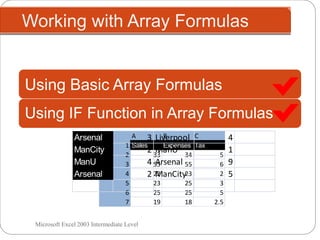
A B C
1 Sales Expenses Tax
2 33 34 5
3 55 55 6
4 22 23 2
5 23 25 3
6 25 25 5
7 19 18 2.5
Using IF Function in Array Formulas
Using Basic Array Formulas
Arsenal 3 Liverpool 4
ManCity 2 ManU 1
ManU 4 Arsenal 9
Arsenal 2 ManCity 5
Section 2: Managing Lists
Creating Lists
Sorting a List
Using AutoFilter
Using Advanced Filter
Using Excel As Database
Microsoft Excel 2003 Intermediate Level
Creating Lists
Microsoft Excel 2003 Intermediate Level
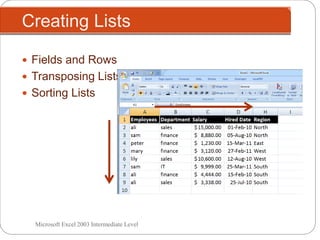
 Fields and Rows
 Transposing Lists
 Sorting Lists
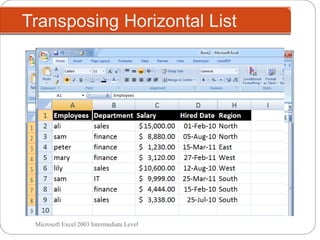
Transposing Horizontal List
Microsoft Excel 2003 Intermediate Level
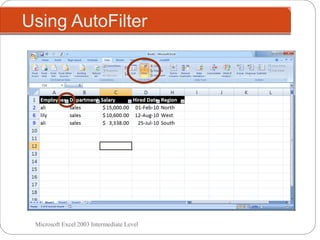
Using AutoFilter
Microsoft Excel 2003 Intermediate Level
Advanced Filter
Microsoft Excel 2003 Intermediate Level
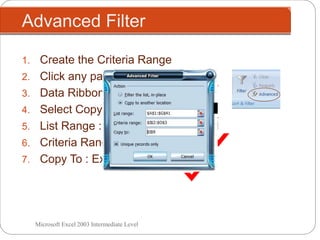
1. Create the Criteria Range
2. Click any part of the source table
3. Data Ribbon > Advanced
4. Select Copy to Another Location
5. List Range : automatically selected
6. Criteria Range : I2:O3
7. Copy To : Extract Range => I9
Using Excel as Database
Microsoft Excel 2003 Intermediate Level
 Validating Your Data
 Creating a List Validation
 Creating a Custom Data Validation
 Database Function
 DAVERAGE
 DCOUNT
 DMAX and DMIN
 DPRODUCT
 DGET
HLOOKUP and VLOOKUP
Microsoft Excel 2003 Intermediate Level
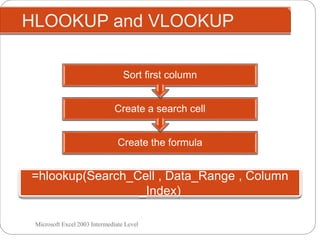
=hlookup(Search_Cell , Data_Range , Column
_Index)
Create the formula
Create a search cell
Sort first column
Using Excel with other Programs
Using Excel in Word
Using Excel with Access
Import data from another program
Microsoft Excel 2003 Intermediate Level
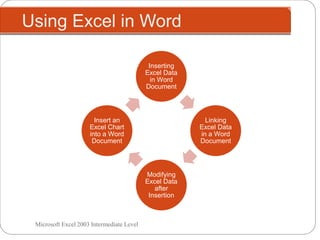
Using Excel in Word
Microsoft Excel 2003 Intermediate Level
Inserting
Excel Data
in Word
Document
Linking
Excel Data
in a Word
Document
Modifying
Excel Data
after
Insertion
Insert an
Excel Chart
into a Word
Document
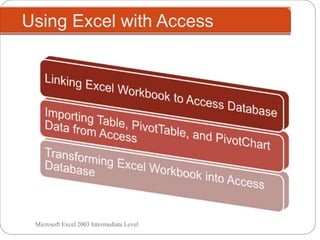
Using Excel with Access
Microsoft Excel 2003 Intermediate Level
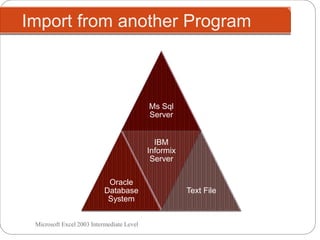
Import from another Program
Microsoft Excel 2003 Intermediate Level
Ms Sql
Server
Oracle
Database
System
IBM
Informix
Server
Text File
Jason Wong
Email : jasonwcc_my@hotmail.com
Contact : +6012-273-6143
Microsoft Excel 2003
Intermediate Level – The End

Ms excel 2003 intermediate

  • 1.
    Presented by Jason Wong Email: jasonwcc_my@hotmail.com Contact : +6012-273-6143 Microsoft Excel 2003 Intermediate Level
  • 2.
    Section 1 :Working with Functions and Formulas 1.1 Using Formulas 1.2 Exploring Excel Functions 1.3 Using Functions 1.4 Working with Names and Ranges 1.5 Working with Array Formulas Microsoft Excel 2003 Intermediate Level
  • 3.
    Using Formulas Microsoft Excel2003 Intermediate Level  Basic Mathematical Operators Operator Function Example = Equivalence =1+2*3 () Parentheses (1+2)*3=9 ^ Exponential 2^3=8 * Multiplication 3*6=18 / Division 12/3=4 + Addition 10+2=12 > Greater Than 2>1=TRUE < Less Than 2<1=FALSE
  • 4.
    =10-5+2 Examples of Formulas MicrosoftExcel 2003 Intermediate Level  Creating Simple Formula =100-5*6=(100-5)*4=2*2^3=(3+3)/2=((4+6)*2)^2=10>2=10-9>2=2+2*3<6+6/3=1+5-2<1*2+5 Answer = 7Answer = 70Answer = 380Answer = 16Answer = 3Answer = 400Answer = TRUEAnswer = FALSEAnswer = FALSEAnswer = TRUE
  • 5.
    Excel Formulas Microsoft Excel2003 Intermediate Level  The Formula Bar  Using Cell Reference  Absolute or Relative Cell Referencing  The Formula Auditing Bar  Trace Dependents and Precedents  Remove Dependencies  Watch Window
  • 6.
    Fixing Formula Errors MicrosoftExcel 2003 Intermediate Level Error Code Meaning… #NAME? You entered something in your formula that Excel interprets as incorrect cell reference, range or function name #REF! A referenced cells has been deleted or accidentally relocated #VALUE! Used text in a formula #DIV/0! Division by zero or an empty cell #NUM! Incorrectly pass in an incorrect argument like text to function that is expecting numerical value ######### Means that a number is too wide to be displayed in the cell. To solve this, auto fit the column width
  • 7.
    Excel Functions Basic Functions Dateand Time Functions Microsoft Excel 2003 Intermediate Level  =sum()  =average()  =min()  =max()  =count()  =sumif()  =countif()  =now()  =day()  =month()  =year()  =date()  =hour()  =minute()
  • 8.
    Microsoft Excel 2003Intermediate Level  Given A1=24th May 2008  Renew car license the following year, same day same month Formula is… =date(year(A1)+1,month(A1),day(A1 )) •Given License date A1=30th August 2009 •Find out the renewal dates which falls on the following year but first day of the month =date(year(a1)+1,month(a 1),1) •Given current road tax on A1=30th August 2009 •Find out the renewal date which falls half a year later, but must be on the 10th of the month =date(year(date), month(date)+6, 10) • Student A borrowed a book on the 15th Feb 2010 • The returning due date of the book is 1 month later =date(year(date), month(date)+1,day(date)) • Student A borrowed a book on the 15th Feb 2010 • Return book at the end of the following month =date(year(date), month(date) +2, 1)-1 DATE Function Scenario
  • 9.
    Financial Functions Microsoft Excel2003 Intermediate Level  PMT  FV PMT Function Arguments =pmt( rate , nper , pv ,fv , type)
  • 10.
    PMT – Example1 Microsoft Excel 2003 Intermediate Level Calculate the monthly repayment for a year loan of 10,000 with an annual interest rate of 6.4%. =PMT(6.4%/12, 12, 10000) If the payments are due at the beginning of the period =PMT(6.4%/12, 12, 10000,0,1)
  • 11.
    PMT – Example2 : Saving Account  How much a student need to save up every month in order to have saving amount of 50,000 at the end of 18 years. Assuming the annual saving interest rate fixed at 1.5% =PMT(1.5%/12,18*12,0,50000) Microsoft Excel 2003 Intermediate Level
  • 12.
    PMT – Example3: EPF saving Microsoft Excel 2003 Intermediate Level  You want to achieve a total saving of 1Million at your retire year (55 yrs old). How much do you need to bank in every month, assuming the following facts  The annual saving interest rate fixed at 5.7%.  You are currently 30 yrs old. =PMT(5.7%/12,(55-30)*12,0,1000000)
  • 13.
    Financial Functions Microsoft Excel2003 Intermediate Level  PMT  FV FV Function Arguments =fv( rate , nper , pmt , pv , type)
  • 14.
    FV – Example1 : Fixed Deposit  Calculate the returns of an investment where you deposit $5,000 into a fixed deposit account that earns 3.9% annually. You are going to deposit $250 at the beginning of the month, each month, for 2 years.  Interest earn on a monthly basis =FV(3.9%/12, 2*12, -250, -5000, 1) Microsoft Excel 2003 Intermediate Level
  • 15.
    FV – Example2 Mutual Fund  Returns the future value of an investment where you deposit $8,000 into a Mutual Fund account that earns 5% annually. You are going to deposit $50 at the end of the week, each week, for 4 years.  Interest earn on a weekly basis =FV(5%/52, 4*52, -50, -8000, 0) Microsoft Excel 2003 Intermediate Level
  • 16.
    FV – Example3 Fixed Deposit  Returns the future value of an investment where you deposit $6,500 into a fixed deposit account that earns 1.95% annually. You are going to deposit $100 at the end of the year, each year, for 10 years.  Interest earn on a yearly basis =FV(1.95%,10,-100,-6500,0) Microsoft Excel 2003 Intermediate Level
  • 17.
    IF Function Microsoft Excel2003 Intermediate Level  Basic IF  Nested IF  Combined conditions with AND | OR operator =if(200*2>300, “Answer is Higher”, “Answer is Lower”) A1=“James” =if(A1=“James”,”Is The Boss”, “Is a Staff”)=if(Condition, True, False)
  • 18.
    Working with ArrayFormulas Microsoft Excel 2003 Intermediate Level A B C 1 Sales Expenses Tax 2 33 34 5 3 55 55 6 4 22 23 2 5 23 25 3 6 25 25 5 7 19 18 2.5 Using IF Function in Array Formulas Using Basic Array Formulas Arsenal 3 Liverpool 4 ManCity 2 ManU 1 ManU 4 Arsenal 9 Arsenal 2 ManCity 5
  • 19.
    Section 2: ManagingLists Creating Lists Sorting a List Using AutoFilter Using Advanced Filter Using Excel As Database Microsoft Excel 2003 Intermediate Level
  • 20.
    Creating Lists Microsoft Excel2003 Intermediate Level  Fields and Rows  Transposing Lists  Sorting Lists
  • 21.
    Transposing Horizontal List MicrosoftExcel 2003 Intermediate Level
  • 22.
    Using AutoFilter Microsoft Excel2003 Intermediate Level
  • 23.
    Advanced Filter Microsoft Excel2003 Intermediate Level 1. Create the Criteria Range 2. Click any part of the source table 3. Data Ribbon > Advanced 4. Select Copy to Another Location 5. List Range : automatically selected 6. Criteria Range : I2:O3 7. Copy To : Extract Range => I9
  • 24.
    Using Excel asDatabase Microsoft Excel 2003 Intermediate Level  Validating Your Data  Creating a List Validation  Creating a Custom Data Validation  Database Function  DAVERAGE  DCOUNT  DMAX and DMIN  DPRODUCT  DGET
  • 25.
    HLOOKUP and VLOOKUP MicrosoftExcel 2003 Intermediate Level =hlookup(Search_Cell , Data_Range , Column _Index) Create the formula Create a search cell Sort first column
  • 26.
    Using Excel withother Programs Using Excel in Word Using Excel with Access Import data from another program Microsoft Excel 2003 Intermediate Level
  • 27.
    Using Excel inWord Microsoft Excel 2003 Intermediate Level Inserting Excel Data in Word Document Linking Excel Data in a Word Document Modifying Excel Data after Insertion Insert an Excel Chart into a Word Document
  • 28.
    Using Excel withAccess Microsoft Excel 2003 Intermediate Level
  • 29.
    Import from anotherProgram Microsoft Excel 2003 Intermediate Level Ms Sql Server Oracle Database System IBM Informix Server Text File
  • 30.
    Jason Wong Email :jasonwcc_my@hotmail.com Contact : +6012-273-6143 Microsoft Excel 2003 Intermediate Level – The End

Editor's Notes

  • #4 Operators = ( ) parentheses ^ Exponent * / + - > Greater than < lesser than
  • #5 Q&A Quiz
  • #6 The Formula Bar View > Formula Bar - F2 to edit Cell Reference - Shows how to use =A1+B2/3 Absolute referencing Press F4 Formula Auditing Bar View > Toolbars > Tick on Formula Auditing Evaluate formula Click on cell containing formula Formulas > Evaluate formula Error Checking Search entire sheet for errorneous formulas Formulas > Error Checking Trace Error Show Formulas on sheets Options > Advanced > Display options > Show Formulas in cells instead of their calculated results Or Formulas > Show formula Trace Dependents and Precedents Dependents -> look for the formula Precedents -> look for the data
  • #7 The Formula Bar View > Formula Bar - F2 to edit ErrorCode #NAME? =sum(a1:b3) chg to =sam(a1:b3) #REF! A1=4 B1=2 C1=A1+B1 Delete entire column of B1 #VALUE! =A1+B1+”Data” #DIV/0! =5/0 #NUM! limited range to due the design of Excel Use mod() A1=10, A2=5, A3=mod(a1,a2) Mod(number, dividsor) If the number=> dividsor*134,217,728 will get #num! Note: due to only 27 bits assign to the 134,217,728 Cell Reference - Shows how to use =A1+B2/3 Absolute referencing Press F4 Evaluate formula Click on cell containing formula Formulas > Evaluate formula Error Checking Search entire sheet for errorneous formulas Formulas > Error Checking Trace Error Show Formulas on sheets Options > Advanced > Display options > Show Formulas in cells instead of their calculated results Or Formulas > Show formula Watch Window Actively monitor the changes on the specific formula across spreadsheet Demo : Sheet1 A1=20 Sheet2 A1=40 Sheet3 A1=Sheet1!A1+Sheet2!A1/2 Formula > Watch Window > Add Watch > Sheet3!A1 Trace Dependents and Precedents Dependents -> look for the formula Precedents -> look for the data
  • #8 Count() – count range of numbers Countif() – count both numbers and text
  • #9 Q&A 1. Given A1=24th May 2008 Renew car license the following year, same day same month Answer : =date(year(A1)+1,month(A1),day(A1) 2. Renew car license the following year but first day of the month Answer : =DATE(YEAR(A1)+1,MONTH(A1),1) 3. Renew car road tax half a year later, but must be on the 10th day of the month Answer :=date(year(A1), month(A1)+6, 10) 4. Return book at the end of the following month Answer := date(year(date), month(date) +2, 1)-1
  • #10 To find Monthly Payment =PMT( ) Rate : interest rate Nper : Number of Payment Pv : Current | Principal | Present Value Fv : Future Value | Expected ROI Type : 1 beginning or 0 end (default) Example : next slide To find Return Of Investment | Future Value
  • #11 1st col => 6.4%/12 bcos over a year 2nd col => 12 payments 3rd col => pv present loan amount value 4th col => fv, amount left outstanding after full repayment default 0 5th col => type of payments, 0 due at end of payment period, 1 due at the beginning of payment period
  • #12 1.5% / 12 – due to the fact interest pay out on monthly basis and by increment onto the principal 18* 12 - number of payments (18 years * 12 months( 0 - no starting value
  • #13 1.5% / 12 – due to the fact interest pay out on monthly basis and by increment onto the principal 18* 12 - number of payments (18 years * 12 months( 0 - no starting value
  • #14 To find Return Of Investment | Future Value =FV() rate : interest rate (if over number a year , must be divided by /12 ) Nper : number of payment Pmt : what is the monthly installment Pv : present value | upfront sum | principal Type : payment type : the end 0, the beginning 1, default to 0)
  • #15 This first example returns the future value of an investment where you deposit $5,000 into a savings account that earns 3.9% annually. You are going to deposit $250 at the beginning of the month, each month, for 2 years. =FV(3.9%/12, 2*12, -250, -5000, 1) 5th col : payment due at the beginning of the month
  • #16 This next example returns the future value of an investment where you deposit $8,000 into a savings account that earns 6% annually. You are going to deposit $50 at the end of the week, each week, for 4 years. =FV(6%/52, 4*52, -50, -8000, 0)
  • #19 Array Protection: Whenever there is a change the whole array need to change simultaneously, no single cell changes alone. Basic Array Formula Demo 1: Type in random numbers in A2 to C7 (3 columns) Now highlight D2 to F7 (must be same block size) Create a formula, say to increase all numbers by 3% =A2:C7*103/100 Make sure to Ctrl+Shft+Enter Using IF in Array Demo 2: From the table in demo 1, highlight G2 to G7 =if(A2:A7=B2:B7,A2:A7,”Not Same”) Ctrl+shft+enter Next, sum up the similar numbers G8 = sum(if(A2:A7=B2:B7,A2:A7,”Not Same”)) Ctrl+shft+enter Demo 3: Using table 2 : Score Board Highlight D1 to D4 =IF(D1:D4>F1:F4,C1:C4,E1:E4) , ctrl+shft+enter
  • #23 Data > Filter > AutoFilter The top 10… Custom
  • #24 The Steps Create the Criteria Range Copy A1:G1 to I2 Type west under the region Click in table Data Ribbon > Advanced Tick on Copy to another … Criteria Range : I2:O3 Now try with another criteria Multiple region Range of sales >500 and <1000 Create 2 sales column in the criteria range Text : Customer name Begins with “The*” Containing the words *pets* Ends with *Store
  • #25 Validation : Start from Advanced Filter sheet Highlight data range Data > Validation Apply validation to: Price <6 Date between 1/1/2009 and 31/12/2009 List Validation SalesRep Departments list Custom Data Validation : Use the Validation sheet Demo 0 : Accept Card F10 Custom List =OR(F4=“Master”,F4=“Visa”) Demo1 : Code cant be used more than once D3:D25 Data validation Custom =countif($d$3:$d$25,a2) <= 1 Demo2 : Method Used cannot be more than twice G3:G7 Data Validation Custom =countif($G$3:$G$7,G3)<=2 Demo3 : Budget constraint to <=10000 F3:F7 Data validation > custom =sum($F$3:$F$7)<=10000 Demo4: No Leading or Trailing Spaces Highlight E3 to E7 =E3=TRIM(E3) Demo5: Prohibit Weekend Dates H3 Data Validation > Custom =WEEKDAY(B2,2) <=5 Higlight H3:H7 Yes to extend them NOTES: -Works on text too, Unfortunately, if user copy content from another cell, it will not blocks Database Function =dfunction(database_range, fields, criteria) Database_range must include the headers Fields can be the number of columns in the DB or field cell reference Criteria as defined in advanced Filter DPRODUCT – answer is multiplication of all the found data according to the criteria Example Using advanced Filter sheet Set the criteria to Region=East , SalesRep=Barone , Quantity<2 DGET - to returns a single record matching criteria. If there is more then one records found, #NUM! will be shown If no records found, #VALUE! Will be shown
  • #26 Search cell : cell containing the data to search (must be on the first column of your data list) Data range : starting from first row on ward Column Index : number , indicating which column to the right to extract
  • #27 Range Name To access frequently used cells To give a meaningfull name to cell range for more readability and clarity For repeating messages Like having one spreadsheet with company name, address, greetings message with name range, then insert name range into any other spreadsheet Formula > Define Name Or Select the cell or cells > on formula bar > enter a name NOTE: Acceptable names letters only No spaces Underscore Hold ctrl to select non-adjacent ranges Create Range Name from Selection Type in A1=Jan B1=Feb C1=Mar A2-C5 = any numbers Highlight A1:C5 or ctrl+a Formulas > Create From Selection , Top column Now type D2=Sales, D3=Profit, D4=Expenses Ctrl+a, Formulas > Create From Selection, top and right column Autocalculate allows you to view result of some basic calculation without having to enter a formula or function Right click any part at the status bar. Tick those function you want to see, untick not to view them
  • #28 Import data from another program such as txt file
  • #29 Copy and Paste from Excel to Word has limited options such as formatting Linking from Word Open Word Insert Excel Chart into Word Doc Excel Select any table > F11 From the chart sheet Just click copy button Open Word > Paste
  • #30 Click and drag
  • #31 Click and drag
  • #32 Passwod : canlogin on the Function Exercise sheet