Title slide
     Light-matter interaction

     from:    dielectric catastrophe
     to:      localization
Content
     dielectric response
     there is a wavevector
     there is dispersion
     density of states
Dielectric response ...
      dielectric response
      there is a wavevector
      there is dispersion
      density of states
Restriction to dielectrics
      dielectric response
      no magnetic response
      no combined response
Restriction to linear response
      all amplitude-like observables scale with
      a single, overall amplitude factor

      all intensity-like observables scale with this
      factor squared
Light-matter interaction
    Light sees variation in speed of light


    Spatial variation in index of refraction
Describing wave propagation
    Why not solving the wave equation
    Problems:
    1.   often not possible
    2.   does not give necessarily insight
    3.   each case has to be done all over again
Non-stationary interaction
          varying with time: very complicated

    all our standard approaches fail unless:
      • fully adiabatic
         or
      • fully diabatic
Stationary interaction from now
    interaction is time-independent
    measurements might be time-dependent
Use symmetry
   time reversal
Translational symmetry
    If there is no translational symmetry
         there is no wavevector
         there is no dispersion relation
         you only have eigenfunctions,
         and you have many of them
When is there a wavevector?
      effective medium
      average over disorder
      lattice
      asymptotically free space
There is a wave vector
    From now on:
    there is a wavevector
There is a wave vector ...
      dielectric response
      there is a wavevector
      there is dispersion
      density of states
We have translational symmetry
    Translational symmetry
       full translational symmetry
       full translational symmetry after averaging
       lattice
Stationary
    Unless I state explicitly otherwise:
    stationary potential
    stationary measurement
       DC, no pulse, no frequency change, ...
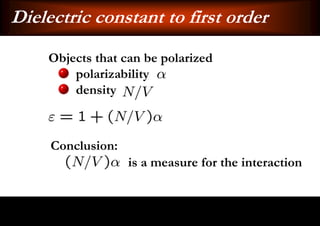
Dielectric constant to first order
    Objects that can be polarized
        polarizability
        density


     Conclusion:
                   is a measure for the interaction
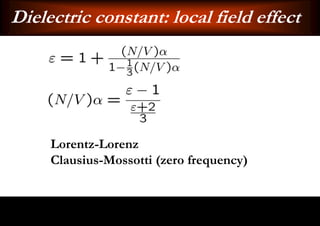
Dielectric constant: local field effect


     Lorentz-Lorenz
     Clausius-Mossotti (zero frequency)
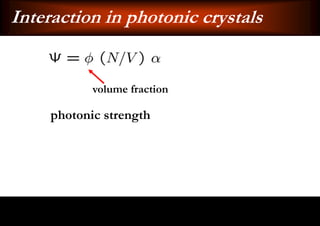
Interaction in photonic crystals


            volume fraction

     photonic strength
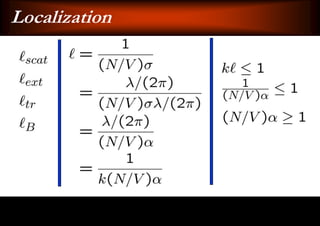
Localization
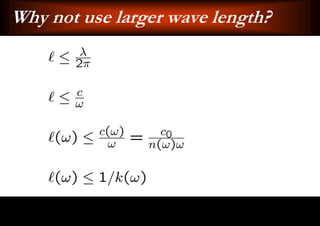
Why not use larger wave length?
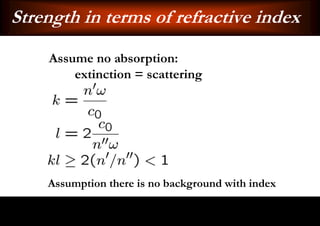
Strength in terms of refractive index
    Assume no absorption:
        extinction = scattering


    Assumption there is no background with index
Is this localization?
     Where is the dispersion?
There is dispersion ...
      dielectric response
       there is a wavevector
      there is dispersion
      density of states
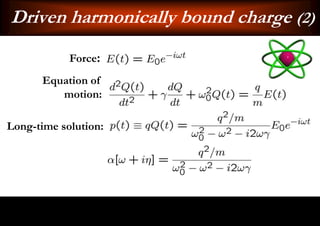
Driven harmonically bound charge (2)
            Force:
      Equation of
         motion:

Long-time solution:
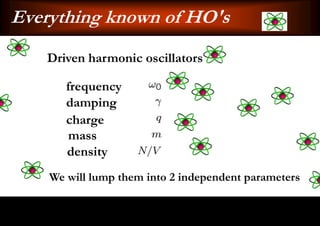
Everything known of HO's
   Driven harmonic oscillators

       frequency
       damping
       charge
       mass
       density
    We will lump them into 2 independent parameters
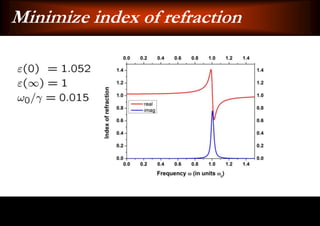
Minimize index of refraction
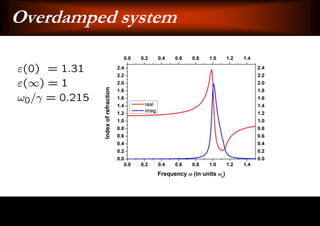
Overdamped system
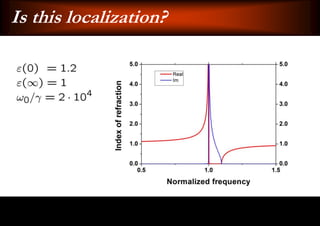
Is this localization?
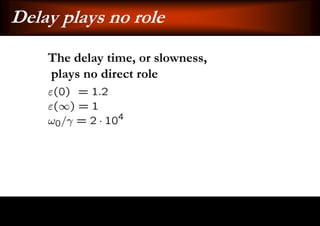
Delay plays no role
    The delay time, or slowness,
    plays no direct role
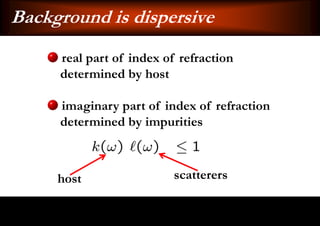
Background is dispersive
     real part of index of refraction
     determined by host

     imaginary part of index of refraction
     determined by impurities


     host                 scatterers
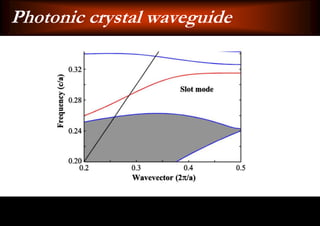
Photonic crystal waveguide
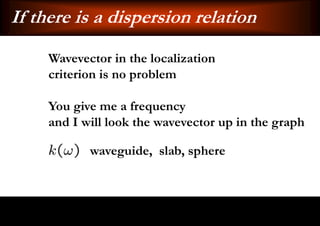
If there is a dispersion relation
     Wavevector in the localization
     criterion is no problem

     You give me a frequency
     and I will look the wavevector up in the graph

            waveguide, slab, sphere
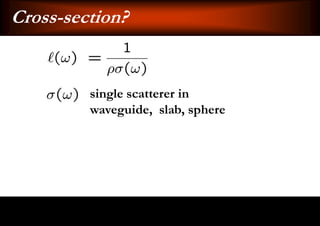
Cross-section?


         single scatterer in
         waveguide, slab, sphere
Is this localization?
     Where is the density of states?
Density of states ...
      introducing group
      there is a wavevector
      there is dispersion
      density of states
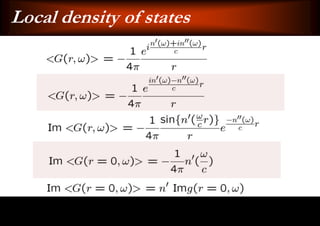
Local density of states
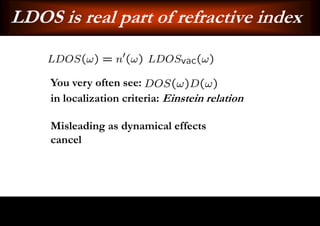
LDOS is real part of refractive index


     You very often see:
     in localization criteria: Einstein relation

     Misleading as dynamical effects
     cancel
Criterion
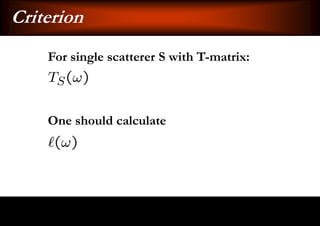
    For single scatterer S with T-matrix:


    One should calculate
The end
     introducing group
     there is a wavevector
     there is dispersion
      density of states

Example Presentation at SlideShare

  • 1.
    Title slide Light-matter interaction from: dielectric catastrophe to: localization
  • 2.
    Content dielectric response there is a wavevector there is dispersion density of states
  • 3.
    Dielectric response ... dielectric response there is a wavevector there is dispersion density of states
  • 4.
    Restriction to dielectrics dielectric response no magnetic response no combined response
  • 5.
    Restriction to linearresponse all amplitude-like observables scale with a single, overall amplitude factor all intensity-like observables scale with this factor squared
  • 6.
    Light-matter interaction Light sees variation in speed of light Spatial variation in index of refraction
  • 7.
    Describing wave propagation Why not solving the wave equation Problems: 1. often not possible 2. does not give necessarily insight 3. each case has to be done all over again
  • 8.
    Non-stationary interaction varying with time: very complicated all our standard approaches fail unless: • fully adiabatic or • fully diabatic
  • 9.
    Stationary interaction fromnow interaction is time-independent measurements might be time-dependent
  • 10.
    Use symmetry time reversal
  • 11.
    Translational symmetry If there is no translational symmetry there is no wavevector there is no dispersion relation you only have eigenfunctions, and you have many of them
  • 12.
    When is therea wavevector? effective medium average over disorder lattice asymptotically free space
  • 13.
    There is awave vector From now on: there is a wavevector
  • 14.
    There is awave vector ... dielectric response there is a wavevector there is dispersion density of states
  • 15.
    We have translationalsymmetry Translational symmetry full translational symmetry full translational symmetry after averaging lattice
  • 16.
    Stationary Unless I state explicitly otherwise: stationary potential stationary measurement DC, no pulse, no frequency change, ...
  • 17.
    Dielectric constant tofirst order Objects that can be polarized polarizability density Conclusion: is a measure for the interaction
  • 18.
    Dielectric constant: localfield effect Lorentz-Lorenz Clausius-Mossotti (zero frequency)
  • 19.
    Interaction in photoniccrystals volume fraction photonic strength
  • 20.
  • 21.
    Why not uselarger wave length?
  • 22.
    Strength in termsof refractive index Assume no absorption: extinction = scattering Assumption there is no background with index
  • 23.
    Is this localization? Where is the dispersion?
  • 24.
    There is dispersion... dielectric response there is a wavevector there is dispersion density of states
  • 25.
    Driven harmonically boundcharge (2) Force: Equation of motion: Long-time solution:
  • 26.
    Everything known ofHO's Driven harmonic oscillators frequency damping charge mass density We will lump them into 2 independent parameters
  • 27.
  • 28.
  • 29.
  • 30.
    Delay plays norole The delay time, or slowness, plays no direct role
  • 31.
    Background is dispersive real part of index of refraction determined by host imaginary part of index of refraction determined by impurities host scatterers
  • 32.
  • 33.
    If there isa dispersion relation Wavevector in the localization criterion is no problem You give me a frequency and I will look the wavevector up in the graph waveguide, slab, sphere
  • 34.
    Cross-section? single scatterer in waveguide, slab, sphere
  • 35.
    Is this localization? Where is the density of states?
  • 36.
    Density of states... introducing group there is a wavevector there is dispersion density of states
  • 37.
  • 38.
    LDOS is realpart of refractive index You very often see: in localization criteria: Einstein relation Misleading as dynamical effects cancel
  • 39.
    Criterion For single scatterer S with T-matrix: One should calculate
  • 40.
    The end introducing group there is a wavevector there is dispersion density of states