Interference & Diffraction
Presentation
By
Aziz Lokhandwala
An Intro to YDSE Experiment
As you all know, that Young’s Double slit experiment verifies the wave nature
of light by principle of superposition. But, I want to say that this is one of the
biggest misconception which is within us due to our high school education. I
will discuss on this misconception with some evidences in further slides. Now,
one other question is why there are two slits in YDSE experiment for light.
Answer to above question is as follows:
Due to thermal agitation or due to acceleration of particles, atoms gain excess
energy due to which as per EM theory for radiation it will start losing all its
energy till it comes to zero energy state. Thus, due to this, light source is not
able to maintain constant phase difference.
An Intro to Diffraction
Diffraction is probably similar to interference which was observed due to
superposition of waves at different points. But diffraction is mostly produced
when a plane wave is passed through slit and then some pattern is observed
on the screen. Scientists are quite interested in diffraction and interference
because they are the key terms for a proper start to quantum mechanics and I
will give reason for this in further slides.
What is the difference between Interference and
Diffraction ?
Answer to above question seems to be quite complicated because diffraction
and interference occur for n number of slits. But actually it’s quite easy
because interference is interference and diffraction is diffraction and it’s
obvious that both are intricated with each other. But, …
“Interference is due to superposition of waves while diffraction is due to
superposition of wavelets”~My understanding
“Interference is considered when few light sources are present while
diffraction is considered when more light sources are present” ~R. Feynman
Application of diffraction in proving one of the
most fundamental concept of Quantum Mechanics
To prove : The uncertainty principle simply states that a particle’s (say
electron) momentum and position cannot be determined simultaneously or
you can also say that a particle energy and time cannot be measured
simultaneously with a desired accuracy.
Consider a beam of electrons travelling along X- Axis as shown in figure. The
slit width of our diffraction apparatus is perpendicular to the path of motion
of electrons. Now, before entering the slit, the momentum of electron was
well defined. After passing through the slit, the electron will acquire
momentum in direction other than X -Axis in terms of some vector position of
(x , y , z).
Now, in case of this experiment our useful stuff is to observe firstly first
minimum because it’s expression would be quite easy for simplification and
we can manipulate that equation extremely for boundary values.
∆d sinø = λ,
Now because ø → 0, sinø → ø, therefore,
∆d . ø = λ
∆d = λ/ ø …(1.1)
Now because § depends upon the component of momentum parallel to the
slit and also we have to consider § → 0 for very small deflection, following
results are obtained,
∆p = p . § …(1.2)
Now on multiplying (1.1) and (1.2), following results can be derived,
∆x . ∆p = λ . p .(§/ø) … (1.3)
Now we know that De Broglie Wavelength associated with a massive particle
like electron can be given as,
λ = h / p …(1.4)
Now using (1.4) in (1.3), we can arrive at a result which almost explains
uncertainty principle, the result is as follows:
∆x . ∆p = h .(§/ø) … (1.5)
Now, our question is regarding the angle ratio we are having. The answer can
be derived experimentally and theoretically, experimentally that ratio was
roughly 1/(2.π), but it can be proved theoretically too.
Gravity and Interference experiment
The scientists research topic is mostly regarding double slit experiment
because when an electron comes towards the two slits, the probability of an
electron arriving at detector is not equivalent to the sum of the probabilities
when slits are open one by one. The superposition principle of quantum
theory tells us to add their amplitudes rather than probabilities. This thing
defies our classical understanding that probabilities of exclusive events add
up to each other. So now or task is to prove that, without thermal agitation,
what makes light sources decoherent. The second is to show that unruh
effect holds true in an accelerating frame which shows that in an accelerating
frame background appears to be warm while in an inertial frame nothing
would be observe.
The answer to the proposed question is the gravity which becomes
responsible for decoherence when experiment is performed in thermal
environment.
Source : https://arxiv.org/pdf/1706.04401.pdf
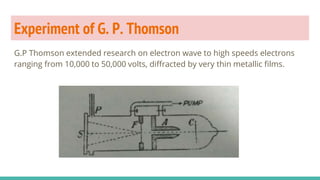
Experiment of G. P. Thomson
G.P Thomson extended research on electron wave to high speeds electrons
ranging from 10,000 to 50,000 volts, diffracted by very thin metallic films.
Apparatus : A beam of cathode rays is produced in a discharge tube AC by
means of an induction coil. The rays are then passed through the diaphragm
of tube A, to obtain a s stream of electrons which is then allowed to fall upon a
very thin metallic film F of gold, silver or aluminium. The thickness of strip
must be in order of 10−8 m. P is the photographic plate which can be slided
down to have stream of electrons shoot on it, and lastly S is the fluorescent
screen.
Procedure : Allow the stream of electrons of known velocity to fall on the
photographic plate. This leads to formation of a diffraction ring pattern and to
make sure that this pattern is produced by electrons and not by the
secondary X-rays generated by the electrons in their passage through the foil ,
the cathode rays in discharge tube are deflected by means of magnetic field
when it found that pattern is observed on S simultaneously.
Result:This experiment simply states that electron stream behave as waves.
THANK YOU

Interference and Diffraction in Light Waves

  • 1.
  • 2.
    An Intro toYDSE Experiment As you all know, that Young’s Double slit experiment verifies the wave nature of light by principle of superposition. But, I want to say that this is one of the biggest misconception which is within us due to our high school education. I will discuss on this misconception with some evidences in further slides. Now, one other question is why there are two slits in YDSE experiment for light. Answer to above question is as follows: Due to thermal agitation or due to acceleration of particles, atoms gain excess energy due to which as per EM theory for radiation it will start losing all its energy till it comes to zero energy state. Thus, due to this, light source is not able to maintain constant phase difference.
  • 3.
    An Intro toDiffraction Diffraction is probably similar to interference which was observed due to superposition of waves at different points. But diffraction is mostly produced when a plane wave is passed through slit and then some pattern is observed on the screen. Scientists are quite interested in diffraction and interference because they are the key terms for a proper start to quantum mechanics and I will give reason for this in further slides.
  • 4.
    What is thedifference between Interference and Diffraction ? Answer to above question seems to be quite complicated because diffraction and interference occur for n number of slits. But actually it’s quite easy because interference is interference and diffraction is diffraction and it’s obvious that both are intricated with each other. But, … “Interference is due to superposition of waves while diffraction is due to superposition of wavelets”~My understanding “Interference is considered when few light sources are present while diffraction is considered when more light sources are present” ~R. Feynman
  • 5.
    Application of diffractionin proving one of the most fundamental concept of Quantum Mechanics To prove : The uncertainty principle simply states that a particle’s (say electron) momentum and position cannot be determined simultaneously or you can also say that a particle energy and time cannot be measured simultaneously with a desired accuracy. Consider a beam of electrons travelling along X- Axis as shown in figure. The slit width of our diffraction apparatus is perpendicular to the path of motion of electrons. Now, before entering the slit, the momentum of electron was well defined. After passing through the slit, the electron will acquire momentum in direction other than X -Axis in terms of some vector position of (x , y , z).
  • 6.
    Now, in caseof this experiment our useful stuff is to observe firstly first minimum because it’s expression would be quite easy for simplification and we can manipulate that equation extremely for boundary values. ∆d sinø = λ, Now because ø → 0, sinø → ø, therefore, ∆d . ø = λ ∆d = λ/ ø …(1.1) Now because § depends upon the component of momentum parallel to the slit and also we have to consider § → 0 for very small deflection, following results are obtained, ∆p = p . § …(1.2)
  • 7.
    Now on multiplying(1.1) and (1.2), following results can be derived, ∆x . ∆p = λ . p .(§/ø) … (1.3) Now we know that De Broglie Wavelength associated with a massive particle like electron can be given as, λ = h / p …(1.4) Now using (1.4) in (1.3), we can arrive at a result which almost explains uncertainty principle, the result is as follows: ∆x . ∆p = h .(§/ø) … (1.5) Now, our question is regarding the angle ratio we are having. The answer can be derived experimentally and theoretically, experimentally that ratio was roughly 1/(2.π), but it can be proved theoretically too.
  • 8.
    Gravity and Interferenceexperiment The scientists research topic is mostly regarding double slit experiment because when an electron comes towards the two slits, the probability of an electron arriving at detector is not equivalent to the sum of the probabilities when slits are open one by one. The superposition principle of quantum theory tells us to add their amplitudes rather than probabilities. This thing defies our classical understanding that probabilities of exclusive events add up to each other. So now or task is to prove that, without thermal agitation, what makes light sources decoherent. The second is to show that unruh effect holds true in an accelerating frame which shows that in an accelerating frame background appears to be warm while in an inertial frame nothing would be observe.
  • 9.
    The answer tothe proposed question is the gravity which becomes responsible for decoherence when experiment is performed in thermal environment. Source : https://arxiv.org/pdf/1706.04401.pdf
  • 10.
    Experiment of G.P. Thomson G.P Thomson extended research on electron wave to high speeds electrons ranging from 10,000 to 50,000 volts, diffracted by very thin metallic films.
  • 11.
    Apparatus : Abeam of cathode rays is produced in a discharge tube AC by means of an induction coil. The rays are then passed through the diaphragm of tube A, to obtain a s stream of electrons which is then allowed to fall upon a very thin metallic film F of gold, silver or aluminium. The thickness of strip must be in order of 10−8 m. P is the photographic plate which can be slided down to have stream of electrons shoot on it, and lastly S is the fluorescent screen. Procedure : Allow the stream of electrons of known velocity to fall on the photographic plate. This leads to formation of a diffraction ring pattern and to make sure that this pattern is produced by electrons and not by the secondary X-rays generated by the electrons in their passage through the foil , the cathode rays in discharge tube are deflected by means of magnetic field when it found that pattern is observed on S simultaneously. Result:This experiment simply states that electron stream behave as waves.
  • 12.