Questions
Humerus
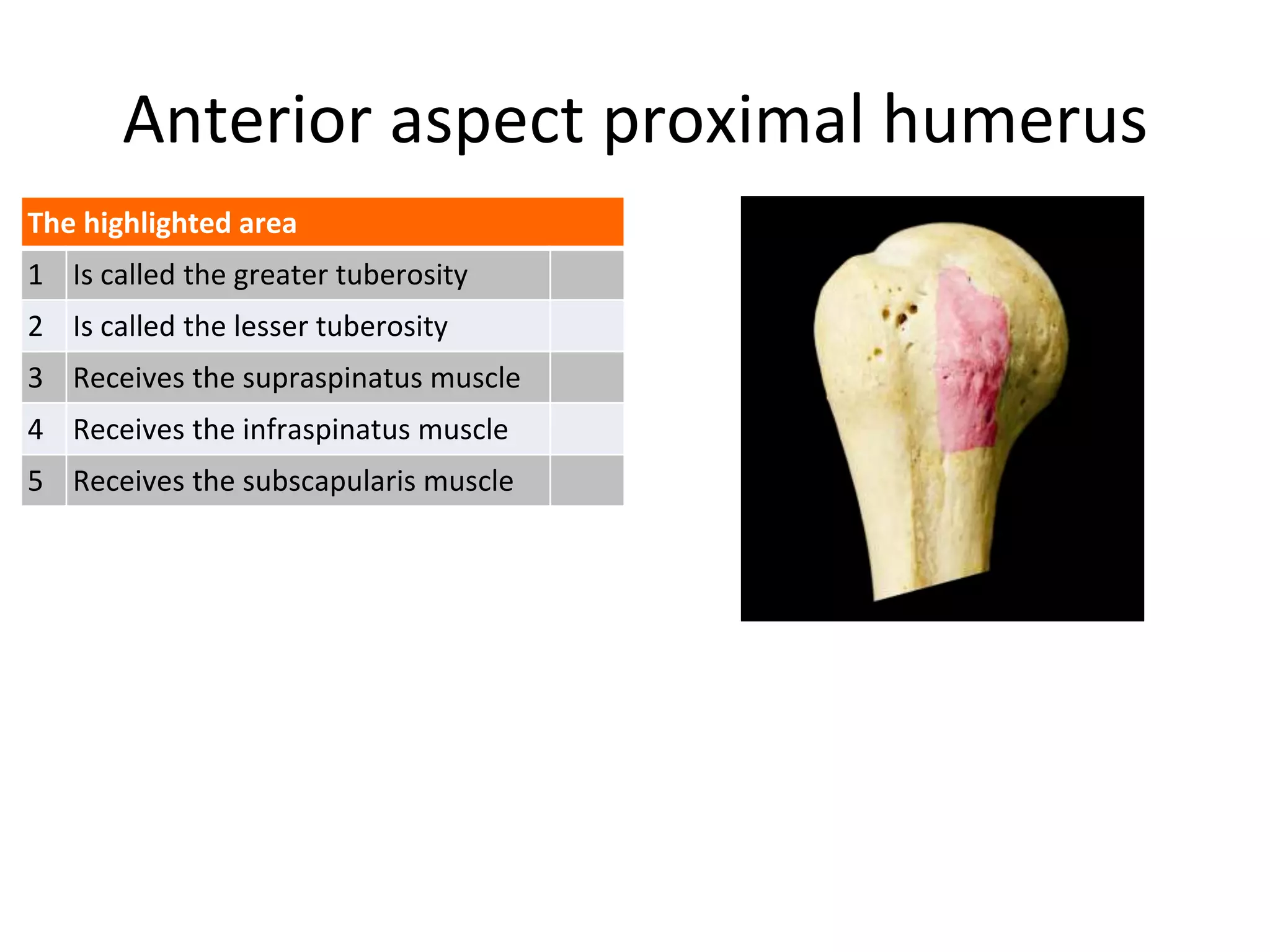
Anterior aspect proximal humerus
The highlighted area
1 Is called the greater tuberosity
2 Is called the lesser tuberosity
3 Receives the supraspinatus muscle
4 Receives the infraspinatus muscle
5 Receives the subscapularis muscle
Anterior aspect proximal humerus
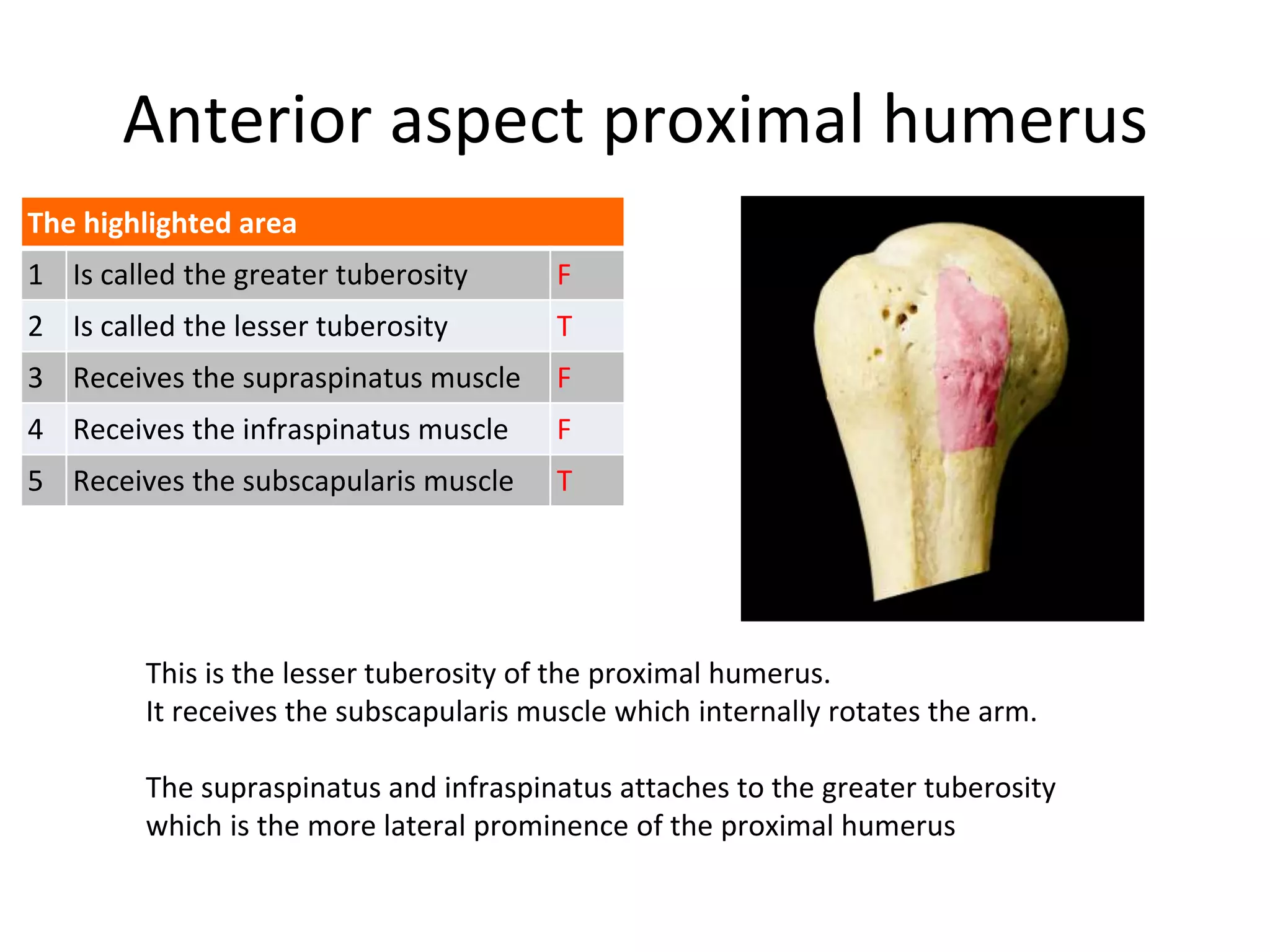
This is the lesser tuberosity of the proximal humerus.
It receives the subscapularis muscle which internally rotates the arm.
The supraspinatus and infraspinatus attaches to the greater tuberosity
which is the more lateral prominence of the proximal humerus
The highlighted area
1 Is called the greater tuberosity F
2 Is called the lesser tuberosity T
3 Receives the supraspinatus muscle F
4 Receives the infraspinatus muscle F
5 Receives the subscapularis muscle T
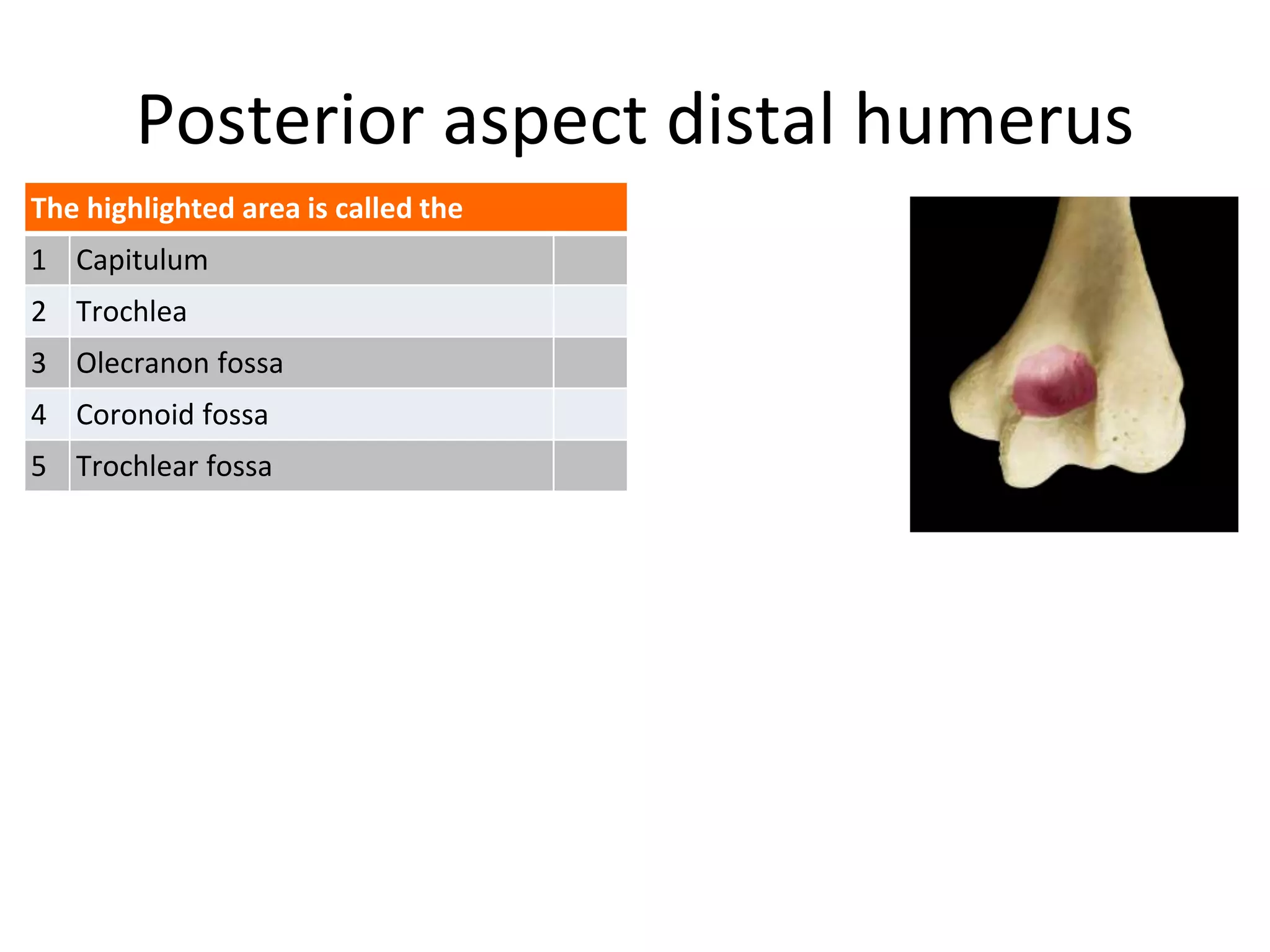
Posterior aspect distal humerus
The highlighted area is called the
1 Capitulum
2 Trochlea
3 Olecranon fossa
4 Coronoid fossa
5 Trochlear fossa
Posterior aspect distal humerus
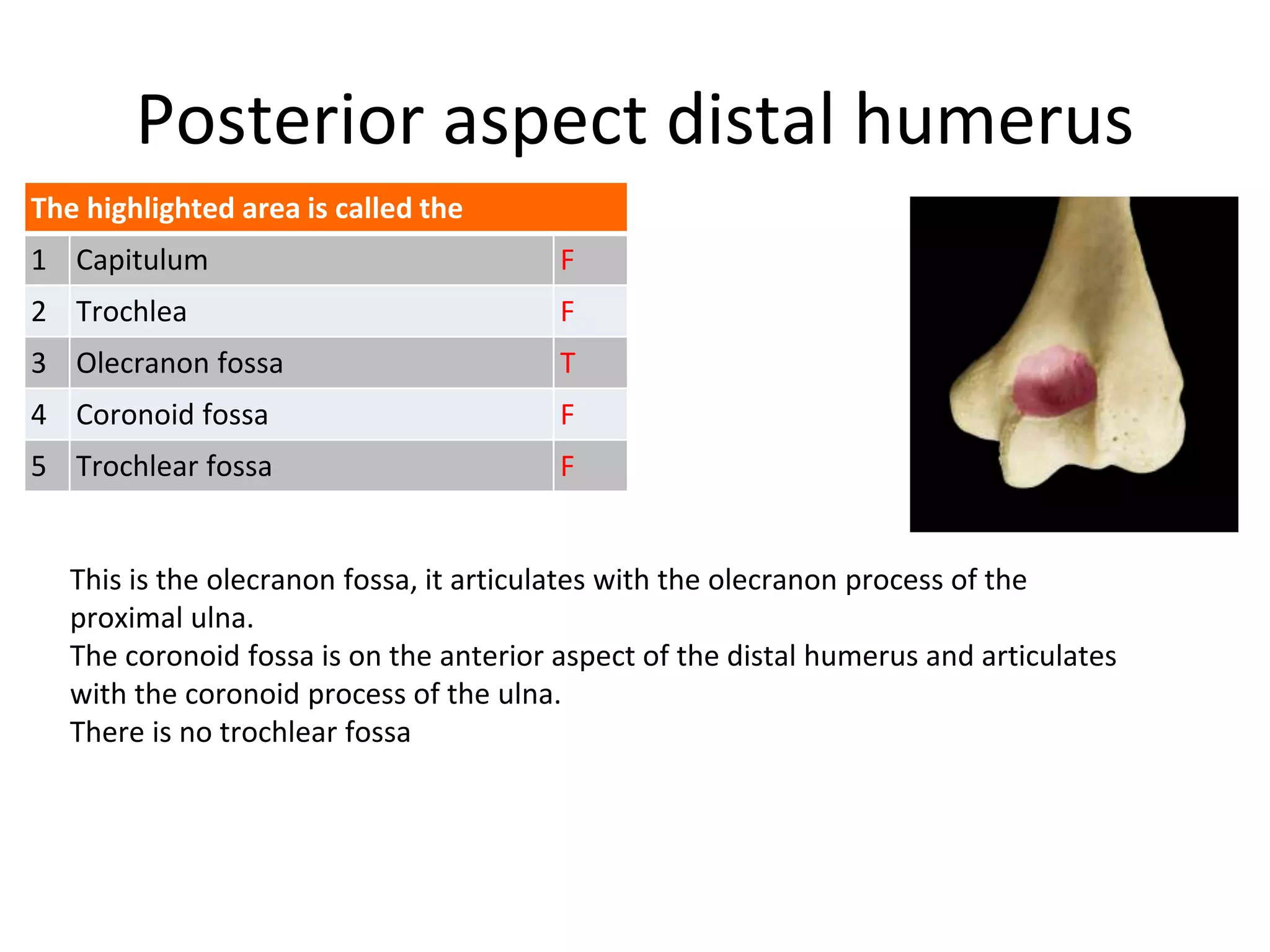
This is the olecranon fossa, it articulates with the olecranon process of the
proximal ulna.
The coronoid fossa is on the anterior aspect of the distal humerus and articulates
with the coronoid process of the ulna.
There is no trochlear fossa
The highlighted area is called the
1 Capitulum F
2 Trochlea F
3 Olecranon fossa T
4 Coronoid fossa F
5 Trochlear fossa F
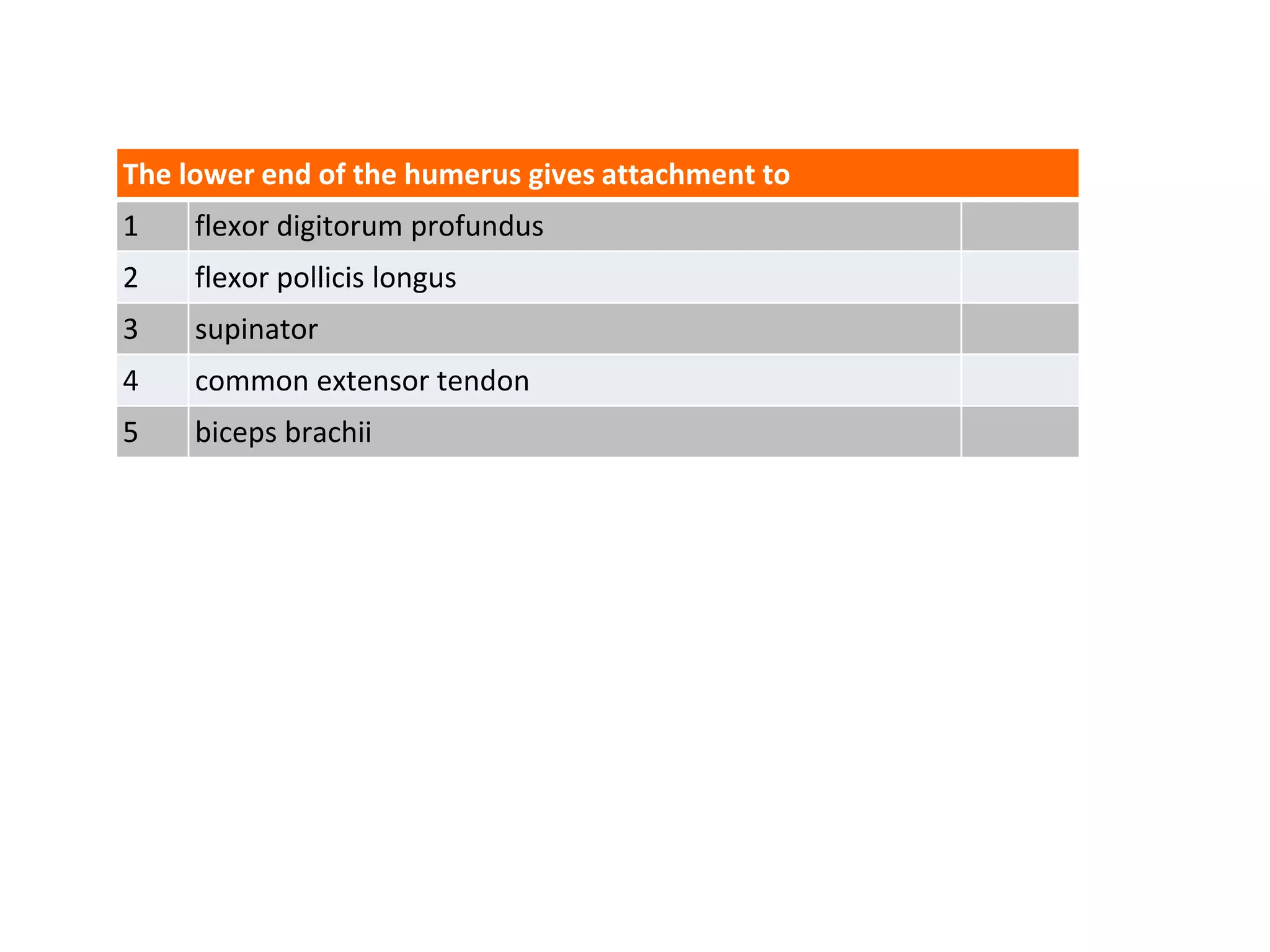
The lower end of the humerus gives attachment to
1 flexor digitorum profundus
2 flexor pollicis longus
3 supinator
4 common extensor tendon
5 biceps brachii
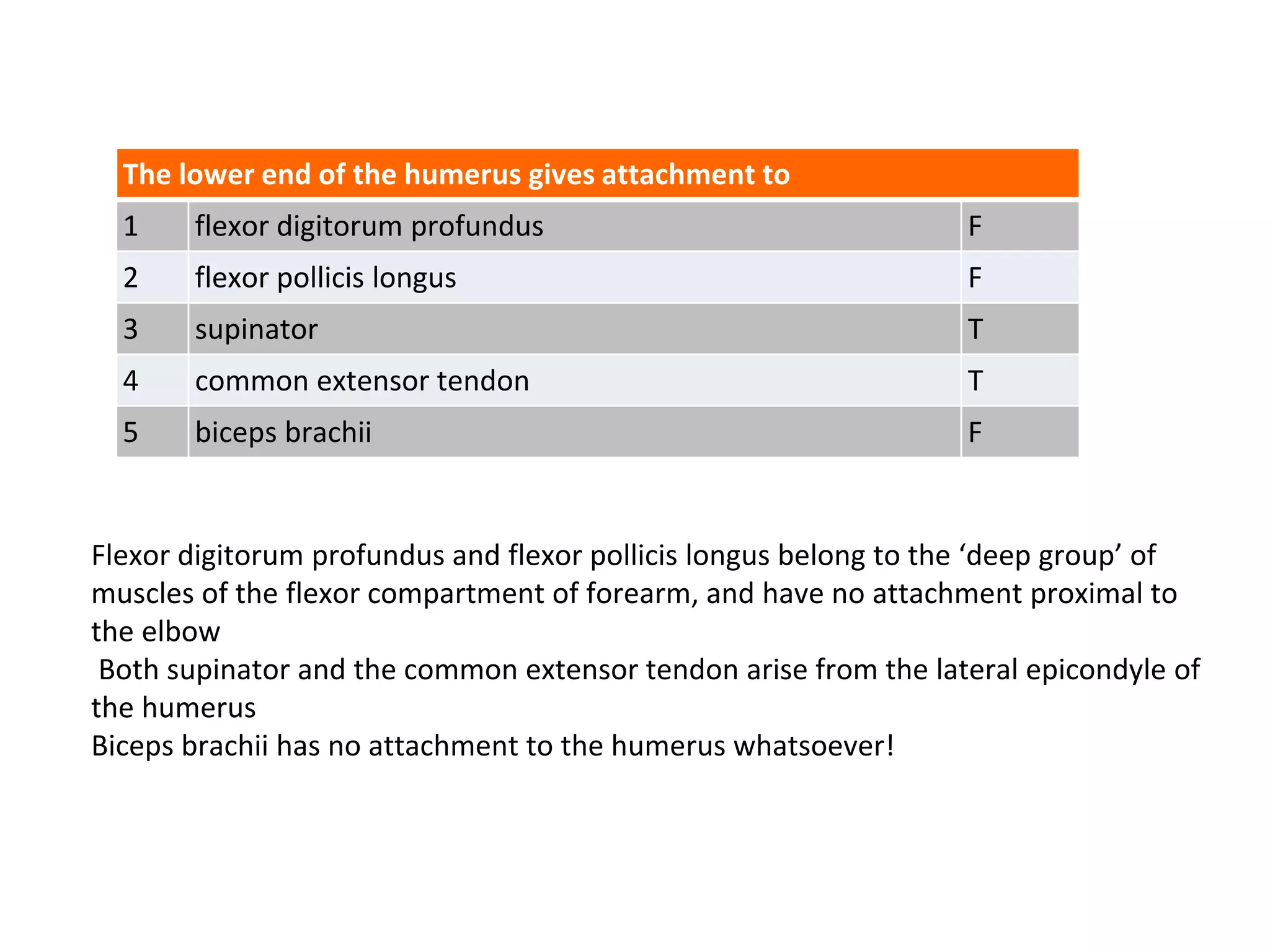
Flexor digitorum profundus and flexor pollicis longus belong to the ‘deep group’ of
muscles of the flexor compartment of forearm, and have no attachment proximal to
the elbow
Both supinator and the common extensor tendon arise from the lateral epicondyle of
the humerus
Biceps brachii has no attachment to the humerus whatsoever!
The lower end of the humerus gives attachment to
1 flexor digitorum profundus F
2 flexor pollicis longus F
3 supinator T
4 common extensor tendon T
5 biceps brachii F
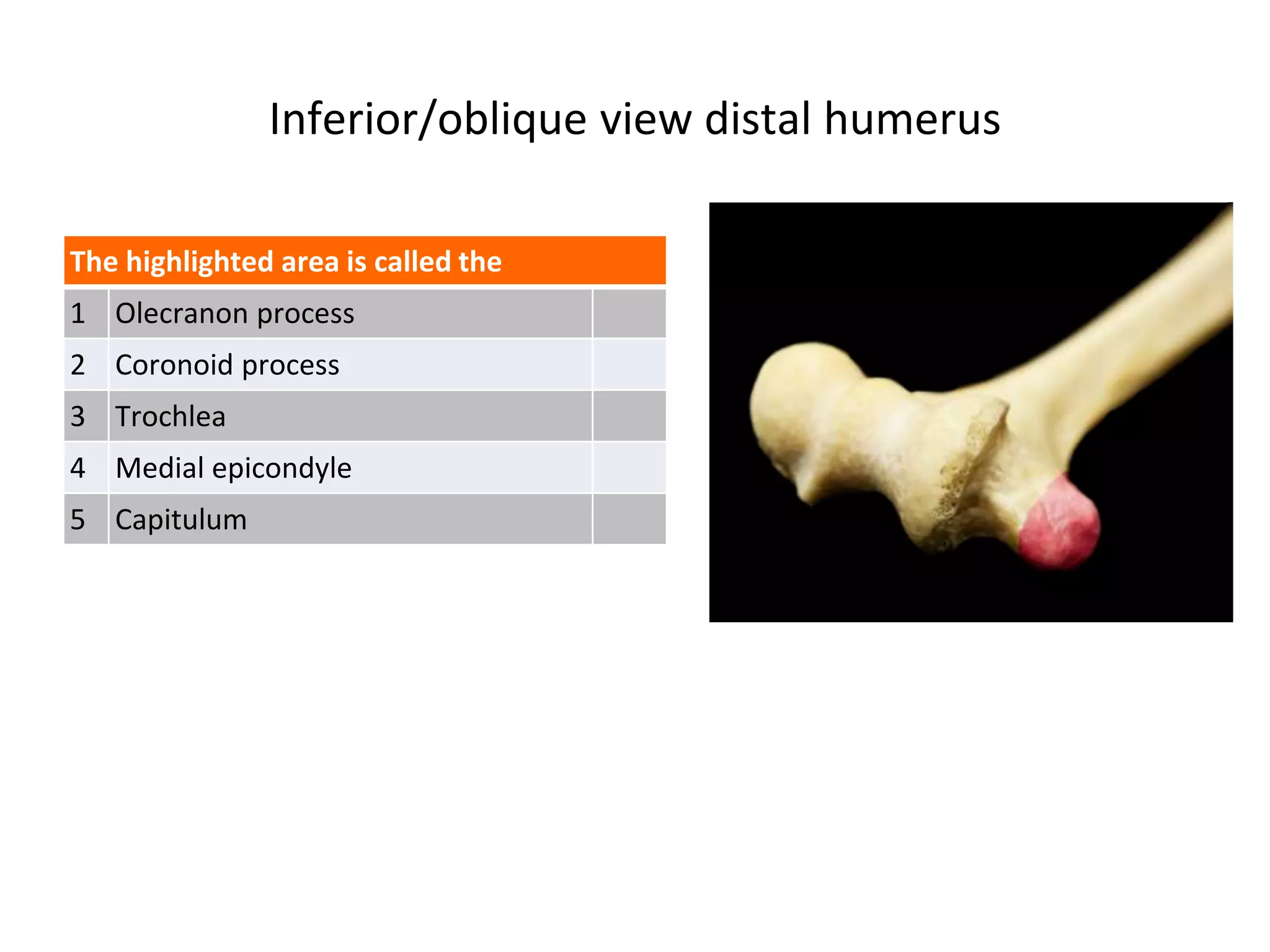
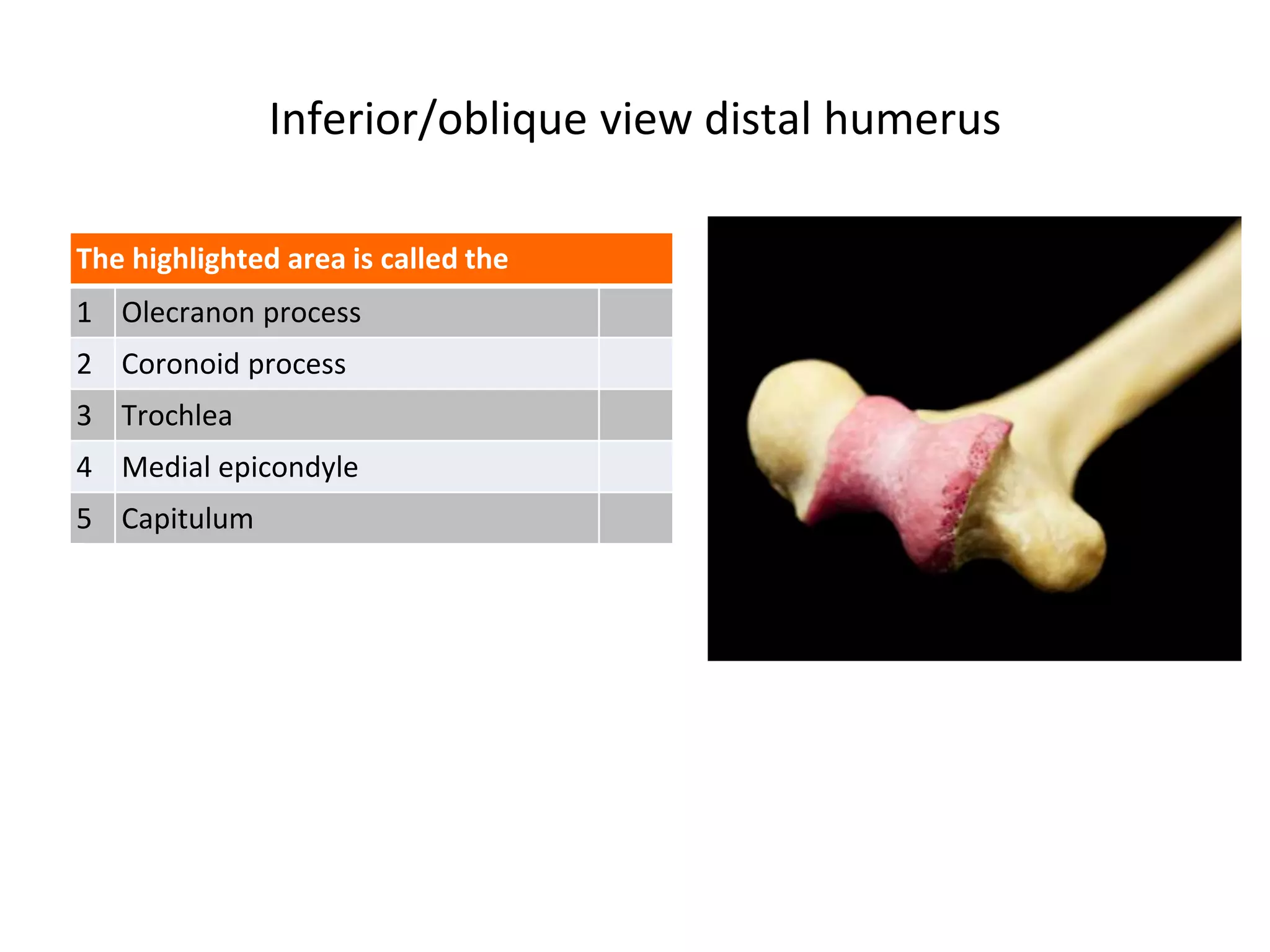
Inferior/oblique view distal humerus
The highlighted area is called the
1 Olecranon process
2 Coronoid process
3 Trochlea
4 Medial epicondyle
5 Capitulum
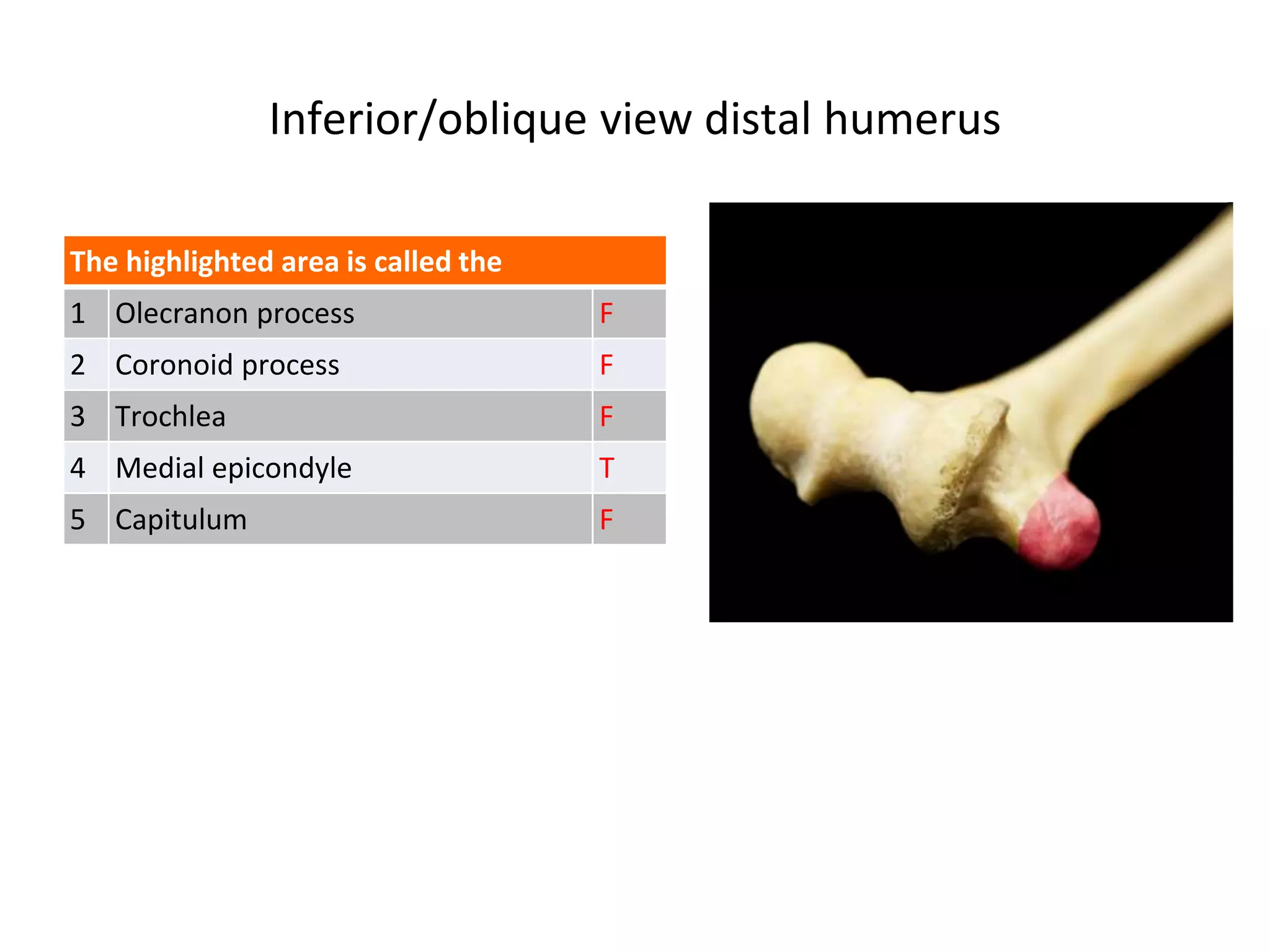
Inferior/oblique view distal humerus
The highlighted area is called the
1 Olecranon process F
2 Coronoid process F
3 Trochlea F
4 Medial epicondyle T
5 Capitulum F
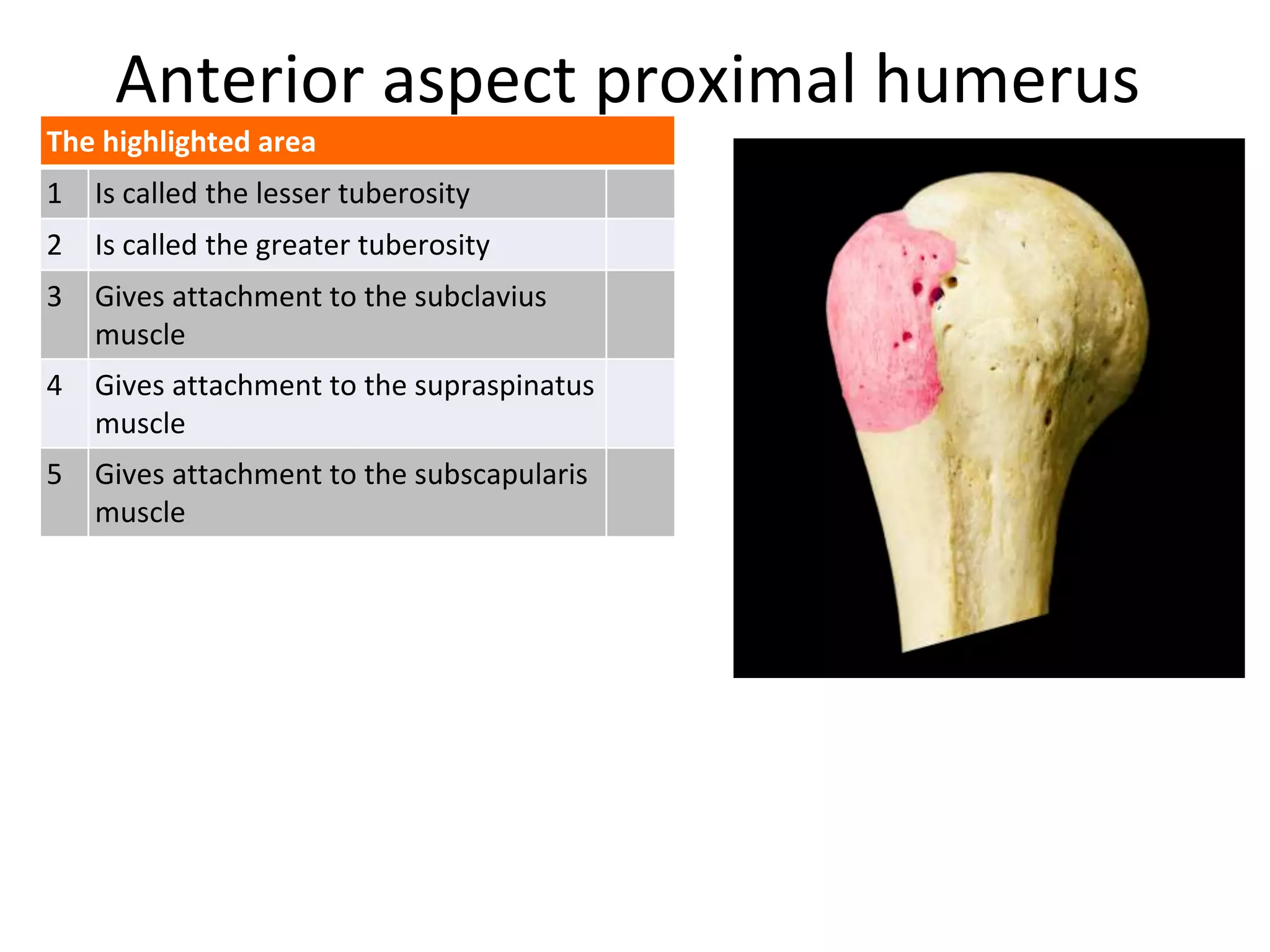
Anterior aspect proximal humerus
The highlighted area
1 Is called the lesser tuberosity
2 Is called the greater tuberosity
3 Gives attachment to the subclavius
muscle
4 Gives attachment to the supraspinatus
muscle
5 Gives attachment to the subscapularis
muscle
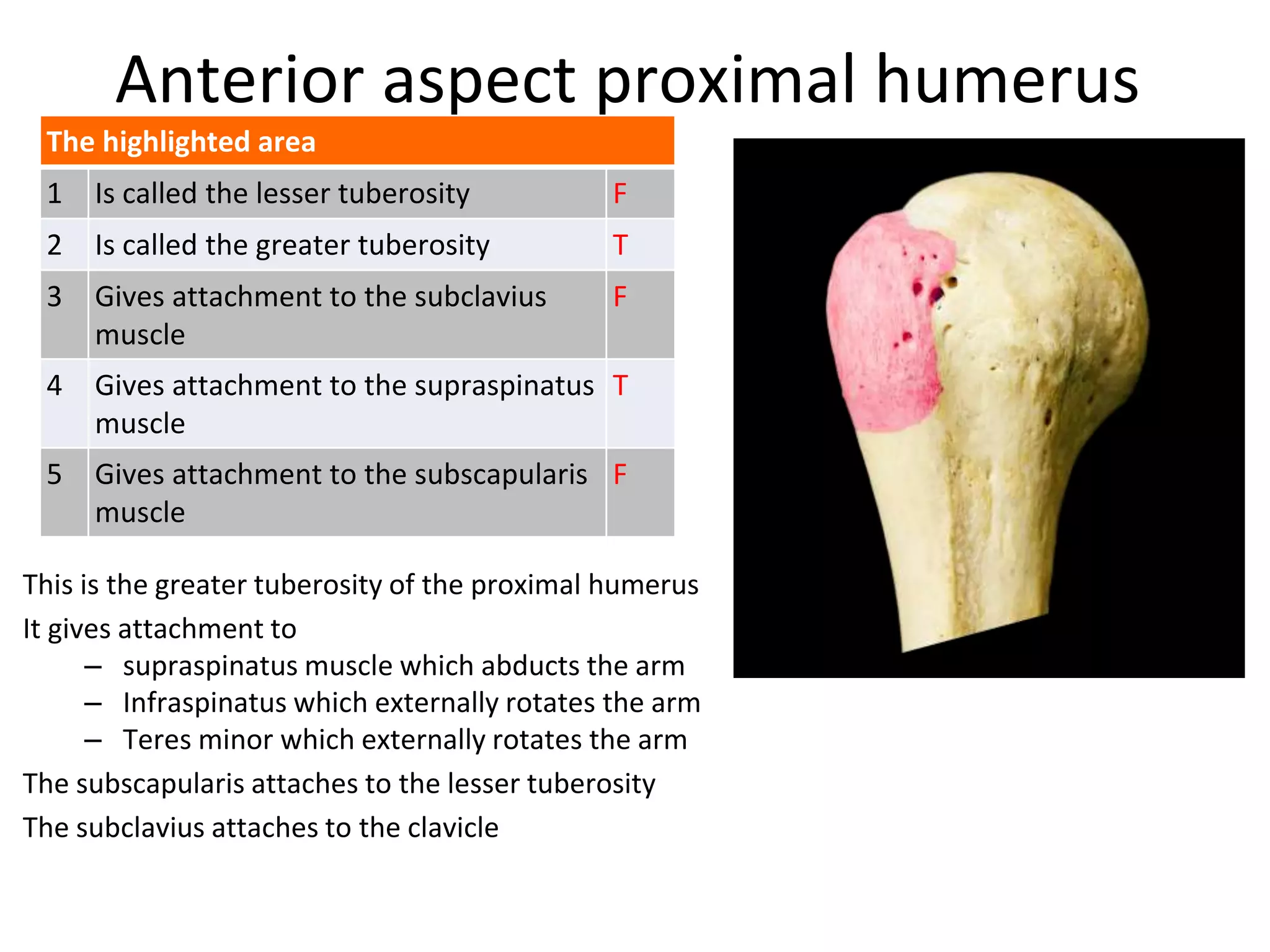
Anterior aspect proximal humerus
The highlighted area
1 Is called the lesser tuberosity F
2 Is called the greater tuberosity T
3 Gives attachment to the subclavius
muscle
F
4 Gives attachment to the supraspinatus
muscle
T
5 Gives attachment to the subscapularis
muscle
F
This is the greater tuberosity of the proximal humerus
It gives attachment to
– supraspinatus muscle which abducts the arm
– Infraspinatus which externally rotates the arm
– Teres minor which externally rotates the arm
The subscapularis attaches to the lesser tuberosity
The subclavius attaches to the clavicle
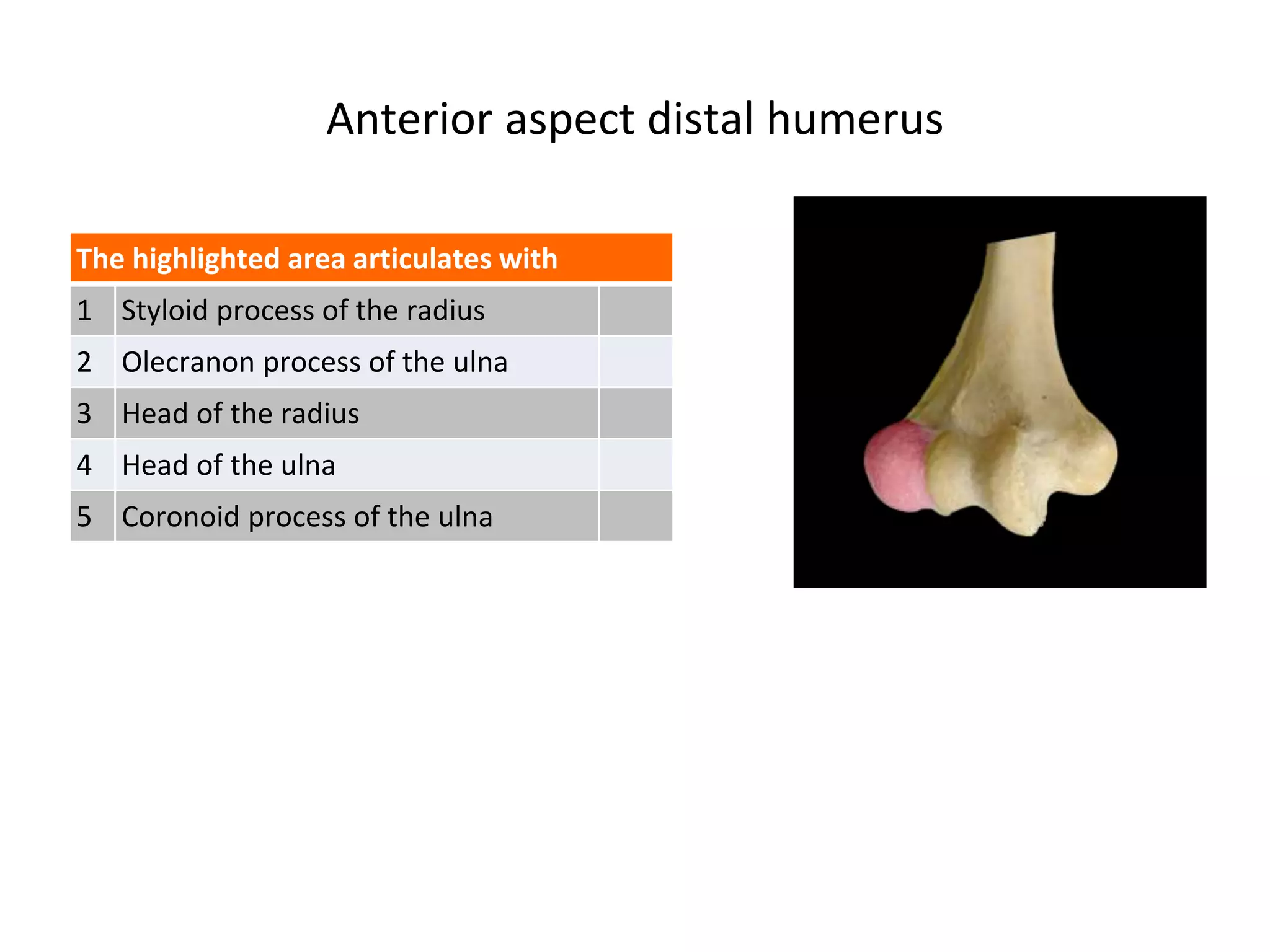
Anterior aspect distal humerus
The highlighted area articulates with
1 Styloid process of the radius
2 Olecranon process of the ulna
3 Head of the radius
4 Head of the ulna
5 Coronoid process of the ulna
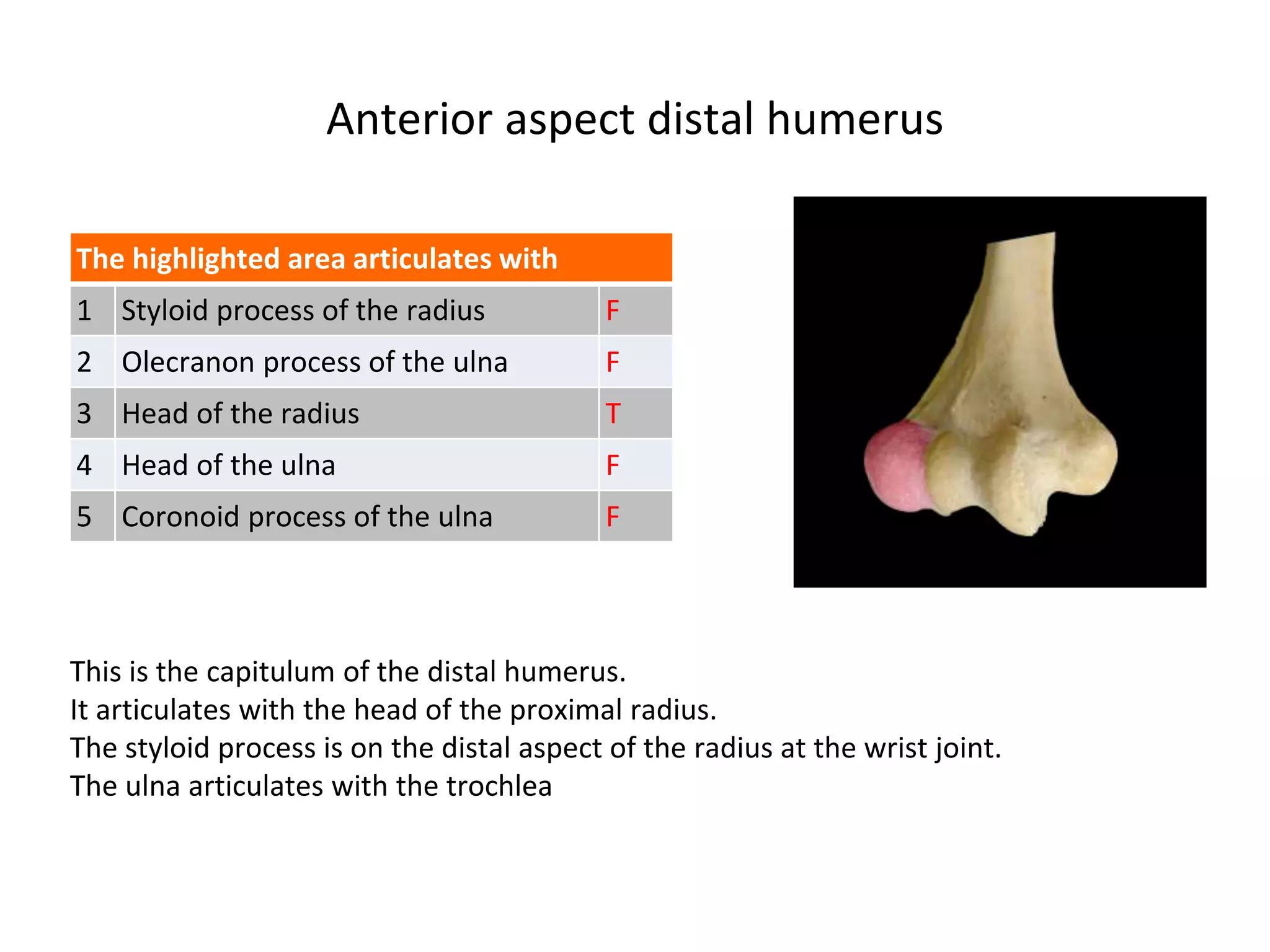
Anterior aspect distal humerus
The highlighted area articulates with
1 Styloid process of the radius F
2 Olecranon process of the ulna F
3 Head of the radius T
4 Head of the ulna F
5 Coronoid process of the ulna F
This is the capitulum of the distal humerus.
It articulates with the head of the proximal radius.
The styloid process is on the distal aspect of the radius at the wrist joint.
The ulna articulates with the trochlea
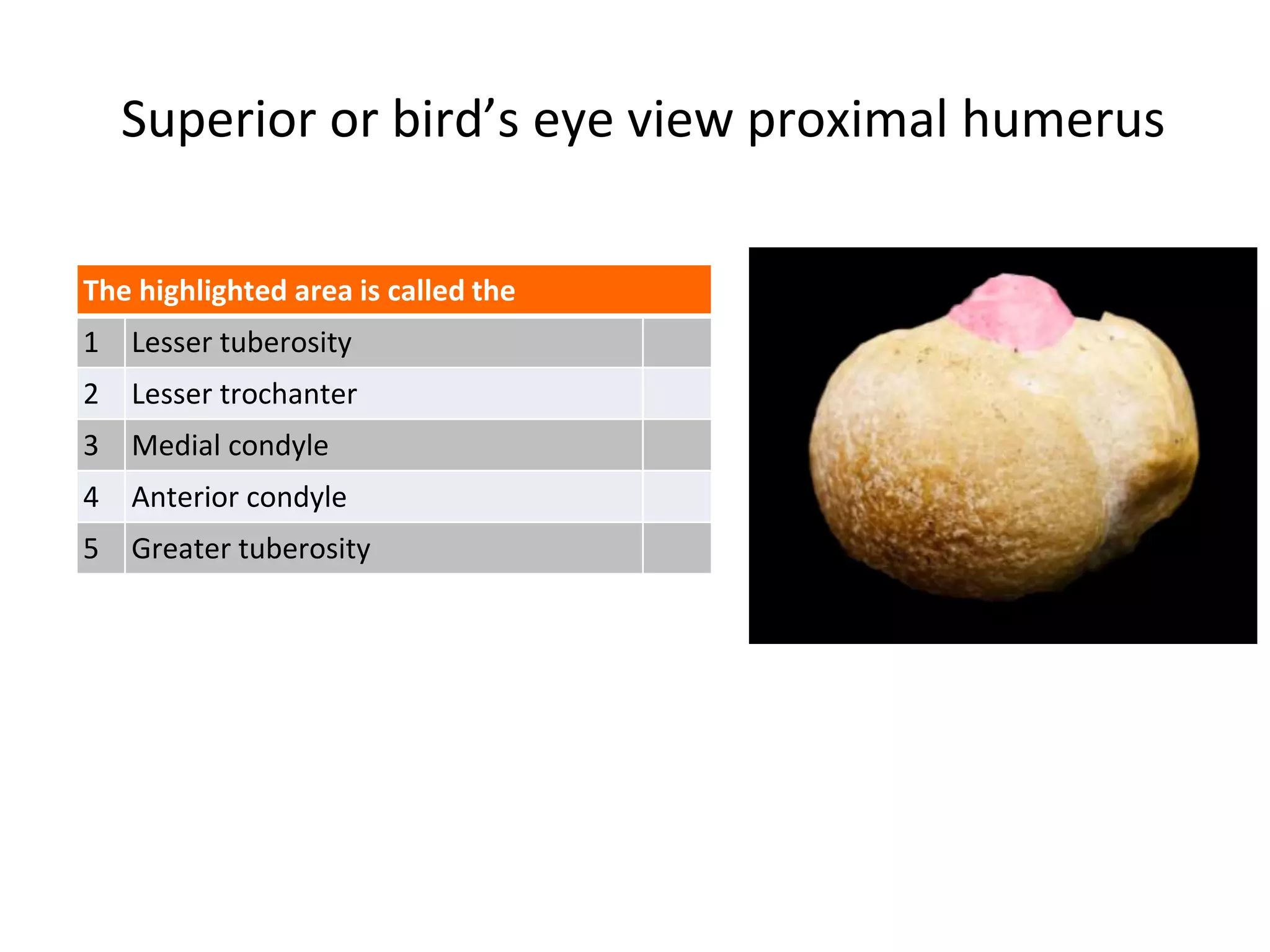
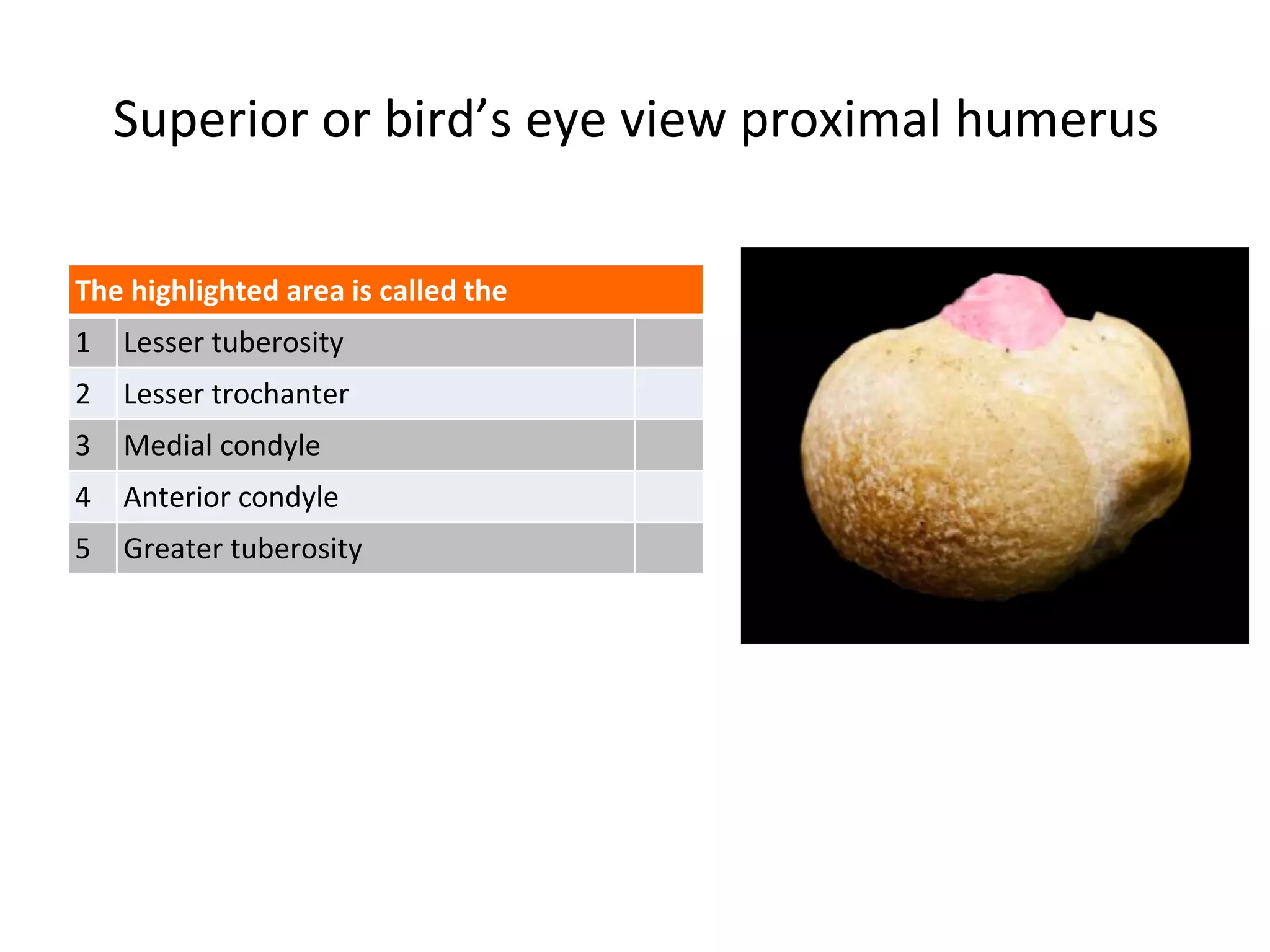
Superior or bird’s eye view proximal humerus
The highlighted area is called the
1 Lesser tuberosity
2 Lesser trochanter
3 Medial condyle
4 Anterior condyle
5 Greater tuberosity
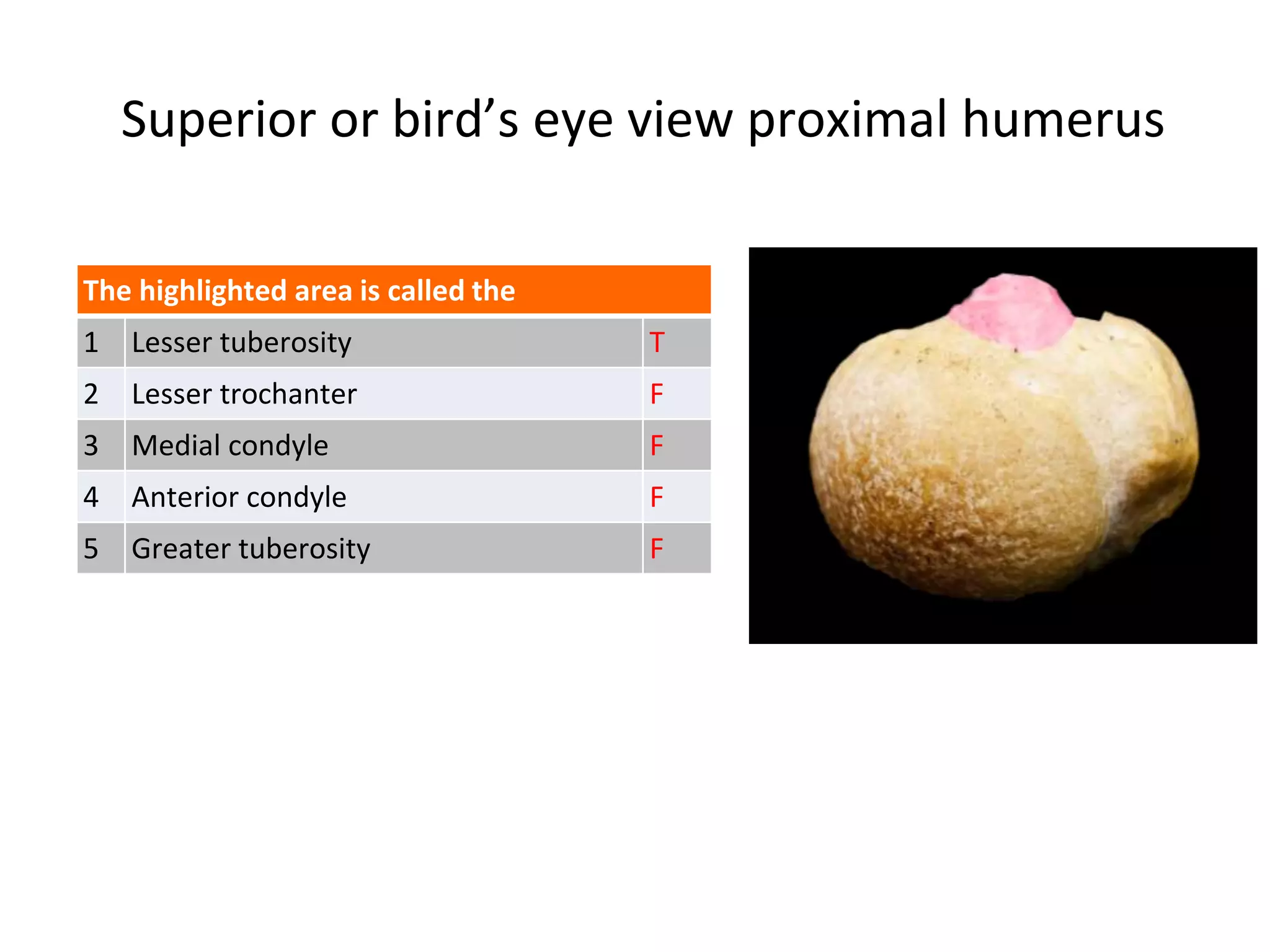
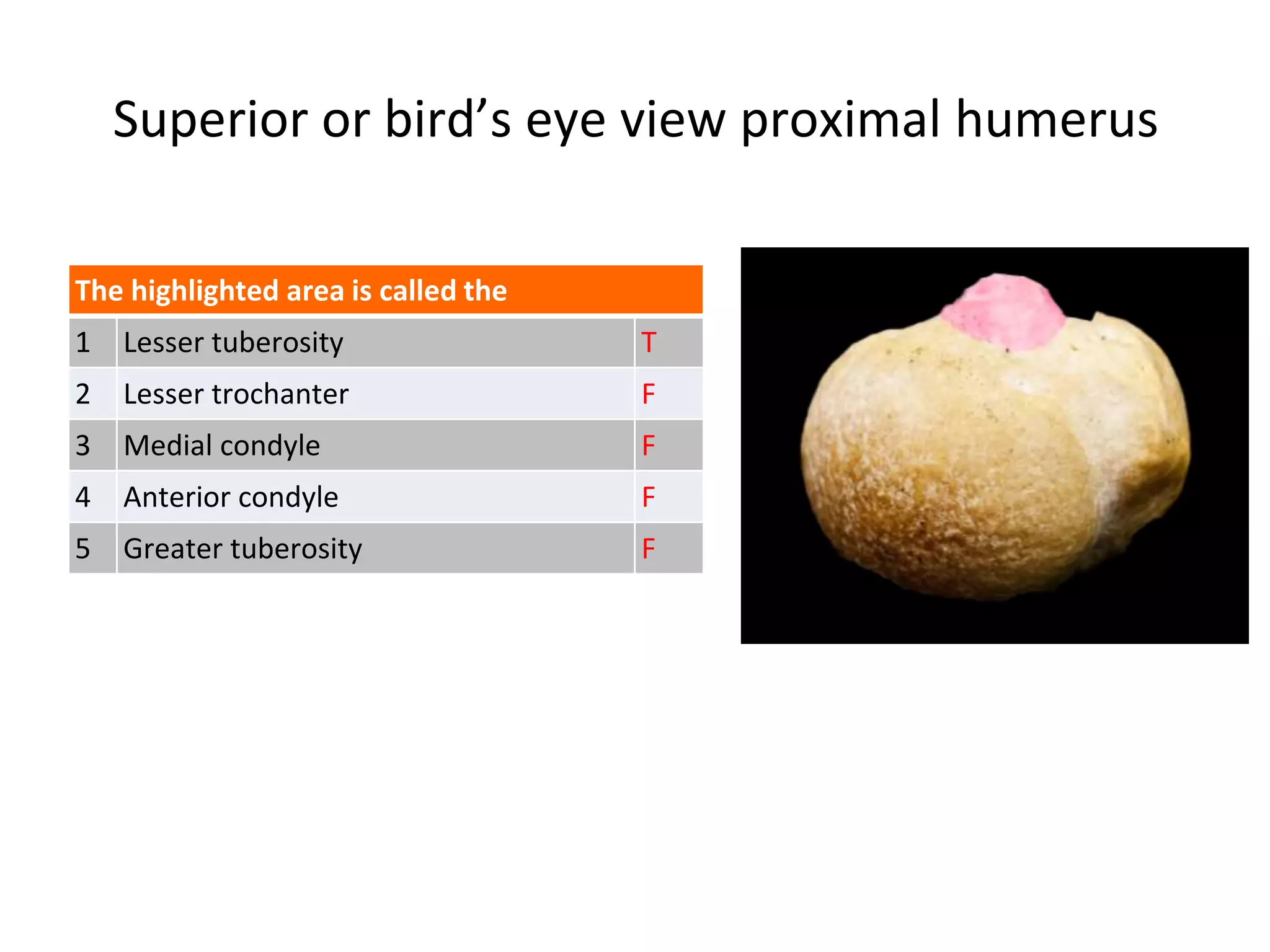
Superior or bird’s eye view proximal humerus
The highlighted area is called the
1 Lesser tuberosity T
2 Lesser trochanter F
3 Medial condyle F
4 Anterior condyle F
5 Greater tuberosity F
Concerning relationships of nerves to the humerus:
1 The radial nerve passes through the bicipital groove
2 The median nerve is closely related to the spiral groove of the distal humerus
3 The radial nerve is closely related to the spiral groove on the midshaft of the
radius
4 The ulnar nerve is closely related to the lateral epicondyle of the distal
humerus
5 The ulnar nerve is closely related to the medial epicondyle of the humerus
Nerves
Concerning relationships of nerves to the humerus:
1 The radial nerve passes through the bicipital groove F
2 The median nerve is closely related to the spiral groove of the distal humerus F
3 The radial nerve is closely related to the spiral groove on the midshaft of the
radius
F
4 The ulnar nerve is closely related to the lateral epicondyle of the distal
humerus
F
5 The ulnar nerve is closely related to the medial epicondyle of the humerus T
Nerves
The radial nerve is closely related to the spiral groove on the midshaft of the humerus.
The ulnar nerve is immediately posterior to the medial epicondyle of the distal
humerus
The long head of biceps tendon passes through the bicipital groove of the proximal
humerus
Anterior aspect proximal humerus
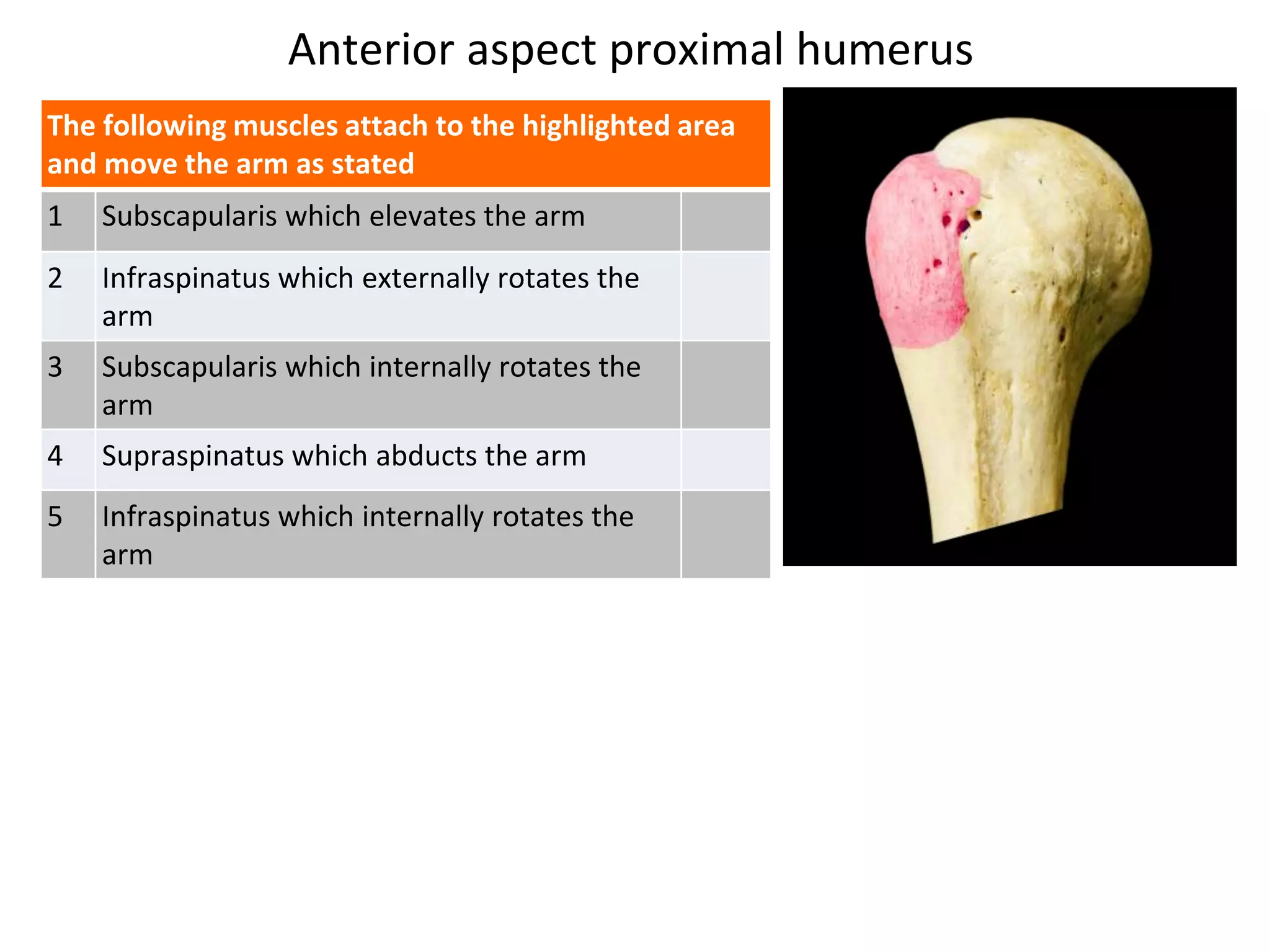
The following muscles attach to the highlighted area
and move the arm as stated
1 Subscapularis which elevates the arm
2 Infraspinatus which externally rotates the
arm
3 Subscapularis which internally rotates the
arm
4 Supraspinatus which abducts the arm
5 Infraspinatus which internally rotates the
arm
Anterior aspect proximal humerus
The following muscles attach to the highlighted area
and move the arm as stated
1 Subscapularis which elevates the arm F
2 Infraspinatus which externally rotates the
arm
T
3 Subscapularis which internally rotates the
arm
F
4 Supraspinatus which abducts the arm T
5 Infraspinatus which internally rotates the
arm
F
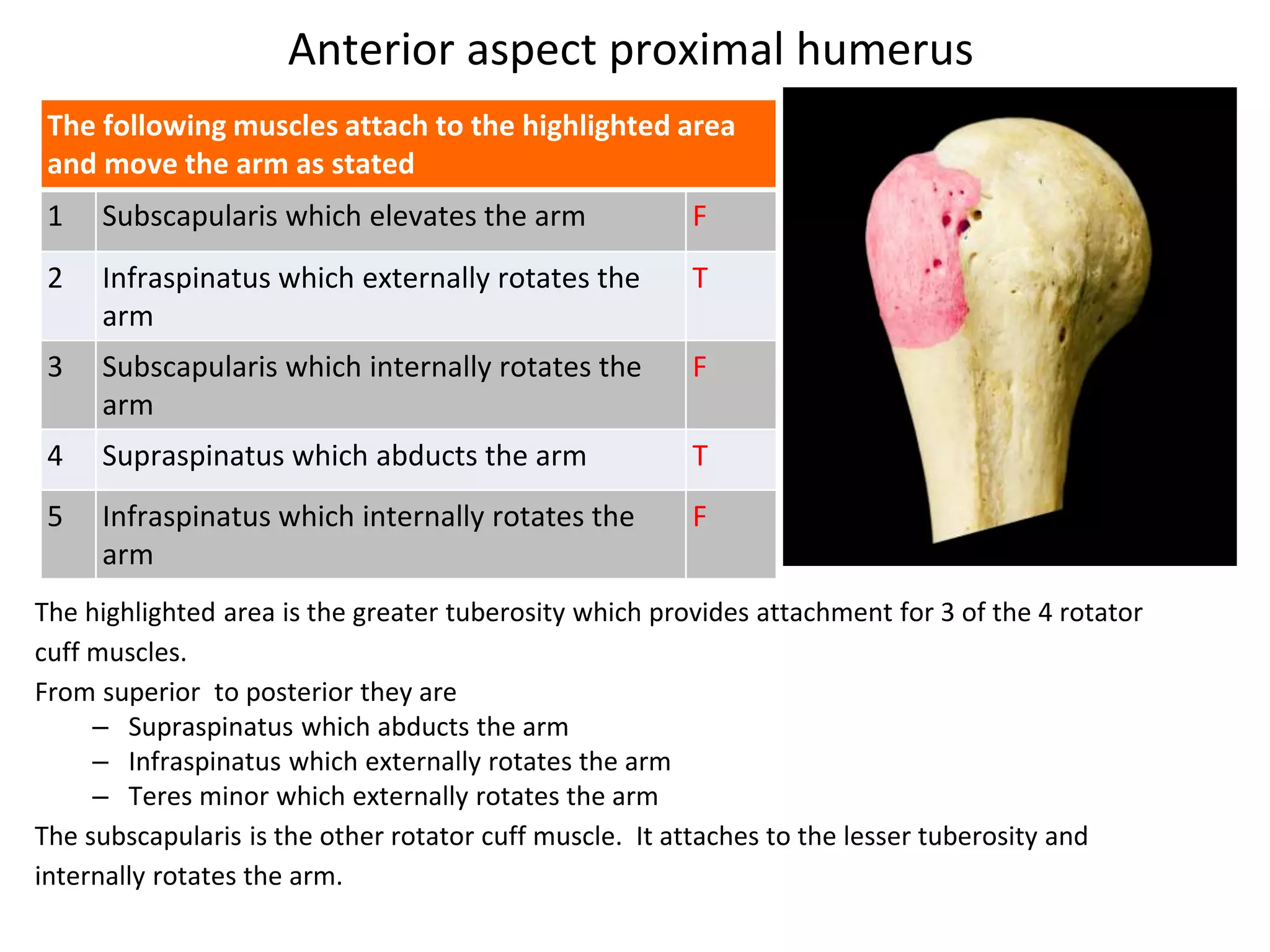
The highlighted area is the greater tuberosity which provides attachment for 3 of the 4 rotator
cuff muscles.
From superior to posterior they are
– Supraspinatus which abducts the arm
– Infraspinatus which externally rotates the arm
– Teres minor which externally rotates the arm
The subscapularis is the other rotator cuff muscle. It attaches to the lesser tuberosity and
internally rotates the arm.
Anterior aspect distal humerus
The highlighted area
1 Is called the trochlea
2 Is called the capitulum
3 Is called the coronoid process
4 Is called the coracoid process
5 Is called the olecranon process
Anterior aspect distal humerus
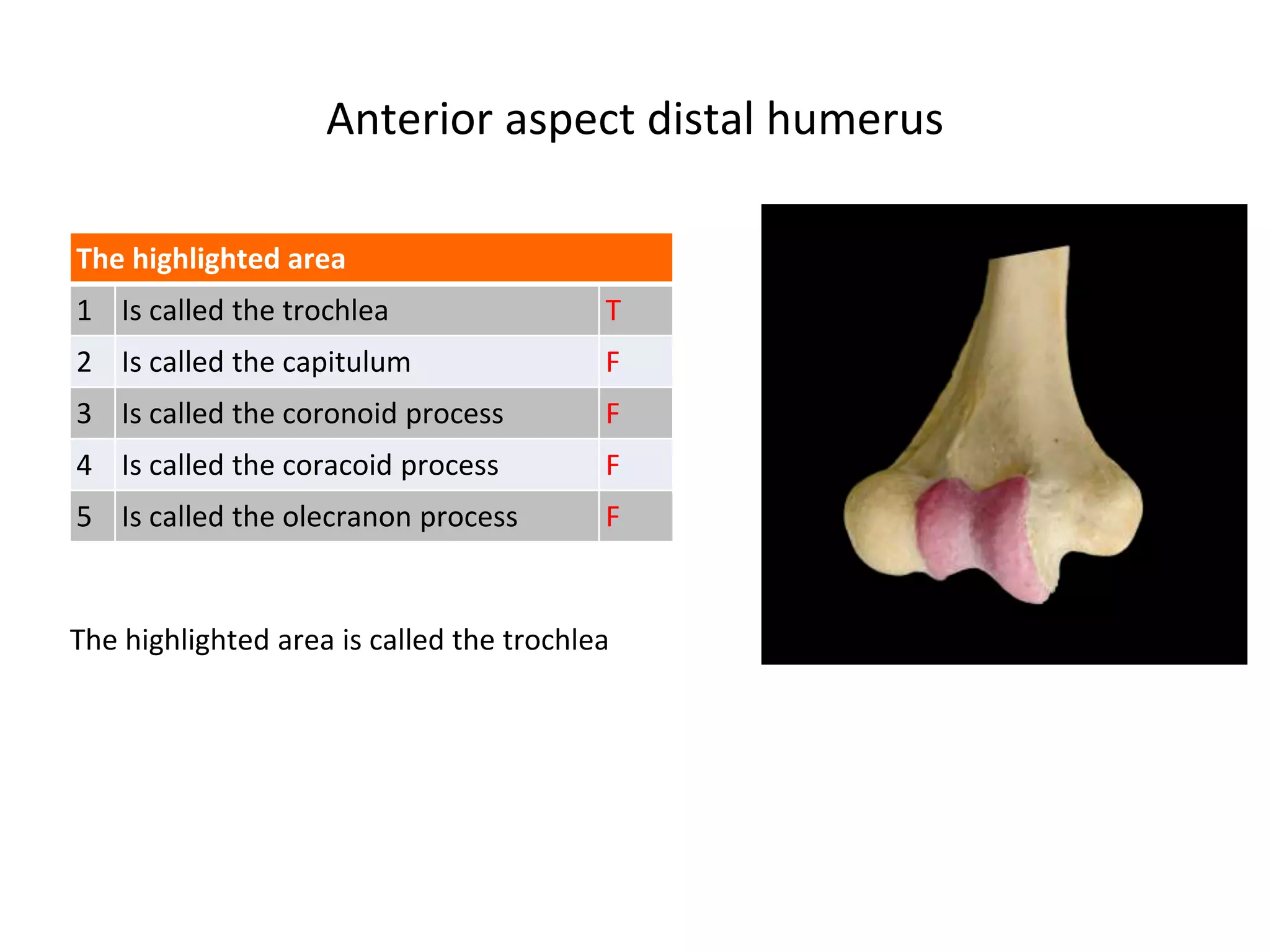
The highlighted area is called the trochlea
The highlighted area
1 Is called the trochlea T
2 Is called the capitulum F
3 Is called the coronoid process F
4 Is called the coracoid process F
5 Is called the olecranon process F
Anterior Aspect Distal Humerus
The following muscles arise from here
1 Palmaris longus
2 Flexor pollicis longus
3 Extensor carpi ulnaris
4 Pronator teres
5 Flexor carpi radialis
Anterior Aspect Distal Humerus
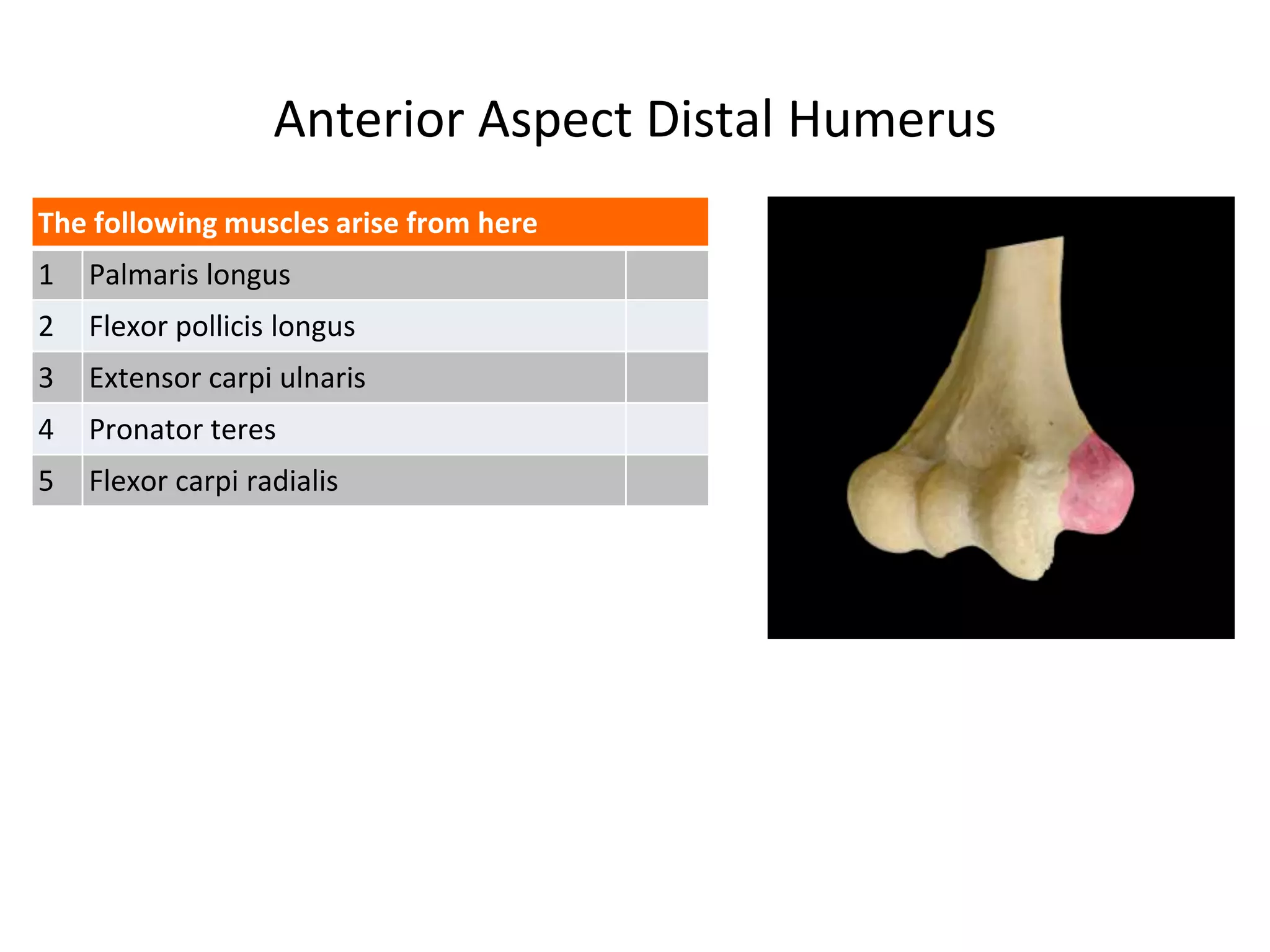
This is the medial epicondyle of the distal humerus. It gives rise to the common flexor
tendons. These include pronator teres, flexor carpi radialis, flexor carpi ulnaris,
palmaris longus and flexor digitorum. Flexor pollicis longus arises from the shaft of the
volar aspect of the radius. Extensor carpi ulnaris arises from the common extensor
tendon on the lateral epicondyle of the distal humerus.
The following muscles arise from here
1 Palmaris longus T
2 Flexor pollicis longus F
3 Extensor carpi ulnaris F
4 Pronator teres T
5 Flexor carpi radialis T
Anterior aspect distal humerus
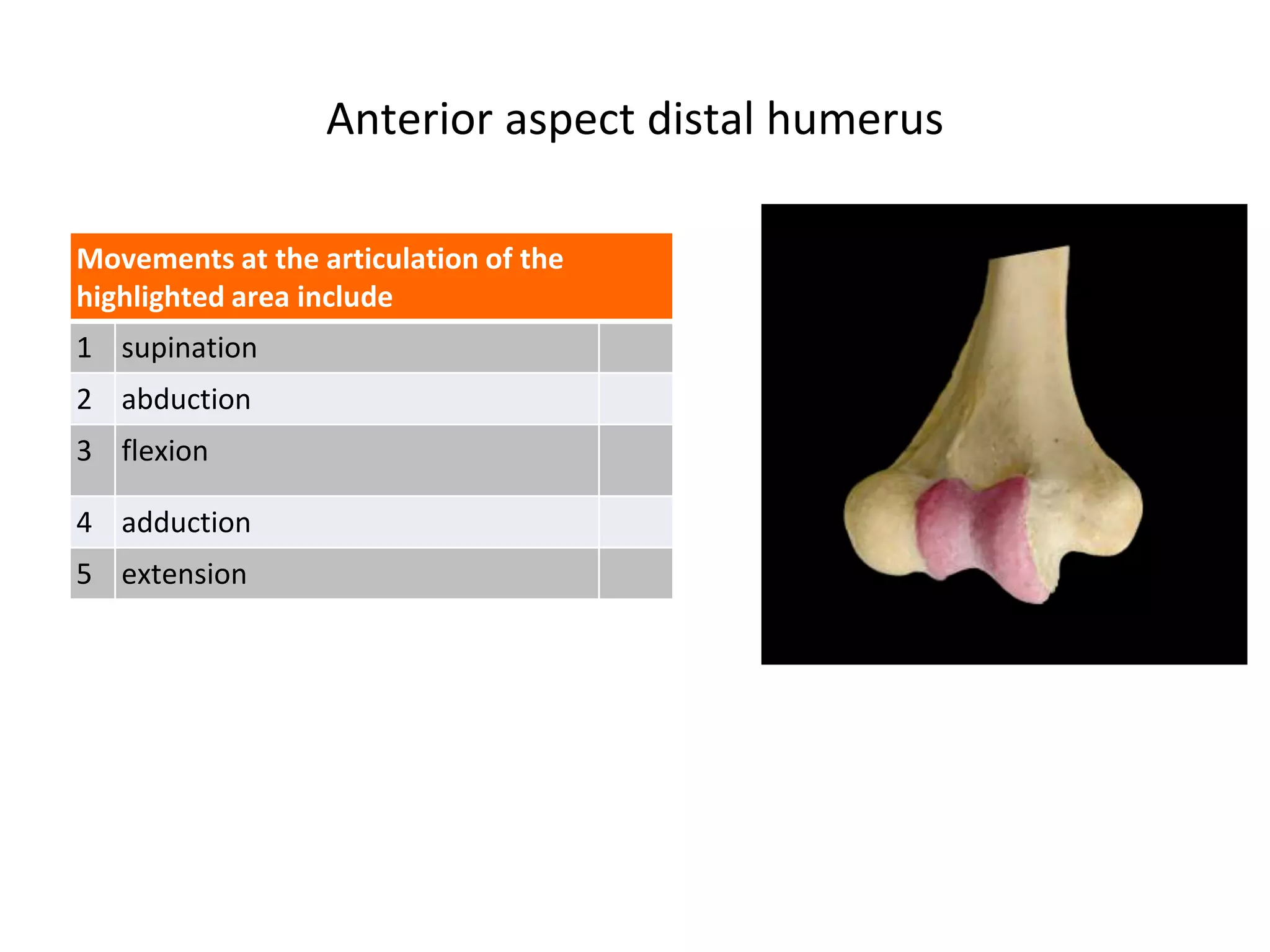
Movements at the articulation of the
highlighted area include
1 supination
2 abduction
3 flexion
4 adduction
5 extension
Anterior aspect distal humerus
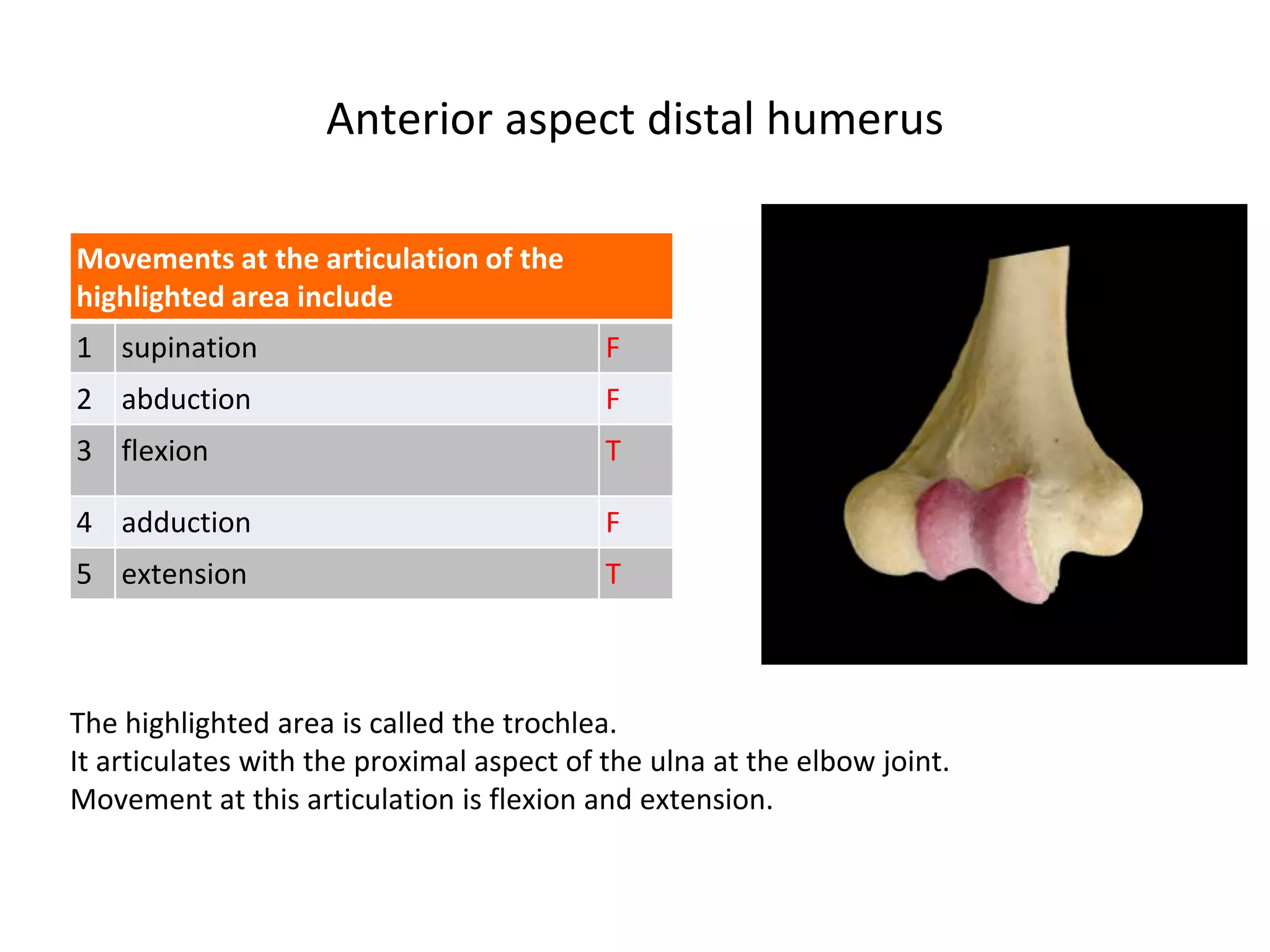
The highlighted area is called the trochlea.
It articulates with the proximal aspect of the ulna at the elbow joint.
Movement at this articulation is flexion and extension.
Movements at the articulation of the
highlighted area include
1 supination F
2 abduction F
3 flexion T
4 adduction F
5 extension T
Inferior/oblique view distal humerus
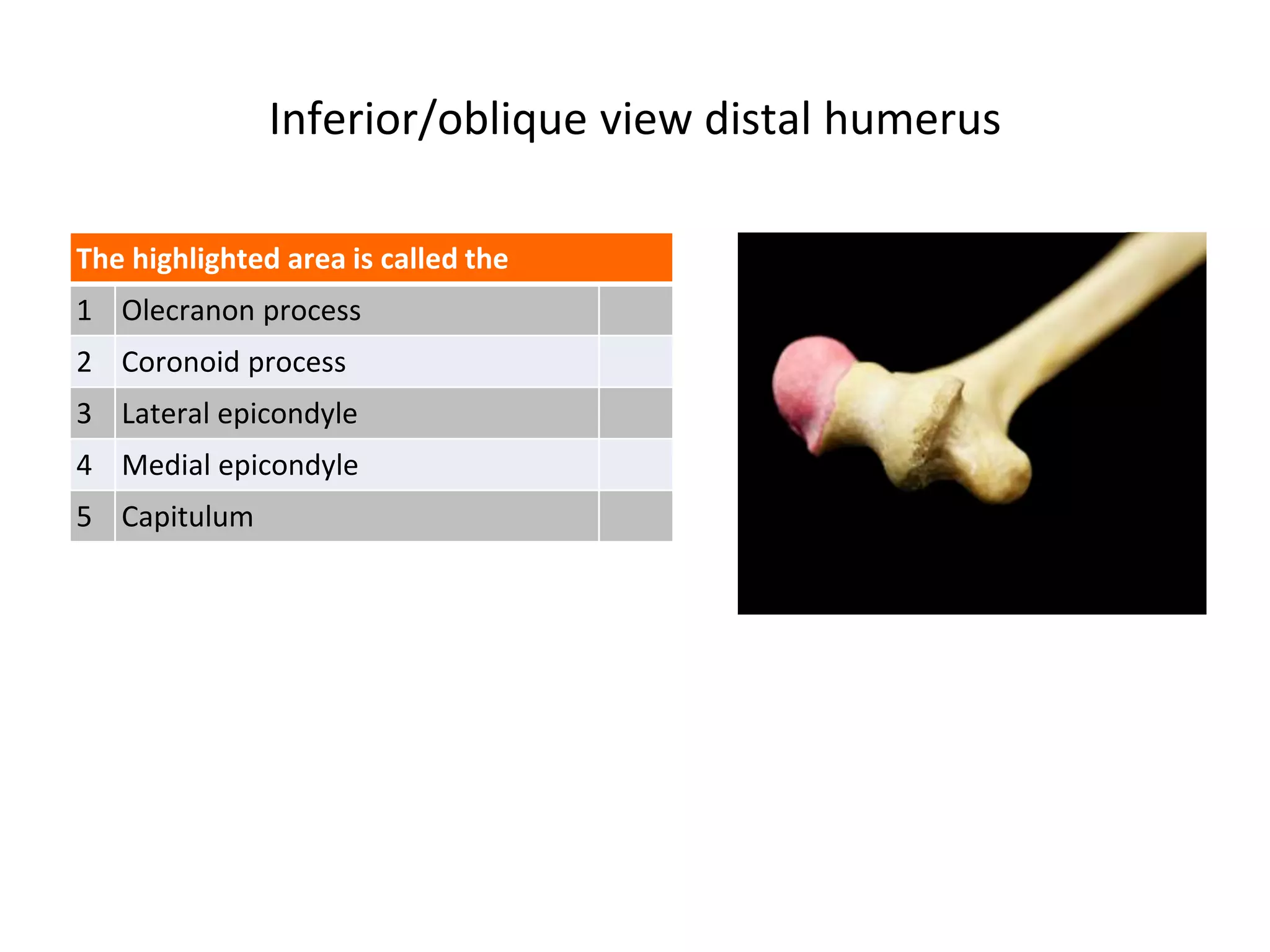
The highlighted area is called the
1 Olecranon process
2 Coronoid process
3 Lateral epicondyle
4 Medial epicondyle
5 Capitulum
Inferior/oblique view distal humerus
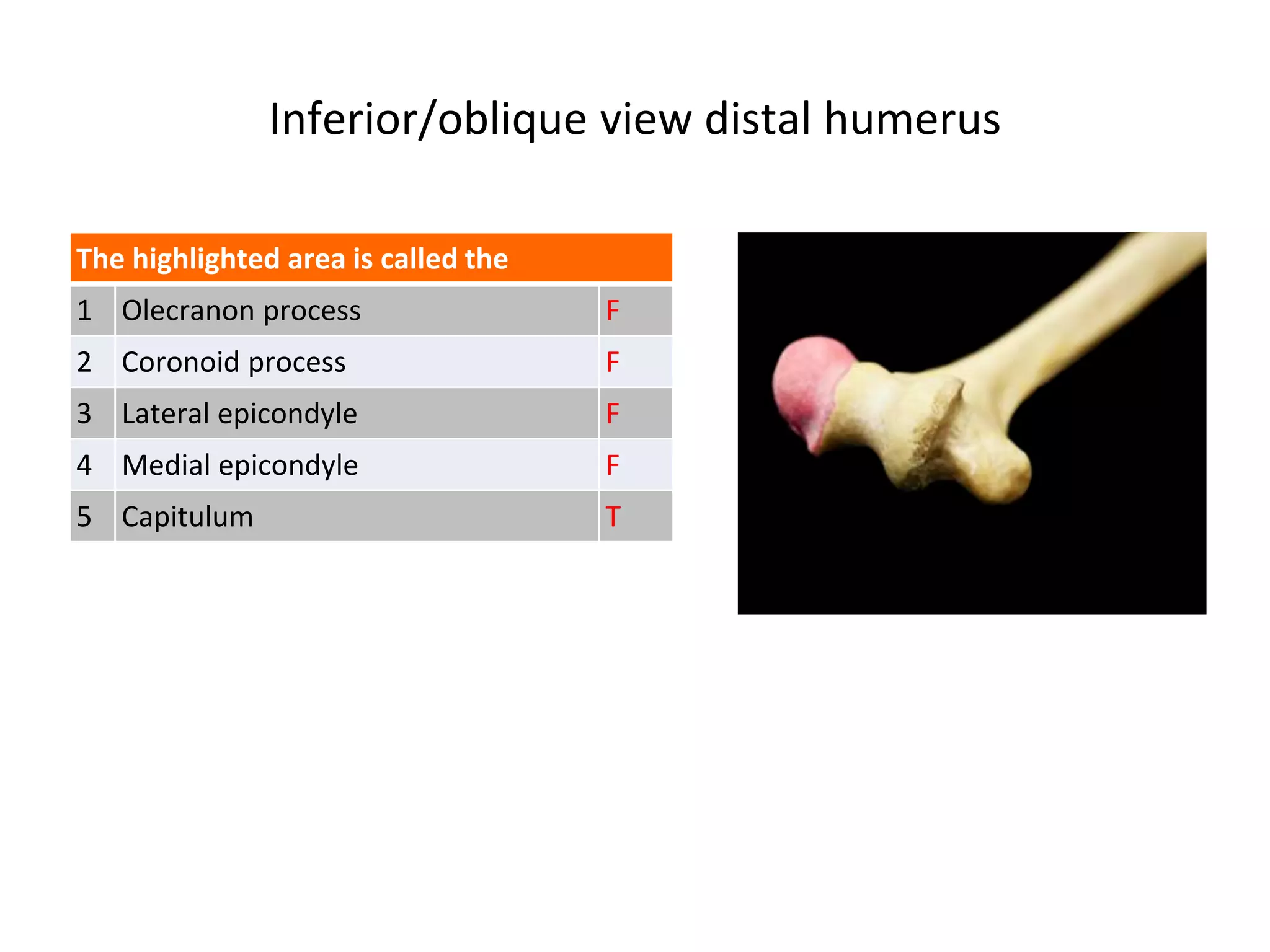
The highlighted area is called the
1 Olecranon process F
2 Coronoid process F
3 Lateral epicondyle F
4 Medial epicondyle F
5 Capitulum T
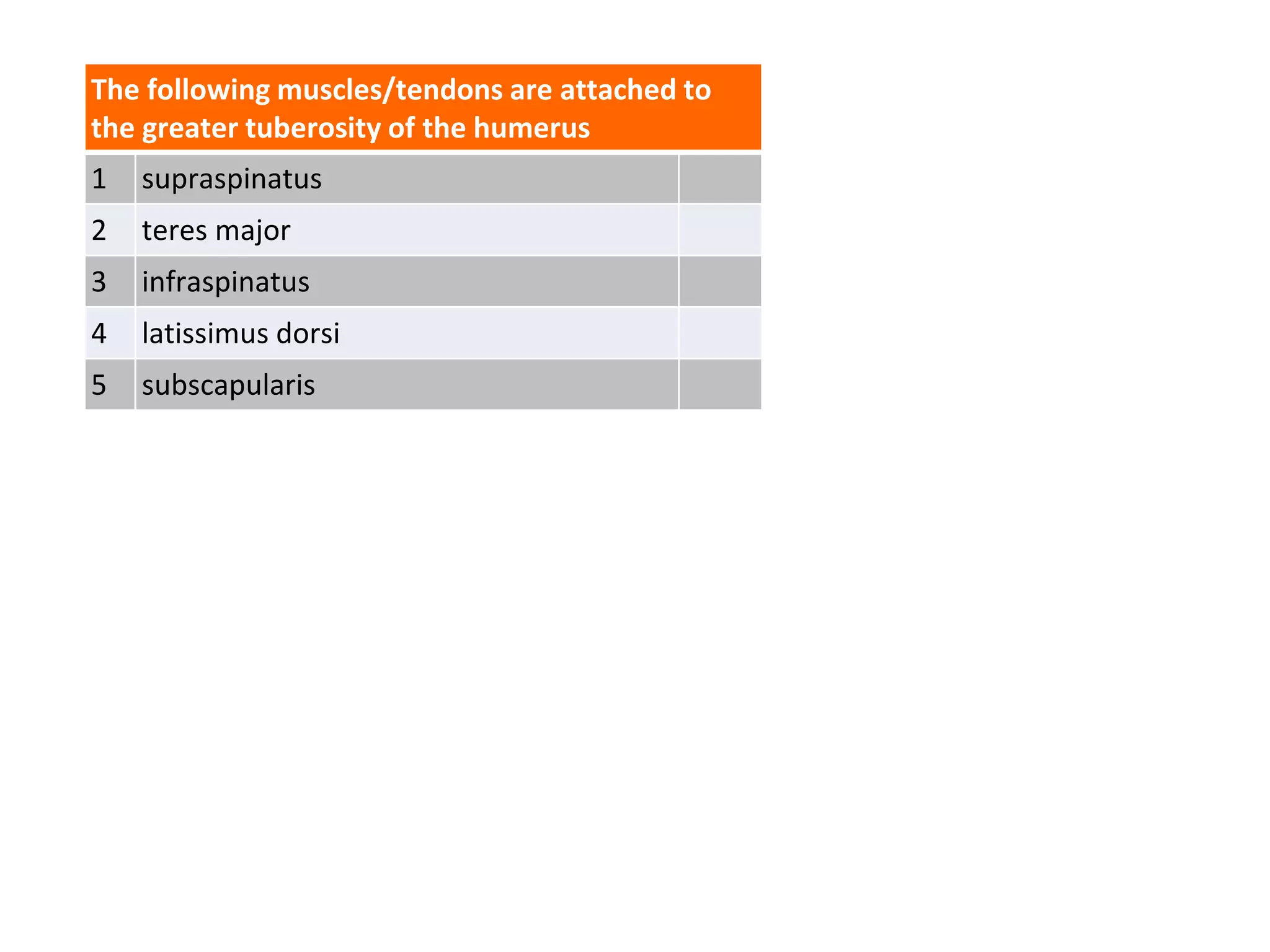
The following muscles/tendons are attached to
the greater tuberosity of the humerus
1 supraspinatus
2 teres major
3 infraspinatus
4 latissimus dorsi
5 subscapularis
Teres major is attached to the medial lip of the intertubercular sulcus
Latissimus dorsi is attached to the floor of the intertubercular sulcus, not the greater
tuberosity
Subscapularis inserts onto the lesser tuberosity, not greater tuberosity.
Three tendons insert onto the greater tuberosity of the humerus: supraspinatus to the
upper aspect, and infraspinatus and teres minor to the posterior aspect. These three
tendons along with subscapularis make up the rotator cuff.
The following muscles/tendons are attached to
the greater tuberosity of the humerus
1 supraspinatus T
2 teres major F
3 infraspinatus T
4 latissimus dorsi F
5 subscapularis F
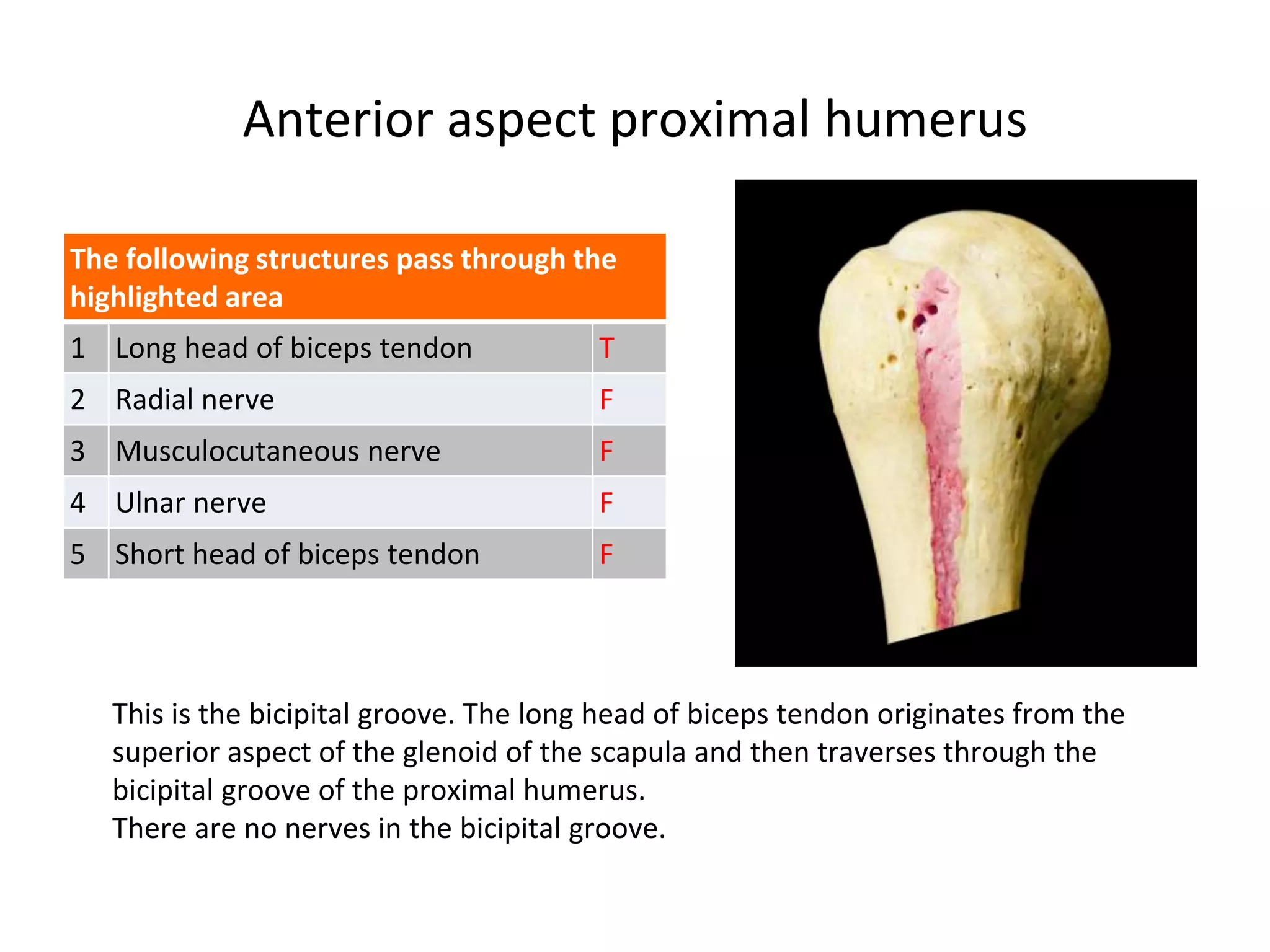
Anterior aspect proximal humerus
The following structures pass through the
highlighted area
1 Long head of biceps tendon
2 Radial nerve
3 Musculocutaneous nerve
4 Ulnar nerve
5 Short head of biceps tendon
Anterior aspect proximal humerus
The following structures pass through the
highlighted area
1 Long head of biceps tendon T
2 Radial nerve F
3 Musculocutaneous nerve F
4 Ulnar nerve F
5 Short head of biceps tendon F
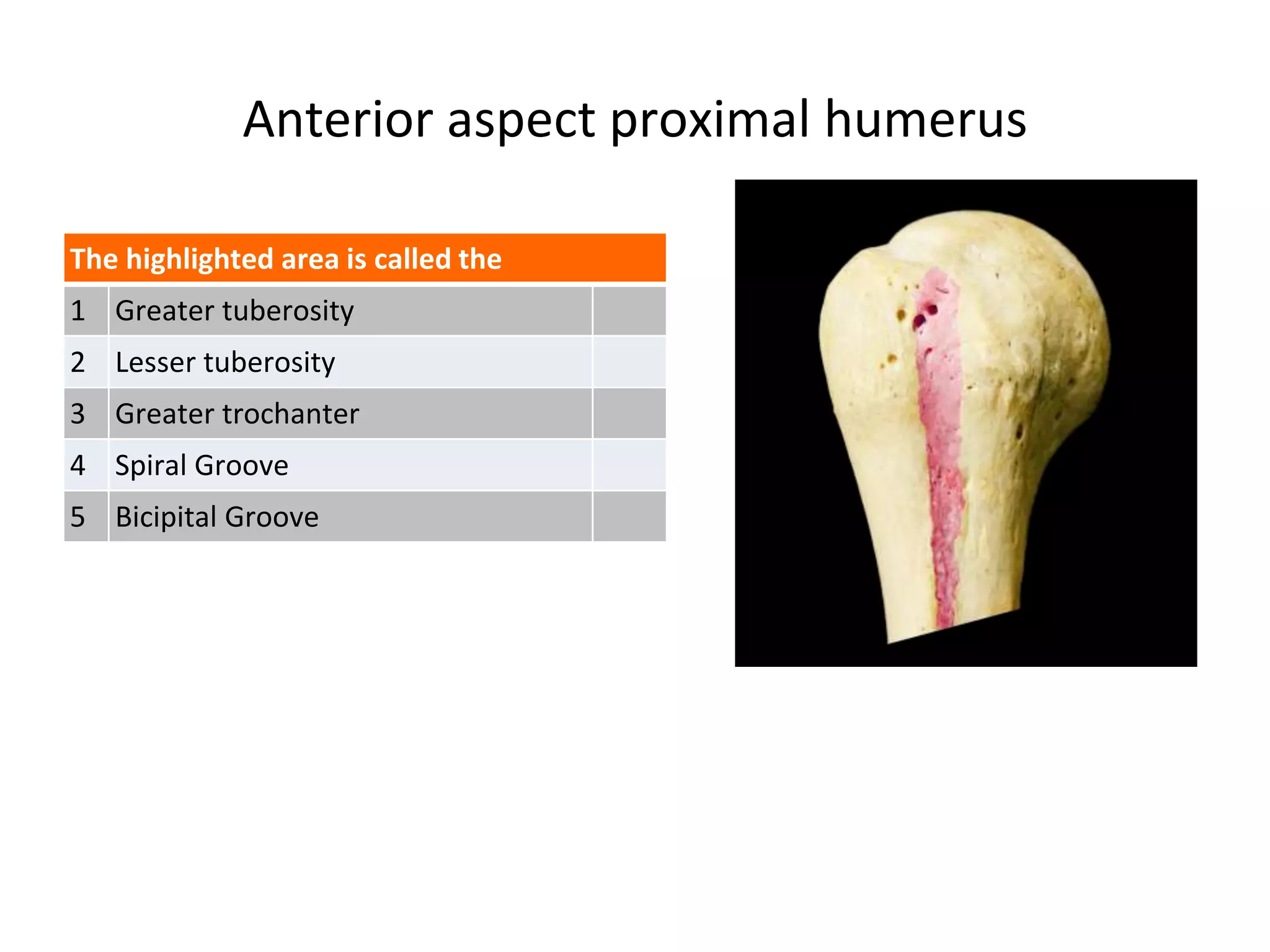
This is the bicipital groove. The long head of biceps tendon originates from the
superior aspect of the glenoid of the scapula and then traverses through the
bicipital groove of the proximal humerus.
There are no nerves in the bicipital groove.
Inferior/oblique view distal humerus
The highlighted area is called the
1 Olecranon process
2 Coronoid process
3 Trochlea
4 Medial epicondyle
5 Capitulum
Inferior/oblique view distal humerus
The highlighted area is called the
1 Olecranon process F
2 Coronoid process F
3 Trochlea T
4 Medial epicondyle F
5 Capitulum F
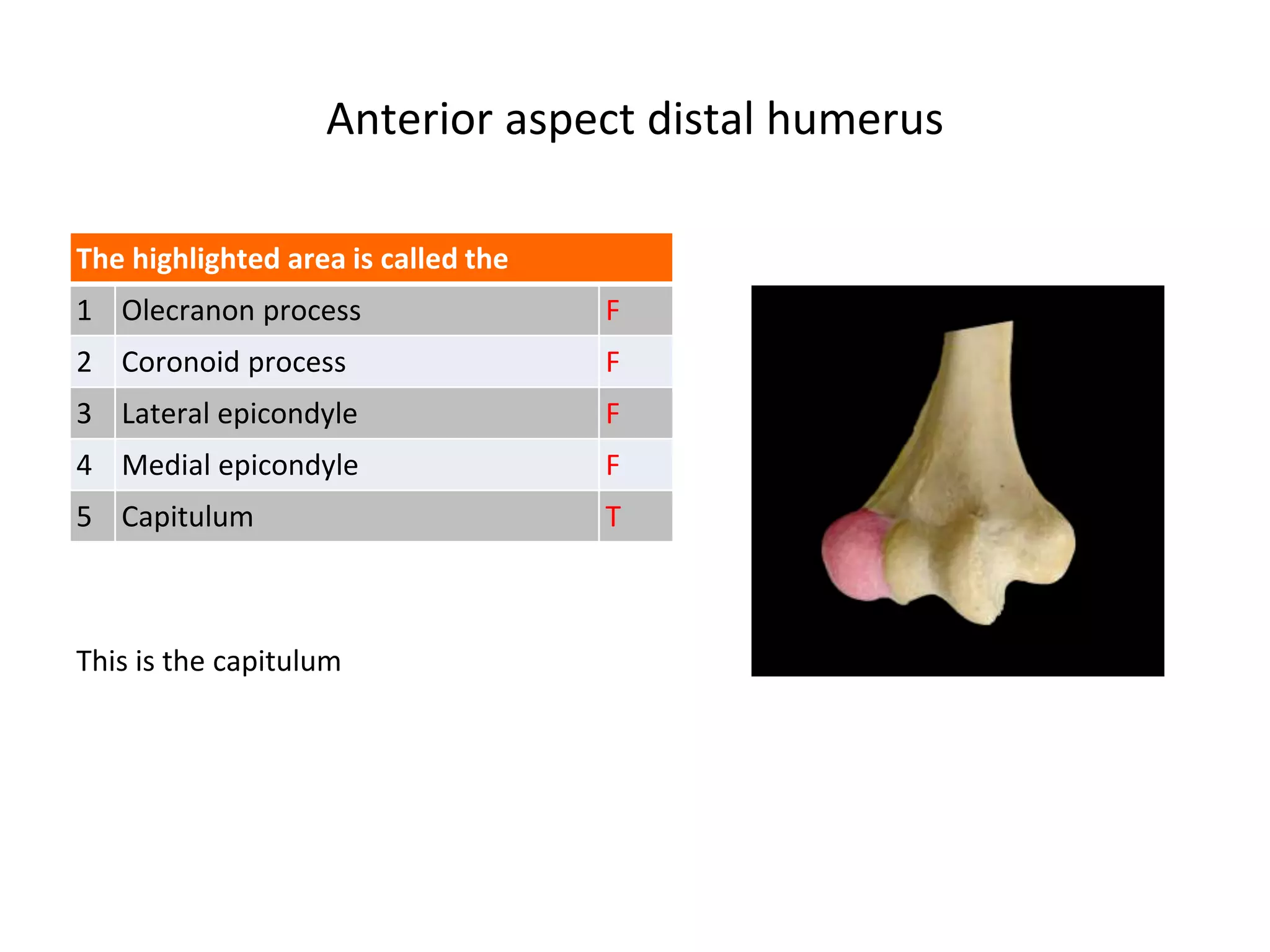
Anterior aspect distal humerus
The highlighted area is called the
1 Olecranon process
2 Coronoid process
3 Lateral epicondyle
4 Medial epicondyle
5 Capitulum
Anterior aspect distal humerus
The highlighted area is called the
1 Olecranon process F
2 Coronoid process F
3 Lateral epicondyle F
4 Medial epicondyle F
5 Capitulum T
This is the capitulum
Superior or bird’s eye view proximal humerus
The muscle that attaches here is innervated by the
1 Anterior suprascapular nerve
2 Axillary nerve
3 Upper subscapular nerve
4 Anterior subscapular nerve
5 Lower subscapular nerve
Superior or bird’s eye view proximal humerus
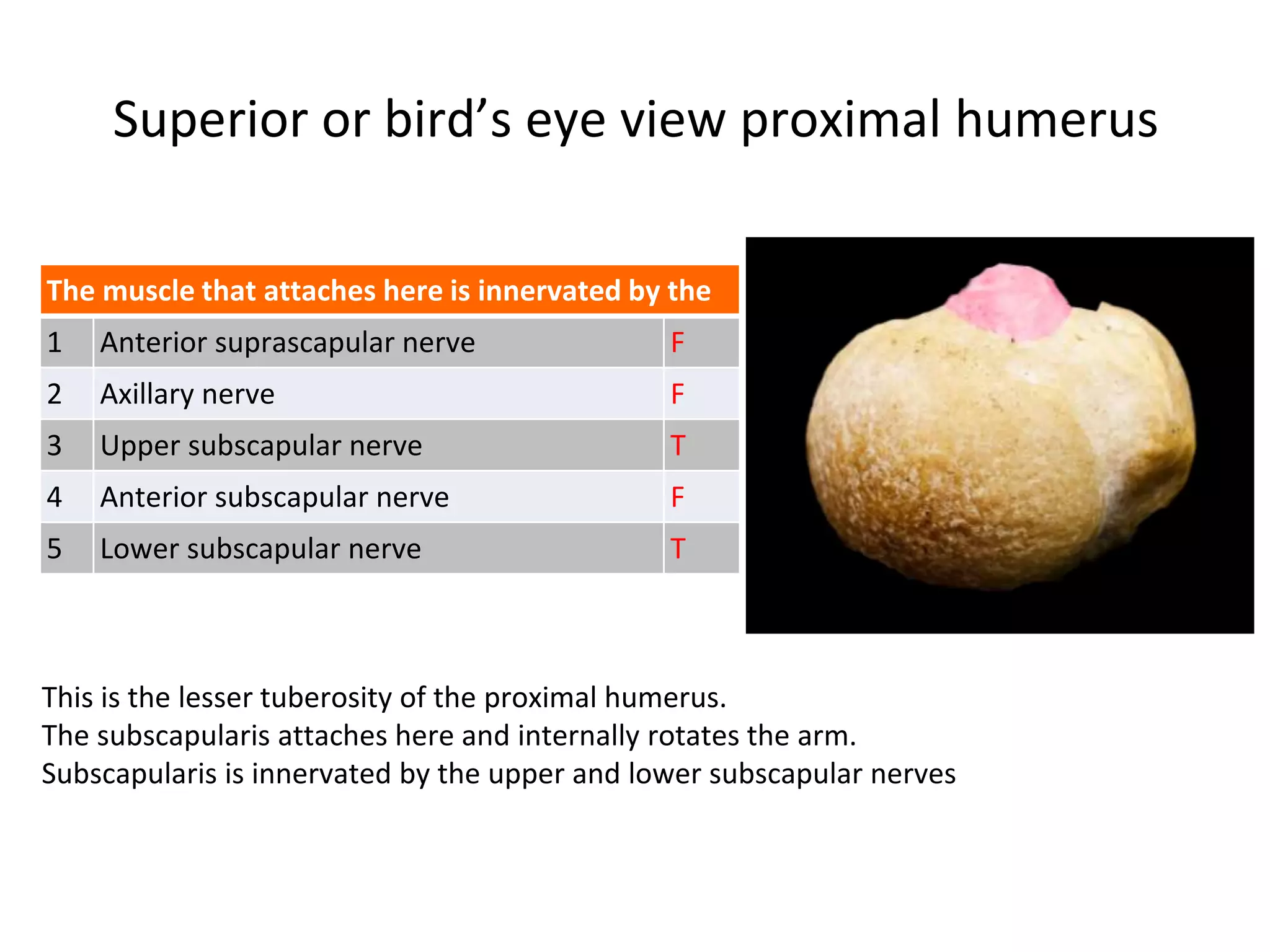
The muscle that attaches here is innervated by the
1 Anterior suprascapular nerve F
2 Axillary nerve F
3 Upper subscapular nerve T
4 Anterior subscapular nerve F
5 Lower subscapular nerve T
This is the lesser tuberosity of the proximal humerus.
The subscapularis attaches here and internally rotates the arm.
Subscapularis is innervated by the upper and lower subscapular nerves
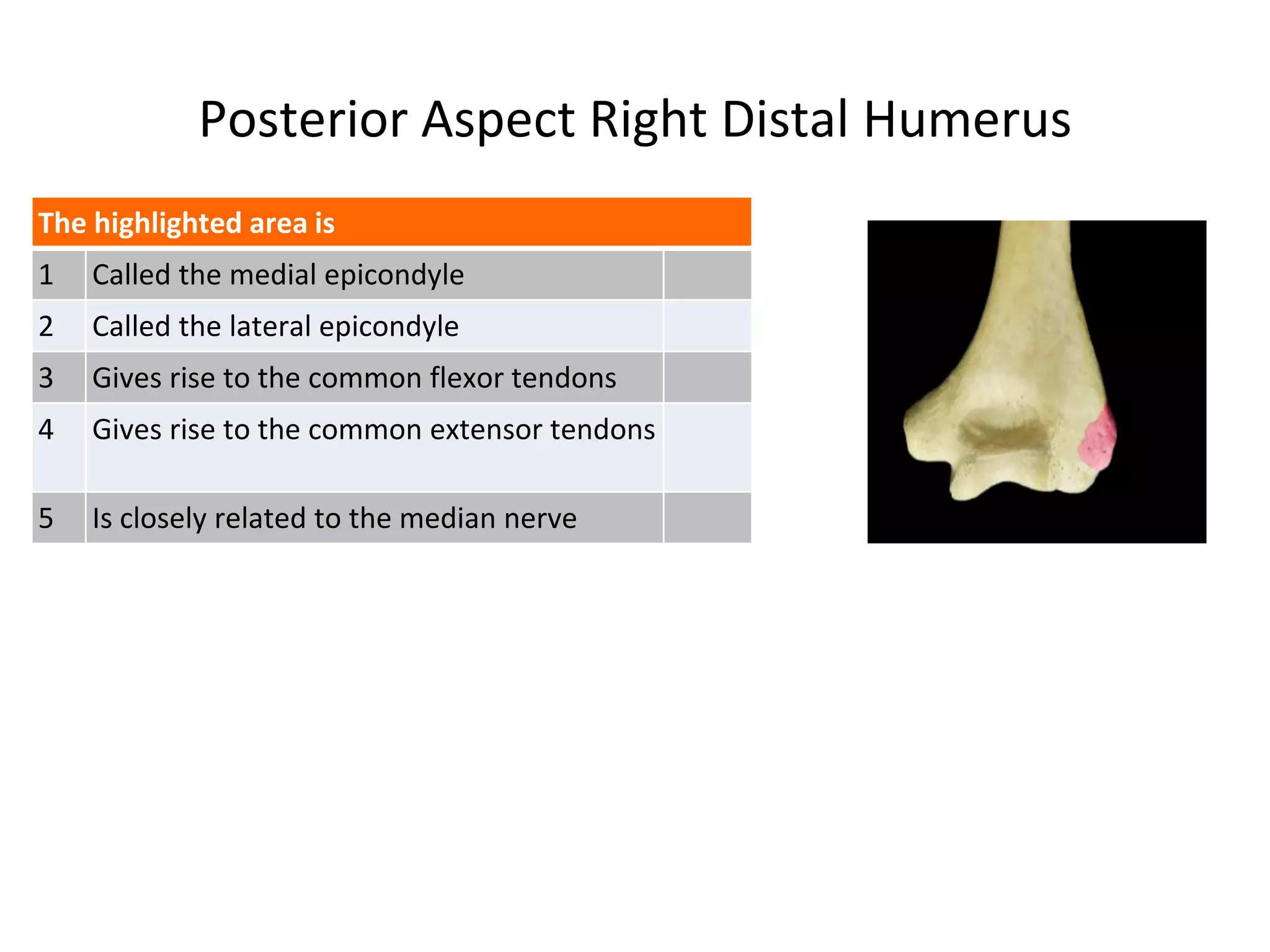
Posterior Aspect Right Distal Humerus
The highlighted area is
1 Called the medial epicondyle
2 Called the lateral epicondyle
3 Gives rise to the common flexor tendons
4 Gives rise to the common extensor tendons
5 Is closely related to the median nerve
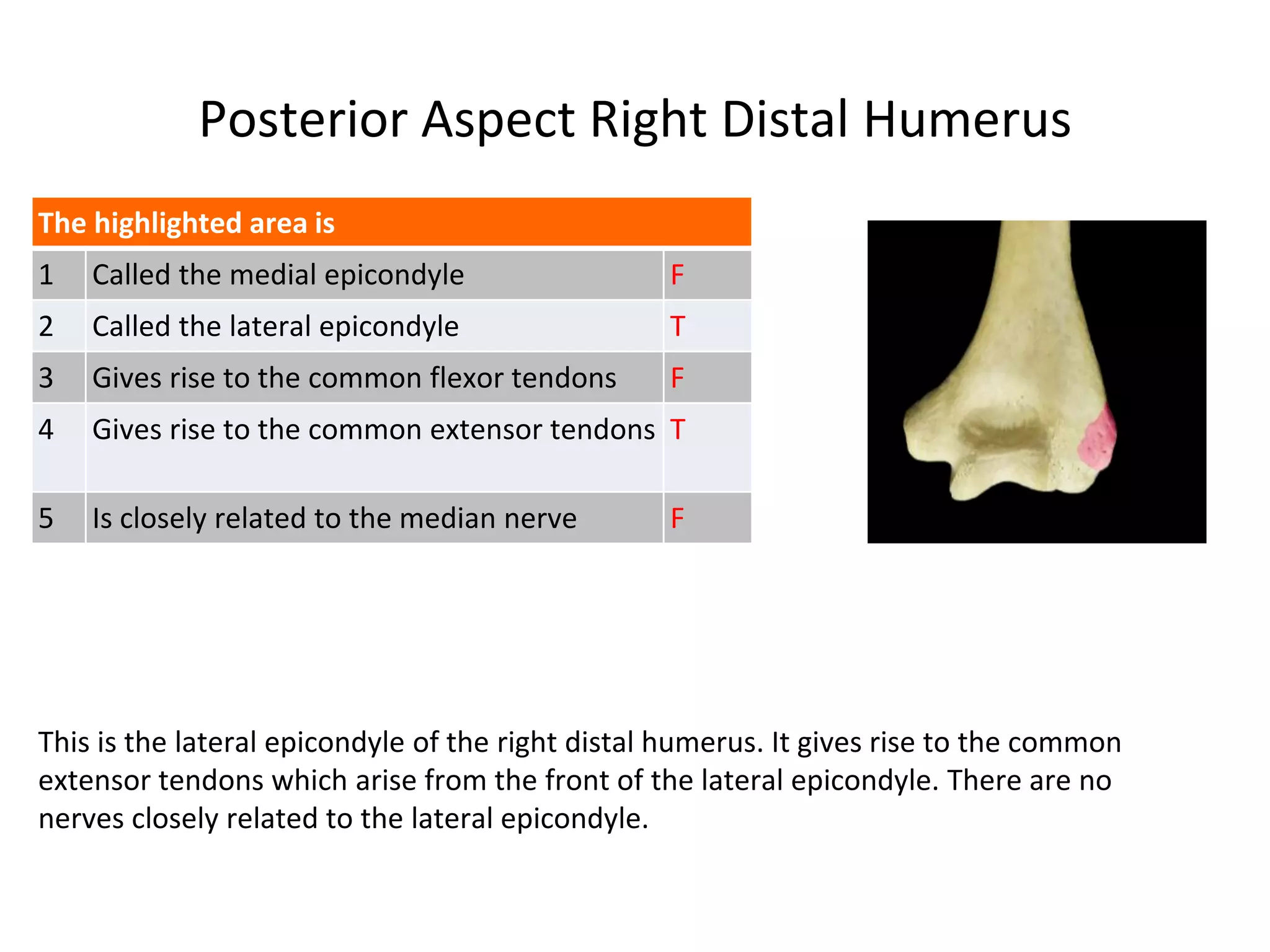
Posterior Aspect Right Distal Humerus
This is the lateral epicondyle of the right distal humerus. It gives rise to the common
extensor tendons which arise from the front of the lateral epicondyle. There are no
nerves closely related to the lateral epicondyle.
The highlighted area is
1 Called the medial epicondyle F
2 Called the lateral epicondyle T
3 Gives rise to the common flexor tendons F
4 Gives rise to the common extensor tendons T
5 Is closely related to the median nerve F
With regard to the humerus
1 The upper end of the humerus is the growing end
2 Teres minor is attached to the lesser tuberosity
3 The long head of triceps arises from the posterior surface of the
humerus
4 The radial nerve is accompanied by an artery as it courses
obliquely behind the humerus
5 Teres major is attached to the lateral lip of the intertubercular
sulcus
The lateral and medial heads of triceps arise from the posterior aspect of the
humerus. The long head arises from the infraglenoid tubercle of the scapula.
The artery which accompanies the radial nerve through the posterior compartment
of the arm is called the profunda brachii artery, and is a branch of the brachial artery
Teres major is attached to the medial lip of the intertubercular sulcus
With regard to the humerus
1 The upper end of the humerus is the growing end T
2 Teres minor is attached to the lesser tuberosity F
3 The long head of triceps arises from the posterior surface of the
humerus
F
4 The radial nerve is accompanied by an artery as it courses
obliquely behind the humerus
T
5 Teres major is attached to the lateral lip of the intertubercular
sulcus
F
Anterior aspect proximal humerus
The highlighted area is called the
1 Greater tuberosity
2 Lesser tuberosity
3 Greater trochanter
4 Spiral Groove
5 Bicipital Groove
Anterior aspect proximal humerus
The highlighted area is called the
1 Greater tuberosity F
2 Lesser tuberosity F
3 Greater trochanter F
4 Spiral Groove F
5 Bicipital Groove T
Superior or bird’s eye view proximal humerus
The highlighted area is called the
1 Lesser tuberosity
2 Lesser trochanter
3 Medial condyle
4 Anterior condyle
5 Greater tuberosity
Superior or bird’s eye view proximal humerus
The highlighted area is called the
1 Lesser tuberosity T
2 Lesser trochanter F
3 Medial condyle F
4 Anterior condyle F
5 Greater tuberosity F
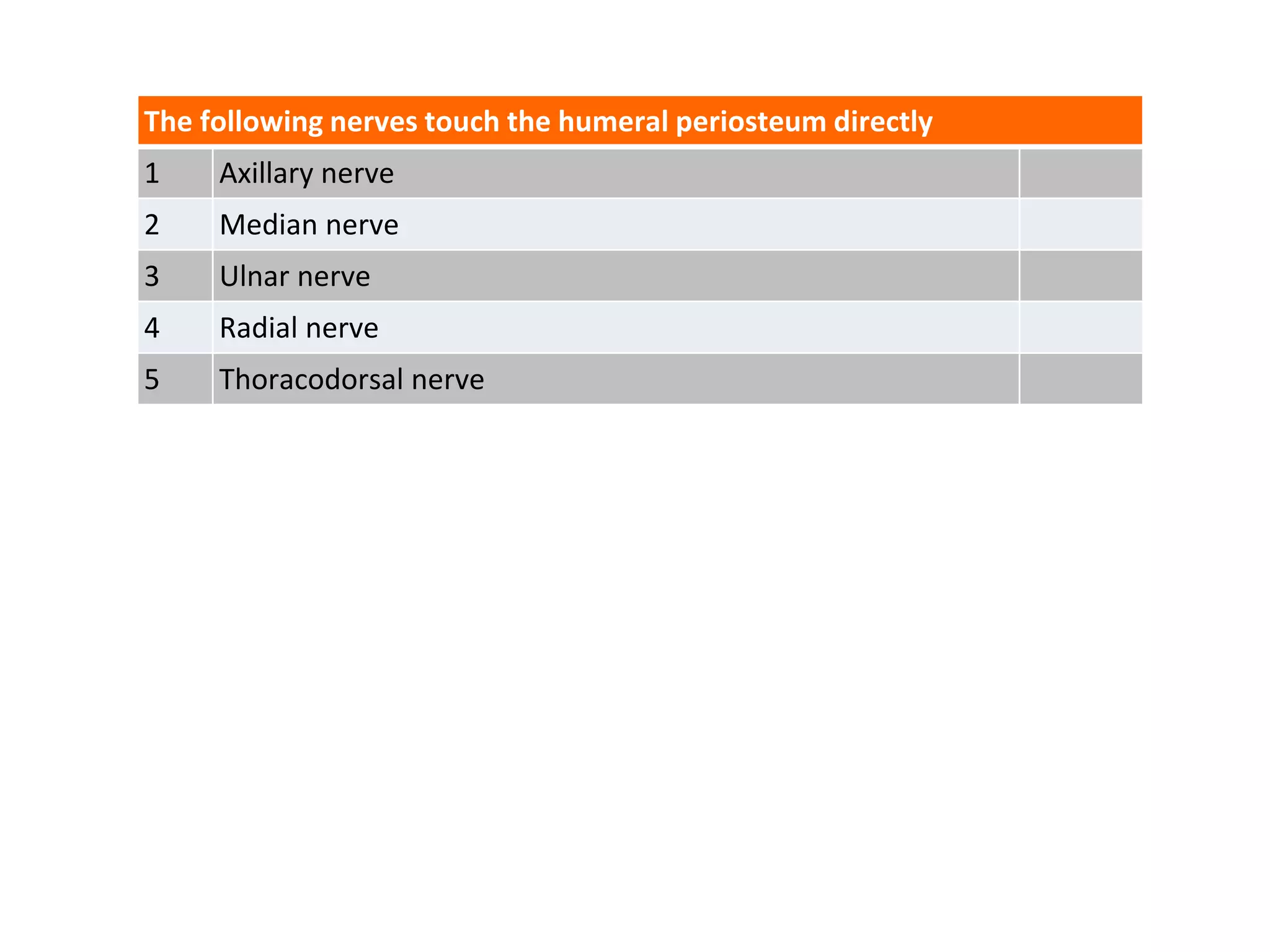
The following nerves touch the humeral periosteum directly
1 Axillary nerve
2 Median nerve
3 Ulnar nerve
4 Radial nerve
5 Thoracodorsal nerve
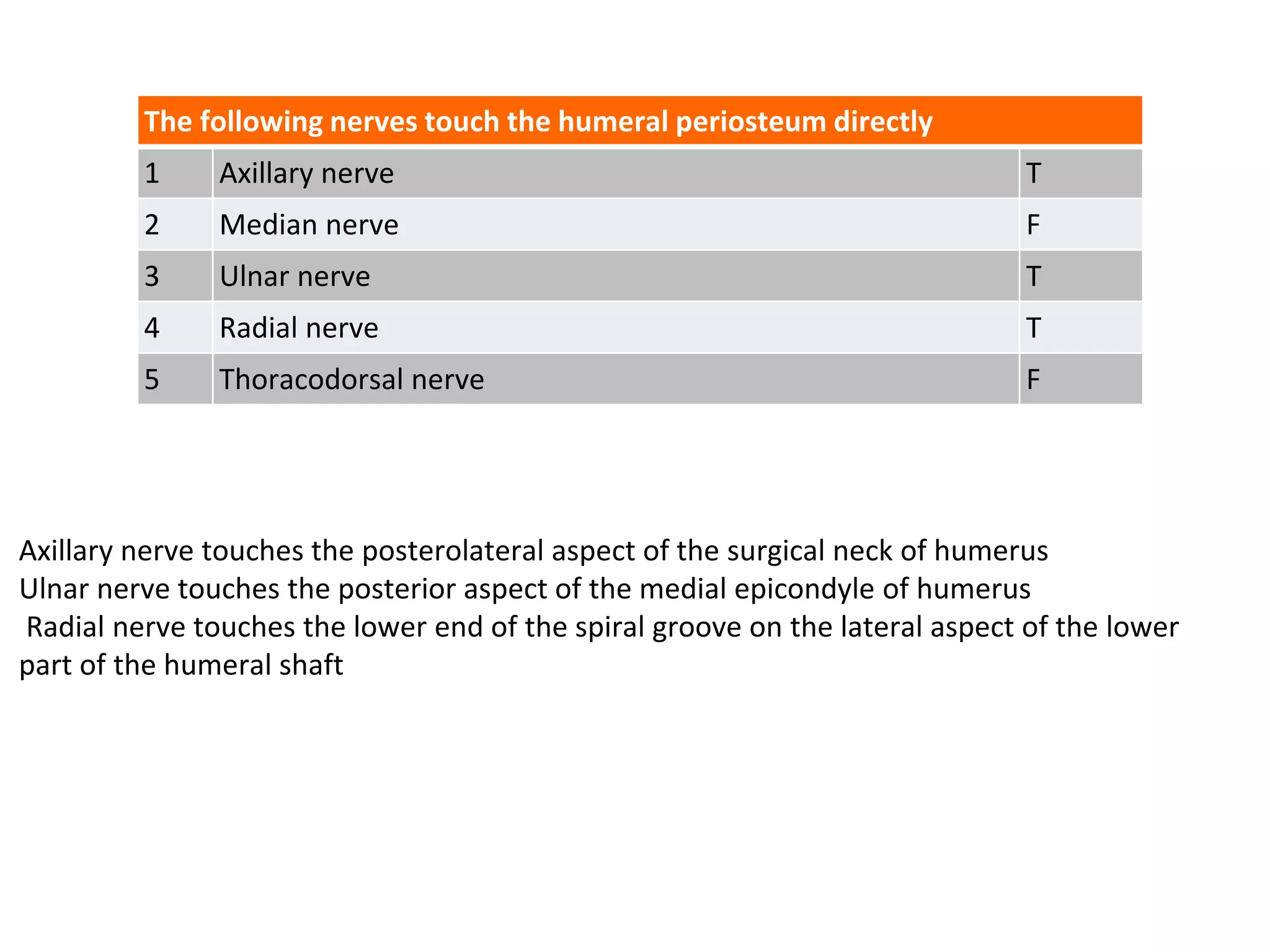
Axillary nerve touches the posterolateral aspect of the surgical neck of humerus
Ulnar nerve touches the posterior aspect of the medial epicondyle of humerus
Radial nerve touches the lower end of the spiral groove on the lateral aspect of the lower
part of the humeral shaft
The following nerves touch the humeral periosteum directly
1 Axillary nerve T
2 Median nerve F
3 Ulnar nerve T
4 Radial nerve T
5 Thoracodorsal nerve F
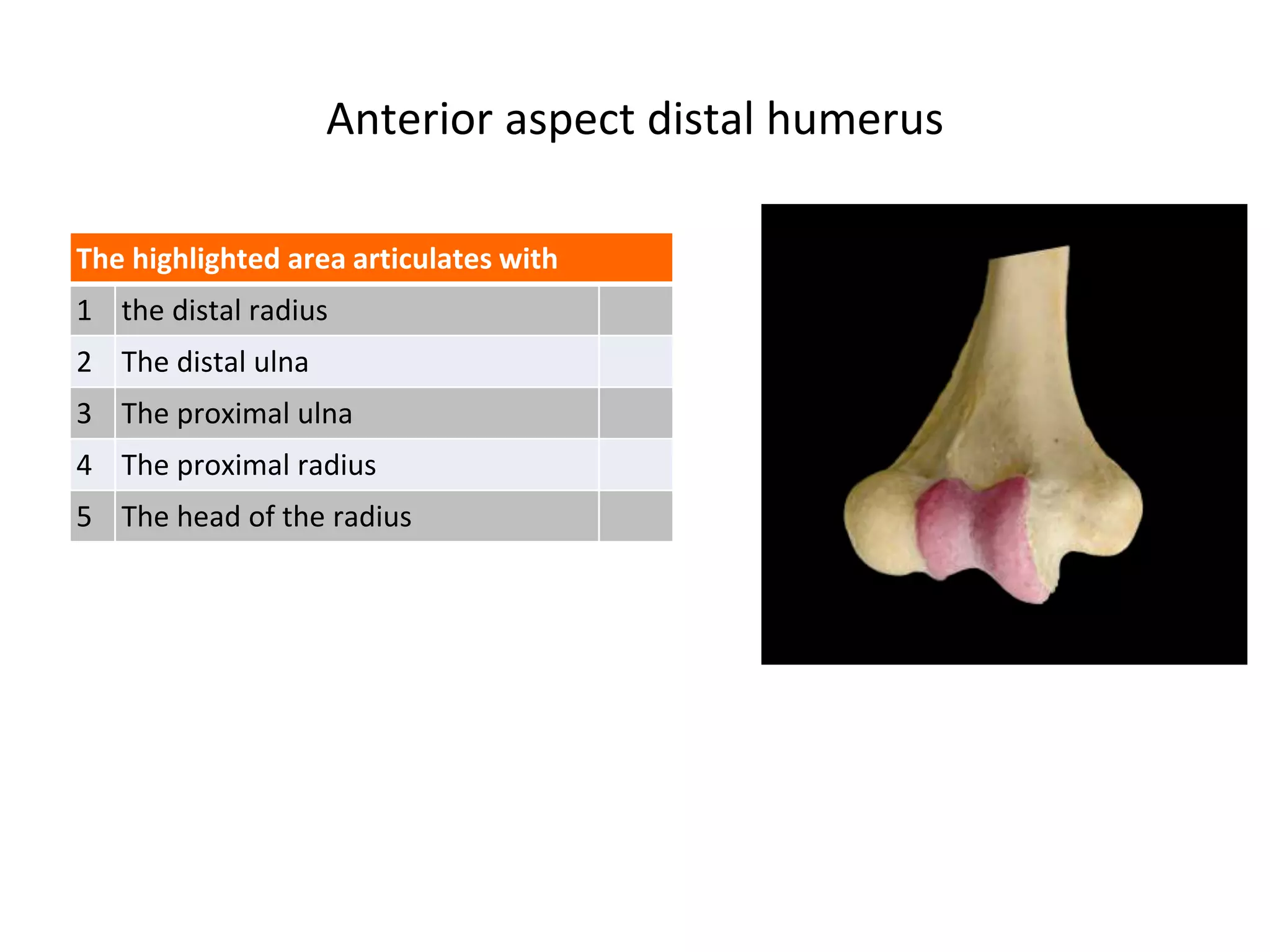
Anterior aspect distal humerus
The highlighted area articulates with
1 the distal radius
2 The distal ulna
3 The proximal ulna
4 The proximal radius
5 The head of the radius
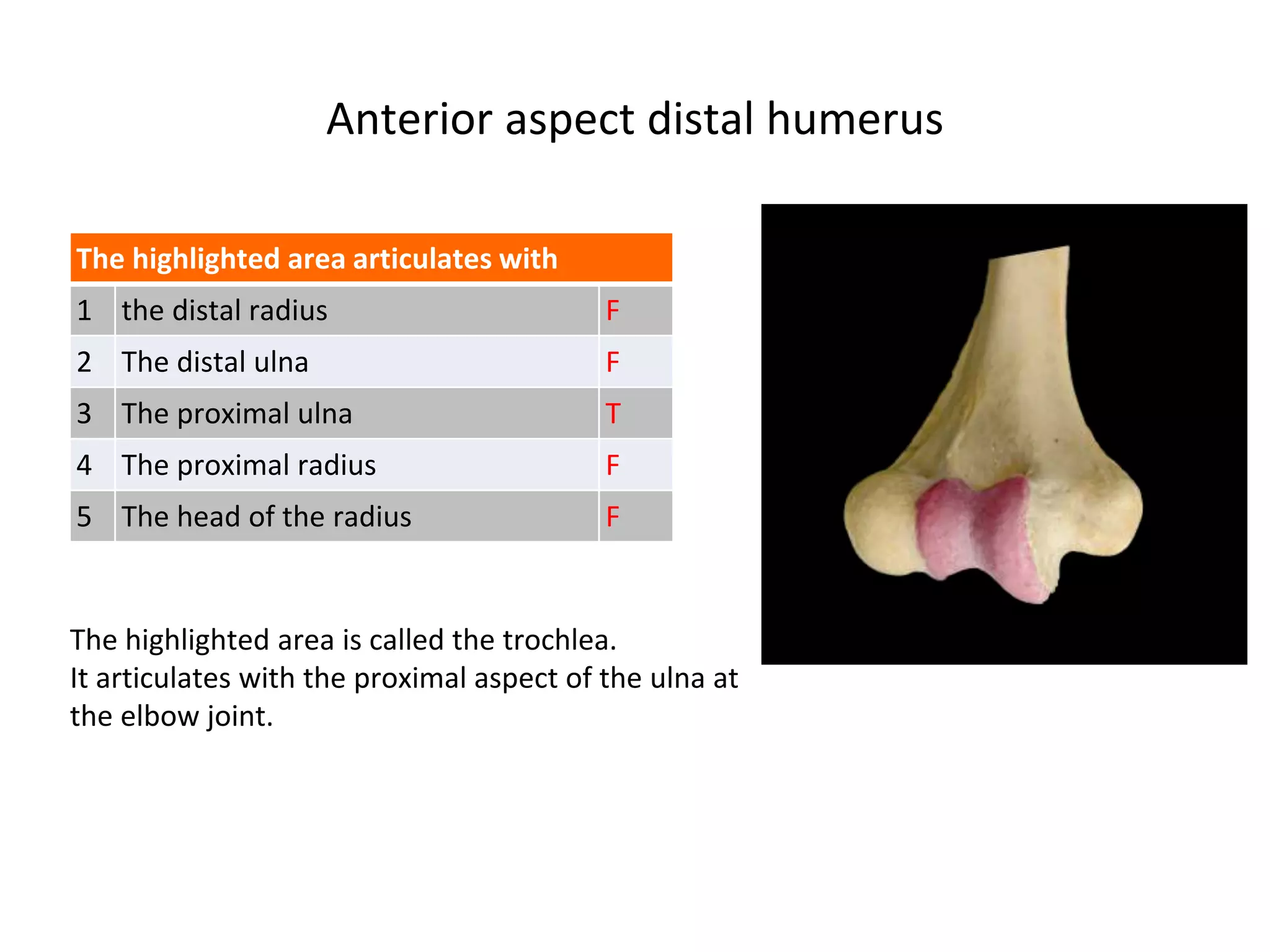
Anterior aspect distal humerus
The highlighted area is called the trochlea.
It articulates with the proximal aspect of the ulna at
the elbow joint.
The highlighted area articulates with
1 the distal radius F
2 The distal ulna F
3 The proximal ulna T
4 The proximal radius F
5 The head of the radius F
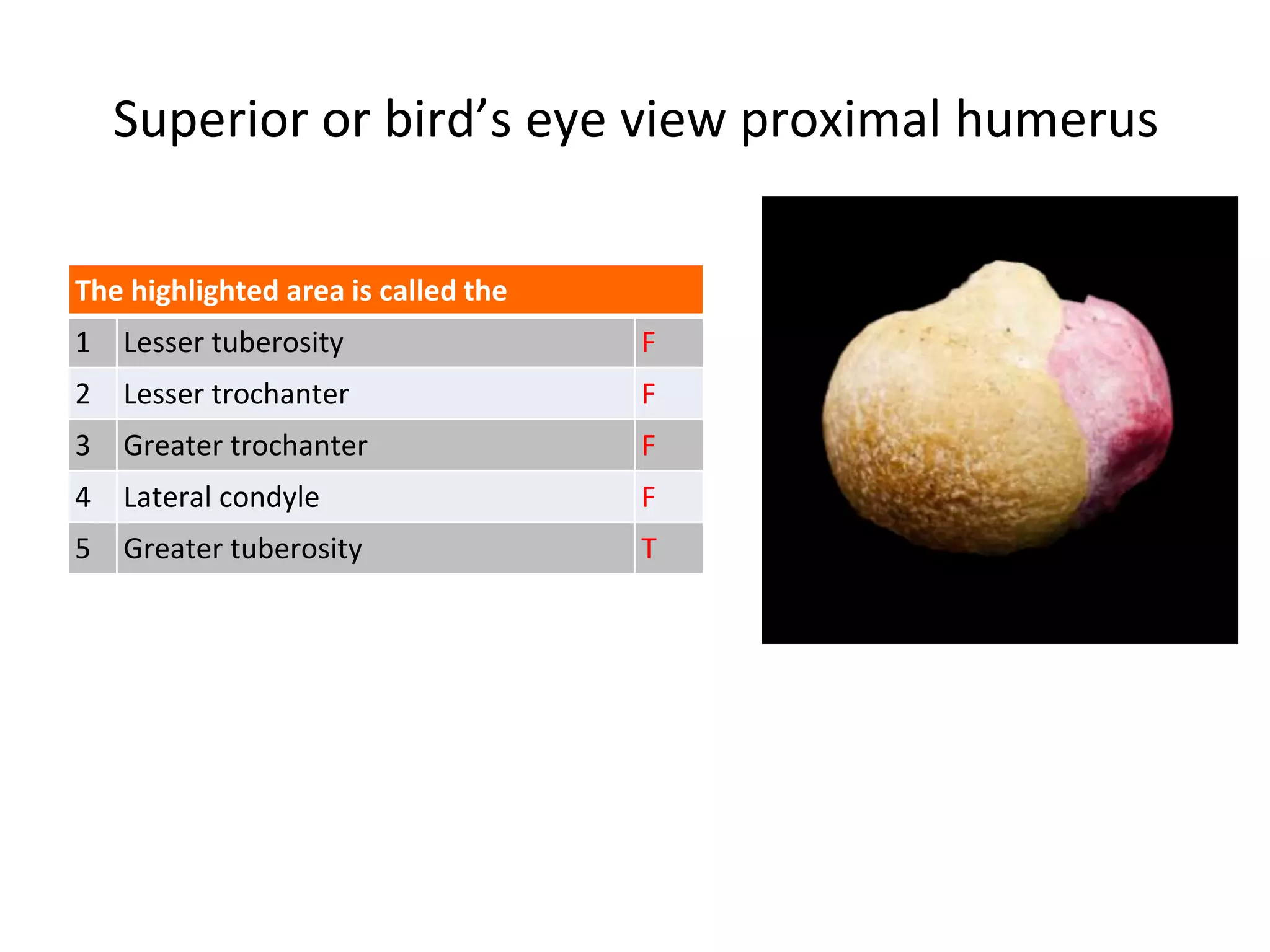
Superior or bird’s eye view proximal humerus
The highlighted area is called the
1 Lesser tuberosity
2 Lesser trochanter
3 Greater trochanter
4 Lateral condyle
5 Greater tuberosity
Superior or bird’s eye view proximal humerus
The highlighted area is called the
1 Lesser tuberosity F
2 Lesser trochanter F
3 Greater trochanter F
4 Lateral condyle F
5 Greater tuberosity T
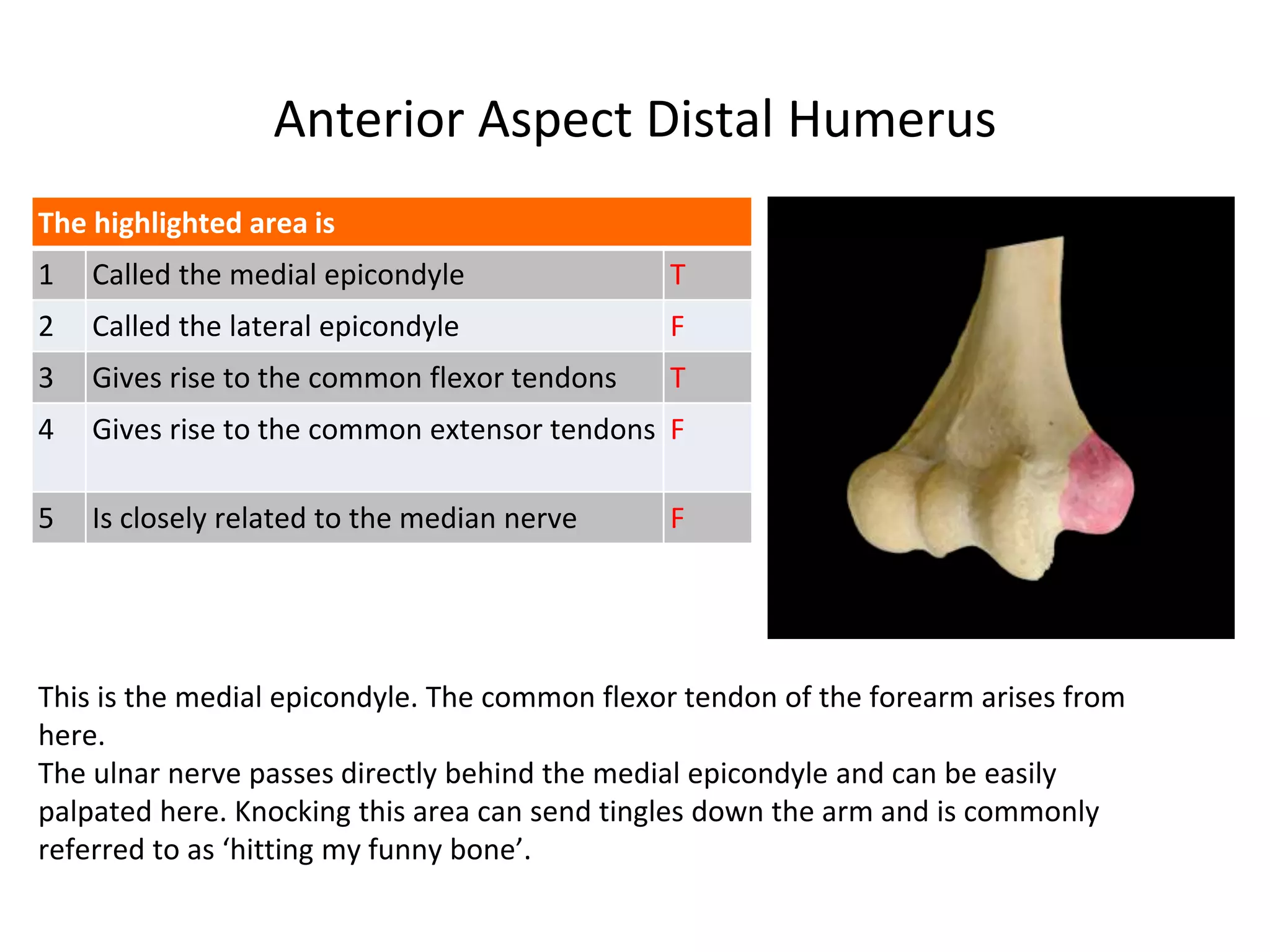
Anterior Aspect Distal Humerus
The highlighted area is
1 Called the medial epicondyle
2 Called the lateral epicondyle
3 Gives rise to the common flexor tendons
4 Gives rise to the common extensor tendons
5 Is closely related to the median nerve
Anterior Aspect Distal Humerus
This is the medial epicondyle. The common flexor tendon of the forearm arises from
here.
The ulnar nerve passes directly behind the medial epicondyle and can be easily
palpated here. Knocking this area can send tingles down the arm and is commonly
referred to as ‘hitting my funny bone’.
The highlighted area is
1 Called the medial epicondyle T
2 Called the lateral epicondyle F
3 Gives rise to the common flexor tendons T
4 Gives rise to the common extensor tendons F
5 Is closely related to the median nerve F
Anterior Aspect Distal Humerus
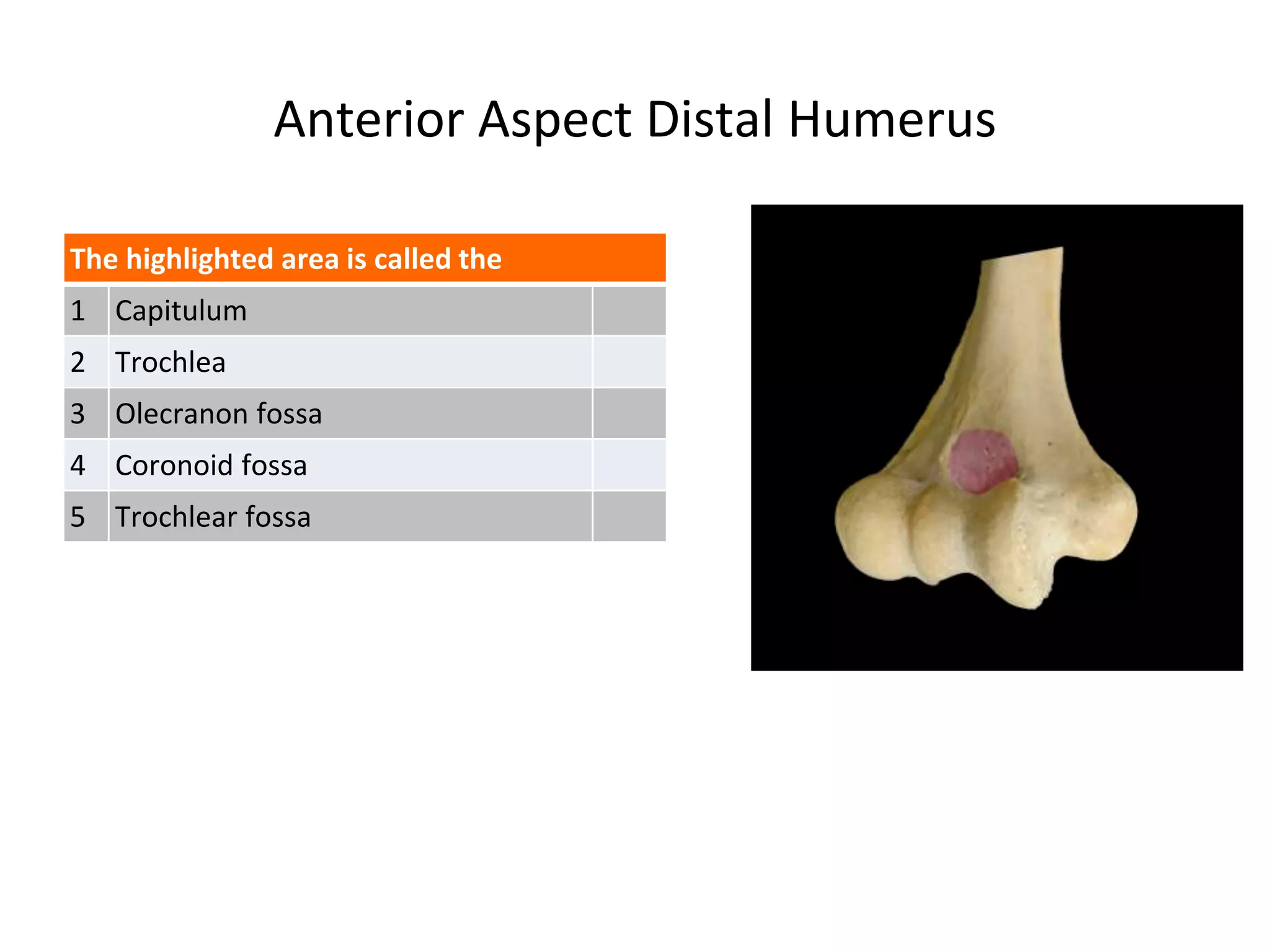
The highlighted area is called the
1 Capitulum
2 Trochlea
3 Olecranon fossa
4 Coronoid fossa
5 Trochlear fossa
Anterior Aspect Distal Humerus
This is the coronoid fossa. It articulates with the coronoid process of the proximal ulna
The highlighted area is called the
1 Capitulum F
2 Trochlea F
3 Olecranon fossa F
4 Coronoid fossa T
5 Trochlear fossa F
The following muscles attach to the highlighted
area and move the arm accordingly
1 Subscapularis which elevates the arm
2 Infraspinatus which externally rotates
the arm
3 Subscapularis which internally rotates
the arm
4 Supraspinatus which abducts the arm
5 Infraspinatus which internally rotates
the arm
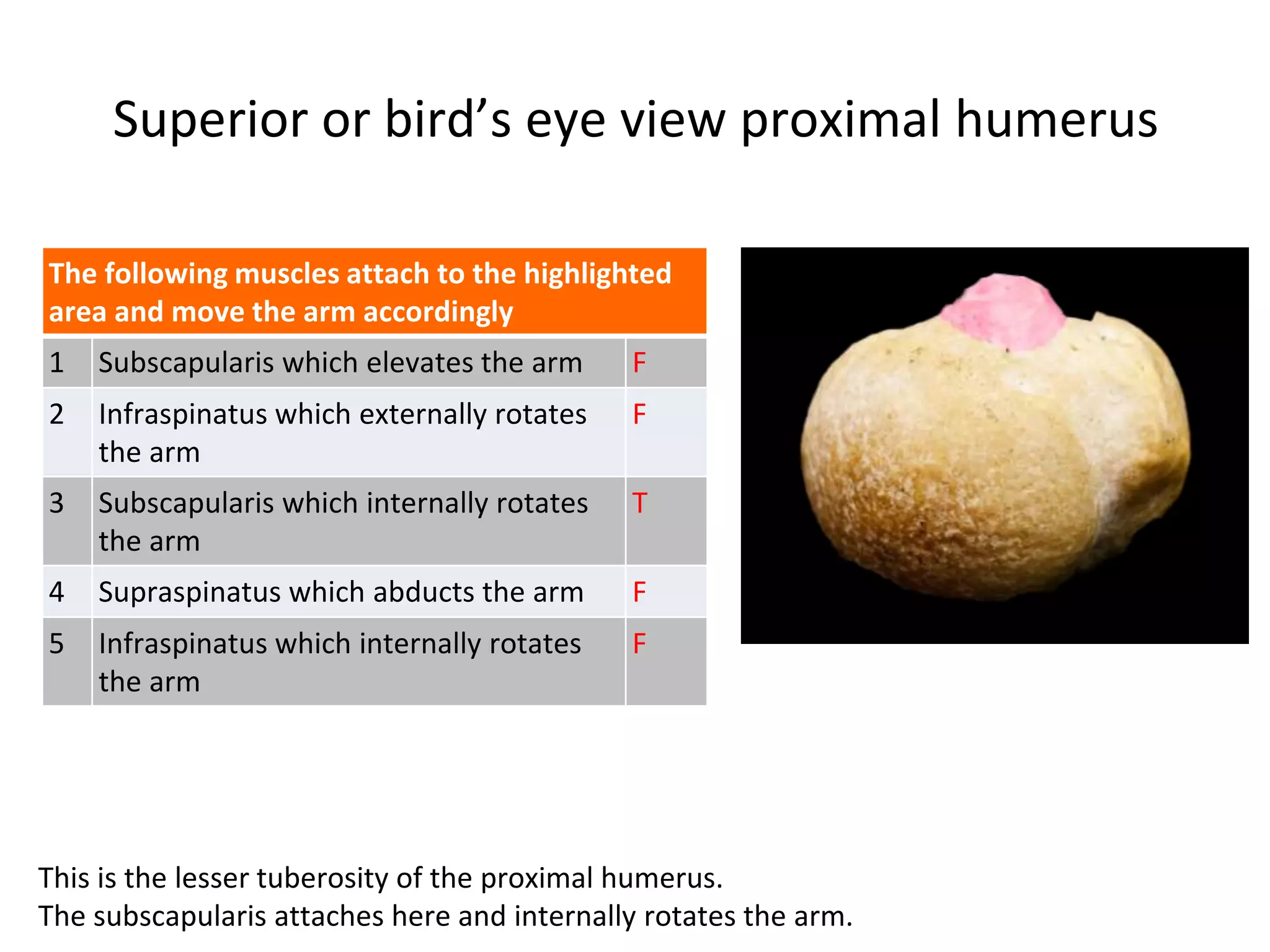
Superior or bird’s eye view proximal humerus
The following muscles attach to the highlighted
area and move the arm accordingly
1 Subscapularis which elevates the arm F
2 Infraspinatus which externally rotates
the arm
F
3 Subscapularis which internally rotates
the arm
T
4 Supraspinatus which abducts the arm F
5 Infraspinatus which internally rotates
the arm
F
Superior or bird’s eye view proximal humerus
This is the lesser tuberosity of the proximal humerus.
The subscapularis attaches here and internally rotates the arm.
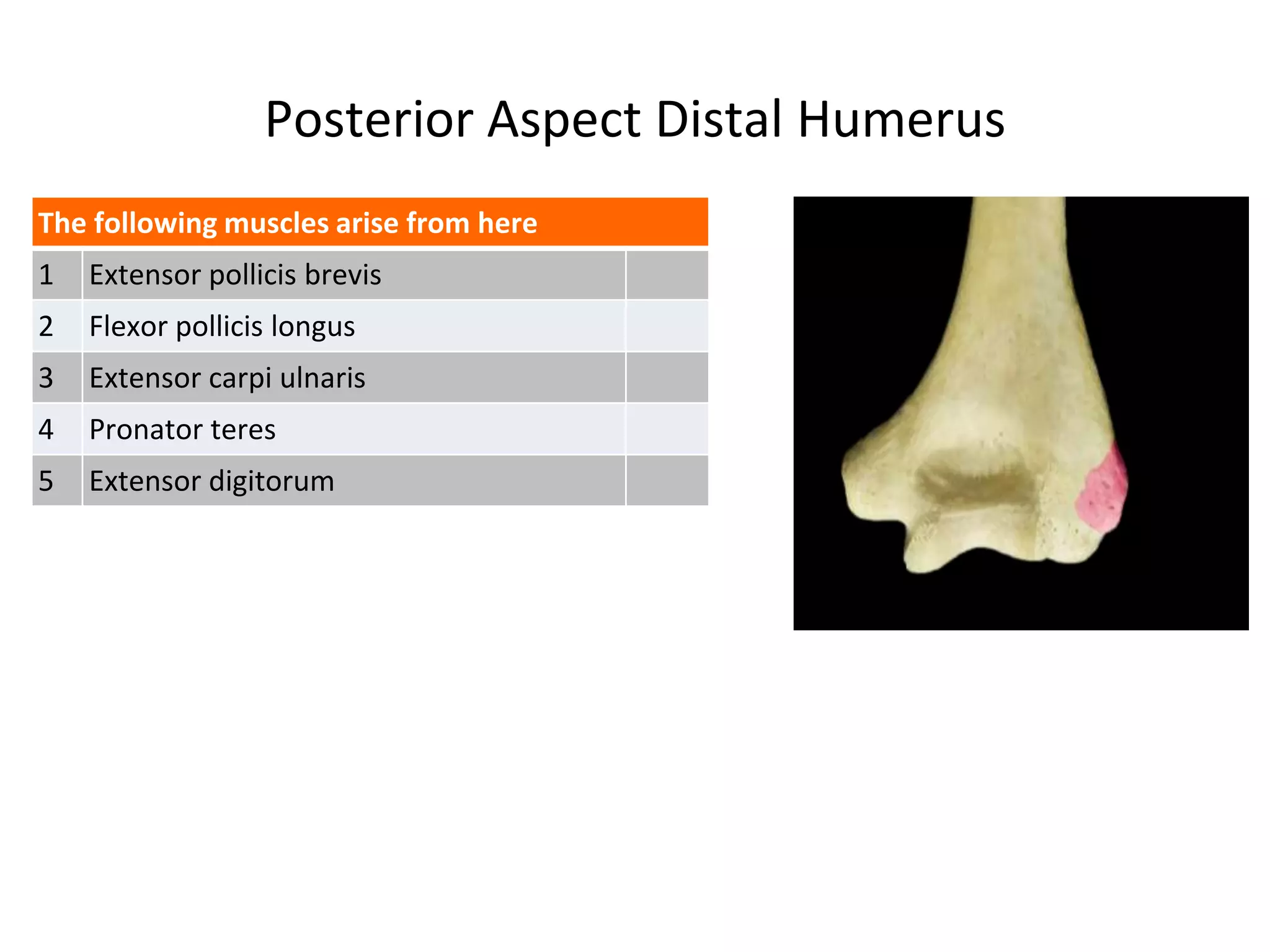
Posterior Aspect Distal Humerus
The following muscles arise from here
1 Extensor pollicis brevis
2 Flexor pollicis longus
3 Extensor carpi ulnaris
4 Pronator teres
5 Extensor digitorum
Posterior Aspect Distal Humerus
This is the lateral epicondyle of the distal humerus. It gives rise to the common
extensor tendons. These include extensor carpi radialis brevis, extensor digitorum,
extensor digiti minimi, extensor carpi ulnaris and anconeus.
Pronator teres arises form the medial epicondyle. Extensor pollicis longus arises from
the shaft of the dorsal aspect of the ulna. Extensor pollicis brevis arises from the shaft
of the radius. Flexor pollicis longus arises from the shaft of the volar aspect of the
radius.
The following muscles arise from here
1 Extensor pollicis brevis F
2 Flexor pollicis longus F
3 Extensor carpi ulnaris T
4 Pronator teres F
5 Extensor digitorum T
The following structures are attached to the lateral epicondyle
of the humerus
1 pronator teres
2 brachioradialis
3 supinator
4 lateral collateral ligament of the elbow joint
5 common extensor tendon
Pronator teres arises through the common flexor tendon from the medial epicondyle
of humerus
The humeral attachment of brachioradialis is to the upper 2/3rds of the lateral
supracondylar ridge; not lateral epicondyle
The superficial head of supinator does indeed arise from the lateral epicondyle
The common extensor tendon arises from the anterior aspect of the lateral
epicondyle
The following structures are attached to the lateral epicondyle
of the humerus
1 pronator teres F
2 brachioradialis F
3 supinator T
4 lateral collateral ligament of the elbow joint T
5 common extensor tendon T

Exam Questions Humerus

  • 1.
  • 2.
    Anterior aspect proximalhumerus The highlighted area 1 Is called the greater tuberosity 2 Is called the lesser tuberosity 3 Receives the supraspinatus muscle 4 Receives the infraspinatus muscle 5 Receives the subscapularis muscle
  • 3.
    Anterior aspect proximalhumerus This is the lesser tuberosity of the proximal humerus. It receives the subscapularis muscle which internally rotates the arm. The supraspinatus and infraspinatus attaches to the greater tuberosity which is the more lateral prominence of the proximal humerus The highlighted area 1 Is called the greater tuberosity F 2 Is called the lesser tuberosity T 3 Receives the supraspinatus muscle F 4 Receives the infraspinatus muscle F 5 Receives the subscapularis muscle T
  • 4.
    Posterior aspect distalhumerus The highlighted area is called the 1 Capitulum 2 Trochlea 3 Olecranon fossa 4 Coronoid fossa 5 Trochlear fossa
  • 5.
    Posterior aspect distalhumerus This is the olecranon fossa, it articulates with the olecranon process of the proximal ulna. The coronoid fossa is on the anterior aspect of the distal humerus and articulates with the coronoid process of the ulna. There is no trochlear fossa The highlighted area is called the 1 Capitulum F 2 Trochlea F 3 Olecranon fossa T 4 Coronoid fossa F 5 Trochlear fossa F
  • 6.
    The lower endof the humerus gives attachment to 1 flexor digitorum profundus 2 flexor pollicis longus 3 supinator 4 common extensor tendon 5 biceps brachii
  • 7.
    Flexor digitorum profundusand flexor pollicis longus belong to the ‘deep group’ of muscles of the flexor compartment of forearm, and have no attachment proximal to the elbow Both supinator and the common extensor tendon arise from the lateral epicondyle of the humerus Biceps brachii has no attachment to the humerus whatsoever! The lower end of the humerus gives attachment to 1 flexor digitorum profundus F 2 flexor pollicis longus F 3 supinator T 4 common extensor tendon T 5 biceps brachii F
  • 8.
    Inferior/oblique view distalhumerus The highlighted area is called the 1 Olecranon process 2 Coronoid process 3 Trochlea 4 Medial epicondyle 5 Capitulum
  • 9.
    Inferior/oblique view distalhumerus The highlighted area is called the 1 Olecranon process F 2 Coronoid process F 3 Trochlea F 4 Medial epicondyle T 5 Capitulum F
  • 10.
    Anterior aspect proximalhumerus The highlighted area 1 Is called the lesser tuberosity 2 Is called the greater tuberosity 3 Gives attachment to the subclavius muscle 4 Gives attachment to the supraspinatus muscle 5 Gives attachment to the subscapularis muscle
  • 11.
    Anterior aspect proximalhumerus The highlighted area 1 Is called the lesser tuberosity F 2 Is called the greater tuberosity T 3 Gives attachment to the subclavius muscle F 4 Gives attachment to the supraspinatus muscle T 5 Gives attachment to the subscapularis muscle F This is the greater tuberosity of the proximal humerus It gives attachment to – supraspinatus muscle which abducts the arm – Infraspinatus which externally rotates the arm – Teres minor which externally rotates the arm The subscapularis attaches to the lesser tuberosity The subclavius attaches to the clavicle
  • 12.
    Anterior aspect distalhumerus The highlighted area articulates with 1 Styloid process of the radius 2 Olecranon process of the ulna 3 Head of the radius 4 Head of the ulna 5 Coronoid process of the ulna
  • 13.
    Anterior aspect distalhumerus The highlighted area articulates with 1 Styloid process of the radius F 2 Olecranon process of the ulna F 3 Head of the radius T 4 Head of the ulna F 5 Coronoid process of the ulna F This is the capitulum of the distal humerus. It articulates with the head of the proximal radius. The styloid process is on the distal aspect of the radius at the wrist joint. The ulna articulates with the trochlea
  • 14.
    Superior or bird’seye view proximal humerus The highlighted area is called the 1 Lesser tuberosity 2 Lesser trochanter 3 Medial condyle 4 Anterior condyle 5 Greater tuberosity
  • 15.
    Superior or bird’seye view proximal humerus The highlighted area is called the 1 Lesser tuberosity T 2 Lesser trochanter F 3 Medial condyle F 4 Anterior condyle F 5 Greater tuberosity F
  • 16.
    Concerning relationships ofnerves to the humerus: 1 The radial nerve passes through the bicipital groove 2 The median nerve is closely related to the spiral groove of the distal humerus 3 The radial nerve is closely related to the spiral groove on the midshaft of the radius 4 The ulnar nerve is closely related to the lateral epicondyle of the distal humerus 5 The ulnar nerve is closely related to the medial epicondyle of the humerus Nerves
  • 17.
    Concerning relationships ofnerves to the humerus: 1 The radial nerve passes through the bicipital groove F 2 The median nerve is closely related to the spiral groove of the distal humerus F 3 The radial nerve is closely related to the spiral groove on the midshaft of the radius F 4 The ulnar nerve is closely related to the lateral epicondyle of the distal humerus F 5 The ulnar nerve is closely related to the medial epicondyle of the humerus T Nerves The radial nerve is closely related to the spiral groove on the midshaft of the humerus. The ulnar nerve is immediately posterior to the medial epicondyle of the distal humerus The long head of biceps tendon passes through the bicipital groove of the proximal humerus
  • 18.
    Anterior aspect proximalhumerus The following muscles attach to the highlighted area and move the arm as stated 1 Subscapularis which elevates the arm 2 Infraspinatus which externally rotates the arm 3 Subscapularis which internally rotates the arm 4 Supraspinatus which abducts the arm 5 Infraspinatus which internally rotates the arm
  • 19.
    Anterior aspect proximalhumerus The following muscles attach to the highlighted area and move the arm as stated 1 Subscapularis which elevates the arm F 2 Infraspinatus which externally rotates the arm T 3 Subscapularis which internally rotates the arm F 4 Supraspinatus which abducts the arm T 5 Infraspinatus which internally rotates the arm F The highlighted area is the greater tuberosity which provides attachment for 3 of the 4 rotator cuff muscles. From superior to posterior they are – Supraspinatus which abducts the arm – Infraspinatus which externally rotates the arm – Teres minor which externally rotates the arm The subscapularis is the other rotator cuff muscle. It attaches to the lesser tuberosity and internally rotates the arm.
  • 20.
    Anterior aspect distalhumerus The highlighted area 1 Is called the trochlea 2 Is called the capitulum 3 Is called the coronoid process 4 Is called the coracoid process 5 Is called the olecranon process
  • 21.
    Anterior aspect distalhumerus The highlighted area is called the trochlea The highlighted area 1 Is called the trochlea T 2 Is called the capitulum F 3 Is called the coronoid process F 4 Is called the coracoid process F 5 Is called the olecranon process F
  • 22.
    Anterior Aspect DistalHumerus The following muscles arise from here 1 Palmaris longus 2 Flexor pollicis longus 3 Extensor carpi ulnaris 4 Pronator teres 5 Flexor carpi radialis
  • 23.
    Anterior Aspect DistalHumerus This is the medial epicondyle of the distal humerus. It gives rise to the common flexor tendons. These include pronator teres, flexor carpi radialis, flexor carpi ulnaris, palmaris longus and flexor digitorum. Flexor pollicis longus arises from the shaft of the volar aspect of the radius. Extensor carpi ulnaris arises from the common extensor tendon on the lateral epicondyle of the distal humerus. The following muscles arise from here 1 Palmaris longus T 2 Flexor pollicis longus F 3 Extensor carpi ulnaris F 4 Pronator teres T 5 Flexor carpi radialis T
  • 24.
    Anterior aspect distalhumerus Movements at the articulation of the highlighted area include 1 supination 2 abduction 3 flexion 4 adduction 5 extension
  • 25.
    Anterior aspect distalhumerus The highlighted area is called the trochlea. It articulates with the proximal aspect of the ulna at the elbow joint. Movement at this articulation is flexion and extension. Movements at the articulation of the highlighted area include 1 supination F 2 abduction F 3 flexion T 4 adduction F 5 extension T
  • 26.
    Inferior/oblique view distalhumerus The highlighted area is called the 1 Olecranon process 2 Coronoid process 3 Lateral epicondyle 4 Medial epicondyle 5 Capitulum
  • 27.
    Inferior/oblique view distalhumerus The highlighted area is called the 1 Olecranon process F 2 Coronoid process F 3 Lateral epicondyle F 4 Medial epicondyle F 5 Capitulum T
  • 28.
    The following muscles/tendonsare attached to the greater tuberosity of the humerus 1 supraspinatus 2 teres major 3 infraspinatus 4 latissimus dorsi 5 subscapularis
  • 29.
    Teres major isattached to the medial lip of the intertubercular sulcus Latissimus dorsi is attached to the floor of the intertubercular sulcus, not the greater tuberosity Subscapularis inserts onto the lesser tuberosity, not greater tuberosity. Three tendons insert onto the greater tuberosity of the humerus: supraspinatus to the upper aspect, and infraspinatus and teres minor to the posterior aspect. These three tendons along with subscapularis make up the rotator cuff. The following muscles/tendons are attached to the greater tuberosity of the humerus 1 supraspinatus T 2 teres major F 3 infraspinatus T 4 latissimus dorsi F 5 subscapularis F
  • 30.
    Anterior aspect proximalhumerus The following structures pass through the highlighted area 1 Long head of biceps tendon 2 Radial nerve 3 Musculocutaneous nerve 4 Ulnar nerve 5 Short head of biceps tendon
  • 31.
    Anterior aspect proximalhumerus The following structures pass through the highlighted area 1 Long head of biceps tendon T 2 Radial nerve F 3 Musculocutaneous nerve F 4 Ulnar nerve F 5 Short head of biceps tendon F This is the bicipital groove. The long head of biceps tendon originates from the superior aspect of the glenoid of the scapula and then traverses through the bicipital groove of the proximal humerus. There are no nerves in the bicipital groove.
  • 32.
    Inferior/oblique view distalhumerus The highlighted area is called the 1 Olecranon process 2 Coronoid process 3 Trochlea 4 Medial epicondyle 5 Capitulum
  • 33.
    Inferior/oblique view distalhumerus The highlighted area is called the 1 Olecranon process F 2 Coronoid process F 3 Trochlea T 4 Medial epicondyle F 5 Capitulum F
  • 34.
    Anterior aspect distalhumerus The highlighted area is called the 1 Olecranon process 2 Coronoid process 3 Lateral epicondyle 4 Medial epicondyle 5 Capitulum
  • 35.
    Anterior aspect distalhumerus The highlighted area is called the 1 Olecranon process F 2 Coronoid process F 3 Lateral epicondyle F 4 Medial epicondyle F 5 Capitulum T This is the capitulum
  • 36.
    Superior or bird’seye view proximal humerus The muscle that attaches here is innervated by the 1 Anterior suprascapular nerve 2 Axillary nerve 3 Upper subscapular nerve 4 Anterior subscapular nerve 5 Lower subscapular nerve
  • 37.
    Superior or bird’seye view proximal humerus The muscle that attaches here is innervated by the 1 Anterior suprascapular nerve F 2 Axillary nerve F 3 Upper subscapular nerve T 4 Anterior subscapular nerve F 5 Lower subscapular nerve T This is the lesser tuberosity of the proximal humerus. The subscapularis attaches here and internally rotates the arm. Subscapularis is innervated by the upper and lower subscapular nerves
  • 38.
    Posterior Aspect RightDistal Humerus The highlighted area is 1 Called the medial epicondyle 2 Called the lateral epicondyle 3 Gives rise to the common flexor tendons 4 Gives rise to the common extensor tendons 5 Is closely related to the median nerve
  • 39.
    Posterior Aspect RightDistal Humerus This is the lateral epicondyle of the right distal humerus. It gives rise to the common extensor tendons which arise from the front of the lateral epicondyle. There are no nerves closely related to the lateral epicondyle. The highlighted area is 1 Called the medial epicondyle F 2 Called the lateral epicondyle T 3 Gives rise to the common flexor tendons F 4 Gives rise to the common extensor tendons T 5 Is closely related to the median nerve F
  • 40.
    With regard tothe humerus 1 The upper end of the humerus is the growing end 2 Teres minor is attached to the lesser tuberosity 3 The long head of triceps arises from the posterior surface of the humerus 4 The radial nerve is accompanied by an artery as it courses obliquely behind the humerus 5 Teres major is attached to the lateral lip of the intertubercular sulcus
  • 41.
    The lateral andmedial heads of triceps arise from the posterior aspect of the humerus. The long head arises from the infraglenoid tubercle of the scapula. The artery which accompanies the radial nerve through the posterior compartment of the arm is called the profunda brachii artery, and is a branch of the brachial artery Teres major is attached to the medial lip of the intertubercular sulcus With regard to the humerus 1 The upper end of the humerus is the growing end T 2 Teres minor is attached to the lesser tuberosity F 3 The long head of triceps arises from the posterior surface of the humerus F 4 The radial nerve is accompanied by an artery as it courses obliquely behind the humerus T 5 Teres major is attached to the lateral lip of the intertubercular sulcus F
  • 42.
    Anterior aspect proximalhumerus The highlighted area is called the 1 Greater tuberosity 2 Lesser tuberosity 3 Greater trochanter 4 Spiral Groove 5 Bicipital Groove
  • 43.
    Anterior aspect proximalhumerus The highlighted area is called the 1 Greater tuberosity F 2 Lesser tuberosity F 3 Greater trochanter F 4 Spiral Groove F 5 Bicipital Groove T
  • 44.
    Superior or bird’seye view proximal humerus The highlighted area is called the 1 Lesser tuberosity 2 Lesser trochanter 3 Medial condyle 4 Anterior condyle 5 Greater tuberosity
  • 45.
    Superior or bird’seye view proximal humerus The highlighted area is called the 1 Lesser tuberosity T 2 Lesser trochanter F 3 Medial condyle F 4 Anterior condyle F 5 Greater tuberosity F
  • 46.
    The following nervestouch the humeral periosteum directly 1 Axillary nerve 2 Median nerve 3 Ulnar nerve 4 Radial nerve 5 Thoracodorsal nerve
  • 47.
    Axillary nerve touchesthe posterolateral aspect of the surgical neck of humerus Ulnar nerve touches the posterior aspect of the medial epicondyle of humerus Radial nerve touches the lower end of the spiral groove on the lateral aspect of the lower part of the humeral shaft The following nerves touch the humeral periosteum directly 1 Axillary nerve T 2 Median nerve F 3 Ulnar nerve T 4 Radial nerve T 5 Thoracodorsal nerve F
  • 48.
    Anterior aspect distalhumerus The highlighted area articulates with 1 the distal radius 2 The distal ulna 3 The proximal ulna 4 The proximal radius 5 The head of the radius
  • 49.
    Anterior aspect distalhumerus The highlighted area is called the trochlea. It articulates with the proximal aspect of the ulna at the elbow joint. The highlighted area articulates with 1 the distal radius F 2 The distal ulna F 3 The proximal ulna T 4 The proximal radius F 5 The head of the radius F
  • 50.
    Superior or bird’seye view proximal humerus The highlighted area is called the 1 Lesser tuberosity 2 Lesser trochanter 3 Greater trochanter 4 Lateral condyle 5 Greater tuberosity
  • 51.
    Superior or bird’seye view proximal humerus The highlighted area is called the 1 Lesser tuberosity F 2 Lesser trochanter F 3 Greater trochanter F 4 Lateral condyle F 5 Greater tuberosity T
  • 52.
    Anterior Aspect DistalHumerus The highlighted area is 1 Called the medial epicondyle 2 Called the lateral epicondyle 3 Gives rise to the common flexor tendons 4 Gives rise to the common extensor tendons 5 Is closely related to the median nerve
  • 53.
    Anterior Aspect DistalHumerus This is the medial epicondyle. The common flexor tendon of the forearm arises from here. The ulnar nerve passes directly behind the medial epicondyle and can be easily palpated here. Knocking this area can send tingles down the arm and is commonly referred to as ‘hitting my funny bone’. The highlighted area is 1 Called the medial epicondyle T 2 Called the lateral epicondyle F 3 Gives rise to the common flexor tendons T 4 Gives rise to the common extensor tendons F 5 Is closely related to the median nerve F
  • 54.
    Anterior Aspect DistalHumerus The highlighted area is called the 1 Capitulum 2 Trochlea 3 Olecranon fossa 4 Coronoid fossa 5 Trochlear fossa
  • 55.
    Anterior Aspect DistalHumerus This is the coronoid fossa. It articulates with the coronoid process of the proximal ulna The highlighted area is called the 1 Capitulum F 2 Trochlea F 3 Olecranon fossa F 4 Coronoid fossa T 5 Trochlear fossa F
  • 56.
    The following musclesattach to the highlighted area and move the arm accordingly 1 Subscapularis which elevates the arm 2 Infraspinatus which externally rotates the arm 3 Subscapularis which internally rotates the arm 4 Supraspinatus which abducts the arm 5 Infraspinatus which internally rotates the arm Superior or bird’s eye view proximal humerus
  • 57.
    The following musclesattach to the highlighted area and move the arm accordingly 1 Subscapularis which elevates the arm F 2 Infraspinatus which externally rotates the arm F 3 Subscapularis which internally rotates the arm T 4 Supraspinatus which abducts the arm F 5 Infraspinatus which internally rotates the arm F Superior or bird’s eye view proximal humerus This is the lesser tuberosity of the proximal humerus. The subscapularis attaches here and internally rotates the arm.
  • 58.
    Posterior Aspect DistalHumerus The following muscles arise from here 1 Extensor pollicis brevis 2 Flexor pollicis longus 3 Extensor carpi ulnaris 4 Pronator teres 5 Extensor digitorum
  • 59.
    Posterior Aspect DistalHumerus This is the lateral epicondyle of the distal humerus. It gives rise to the common extensor tendons. These include extensor carpi radialis brevis, extensor digitorum, extensor digiti minimi, extensor carpi ulnaris and anconeus. Pronator teres arises form the medial epicondyle. Extensor pollicis longus arises from the shaft of the dorsal aspect of the ulna. Extensor pollicis brevis arises from the shaft of the radius. Flexor pollicis longus arises from the shaft of the volar aspect of the radius. The following muscles arise from here 1 Extensor pollicis brevis F 2 Flexor pollicis longus F 3 Extensor carpi ulnaris T 4 Pronator teres F 5 Extensor digitorum T
  • 60.
    The following structuresare attached to the lateral epicondyle of the humerus 1 pronator teres 2 brachioradialis 3 supinator 4 lateral collateral ligament of the elbow joint 5 common extensor tendon
  • 61.
    Pronator teres arisesthrough the common flexor tendon from the medial epicondyle of humerus The humeral attachment of brachioradialis is to the upper 2/3rds of the lateral supracondylar ridge; not lateral epicondyle The superficial head of supinator does indeed arise from the lateral epicondyle The common extensor tendon arises from the anterior aspect of the lateral epicondyle The following structures are attached to the lateral epicondyle of the humerus 1 pronator teres F 2 brachioradialis F 3 supinator T 4 lateral collateral ligament of the elbow joint T 5 common extensor tendon T