LITERARY GENRES
false, fantasy, fable,
fairy tale, fictitious,
fabricated, phony,
fib, figment, fake,
fraud
myth
Elements
 May explain how
something in nature
looks or works
(example: why the
spider spins a web).
 May explain why people behave in
certain ways.
 Characters: Often includes gods or
goddesses who interact with humans.
fable
 Setting: In the distant past or a
timeless place.
Elements
 a very short story that usual has
only 2 or 3 characters.
 Characters: Often the characters
are animals or things that talk and
act like humans.
fantasy
 Setting: In a place that does not exist
in the real world.
Elements
 Events occur that could not happen
in the real world.
 Characters: people animal or objects are able to do things
they cannot do in the real world.
fairy tale
 Setting: in the distant
past. Often has an open
phrase, “Once upon a
time…” or “A very long
time ago…”
Elements
 A difficult, sometimes seemingly
impossible, problem to solve.
 Characters: often with magical powers;
imaginary characters such as dragons,
fairies, giants, elves; royal
characters such as queens,
princes, etc. The granting of
wishes often occurs.
 Has a happy ending in
which good wins over
evil.
Types
Types
Novel
l o n g fiction
Short Story
short fiction
Format
legend
 Setting: in the past.
Elements
 Tells the story of a hero.
 May be based on facts and real history,
but through numerous retellings the hero
and his or her deeds become larger than
life, and some facts are distorted.
realistic fiction
 Setting: a real place or could be a real place.
Elements
 The events in the story could happen in real life.
 Characters: behave as people do in real life.
folk tale
Elements
 Stories passed down from one generation to
another. Originally told orally. Reflect the
culture in which they originated.
 Characters: may include animals or
inanimate objects that speak. They often
teach a moral or lesson in life.
 Some folk tales called trickster tales are
about weak people or tiny animals
outwitting their stronger enemies.
 Action builds through repetition. Has an
exciting climax at the end. Goodness and
intelligence win out over evil and
foolishness.
 Told from 3rd
person point of view.
“tall tales”
 Setting: in the recent or
distant past.
Elements
 humorous exaggeration to tell the
adventures of a fictional (or possibly
nonfictional) character.
 Build upon improbable incidences and unusual
problems that are saved in creative ways.
historical fiction
 Setting: some specific
period of the past.
Elements
 A type of
realistic
fiction. Often,
but not
always, the
story is based
on actual
historical
events and
people of the
period.
 The plot reflects
events or problems of
the period.
 The details about
clothing, tools, and
food are authentic to
the period.
Types
Types
Types
LITERARY GENRES
The opposite of fiction.
True.
Real.
Book
l o n g nonfiction
Essay
short nonfiction
Format
biography
The true story of
someone’s life
written by someone
else.
Elements
 It may span a person’s whole life, or it
may tell about an important part of a
person’s life.
 An account of an person’s entire life is
almost always told in chronological order
(in the time order events occurred).
 Contains a variety of
important information
about the person’s life.
Often tells how the
person feels and thinks
about things.
opinions &
philosophy
Types
told as a story
facts; information
Writing Styles
Elements
 Often includes subheads
to organize topics.
 Might contain diagrams,
photographs and other
illustrations.
 Contains information that
can be checked by
looking at other sources.
autobiography
The true story of
someone’s life written
by that person.
Elements
 see “biography”
facts about history,
science, politics, etc.
instruction manuals
LITERARY GENRES
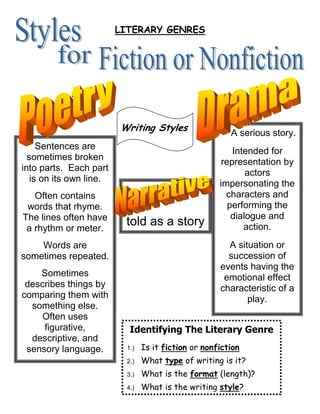
Sentences are
sometimes broken
into parts. Each part
is on its own line.
Often contains
words that rhyme.
The lines often have
a rhythm or meter.
Words are
sometimes repeated.
Sometimes
describes things by
comparing them with
something else.
Often uses
figurative,
descriptive, and
sensory language.
A serious story.
Intended for
representation by
actors
impersonating the
characters and
performing the
dialogue and
action.
A situation or
succession of
events having the
emotional effect
characteristic of a
play.
Writing Styles
Identifying The Literary Genre
1.) Is it fiction or nonfiction
2.) What type of writing is it?
3.) What is the format (length)?
4.) What is the writing style?
told as a story

Literary genres

  • 1.
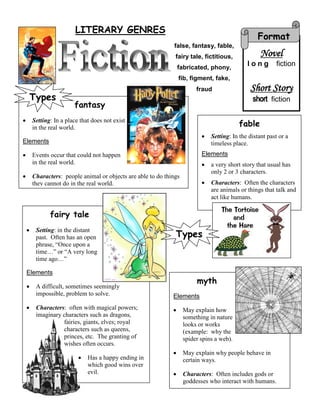
    LITERARY GENRES false, fantasy,fable, fairy tale, fictitious, fabricated, phony, fib, figment, fake, fraud myth Elements  May explain how something in nature looks or works (example: why the spider spins a web).  May explain why people behave in certain ways.  Characters: Often includes gods or goddesses who interact with humans. fable  Setting: In the distant past or a timeless place. Elements  a very short story that usual has only 2 or 3 characters.  Characters: Often the characters are animals or things that talk and act like humans. fantasy  Setting: In a place that does not exist in the real world. Elements  Events occur that could not happen in the real world.  Characters: people animal or objects are able to do things they cannot do in the real world. fairy tale  Setting: in the distant past. Often has an open phrase, “Once upon a time…” or “A very long time ago…” Elements  A difficult, sometimes seemingly impossible, problem to solve.  Characters: often with magical powers; imaginary characters such as dragons, fairies, giants, elves; royal characters such as queens, princes, etc. The granting of wishes often occurs.  Has a happy ending in which good wins over evil. Types Types Novel l o n g fiction Short Story short fiction Format
  • 2.
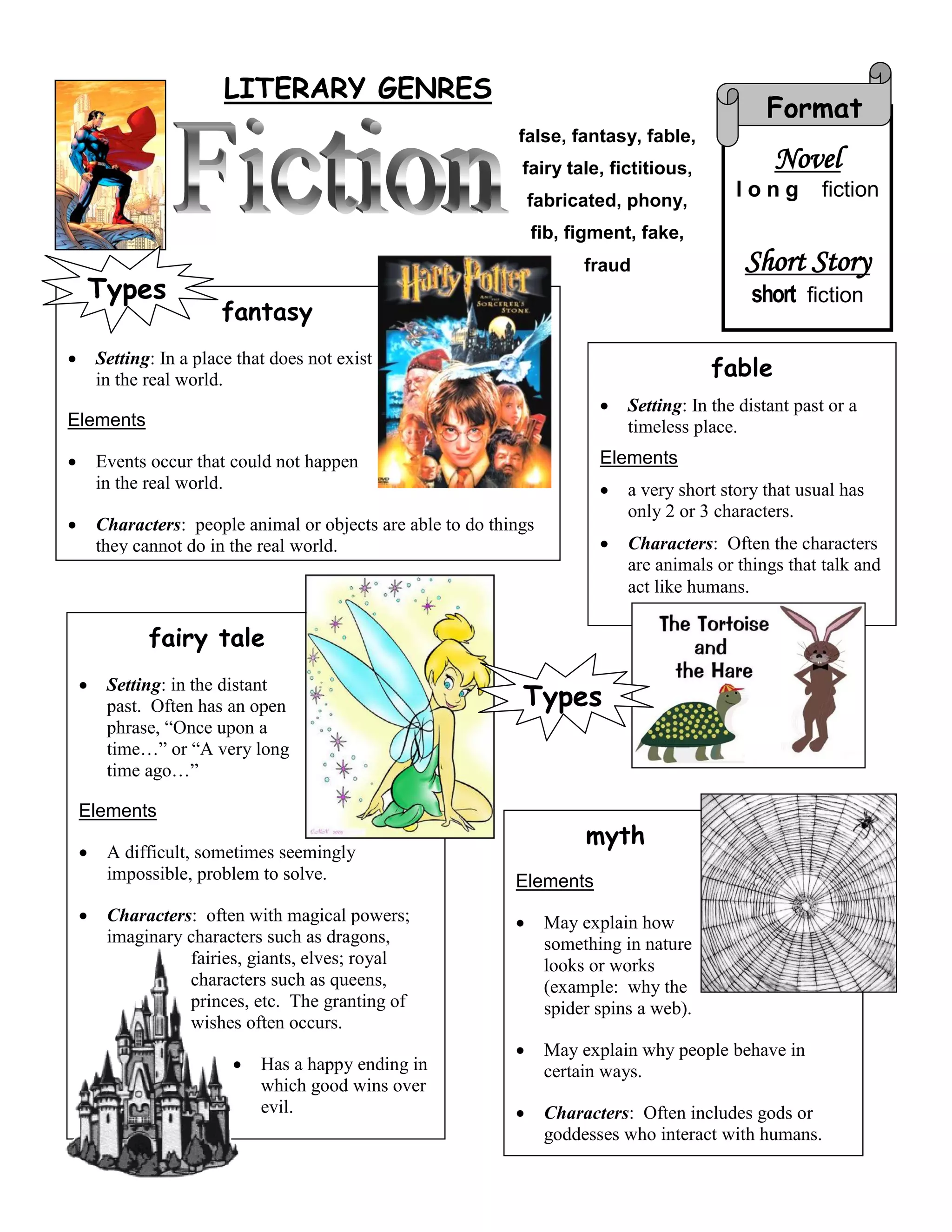
    legend  Setting: inthe past. Elements  Tells the story of a hero.  May be based on facts and real history, but through numerous retellings the hero and his or her deeds become larger than life, and some facts are distorted. realistic fiction  Setting: a real place or could be a real place. Elements  The events in the story could happen in real life.  Characters: behave as people do in real life. folk tale Elements  Stories passed down from one generation to another. Originally told orally. Reflect the culture in which they originated.  Characters: may include animals or inanimate objects that speak. They often teach a moral or lesson in life.  Some folk tales called trickster tales are about weak people or tiny animals outwitting their stronger enemies.  Action builds through repetition. Has an exciting climax at the end. Goodness and intelligence win out over evil and foolishness.  Told from 3rd person point of view. “tall tales”  Setting: in the recent or distant past. Elements  humorous exaggeration to tell the adventures of a fictional (or possibly nonfictional) character.  Build upon improbable incidences and unusual problems that are saved in creative ways. historical fiction  Setting: some specific period of the past. Elements  A type of realistic fiction. Often, but not always, the story is based on actual historical events and people of the period.  The plot reflects events or problems of the period.  The details about clothing, tools, and food are authentic to the period. Types Types Types
  • 3.
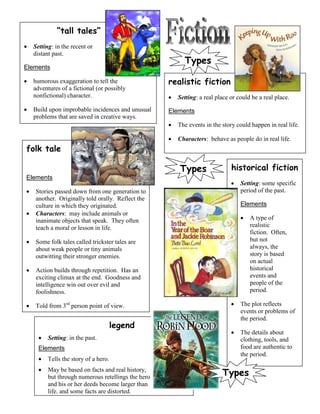
    LITERARY GENRES The oppositeof fiction. True. Real. Book l o n g nonfiction Essay short nonfiction Format biography The true story of someone’s life written by someone else. Elements  It may span a person’s whole life, or it may tell about an important part of a person’s life.  An account of an person’s entire life is almost always told in chronological order (in the time order events occurred).  Contains a variety of important information about the person’s life. Often tells how the person feels and thinks about things. opinions & philosophy Types told as a story facts; information Writing Styles Elements  Often includes subheads to organize topics.  Might contain diagrams, photographs and other illustrations.  Contains information that can be checked by looking at other sources. autobiography The true story of someone’s life written by that person. Elements  see “biography” facts about history, science, politics, etc. instruction manuals
  • 4.
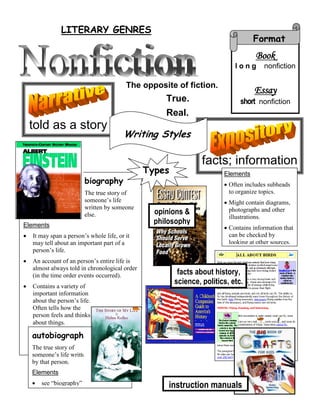
    LITERARY GENRES Sentences are sometimesbroken into parts. Each part is on its own line. Often contains words that rhyme. The lines often have a rhythm or meter. Words are sometimes repeated. Sometimes describes things by comparing them with something else. Often uses figurative, descriptive, and sensory language. A serious story. Intended for representation by actors impersonating the characters and performing the dialogue and action. A situation or succession of events having the emotional effect characteristic of a play. Writing Styles Identifying The Literary Genre 1.) Is it fiction or nonfiction 2.) What type of writing is it? 3.) What is the format (length)? 4.) What is the writing style? told as a story