Environmental
Studies
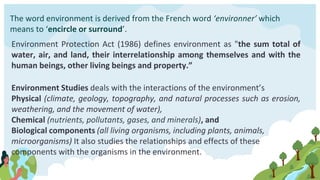
The word environment is derived from the French word ‘environner’ which
means to ‘encircle or surround’.
Environment Protection Act (1986) defines environment as "the sum total of
water, air, and land, their interrelationship among themselves and with the
human beings, other living beings and property.”
Environment Studies deals with the interactions of the environment’s
Physical (climate, geology, topography, and natural processes such as erosion,
weathering, and the movement of water),
Chemical (nutrients, pollutants, gases, and minerals), and
Biological components (all living organisms, including plants, animals,
microorganisms) It also studies the relationships and effects of these
components with the organisms in the environment.
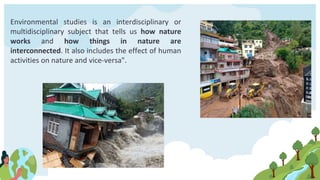
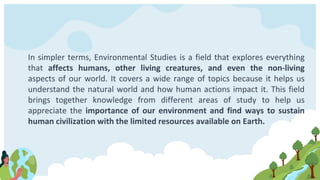
Environmental studies is an interdisciplinary or
multidisciplinary subject that tells us how nature
works and how things in nature are
interconnected. It also includes the effect of human
activities on nature and vice-versa".
In simpler terms, Environmental Studies is a field that explores everything
that affects humans, other living creatures, and even the non-living
aspects of our world. It covers a wide range of topics because it helps us
understand the natural world and how human actions impact it. This field
brings together knowledge from different areas of study to help us
appreciate the importance of our environment and find ways to sustain
human civilization with the limited resources available on Earth.
Environmental studies as a subject has a wide scope. It includes a large
number of areas and aspects, which may be summarized as follows:
Scope of Environmental Studies
Natural resources - their conservation and management
Ecology and Biodiversity
Environmental pollution and control
Human population and environment
Social issues- in relation to development and environment
Ecosystem
An ecosystem is a geographic area where plants, animals, and other organisms,
as well as weather and landscape, work together to form a bubble of life.
An Ecosystem can simply be defined as a system comprising all living
organisms existing with one another in a unit of space interacting with abiotic
components.
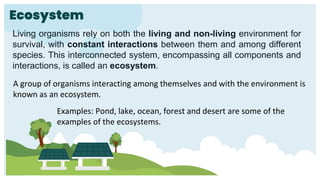
Ecosystem
A group of organisms interacting among themselves and with the environment is
known as an ecosystem.
Living organisms rely on both the living and non-living environment for
survival, with constant interactions between them and among different
species. This interconnected system, encompassing all components and
interactions, is called an ecosystem.
Examples: Pond, lake, ocean, forest and desert are some of the
examples of the ecosystems.
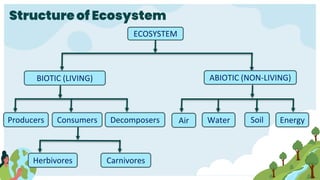
Structure of Ecosystem
ECOSYSTEM
BIOTIC (LIVING) ABIOTIC (NON-LIVING)
Producers Consumers Decomposers
Herbivores Carnivores
Air Water Energy
Soil
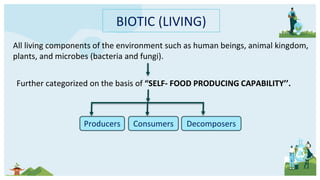
BIOTIC (LIVING)
All living components of the environment such as human beings, animal kingdom,
plants, and microbes (bacteria and fungi).
Further categorized on the basis of “SELF- FOOD PRODUCING CAPABILITY’’.
Producers Consumers Decomposers
BIOTIC (LIVING)
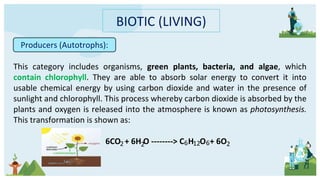
This category includes organisms, green plants, bacteria, and algae, which
contain chlorophyll. They are able to absorb solar energy to convert it into
usable chemical energy by using carbon dioxide and water in the presence of
sunlight and chlorophyll. This process whereby carbon dioxide is absorbed by the
plants and oxygen is released into the atmosphere is known as photosynthesis.
This transformation is shown as:
6CO + 6H O --------> C H O + 6O
Producers (Autotrophs):
2 2 6 12 6 2
They are animals who cannot produce their own food. They obtain the same
from plants or other animals for survival.
Consumers (Heterotrophs):
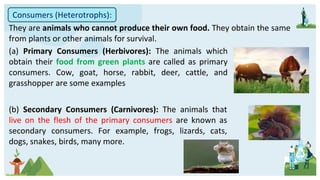
(a) Primary Consumers (Herbivores): The animals which
obtain their food from green plants are called as primary
consumers. Cow, goat, horse, rabbit, deer, cattle, and
grasshopper are some examples
(b) Secondary Consumers (Carnivores): The animals that
live on the flesh of the primary consumers are known as
secondary consumers. For example, frogs, lizards, cats,
dogs, snakes, birds, many more.
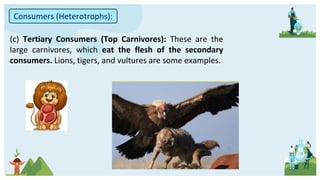
(c) Tertiary Consumers (Top Carnivores): These are the
large carnivores, which eat the flesh of the secondary
consumers. Lions, tigers, and vultures are some examples.
Consumers (Heterotrophs):
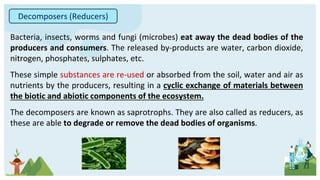
Bacteria, insects, worms and fungi (microbes) eat away the dead bodies of the
producers and consumers. The released by-products are water, carbon dioxide,
nitrogen, phosphates, sulphates, etc.
These simple substances are re-used or absorbed from the soil, water and air as
nutrients by the producers, resulting in a cyclic exchange of materials between
the biotic and abiotic components of the ecosystem.
The decomposers are known as saprotrophs. They are also called as reducers, as
these are able to degrade or remove the dead bodies of organisms.
Decomposers (Reducers)
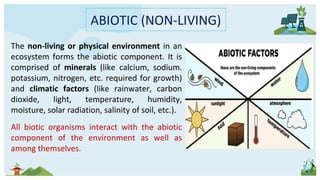
ABIOTIC (NON-LIVING)
The non-living or physical environment in an
ecosystem forms the abiotic component. It is
comprised of minerals (like calcium, sodium.
potassium, nitrogen, etc. required for growth)
and climatic factors (like rainwater, carbon
dioxide, light, temperature, humidity,
moisture, solar radiation, salinity of soil, etc.).
All biotic organisms interact with the abiotic
component of the environment as well as
among themselves.
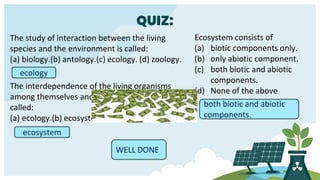
QUIZ:
The study of interaction between the living
species and the environment is called:
(a) biology.(b) antology.(c) ecology. (d) zoology.
ecology
The interdependence of the living organisms
among themselves and with the environment is
called:
(a) ecology.(b) ecosystem.(c) biology.(d) antology.
ecosystem
Ecosystem consists of
(a) biotic components only.
(b) only abiotic component.
(c) both biotic and abiotic
components.
(d) None of the above
both biotic and abiotic
components.
WELL DONE
Functioning of Ecosystem
PRODUCTIVITY
FOOD CHAINS AND FOOD WEBS
TROPICAL LEVELS
ECOLOGICAL SUCCESSION
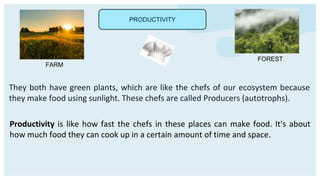
PRODUCTIVITY
FARM
FOREST
They both have green plants, which are like the chefs of our ecosystem because
they make food using sunlight. These chefs are called Producers (autotrophs).
Productivity is like how fast the chefs in these places can make food. It's about
how much food they can cook up in a certain amount of time and space.
PRODUCTIVITY
Gross Primary Production (GPP):
This is the total amount of food that the chefs (autotrophs) make by using sunlight.
It's like all the dishes they prepare.
In our forest, the chefs (plants) make a lot of food because they have plenty of
sunlight. So, they have a high GPP.
But on the farm, the chefs (crops) also make a good amount of food, but not as
much as in the forest because they have less sunlight. So, their GPP is lower.
The rate of food production in unit time per unit area is called productivity.
The rate of primary production depends upon the availability of solar energy and
the amount of energy expenditure by respiration and other maintenance process.
PRODUCTIVITY
Net Primary Production (NPP): This is the amount of food that's left after the
chefs (plants) use some of it for their own energy. It's what's available for all the
other creatures (heterotrophs) in the neighborhood to eat.
In the forest, even though they make a lot of food (high GPP), they also use a lot of
it for themselves or in respiration. So, there's not much food left for others
(low NPP).
For instance: It's like a fancy restaurant that makes delicious food but eats a lot of
it themselves.
On the farm, the chefs (crops) use less food for themselves, so there's more left
for others (high NPP). For instance: It's like a place where the chefs make good
food and share it generously.
FOOD CHAINS AND FOOD WEBS
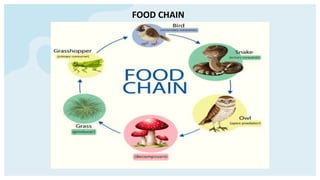
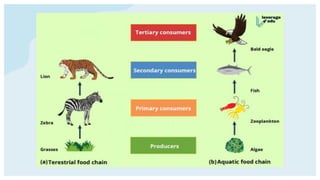
 A food chain shows how each living organism obtains its food.
 The food produced by an autotroph (plants) is eaten by primary consumers
(herbivores), which are eaten by secondary consumers (carnivores). This, in turn,
becomes food for Tertiary Consumers (top carnivores) and the process of
providing food as well as the energy source for other organisms continues.
 Ultimately, the dead organism is decomposed by different decomposers
(bacteria, fungi, microbes, etc.). There is recycling of nutrients into the soil on
which plant life grows.
FOOD CHAIN
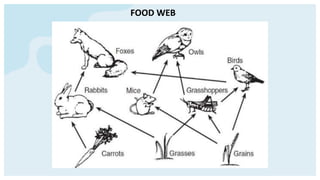
A food web is a way to show how different living things in an ecosystem eat and
interact with each other. It's like a map that helps us understand who eats whom
in nature.
Example:
For example, a basic food chain could be "Grass -> Rabbit -> Fox," where the
grass is eaten by the rabbit, which is then eaten by the fox.
In a food web, for instance, a plant (grass) is eaten not only by rabbits but also
by deer and insects. Similarly, a fox might eat not only rabbits but also birds,
and other prey.
It illustrates the many ways energy and nutrients flow through an ecosystem.
FOOD WEB
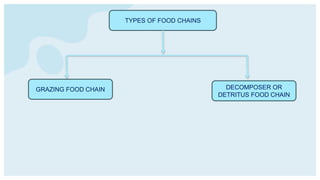
TYPES OF FOOD CHAINS
GRAZING FOOD CHAIN DECOMPOSER OR
DETRITUS FOOD CHAIN
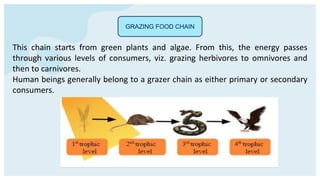
GRAZING FOOD CHAIN
This chain starts from green plants and algae. From this, the energy passes
through various levels of consumers, viz. grazing herbivores to omnivores and
then to carnivores.
Human beings generally belong to a grazer chain as either primary or secondary
consumers.
DECOMPOSER OR
DETRITUS FOOD CHAIN
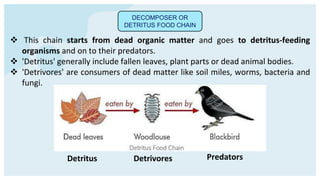
 This chain starts from dead organic matter and goes to detritus-feeding
organisms and on to their predators.
 'Detritus' generally include fallen leaves, plant parts or dead animal bodies.
 'Detrivores' are consumers of dead matter like soil miles, worms, bacteria and
fungi.
Detrivores
Detritus Predators
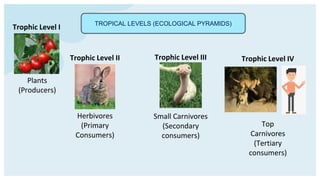
TROPICAL LEVELS (ECOLOGICAL PYRAMIDS)
Plants
(Producers)
Herbivores
(Primary
Consumers)
Small Carnivores
(Secondary
consumers)
Top
Carnivores
(Tertiary
consumers)
Trophic Level I
Trophic Level II Trophic Level III Trophic Level IV
Scientist Charles Elton was the first to observe in 1927 that the number of
animals present at the top of the trophic level was much less compared to the
number of animals present at the base of the food chain. He plotted his
findings on a graph in the form of a pyramid-like structure.
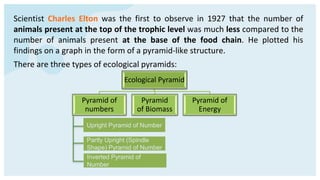
There are three types of ecological pyramids:
Ecological Pyramid
Pyramid of
numbers
Pyramid
of Biomass
Pyramid of
Energy
Upright Pyramid of Number
Partly Upright (Spindle
Shape) Pyramid of Number
Inverted Pyramid of
Number
1. Pyramid of numbers
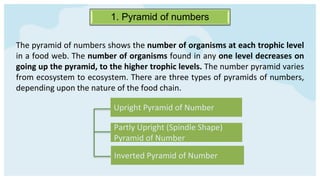
The pyramid of numbers shows the number of organisms at each trophic level
in a food web. The number of organisms found in any one level decreases on
going up the pyramid, to the higher trophic levels. The number pyramid varies
from ecosystem to ecosystem. There are three types of pyramids of numbers,
depending upon the nature of the food chain.
Upright Pyramid of Number
Partly Upright (Spindle Shape)
Pyramid of Number
Inverted Pyramid of Number
Pyramid of numbers
Upright Pyramid of Number
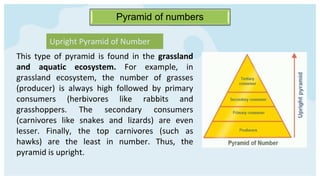
This type of pyramid is found in the grassland
and aquatic ecosystem. For example, in
grassland ecosystem, the number of grasses
(producer) is always high followed by primary
consumers (herbivores like rabbits and
grasshoppers. The secondary consumers
(carnivores like snakes and lizards) are even
lesser. Finally, the top carnivores (such as
hawks) are the least in number. Thus, the
pyramid is upright.
Pyramid of numbers
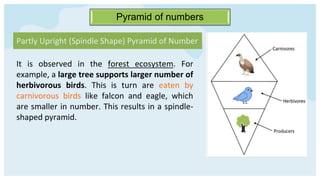
It is observed in the forest ecosystem. For
example, a large tree supports larger number of
herbivorous birds. This is turn are eaten by
carnivorous birds like falcon and eagle, which
are smaller in number. This results in a spindle-
shaped pyramid.
Partly Upright (Spindle Shape) Pyramid of Number
Pyramid of numbers
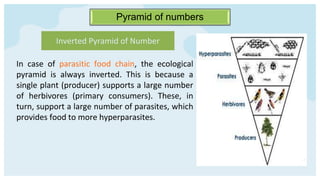
In case of parasitic food chain, the ecological
pyramid is always inverted. This is because a
single plant (producer) supports a large number
of herbivores (primary consumers). These, in
turn, support a large number of parasites, which
provides food to more hyperparasites.
Inverted Pyramid of Number
2. Pyramid of Biomass
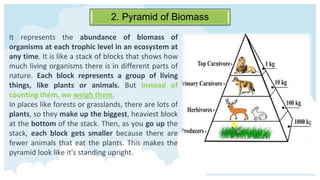
It represents the abundance of biomass of
organisms at each trophic level in an ecosystem at
any time. It is like a stack of blocks that shows how
much living organisms there is in different parts of
nature. Each block represents a group of living
things, like plants or animals. But instead of
counting them, we weigh them.
In places like forests or grasslands, there are lots of
plants, so they make up the biggest, heaviest block
at the bottom of the stack. Then, as you go up the
stack, each block gets smaller because there are
fewer animals that eat the plants. This makes the
pyramid look like it's standing upright.
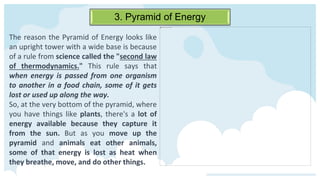
3. Pyramid of Energy
The reason the Pyramid of Energy looks like
an upright tower with a wide base is because
of a rule from science called the "second law
of thermodynamics." This rule says that
when energy is passed from one organism
to another in a food chain, some of it gets
lost or used up along the way.
So, at the very bottom of the pyramid, where
you have things like plants, there's a lot of
energy available because they capture it
from the sun. But as you move up the
pyramid and animals eat other animals,
some of that energy is lost as heat when
they breathe, move, and do other things.
3. Pyramid of Energy
Because of this loss of energy at each step, there's less and less energy available for
the next level of animals. That's why the pyramid starts wide at the bottom (lots of
energy) and gets narrower as it goes up (less energy). It's like showing us how much
energy is left for each group of animals in the food chain.
Energy is expressed per unit area per unit time, i.e., KJ m²/year. The energy contained
at each tropic level decreases by 90 percent at each successive step as the energy
acquired by any organism cannot be fully transferred to the higher trophic level.
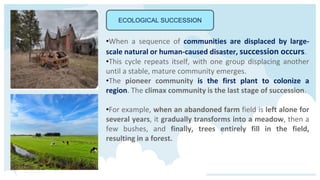
ECOLOGICAL SUCCESSION
•When a sequence of communities are displaced by large-
scale natural or human-caused disaster, succession occurs.
•This cycle repeats itself, with one group displacing another
until a stable, mature community emerges.
•The pioneer community is the first plant to colonize a
region. The climax community is the last stage of succession.
•For example, when an abandoned farm field is left alone for
several years, it gradually transforms into a meadow, then a
few bushes, and finally, trees entirely fill in the field,
resulting in a forest.
ECOLOGICAL SUCCESSION
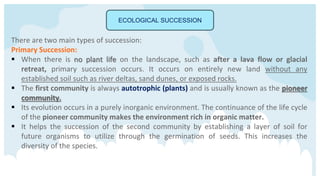
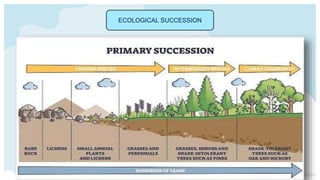
There are two main types of succession:
Primary Succession:
 When there is no plant life on the landscape, such as after a lava flow or glacial
retreat, primary succession occurs. It occurs on entirely new land without any
established soil such as river deltas, sand dunes, or exposed rocks.
 The first community is always autotrophic (plants) and is usually known as the pioneer
community.
 Its evolution occurs in a purely inorganic environment. The continuance of the life cycle
of the pioneer community makes the environment rich in organic matter.
 It helps the succession of the second community by establishing a layer of soil for
future organisms to utilize through the germination of seeds. This increases the
diversity of the species.
ECOLOGICAL SUCCESSION
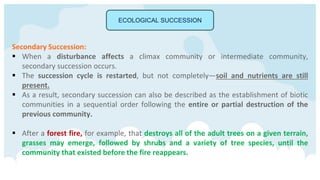
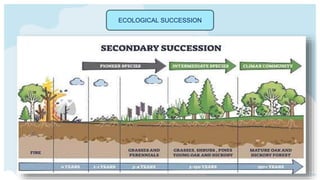
Secondary Succession:
 When a disturbance affects a climax community or intermediate community,
secondary succession occurs.
 The succession cycle is restarted, but not completely—soil and nutrients are still
present.
 As a result, secondary succession can also be described as the establishment of biotic
communities in a sequential order following the entire or partial destruction of the
previous community.
 After a forest fire, for example, that destroys all of the adult trees on a given terrain,
grasses may emerge, followed by shrubs and a variety of tree species, until the
community that existed before the fire reappears.
ECOLOGICAL SUCCESSION
CREDITS: This presentation template was created by Slidesgo, and
includes icons by Flaticon, and infographics & images by Freepik
Thanks

EVS Notes- Ecosystem, Biotic, Abiotic, Ecological succession

  • 1.
  • 3.
    The word environmentis derived from the French word ‘environner’ which means to ‘encircle or surround’. Environment Protection Act (1986) defines environment as "the sum total of water, air, and land, their interrelationship among themselves and with the human beings, other living beings and property.” Environment Studies deals with the interactions of the environment’s Physical (climate, geology, topography, and natural processes such as erosion, weathering, and the movement of water), Chemical (nutrients, pollutants, gases, and minerals), and Biological components (all living organisms, including plants, animals, microorganisms) It also studies the relationships and effects of these components with the organisms in the environment.
  • 4.
    Environmental studies isan interdisciplinary or multidisciplinary subject that tells us how nature works and how things in nature are interconnected. It also includes the effect of human activities on nature and vice-versa".
  • 5.
    In simpler terms,Environmental Studies is a field that explores everything that affects humans, other living creatures, and even the non-living aspects of our world. It covers a wide range of topics because it helps us understand the natural world and how human actions impact it. This field brings together knowledge from different areas of study to help us appreciate the importance of our environment and find ways to sustain human civilization with the limited resources available on Earth.
  • 6.
    Environmental studies asa subject has a wide scope. It includes a large number of areas and aspects, which may be summarized as follows: Scope of Environmental Studies Natural resources - their conservation and management Ecology and Biodiversity Environmental pollution and control Human population and environment Social issues- in relation to development and environment
  • 7.
    Ecosystem An ecosystem isa geographic area where plants, animals, and other organisms, as well as weather and landscape, work together to form a bubble of life. An Ecosystem can simply be defined as a system comprising all living organisms existing with one another in a unit of space interacting with abiotic components.
  • 8.
    Ecosystem A group oforganisms interacting among themselves and with the environment is known as an ecosystem. Living organisms rely on both the living and non-living environment for survival, with constant interactions between them and among different species. This interconnected system, encompassing all components and interactions, is called an ecosystem. Examples: Pond, lake, ocean, forest and desert are some of the examples of the ecosystems.
  • 9.
    Structure of Ecosystem ECOSYSTEM BIOTIC(LIVING) ABIOTIC (NON-LIVING) Producers Consumers Decomposers Herbivores Carnivores Air Water Energy Soil
  • 10.
    BIOTIC (LIVING) All livingcomponents of the environment such as human beings, animal kingdom, plants, and microbes (bacteria and fungi). Further categorized on the basis of “SELF- FOOD PRODUCING CAPABILITY’’. Producers Consumers Decomposers
  • 11.
    BIOTIC (LIVING) This categoryincludes organisms, green plants, bacteria, and algae, which contain chlorophyll. They are able to absorb solar energy to convert it into usable chemical energy by using carbon dioxide and water in the presence of sunlight and chlorophyll. This process whereby carbon dioxide is absorbed by the plants and oxygen is released into the atmosphere is known as photosynthesis. This transformation is shown as: 6CO + 6H O --------> C H O + 6O Producers (Autotrophs): 2 2 6 12 6 2
  • 12.
    They are animalswho cannot produce their own food. They obtain the same from plants or other animals for survival. Consumers (Heterotrophs): (a) Primary Consumers (Herbivores): The animals which obtain their food from green plants are called as primary consumers. Cow, goat, horse, rabbit, deer, cattle, and grasshopper are some examples (b) Secondary Consumers (Carnivores): The animals that live on the flesh of the primary consumers are known as secondary consumers. For example, frogs, lizards, cats, dogs, snakes, birds, many more.
  • 13.
    (c) Tertiary Consumers(Top Carnivores): These are the large carnivores, which eat the flesh of the secondary consumers. Lions, tigers, and vultures are some examples. Consumers (Heterotrophs):
  • 14.
    Bacteria, insects, wormsand fungi (microbes) eat away the dead bodies of the producers and consumers. The released by-products are water, carbon dioxide, nitrogen, phosphates, sulphates, etc. These simple substances are re-used or absorbed from the soil, water and air as nutrients by the producers, resulting in a cyclic exchange of materials between the biotic and abiotic components of the ecosystem. The decomposers are known as saprotrophs. They are also called as reducers, as these are able to degrade or remove the dead bodies of organisms. Decomposers (Reducers)
  • 15.
    ABIOTIC (NON-LIVING) The non-livingor physical environment in an ecosystem forms the abiotic component. It is comprised of minerals (like calcium, sodium. potassium, nitrogen, etc. required for growth) and climatic factors (like rainwater, carbon dioxide, light, temperature, humidity, moisture, solar radiation, salinity of soil, etc.). All biotic organisms interact with the abiotic component of the environment as well as among themselves.
  • 16.
    QUIZ: The study ofinteraction between the living species and the environment is called: (a) biology.(b) antology.(c) ecology. (d) zoology. ecology The interdependence of the living organisms among themselves and with the environment is called: (a) ecology.(b) ecosystem.(c) biology.(d) antology. ecosystem Ecosystem consists of (a) biotic components only. (b) only abiotic component. (c) both biotic and abiotic components. (d) None of the above both biotic and abiotic components. WELL DONE
  • 17.
    Functioning of Ecosystem PRODUCTIVITY FOODCHAINS AND FOOD WEBS TROPICAL LEVELS ECOLOGICAL SUCCESSION
  • 18.
    PRODUCTIVITY FARM FOREST They both havegreen plants, which are like the chefs of our ecosystem because they make food using sunlight. These chefs are called Producers (autotrophs). Productivity is like how fast the chefs in these places can make food. It's about how much food they can cook up in a certain amount of time and space.
  • 19.
    PRODUCTIVITY Gross Primary Production(GPP): This is the total amount of food that the chefs (autotrophs) make by using sunlight. It's like all the dishes they prepare. In our forest, the chefs (plants) make a lot of food because they have plenty of sunlight. So, they have a high GPP. But on the farm, the chefs (crops) also make a good amount of food, but not as much as in the forest because they have less sunlight. So, their GPP is lower. The rate of food production in unit time per unit area is called productivity. The rate of primary production depends upon the availability of solar energy and the amount of energy expenditure by respiration and other maintenance process.
  • 20.
    PRODUCTIVITY Net Primary Production(NPP): This is the amount of food that's left after the chefs (plants) use some of it for their own energy. It's what's available for all the other creatures (heterotrophs) in the neighborhood to eat. In the forest, even though they make a lot of food (high GPP), they also use a lot of it for themselves or in respiration. So, there's not much food left for others (low NPP). For instance: It's like a fancy restaurant that makes delicious food but eats a lot of it themselves. On the farm, the chefs (crops) use less food for themselves, so there's more left for others (high NPP). For instance: It's like a place where the chefs make good food and share it generously.
  • 21.
    FOOD CHAINS ANDFOOD WEBS  A food chain shows how each living organism obtains its food.  The food produced by an autotroph (plants) is eaten by primary consumers (herbivores), which are eaten by secondary consumers (carnivores). This, in turn, becomes food for Tertiary Consumers (top carnivores) and the process of providing food as well as the energy source for other organisms continues.  Ultimately, the dead organism is decomposed by different decomposers (bacteria, fungi, microbes, etc.). There is recycling of nutrients into the soil on which plant life grows.
  • 22.
  • 23.
    A food webis a way to show how different living things in an ecosystem eat and interact with each other. It's like a map that helps us understand who eats whom in nature. Example: For example, a basic food chain could be "Grass -> Rabbit -> Fox," where the grass is eaten by the rabbit, which is then eaten by the fox. In a food web, for instance, a plant (grass) is eaten not only by rabbits but also by deer and insects. Similarly, a fox might eat not only rabbits but also birds, and other prey. It illustrates the many ways energy and nutrients flow through an ecosystem.
  • 24.
  • 25.
    TYPES OF FOODCHAINS GRAZING FOOD CHAIN DECOMPOSER OR DETRITUS FOOD CHAIN
  • 26.
    GRAZING FOOD CHAIN Thischain starts from green plants and algae. From this, the energy passes through various levels of consumers, viz. grazing herbivores to omnivores and then to carnivores. Human beings generally belong to a grazer chain as either primary or secondary consumers.
  • 28.
    DECOMPOSER OR DETRITUS FOODCHAIN  This chain starts from dead organic matter and goes to detritus-feeding organisms and on to their predators.  'Detritus' generally include fallen leaves, plant parts or dead animal bodies.  'Detrivores' are consumers of dead matter like soil miles, worms, bacteria and fungi. Detrivores Detritus Predators
  • 29.
    TROPICAL LEVELS (ECOLOGICALPYRAMIDS) Plants (Producers) Herbivores (Primary Consumers) Small Carnivores (Secondary consumers) Top Carnivores (Tertiary consumers) Trophic Level I Trophic Level II Trophic Level III Trophic Level IV
  • 30.
    Scientist Charles Eltonwas the first to observe in 1927 that the number of animals present at the top of the trophic level was much less compared to the number of animals present at the base of the food chain. He plotted his findings on a graph in the form of a pyramid-like structure. There are three types of ecological pyramids: Ecological Pyramid Pyramid of numbers Pyramid of Biomass Pyramid of Energy Upright Pyramid of Number Partly Upright (Spindle Shape) Pyramid of Number Inverted Pyramid of Number
  • 31.
    1. Pyramid ofnumbers The pyramid of numbers shows the number of organisms at each trophic level in a food web. The number of organisms found in any one level decreases on going up the pyramid, to the higher trophic levels. The number pyramid varies from ecosystem to ecosystem. There are three types of pyramids of numbers, depending upon the nature of the food chain. Upright Pyramid of Number Partly Upright (Spindle Shape) Pyramid of Number Inverted Pyramid of Number
  • 32.
    Pyramid of numbers UprightPyramid of Number This type of pyramid is found in the grassland and aquatic ecosystem. For example, in grassland ecosystem, the number of grasses (producer) is always high followed by primary consumers (herbivores like rabbits and grasshoppers. The secondary consumers (carnivores like snakes and lizards) are even lesser. Finally, the top carnivores (such as hawks) are the least in number. Thus, the pyramid is upright.
  • 33.
    Pyramid of numbers Itis observed in the forest ecosystem. For example, a large tree supports larger number of herbivorous birds. This is turn are eaten by carnivorous birds like falcon and eagle, which are smaller in number. This results in a spindle- shaped pyramid. Partly Upright (Spindle Shape) Pyramid of Number
  • 34.
    Pyramid of numbers Incase of parasitic food chain, the ecological pyramid is always inverted. This is because a single plant (producer) supports a large number of herbivores (primary consumers). These, in turn, support a large number of parasites, which provides food to more hyperparasites. Inverted Pyramid of Number
  • 35.
    2. Pyramid ofBiomass It represents the abundance of biomass of organisms at each trophic level in an ecosystem at any time. It is like a stack of blocks that shows how much living organisms there is in different parts of nature. Each block represents a group of living things, like plants or animals. But instead of counting them, we weigh them. In places like forests or grasslands, there are lots of plants, so they make up the biggest, heaviest block at the bottom of the stack. Then, as you go up the stack, each block gets smaller because there are fewer animals that eat the plants. This makes the pyramid look like it's standing upright.
  • 36.
    3. Pyramid ofEnergy The reason the Pyramid of Energy looks like an upright tower with a wide base is because of a rule from science called the "second law of thermodynamics." This rule says that when energy is passed from one organism to another in a food chain, some of it gets lost or used up along the way. So, at the very bottom of the pyramid, where you have things like plants, there's a lot of energy available because they capture it from the sun. But as you move up the pyramid and animals eat other animals, some of that energy is lost as heat when they breathe, move, and do other things.
  • 37.
    3. Pyramid ofEnergy Because of this loss of energy at each step, there's less and less energy available for the next level of animals. That's why the pyramid starts wide at the bottom (lots of energy) and gets narrower as it goes up (less energy). It's like showing us how much energy is left for each group of animals in the food chain. Energy is expressed per unit area per unit time, i.e., KJ m²/year. The energy contained at each tropic level decreases by 90 percent at each successive step as the energy acquired by any organism cannot be fully transferred to the higher trophic level.
  • 38.
    ECOLOGICAL SUCCESSION •When asequence of communities are displaced by large- scale natural or human-caused disaster, succession occurs. •This cycle repeats itself, with one group displacing another until a stable, mature community emerges. •The pioneer community is the first plant to colonize a region. The climax community is the last stage of succession. •For example, when an abandoned farm field is left alone for several years, it gradually transforms into a meadow, then a few bushes, and finally, trees entirely fill in the field, resulting in a forest.
  • 39.
    ECOLOGICAL SUCCESSION There aretwo main types of succession: Primary Succession:  When there is no plant life on the landscape, such as after a lava flow or glacial retreat, primary succession occurs. It occurs on entirely new land without any established soil such as river deltas, sand dunes, or exposed rocks.  The first community is always autotrophic (plants) and is usually known as the pioneer community.  Its evolution occurs in a purely inorganic environment. The continuance of the life cycle of the pioneer community makes the environment rich in organic matter.  It helps the succession of the second community by establishing a layer of soil for future organisms to utilize through the germination of seeds. This increases the diversity of the species.
  • 40.
  • 41.
    ECOLOGICAL SUCCESSION Secondary Succession: When a disturbance affects a climax community or intermediate community, secondary succession occurs.  The succession cycle is restarted, but not completely—soil and nutrients are still present.  As a result, secondary succession can also be described as the establishment of biotic communities in a sequential order following the entire or partial destruction of the previous community.  After a forest fire, for example, that destroys all of the adult trees on a given terrain, grasses may emerge, followed by shrubs and a variety of tree species, until the community that existed before the fire reappears.
  • 42.
  • 43.
    CREDITS: This presentationtemplate was created by Slidesgo, and includes icons by Flaticon, and infographics & images by Freepik Thanks