Evolution of Game Development
Why we are standing here today
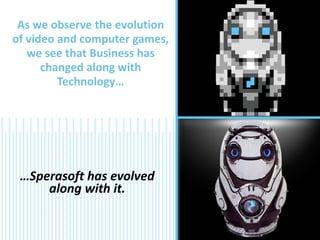
As we observe the evolution
of video and computer games,
we see that Business has
changed along with
Technology…
…Sperasoft has evolved
along with it.
In the Beginning…
1960’s-1970’s
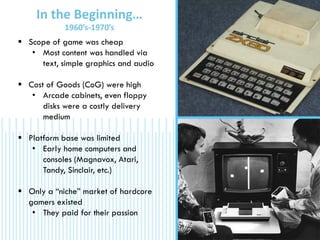
 Scope of game was cheap
• Most content was handled via
text, simple graphics and audio
 Cost of Goods (CoG) were high
• Arcade cabinets, even floppy
disks were a costly delivery
medium
 Platform base was limited
• Early home computers and
consoles (Magnavox, Atari,
Tandy, Sinclair, etc.)
 Only a “niche” market of hardcore
gamers existed
• They paid for their passion
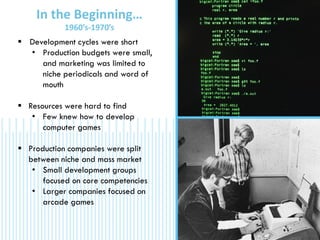
 Development cycles were short
• Production budgets were small,
and marketing was limited to
niche periodicals and word of
mouth
 Resources were hard to find
• Few knew how to develop
computer games
 Production companies were split
between niche and mass market
• Small development groups
focused on core competencies
• Larger companies focused on
arcade games
In the Beginning…
1960’s-1970’s
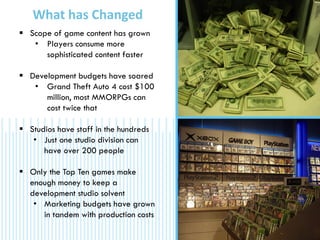
What has Changed
 Scope of game content has grown
• Players consume more
sophisticated content faster
 Development budgets have soared
• Grand Theft Auto 4 cost $100
million, most MMORPGs can
cost twice that
 Studios have staff in the hundreds
• Just one studio division can
have over 200 people
 Only the Top Ten games make
enough money to keep a
development studio solvent
• Marketing budgets have grown
in tandem with production costs
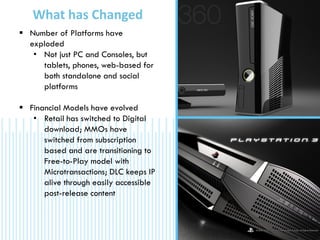
 Number of Platforms have
exploded
• Not just PC and Consoles, but
tablets, phones, web-based for
both standalone and social
platforms
 Financial Models have evolved
• Retail has switched to Digital
download; MMOs have
switched from subscription
based and are transitioning to
Free-to-Play model with
Microtransactions; DLC keeps IP
alive through easily accessible
post-release content
What has Changed
What has stayed the Same
 A bad game is still a bad game
• Even the best production values
can not save a bad design
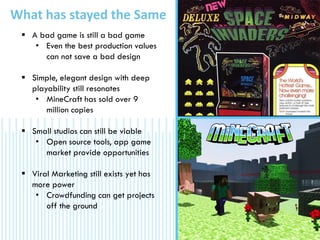
 Simple, elegant design with deep
playability still resonates
• MineCraft has sold over 9
million copies
 Small studios can still be viable
• Open source tools, app game
market provide opportunities
 Viral Marketing still exists yet has
more power
• Crowdfunding can get projects
off the ground
What has stayed the Same
 Hardcore audience endures
• Generational transference has
latitude
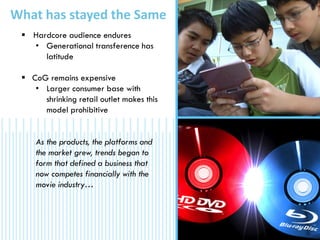
 CoG remains expensive
• Larger consumer base with
shrinking retail outlet makes this
model prohibitive
As the products, the platforms and
the market grew, trends began to
form that defined a business that
now competes financially with the
movie industry…

Evolution of Game Development

  • 1.
    Evolution of GameDevelopment Why we are standing here today
  • 2.
    As we observethe evolution of video and computer games, we see that Business has changed along with Technology… …Sperasoft has evolved along with it.
  • 3.
    In the Beginning… 1960’s-1970’s Scope of game was cheap • Most content was handled via text, simple graphics and audio  Cost of Goods (CoG) were high • Arcade cabinets, even floppy disks were a costly delivery medium  Platform base was limited • Early home computers and consoles (Magnavox, Atari, Tandy, Sinclair, etc.)  Only a “niche” market of hardcore gamers existed • They paid for their passion
  • 4.
     Development cycleswere short • Production budgets were small, and marketing was limited to niche periodicals and word of mouth  Resources were hard to find • Few knew how to develop computer games  Production companies were split between niche and mass market • Small development groups focused on core competencies • Larger companies focused on arcade games In the Beginning… 1960’s-1970’s
  • 5.
    What has Changed Scope of game content has grown • Players consume more sophisticated content faster  Development budgets have soared • Grand Theft Auto 4 cost $100 million, most MMORPGs can cost twice that  Studios have staff in the hundreds • Just one studio division can have over 200 people  Only the Top Ten games make enough money to keep a development studio solvent • Marketing budgets have grown in tandem with production costs
  • 6.
     Number ofPlatforms have exploded • Not just PC and Consoles, but tablets, phones, web-based for both standalone and social platforms  Financial Models have evolved • Retail has switched to Digital download; MMOs have switched from subscription based and are transitioning to Free-to-Play model with Microtransactions; DLC keeps IP alive through easily accessible post-release content What has Changed
  • 7.
    What has stayedthe Same  A bad game is still a bad game • Even the best production values can not save a bad design  Simple, elegant design with deep playability still resonates • MineCraft has sold over 9 million copies  Small studios can still be viable • Open source tools, app game market provide opportunities  Viral Marketing still exists yet has more power • Crowdfunding can get projects off the ground
  • 8.
    What has stayedthe Same  Hardcore audience endures • Generational transference has latitude  CoG remains expensive • Larger consumer base with shrinking retail outlet makes this model prohibitive As the products, the platforms and the market grew, trends began to form that defined a business that now competes financially with the movie industry…