Video Game Development: A Brief OverviewA. Babadi 1 of 34
In The Name Of God
Video Game Development
Amin Babadi
Department of Electrical and Computer Engineering
Isfahan University of Technology
Spring 2015
A Brief Overview
Video Game Development: A Brief OverviewA. Babadi 2 of 34
Outline
 Some guidelines
 A road map to the course
 Evolution of the game industry
 Market information
 What is ESRB?
 Who is playing?
 Video game development
 What’s next?
Video Game Development: A Brief OverviewA. Babadi 3 of 34
Some Guidelines…
 Textbooks:
o Novak, J. (2011). Game Development Essentials: an Introduction (3rd
Edition). Cengage Learning.
o Lengyel, E. (2011). Mathematics for 3D Game Programming and
Computer Graphics (3rd Edition). Cengage Learning PTR.
o Sanchez-Crespo, D. (2003). Core Techniques and Algorithms in Game
Programming. New Riders Publishing.
 All announcements will be made via IVUT course page, titled
“Video Game Development”.
 Feel free to contact me via amin.babadi@yahoo.com.
Video Game Development: A Brief OverviewA. Babadi 4 of 34
A Road Map to the Course
 Historical elements, platforms & player modes, goals & genres
o Chapters 1-3 of Novak’s textbook
 The rendering pipeline, vectors
o Chapters 1-2 of Lengyel’s textbook
 Architecture, data structures, design patterns, user input, AI
o Chapters 2-8 of Sanchez-Crespo’s textbook
 We will also try to cover all of course materials using weekly
practical sessions.
o Mostly on Unity game engine
 Extra topics
o TBA
Video Game Development: A Brief OverviewA. Babadi 5 of 34
Grading Policy
 Grading structure (21 + 2 pts.):
o Homeworks: 2 pts.
o Presentation: 1.5 + 0.5 pts.
o Final project: 4 + 1.5 pts.
o Midterm exam: 4.5 pts.
o Final exam: 9 pts.
 Attending class is not mandatory; although it may become a
plus point.
 TA class will be held on demand too.
Video Game Development: A Brief OverviewA. Babadi 6 of 34
Grading Policy
 Homeworks:
o You will be asked to do several practical homeworks every 2 weeks
during the semester.
 Final project:
o Students should develop a small game project based on a subject that
will be announced soon. Game development requires a great amount
of teamwork skill; so it is recommended that students get into groups.
Each group may have up to 2 members.
 Presentation:
o Students should also make some short presentations about several
extra topics that will be announced soon. Again, each group may have
up to 2 members.
 Midterm and final exams:
o Lecture notes are satisfactory for passing all the exams.
Video Game Development: A Brief OverviewA. Babadi 7 of 34
So It Begins…
Video Game Development: A Brief OverviewA. Babadi 8 of 34
Introduction
 Game industry revenues have surpassed film box office and
music concert revenues in the U.S., making the games the
fastest growing segment of the entertainment market.
 In 2012 there were more than 100,000 employees all over the
world in the game industry.
 Hundreds of colleges and universities have started to work on
game development programs in the last few years.
Video Game Development: A Brief OverviewA. Babadi 9 of 34
When Did It Start?
 It started in 1940s (Cathode ray tube amusement device)
 Limited access of hardware
 Games ran on mainframe computers at U.S.A universities.
 It went on until 1970s.
Video Game Development: A Brief OverviewA. Babadi 10 of 34
Early Arcade Games
 Foundation of Atari Inc.
 Pong: first official product of Atari
Video Game Development: A Brief OverviewA. Babadi 11 of 34
1st Generation Game Consoles
 1972-1977
 The first game console, called Magnavox Odyssey
 Game(s) hardwired into the console.
 2 million consoles sold in the U.S. market
Video Game Development: A Brief OverviewA. Babadi 12 of 34
2nd Generation Game Consoles
 1977-1983
 Game burned into ROM chips.
 ROM chips were mounted inside plastic cartridge casings.
 Those casings could be plugged into slots on the console.
 Several games consoles developed.
 Creation of Activision
Video Game Development: A Brief OverviewA. Babadi 13 of 34
3rd Generation Game Consoles
 1983-1995
 Appearing of home computers
 Development of the first 8 bit systems
 Genre innovation
Video Game Development: A Brief OverviewA. Babadi 14 of 34
4th Generation Game Consoles
 1988-1999
 Development of the first 16 bit systems
 CD-ROM drives were first seen in this generation.
 Basic 3D graphics entered the mainstream.
Video Game Development: A Brief OverviewA. Babadi 15 of 34
5th Generation Game Consoles
 1993-2006
 32 bit and 64 bits consoles released.
 Several successful consoles (Sega, PlayStation, etc.)
Video Game Development: A Brief OverviewA. Babadi 16 of 34
6th Generation Game Consoles
 1998-2013
 The Xbox, Microsoft’s entry into the game console industry.
 Many publishers turned to online gaming.
 Mobile games got available too.
 GTA III popularized open world games.
Video Game Development: A Brief OverviewA. Babadi 17 of 34
7th Generation Game Consoles
 2005-Present
 This generation opened early for handheld consoles (PSP, etc.)
 Microsoft stepped forward first in November 2005 with the
Xbox 360, and Sony followed in 2006 with the PlayStation 3.
 Rise of casual PC games.
Video Game Development: A Brief OverviewA. Babadi 18 of 34
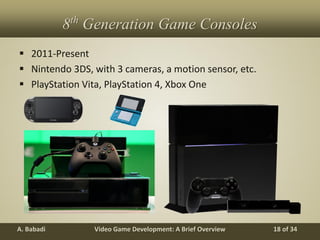
8th Generation Game Consoles
 2011-Present
 Nintendo 3DS, with 3 cameras, a motion sensor, etc.
 PlayStation Vita, PlayStation 4, Xbox One
Video Game Development: A Brief OverviewA. Babadi 19 of 34
 And they are all video games now!
A Quick Overview
Video Game Development: A Brief OverviewA. Babadi 20 of 34
Cheer Up!
Video Game Development: A Brief OverviewA. Babadi 21 of 34
Sales Information
6.9 7 7.3 6.9 7.3
9.5
11.7
16.2
16.9 16.4
14.8
2002 2003 2004 2005 2006 2007 2008 2009 2010 2011 2012
U.S. Video Game Dollar Sales Growth ($ Billions)
Video Game Development: A Brief OverviewA. Babadi 22 of 34
Sales Information
$1.93
$4.04
$14.80
Total Consumer Spend on Game Industry 2012 ($ Billions)
Accessories
Hardware
Content
Video Game Development: A Brief OverviewA. Babadi 23 of 34
Entertainment Software Rating Board (ESRB)
 In 1993, U.S. created ESRB to provide parents and consumers
with detailed information on game content so they can make
appropriate purchasing decisions.
Video Game Development: A Brief OverviewA. Babadi 24 of 34
Who Is Playing?
 Percentage of Americans who are gamers
 Average age of gamers
 Percentage of female gamers
 Percentage of gamers who play multiplayer games
 Average number of years gamers have been playing
5830
45
13
62
Video Game Development: A Brief OverviewA. Babadi 25 of 34
Who Is Playing?
 Percentage of Americans who are gamers = 58
 Average age of gamers
 Percentage of female gamers
 Percentage of gamers who play multiplayer games
 Average number of years gamers have been playing
5830
45
13
62
Video Game Development: A Brief OverviewA. Babadi 26 of 34
Who Is Playing?
 Percentage of Americans who are gamers = 58
 Average age of gamers = 30
 Percentage of female gamers
 Percentage of gamers who play multiplayer games
 Average number of years gamers have been playing
5830
45
13
62
Video Game Development: A Brief OverviewA. Babadi 27 of 34
Who Is Playing?
 Percentage of Americans who are gamers = 58
 Average age of gamers = 30
 Percentage of female gamers = 45
 Percentage of gamers who play multiplayer games
 Average number of years gamers have been playing
5830
45
13
62
Video Game Development: A Brief OverviewA. Babadi 28 of 34
Who Is Playing?
 Percentage of Americans who are gamers = 58
 Average age of gamers = 30
 Percentage of female gamers = 45
 Percentage of gamers who play multiplayer games = 62
 Average number of years gamers have been playing
5830
45
13
62
Video Game Development: A Brief OverviewA. Babadi 29 of 34
Who Is Playing?
 Percentage of Americans who are gamers = 58
 Average age of gamers = 30
 Percentage of female gamers = 45
 Percentage of gamers who play multiplayer games = 62
 Average number of years gamers have been playing = 13
5830
45
13
62
Video Game Development: A Brief OverviewA. Babadi 30 of 34
Agile Methodology
 One method employed for game development is agile
development.
Video Game Development: A Brief OverviewA. Babadi 31 of 34
Video Game Development
 Development of a commercial game usually includes the
following stages:
1. Pre-production
2. Production
3. Milestones
4. Post-production
Video Game Development: A Brief OverviewA. Babadi 32 of 34
Your Coworkers
 Members of a game development team include:
o Programmers,
o Artists,
o Animators,
o Designers,
o Audio engineers,
o Composers,
o Testers,
o Project managers,
o Etc.
Video Game Development: A Brief OverviewA. Babadi 33 of 34
What’s Next?
 Where do you think the industry will be 10 years from now?
 Do you sense another industry segment beginning to bubble
under the surface?
 Stay tuned!
Video Game Development: A Brief OverviewA. Babadi 34 of 34
References
 Novak’s textbook,
 Wikipedia,
 Entertainment software association website, and
 Some other sources on the Internet.

01. A Brief Overview

  • 1.
    Video Game Development:A Brief OverviewA. Babadi 1 of 34 In The Name Of God Video Game Development Amin Babadi Department of Electrical and Computer Engineering Isfahan University of Technology Spring 2015 A Brief Overview
  • 2.
    Video Game Development:A Brief OverviewA. Babadi 2 of 34 Outline  Some guidelines  A road map to the course  Evolution of the game industry  Market information  What is ESRB?  Who is playing?  Video game development  What’s next?
  • 3.
    Video Game Development:A Brief OverviewA. Babadi 3 of 34 Some Guidelines…  Textbooks: o Novak, J. (2011). Game Development Essentials: an Introduction (3rd Edition). Cengage Learning. o Lengyel, E. (2011). Mathematics for 3D Game Programming and Computer Graphics (3rd Edition). Cengage Learning PTR. o Sanchez-Crespo, D. (2003). Core Techniques and Algorithms in Game Programming. New Riders Publishing.  All announcements will be made via IVUT course page, titled “Video Game Development”.  Feel free to contact me via amin.babadi@yahoo.com.
  • 4.
    Video Game Development:A Brief OverviewA. Babadi 4 of 34 A Road Map to the Course  Historical elements, platforms & player modes, goals & genres o Chapters 1-3 of Novak’s textbook  The rendering pipeline, vectors o Chapters 1-2 of Lengyel’s textbook  Architecture, data structures, design patterns, user input, AI o Chapters 2-8 of Sanchez-Crespo’s textbook  We will also try to cover all of course materials using weekly practical sessions. o Mostly on Unity game engine  Extra topics o TBA
  • 5.
    Video Game Development:A Brief OverviewA. Babadi 5 of 34 Grading Policy  Grading structure (21 + 2 pts.): o Homeworks: 2 pts. o Presentation: 1.5 + 0.5 pts. o Final project: 4 + 1.5 pts. o Midterm exam: 4.5 pts. o Final exam: 9 pts.  Attending class is not mandatory; although it may become a plus point.  TA class will be held on demand too.
  • 6.
    Video Game Development:A Brief OverviewA. Babadi 6 of 34 Grading Policy  Homeworks: o You will be asked to do several practical homeworks every 2 weeks during the semester.  Final project: o Students should develop a small game project based on a subject that will be announced soon. Game development requires a great amount of teamwork skill; so it is recommended that students get into groups. Each group may have up to 2 members.  Presentation: o Students should also make some short presentations about several extra topics that will be announced soon. Again, each group may have up to 2 members.  Midterm and final exams: o Lecture notes are satisfactory for passing all the exams.
  • 7.
    Video Game Development:A Brief OverviewA. Babadi 7 of 34 So It Begins…
  • 8.
    Video Game Development:A Brief OverviewA. Babadi 8 of 34 Introduction  Game industry revenues have surpassed film box office and music concert revenues in the U.S., making the games the fastest growing segment of the entertainment market.  In 2012 there were more than 100,000 employees all over the world in the game industry.  Hundreds of colleges and universities have started to work on game development programs in the last few years.
  • 9.
    Video Game Development:A Brief OverviewA. Babadi 9 of 34 When Did It Start?  It started in 1940s (Cathode ray tube amusement device)  Limited access of hardware  Games ran on mainframe computers at U.S.A universities.  It went on until 1970s.
  • 10.
    Video Game Development:A Brief OverviewA. Babadi 10 of 34 Early Arcade Games  Foundation of Atari Inc.  Pong: first official product of Atari
  • 11.
    Video Game Development:A Brief OverviewA. Babadi 11 of 34 1st Generation Game Consoles  1972-1977  The first game console, called Magnavox Odyssey  Game(s) hardwired into the console.  2 million consoles sold in the U.S. market
  • 12.
    Video Game Development:A Brief OverviewA. Babadi 12 of 34 2nd Generation Game Consoles  1977-1983  Game burned into ROM chips.  ROM chips were mounted inside plastic cartridge casings.  Those casings could be plugged into slots on the console.  Several games consoles developed.  Creation of Activision
  • 13.
    Video Game Development:A Brief OverviewA. Babadi 13 of 34 3rd Generation Game Consoles  1983-1995  Appearing of home computers  Development of the first 8 bit systems  Genre innovation
  • 14.
    Video Game Development:A Brief OverviewA. Babadi 14 of 34 4th Generation Game Consoles  1988-1999  Development of the first 16 bit systems  CD-ROM drives were first seen in this generation.  Basic 3D graphics entered the mainstream.
  • 15.
    Video Game Development:A Brief OverviewA. Babadi 15 of 34 5th Generation Game Consoles  1993-2006  32 bit and 64 bits consoles released.  Several successful consoles (Sega, PlayStation, etc.)
  • 16.
    Video Game Development:A Brief OverviewA. Babadi 16 of 34 6th Generation Game Consoles  1998-2013  The Xbox, Microsoft’s entry into the game console industry.  Many publishers turned to online gaming.  Mobile games got available too.  GTA III popularized open world games.
  • 17.
    Video Game Development:A Brief OverviewA. Babadi 17 of 34 7th Generation Game Consoles  2005-Present  This generation opened early for handheld consoles (PSP, etc.)  Microsoft stepped forward first in November 2005 with the Xbox 360, and Sony followed in 2006 with the PlayStation 3.  Rise of casual PC games.
  • 18.
    Video Game Development:A Brief OverviewA. Babadi 18 of 34 8th Generation Game Consoles  2011-Present  Nintendo 3DS, with 3 cameras, a motion sensor, etc.  PlayStation Vita, PlayStation 4, Xbox One
  • 19.
    Video Game Development:A Brief OverviewA. Babadi 19 of 34  And they are all video games now! A Quick Overview
  • 20.
    Video Game Development:A Brief OverviewA. Babadi 20 of 34 Cheer Up!
  • 21.
    Video Game Development:A Brief OverviewA. Babadi 21 of 34 Sales Information 6.9 7 7.3 6.9 7.3 9.5 11.7 16.2 16.9 16.4 14.8 2002 2003 2004 2005 2006 2007 2008 2009 2010 2011 2012 U.S. Video Game Dollar Sales Growth ($ Billions)
  • 22.
    Video Game Development:A Brief OverviewA. Babadi 22 of 34 Sales Information $1.93 $4.04 $14.80 Total Consumer Spend on Game Industry 2012 ($ Billions) Accessories Hardware Content
  • 23.
    Video Game Development:A Brief OverviewA. Babadi 23 of 34 Entertainment Software Rating Board (ESRB)  In 1993, U.S. created ESRB to provide parents and consumers with detailed information on game content so they can make appropriate purchasing decisions.
  • 24.
    Video Game Development:A Brief OverviewA. Babadi 24 of 34 Who Is Playing?  Percentage of Americans who are gamers  Average age of gamers  Percentage of female gamers  Percentage of gamers who play multiplayer games  Average number of years gamers have been playing 5830 45 13 62
  • 25.
    Video Game Development:A Brief OverviewA. Babadi 25 of 34 Who Is Playing?  Percentage of Americans who are gamers = 58  Average age of gamers  Percentage of female gamers  Percentage of gamers who play multiplayer games  Average number of years gamers have been playing 5830 45 13 62
  • 26.
    Video Game Development:A Brief OverviewA. Babadi 26 of 34 Who Is Playing?  Percentage of Americans who are gamers = 58  Average age of gamers = 30  Percentage of female gamers  Percentage of gamers who play multiplayer games  Average number of years gamers have been playing 5830 45 13 62
  • 27.
    Video Game Development:A Brief OverviewA. Babadi 27 of 34 Who Is Playing?  Percentage of Americans who are gamers = 58  Average age of gamers = 30  Percentage of female gamers = 45  Percentage of gamers who play multiplayer games  Average number of years gamers have been playing 5830 45 13 62
  • 28.
    Video Game Development:A Brief OverviewA. Babadi 28 of 34 Who Is Playing?  Percentage of Americans who are gamers = 58  Average age of gamers = 30  Percentage of female gamers = 45  Percentage of gamers who play multiplayer games = 62  Average number of years gamers have been playing 5830 45 13 62
  • 29.
    Video Game Development:A Brief OverviewA. Babadi 29 of 34 Who Is Playing?  Percentage of Americans who are gamers = 58  Average age of gamers = 30  Percentage of female gamers = 45  Percentage of gamers who play multiplayer games = 62  Average number of years gamers have been playing = 13 5830 45 13 62
  • 30.
    Video Game Development:A Brief OverviewA. Babadi 30 of 34 Agile Methodology  One method employed for game development is agile development.
  • 31.
    Video Game Development:A Brief OverviewA. Babadi 31 of 34 Video Game Development  Development of a commercial game usually includes the following stages: 1. Pre-production 2. Production 3. Milestones 4. Post-production
  • 32.
    Video Game Development:A Brief OverviewA. Babadi 32 of 34 Your Coworkers  Members of a game development team include: o Programmers, o Artists, o Animators, o Designers, o Audio engineers, o Composers, o Testers, o Project managers, o Etc.
  • 33.
    Video Game Development:A Brief OverviewA. Babadi 33 of 34 What’s Next?  Where do you think the industry will be 10 years from now?  Do you sense another industry segment beginning to bubble under the surface?  Stay tuned!
  • 34.
    Video Game Development:A Brief OverviewA. Babadi 34 of 34 References  Novak’s textbook,  Wikipedia,  Entertainment software association website, and  Some other sources on the Internet.