GAMING SYSTEMS
(CONSOLES)
Topics:
 History of Gaming
 Technologies developed by Gaming
Industry . Market Cap and major
Companies.
 Process of Game Development
 Challenges faced by the Industry
1. The Beginning (1970s - 1980s) –
Arcade and Classic Consoles
 Gaming started with arcade machines
(like Pac-Man, Space Invaders) and early
home consoles (like Atari 2600).
 Games were simple, pixelated, and
mostly 2D with limited features.
2. Home Consoles & PCs
(1990s - Early 2000s)
 Companies like Nintendo, Sony
(PlayStation), and Microsoft (Xbox) made
gaming popular at home.
 3D graphics, better storytelling, and
multiplayer gaming became common (e.g.,
Super Mario 64, GTA, Counter-Strike).
HISTORY OF GAMING SYSTEMS (CONSOLES)
3. Online & Mobile Gaming (2000s -
2010s)
Games that require an internet connection,
allowing multiplayer interactions in real-time.
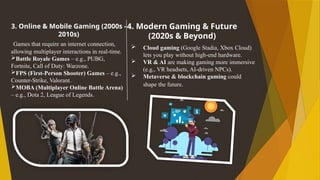
Battle Royale Games – e.g., PUBG,
Fortnite, Call of Duty: Warzone.
FPS (First-Person Shooter) Games – e.g.,
Counter-Strike, Valorant.
MOBA (Multiplayer Online Battle Arena)
– e.g., Dota 2, League of Legends.
4. Modern Gaming & Future
(2020s & Beyond)
 Cloud gaming (Google Stadia, Xbox Cloud)
lets you play without high-end hardware.
 VR & AI are making gaming more immersive
(e.g., VR headsets, AI-driven NPCs).
 Metaverse & blockchain gaming could
shape the future.
1. Graphics and Display
Technologies:
 GPUs: Power AI, scientific
simulations, and cryptocurrency
mining.
 Ray Tracing: Rendering for movies
and simulations.
 High-Refresh-Rate Displays:
professional work like editing.
 VR (Virtual Reality) & AR
(Augmented Reality): Training,
medicine, education.
 Game AI: NPCs (non-player characters)
use AI for decision-making,.
 Reinforcement Learning: Used in AI-
driven opponents and self-learning
systems
2. Artificial Intelligence (AI) and Machine
Learning
Technologies Developed:
 Online Multiplayer Infrastructure:
Development of low-latency servers and
protocols benefits real-time
communication applications.
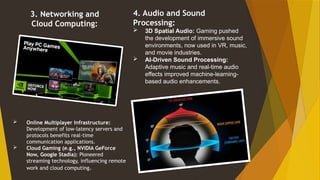
 Cloud Gaming (e.g., NVIDIA GeForce
Now, Google Stadia): Pioneered
streaming technology, influencing remote
work and cloud computing.
3. Networking and
Cloud Computing:
4. Audio and Sound
Processing:
 3D Spatial Audio: Gaming pushed
the development of immersive sound
environments, now used in VR, music,
and movie industries.
 AI-Driven Sound Processing:
Adaptive music and real-time audio
effects improved machine-learning-
based audio enhancements.
Valuations and
Major
Companies
Leading companies
 As of 2023, the leading gaming companies by revenue are:
• Sony: Generated approximately $30 billion in gaming revenue.
tweaktown.com
• Tencent: Reported gaming revenues of about $25.5 billion.
ru.wikipedia.org
• Microsoft: Achieved gaming revenues around $21.5 billion.
ru.wikipedia.org
• Nintendo: Recorded gaming revenues of approximately $12.08 billion.
tweaktown.com
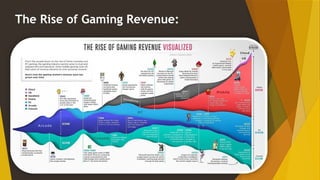
The Rise of Gaming Revenue:
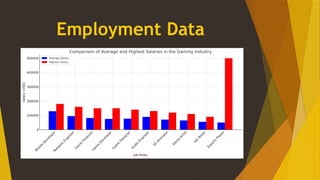
Employment Data
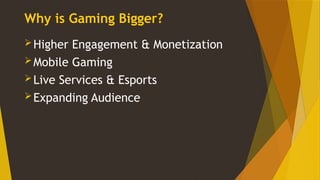
Why is Gaming Bigger?
Higher Engagement & Monetization
Mobile Gaming
Live Services & Esports
Expanding Audience
The Process of
Game
Development
Game development is a complex and iterative process
that involves multiple stages, from the initial idea to the
final release. Here’s a detailed overview of each stage:
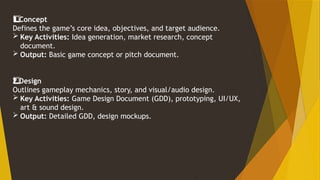
Concept
1️
1️
⃣
Defines the game’s core idea, objectives, and target audience.
 Key Activities: Idea generation, market research, concept
document.
 Output: Basic game concept or pitch document.
Design
2️
⃣
Outlines gameplay mechanics, story, and visual/audio design.
 Key Activities: Game Design Document (GDD), prototyping, UI/UX,
art & sound design.
 Output: Detailed GDD, design mockups.
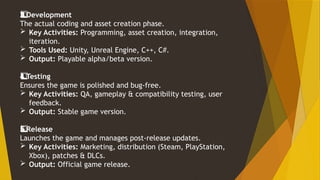
Development
3️
3️
⃣
The actual coding and asset creation phase.
 Key Activities: Programming, asset creation, integration,
iteration.
 Tools Used: Unity, Unreal Engine, C++, C#.
 Output: Playable alpha/beta version.
Testing
4️
⃣
Ensures the game is polished and bug-free.
 Key Activities: QA, gameplay & compatibility testing, user
feedback.
 Output: Stable game version.
Release
5️
5️
⃣
Launches the game and manages post-release updates.
 Key Activities: Marketing, distribution (Steam, PlayStation,
Xbox), patches & DLCs.
 Output: Official game release.
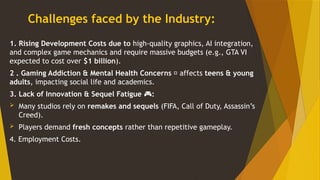
Challenges faced by the Industry:
1. Rising Development Costs due to high-quality graphics, AI integration,
and complex game mechanics and require massive budgets (e.g., GTA VI
expected to cost over $1 billion).
2 . Gaming Addiction & Mental Health Concerns 🧠 affects teens & young
adults, impacting social life and academics.
3. Lack of Innovation & Sequel Fatigue :
🎮
 Many studios rely on remakes and sequels (FIFA, Call of Duty, Assassin’s
Creed).
 Players demand fresh concepts rather than repetitive gameplay.
4. Employment Costs.
Solutions:
1. To recover development costs :
 Implement ethical monetization strategies like optional in-game cosmetics,
subscription services (e.g., Xbox Game Pass), and fair pricing models.
2. To prevent piracy and hacking :
 Implement ethical monetization strategies like optional in-game cosmetics,
subscription services (e.g., Xbox Game Pass), and fair pricing models.
3. To prevent employee burnout:
 Promote better project management, realistic deadlines, and better work-life balance
policies.
4. To improve creativity and sequel fatigue :
 Promote better project management, realistic deadlines, and better work-life balance
policies.
 Conclusion:
Gaming has not only improved entertainment but has also influenced multiple industries, from AI Research to healthcare.
The gaming industry faces challenges, but they are outweighed by the innovation and revenue it generates.
Thank You !