Introduction The Game Development Process
Outline Game Business Overview Stats Shape Game Companies Structure Timeline
Random Statistics 60% of all Americans play video games In 2000, 35% of Americans rated playing computer and video games as  the most fun entertainment activity  for the third consecutive year Computer/video game industry on par with box office sales of the movie industry $6.35B/year for U.S. Sales in 2001 Development Costs $3M to $10M to develop average game Takes 12-24 months 70+ million Playstations worldwide 30 million PS2’s, 4 million Xbox’s, 4 million GameCubes 400,000 pay $12.50/month to play Everquest Laird and Jamin, EECS 494, Umich, Fall 2003
Hit-Driven, Entertainment Business Entertainment, not packaged goods Consumers say, “I have to  have  the next  WarCraft  game from Blizzard!” No one says, “I have to  have  that next razor blade from Gillette!” Games generate  emotional responses - fulfill fantasies escape from reality - stimulate the senses Causes of success are  intangible “ Quality is king” Consumers are smarter than often thought Hits are made by: those who are: creative, instinctive, and who know what a great gaming experience feels like not by marketing executives Laird and Jamin, EECS 494, Umich, Fall 2003
Business Models Software developers and publishers Money from game sales Internet games Initial game Monthly fee Console developers Proprietary media delivery Lose money on consoles (the faster they sell, the faster they go out of business) Charge fee for each game sold Tool developers Create “engines” and “middleware” and sell to game developers Contract services: Motion capture, art, cut-scenes, audio, … Laird and Jamin, EECS 494, Umich, Fall 2003
Sales 2003 U.S. sales of console games totaled $5.8 B Computer games $1.2 billion, consoles $4.6 billion Only entertainment industry to grow in 2003 Movie and music industries reported losses  According to Exhibitor Relations and Nielsen SoundScan Console game players: Action (30%), sports (20%), racing (15%), RPG (10%), fighting (5%), family entertainment (5%), and shooters (5%)  Computer gamer players: Strategy (30%), children's entertainment (15%),  shooters (15%), family entertainment titles (10%), RPG (10%), sports (5%), racing (5%), adventure (5%), and simulation (5%)  The Entertainment Software Association
Online Growth Grew from 38 million (1999) to 68 million (2003) Not just for PC gamers anymore 24% of revenues will come from online by 2010 (Forrester Research) Video gamers 78% have access to the Internet 44% play games online Spend 12.8 hours online per week Spend 6.5 playing games online Laird and Jamin, EECS 494, Umich, Fall 2003
Outline Game Business Overview Game Companies Game Development Timeline The Role of Documentation
Shape of Industry (1 of 2) Hardware: Sony, Nintendo, Intel, Microsoft Software: Publishers Electronic Arts, Activision, Sony, Microsoft, Infogrames, UbiSoft, Mindscape, Interplay,… Developers Electronic Arts, Sony, Microsoft (Bungie), Blizzard, Lucas Arts, id, Namco, Square, Valve, Raven, Relic, Red Storm, High Voltage, Outrage, 3DO, … Laird and Jamin, EECS 494, Umich, Fall 2003
Shape of Industry (2 of 2) Similar to Film Industry About  1  in  10  titles breaks even or makes money Sequels and franchises are popular EA Sports, Sims, Star Trek, … Few self-published titles Fewer small developers as development costs go up Internet Increasingly sales Updates Multiplayer versions of games Massively multiplayer games Laird and Jamin, EECS 494, Umich, Fall 2003
Game Studios – Vertical Structure Developers Publishers Distributors Retailers Much like a mini-Hollywood Laird and Jamin, EECS 494, Umich, Fall 2003
Developers Design and implement games   Including:  programming ,  art ,  sound effects , and  music   Historically, small groups Analogous to book authors Typically work for royalties & funded by advances Do not have the capital, distribution channels, or marketing resources to publish their games Can be unstable Laird and Jamin, EECS 494, Umich, Fall 2003
Publishers Fund development of games Including: manufacturing, marketing/PR, distribution, and customer support Publishers assume most of the risk, but they also take most of the profits Relationship to developers Star Developers can often bully Publishers, because publishers are desperate for content Most Developers are at the mercy of the almighty Publisher Originally grew out of developers Massive consolidation in recent years Most also develop games in-house Laird and Jamin, EECS 494, Umich, Fall 2003
Moving Projects Forward Most Publishers have a “Greenlight Process” Use to determine which projects go forward Developers submit to committee at five, independent stages: Concept Assessment Prototype First Playable Alpha At each stage, committee reviews: Decides whether or not to continue funding Evaluates market potential Adjusts unit forecasts accordingly Laird and Jamin, EECS 494, Umich, Fall 2003
Distributors and Retailers Distributors Get software from publisher to retailer Originally modeled on book distribution Becoming less important as the retail market changes Retailers Sell software Started with mail-order and computer specialty stores Shift in 80’s to game specialty stores, especially chains (Today 25%) Shift in 90’s to mass market retailers (Today 70%) Target, Best Buy, WalMart Internet sales big but still not huge (Today 5%) Laird and Jamin, EECS 494, Umich, Fall 2003
Development Team Size As late as the mid-80’s teams as small as one person. Today, teams today ranging from 10-60 people. Programming now a proportionally smaller part of any project Artistic content creation proportionally larger See Gamasutra, (www.gamasutra.com) Search “post mortem” Game data at bottom includes team size and composition Laird and Jamin, EECS 494, Umich, Fall 2003
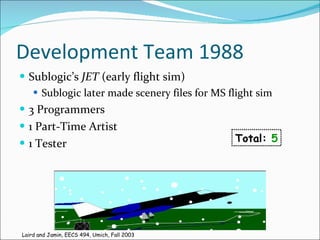
Development Team 1988 Sublogic’s  JET  (early flight sim) Sublogic later made scenery files for MS flight sim 3 Programmers 1 Part-Time Artist 1 Tester Total:  5 Laird and Jamin, EECS 494, Umich, Fall 2003
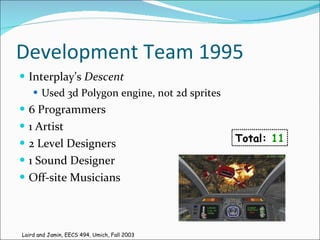
Development Team 1995 Interplay’s  Descent Used 3d Polygon engine, not 2d sprites 6 Programmers 1 Artist 2 Level Designers 1 Sound Designer Off-site Musicians Total:  11 Laird and Jamin, EECS 494, Umich, Fall 2003
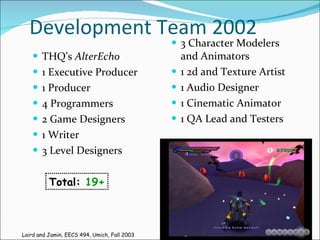
Development Team 2002 THQ’s  AlterEcho 1 Executive Producer 1 Producer 4 Programmers 2 Game Designers 1 Writer 3 Level Designers 3 Character Modelers and Animators 1 2d and Texture Artist 1 Audio Designer 1 Cinematic Animator 1 QA Lead and Testers Total:  19+ Laird and Jamin, EECS 494, Umich, Fall 2003
Development Teams for Online Games Star Wars online (2003?) Development team: 44 people 50% Artists 25% Designers 25% Programmers 3 Producers “ Live” Team (starting at Beta, 6 months before done) 8 Developers 50-60 Customer support (for 200K users) 1000 Volunteer staff (for 200K users) Laird and Jamin, EECS 494, Umich, Fall 2003
A (Larger) Developer Company Today Designing and creating computer games is serious business Large budgets ($1000000+) Large number of people involved Large risk Wisdom Use modern software development techniques Keep creativity were it belongs  In the design Not during the programming 
What’s Involved? People involved lead designer project leader software planner architectural lead programmers artists level designers testers  Time involved 12-24 months (Will walk through what phase Each plays a roll, next)
Game Development Timeline (1 of 4) Inspiration getting the global idea of the game duration: 1 month (for a professional game) people: lead designer result: treatment document, decision to continue Conceptualization preparing the "complete" design of the game duration: 3 months people: lead designer result: complete design document Based on notes from Mark Overmars
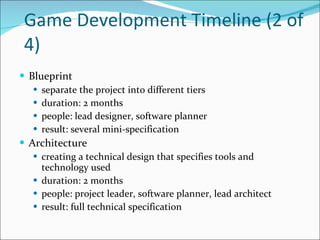
Game Development Timeline (2 of 4) Blueprint separate the project into different tiers duration: 2 months people: lead designer, software planner result: several mini-specification Architecture creating a technical design that specifies tools and technology used duration: 2 months people: project leader, software planner, lead architect result: full technical specification
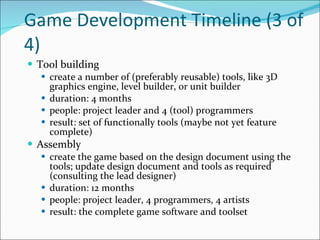
Game Development Timeline (3 of 4) Tool building create a number of (preferably reusable) tools, like 3D graphics engine, level builder, or unit builder duration: 4 months people: project leader and 4 (tool) programmers result: set of functionally tools (maybe not yet feature complete) Assembly create the game based on the design document using the tools; update design document and tools as required (consulting the lead designer) duration: 12 months people: project leader, 4 programmers, 4 artists result: the complete game software and toolset
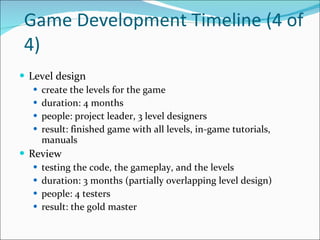
Game Development Timeline (4 of 4) Level design create the levels for the game duration: 4 months people: project leader, 3 level designers result: finished game with all levels, in-game tutorials, manuals Review testing the code, the gameplay, and the levels duration: 3 months (partially overlapping level design) people: 4 testers result: the gold master
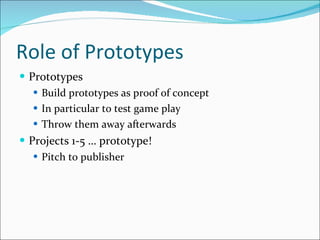
Role of Prototypes Prototypes Build prototypes as proof of concept In particular to test game play Throw them away afterwards Projects 1-5 … prototype! Pitch to publisher 
Is This the Way for Everyone? Some companies still work in old-fashioned ways No good division of tasks No good schedule/deadlines No good design Feature creep No good software development techniques No reusable components Not object oriented (or even assembly) No working hours, dress codes, etc. Bad salaries Things need to change It is getting too expensive Games are getting too complex Many projects fail Many companies go bankrupt Divide tasks and responsibilities See the timeline above

Intro to Game Design

  • 1.
    Introduction The GameDevelopment Process
  • 2.
    Outline Game BusinessOverview Stats Shape Game Companies Structure Timeline
  • 3.
    Random Statistics 60%of all Americans play video games In 2000, 35% of Americans rated playing computer and video games as the most fun entertainment activity for the third consecutive year Computer/video game industry on par with box office sales of the movie industry $6.35B/year for U.S. Sales in 2001 Development Costs $3M to $10M to develop average game Takes 12-24 months 70+ million Playstations worldwide 30 million PS2’s, 4 million Xbox’s, 4 million GameCubes 400,000 pay $12.50/month to play Everquest Laird and Jamin, EECS 494, Umich, Fall 2003
  • 4.
    Hit-Driven, Entertainment BusinessEntertainment, not packaged goods Consumers say, “I have to have the next WarCraft game from Blizzard!” No one says, “I have to have that next razor blade from Gillette!” Games generate emotional responses - fulfill fantasies escape from reality - stimulate the senses Causes of success are intangible “ Quality is king” Consumers are smarter than often thought Hits are made by: those who are: creative, instinctive, and who know what a great gaming experience feels like not by marketing executives Laird and Jamin, EECS 494, Umich, Fall 2003
  • 5.
    Business Models Softwaredevelopers and publishers Money from game sales Internet games Initial game Monthly fee Console developers Proprietary media delivery Lose money on consoles (the faster they sell, the faster they go out of business) Charge fee for each game sold Tool developers Create “engines” and “middleware” and sell to game developers Contract services: Motion capture, art, cut-scenes, audio, … Laird and Jamin, EECS 494, Umich, Fall 2003
  • 6.
    Sales 2003 U.S.sales of console games totaled $5.8 B Computer games $1.2 billion, consoles $4.6 billion Only entertainment industry to grow in 2003 Movie and music industries reported losses According to Exhibitor Relations and Nielsen SoundScan Console game players: Action (30%), sports (20%), racing (15%), RPG (10%), fighting (5%), family entertainment (5%), and shooters (5%) Computer gamer players: Strategy (30%), children's entertainment (15%), shooters (15%), family entertainment titles (10%), RPG (10%), sports (5%), racing (5%), adventure (5%), and simulation (5%)  The Entertainment Software Association
  • 7.
    Online Growth Grewfrom 38 million (1999) to 68 million (2003) Not just for PC gamers anymore 24% of revenues will come from online by 2010 (Forrester Research) Video gamers 78% have access to the Internet 44% play games online Spend 12.8 hours online per week Spend 6.5 playing games online Laird and Jamin, EECS 494, Umich, Fall 2003
  • 8.
    Outline Game BusinessOverview Game Companies Game Development Timeline The Role of Documentation
  • 9.
    Shape of Industry(1 of 2) Hardware: Sony, Nintendo, Intel, Microsoft Software: Publishers Electronic Arts, Activision, Sony, Microsoft, Infogrames, UbiSoft, Mindscape, Interplay,… Developers Electronic Arts, Sony, Microsoft (Bungie), Blizzard, Lucas Arts, id, Namco, Square, Valve, Raven, Relic, Red Storm, High Voltage, Outrage, 3DO, … Laird and Jamin, EECS 494, Umich, Fall 2003
  • 10.
    Shape of Industry(2 of 2) Similar to Film Industry About 1 in 10 titles breaks even or makes money Sequels and franchises are popular EA Sports, Sims, Star Trek, … Few self-published titles Fewer small developers as development costs go up Internet Increasingly sales Updates Multiplayer versions of games Massively multiplayer games Laird and Jamin, EECS 494, Umich, Fall 2003
  • 11.
    Game Studios –Vertical Structure Developers Publishers Distributors Retailers Much like a mini-Hollywood Laird and Jamin, EECS 494, Umich, Fall 2003
  • 12.
    Developers Design andimplement games Including: programming , art , sound effects , and music Historically, small groups Analogous to book authors Typically work for royalties & funded by advances Do not have the capital, distribution channels, or marketing resources to publish their games Can be unstable Laird and Jamin, EECS 494, Umich, Fall 2003
  • 13.
    Publishers Fund developmentof games Including: manufacturing, marketing/PR, distribution, and customer support Publishers assume most of the risk, but they also take most of the profits Relationship to developers Star Developers can often bully Publishers, because publishers are desperate for content Most Developers are at the mercy of the almighty Publisher Originally grew out of developers Massive consolidation in recent years Most also develop games in-house Laird and Jamin, EECS 494, Umich, Fall 2003
  • 14.
    Moving Projects ForwardMost Publishers have a “Greenlight Process” Use to determine which projects go forward Developers submit to committee at five, independent stages: Concept Assessment Prototype First Playable Alpha At each stage, committee reviews: Decides whether or not to continue funding Evaluates market potential Adjusts unit forecasts accordingly Laird and Jamin, EECS 494, Umich, Fall 2003
  • 15.
    Distributors and RetailersDistributors Get software from publisher to retailer Originally modeled on book distribution Becoming less important as the retail market changes Retailers Sell software Started with mail-order and computer specialty stores Shift in 80’s to game specialty stores, especially chains (Today 25%) Shift in 90’s to mass market retailers (Today 70%) Target, Best Buy, WalMart Internet sales big but still not huge (Today 5%) Laird and Jamin, EECS 494, Umich, Fall 2003
  • 16.
    Development Team SizeAs late as the mid-80’s teams as small as one person. Today, teams today ranging from 10-60 people. Programming now a proportionally smaller part of any project Artistic content creation proportionally larger See Gamasutra, (www.gamasutra.com) Search “post mortem” Game data at bottom includes team size and composition Laird and Jamin, EECS 494, Umich, Fall 2003
  • 17.
    Development Team 1988Sublogic’s JET (early flight sim) Sublogic later made scenery files for MS flight sim 3 Programmers 1 Part-Time Artist 1 Tester Total: 5 Laird and Jamin, EECS 494, Umich, Fall 2003
  • 18.
    Development Team 1995Interplay’s Descent Used 3d Polygon engine, not 2d sprites 6 Programmers 1 Artist 2 Level Designers 1 Sound Designer Off-site Musicians Total: 11 Laird and Jamin, EECS 494, Umich, Fall 2003
  • 19.
    Development Team 2002THQ’s AlterEcho 1 Executive Producer 1 Producer 4 Programmers 2 Game Designers 1 Writer 3 Level Designers 3 Character Modelers and Animators 1 2d and Texture Artist 1 Audio Designer 1 Cinematic Animator 1 QA Lead and Testers Total: 19+ Laird and Jamin, EECS 494, Umich, Fall 2003
  • 20.
    Development Teams forOnline Games Star Wars online (2003?) Development team: 44 people 50% Artists 25% Designers 25% Programmers 3 Producers “ Live” Team (starting at Beta, 6 months before done) 8 Developers 50-60 Customer support (for 200K users) 1000 Volunteer staff (for 200K users) Laird and Jamin, EECS 494, Umich, Fall 2003
  • 21.
    A (Larger) DeveloperCompany Today Designing and creating computer games is serious business Large budgets ($1000000+) Large number of people involved Large risk Wisdom Use modern software development techniques Keep creativity were it belongs In the design Not during the programming 
  • 22.
    What’s Involved? Peopleinvolved lead designer project leader software planner architectural lead programmers artists level designers testers  Time involved 12-24 months (Will walk through what phase Each plays a roll, next)
  • 23.
    Game Development Timeline(1 of 4) Inspiration getting the global idea of the game duration: 1 month (for a professional game) people: lead designer result: treatment document, decision to continue Conceptualization preparing the "complete" design of the game duration: 3 months people: lead designer result: complete design document Based on notes from Mark Overmars
  • 24.
    Game Development Timeline(2 of 4) Blueprint separate the project into different tiers duration: 2 months people: lead designer, software planner result: several mini-specification Architecture creating a technical design that specifies tools and technology used duration: 2 months people: project leader, software planner, lead architect result: full technical specification
  • 25.
    Game Development Timeline(3 of 4) Tool building create a number of (preferably reusable) tools, like 3D graphics engine, level builder, or unit builder duration: 4 months people: project leader and 4 (tool) programmers result: set of functionally tools (maybe not yet feature complete) Assembly create the game based on the design document using the tools; update design document and tools as required (consulting the lead designer) duration: 12 months people: project leader, 4 programmers, 4 artists result: the complete game software and toolset
  • 26.
    Game Development Timeline(4 of 4) Level design create the levels for the game duration: 4 months people: project leader, 3 level designers result: finished game with all levels, in-game tutorials, manuals Review testing the code, the gameplay, and the levels duration: 3 months (partially overlapping level design) people: 4 testers result: the gold master
  • 27.
    Role of PrototypesPrototypes Build prototypes as proof of concept In particular to test game play Throw them away afterwards Projects 1-5 … prototype! Pitch to publisher 
  • 28.
    Is This theWay for Everyone? Some companies still work in old-fashioned ways No good division of tasks No good schedule/deadlines No good design Feature creep No good software development techniques No reusable components Not object oriented (or even assembly) No working hours, dress codes, etc. Bad salaries Things need to change It is getting too expensive Games are getting too complex Many projects fail Many companies go bankrupt Divide tasks and responsibilities See the timeline above