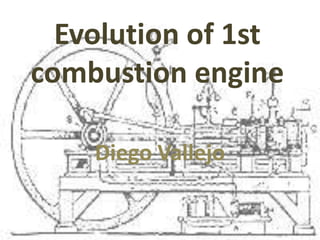
Evolution of 1st
combustion engine

    Diego Vallejo
History of the internal combustion
                engine
• Although various forms of internal combustion
  engines were developed before the 19th
  century, their use was hindered until the
  commercial drilling and production of
  petroleum began in the mid-1850s. By the late
  19th century, engineering advances led to
  their widespread adoption in a variety of
  applications.
Timeline of development
•   17th century: Christiaan Huygens designs a gunpowder engine to drive water
    pumps, to supply 3000 cubic meters of water/day for the Versailles palace
    gardens, essentially creating the first idea of a rudimentary internal combustion
    piston engine.
•   1807 :Francois Isaac de Rivaz of Switzerland invented an internal combustion
    engine that used a mixture of hydrogen and oxygen for fuel. Rivaz designed a car
    for his engine - the first internal combustion powered automobile.
•   1824: French physicist Sadi Carnot established the thermodynamic theory of
    idealized heat engines. This scientifically established the need for compression to
    increase the difference between the upper and lower working temperatures.
•   1858 :Belgian engineer, Jean JosephÉtienne Lenoir invented and patented a
    double-acting, electric spark-ignition internal combustion engine fueled by coal
    gas. In 1863, Lenoir attached an improved engine (using petroleum and a primitive
    carburetor) to a three-wheeled wagon that managed to complete an historic fifty-
    mile road trip.
•   1854-57: Eugenio Barsanti & Felice Matteucci invented an engine that was possibly
    the first 4-cycle engine, but the patent was lost
•   1860: Belgian Jean Joseph Etienne Lenoir produced a gas-fired internal
    combustion engine similar in appearance to a horizontal double-acting steam
    engine, with cylinders, pistons, connecting rods, and flywheel in which the gas
    essentially took the place of the steam. This was the first internal combustion
    engine to be produced in numbers.
• 1862:Nikolaus Otto was the first to build and sell the engine. He designed
  an indirect-acting free-piston compressionless engine whose greater
  efficiency won the support of Eugen Langen and then most of the
  market, which at that time was mostly for small stationary engines fueled
  by lighting gas.
• 1870:In Vienna, Siegfried Marcus put the first mobile gasoline engine on a
  handcart.
• 1873 :George Brayton, an American engineer, developed an unsuccessful
  two-stroke kerosene engine (it used two external pumping cylinders).
  However, it was considered the first safe and practical oil engine.
• 1876: Nikolaus Otto, working with Gottlieb Daimler and Wilhelm
  Maybach, started the genesis of the four-cycle engine. The German
  courts, however, did not hold his patent to cover all in-cylinder
  compression engines or even the four-stroke cycle, and after this
  decision, in-cylinder compression became universal.
• 1884:British engineer Edward Butler constructed the first petrol (gasoline)
  internal combustion engine. Butler invented the spark plug, magneto, coil
  ignition and spray jet carburetor, and was the first to use the word petrol.
• 1885 :Gottlieb Daimler invented what is often recognized as the prototype
  of the modern gas engine with a vertical cylinder, and with gasoline
  injected through a carburetor (patented in 1887). Daimler first built a two-
  wheeled vehicle the "Reitwagen" (Riding Carriage) with this engine and a
  year later built the world's first four-wheeled motor vehicle.
• 1886 :On January 29, Karl Benz received the first patent for a gas-fueled
  car.
• 1890 :Wilhelm Maybach built the first four-cylinder, four-stroke engine.
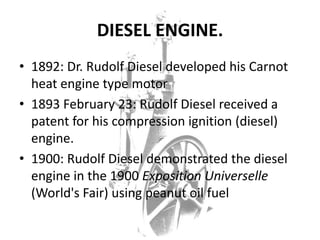
DIESEL ENGINE.
• 1892: Dr. Rudolf Diesel developed his Carnot
  heat engine type motor
• 1893 February 23: Rudolf Diesel received a
  patent for his compression ignition (diesel)
  engine.
• 1900: Rudolf Diesel demonstrated the diesel
  engine in the 1900 Exposition Universelle
  (World's Fair) using peanut oil fuel
Engine design , and car design were integral
activities, almost all of the engine designers
mentioned above also designed cars, and a
few went on to become major manufacturers
of automobiles. All of these inventors and
more made notable improvements in the
evolution of the internal combustion vehicles.

Evolution of 1st combustion engine

  • 1.
    Evolution of 1st combustionengine Diego Vallejo
  • 2.
    History of theinternal combustion engine • Although various forms of internal combustion engines were developed before the 19th century, their use was hindered until the commercial drilling and production of petroleum began in the mid-1850s. By the late 19th century, engineering advances led to their widespread adoption in a variety of applications.
  • 3.
    Timeline of development • 17th century: Christiaan Huygens designs a gunpowder engine to drive water pumps, to supply 3000 cubic meters of water/day for the Versailles palace gardens, essentially creating the first idea of a rudimentary internal combustion piston engine. • 1807 :Francois Isaac de Rivaz of Switzerland invented an internal combustion engine that used a mixture of hydrogen and oxygen for fuel. Rivaz designed a car for his engine - the first internal combustion powered automobile. • 1824: French physicist Sadi Carnot established the thermodynamic theory of idealized heat engines. This scientifically established the need for compression to increase the difference between the upper and lower working temperatures. • 1858 :Belgian engineer, Jean JosephÉtienne Lenoir invented and patented a double-acting, electric spark-ignition internal combustion engine fueled by coal gas. In 1863, Lenoir attached an improved engine (using petroleum and a primitive carburetor) to a three-wheeled wagon that managed to complete an historic fifty- mile road trip. • 1854-57: Eugenio Barsanti & Felice Matteucci invented an engine that was possibly the first 4-cycle engine, but the patent was lost • 1860: Belgian Jean Joseph Etienne Lenoir produced a gas-fired internal combustion engine similar in appearance to a horizontal double-acting steam engine, with cylinders, pistons, connecting rods, and flywheel in which the gas essentially took the place of the steam. This was the first internal combustion engine to be produced in numbers.
  • 4.
    • 1862:Nikolaus Ottowas the first to build and sell the engine. He designed an indirect-acting free-piston compressionless engine whose greater efficiency won the support of Eugen Langen and then most of the market, which at that time was mostly for small stationary engines fueled by lighting gas. • 1870:In Vienna, Siegfried Marcus put the first mobile gasoline engine on a handcart. • 1873 :George Brayton, an American engineer, developed an unsuccessful two-stroke kerosene engine (it used two external pumping cylinders). However, it was considered the first safe and practical oil engine. • 1876: Nikolaus Otto, working with Gottlieb Daimler and Wilhelm Maybach, started the genesis of the four-cycle engine. The German courts, however, did not hold his patent to cover all in-cylinder compression engines or even the four-stroke cycle, and after this decision, in-cylinder compression became universal. • 1884:British engineer Edward Butler constructed the first petrol (gasoline) internal combustion engine. Butler invented the spark plug, magneto, coil ignition and spray jet carburetor, and was the first to use the word petrol. • 1885 :Gottlieb Daimler invented what is often recognized as the prototype of the modern gas engine with a vertical cylinder, and with gasoline injected through a carburetor (patented in 1887). Daimler first built a two- wheeled vehicle the "Reitwagen" (Riding Carriage) with this engine and a year later built the world's first four-wheeled motor vehicle. • 1886 :On January 29, Karl Benz received the first patent for a gas-fueled car. • 1890 :Wilhelm Maybach built the first four-cylinder, four-stroke engine.
  • 5.
    DIESEL ENGINE. • 1892:Dr. Rudolf Diesel developed his Carnot heat engine type motor • 1893 February 23: Rudolf Diesel received a patent for his compression ignition (diesel) engine. • 1900: Rudolf Diesel demonstrated the diesel engine in the 1900 Exposition Universelle (World's Fair) using peanut oil fuel
  • 6.
    Engine design ,and car design were integral activities, almost all of the engine designers mentioned above also designed cars, and a few went on to become major manufacturers of automobiles. All of these inventors and more made notable improvements in the evolution of the internal combustion vehicles.