History Jay Lee Brian
Car is an automobile. Car is a  vehicle, such as a streetcar, that runs on rails: a railroad car. Car is  a motorized road vehicle designed to carry a small number of people. Today , the car influences own life very importantly.
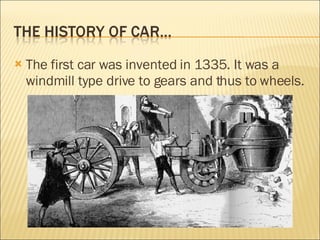
The first car was invented in 1335.  It was a windmill type drive to gears and thus to wheels.
In 1769, the very first self-propelled road vehicle was a military tractor invented by French engineer and mechanic, Nicolas Joseph Cugnot. He used a steam engine to power his vehicle, built under his instructions at the Paris Arsenal by mechanic Brezin. And he built a steam-powered tricycle that carried four passengers.
Between 1832 and 1839, Robert Anderson of Scotland invented the first crude electric carriage. Inventors were the first to use non-rechargeable electric cells. Frenchmen Gaston Plante invented a better storage battery in 1865  and his fellow countrymen  Camille Faure improved the  storage battery in 1881.
France and Great Britain were the first nations to support the widespread development of electric vehicles in the late 1800s. In 1899, a Belgian built electric racing car called " La Jamais Contente " set a world record for land speed -  68 mph  - designed by Camille Jénatzy. In 1897, the first commercial application was established as a fleet of  New York City   taxis built by the  Electric Carriage  and Wagon Company of  Philadelphia .
History of the Internal Combustion Engine - The Heart of the Automobile   # An internal combustion engine is any engine that uses the explosive combustion of fuel to push a piston within a cylinder - the piston's movement turns a crankshaft that then turns the car wheels via a chain or a drive shaft. The different types of fuel commonly used for car combustion engines are gasoline (or petrol), diesel, and kerosene.
1680  - Dutch physicist,  Christian Huygens  designed (but never built) an internal combustion engine that was to be fueled with gunpowder.  1873  -  American engineer  developed an  unsuccessful two-stroke kerosene engine . However, it was  considered the first safe  and  practical oil engine . 1889  -  Daimler  built an improved  four-stroke   engine  with  mushroom-shaped valves  and  two  V-slant cylinders .  1890  -  Wilhelm Maybach  built the  first four-cylinder, four-stroke  engine . 
The Gasoline cars started to outsell all other types of motor vehicles in by the early 1900s.  The first car manufacturers in the world were French:  Panhard  &  Levassor  (1889) and Peugeot (1891).  Rene Panhard  and  Emile Levassor  built their first car in 1890 using a  Daimler engine .
America's first gasoline-powered commercial car manufacturers were  Charles  and  Frank Duryea . The first automobile to be mass produced in the United States was the 1901,  Curved Dash Oldsmobile , built by the American  car manufacturer  RansomeEli Olds  (1864-1950). 1891, Panhard and Levassor vehicle with front engine.

Automobile

  • 1.
  • 2.
    Car is anautomobile. Car is a vehicle, such as a streetcar, that runs on rails: a railroad car. Car is a motorized road vehicle designed to carry a small number of people. Today , the car influences own life very importantly.
  • 3.
    The first carwas invented in 1335. It was a windmill type drive to gears and thus to wheels.
  • 4.
    In 1769, thevery first self-propelled road vehicle was a military tractor invented by French engineer and mechanic, Nicolas Joseph Cugnot. He used a steam engine to power his vehicle, built under his instructions at the Paris Arsenal by mechanic Brezin. And he built a steam-powered tricycle that carried four passengers.
  • 5.
    Between 1832 and1839, Robert Anderson of Scotland invented the first crude electric carriage. Inventors were the first to use non-rechargeable electric cells. Frenchmen Gaston Plante invented a better storage battery in 1865 and his fellow countrymen Camille Faure improved the storage battery in 1881.
  • 6.
    France and GreatBritain were the first nations to support the widespread development of electric vehicles in the late 1800s. In 1899, a Belgian built electric racing car called " La Jamais Contente " set a world record for land speed - 68 mph - designed by Camille Jénatzy. In 1897, the first commercial application was established as a fleet of New York City taxis built by the Electric Carriage and Wagon Company of Philadelphia .
  • 7.
    History of theInternal Combustion Engine - The Heart of the Automobile # An internal combustion engine is any engine that uses the explosive combustion of fuel to push a piston within a cylinder - the piston's movement turns a crankshaft that then turns the car wheels via a chain or a drive shaft. The different types of fuel commonly used for car combustion engines are gasoline (or petrol), diesel, and kerosene.
  • 8.
    1680 -Dutch physicist, Christian Huygens designed (but never built) an internal combustion engine that was to be fueled with gunpowder. 1873 - American engineer developed an unsuccessful two-stroke kerosene engine . However, it was considered the first safe and practical oil engine . 1889 - Daimler built an improved four-stroke engine with mushroom-shaped valves and two V-slant cylinders . 1890 - Wilhelm Maybach built the first four-cylinder, four-stroke engine . 
  • 9.
    The Gasoline carsstarted to outsell all other types of motor vehicles in by the early 1900s. The first car manufacturers in the world were French: Panhard & Levassor (1889) and Peugeot (1891). Rene Panhard and Emile Levassor built their first car in 1890 using a Daimler engine .
  • 10.
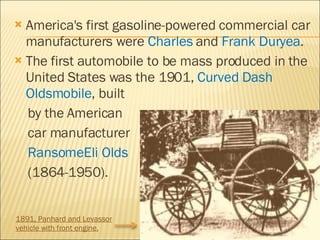
    America's first gasoline-poweredcommercial car manufacturers were Charles and Frank Duryea . The first automobile to be mass produced in the United States was the 1901, Curved Dash Oldsmobile , built by the American car manufacturer RansomeEli Olds (1864-1950). 1891, Panhard and Levassor vehicle with front engine.