Evolution and function of money
Contents:
Evolution of money
Classification of money
Function of money
Evolution of money:
 Barter system
 Commodity money
 Paper money
 Demand deposits
 E-money
Barter system:
Direct exchange of goods and services for other goods
and services
Difficulties in barter system:
 Lack of double co-incidence of wants.
 Lack of common measures of values.
 Difficulties in storing values.
 Deferred of payments / Absence of loaning.
 Indivisibility of certain goods.
Commodity money:
Commodity money is money whose value comes from
a commodity of which it is made. Commodity money
consists of objects that have value in themselves as
well as value in their use as money
Paper money:
Paper currency that is circulated for transaction-
related purposes. The printing of paper money is
typically regulated by a country's central
bank/treasury in order to keep the flow of money in
line with monetary policy.
Demand deposits:
Demand Deposit refers to a type of account held at
banks and financial institutions that may be
withdrawn at any time by the customer. The majority
of such Demand Deposit accounts are checking and
savings accounts.
E-money:
All types of money which people deal with it
electronically, far from traditional ways of payment
like banks, cheques, paper money and coins, e-Money
allow users through internet or wireless devices to pay
the charges of their purchases directly from their bank
accounts by electronical ways such as Smart cards,
Digital wallets and micropayments
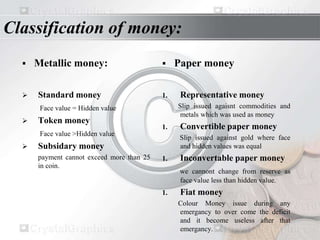
Classification of money:
 Metallic money:
 Standard money
Face value = Hidden value
 Token money
Face value >Hidden value
 Subsidary money
payment cannot exceed more than 25
in coin.
 Paper money
1. Representative money
Slip issued agaisnt commodities and
metals which was used as money
1. Convertible paper money
Slip issued against gold where face
and hidden values was equal
1. Inconvertable paper money
we cannont change from reserve as
face value less than hidden value.
1. Fiat money
Colour Money issue during any
emergancy to over come the deficit
and it become useless after that
emergancy.
Legal tender and non legal tender money
 Legal tender money
 Issued by the central bank
 People has trust
 Limited and unlimited legal
money
 Non legal tender money
 It is not generally accepted
 It is optional money because it
is in form of cheques ATM’s
Legal tender and non legal tender money
 Limited legal money
Limited legal tender money is
that which a creditor can
accept in settlement of claims
up to certain limit only. In
Pakistan coins of small
denomination valuing upon
paisa 50 are limited legal
tender money.
 Unlimited legal money
Unlimited tender money is one
in terms of which debt can be
legally paid up to any amount.
In Pakistan, for instance notes
of state bank of Pakistan
valuing Rs. 100.00, Rs. 5.00
and Rs. 1.00 are full legal
tender money.
Functions of money:
Primary functions
1. Medium of exchange
2. Unit of account
Secondary functions
1. Store of value
2. Standard of deffer payments
3. Easy transfer of value
Primary functions:
Medium of exchange
 Generally acceptable.
 Removed the needs of double
coincidence of wants.
 Remove the difficulties of barter
system.
 Make transaction on time at
any place.
 Works as intermediary between
labor and production to
increase output.
Unit of account
 Standard monetary unit for
measurement of goods services
and assets.
 It is a common denominator
which determines the rate of
exchange between goods and
services.
 It is used to check profit loss
and liabilities.
Secondary functions:
Standard of deferred
payments:
Store of value: Transfer of value:
Debt are easily return
back with the same value
of money
Make possible contracts
for goods and services
against the bond and
securities
Fixed debt contracts
eliminate the gain or loss of
creditor and debtor.
Works as bridge between
present and future value of
wealth.
It is used to meet
unforseen emergency and
to pay debt.
Equally chances of gain
and loss because it is
included bonds securities
commercial papers.
Money has ability to
transfer value one person
to other person easily at
any place.

Evolution and function of money

  • 1.
  • 2.
  • 3.
    Evolution of money: Barter system  Commodity money  Paper money  Demand deposits  E-money
  • 4.
    Barter system: Direct exchangeof goods and services for other goods and services Difficulties in barter system:  Lack of double co-incidence of wants.  Lack of common measures of values.  Difficulties in storing values.  Deferred of payments / Absence of loaning.  Indivisibility of certain goods.
  • 5.
    Commodity money: Commodity moneyis money whose value comes from a commodity of which it is made. Commodity money consists of objects that have value in themselves as well as value in their use as money
  • 6.
    Paper money: Paper currencythat is circulated for transaction- related purposes. The printing of paper money is typically regulated by a country's central bank/treasury in order to keep the flow of money in line with monetary policy.
  • 7.
    Demand deposits: Demand Depositrefers to a type of account held at banks and financial institutions that may be withdrawn at any time by the customer. The majority of such Demand Deposit accounts are checking and savings accounts.
  • 8.
    E-money: All types ofmoney which people deal with it electronically, far from traditional ways of payment like banks, cheques, paper money and coins, e-Money allow users through internet or wireless devices to pay the charges of their purchases directly from their bank accounts by electronical ways such as Smart cards, Digital wallets and micropayments
  • 9.
    Classification of money: Metallic money:  Standard money Face value = Hidden value  Token money Face value >Hidden value  Subsidary money payment cannot exceed more than 25 in coin.  Paper money 1. Representative money Slip issued agaisnt commodities and metals which was used as money 1. Convertible paper money Slip issued against gold where face and hidden values was equal 1. Inconvertable paper money we cannont change from reserve as face value less than hidden value. 1. Fiat money Colour Money issue during any emergancy to over come the deficit and it become useless after that emergancy.
  • 10.
    Legal tender andnon legal tender money  Legal tender money  Issued by the central bank  People has trust  Limited and unlimited legal money  Non legal tender money  It is not generally accepted  It is optional money because it is in form of cheques ATM’s
  • 11.
    Legal tender andnon legal tender money  Limited legal money Limited legal tender money is that which a creditor can accept in settlement of claims up to certain limit only. In Pakistan coins of small denomination valuing upon paisa 50 are limited legal tender money.  Unlimited legal money Unlimited tender money is one in terms of which debt can be legally paid up to any amount. In Pakistan, for instance notes of state bank of Pakistan valuing Rs. 100.00, Rs. 5.00 and Rs. 1.00 are full legal tender money.
  • 12.
    Functions of money: Primaryfunctions 1. Medium of exchange 2. Unit of account Secondary functions 1. Store of value 2. Standard of deffer payments 3. Easy transfer of value
  • 13.
    Primary functions: Medium ofexchange  Generally acceptable.  Removed the needs of double coincidence of wants.  Remove the difficulties of barter system.  Make transaction on time at any place.  Works as intermediary between labor and production to increase output. Unit of account  Standard monetary unit for measurement of goods services and assets.  It is a common denominator which determines the rate of exchange between goods and services.  It is used to check profit loss and liabilities.
  • 14.
    Secondary functions: Standard ofdeferred payments: Store of value: Transfer of value: Debt are easily return back with the same value of money Make possible contracts for goods and services against the bond and securities Fixed debt contracts eliminate the gain or loss of creditor and debtor. Works as bridge between present and future value of wealth. It is used to meet unforseen emergency and to pay debt. Equally chances of gain and loss because it is included bonds securities commercial papers. Money has ability to transfer value one person to other person easily at any place.