



ECONOMICS
PROJECT
Acknowledgement
I would like to express my special
thanks of gratitude to my teacher “Mr.
Bhavin Oza” who gave me the
opportunity to do this wonderful
project of ECONOMICS on “MONEY
AND BANKING”. I came to know about
so many new things I am really
thankful. Secondly, I would also like to
thank my parents and friends who
helped me a lot in finalizing this
project within the limited time frame.
AKSHITA GROVER
XII-F (COMMERCE)
Certificate
This is to certify that this project has
been made by AKSHITA GROVER of
class XII COMMERCE of ECONOMICS
on “MONEY AND BANKING” under my
guidance and has completed
successfully.
____________________
Mr. Bhavin Oza
(P.G.T ECONOMICS)
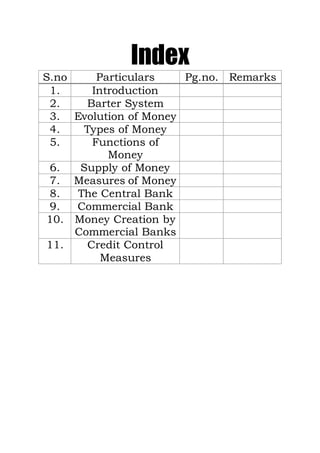
Index
S.no Particulars Pg.no. Remarks
1. Introduction
2. Barter System
3. Evolution of Money
4. Types of Money
5. Functions of
Money
6. Supply of Money
7. Measures of Money
8. The Central Bank
9. Commercial Bank
10. Money Creation by
Commercial Banks
11. Credit Control
Measures
Introduction
The word "money" is believed to originate from a
temple of Juno, on Capitoline, one of Rome's seven
hills. In the ancient world Juno was often
associated with money. Money is any item or
verifiable record that is generally accepted
as payment for goods and services and repayment
of debts, such as taxes, in a particular country or
socio-economic context.
Money and banking are related to each other in
many ways. In today’s progressive world, the
banking sector has become the backbone of every
economy worldwide just like blood is to the veins
and unique because of its formation, staffing and
extraordinary services rendered by the industry.
Banking sector works in the best interest of the
country and due to their contribution in the
financial stability, banking is highly regulated in
most of the countries. When the banking industry
was born the primary job of banks was to mobilize
money from individuals and lend most of the money
to the companies. The biggest strength of an entity
is the steadiness and banking sector has
consistently performed better than others around
the world over a few decades.
Barter System
Before money was invented, the primitive world’s
trade was carried out according to the barter system
of exchange. In the beginning of civilization, human
needs were simple and limited. People used to
exchange goods with each other to satisfy their
wants. Barter Exchange refers to exchange of goods
for goods. An economy, where there is a direct
barter of goods and services, is called a ‘Barter
Economy’ or ‘C-C Economy’ (where C stands for
commodity). Barter System can work when there
exists ‘Double Coincidence of Wants
Drawbacks of Barter System
1.Lack of Common Measure of Value:
The absence of a common unit of measurement to
evaluate the goods for exchange makes proper
accounting impossible.
2.Lack of Store of Value:
In barter system, it was not possible to store
things for future because many of the goods are
perishable in nature.
3.Lack of standard for deferred payments:
In barter system, it was not possible to make future
payments or contractual payments.
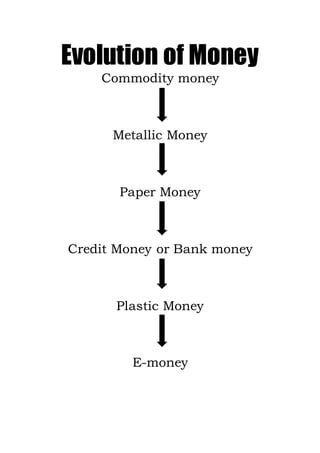
Evolution of Money
Commodity money
Metallic Money
Paper Money
Credit Money or Bank money
Plastic Money
E-money
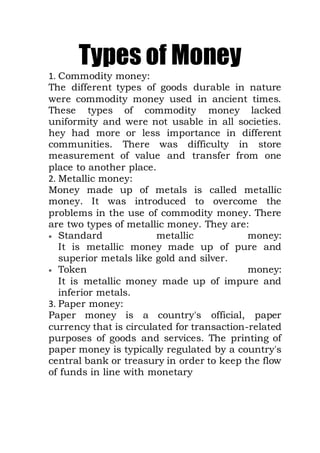
Types of Money
1. Commodity money:
The different types of goods durable in nature
were commodity money used in ancient times.
These types of commodity money lacked
uniformity and were not usable in all societies.
hey had more or less importance in different
communities. There was difficulty in store
measurement of value and transfer from one
place to another place.
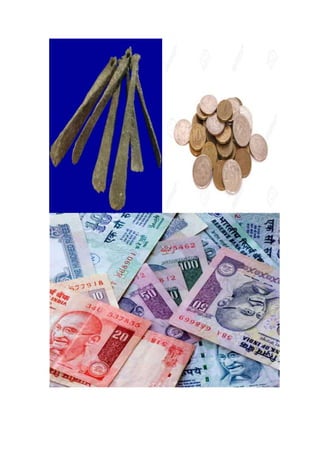
2. Metallic money:
Money made up of metals is called metallic
money. It was introduced to overcome the
problems in the use of commodity money. There
are two types of metallic money. They are:
 Standard metallic money:
It is metallic money made up of pure and
superior metals like gold and silver.
 Token money:
It is metallic money made up of impure and
inferior metals.
3. Paper money:
Paper money is a country's official, paper
currency that is circulated for transaction-related
purposes of goods and services. The printing of
paper money is typically regulated by a country's
central bank or treasury in order to keep the flow
of funds in line with monetary
policy. Paper money tends to be updated with new
versions that contain security features that seek
to make it more difficult for counterfeiters to
create illegal copies.
4. Credit money:
Credit money is any future monetary claim
against an individual that can be used to buy
goods and services. There are many forms of
credit money, such as IOUs, bonds and money
market accounts. Virtually any form of financial
instrument that cannot or is not meant to be
repaid immediately is credit money. It is an
instrument which is equivalent to money.
5. Plastic money
Plastic money is a term that is used
predominantly in reference to the hard-
plastic cards we use every day in place of
actual bank notes. They can come in many
different forms such as cash cards, credit cards,
debit cards, pre-paid cash cards and store cards.
6. E-money:
Electronic money refers to money that exists in
banking computer systems that may be used to
facilitate electronic transactions. Although its
value is backed by fiat currency and may,
therefore, be exchanged into a physical, tangible
form, electronic money is primarily used for
electronic transactions due to the sheer
convenience of this methodology.
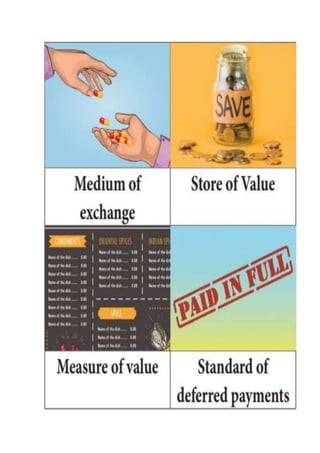
Functions of Money
1.A medium of Exchange:
In an exchange economy, money plays an
intermediary role. It makes the exchange
system smooth and convenient.
2.A measure of Value:
The value of a product or service is determined
on the basis of the money needed for its
possession. This helps in making the exchange
a mutually profitable activity.
3.The Standard of Deferred Payments:
Money plays an important role in lending and
borrowing. Money is taken as a loan and
repaid after a time-gap.
4.Store of Value:
You can store the purchasing power of money
and keep a part of it for future use – monetary
savings. You can use your current income for
current consumption as well as future
consumption through savings.
Supply of Money
The total stock of money circulating in an economy
is the money supply. The circulating money involves
the currency, printed notes, money in the deposit
accounts and in the form of other liquid assets.
Valuation and analysis of the money supply help
the economist and policy makers to frame the policy
or to alter the existing policy of increasing or
reducing the supply of money. The valuation is
important as it ultimately affects the business cycle
and thereby affects the economy. Periodically, every
country's central bank publishes the money supply
data based on the monetary aggregates set by them.
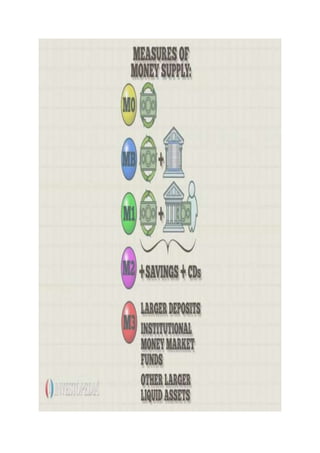
In India, the Reserve Bank of India follows M0, M1,
M2, M3 and M4 monetary aggregates.
Sources of Money Supply:
 Government (which Issues one-rupee notes and
all other coins)
 RBI (which issues paper currency)
 Commercial banks (which create credit on the
basis of demand deposits)
Measures of Money
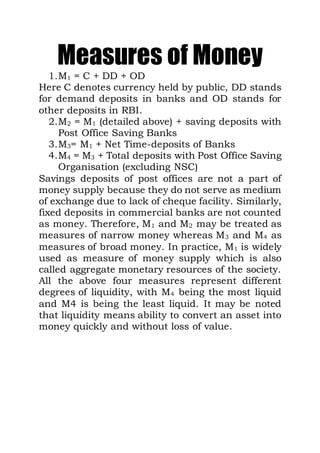
1.M1 = C + DD + OD
Here C denotes currency held by public, DD stands
for demand deposits in banks and OD stands for
other deposits in RBI.
2.M2 = M1 (detailed above) + saving deposits with
Post Office Saving Banks
3.M3= M1 + Net Time-deposits of Banks
4.M4 = M3 + Total deposits with Post Office Saving
Organisation (excluding NSC)
Savings deposits of post offices are not a part of
money supply because they do not serve as medium
of exchange due to lack of cheque facility. Similarly,
fixed deposits in commercial banks are not counted
as money. Therefore, M1 and M2 may be treated as
measures of narrow money whereas M3 and M4 as
measures of broad money. In practice, M1 is widely
used as measure of money supply which is also
called aggregate monetary resources of the society.
All the above four measures represent different
degrees of liquidity, with M4 being the most liquid
and M4 is being the least liquid. It may be noted
that liquidity means ability to convert an asset into
money quickly and without loss of value.
The Central Bank
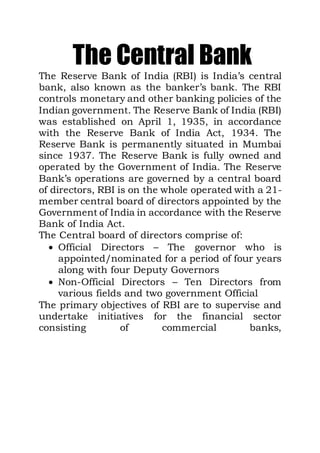
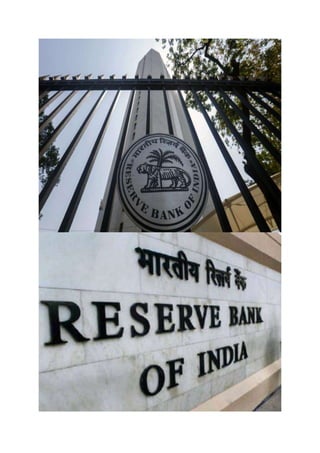
The Reserve Bank of India (RBI) is India’s central
bank, also known as the banker’s bank. The RBI
controls monetary and other banking policies of the
Indian government. The Reserve Bank of India (RBI)
was established on April 1, 1935, in accordance
with the Reserve Bank of India Act, 1934. The
Reserve Bank is permanently situated in Mumbai
since 1937. The Reserve Bank is fully owned and
operated by the Government of India. The Reserve
Bank’s operations are governed by a central board
of directors, RBI is on the whole operated with a 21-
member central board of directors appointed by the
Government of India in accordance with the Reserve
Bank of India Act.
The Central board of directors comprise of:
 Official Directors – The governor who is
appointed/nominated for a period of four years
along with four Deputy Governors
 Non-Official Directors – Ten Directors from
various fields and two government Official
The primary objectives of RBI are to supervise and
undertake initiatives for the financial sector
consisting of commercial banks,
financial institutions and non-banking financial
companies (NBFCs).
Some key initiatives are:
 Restructuring bank inspections
 Fortifying the role of statutory auditors in the
banking system
The Reserve Bank of India comes under the purview
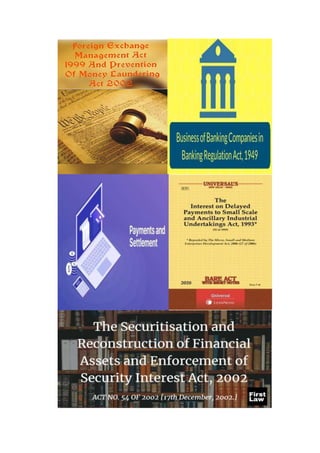
of the following Acts:
 Reserve Bank of India Act, 1934
 Public Debt Act, 1944
 Government Securities Regulations, 2007
 Banking Regulation Act, 1949
 Foreign Exchange Management Act, 1999
 Securitisation and Reconstruction of Financial
Assets and Enforcement of Security Interest
Act, 2002
 Credit Information Companies(Regulation) Act,
2005
 Payment and Settlement Systems Act, 2007
Major Functions of RBI are:
 Monetary Authority: Formulating and
implementing the national monetary policy.
Maintaining price stability across all sectors
while also keeping the objective of growth.
 Regulatory and Supervisory: Set parameters for
banks and financial operations within which
banking and financial systems function. Protect
investors interest and provide economic and
cost-effective banking to the public.
 Foreign Exchange Management: Oversees the
Foreign Exchange Management Act, 1999.
Facilitate external trade and development of
foreign exchange market in India.
 Currency Issuer: Issues, exchanges or destroys
currency and not fit for circulation. Provides the
public adequately with currency notes and
coins and in good quality.
 Developmental role: Promotes and performs
promotional functions to support national
banking and financial objectives.
 Chief Banker to all banks: Provides banking
solutions to the central and the state
governments and also acts as their banker. It
maintains banking accounts of all scheduled
banks.
RBI Annually publishes Annual Report, Report on
Trend and Progress of Banking in India, Lectures,
Report on Currency and Finance, Handbook of
Statistics on the Indian Economy, State Finances:
A Study of Budgets, Statistical Tables Relating to
Banks in India and Basic Statistical Returns.
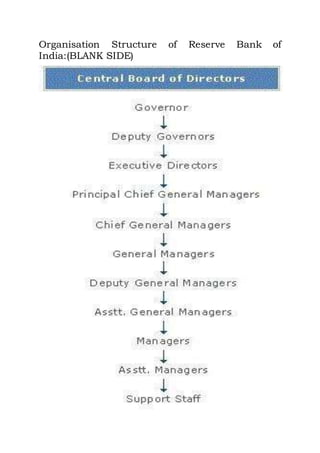
Organisation Structure of Reserve Bank of
India:(BLANK SIDE)
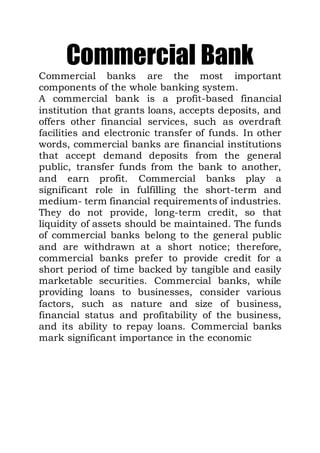
Commercial Bank
Commercial banks are the most important
components of the whole banking system.
A commercial bank is a profit-based financial
institution that grants loans, accepts deposits, and
offers other financial services, such as overdraft
facilities and electronic transfer of funds. In other
words, commercial banks are financial institutions
that accept demand deposits from the general
public, transfer funds from the bank to another,
and earn profit. Commercial banks play a
significant role in fulfilling the short-term and
medium- term financial requirements of industries.
They do not provide, long-term credit, so that
liquidity of assets should be maintained. The funds
of commercial banks belong to the general public
and are withdrawn at a short notice; therefore,
commercial banks prefer to provide credit for a
short period of time backed by tangible and easily
marketable securities. Commercial banks, while
providing loans to businesses, consider various
factors, such as nature and size of business,
financial status and profitability of the business,
and its ability to repay loans. Commercial banks
mark significant importance in the economic
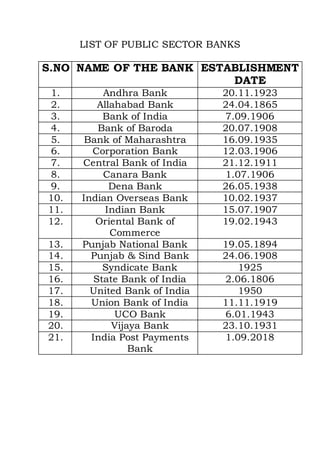
LIST OF PUBLIC SECTOR BANKS
S.NO NAME OF THE BANK ESTABLISHMENT
DATE
1. Andhra Bank 20.11.1923
2. Allahabad Bank 24.04.1865
3. Bank of India 7.09.1906
4. Bank of Baroda 20.07.1908
5. Bank of Maharashtra 16.09.1935
6. Corporation Bank 12.03.1906
7. Central Bank of India 21.12.1911
8. Canara Bank 1.07.1906
9. Dena Bank 26.05.1938
10. Indian Overseas Bank 10.02.1937
11. Indian Bank 15.07.1907
12. Oriental Bank of
Commerce
19.02.1943
13. Punjab National Bank 19.05.1894
14. Punjab & Sind Bank 24.06.1908
15. Syndicate Bank 1925
16. State Bank of India 2.06.1806
17. United Bank of India 1950
18. Union Bank of India 11.11.1919
19. UCO Bank 6.01.1943
20. Vijaya Bank 23.10.1931
21. India Post Payments
Bank
1.09.2018
development of a country as well as serving the
financial requirements of the general public.
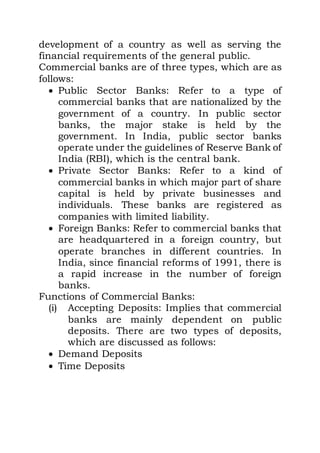
Commercial banks are of three types, which are as
follows:
 Public Sector Banks: Refer to a type of
commercial banks that are nationalized by the
government of a country. In public sector
banks, the major stake is held by the
government. In India, public sector banks
operate under the guidelines of Reserve Bank of
India (RBI), which is the central bank.
 Private Sector Banks: Refer to a kind of
commercial banks in which major part of share
capital is held by private businesses and
individuals. These banks are registered as
companies with limited liability.
 Foreign Banks: Refer to commercial banks that
are headquartered in a foreign country, but
operate branches in different countries. In
India, since financial reforms of 1991, there is
a rapid increase in the number of foreign
banks.
Functions of Commercial Banks:
(i) Accepting Deposits: Implies that commercial
banks are mainly dependent on public
deposits. There are two types of deposits,
which are discussed as follows:
 Demand Deposits
 Time Deposits
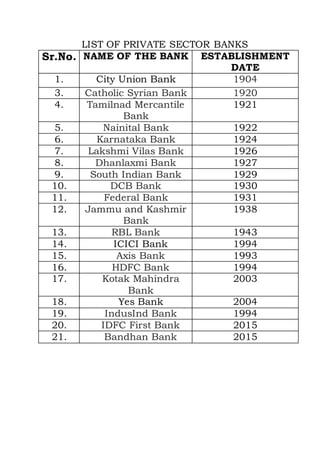
LIST OF PRIVATE SECTOR BANKS
Sr.No. NAME OF THE BANK ESTABLISHMENT
DATE
1. City Union Bank 1904
3. Catholic Syrian Bank 1920
4. Tamilnad Mercantile
Bank
1921
5. Nainital Bank 1922
6. Karnataka Bank 1924
7. Lakshmi Vilas Bank 1926
8. Dhanlaxmi Bank 1927
9. South Indian Bank 1929
10. DCB Bank 1930
11. Federal Bank 1931
12. Jammu and Kashmir
Bank
1938
13. RBL Bank 1943
14. ICICI Bank 1994
15. Axis Bank 1993
16. HDFC Bank 1994
17. Kotak Mahindra
Bank
2003
18. Yes Bank 2004
19. IndusInd Bank 1994
20. IDFC First Bank 2015
21. Bandhan Bank 2015
(ii) Advancing Loans: The public deposits are
used by commercial banks for the purpose of
granting loans to individuals and businesses.
Commercial banks grant loans in the form of
overdraft, cash credit, and discounting bills
of exchange.
(iii) Agency Functions: Implies that commercial
banks act as agents of customers by
performing various functions, which are as
follows:
 Collecting Checks
 Collecting Income
 Paying Expenses
(iv) General Utility Functions:
These functions
 Providing Locker Facilities
 Issuing Traveller’s Checks
 Dealing in Foreign Exchange
 Transferring Funds
(v) Other Functions:
Some other functions of commercial banks are:
 Creating Money
 Electronic Banking
Commercial Banks offers a variety of types of credit
to the public which includes Bank loan, Cash
credit, Bank overdraft and Discounting of bills.
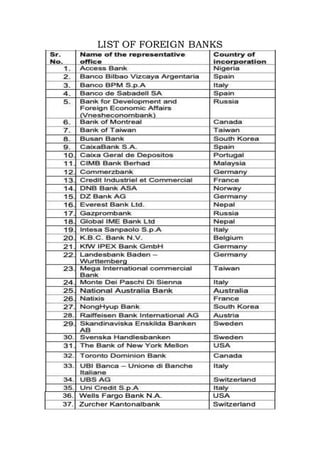
LIST OF FOREIGN BANKS
Money creation by
commercial banks
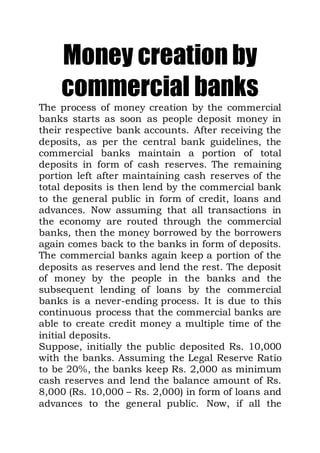
The process of money creation by the commercial
banks starts as soon as people deposit money in
their respective bank accounts. After receiving the
deposits, as per the central bank guidelines, the
commercial banks maintain a portion of total
deposits in form of cash reserves. The remaining
portion left after maintaining cash reserves of the
total deposits is then lend by the commercial bank
to the general public in form of credit, loans and
advances. Now assuming that all transactions in
the economy are routed through the commercial
banks, then the money borrowed by the borrowers
again comes back to the banks in form of deposits.
The commercial banks again keep a portion of the
deposits as reserves and lend the rest. The deposit
of money by the people in the banks and the
subsequent lending of loans by the commercial
banks is a never-ending process. It is due to this
continuous process that the commercial banks are
able to create credit money a multiple time of the
initial deposits.
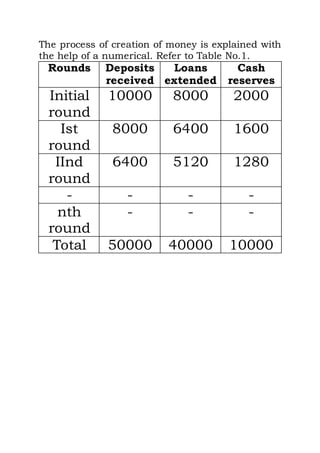
Suppose, initially the public deposited Rs. 10,000
with the banks. Assuming the Legal Reserve Ratio
to be 20%, the banks keep Rs. 2,000 as minimum
cash reserves and lend the balance amount of Rs.
8,000 (Rs. 10,000 – Rs. 2,000) in form of loans and
advances to the general public.
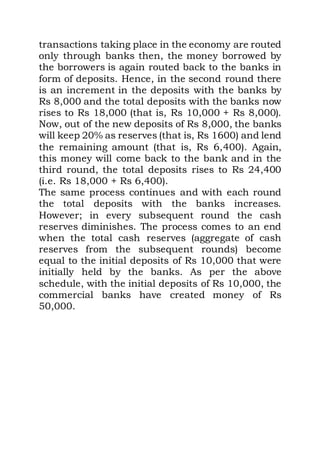
 Now, if all the
transactions taking place in the economy are routed
only through banks then, the money borrowed by
the borrowers is again routed back to the banks in
form of deposits. Hence, in the second round there
is an increment in the deposits with the banks by
Rs 8,000 and the total deposits with the banks now
rises to Rs 18,000 (that is, Rs 10,000 + Rs 8,000).
Now, out of the new deposits of Rs 8,000, the banks
will keep 20% as reserves (that is, Rs 1600) and lend
the remaining amount (that is, Rs 6,400). Again,
this money will come back to the bank and in the
third round, the total deposits rises to Rs 24,400
(i.e. Rs 18,000 + Rs 6,400).
The same process continues and with each round
the total deposits with the banks increases.
However; in every subsequent round the cash
reserves diminishes. The process comes to an end
when the total cash reserves (aggregate of cash
reserves from the subsequent rounds) become
equal to the initial deposits of Rs 10,000 that were
initially held by the banks. As per the above
schedule, with the initial deposits of Rs 10,000, the
commercial banks have created money of Rs
50,000.
The process of creation of money is explained with
the help of a numerical. Refer to Table No.1.
Rounds Deposits
received
Loans
extended
Cash
reserves
Initial
round
10000 8000 2000
Ist
round
8000 6400 1600
IInd
round
6400 5120 1280
- - - -
nth
round
- - -
Total 50000 40000 10000
Credit Control
Measures
Quantitative or General Methods
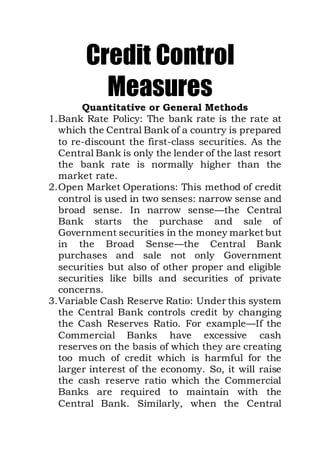
1.Bank Rate Policy: The bank rate is the rate at
which the Central Bank of a country is prepared
to re-discount the first-class securities. As the
Central Bank is only the lender of the last resort
the bank rate is normally higher than the
market rate.
2.Open Market Operations: This method of credit
control is used in two senses: narrow sense and
broad sense. In narrow sense—the Central
Bank starts the purchase and sale of
Government securities in the money market but
in the Broad Sense—the Central Bank
purchases and sale not only Government
securities but also of other proper and eligible
securities like bills and securities of private
concerns.
3.Variable Cash Reserve Ratio: Under this system
the Central Bank controls credit by changing
the Cash Reserves Ratio. For example—If the
Commercial Banks have excessive cash
reserves on the basis of which they are creating
too much of credit which is harmful for the
larger interest of the economy. So, it will raise
the cash reserve ratio which the Commercial
Banks are required to maintain with the
Central Bank. Similarly, when the Central
Bank desires that the Commercial Banks
should increase the volume of credit in order to
bring about an economic revival in the country.
The Central Bank will lower down the Cash
Reserve ratio with a view to expand the cash
reserves of the Commercial Banks.
Qualitative or Selective Method of
Credit Control
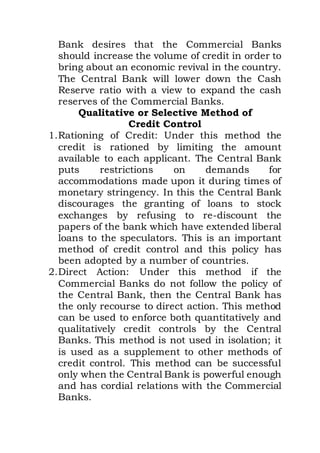
1.Rationing of Credit: Under this method the
credit is rationed by limiting the amount
available to each applicant. The Central Bank
puts restrictions on demands for
accommodations made upon it during times of
monetary stringency. In this the Central Bank
discourages the granting of loans to stock
exchanges by refusing to re-discount the
papers of the bank which have extended liberal
loans to the speculators. This is an important
method of credit control and this policy has
been adopted by a number of countries.
2.Direct Action: Under this method if the
Commercial Banks do not follow the policy of
the Central Bank, then the Central Bank has
the only recourse to direct action. This method
can be used to enforce both quantitatively and
qualitatively credit controls by the Central
Banks. This method is not used in isolation; it
is used as a supplement to other methods of
credit control. This method can be successful
only when the Central Bank is powerful enough
and has cordial relations with the Commercial
Banks.
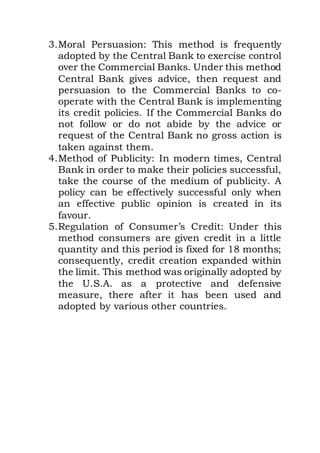
3.Moral Persuasion: This method is frequently
adopted by the Central Bank to exercise control
over the Commercial Banks. Under this method
Central Bank gives advice, then request and
persuasion to the Commercial Banks to co-
operate with the Central Bank is implementing
its credit policies. If the Commercial Banks do
not follow or do not abide by the advice or
request of the Central Bank no gross action is
taken against them.
4.Method of Publicity: In modern times, Central
Bank in order to make their policies successful,
take the course of the medium of publicity. A
policy can be effectively successful only when
an effective public opinion is created in its
favour.
5.Regulation of Consumer’s Credit: Under this
method consumers are given credit in a little
quantity and this period is fixed for 18 months;
consequently, credit creation expanded within
the limit. This method was originally adopted by
the U.S.A. as a protective and defensive
measure, there after it has been used and
adopted by various other countries.

Economics project

  • 1.
  • 2.
    Acknowledgement I would liketo express my special thanks of gratitude to my teacher “Mr. Bhavin Oza” who gave me the opportunity to do this wonderful project of ECONOMICS on “MONEY AND BANKING”. I came to know about so many new things I am really thankful. Secondly, I would also like to thank my parents and friends who helped me a lot in finalizing this project within the limited time frame. AKSHITA GROVER XII-F (COMMERCE)
  • 3.
    Certificate This is tocertify that this project has been made by AKSHITA GROVER of class XII COMMERCE of ECONOMICS on “MONEY AND BANKING” under my guidance and has completed successfully. ____________________ Mr. Bhavin Oza (P.G.T ECONOMICS)
  • 4.
    Index S.no Particulars Pg.no.Remarks 1. Introduction 2. Barter System 3. Evolution of Money 4. Types of Money 5. Functions of Money 6. Supply of Money 7. Measures of Money 8. The Central Bank 9. Commercial Bank 10. Money Creation by Commercial Banks 11. Credit Control Measures
  • 5.
    Introduction The word "money"is believed to originate from a temple of Juno, on Capitoline, one of Rome's seven hills. In the ancient world Juno was often associated with money. Money is any item or verifiable record that is generally accepted as payment for goods and services and repayment of debts, such as taxes, in a particular country or socio-economic context. Money and banking are related to each other in many ways. In today’s progressive world, the banking sector has become the backbone of every economy worldwide just like blood is to the veins and unique because of its formation, staffing and extraordinary services rendered by the industry. Banking sector works in the best interest of the country and due to their contribution in the financial stability, banking is highly regulated in most of the countries. When the banking industry was born the primary job of banks was to mobilize money from individuals and lend most of the money to the companies. The biggest strength of an entity is the steadiness and banking sector has consistently performed better than others around the world over a few decades.
  • 6.
    Barter System Before moneywas invented, the primitive world’s trade was carried out according to the barter system of exchange. In the beginning of civilization, human needs were simple and limited. People used to exchange goods with each other to satisfy their wants. Barter Exchange refers to exchange of goods for goods. An economy, where there is a direct barter of goods and services, is called a ‘Barter Economy’ or ‘C-C Economy’ (where C stands for commodity). Barter System can work when there exists ‘Double Coincidence of Wants Drawbacks of Barter System 1.Lack of Common Measure of Value: The absence of a common unit of measurement to evaluate the goods for exchange makes proper accounting impossible. 2.Lack of Store of Value: In barter system, it was not possible to store things for future because many of the goods are perishable in nature. 3.Lack of standard for deferred payments: In barter system, it was not possible to make future payments or contractual payments.
  • 8.
    Evolution of Money Commoditymoney Metallic Money Paper Money Credit Money or Bank money Plastic Money E-money
  • 10.
    Types of Money 1.Commodity money: The different types of goods durable in nature were commodity money used in ancient times. These types of commodity money lacked uniformity and were not usable in all societies. hey had more or less importance in different communities. There was difficulty in store measurement of value and transfer from one place to another place. 2. Metallic money: Money made up of metals is called metallic money. It was introduced to overcome the problems in the use of commodity money. There are two types of metallic money. They are:  Standard metallic money: It is metallic money made up of pure and superior metals like gold and silver.  Token money: It is metallic money made up of impure and inferior metals. 3. Paper money: Paper money is a country's official, paper currency that is circulated for transaction-related purposes of goods and services. The printing of paper money is typically regulated by a country's central bank or treasury in order to keep the flow of funds in line with monetary
  • 12.
    policy. Paper moneytends to be updated with new versions that contain security features that seek to make it more difficult for counterfeiters to create illegal copies. 4. Credit money: Credit money is any future monetary claim against an individual that can be used to buy goods and services. There are many forms of credit money, such as IOUs, bonds and money market accounts. Virtually any form of financial instrument that cannot or is not meant to be repaid immediately is credit money. It is an instrument which is equivalent to money. 5. Plastic money Plastic money is a term that is used predominantly in reference to the hard- plastic cards we use every day in place of actual bank notes. They can come in many different forms such as cash cards, credit cards, debit cards, pre-paid cash cards and store cards. 6. E-money: Electronic money refers to money that exists in banking computer systems that may be used to facilitate electronic transactions. Although its value is backed by fiat currency and may, therefore, be exchanged into a physical, tangible form, electronic money is primarily used for electronic transactions due to the sheer convenience of this methodology.
  • 14.
    Functions of Money 1.Amedium of Exchange: In an exchange economy, money plays an intermediary role. It makes the exchange system smooth and convenient. 2.A measure of Value: The value of a product or service is determined on the basis of the money needed for its possession. This helps in making the exchange a mutually profitable activity. 3.The Standard of Deferred Payments: Money plays an important role in lending and borrowing. Money is taken as a loan and repaid after a time-gap. 4.Store of Value: You can store the purchasing power of money and keep a part of it for future use – monetary savings. You can use your current income for current consumption as well as future consumption through savings.
  • 16.
    Supply of Money Thetotal stock of money circulating in an economy is the money supply. The circulating money involves the currency, printed notes, money in the deposit accounts and in the form of other liquid assets. Valuation and analysis of the money supply help the economist and policy makers to frame the policy or to alter the existing policy of increasing or reducing the supply of money. The valuation is important as it ultimately affects the business cycle and thereby affects the economy. Periodically, every country's central bank publishes the money supply data based on the monetary aggregates set by them. In India, the Reserve Bank of India follows M0, M1, M2, M3 and M4 monetary aggregates. Sources of Money Supply:  Government (which Issues one-rupee notes and all other coins)  RBI (which issues paper currency)  Commercial banks (which create credit on the basis of demand deposits)
  • 17.
    Measures of Money 1.M1= C + DD + OD Here C denotes currency held by public, DD stands for demand deposits in banks and OD stands for other deposits in RBI. 2.M2 = M1 (detailed above) + saving deposits with Post Office Saving Banks 3.M3= M1 + Net Time-deposits of Banks 4.M4 = M3 + Total deposits with Post Office Saving Organisation (excluding NSC) Savings deposits of post offices are not a part of money supply because they do not serve as medium of exchange due to lack of cheque facility. Similarly, fixed deposits in commercial banks are not counted as money. Therefore, M1 and M2 may be treated as measures of narrow money whereas M3 and M4 as measures of broad money. In practice, M1 is widely used as measure of money supply which is also called aggregate monetary resources of the society. All the above four measures represent different degrees of liquidity, with M4 being the most liquid and M4 is being the least liquid. It may be noted that liquidity means ability to convert an asset into money quickly and without loss of value.
  • 19.
    The Central Bank TheReserve Bank of India (RBI) is India’s central bank, also known as the banker’s bank. The RBI controls monetary and other banking policies of the Indian government. The Reserve Bank of India (RBI) was established on April 1, 1935, in accordance with the Reserve Bank of India Act, 1934. The Reserve Bank is permanently situated in Mumbai since 1937. The Reserve Bank is fully owned and operated by the Government of India. The Reserve Bank’s operations are governed by a central board of directors, RBI is on the whole operated with a 21- member central board of directors appointed by the Government of India in accordance with the Reserve Bank of India Act. The Central board of directors comprise of:  Official Directors – The governor who is appointed/nominated for a period of four years along with four Deputy Governors  Non-Official Directors – Ten Directors from various fields and two government Official The primary objectives of RBI are to supervise and undertake initiatives for the financial sector consisting of commercial banks,
  • 21.
    financial institutions andnon-banking financial companies (NBFCs). Some key initiatives are:  Restructuring bank inspections  Fortifying the role of statutory auditors in the banking system The Reserve Bank of India comes under the purview of the following Acts:  Reserve Bank of India Act, 1934  Public Debt Act, 1944  Government Securities Regulations, 2007  Banking Regulation Act, 1949  Foreign Exchange Management Act, 1999  Securitisation and Reconstruction of Financial Assets and Enforcement of Security Interest Act, 2002  Credit Information Companies(Regulation) Act, 2005  Payment and Settlement Systems Act, 2007 Major Functions of RBI are:  Monetary Authority: Formulating and implementing the national monetary policy. Maintaining price stability across all sectors while also keeping the objective of growth.  Regulatory and Supervisory: Set parameters for banks and financial operations within which banking and financial systems function. Protect investors interest and provide economic and cost-effective banking to the public.
  • 23.
     Foreign ExchangeManagement: Oversees the Foreign Exchange Management Act, 1999. Facilitate external trade and development of foreign exchange market in India.  Currency Issuer: Issues, exchanges or destroys currency and not fit for circulation. Provides the public adequately with currency notes and coins and in good quality.  Developmental role: Promotes and performs promotional functions to support national banking and financial objectives.  Chief Banker to all banks: Provides banking solutions to the central and the state governments and also acts as their banker. It maintains banking accounts of all scheduled banks. RBI Annually publishes Annual Report, Report on Trend and Progress of Banking in India, Lectures, Report on Currency and Finance, Handbook of Statistics on the Indian Economy, State Finances: A Study of Budgets, Statistical Tables Relating to Banks in India and Basic Statistical Returns.
  • 24.
    Organisation Structure ofReserve Bank of India:(BLANK SIDE)
  • 25.
    Commercial Bank Commercial banksare the most important components of the whole banking system. A commercial bank is a profit-based financial institution that grants loans, accepts deposits, and offers other financial services, such as overdraft facilities and electronic transfer of funds. In other words, commercial banks are financial institutions that accept demand deposits from the general public, transfer funds from the bank to another, and earn profit. Commercial banks play a significant role in fulfilling the short-term and medium- term financial requirements of industries. They do not provide, long-term credit, so that liquidity of assets should be maintained. The funds of commercial banks belong to the general public and are withdrawn at a short notice; therefore, commercial banks prefer to provide credit for a short period of time backed by tangible and easily marketable securities. Commercial banks, while providing loans to businesses, consider various factors, such as nature and size of business, financial status and profitability of the business, and its ability to repay loans. Commercial banks mark significant importance in the economic
  • 26.
    LIST OF PUBLICSECTOR BANKS S.NO NAME OF THE BANK ESTABLISHMENT DATE 1. Andhra Bank 20.11.1923 2. Allahabad Bank 24.04.1865 3. Bank of India 7.09.1906 4. Bank of Baroda 20.07.1908 5. Bank of Maharashtra 16.09.1935 6. Corporation Bank 12.03.1906 7. Central Bank of India 21.12.1911 8. Canara Bank 1.07.1906 9. Dena Bank 26.05.1938 10. Indian Overseas Bank 10.02.1937 11. Indian Bank 15.07.1907 12. Oriental Bank of Commerce 19.02.1943 13. Punjab National Bank 19.05.1894 14. Punjab & Sind Bank 24.06.1908 15. Syndicate Bank 1925 16. State Bank of India 2.06.1806 17. United Bank of India 1950 18. Union Bank of India 11.11.1919 19. UCO Bank 6.01.1943 20. Vijaya Bank 23.10.1931 21. India Post Payments Bank 1.09.2018
  • 27.
    development of acountry as well as serving the financial requirements of the general public. Commercial banks are of three types, which are as follows:  Public Sector Banks: Refer to a type of commercial banks that are nationalized by the government of a country. In public sector banks, the major stake is held by the government. In India, public sector banks operate under the guidelines of Reserve Bank of India (RBI), which is the central bank.  Private Sector Banks: Refer to a kind of commercial banks in which major part of share capital is held by private businesses and individuals. These banks are registered as companies with limited liability.  Foreign Banks: Refer to commercial banks that are headquartered in a foreign country, but operate branches in different countries. In India, since financial reforms of 1991, there is a rapid increase in the number of foreign banks. Functions of Commercial Banks: (i) Accepting Deposits: Implies that commercial banks are mainly dependent on public deposits. There are two types of deposits, which are discussed as follows:  Demand Deposits  Time Deposits
  • 28.
    LIST OF PRIVATESECTOR BANKS Sr.No. NAME OF THE BANK ESTABLISHMENT DATE 1. City Union Bank 1904 3. Catholic Syrian Bank 1920 4. Tamilnad Mercantile Bank 1921 5. Nainital Bank 1922 6. Karnataka Bank 1924 7. Lakshmi Vilas Bank 1926 8. Dhanlaxmi Bank 1927 9. South Indian Bank 1929 10. DCB Bank 1930 11. Federal Bank 1931 12. Jammu and Kashmir Bank 1938 13. RBL Bank 1943 14. ICICI Bank 1994 15. Axis Bank 1993 16. HDFC Bank 1994 17. Kotak Mahindra Bank 2003 18. Yes Bank 2004 19. IndusInd Bank 1994 20. IDFC First Bank 2015 21. Bandhan Bank 2015
  • 29.
    (ii) Advancing Loans:The public deposits are used by commercial banks for the purpose of granting loans to individuals and businesses. Commercial banks grant loans in the form of overdraft, cash credit, and discounting bills of exchange. (iii) Agency Functions: Implies that commercial banks act as agents of customers by performing various functions, which are as follows:  Collecting Checks  Collecting Income  Paying Expenses (iv) General Utility Functions: These functions  Providing Locker Facilities  Issuing Traveller’s Checks  Dealing in Foreign Exchange  Transferring Funds (v) Other Functions: Some other functions of commercial banks are:  Creating Money  Electronic Banking Commercial Banks offers a variety of types of credit to the public which includes Bank loan, Cash credit, Bank overdraft and Discounting of bills.
  • 30.
  • 31.
    Money creation by commercialbanks The process of money creation by the commercial banks starts as soon as people deposit money in their respective bank accounts. After receiving the deposits, as per the central bank guidelines, the commercial banks maintain a portion of total deposits in form of cash reserves. The remaining portion left after maintaining cash reserves of the total deposits is then lend by the commercial bank to the general public in form of credit, loans and advances. Now assuming that all transactions in the economy are routed through the commercial banks, then the money borrowed by the borrowers again comes back to the banks in form of deposits. The commercial banks again keep a portion of the deposits as reserves and lend the rest. The deposit of money by the people in the banks and the subsequent lending of loans by the commercial banks is a never-ending process. It is due to this continuous process that the commercial banks are able to create credit money a multiple time of the initial deposits. Suppose, initially the public deposited Rs. 10,000 with the banks. Assuming the Legal Reserve Ratio to be 20%, the banks keep Rs. 2,000 as minimum cash reserves and lend the balance amount of Rs. 8,000 (Rs. 10,000 – Rs. 2,000) in form of loans and advances to the general public.
 Now, if all the
  • 32.
    transactions taking placein the economy are routed only through banks then, the money borrowed by the borrowers is again routed back to the banks in form of deposits. Hence, in the second round there is an increment in the deposits with the banks by Rs 8,000 and the total deposits with the banks now rises to Rs 18,000 (that is, Rs 10,000 + Rs 8,000). Now, out of the new deposits of Rs 8,000, the banks will keep 20% as reserves (that is, Rs 1600) and lend the remaining amount (that is, Rs 6,400). Again, this money will come back to the bank and in the third round, the total deposits rises to Rs 24,400 (i.e. Rs 18,000 + Rs 6,400). The same process continues and with each round the total deposits with the banks increases. However; in every subsequent round the cash reserves diminishes. The process comes to an end when the total cash reserves (aggregate of cash reserves from the subsequent rounds) become equal to the initial deposits of Rs 10,000 that were initially held by the banks. As per the above schedule, with the initial deposits of Rs 10,000, the commercial banks have created money of Rs 50,000.
  • 33.
    The process ofcreation of money is explained with the help of a numerical. Refer to Table No.1. Rounds Deposits received Loans extended Cash reserves Initial round 10000 8000 2000 Ist round 8000 6400 1600 IInd round 6400 5120 1280 - - - - nth round - - - Total 50000 40000 10000
  • 34.
    Credit Control Measures Quantitative orGeneral Methods 1.Bank Rate Policy: The bank rate is the rate at which the Central Bank of a country is prepared to re-discount the first-class securities. As the Central Bank is only the lender of the last resort the bank rate is normally higher than the market rate. 2.Open Market Operations: This method of credit control is used in two senses: narrow sense and broad sense. In narrow sense—the Central Bank starts the purchase and sale of Government securities in the money market but in the Broad Sense—the Central Bank purchases and sale not only Government securities but also of other proper and eligible securities like bills and securities of private concerns. 3.Variable Cash Reserve Ratio: Under this system the Central Bank controls credit by changing the Cash Reserves Ratio. For example—If the Commercial Banks have excessive cash reserves on the basis of which they are creating too much of credit which is harmful for the larger interest of the economy. So, it will raise the cash reserve ratio which the Commercial Banks are required to maintain with the Central Bank. Similarly, when the Central
  • 35.
    Bank desires thatthe Commercial Banks should increase the volume of credit in order to bring about an economic revival in the country. The Central Bank will lower down the Cash Reserve ratio with a view to expand the cash reserves of the Commercial Banks. Qualitative or Selective Method of Credit Control 1.Rationing of Credit: Under this method the credit is rationed by limiting the amount available to each applicant. The Central Bank puts restrictions on demands for accommodations made upon it during times of monetary stringency. In this the Central Bank discourages the granting of loans to stock exchanges by refusing to re-discount the papers of the bank which have extended liberal loans to the speculators. This is an important method of credit control and this policy has been adopted by a number of countries. 2.Direct Action: Under this method if the Commercial Banks do not follow the policy of the Central Bank, then the Central Bank has the only recourse to direct action. This method can be used to enforce both quantitatively and qualitatively credit controls by the Central Banks. This method is not used in isolation; it is used as a supplement to other methods of credit control. This method can be successful only when the Central Bank is powerful enough and has cordial relations with the Commercial Banks.
  • 36.
    3.Moral Persuasion: Thismethod is frequently adopted by the Central Bank to exercise control over the Commercial Banks. Under this method Central Bank gives advice, then request and persuasion to the Commercial Banks to co- operate with the Central Bank is implementing its credit policies. If the Commercial Banks do not follow or do not abide by the advice or request of the Central Bank no gross action is taken against them. 4.Method of Publicity: In modern times, Central Bank in order to make their policies successful, take the course of the medium of publicity. A policy can be effectively successful only when an effective public opinion is created in its favour. 5.Regulation of Consumer’s Credit: Under this method consumers are given credit in a little quantity and this period is fixed for 18 months; consequently, credit creation expanded within the limit. This method was originally adopted by the U.S.A. as a protective and defensive measure, there after it has been used and adopted by various other countries.