



M WASEEM 3509
SAQIB RIAZ 3519
M USMAN 3529
M RIZWAN 3513
M SHEHZAD 3507
HASSAN ALI 3517
M AMMAR 3540
TOPIC OF PRESENTATION
EVOLUTION OF
MONEY
MONEY
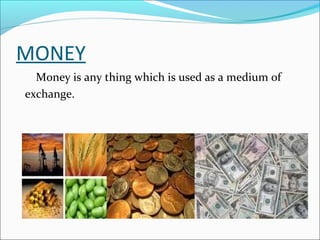
Money is any thing which is used as a medium of
exchange.
EVOLUTION OF MONEY
The word “money” is derived from the Latin word
“Monet”
The origin of money is lost
Hunting society, skin of wild animals were used as
money
Pastoral society used livestock
Agriculture society used grain and foods
The Roman used cattle and salt.
EVOLUTION OF MONEY
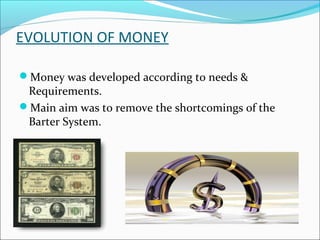
Money was developed according to needs &
Requirements.
Main aim was to remove the shortcomings of the
Barter System.
DIFFERENT STAGES OF EVOLUTION OF MONEY
1. COMMODITY MONEY
2. METALIC MONEY
3. PAPER MONEY
4. CREDIT MONEY
5. ELECTRONIC MONEY
1. COMMODITY MONEY
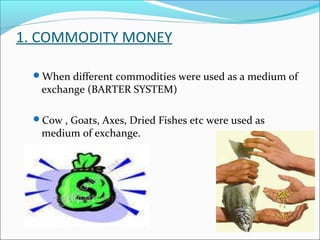
When different commodities were used as a medium of
exchange (BARTER SYSTEM)
Cow , Goats, Axes, Dried Fishes etc were used as
medium of exchange.
1. COMMODITY MONEY
 Commodity money had different problem like:
1. Storing Problem
2. Durability problem
3. Transportation problem
4. Divisibility problem
2. METALLIC MONEY
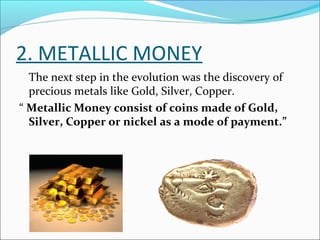
The next step in the evolution was the discovery of
precious metals like Gold, Silver, Copper.
“ Metallic Money consist of coins made of Gold,
Silver, Copper or nickel as a mode of payment.”
2. METALLIC MONEY
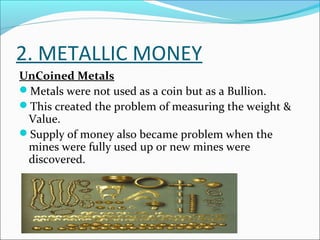
UnCoined Metals
Metals were not used as a coin but as a Bullion.
This created the problem of measuring the weight &
Value.
Supply of money also became problem when the
mines were fully used up or new mines were
discovered.
2. METALLIC MONEY
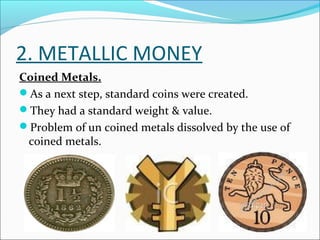
Coined Metals.
As a next step, standard coins were created.
They had a standard weight & value.
Problem of un coined metals dissolved by the use of
coined metals.
2. METALLIC MONEY
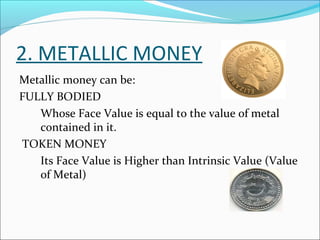
Metallic money can be:
FULLY BODIED
Whose Face Value is equal to the value of metal
contained in it.
TOKEN MONEY
Its Face Value is Higher than Intrinsic Value (Value
of Metal)
3. PAPER MONEY
3. PAPER MONEY
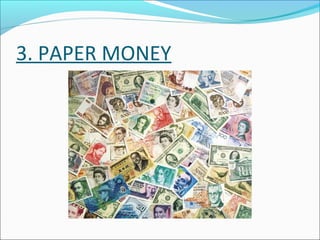
When paper currency was introduced as a mode of
payment.
Originated as a receipt issued by Goldsmiths.
These receipts were then later on used for payments.
Difference in the value of receipts was becoming a
problem then.
3. PAPER MONEY
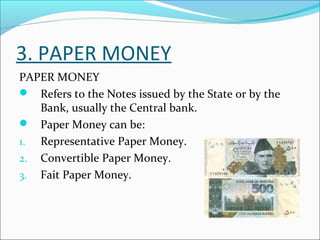
PAPER MONEY
 Refers to the Notes issued by the State or by the
Bank, usually the Central bank.
 Paper Money can be:
1. Representative Paper Money.
2. Convertible Paper Money.
3. Fait Paper Money.
3. PAPER MONEY
Representative Paper Money.
It is that money which is fully backed by
equivalent metallic reserves.
Convertible Paper Money
Which is convertible into coins on demand.
Fait Paper Money
Which is not redeemable or convertible into Gold
or Silver on demand. It is accepted because it is
declared legal tender by the issuing authority and
has general acceptance as a medium of exchange.
The intrinsic value of Fait money is Nil.
4. CREDIT MONEY
4. CREDIT MONEY
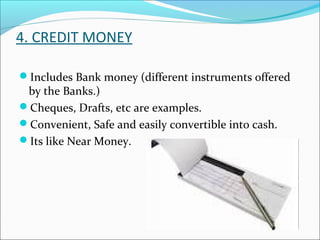
Includes Bank money (different instruments offered
by the Banks.)
Cheques, Drafts, etc are examples.
Convenient, Safe and easily convertible into cash.
Its like Near Money.
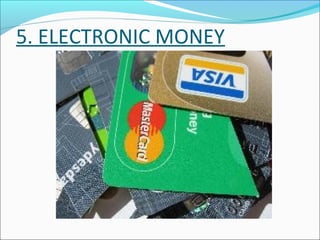
5. ELECTRONIC MONEY
5. ELECTRONIC MONEY
Electronic money (also known as e-money,
electronic cash, electronic currency, digital
money, digital cash or digital currency) refers
to money or scrip which is exchanged only
electronically. Typically, this involves use of
computer networks, the internet and digital
stored value systems.
CHARACTERISTICS OF MONEY
General Acceptability.
Stability of Value.
Transportability.
Storability
divisibility.
Evolution of money
Evolution of money

Evolution of money

  • 2.
    M WASEEM 3509 SAQIBRIAZ 3519 M USMAN 3529 M RIZWAN 3513 M SHEHZAD 3507 HASSAN ALI 3517 M AMMAR 3540
  • 3.
  • 4.
    MONEY Money is anything which is used as a medium of exchange.
  • 5.
    EVOLUTION OF MONEY Theword “money” is derived from the Latin word “Monet” The origin of money is lost Hunting society, skin of wild animals were used as money Pastoral society used livestock Agriculture society used grain and foods The Roman used cattle and salt.
  • 6.
    EVOLUTION OF MONEY Moneywas developed according to needs & Requirements. Main aim was to remove the shortcomings of the Barter System.
  • 7.
    DIFFERENT STAGES OFEVOLUTION OF MONEY 1. COMMODITY MONEY 2. METALIC MONEY 3. PAPER MONEY 4. CREDIT MONEY 5. ELECTRONIC MONEY
  • 8.
    1. COMMODITY MONEY Whendifferent commodities were used as a medium of exchange (BARTER SYSTEM) Cow , Goats, Axes, Dried Fishes etc were used as medium of exchange.
  • 9.
    1. COMMODITY MONEY Commodity money had different problem like: 1. Storing Problem 2. Durability problem 3. Transportation problem 4. Divisibility problem
  • 10.
    2. METALLIC MONEY Thenext step in the evolution was the discovery of precious metals like Gold, Silver, Copper. “ Metallic Money consist of coins made of Gold, Silver, Copper or nickel as a mode of payment.”
  • 11.
    2. METALLIC MONEY UnCoinedMetals Metals were not used as a coin but as a Bullion. This created the problem of measuring the weight & Value. Supply of money also became problem when the mines were fully used up or new mines were discovered.
  • 12.
    2. METALLIC MONEY CoinedMetals. As a next step, standard coins were created. They had a standard weight & value. Problem of un coined metals dissolved by the use of coined metals.
  • 13.
    2. METALLIC MONEY Metallicmoney can be: FULLY BODIED Whose Face Value is equal to the value of metal contained in it. TOKEN MONEY Its Face Value is Higher than Intrinsic Value (Value of Metal)
  • 14.
  • 15.
    3. PAPER MONEY Whenpaper currency was introduced as a mode of payment. Originated as a receipt issued by Goldsmiths. These receipts were then later on used for payments. Difference in the value of receipts was becoming a problem then.
  • 16.
    3. PAPER MONEY PAPERMONEY  Refers to the Notes issued by the State or by the Bank, usually the Central bank.  Paper Money can be: 1. Representative Paper Money. 2. Convertible Paper Money. 3. Fait Paper Money.
  • 17.
    3. PAPER MONEY RepresentativePaper Money. It is that money which is fully backed by equivalent metallic reserves. Convertible Paper Money Which is convertible into coins on demand. Fait Paper Money Which is not redeemable or convertible into Gold or Silver on demand. It is accepted because it is declared legal tender by the issuing authority and has general acceptance as a medium of exchange. The intrinsic value of Fait money is Nil.
  • 18.
  • 19.
    4. CREDIT MONEY IncludesBank money (different instruments offered by the Banks.) Cheques, Drafts, etc are examples. Convenient, Safe and easily convertible into cash. Its like Near Money.
  • 20.
  • 21.
    5. ELECTRONIC MONEY Electronicmoney (also known as e-money, electronic cash, electronic currency, digital money, digital cash or digital currency) refers to money or scrip which is exchanged only electronically. Typically, this involves use of computer networks, the internet and digital stored value systems.
  • 22.
  • 23.
    CHARACTERISTICS OF MONEY GeneralAcceptability. Stability of Value. Transportability. Storability divisibility.