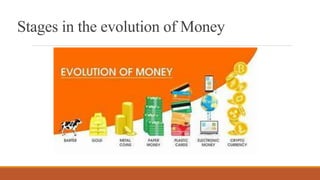
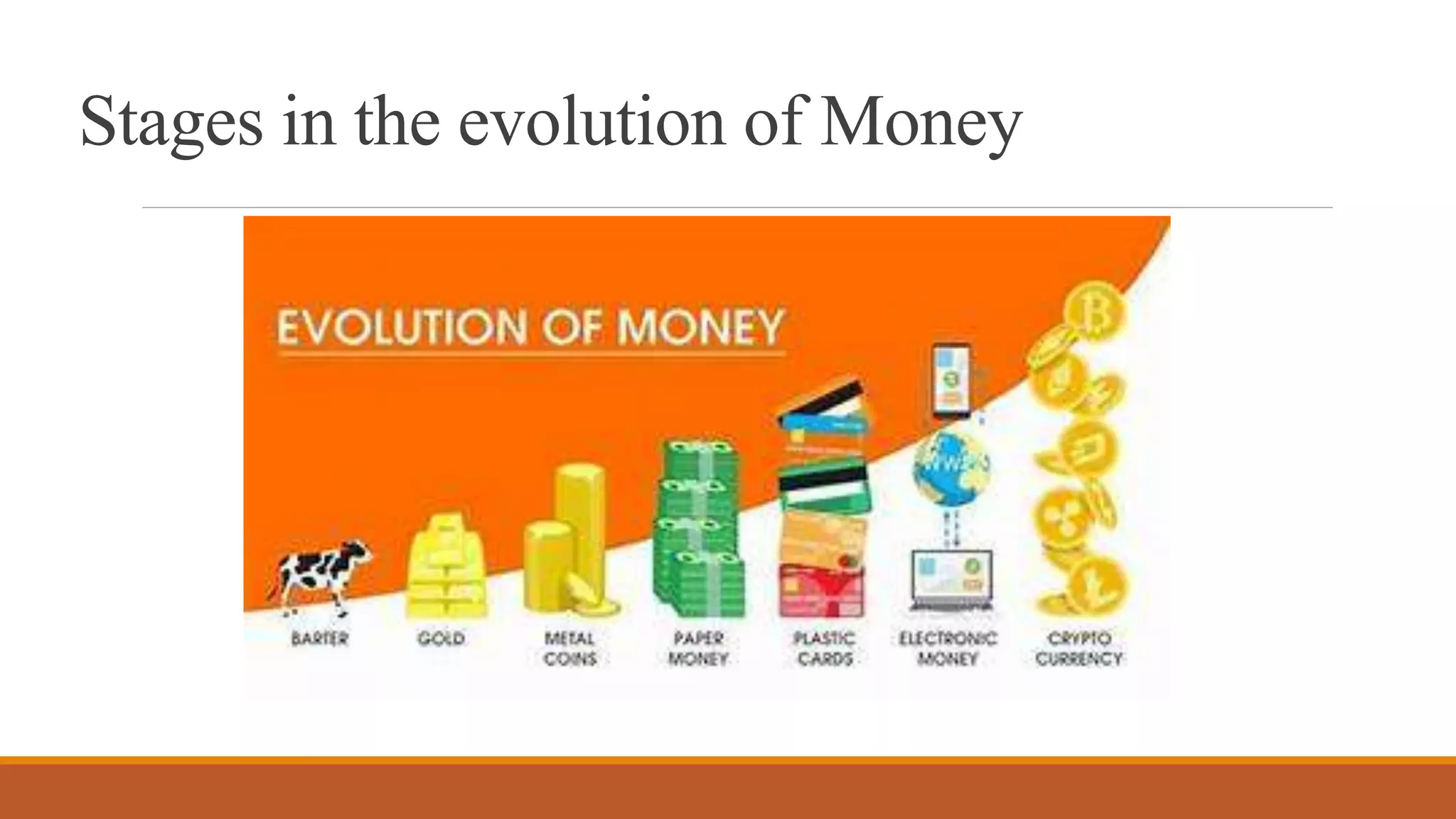
Stages in the evolution of Money
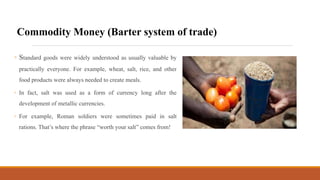
Commodity Money (Barter system of trade)
◦ Standard goods were widely understood as usually valuable by
practically everyone. For example, wheat, salt, rice, and other
food products were always needed to create meals.
◦ In fact, salt was used as a form of currency long after the
development of metallic currencies.
◦ For example, Roman soldiers were sometimes paid in salt
rations. That’s where the phrase “worth your salt” comes from!
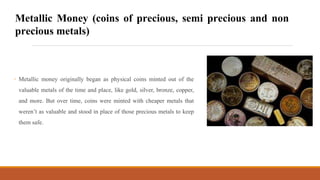
Metallic Money (coins of precious, semi precious and non
precious metals)
◦ Metallic money originally began as physical coins minted out of the
valuable metals of the time and place, like gold, silver, bronze, copper,
and more. But over time, coins were minted with cheaper metals that
weren’t as valuable and stood in place of those precious metals to keep
them safe.
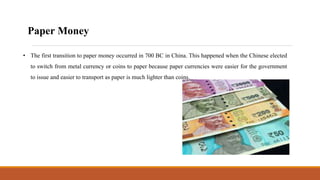
• The first transition to paper money occurred in 700 BC in China. This happened when the Chinese elected
to switch from metal currency or coins to paper because paper currencies were easier for the government
to issue and easier to transport as paper is much lighter than coins.
Paper Money
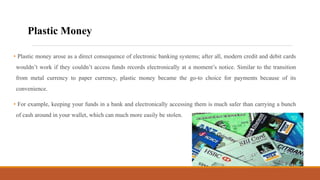
• Plastic money arose as a direct consequence of electronic banking systems; after all, modern credit and debit cards
wouldn’t work if they couldn’t access funds records electronically at a moment’s notice. Similar to the transition
from metal currency to paper currency, plastic money became the go-to choice for payments because of its
convenience.
• For example, keeping your funds in a bank and electronically accessing them is much safer than carrying a bunch
of cash around in your wallet, which can much more easily be stolen.
Plastic Money
• The electronic money is the latest version of the evolution of money. A computerized device’s digital storage of a medium
of trade is known as electronic money (or e-money). A cashless payment system that facilitates fast and simple money
transfers of any amount is a major benefit. The global shift to digital currencies is greatly influenced by electronic money.
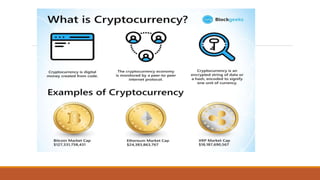
• Cryptocurrencies are another type of electronic money used in modern-day economies. This form of money is digital and is
neither controlled or issued by one particular organization.
• Due to the decentralized nature of blockchain technology, it’s almost impossible for someone to fabricate a cryptocurrency
transaction, add a transaction, or fabricate coins out of the ether.
Electronic / Digital Money
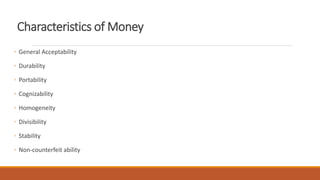
Characteristics of Money
◦ General Acceptability
◦ Durability
◦ Portability
◦ Cognizability
◦ Homogeneity
◦ Divisibility
◦ Stability
◦ Non-counterfeit ability
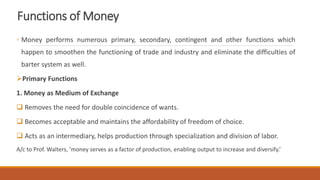
Functions of Money
◦ Money performs numerous primary, secondary, contingent and other functions which
happen to smoothen the functioning of trade and industry and eliminate the difficulties of
barter system as well.
Primary Functions
1. Money as Medium of Exchange
 Removes the need for double coincidence of wants.
 Becomes acceptable and maintains the affordability of freedom of choice.
 Acts as an intermediary, helps production through specialization and division of labor.
A/c to Prof. Walters, ‘money serves as a factor of production, enabling output to increase and diversify.’
Functions of Money
 Primary Functions
2. Money as Unit of Value
 Money becomes standard for measurement of value just as meters or kilometers is for
distance.
 Eliminates the necessity of quoting the price of one good in terms of the other. Simply,
facilitates the comparison in terms of value of exchange.
 Facilitates accounting of all kinds of incomes, expenses, assets and liabilities.
 Helps in calculation of economic variables including estimations of national product,
profitability, costs and revenues etc.
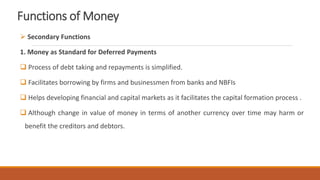
Functions of Money
 Secondary Functions
1. Money as Standard for Deferred Payments
 Process of debt taking and repayments is simplified.
 Facilitates borrowing by firms and businessmen from banks and NBFIs
 Helps developing financial and capital markets as it facilitates the capital formation process .
 Although change in value of money in terms of another currency over time may harm or
benefit the creditors and debtors.
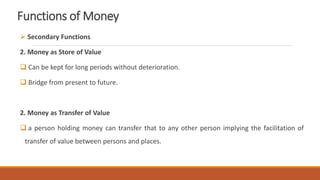
Functions of Money
 Secondary Functions
2. Money as Store of Value
 Can be kept for long periods without deterioration.
 Bridge from present to future.
2. Money as Transfer of Value
 a person holding money can transfer that to any other person implying the facilitation of
transfer of value between persons and places.
Functions of Money
 Contingent Functions (as proposed by Prof. David Kinley)
1. Money as the Most Liquid of all Liquid Assets
2. Basis of the Credit System
3. Equalizer of Marginal Utilities and Productivities
4. Measurement of National Income
5. Distribution of National Income
Functions of Money
 Other Functions
1. Helpful in Making Decisions.
2. Money as basis of Adjustment.
It is on the basis of these functions that money guarantees the solvency of the payer and
provides options to the holder of money to use it any way, they like.
Theories of Demand for Money
Demand for money arises from two important functions of money, first being the money acting
as medium of exchange
 Fisher’s Equation of ExchangeDemand for Money
1. Helpful in Making Decisions.
2. Money as basis of Adjustment.
It is on the basis of these functions that money guarantees the solvency of the payer and
provides options to the holder of money to use it any way, they like.
Functions of Money
 Other Functions
1. Helpful in Making Decisions.
2. Money as basis of Adjustment.
It is on the basis of these functions that money guarantees the solvency of the payer and
provides options to the holder of money to use it any way, they like.
Functions of Money
 Other Functions
1. Helpful in Making Decisions.
2. Money as basis of Adjustment.
It is on the basis of these functions that money guarantees the solvency of the payer and
provides options to the holder of money to use it any way, they like.
Functions of Money
 Other Functions
1. Helpful in Making Decisions.
2. Money as basis of Adjustment.
It is on the basis of these functions that money guarantees the solvency of the payer and
provides options to the holder of money to use it any way, they like.
Functions of Money
 Other Functions
1. Helpful in Making Decisions.
2. Money as basis of Adjustment.
It is on the basis of these functions that money guarantees the solvency of the payer and
provides options to the holder of money to use it any way, they like.
Functions of Money
 Other Functions
1. Helpful in Making Decisions.
2. Money as basis of Adjustment.
It is on the basis of these functions that money guarantees the solvency of the payer and
provides options to the holder of money to use it any way, they like.

Evolution and Types of Money.pptx

  • 1.
    Stages in theevolution of Money
  • 2.
    Commodity Money (Bartersystem of trade) ◦ Standard goods were widely understood as usually valuable by practically everyone. For example, wheat, salt, rice, and other food products were always needed to create meals. ◦ In fact, salt was used as a form of currency long after the development of metallic currencies. ◦ For example, Roman soldiers were sometimes paid in salt rations. That’s where the phrase “worth your salt” comes from!
  • 3.
    Metallic Money (coinsof precious, semi precious and non precious metals) ◦ Metallic money originally began as physical coins minted out of the valuable metals of the time and place, like gold, silver, bronze, copper, and more. But over time, coins were minted with cheaper metals that weren’t as valuable and stood in place of those precious metals to keep them safe.
  • 4.
    • The firsttransition to paper money occurred in 700 BC in China. This happened when the Chinese elected to switch from metal currency or coins to paper because paper currencies were easier for the government to issue and easier to transport as paper is much lighter than coins. Paper Money
  • 5.
    • Plastic moneyarose as a direct consequence of electronic banking systems; after all, modern credit and debit cards wouldn’t work if they couldn’t access funds records electronically at a moment’s notice. Similar to the transition from metal currency to paper currency, plastic money became the go-to choice for payments because of its convenience. • For example, keeping your funds in a bank and electronically accessing them is much safer than carrying a bunch of cash around in your wallet, which can much more easily be stolen. Plastic Money
  • 6.
    • The electronicmoney is the latest version of the evolution of money. A computerized device’s digital storage of a medium of trade is known as electronic money (or e-money). A cashless payment system that facilitates fast and simple money transfers of any amount is a major benefit. The global shift to digital currencies is greatly influenced by electronic money. • Cryptocurrencies are another type of electronic money used in modern-day economies. This form of money is digital and is neither controlled or issued by one particular organization. • Due to the decentralized nature of blockchain technology, it’s almost impossible for someone to fabricate a cryptocurrency transaction, add a transaction, or fabricate coins out of the ether. Electronic / Digital Money
  • 8.
    Characteristics of Money ◦General Acceptability ◦ Durability ◦ Portability ◦ Cognizability ◦ Homogeneity ◦ Divisibility ◦ Stability ◦ Non-counterfeit ability
  • 9.
    Functions of Money ◦Money performs numerous primary, secondary, contingent and other functions which happen to smoothen the functioning of trade and industry and eliminate the difficulties of barter system as well. Primary Functions 1. Money as Medium of Exchange  Removes the need for double coincidence of wants.  Becomes acceptable and maintains the affordability of freedom of choice.  Acts as an intermediary, helps production through specialization and division of labor. A/c to Prof. Walters, ‘money serves as a factor of production, enabling output to increase and diversify.’
  • 10.
    Functions of Money Primary Functions 2. Money as Unit of Value  Money becomes standard for measurement of value just as meters or kilometers is for distance.  Eliminates the necessity of quoting the price of one good in terms of the other. Simply, facilitates the comparison in terms of value of exchange.  Facilitates accounting of all kinds of incomes, expenses, assets and liabilities.  Helps in calculation of economic variables including estimations of national product, profitability, costs and revenues etc.
  • 11.
    Functions of Money Secondary Functions 1. Money as Standard for Deferred Payments  Process of debt taking and repayments is simplified.  Facilitates borrowing by firms and businessmen from banks and NBFIs  Helps developing financial and capital markets as it facilitates the capital formation process .  Although change in value of money in terms of another currency over time may harm or benefit the creditors and debtors.
  • 12.
    Functions of Money Secondary Functions 2. Money as Store of Value  Can be kept for long periods without deterioration.  Bridge from present to future. 2. Money as Transfer of Value  a person holding money can transfer that to any other person implying the facilitation of transfer of value between persons and places.
  • 13.
    Functions of Money Contingent Functions (as proposed by Prof. David Kinley) 1. Money as the Most Liquid of all Liquid Assets 2. Basis of the Credit System 3. Equalizer of Marginal Utilities and Productivities 4. Measurement of National Income 5. Distribution of National Income
  • 14.
    Functions of Money Other Functions 1. Helpful in Making Decisions. 2. Money as basis of Adjustment. It is on the basis of these functions that money guarantees the solvency of the payer and provides options to the holder of money to use it any way, they like.
  • 15.
    Theories of Demandfor Money Demand for money arises from two important functions of money, first being the money acting as medium of exchange  Fisher’s Equation of ExchangeDemand for Money 1. Helpful in Making Decisions. 2. Money as basis of Adjustment. It is on the basis of these functions that money guarantees the solvency of the payer and provides options to the holder of money to use it any way, they like.
  • 16.
    Functions of Money Other Functions 1. Helpful in Making Decisions. 2. Money as basis of Adjustment. It is on the basis of these functions that money guarantees the solvency of the payer and provides options to the holder of money to use it any way, they like.
  • 17.
    Functions of Money Other Functions 1. Helpful in Making Decisions. 2. Money as basis of Adjustment. It is on the basis of these functions that money guarantees the solvency of the payer and provides options to the holder of money to use it any way, they like.
  • 18.
    Functions of Money Other Functions 1. Helpful in Making Decisions. 2. Money as basis of Adjustment. It is on the basis of these functions that money guarantees the solvency of the payer and provides options to the holder of money to use it any way, they like.
  • 19.
    Functions of Money Other Functions 1. Helpful in Making Decisions. 2. Money as basis of Adjustment. It is on the basis of these functions that money guarantees the solvency of the payer and provides options to the holder of money to use it any way, they like.
  • 20.
    Functions of Money Other Functions 1. Helpful in Making Decisions. 2. Money as basis of Adjustment. It is on the basis of these functions that money guarantees the solvency of the payer and provides options to the holder of money to use it any way, they like.