EVIDENCE –
BASED DENTISTRY
INDEX
1. INTRODUCTION
2. NEED FOR EVIDENCE BASED DECISION MAKING
3. ADVANTAGES
4. SKILLS REQUIRED
 ASKING QUESTIONS
 COMPUTERIZED RESEARCH
 APPRAISING THE EVIDENCE
 APPLY RESULTS
 EVALUATING THE OUTCOMES
5. DIFFICULTIES FACED AND SOLUTIONS
INTRODUCTION
• Pioneered in 1980 at MC MASTER UNIVERSITY,
ONTARIO CANADA
• EVIDENCE-BASED MEDICINE (EBM) defined as
Integration of best research evidence with
clinical expertise and patient values.
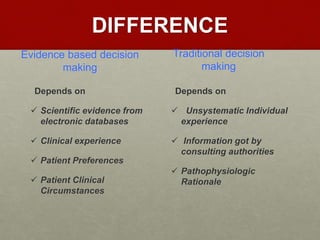
DIFFERENCE
Evidence based decision
making
Depends on
 Scientific evidence from
electronic databases
 Clinical experience
 Patient Preferences
 Patient Clinical
Circumstances
Traditional decision
making
Depends on
 Unsystematic Individual
experience
 Information got by
consulting authorities
 Pathophysiologic
Rationale
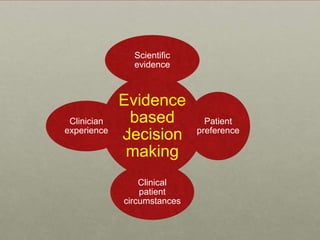
Evidence
based
decision
making
Scientific
evidence
Patient
preference
Clinical
patient
circumstances
Clinician
experience
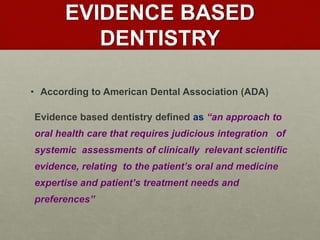
EVIDENCE BASED
DENTISTRY
• According to American Dental Association (ADA)
Evidence based dentistry defined as “an approach to
oral health care that requires judicious integration of
systemic assessments of clinically relevant scientific
evidence, relating to the patient’s oral and medicine
expertise and patient’s treatment needs and
preferences’’
NEED FOR EVIDENCE-BASED
DECISION MAKING
1. VARIATION IN PRACTICE PATTERNS:
occurs due to delay in adopting current research
techniques and discontinuing the old ineffective
techniques. This might occur due to lack of
knowledge about new researches. Evidence
based approach help to inform the clinician
regarding latest researches and new treatment
modalities.
2. DIFFICULTY FACED BY CLINICIANS IN
ASSIMILATING SCIENTIFIC EVIDENCE
INTO THEIR PRACTICE- as new
researches are being published in large
number of journals that are difficult for a
clinician to read and implement. Thus a
method is required to easily incorporate
scientific evidence into clinical practice.
ADVANTAGES OF EVIDENCE
BASED APPROACH
 QUALITY OF CLINICAL PRACTICE IMPROVES
BY INCORPORATING LATEST EFFECTIVE
CLINICAL TECHNIQUES INTO PATIENT CARE
OTHER ADVANTAGES
Objective
Scientifically sound
Patient-focused
Incorporates clinical experience and judgments
Uses transparent methodology
OTHER ADVANTAGES
Advancement in dentistry like cosmetic bonding,
role of genetics in periodontitis, medical
therapeutics for treating various periodontal
diseases
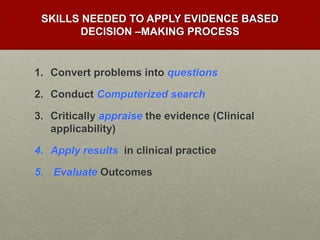
SKILLS NEEDED TO APPLY EVIDENCE BASED
DECISION –MAKING PROCESS
1. Convert problems into questions
2. Conduct Computerized search
3. Critically appraise the evidence (Clinical
applicability)
4. Apply results in clinical practice
5. Evaluate Outcomes
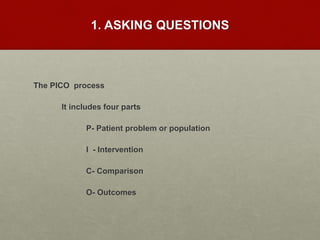
1. ASKING QUESTIONS
The PICO process
It includes four parts
P- Patient problem or population
I - Intervention
C- Comparison
O- Outcomes
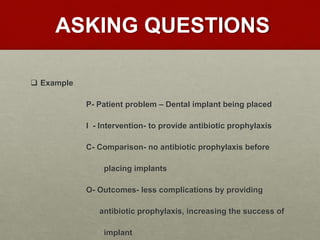
ASKING QUESTIONS
 Example
P- Patient problem – Dental implant being placed
I - Intervention- to provide antibiotic prophylaxis
C- Comparison- no antibiotic prophylaxis before
placing implants
O- Outcomes- less complications by providing
antibiotic prophylaxis, increasing the success of
implant
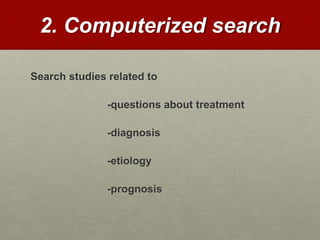
2. Computerized search
Search studies related to
-questions about treatment
-diagnosis
-etiology
-prognosis
Computerized search
TRADITIONAL SOURCES INCLUDES- Journals,
Books, Colleagues
DATA SOURCE (COMPUTERIZED SEARCH) –
Electronic database eg MEDLINE free data base
available from PubMed (Online Journals)
LEVELS OF EVIDENCE
 Randomized controlled trials (RCTs) are the best methodology of finding
evidences on therapeutic interventions
 Highest level is SYSTEMATIC REVIEW (SR) and METAANALYSIS using
two or more RANDOMIZED CONTROLLED TRIALS.
 SYSTEMATIC REVIEW (SR)– Critical analysis of all related studies about a
specific problem. It provide high quality summary of randomized controlled
trials and provide easy, quick access to recent evidence on these
interventions.
 META ANALYSIS- Statistical technique used along with Systematic review.
It consists of combining statistical analysis of various studies into one
analysis.
Levels of various studies (DECREASE
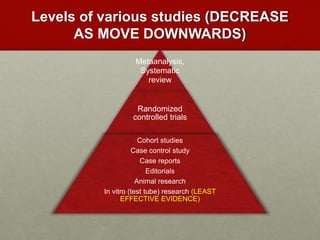
AS MOVE DOWNWARDS)
Metaanalysis,
Systematic
review
Randomized
controlled trials
Cohort studies
Case control study
Case reports
Editorials
Animal research
In vitro (test tube) research (LEAST
EFFECTIVE EVIDENCE)
SOURCES OF EVIDENCE
Primary sources- Original research publications that
have not been synthesized. eg. RCTs
Secondary sources- Synthesized publications from the
primary literature. These include SRs and Metaanalysis,
evidence based reviews and clinical practice guidelines
and protocols.
Biomedical databases as MEDLINE (PubMed), EMBASE,
HealthSTAR and CINALH provide both primary and
secondary sources.
Secondary sources are at
higher level of evidence
than Primary sources
Because of growing numbers of dental journal and
new studies, it is difficult for a clinician to stay current
with dental literature. To overcome this, Evidence
based journals and Cochrane Library Databases
are being designed to help busy practitioners. Such
journals publish summaries of Systematic Reviews
and relevant research articles in easy formats.
EVIDENCE BASED JOURNALS
Examples are- JOURNAL OF EVIDENCE BASED DENTAL
PRACTICE and EVIDENCE BASED DENTISTRY
Such journals provide easy to read summaries of SRs
and original researches (1-2 page abstract with expert
commentary providing most relevant information).
COCHRANE GROUP
Cochrane group contain Systematic Reviews based
on international standards and update their reviews
every 2-4years with new evidences. Abstracts of all
Systematic Reviews can be assessed free of cost
from Cochrane Database of Systematic
Reviews(COCH) in Cochrane Library Databases
3. APPRAISING THE EVIDENCE
 Critical appraisal is assessing quality of published
papers in order to sort out the relevant or valid
papers from irrelevant ones.
International evidence based groups have
developed appraisal forms and checklists to
determine validity of systematic review or study
through series of Yes/No questions
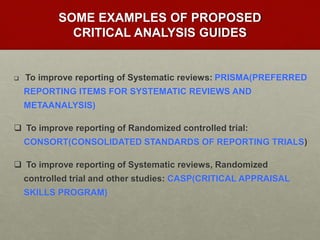
SOME EXAMPLES OF PROPOSED
CRITICAL ANALYSIS GUIDES
 To improve reporting of Systematic reviews: PRISMA(PREFERRED
REPORTING ITEMS FOR SYSTEMATIC REVIEWS AND
METAANALYSIS)
 To improve reporting of Randomized controlled trial:
CONSORT(CONSOLIDATED STANDARDS OF REPORTING TRIALS)
 To improve reporting of Systematic reviews, Randomized
controlled trial and other studies: CASP(CRITICAL APPRAISAL
SKILLS PROGRAM)
These help the authors to have complete and
transparent reporting of systematic reviews,
metaanalysis and other types of studies. Many
journals are instructing authors to adhere to
these guides before conducting and publishing
them. They described them the preferred way
to present ABSTRACT, INTRODUCTION,
METHOD, RESULT, DISCUSSION
APPRAISAL CAN HELP THE CLINICIAN TO
ASSESS:
Validity
Clinical importance
Clinical relevance
4. Apply results in clinical
practice
There are a number of well documented delays
between clinical practice and the available
research evidence.
The practitioner needs to decide whether the
specific patient is similar enough to those in the
research to use the findings. There may also be
barriers regarding the materials or equipments
availability and cost factors.
The decision to act on evidence should be
based on the evidence, the relevance to patient,
willingness of patient to receive that treatment,
and the practitioners ability (skills) to provide the
treatment. So its a carefully considered
decision
5. EVALUATE THE OUTCOMES
The final step of the evidence-based
approach is self-evaluation.
A few examples are shown below:
Question
• Am I asking correct clinical questions?
• Are they well/properly structured?
Finding
• Am I searching for correct evidences?
• Do I know what the best sources are?
• Am I finding evidences?
Appraisal
• Am I critically assessing the available
evidence?
Act
• Am I using evidence I find and
reviewing/appraising it in my practice?
DIFFICULTIES FACED
AND SOLUTIONS
Searching the evidences and critically
appraising/evaluating them are the most
difficult thing being faced by dental
practitioners.
Nowadays online tutorials are quiet
helpful in improving database searching
skills
DIFFICULTIES FACED
AND SOLUTIONS
• Another barrier is changing
behavior or their resistance to
change
Dental practitioner should try to adopt quality
evidences in dental practice, accept evidence
based new practices and letting go existing
theories
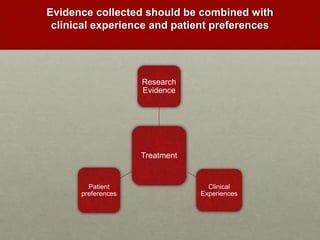
Evidence collected should be combined with
clinical experience and patient preferences
Treatment
Research
Evidence
Clinical
Experiences
Patient
preferences
• Change is a slow process
• Clinical studies should be conducted with clear
patient benefits
• Current dental students should be provided training
for implementing evidence based practice
• Positive environment with advancement in science
can help facilitate evidence based change in future.
•
THANK YOU

Evidence based dentistry

  • 1.
  • 3.
    INDEX 1. INTRODUCTION 2. NEEDFOR EVIDENCE BASED DECISION MAKING 3. ADVANTAGES 4. SKILLS REQUIRED  ASKING QUESTIONS  COMPUTERIZED RESEARCH
  • 4.
     APPRAISING THEEVIDENCE  APPLY RESULTS  EVALUATING THE OUTCOMES 5. DIFFICULTIES FACED AND SOLUTIONS
  • 5.
    INTRODUCTION • Pioneered in1980 at MC MASTER UNIVERSITY, ONTARIO CANADA • EVIDENCE-BASED MEDICINE (EBM) defined as Integration of best research evidence with clinical expertise and patient values.
  • 6.
    DIFFERENCE Evidence based decision making Dependson  Scientific evidence from electronic databases  Clinical experience  Patient Preferences  Patient Clinical Circumstances Traditional decision making Depends on  Unsystematic Individual experience  Information got by consulting authorities  Pathophysiologic Rationale
  • 7.
  • 8.
    EVIDENCE BASED DENTISTRY • Accordingto American Dental Association (ADA) Evidence based dentistry defined as “an approach to oral health care that requires judicious integration of systemic assessments of clinically relevant scientific evidence, relating to the patient’s oral and medicine expertise and patient’s treatment needs and preferences’’
  • 9.
    NEED FOR EVIDENCE-BASED DECISIONMAKING 1. VARIATION IN PRACTICE PATTERNS: occurs due to delay in adopting current research techniques and discontinuing the old ineffective techniques. This might occur due to lack of knowledge about new researches. Evidence based approach help to inform the clinician regarding latest researches and new treatment modalities.
  • 10.
    2. DIFFICULTY FACEDBY CLINICIANS IN ASSIMILATING SCIENTIFIC EVIDENCE INTO THEIR PRACTICE- as new researches are being published in large number of journals that are difficult for a clinician to read and implement. Thus a method is required to easily incorporate scientific evidence into clinical practice.
  • 11.
    ADVANTAGES OF EVIDENCE BASEDAPPROACH  QUALITY OF CLINICAL PRACTICE IMPROVES BY INCORPORATING LATEST EFFECTIVE CLINICAL TECHNIQUES INTO PATIENT CARE
  • 12.
    OTHER ADVANTAGES Objective Scientifically sound Patient-focused Incorporatesclinical experience and judgments Uses transparent methodology
  • 13.
    OTHER ADVANTAGES Advancement indentistry like cosmetic bonding, role of genetics in periodontitis, medical therapeutics for treating various periodontal diseases
  • 14.
    SKILLS NEEDED TOAPPLY EVIDENCE BASED DECISION –MAKING PROCESS 1. Convert problems into questions 2. Conduct Computerized search 3. Critically appraise the evidence (Clinical applicability) 4. Apply results in clinical practice 5. Evaluate Outcomes
  • 15.
    1. ASKING QUESTIONS ThePICO process It includes four parts P- Patient problem or population I - Intervention C- Comparison O- Outcomes
  • 16.
    ASKING QUESTIONS  Example P-Patient problem – Dental implant being placed I - Intervention- to provide antibiotic prophylaxis C- Comparison- no antibiotic prophylaxis before placing implants O- Outcomes- less complications by providing antibiotic prophylaxis, increasing the success of implant
  • 17.
    2. Computerized search Searchstudies related to -questions about treatment -diagnosis -etiology -prognosis
  • 18.
    Computerized search TRADITIONAL SOURCESINCLUDES- Journals, Books, Colleagues DATA SOURCE (COMPUTERIZED SEARCH) – Electronic database eg MEDLINE free data base available from PubMed (Online Journals)
  • 19.
    LEVELS OF EVIDENCE Randomized controlled trials (RCTs) are the best methodology of finding evidences on therapeutic interventions  Highest level is SYSTEMATIC REVIEW (SR) and METAANALYSIS using two or more RANDOMIZED CONTROLLED TRIALS.  SYSTEMATIC REVIEW (SR)– Critical analysis of all related studies about a specific problem. It provide high quality summary of randomized controlled trials and provide easy, quick access to recent evidence on these interventions.  META ANALYSIS- Statistical technique used along with Systematic review. It consists of combining statistical analysis of various studies into one analysis.
  • 20.
    Levels of variousstudies (DECREASE AS MOVE DOWNWARDS) Metaanalysis, Systematic review Randomized controlled trials Cohort studies Case control study Case reports Editorials Animal research In vitro (test tube) research (LEAST EFFECTIVE EVIDENCE)
  • 21.
    SOURCES OF EVIDENCE Primarysources- Original research publications that have not been synthesized. eg. RCTs Secondary sources- Synthesized publications from the primary literature. These include SRs and Metaanalysis, evidence based reviews and clinical practice guidelines and protocols. Biomedical databases as MEDLINE (PubMed), EMBASE, HealthSTAR and CINALH provide both primary and secondary sources.
  • 22.
    Secondary sources areat higher level of evidence than Primary sources
  • 23.
    Because of growingnumbers of dental journal and new studies, it is difficult for a clinician to stay current with dental literature. To overcome this, Evidence based journals and Cochrane Library Databases are being designed to help busy practitioners. Such journals publish summaries of Systematic Reviews and relevant research articles in easy formats.
  • 24.
    EVIDENCE BASED JOURNALS Examplesare- JOURNAL OF EVIDENCE BASED DENTAL PRACTICE and EVIDENCE BASED DENTISTRY Such journals provide easy to read summaries of SRs and original researches (1-2 page abstract with expert commentary providing most relevant information).
  • 25.
    COCHRANE GROUP Cochrane groupcontain Systematic Reviews based on international standards and update their reviews every 2-4years with new evidences. Abstracts of all Systematic Reviews can be assessed free of cost from Cochrane Database of Systematic Reviews(COCH) in Cochrane Library Databases
  • 26.
    3. APPRAISING THEEVIDENCE  Critical appraisal is assessing quality of published papers in order to sort out the relevant or valid papers from irrelevant ones. International evidence based groups have developed appraisal forms and checklists to determine validity of systematic review or study through series of Yes/No questions
  • 27.
    SOME EXAMPLES OFPROPOSED CRITICAL ANALYSIS GUIDES  To improve reporting of Systematic reviews: PRISMA(PREFERRED REPORTING ITEMS FOR SYSTEMATIC REVIEWS AND METAANALYSIS)  To improve reporting of Randomized controlled trial: CONSORT(CONSOLIDATED STANDARDS OF REPORTING TRIALS)  To improve reporting of Systematic reviews, Randomized controlled trial and other studies: CASP(CRITICAL APPRAISAL SKILLS PROGRAM)
  • 28.
    These help theauthors to have complete and transparent reporting of systematic reviews, metaanalysis and other types of studies. Many journals are instructing authors to adhere to these guides before conducting and publishing them. They described them the preferred way to present ABSTRACT, INTRODUCTION, METHOD, RESULT, DISCUSSION
  • 29.
    APPRAISAL CAN HELPTHE CLINICIAN TO ASSESS: Validity Clinical importance Clinical relevance
  • 30.
    4. Apply resultsin clinical practice There are a number of well documented delays between clinical practice and the available research evidence. The practitioner needs to decide whether the specific patient is similar enough to those in the research to use the findings. There may also be barriers regarding the materials or equipments availability and cost factors.
  • 31.
    The decision toact on evidence should be based on the evidence, the relevance to patient, willingness of patient to receive that treatment, and the practitioners ability (skills) to provide the treatment. So its a carefully considered decision
  • 32.
    5. EVALUATE THEOUTCOMES The final step of the evidence-based approach is self-evaluation. A few examples are shown below: Question • Am I asking correct clinical questions? • Are they well/properly structured?
  • 33.
    Finding • Am Isearching for correct evidences? • Do I know what the best sources are? • Am I finding evidences?
  • 34.
    Appraisal • Am Icritically assessing the available evidence? Act • Am I using evidence I find and reviewing/appraising it in my practice?
  • 35.
    DIFFICULTIES FACED AND SOLUTIONS Searchingthe evidences and critically appraising/evaluating them are the most difficult thing being faced by dental practitioners. Nowadays online tutorials are quiet helpful in improving database searching skills
  • 36.
    DIFFICULTIES FACED AND SOLUTIONS •Another barrier is changing behavior or their resistance to change
  • 37.
    Dental practitioner shouldtry to adopt quality evidences in dental practice, accept evidence based new practices and letting go existing theories
  • 38.
    Evidence collected shouldbe combined with clinical experience and patient preferences Treatment Research Evidence Clinical Experiences Patient preferences
  • 39.
    • Change isa slow process • Clinical studies should be conducted with clear patient benefits • Current dental students should be provided training for implementing evidence based practice • Positive environment with advancement in science can help facilitate evidence based change in future.
  • 40.

Editor's Notes