INDEX-
CPITN, DMFT & DMFS
By:
Ritik Kashwani
Contents
Index
CPITN Index
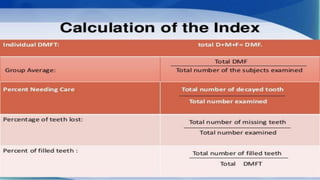
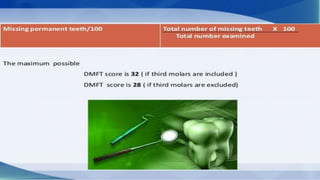
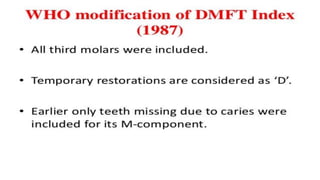
DMFT Index
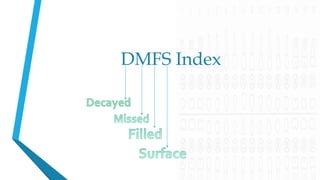
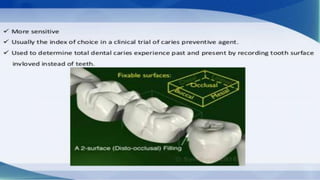
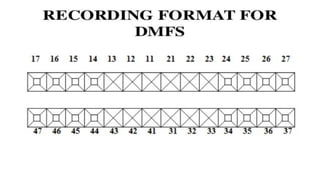
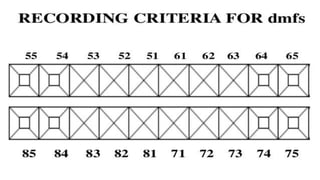
DMFS Index
Definition, ideal requisites, classification and uses
What is an index?
According to Russel A.L.,
An index is defined as a numerical value describing the relative status of a
population on a graduated scale with definite upper and lower limits, which is
designed to permit and facilitate comparison with other populations classified
by the same criteria and methods.
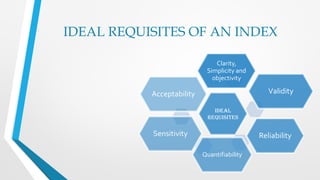
IDEAL REQUISITES OF AN INDEX
IDEAL
REQUISITES
Clarity,
Simplicity and
objectivity
Validity
Reliability
Quantifiability
Sensitivity
Acceptability
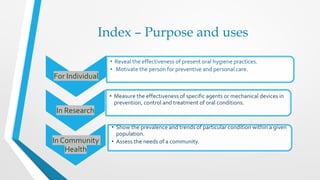
Index – Purpose and uses
For Individual
• Reveal the effectiveness of present oral hygiene practices.
• Motivate the person for preventive and personal care.
In Research
• Measure the effectiveness of specific agents or mechanical devices in
prevention, control and treatment of oral conditions.
In Community
Health
• Show the prevalence and trends of particular condition within a given
population.
• Assess the needs of a community.
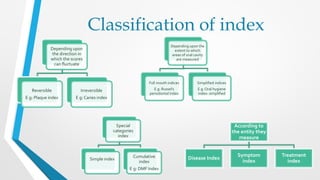
Depending upon the
extent to which
areas of oral cavity
are measured
Full mouth indices
E g: Russel’s
periodontal index
Simplified indices
E g: Oral hygiene
index- simplified
Special
categories
index
Simple index
Cumulative
index
E g: DMF Index
Depending upon
the direction in
which the scores
can fluctuate
Reversible
E g: Plaque index
Irreversible
E g: Caries index
Classification of index
According to
the entity they
measure
Disease Index
Symptom
index
Treatment
index
Community Periodontal Index Of
Treatment Needs (CPITN)
Who developed
CPITN??
It was given by Jukka
Ainamo, David
Barmes., George
Beagrie.,Terry
Cutress., Jean Martin.
And Jennifer Sardo-
Infirri in 1982
Joint working committee (W.H.O./ F.D.I.)
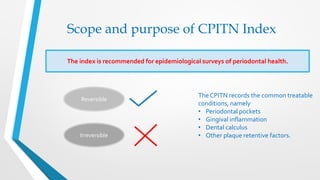
Scope and purpose of CPITN Index
Irreversible
Reversible
The CPITN records the common treatable
conditions, namely
• Periodontal pockets
• Gingival inflammation
• Dental calculus
• Other plaque retentive factors.
The index is recommended for epidemiological surveys of periodontal health.
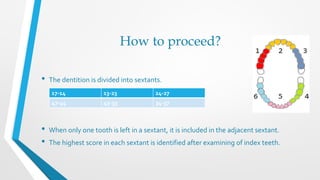
How to proceed?
• The dentition is divided into sextants.
• When only one tooth is left in a sextant, it is included in the adjacent sextant.
• The highest score in each sextant is identified after examining of index teeth.
17-14 13-23 24-27
47-44 43-33 34-37
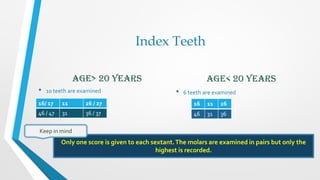
Index Teeth
Age> 20 years
• 10 teeth are examined
Age< 20 years
• 6 teeth are examined
16 11 26
46 31 36
Only one score is given to each sextant.The molars are examined in pairs but only the
highest is recorded.
Keep in mind
16/ 17 11 26 / 27
46 / 47 31 36 / 37
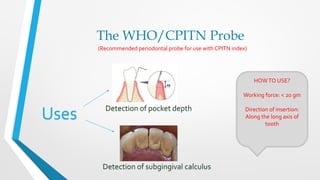
The WHO/CPITN Probe
(Recommended periodontal probe for use with CPITN index)
Uses Detection of pocket depth
Detection of subgingival calculus
HOWTO USE?
Working force: < 20 gm
Direction of insertion:
Along the long axis of
tooth
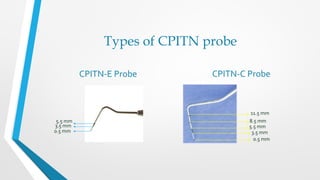
Types of CPITN probe
CPITN-E Probe CPITN-C Probe
0.5 mm
3.5 mm
5.5 mm
0.5 mm
8.5 mm
11.5 mm
3.5 mm
5.5 mm
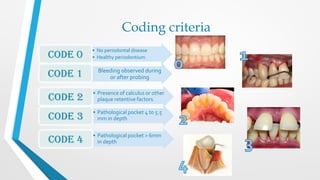
Coding criteria
• No periodontal disease
• Healthy periodontium
Code 0
Bleeding observed during
or after probing
Code 1
• Presence of calculus or other
plaque retentive factors.
Code 2
• Pathological pocket 4 to 5.5
mm in depth
Code 3
• Pathological pocket > 6mm
in depth
Code 4
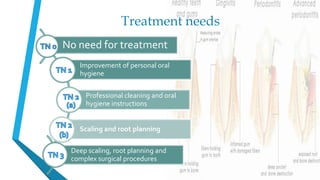
Treatment needs
Improvement of personal oral
hygiene
Professional cleaning and oral
hygiene instructions
Scaling and root planning
Deep scaling, root planning and
complex surgical procedures
No need for treatment
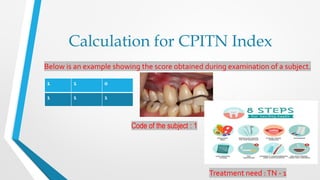
Calculation for CPITN Index
1 1 0
1 1 1
Code of the subject : 1
Below is an example showing the score obtained during examination of a subject.
Treatment need :TN - 1
CPITN Index
Advantages
• Simplicity
• Speed
• International Uniformity
Disadvantages
• Partial recording
• Exclusion of some important signs
of past periodontal breakdown.
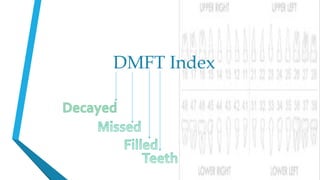
DMFT Index
DMFS Index
INDEX CPITN, DMFT & DMFS

INDEX CPITN, DMFT & DMFS

  • 1.
    INDEX- CPITN, DMFT &DMFS By: Ritik Kashwani
  • 2.
    Contents Index CPITN Index DMFT Index DMFSIndex Definition, ideal requisites, classification and uses
  • 3.
    What is anindex? According to Russel A.L., An index is defined as a numerical value describing the relative status of a population on a graduated scale with definite upper and lower limits, which is designed to permit and facilitate comparison with other populations classified by the same criteria and methods.
  • 4.
    IDEAL REQUISITES OFAN INDEX IDEAL REQUISITES Clarity, Simplicity and objectivity Validity Reliability Quantifiability Sensitivity Acceptability
  • 5.
    Index – Purposeand uses For Individual • Reveal the effectiveness of present oral hygiene practices. • Motivate the person for preventive and personal care. In Research • Measure the effectiveness of specific agents or mechanical devices in prevention, control and treatment of oral conditions. In Community Health • Show the prevalence and trends of particular condition within a given population. • Assess the needs of a community.
  • 6.
    Depending upon the extentto which areas of oral cavity are measured Full mouth indices E g: Russel’s periodontal index Simplified indices E g: Oral hygiene index- simplified Special categories index Simple index Cumulative index E g: DMF Index Depending upon the direction in which the scores can fluctuate Reversible E g: Plaque index Irreversible E g: Caries index Classification of index According to the entity they measure Disease Index Symptom index Treatment index
  • 7.
    Community Periodontal IndexOf Treatment Needs (CPITN) Who developed CPITN?? It was given by Jukka Ainamo, David Barmes., George Beagrie.,Terry Cutress., Jean Martin. And Jennifer Sardo- Infirri in 1982 Joint working committee (W.H.O./ F.D.I.)
  • 8.
    Scope and purposeof CPITN Index Irreversible Reversible The CPITN records the common treatable conditions, namely • Periodontal pockets • Gingival inflammation • Dental calculus • Other plaque retentive factors. The index is recommended for epidemiological surveys of periodontal health.
  • 9.
    How to proceed? •The dentition is divided into sextants. • When only one tooth is left in a sextant, it is included in the adjacent sextant. • The highest score in each sextant is identified after examining of index teeth. 17-14 13-23 24-27 47-44 43-33 34-37
  • 10.
    Index Teeth Age> 20years • 10 teeth are examined Age< 20 years • 6 teeth are examined 16 11 26 46 31 36 Only one score is given to each sextant.The molars are examined in pairs but only the highest is recorded. Keep in mind 16/ 17 11 26 / 27 46 / 47 31 36 / 37
  • 11.
    The WHO/CPITN Probe (Recommendedperiodontal probe for use with CPITN index) Uses Detection of pocket depth Detection of subgingival calculus HOWTO USE? Working force: < 20 gm Direction of insertion: Along the long axis of tooth
  • 12.
    Types of CPITNprobe CPITN-E Probe CPITN-C Probe 0.5 mm 3.5 mm 5.5 mm 0.5 mm 8.5 mm 11.5 mm 3.5 mm 5.5 mm
  • 13.
    Coding criteria • Noperiodontal disease • Healthy periodontium Code 0 Bleeding observed during or after probing Code 1 • Presence of calculus or other plaque retentive factors. Code 2 • Pathological pocket 4 to 5.5 mm in depth Code 3 • Pathological pocket > 6mm in depth Code 4
  • 14.
    Treatment needs Improvement ofpersonal oral hygiene Professional cleaning and oral hygiene instructions Scaling and root planning Deep scaling, root planning and complex surgical procedures No need for treatment
  • 15.
    Calculation for CPITNIndex 1 1 0 1 1 1 Code of the subject : 1 Below is an example showing the score obtained during examination of a subject. Treatment need :TN - 1
  • 16.
    CPITN Index Advantages • Simplicity •Speed • International Uniformity Disadvantages • Partial recording • Exclusion of some important signs of past periodontal breakdown.
  • 17.
  • 26.