EVIDENCE BASED DECISION MAKING IN PERIODONTICS
PREPARED BY: DR. HARDI GANDHI GUIDED BY: DR. PRASAD NADIG
INDEX
• INTRODUCING EVIDENCE BASED DECISION MAKING(EBDM) DENTISTRY
• NEED FOR EBDM
• PRINCIPLES AND GOALS
• TRADITIONAL MODEL VS EVIDENCE BASED MODEL
• ADVANTAGES OF EBDM
• SKILLS NEEDED TO APPLY
• ASSESSING THE EVIDENCE : 12 TOOLS
• IMPLEMENTING INTO THE PRACTICE
• CONCLUSION
INTRODUCTION:
• Evidence-based decision making (EBDM) is the formalized process
and structure for learning these skills so that the best scientific
evidence is considered when making patient care decisions.
• So, it is the ability to find, evaluate, discriminate and use the
information to deliver best clinical care
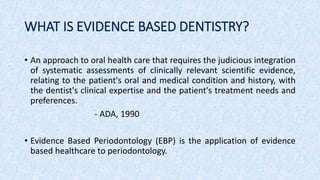
WHAT IS EVIDENCE BASED DENTISTRY?
• An approach to oral health care that requires the judicious integration
of systematic assessments of clinically relevant scientific evidence,
relating to the patient's oral and medical condition and history, with
the dentist's clinical expertise and the patient's treatment needs and
preferences.
- ADA, 1990
• Evidence Based Periodontology (EBP) is the application of evidence
based healthcare to periodontology.
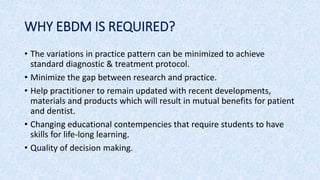
WHY EBDM IS REQUIRED?
• The variations in practice pattern can be minimized to achieve
standard diagnostic & treatment protocol.
• Minimize the gap between research and practice.
• Help practitioner to remain updated with recent developments,
materials and products which will result in mutual benefits for patient
and dentist.
• Changing educational contempencies that require students to have
skills for life-long learning.
• Quality of decision making.
PRINCIPLES:
• Evidence alone is never sufficient to make a clinical decision.
• Hierarchies of quality and applicability of evidence exist to guide
clinical decision making.
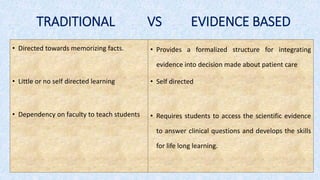
TRADITIONAL VS EVIDENCE BASED
• Directed towards memorizing facts.
• Little or no self directed learning
• Dependency on faculty to teach students
• Provides a formalized structure for integrating
evidence into decision made about patient care
• Self directed
• Requires students to access the scientific evidence
to answer clinical questions and develops the skills
for life long learning.
ADVANTAGES OF EVIDENCE BASED APPROACH
• Objective
• Scientifically sound
• Patient focused
• Incorporates clinical experience
• Stresses good judgment
• Thorough and comprehensive
• Uses transparent methodology
SKILLS & ABILITIES APPLIED
• Convert the information and problems into clinical questions.
• Conduct a computerized search with maximum efficiency.
• Critically appraise the evidence.
• Apply the results of the appraisal or evidence in clinical practice.
• Evaluate the process and your performance.
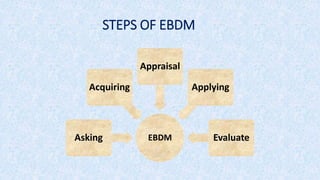
STEPS OF EBDM
EBDM
Asking
Acquiring
Appraisal
Applying
Evaluate
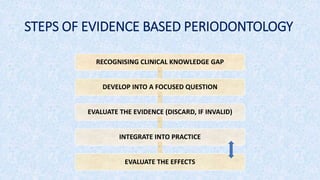
STEPS OF EVIDENCE BASED PERIODONTOLOGY
RECOGNISING CLINICAL KNOWLEDGE GAP
DEVELOP INTO A FOCUSED QUESTION
EVALUATE THE EVIDENCE (DISCARD, IF INVALID)
INTEGRATE INTO PRACTICE
EVALUATE THE EFFECTS
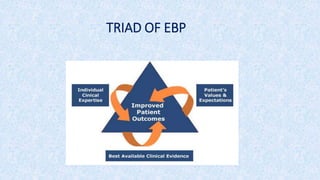
TRIAD OF EBP
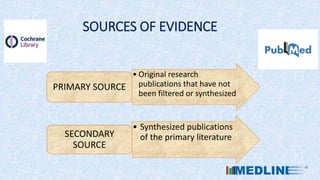
SOURCES OF EVIDENCE
• Original research
publications that have not
been filtered or synthesized
PRIMARY SOURCE
• Synthesized publications
of the primary literature
SECONDARY
SOURCE
EVALUATING THE OUTCOMES
1. RELATIVE RISK
2. RISK REDUCTION
3. BIAS
4. p VALUE
RELATIVE RISK
• It can be defined as a ratio of the probability of the event occurring in
the exposed group versus a non-exposed group.
Sistrom CL, Garvan CW 2004
RR > 1 : a person is estimated to be at an increased risk (or benefit)
RR<1 : a person may be at decreased risk (or benefit)
RR=1 : no apparent effect on risk or benefit at all
ABSOLUTE RISK REDUCTION/RISK DIFFERENCE
• It is the absolute arithmetic difference in the event rates between two
groups. Eg. The control group and experimental group (CER and EER)
• ARR= CER-EER
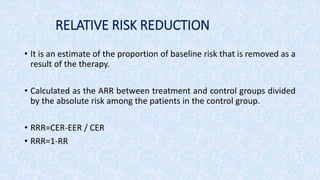
RELATIVE RISK REDUCTION
• It is an estimate of the proportion of baseline risk that is removed as a
result of the therapy.
• Calculated as the ARR between treatment and control groups divided
by the absolute risk among the patients in the control group.
• RRR=CER-EER / CER
• RRR=1-RR
BIAS
• Bias is the principal enemy of validity.
• It is the existence of factors or processes that can influence the results or
conclusions of a trial.
• Bias occurs when there are important differences in :
(1) the way in which subjects or groups of subjects are treated or observed.
(2) how data is measured or analyzed.
Treatment decisions are based on lowest possible risk of bias.
p-VALUE
• It can be defined as the level of marginal significance within a statistical
hypothesis test, representing the probability of the occurrence of a given
event.
-Goodman 1999
• P value or calculated probability is the estimated probability of rejecting
the null hypothesis of a study question when the hypothesis is true.
• p value ˂ 0.05 = statistically significant
• p value ˃ 0.05 = statistically not significant
ASSESING EVIDENCE
• 1. BE SKEPTICAL
• Was this evidence convincing ?
• Evidence on how to cure, manage or prevent can be contraindicatory,
inconsistent and unreliable.
• It is estimated that less than 0.1% of all investigations are effective.
• Incomplete and mistaken understandings can lead to cascade of
wrong turns in exploration of possible diagnosis, prognosis and
treatment.
2. DON’T TRUST BIOLOGIC PLAUSIBILITY
• If an irregular heartbeat increases mortality risk and if encainide can turn an irregular heartbeat
into a normal heartbeat, then encainide should improve survival.
• If Streptococcus mutans causes dental decay, and if chlorhexidine can eradicate S. mutans, then
chlorhexidine can wipe out dental decay.
• Such “causal chain thinking” (A causes B, B causes C, therefore A causes C) is common and
dangerous.
• Causal chain thinking is sometimes referred to as “deductive inference,” “deductive reasoning,”
or a “logical system.”
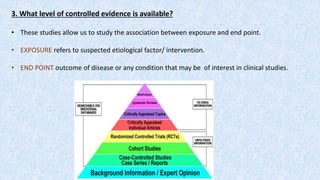
3. What level of controlled evidence is available?
• These studies allow us to study the association between exposure and end point.
• EXPOSURE refers to suspected etiological factor/ intervention.
• END POINT outcome of disease or any condition that may be of interest in clinical studies.
4. DID THE CAUSE PRECED THE EFFECT?
• Retroactive prayer shortened hospital stay in pt. with bloodstream infection.
• Non specified prayer to non specified deity i.e.
• Finding the proper cause should be done.
• In periodontal research, many studies relating plaque or specific infections to
periodontal diseases suffer from unclear temporality. For e.g.
• Is chronic periodontitis preceding systemic disease or both conditions caused by a
common factor, such as sucrose.
5. NO BETTING ON THE HORSE AFTER THE RACE IS OVER
• An essential characteristic of science is that hypotheses or ideas predict
observations, not that hypotheses or ideas can be fitted to observations.
• This essential characteristic of scientific enterprise—prediction—is often lost in
medical and dental research when poorly defined pre-study hypotheses result in
convoluted data-generated ideas or hypotheses that fit the observed data.
• A wealth of data-generated ideas can be created by exploring patient subgroups,
exposures, and endpoints
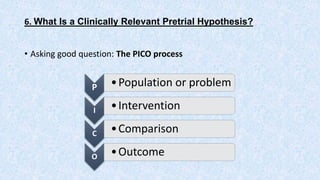
6. What Is a Clinically Relevant Pretrial Hypothesis?
• Asking good question: The PICO process
P •Population or problem
I •Intervention
C •Comparison
O •Outcome
7. Sample size does matter
• The larger an association, the less likely it is caused by bias, and the
more likely it is causal.
• Simple ways to calculate :
• 1. odds ratio
• 2. CI
*Odds - a way of expressing the chance of an event, by dividing the
number of individuals in a sample who experienced the event by the
number who did not.
• Odds ratio (OR) - ratio of the odds of an event in 2 groups.
Interpreting Odds Ratios
OR=1 - Odds of being exposed with disease = without disease (no association)
OR>1 - Odds of being exposed with disease > without disease (+ association)
OR<1 - Odds of being exposed with disease < without disease (- association)
2* Confidence interval is the range within which you are sure to a specified level (generally
95%) that the actual value lies.
It will also tell you about the precision of the result.
If the CI contains the no effect value this implies that the
p-value is >0.05 and vice-versa.
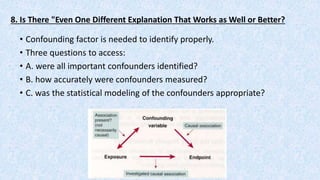
8. Is There "Even One Different Explanation That Works as Well or Better?
• Confounding factor is needed to identify properly.
• Three questions to access:
• A. were all important confounders identified?
• B. how accurately were confounders measured?
• C. was the statistical modeling of the confounders appropriate?
9. Was the Study Properly Randomized?
• Randomisation is important to decrease the risk of bias.
10. When to Rely on Nonrandomized Evidence?
• Many reported evidence that hormone replacement therapy provided benefits
to postmenopausal women.
• Despite this "strong" evidence from "leading" researchers, and despite the
opposition on ethical grounds to initiate a placebo-controlled trial, the Women's
Health Initiative trial was initiated.
• The " miracle" of hormone replacement therapy was shown to lead to increases
in breast cancer risk, dementia, myocardial infarction, and stroke.
• there can be powerful political issues surrounding the decision to initiate clinical
trials.
11. Placebo Effects: Real or Sham?
• It suggest that placebo effects can be real and measurable, and that the magnitude of the
placebo effect may depend on the treatment under study and the type of outcome
evaluated.
• 12. WAS THERE PROTECTION AGAINST CONFLICT OF INTEREST?
• Conflict of interest has been defined as “a set of conditions in which professional judgment
concerning a primary interest (such as patient's welfare or validity of research) tends to be
unduly influenced by a secondary interest.”
INCORPORATING EVIDENCE INTO PRACTICE
Things to keep in mind while implementing :
1. Is the study valid?
VALIDITY
• It measures how accurately the evidence reflects what is true, and it is an essential
characteristic of evidence.
• Some types of evidence are more vulnerable to bias than others.
2. What are the results? (EFFECTIVENESS)
3. Are the results applicable to my needs?
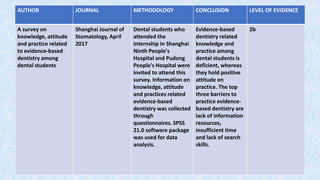
AUTHOR JOURNAL METHODOLOGY CONCLUSION LEVEL OF EVIDENCE
A survey on
knowledge, attitude
and practice related
to evidence-based
dentistry among
dental students
Shanghai Journal of
Stomatology, April
2017
Dental students who
attended the
internship in Shanghai
Ninth People's
Hospital and Pudong
People's Hospital were
invited to attend this
survey. Information on
knowledge, attitude
and practices related
evidence-based
dentistry was collected
through
questionnaires. SPSS
21.0 software package
was used for data
analysis.
Evidence-based
dentistry related
knowledge and
practice among
dental students is
deficient, whereas
they hold positive
attitude on
practice. The top
three barriers to
practice evidence-
based dentistry are
lack of information
resources,
insufficient time
and lack of search
skills.
2b
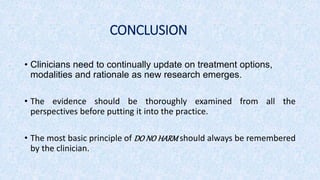
CONCLUSION
• Clinicians need to continually update on treatment options,
modalities and rationale as new research emerges.
• The evidence should be thoroughly examined from all the
perspectives before putting it into the practice.
• The most basic principle of DO NO HARM should always be remembered
by the clinician.
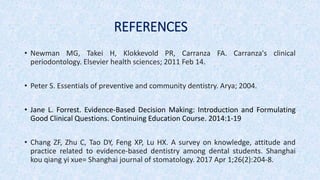
REFERENCES
• Newman MG, Takei H, Klokkevold PR, Carranza FA. Carranza's clinical
periodontology. Elsevier health sciences; 2011 Feb 14.
• Peter S. Essentials of preventive and community dentistry. Arya; 2004.
• Jane L. Forrest. Evidence-Based Decision Making: Introduction and Formulating
Good Clinical Questions. Continuing Education Course. 2014:1-19
• Chang ZF, Zhu C, Tao DY, Feng XP, Lu HX. A survey on knowledge, attitude and
practice related to evidence-based dentistry among dental students. Shanghai
kou qiang yi xue= Shanghai journal of stomatology. 2017 Apr 1;26(2):204-8.
THANKYOU!

Evidence based decision making in periodontics

  • 1.
    EVIDENCE BASED DECISIONMAKING IN PERIODONTICS PREPARED BY: DR. HARDI GANDHI GUIDED BY: DR. PRASAD NADIG
  • 2.
    INDEX • INTRODUCING EVIDENCEBASED DECISION MAKING(EBDM) DENTISTRY • NEED FOR EBDM • PRINCIPLES AND GOALS • TRADITIONAL MODEL VS EVIDENCE BASED MODEL • ADVANTAGES OF EBDM • SKILLS NEEDED TO APPLY • ASSESSING THE EVIDENCE : 12 TOOLS • IMPLEMENTING INTO THE PRACTICE • CONCLUSION
  • 3.
    INTRODUCTION: • Evidence-based decisionmaking (EBDM) is the formalized process and structure for learning these skills so that the best scientific evidence is considered when making patient care decisions. • So, it is the ability to find, evaluate, discriminate and use the information to deliver best clinical care
  • 4.
    WHAT IS EVIDENCEBASED DENTISTRY? • An approach to oral health care that requires the judicious integration of systematic assessments of clinically relevant scientific evidence, relating to the patient's oral and medical condition and history, with the dentist's clinical expertise and the patient's treatment needs and preferences. - ADA, 1990 • Evidence Based Periodontology (EBP) is the application of evidence based healthcare to periodontology.
  • 5.
    WHY EBDM ISREQUIRED? • The variations in practice pattern can be minimized to achieve standard diagnostic & treatment protocol. • Minimize the gap between research and practice. • Help practitioner to remain updated with recent developments, materials and products which will result in mutual benefits for patient and dentist. • Changing educational contempencies that require students to have skills for life-long learning. • Quality of decision making.
  • 6.
    PRINCIPLES: • Evidence aloneis never sufficient to make a clinical decision. • Hierarchies of quality and applicability of evidence exist to guide clinical decision making.
  • 7.
    TRADITIONAL VS EVIDENCEBASED • Directed towards memorizing facts. • Little or no self directed learning • Dependency on faculty to teach students • Provides a formalized structure for integrating evidence into decision made about patient care • Self directed • Requires students to access the scientific evidence to answer clinical questions and develops the skills for life long learning.
  • 8.
    ADVANTAGES OF EVIDENCEBASED APPROACH • Objective • Scientifically sound • Patient focused • Incorporates clinical experience • Stresses good judgment • Thorough and comprehensive • Uses transparent methodology
  • 9.
    SKILLS & ABILITIESAPPLIED • Convert the information and problems into clinical questions. • Conduct a computerized search with maximum efficiency. • Critically appraise the evidence. • Apply the results of the appraisal or evidence in clinical practice. • Evaluate the process and your performance.
  • 10.
  • 11.
    STEPS OF EVIDENCEBASED PERIODONTOLOGY RECOGNISING CLINICAL KNOWLEDGE GAP DEVELOP INTO A FOCUSED QUESTION EVALUATE THE EVIDENCE (DISCARD, IF INVALID) INTEGRATE INTO PRACTICE EVALUATE THE EFFECTS
  • 12.
  • 13.
    SOURCES OF EVIDENCE •Original research publications that have not been filtered or synthesized PRIMARY SOURCE • Synthesized publications of the primary literature SECONDARY SOURCE
  • 14.
    EVALUATING THE OUTCOMES 1.RELATIVE RISK 2. RISK REDUCTION 3. BIAS 4. p VALUE
  • 15.
    RELATIVE RISK • Itcan be defined as a ratio of the probability of the event occurring in the exposed group versus a non-exposed group. Sistrom CL, Garvan CW 2004 RR > 1 : a person is estimated to be at an increased risk (or benefit) RR<1 : a person may be at decreased risk (or benefit) RR=1 : no apparent effect on risk or benefit at all
  • 16.
    ABSOLUTE RISK REDUCTION/RISKDIFFERENCE • It is the absolute arithmetic difference in the event rates between two groups. Eg. The control group and experimental group (CER and EER) • ARR= CER-EER
  • 17.
    RELATIVE RISK REDUCTION •It is an estimate of the proportion of baseline risk that is removed as a result of the therapy. • Calculated as the ARR between treatment and control groups divided by the absolute risk among the patients in the control group. • RRR=CER-EER / CER • RRR=1-RR
  • 18.
    BIAS • Bias isthe principal enemy of validity. • It is the existence of factors or processes that can influence the results or conclusions of a trial. • Bias occurs when there are important differences in : (1) the way in which subjects or groups of subjects are treated or observed. (2) how data is measured or analyzed. Treatment decisions are based on lowest possible risk of bias.
  • 19.
    p-VALUE • It canbe defined as the level of marginal significance within a statistical hypothesis test, representing the probability of the occurrence of a given event. -Goodman 1999 • P value or calculated probability is the estimated probability of rejecting the null hypothesis of a study question when the hypothesis is true. • p value ˂ 0.05 = statistically significant • p value ˃ 0.05 = statistically not significant
  • 20.
    ASSESING EVIDENCE • 1.BE SKEPTICAL • Was this evidence convincing ? • Evidence on how to cure, manage or prevent can be contraindicatory, inconsistent and unreliable. • It is estimated that less than 0.1% of all investigations are effective. • Incomplete and mistaken understandings can lead to cascade of wrong turns in exploration of possible diagnosis, prognosis and treatment.
  • 21.
    2. DON’T TRUSTBIOLOGIC PLAUSIBILITY • If an irregular heartbeat increases mortality risk and if encainide can turn an irregular heartbeat into a normal heartbeat, then encainide should improve survival. • If Streptococcus mutans causes dental decay, and if chlorhexidine can eradicate S. mutans, then chlorhexidine can wipe out dental decay. • Such “causal chain thinking” (A causes B, B causes C, therefore A causes C) is common and dangerous. • Causal chain thinking is sometimes referred to as “deductive inference,” “deductive reasoning,” or a “logical system.”
  • 22.
    3. What levelof controlled evidence is available? • These studies allow us to study the association between exposure and end point. • EXPOSURE refers to suspected etiological factor/ intervention. • END POINT outcome of disease or any condition that may be of interest in clinical studies.
  • 23.
    4. DID THECAUSE PRECED THE EFFECT? • Retroactive prayer shortened hospital stay in pt. with bloodstream infection. • Non specified prayer to non specified deity i.e. • Finding the proper cause should be done. • In periodontal research, many studies relating plaque or specific infections to periodontal diseases suffer from unclear temporality. For e.g. • Is chronic periodontitis preceding systemic disease or both conditions caused by a common factor, such as sucrose.
  • 24.
    5. NO BETTINGON THE HORSE AFTER THE RACE IS OVER • An essential characteristic of science is that hypotheses or ideas predict observations, not that hypotheses or ideas can be fitted to observations. • This essential characteristic of scientific enterprise—prediction—is often lost in medical and dental research when poorly defined pre-study hypotheses result in convoluted data-generated ideas or hypotheses that fit the observed data. • A wealth of data-generated ideas can be created by exploring patient subgroups, exposures, and endpoints
  • 25.
    6. What Isa Clinically Relevant Pretrial Hypothesis? • Asking good question: The PICO process P •Population or problem I •Intervention C •Comparison O •Outcome
  • 26.
    7. Sample sizedoes matter • The larger an association, the less likely it is caused by bias, and the more likely it is causal. • Simple ways to calculate : • 1. odds ratio • 2. CI *Odds - a way of expressing the chance of an event, by dividing the number of individuals in a sample who experienced the event by the number who did not. • Odds ratio (OR) - ratio of the odds of an event in 2 groups.
  • 27.
    Interpreting Odds Ratios OR=1- Odds of being exposed with disease = without disease (no association) OR>1 - Odds of being exposed with disease > without disease (+ association) OR<1 - Odds of being exposed with disease < without disease (- association) 2* Confidence interval is the range within which you are sure to a specified level (generally 95%) that the actual value lies. It will also tell you about the precision of the result. If the CI contains the no effect value this implies that the p-value is >0.05 and vice-versa.
  • 28.
    8. Is There"Even One Different Explanation That Works as Well or Better? • Confounding factor is needed to identify properly. • Three questions to access: • A. were all important confounders identified? • B. how accurately were confounders measured? • C. was the statistical modeling of the confounders appropriate?
  • 29.
    9. Was theStudy Properly Randomized? • Randomisation is important to decrease the risk of bias. 10. When to Rely on Nonrandomized Evidence? • Many reported evidence that hormone replacement therapy provided benefits to postmenopausal women. • Despite this "strong" evidence from "leading" researchers, and despite the opposition on ethical grounds to initiate a placebo-controlled trial, the Women's Health Initiative trial was initiated. • The " miracle" of hormone replacement therapy was shown to lead to increases in breast cancer risk, dementia, myocardial infarction, and stroke. • there can be powerful political issues surrounding the decision to initiate clinical trials.
  • 30.
    11. Placebo Effects:Real or Sham? • It suggest that placebo effects can be real and measurable, and that the magnitude of the placebo effect may depend on the treatment under study and the type of outcome evaluated. • 12. WAS THERE PROTECTION AGAINST CONFLICT OF INTEREST? • Conflict of interest has been defined as “a set of conditions in which professional judgment concerning a primary interest (such as patient's welfare or validity of research) tends to be unduly influenced by a secondary interest.”
  • 31.
    INCORPORATING EVIDENCE INTOPRACTICE Things to keep in mind while implementing : 1. Is the study valid? VALIDITY • It measures how accurately the evidence reflects what is true, and it is an essential characteristic of evidence. • Some types of evidence are more vulnerable to bias than others. 2. What are the results? (EFFECTIVENESS) 3. Are the results applicable to my needs?
  • 32.
    AUTHOR JOURNAL METHODOLOGYCONCLUSION LEVEL OF EVIDENCE A survey on knowledge, attitude and practice related to evidence-based dentistry among dental students Shanghai Journal of Stomatology, April 2017 Dental students who attended the internship in Shanghai Ninth People's Hospital and Pudong People's Hospital were invited to attend this survey. Information on knowledge, attitude and practices related evidence-based dentistry was collected through questionnaires. SPSS 21.0 software package was used for data analysis. Evidence-based dentistry related knowledge and practice among dental students is deficient, whereas they hold positive attitude on practice. The top three barriers to practice evidence- based dentistry are lack of information resources, insufficient time and lack of search skills. 2b
  • 33.
    CONCLUSION • Clinicians needto continually update on treatment options, modalities and rationale as new research emerges. • The evidence should be thoroughly examined from all the perspectives before putting it into the practice. • The most basic principle of DO NO HARM should always be remembered by the clinician.
  • 34.
    REFERENCES • Newman MG,Takei H, Klokkevold PR, Carranza FA. Carranza's clinical periodontology. Elsevier health sciences; 2011 Feb 14. • Peter S. Essentials of preventive and community dentistry. Arya; 2004. • Jane L. Forrest. Evidence-Based Decision Making: Introduction and Formulating Good Clinical Questions. Continuing Education Course. 2014:1-19 • Chang ZF, Zhu C, Tao DY, Feng XP, Lu HX. A survey on knowledge, attitude and practice related to evidence-based dentistry among dental students. Shanghai kou qiang yi xue= Shanghai journal of stomatology. 2017 Apr 1;26(2):204-8.
  • 35.