Building Evidence-Based Practice into All Areas of Dietetics Linda Farr RD/LD TDA Delegate 2007-2012  Owner Nutrition Associates of San Antonio 210-735-2402 [email_address]
Presentation Objectives Define Evidence-Based Dietetics Practice  Discuss the benefits of using EBP Outline the EBP process  Discuss areas for EBP implementation
 
Why is EBP important? Evidence-based practice will position the profession for improved reimbursement, recognition, and quality services.
What is Evidence-Based Practice?
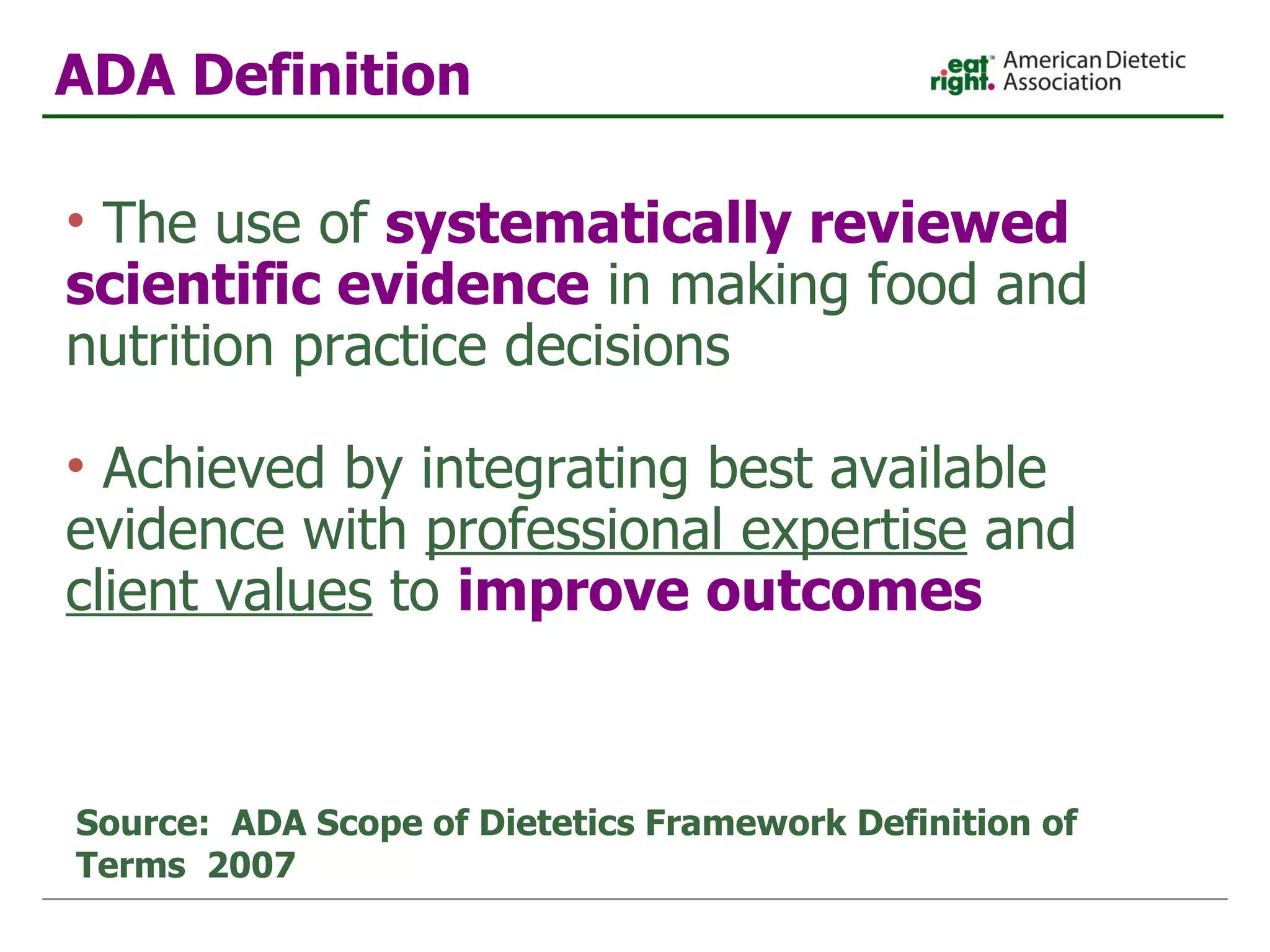
The use of  systematically reviewed scientific evidence  in making food and nutrition practice decisions  Achieved by integrating best available evidence with  professional expertise  and  client values  to  improve outcomes Source:  ADA Scope of Dietetics Framework Definition of Terms  2007 ADA Definition
Key Considerations EBP is based on the  best available evidence  including research, national guidelines, policies, consensus statements, expert opinion and quality improvement data. EBP involves continuing evaluation of  outcomes . EBP involves complex and conscientious decision-making based not only on the available evidence but also on   client/customer/community   characteristics, situations, and preferences .
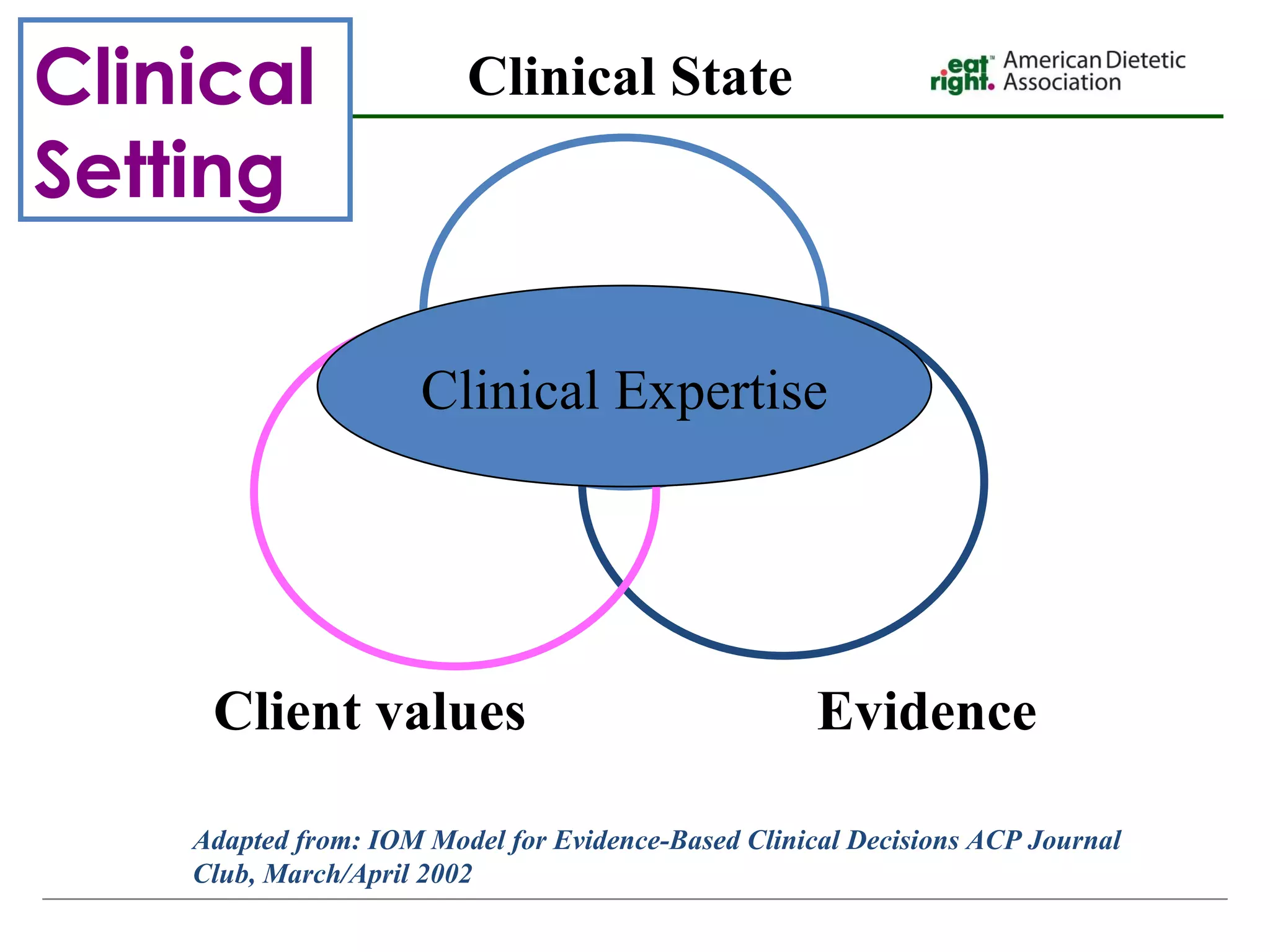
Clinical Expertise Client values Clinical State Evidence  Adapted from: IOM Model for Evidence-Based Clinical Decisions ACP Journal Club, March/April 2002 Clinical  Setting
Code of Ethics Supports EBP Principle 12: The dietetics practitioner practices dietetics based on evidence-based principles and current information. Principle 13: The dietetics practitioner presents reliable and substantiated information and interprets controversial information without personal bias……
Nutrition Care Process supports EBP March 2003
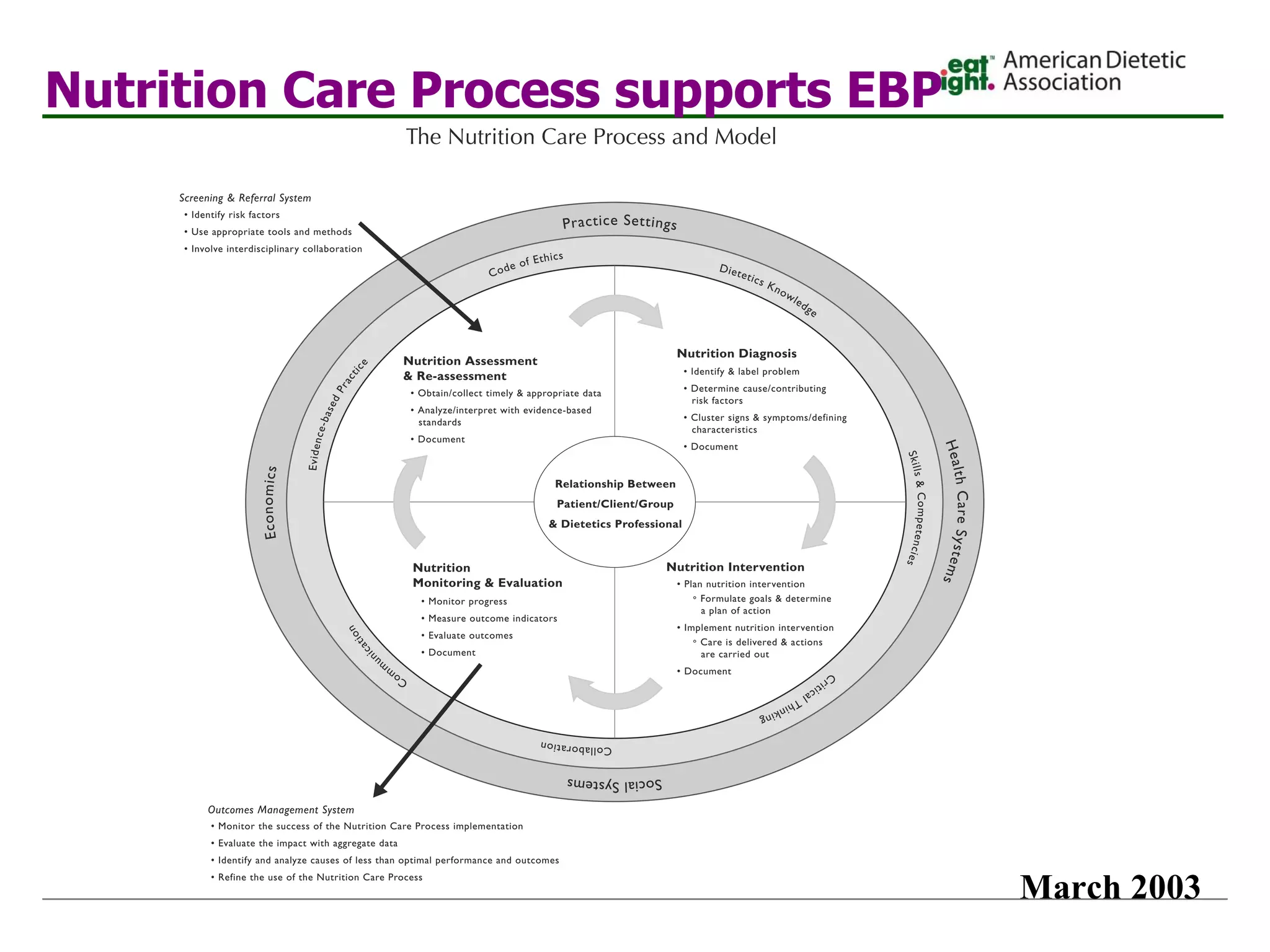
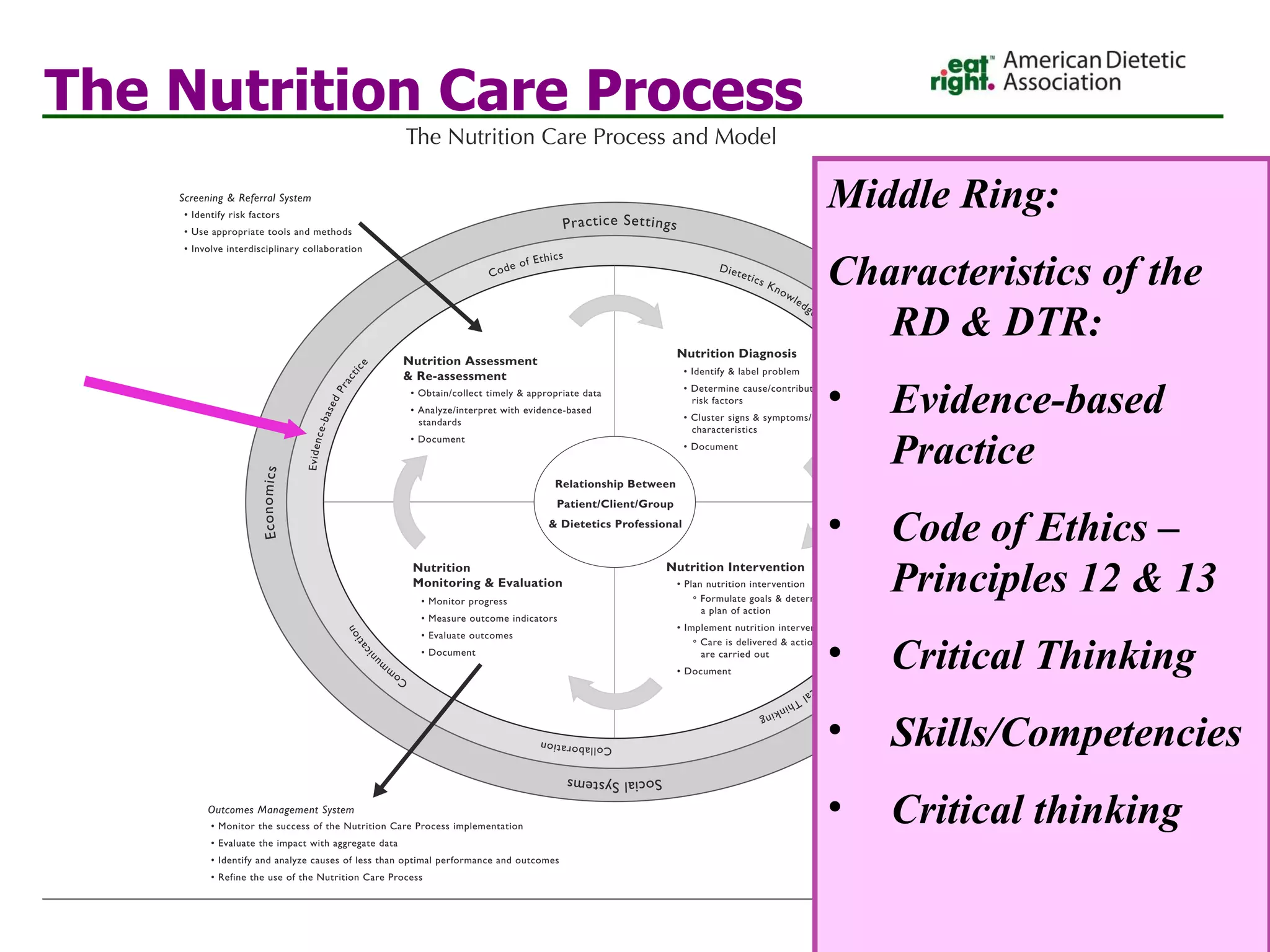
The Nutrition Care Process Middle Ring: Characteristics of the RD & DTR: Evidence-based Practice Code of Ethics – Principles 12 & 13  Critical Thinking Skills/Competencies Critical thinking
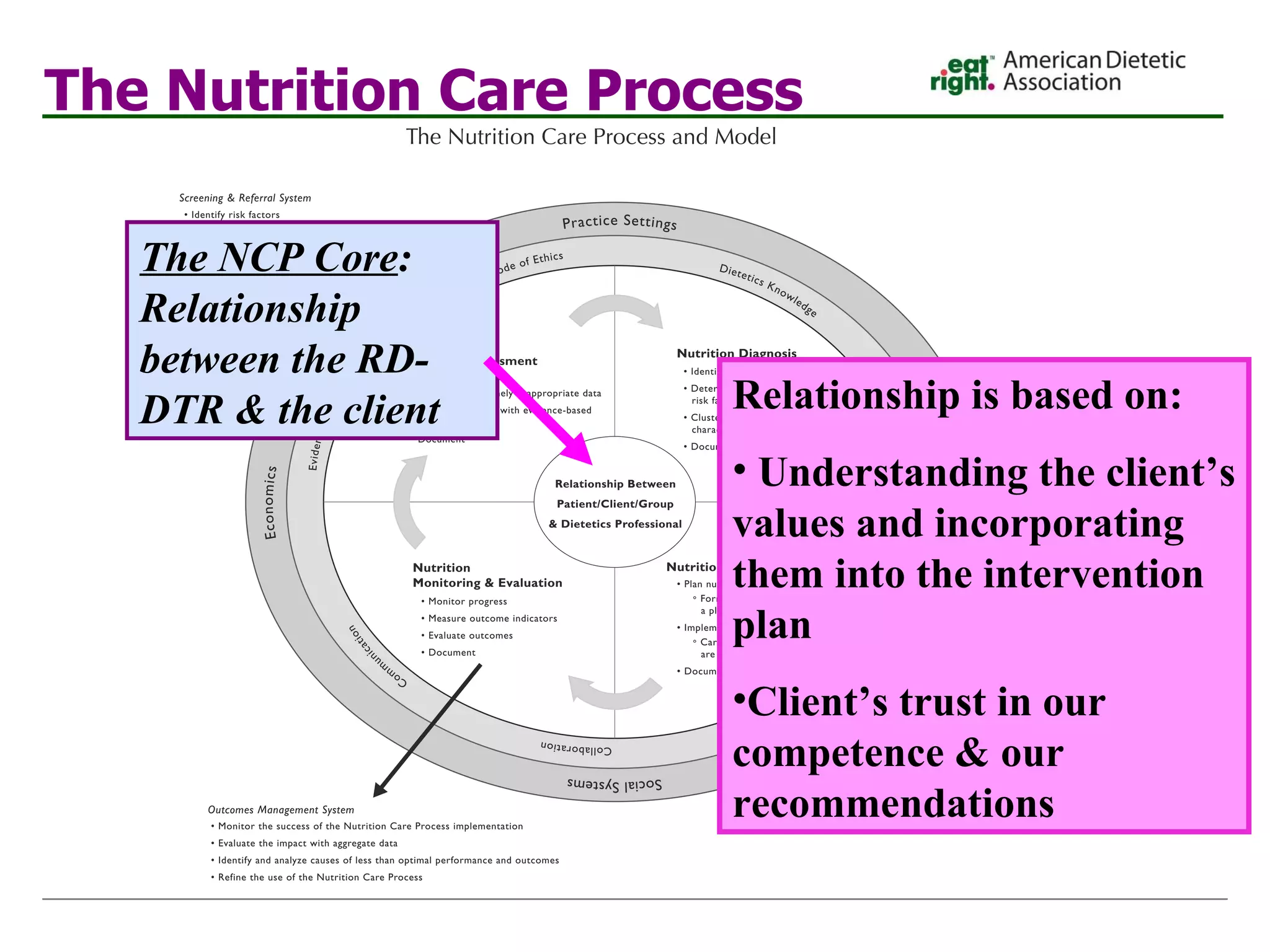
The Nutrition Care Process Relationship is based on: Understanding the client’s values and incorporating them into the intervention plan Client’s trust in our competence & our recommendations  The NCP Core :  Relationship between the RD-DTR & the client
Why use Evidence-Based Practice?
Explosion of Literature Over 10,000 new research articles added to MedLine annually Estimated that clinicians must read ~20 articles a day to keep up!
Unmet Information Needs Questions from clients and other stakeholders are continuously being generated.
Implementation Delays Research findings are often delayed in implementation. It can take 10 to 20 years for original research to be put into clinical practice http://www. ahrq .gov/RESEARCH/trip2fac. htm
Need for Data on MNT Effectiveness There is limited data on MNT effectiveness beyond diabetes and lipid disorders. Relatively speaking, there is limited nutrition research; especially that targets the RD.
Importance of collecting outcomes/data   Ensure progress of profession Reimbursement No data no research No research no evidence No evidence no basis for practice standards Align our profession with other medical fields basing their practice on evidence There is limited nutrition research
Standardization of Practice There is a significant gap between best research evidence and application of evidence to practice. Nutrition support is not always applied effectively or consistently,  despite available scientific evidence  that could be used to enhance  a given treatment protocol.
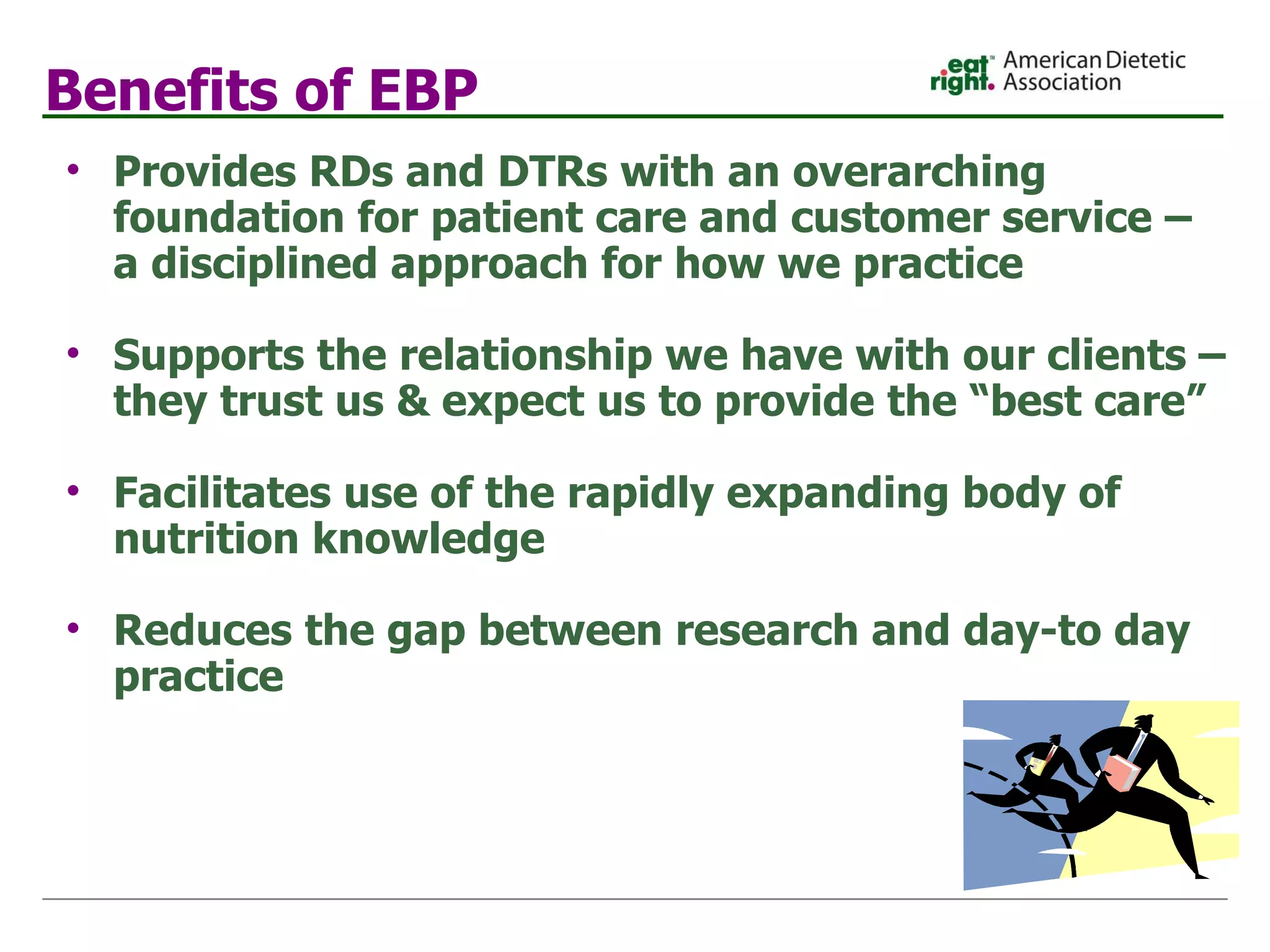
Benefits of EBP Provides RDs and DTRs with an overarching foundation for patient care and customer service – a disciplined approach for how we practice Supports the relationship we have with our clients – they trust us & expect us to provide the “best care” Facilitates use of the rapidly expanding body of nutrition knowledge Reduces the gap between research and day-to day practice
Personal Benefits of EBP Enhances our status on the health care team Enhances our confidence – the EAL is a great resource to support our recommendations to team members & payers  Provides a sense of satisfaction – Measuring outcomes allows us to see that we make a difference  Promotes effective time management  Promotes compliance with regulations for MNT, e.g. Medicare part B Limits the basis for litigation
Bottom Line Benefits EBP leads to: Improved quality of care  Increased patient safety  Decreased variation in practice  Efficient use of resources Increased likelihood of achieving desired patient  outcomes Improved client, provider & payer satisfaction Increased likelihood of coverage for MNT
The Development of EBP includes…. Five Fundamental Steps.
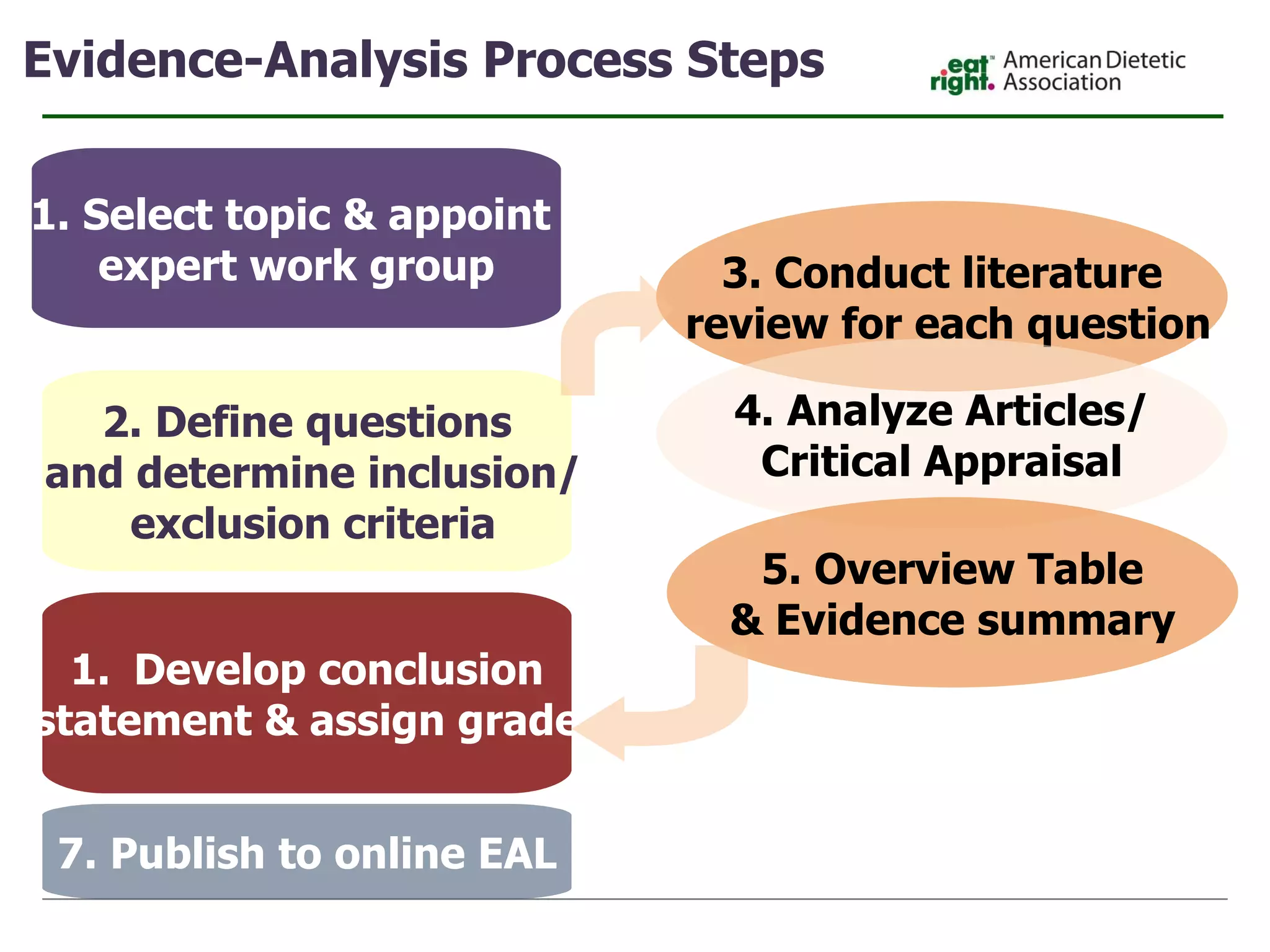
Evidence-Analysis Process Steps 1. Select topic & appoint  expert work group 2. Define questions and determine inclusion/ exclusion criteria 3. Conduct literature review for each question 4. Analyze Articles/ Critical Appraisal 5. Overview Table & Evidence summary Develop conclusion statement & assign grade 7. Publish to online EAL
Guidelines Methodologies Used http://www.cebm.net/ http://www.nhlbi.nih.gov / http://www.icsi.org/ Whenever possible we don’t “reinvent the wheel.”
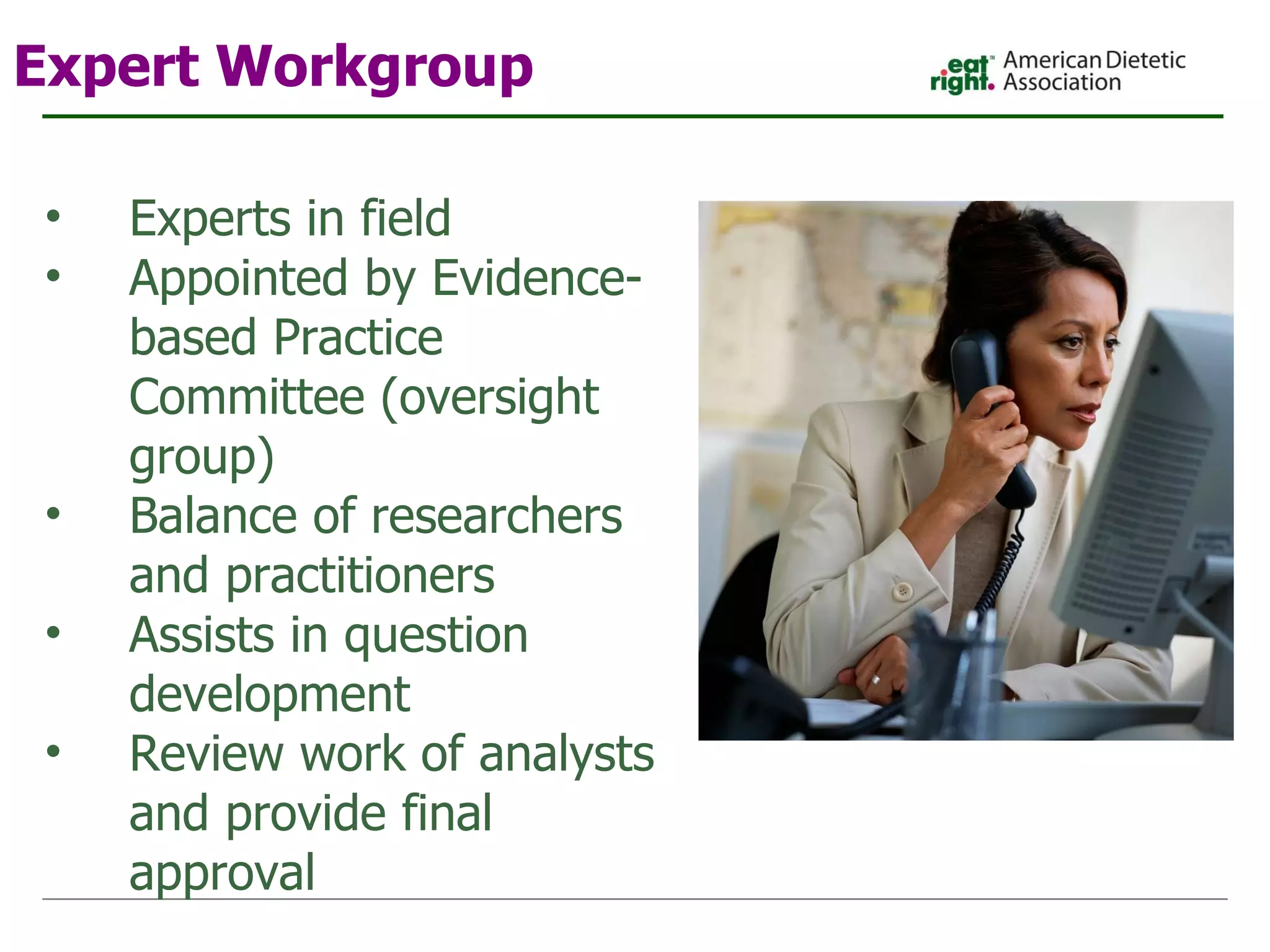
Expert Workgroup Experts in field Appointed by Evidence-based Practice Committee (oversight group) Balance of researchers and practitioners Assists in question development Review work of analysts and provide final approval
Evidence Analysts Experts in critically analyzing articles Must have at least Master’s degree; many have PhD’s Trained at ADA’s EA workshop Mentored by ADA Staff and Lead Analysts Read and analyze articles
Step 4--Critical Appraisal of Each Article Completes worksheet Completes quality criteria checklist  Completes overview tables Completes evidence summaries. Most detailed information on EAL Responsibility of analyst Reviewed by lead analyst Approved by workgroup
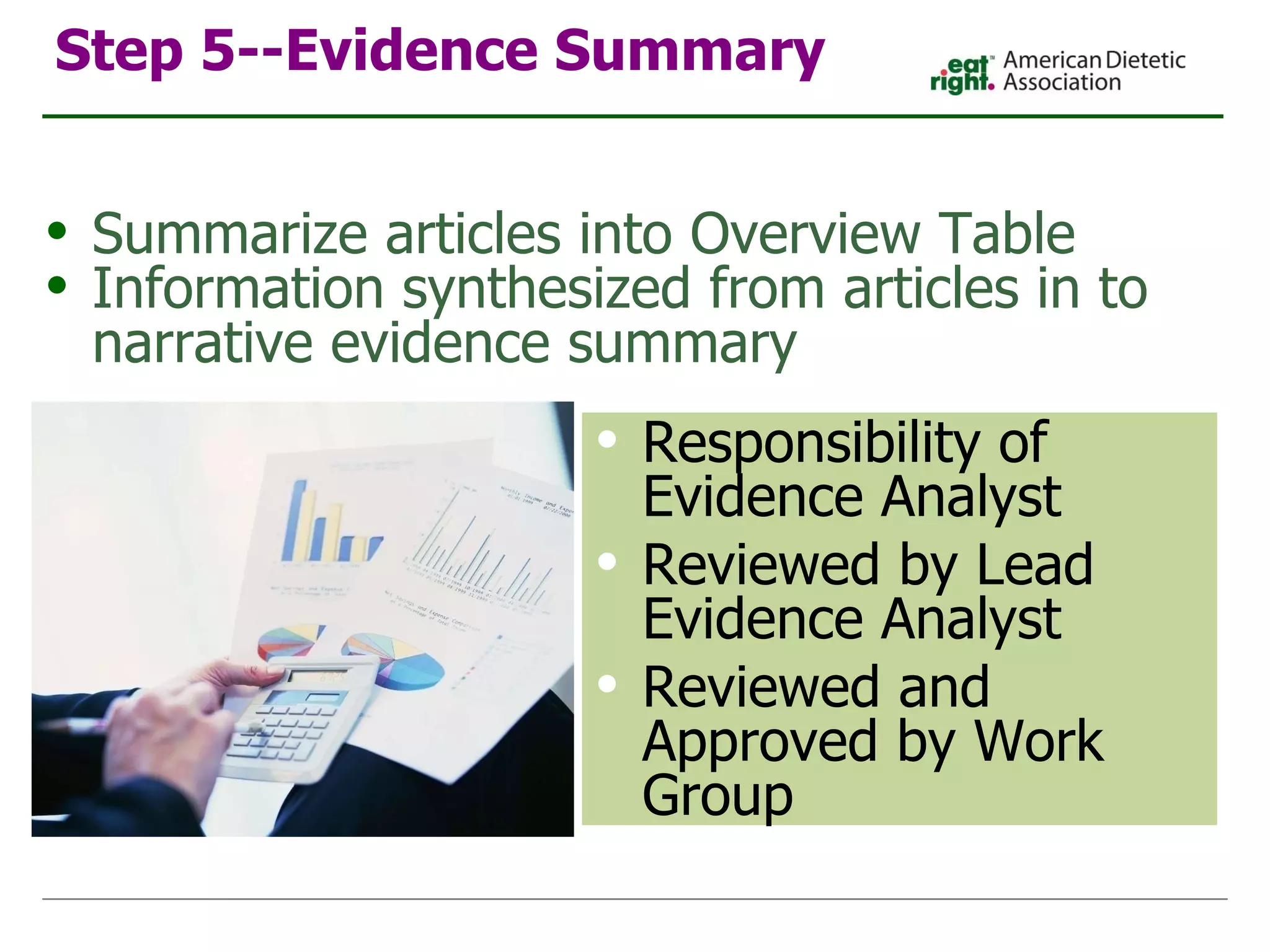
Step 5--Evidence Summary Summarize articles into Overview Table Information synthesized from articles in to narrative evidence summary Responsibility of Evidence Analyst Reviewed by Lead Evidence Analyst Reviewed and Approved by Work Group
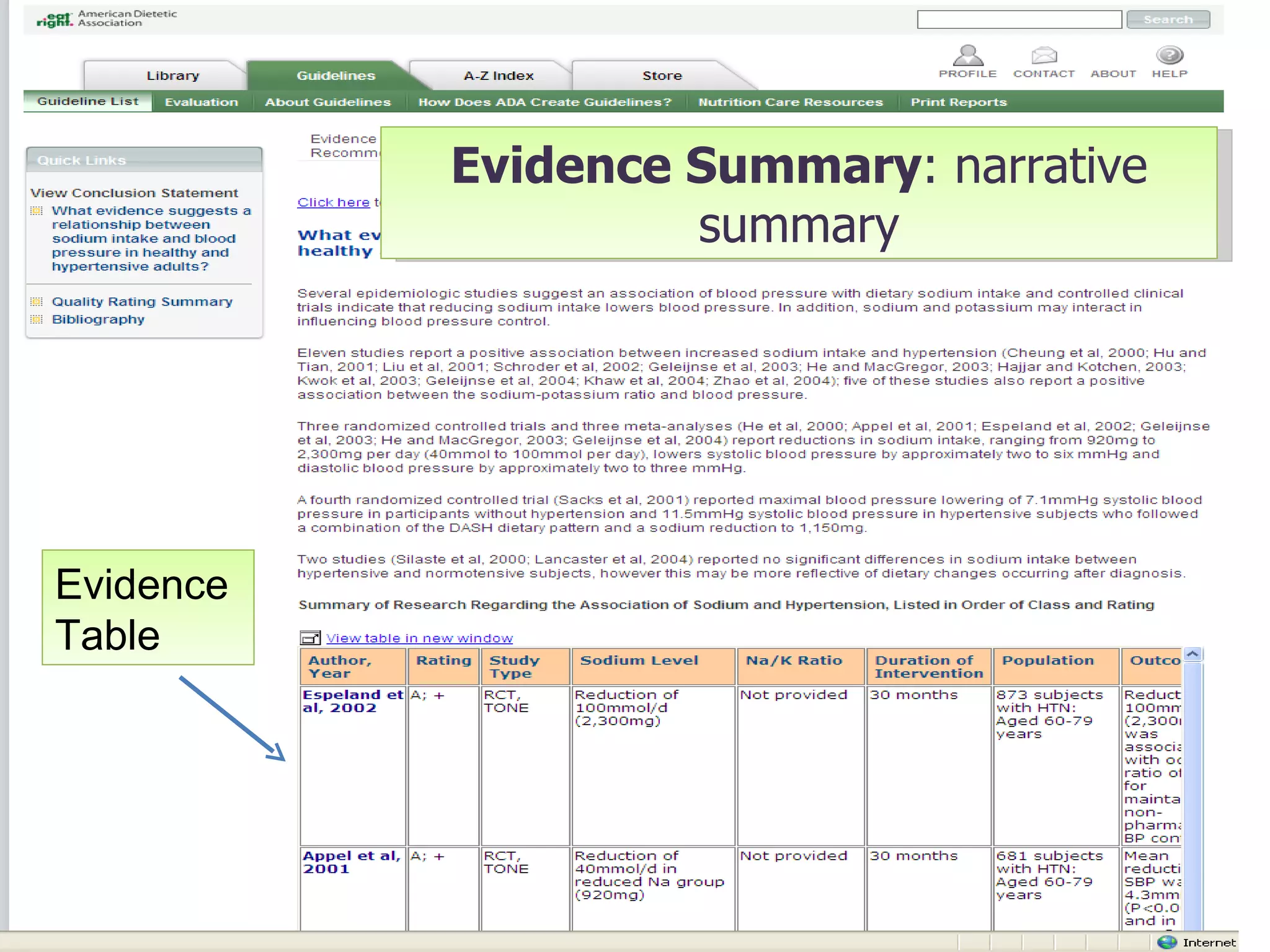
Evidence Summary : narrative summary Evidence Table
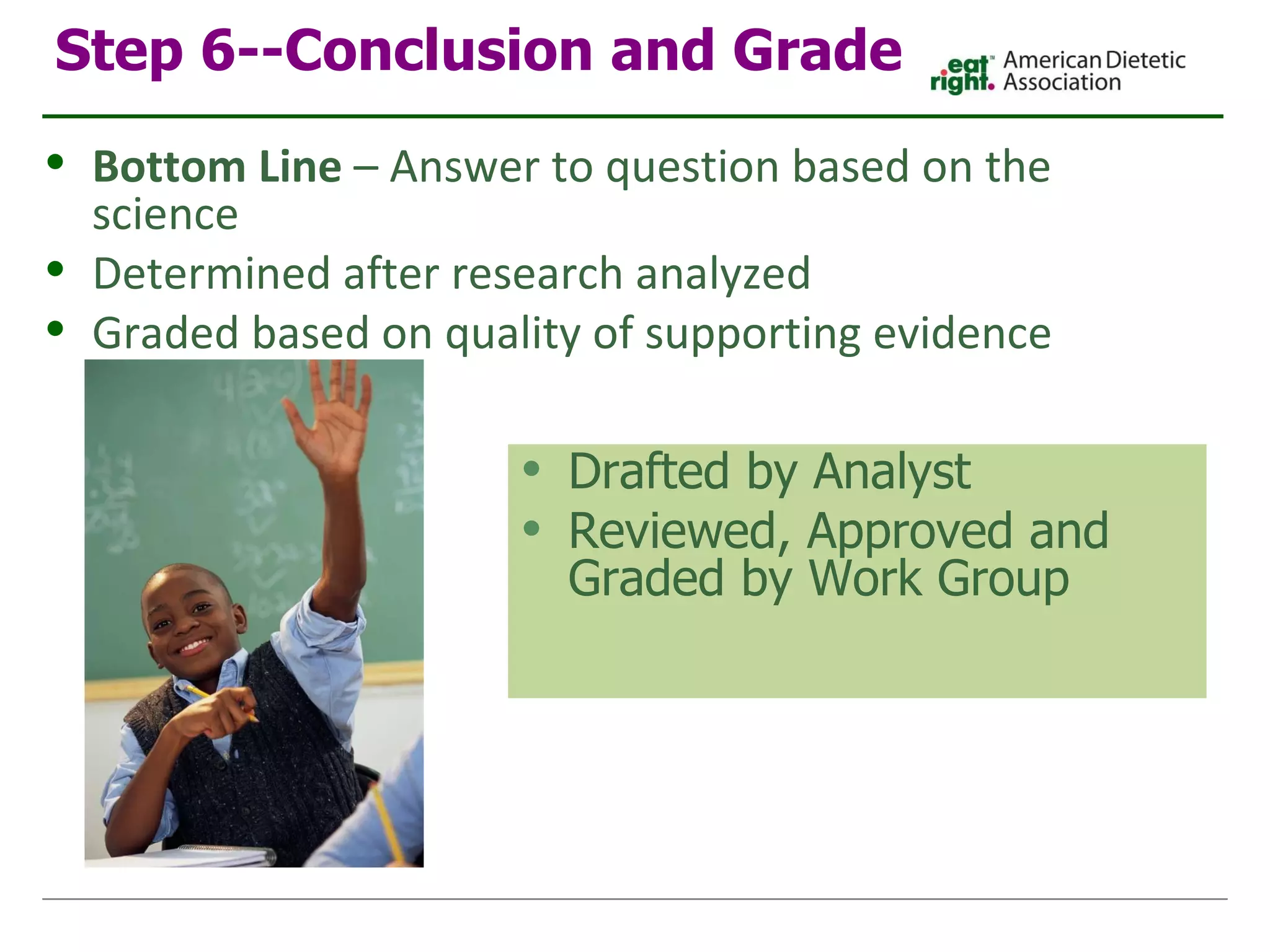
Step 6--Conclusion and Grade Drafted by Analyst Reviewed, Approved and Graded by Work Group Bottom Line  – Answer to question based on the science Determined after research analyzed Graded based on quality of supporting evidence
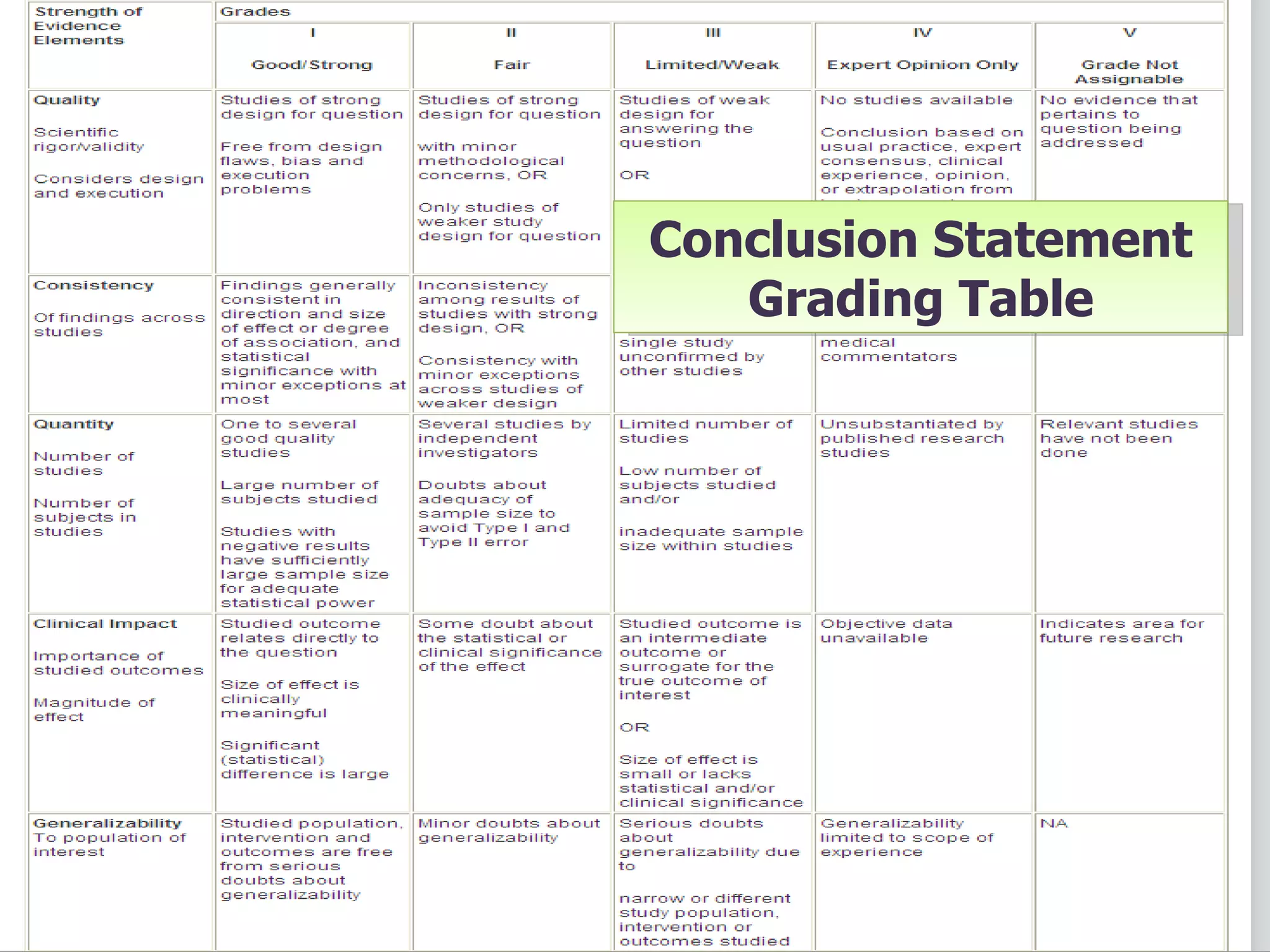
12/28/10 Conclusion Statement Grading Table
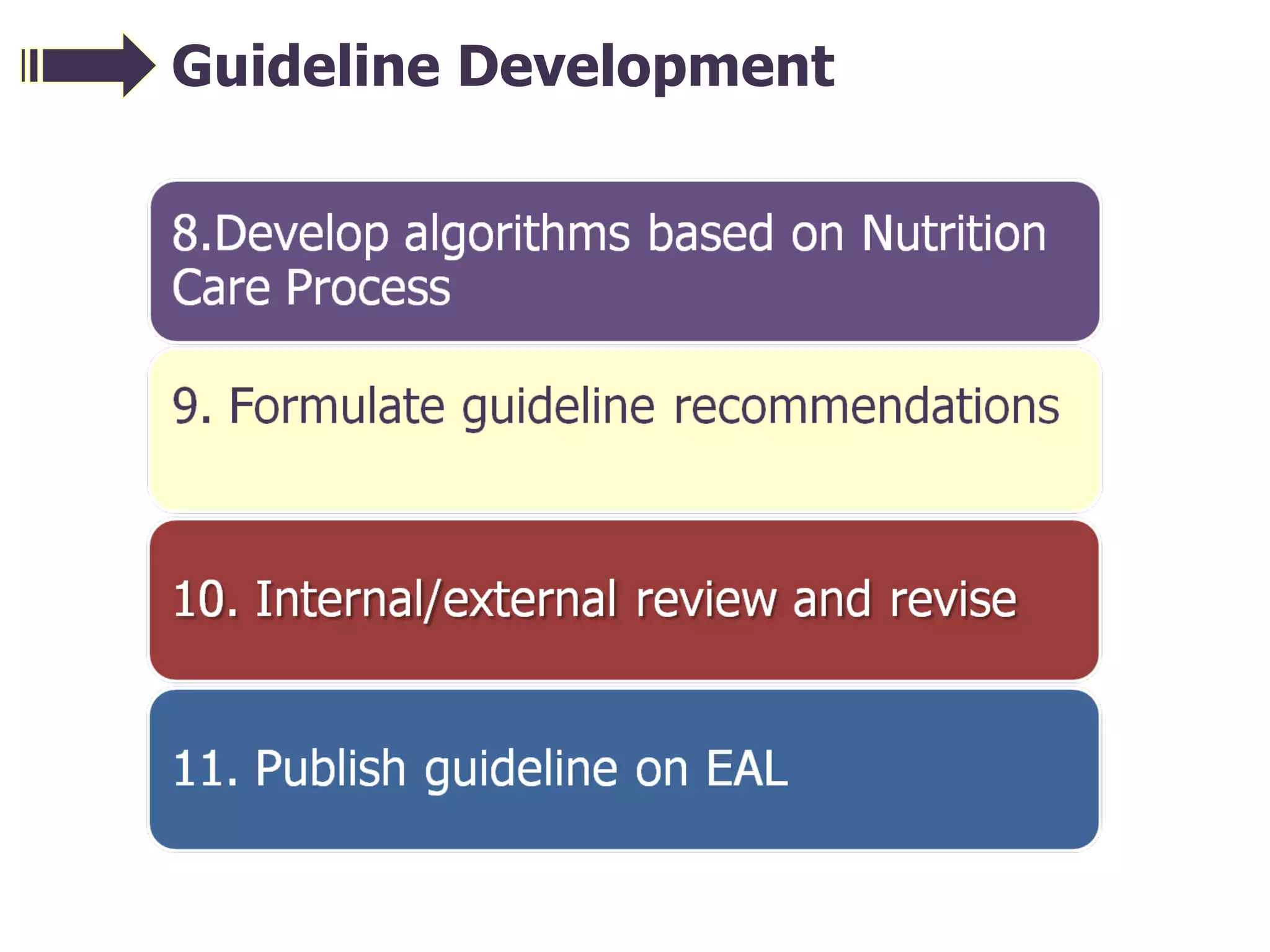
Guideline   Development
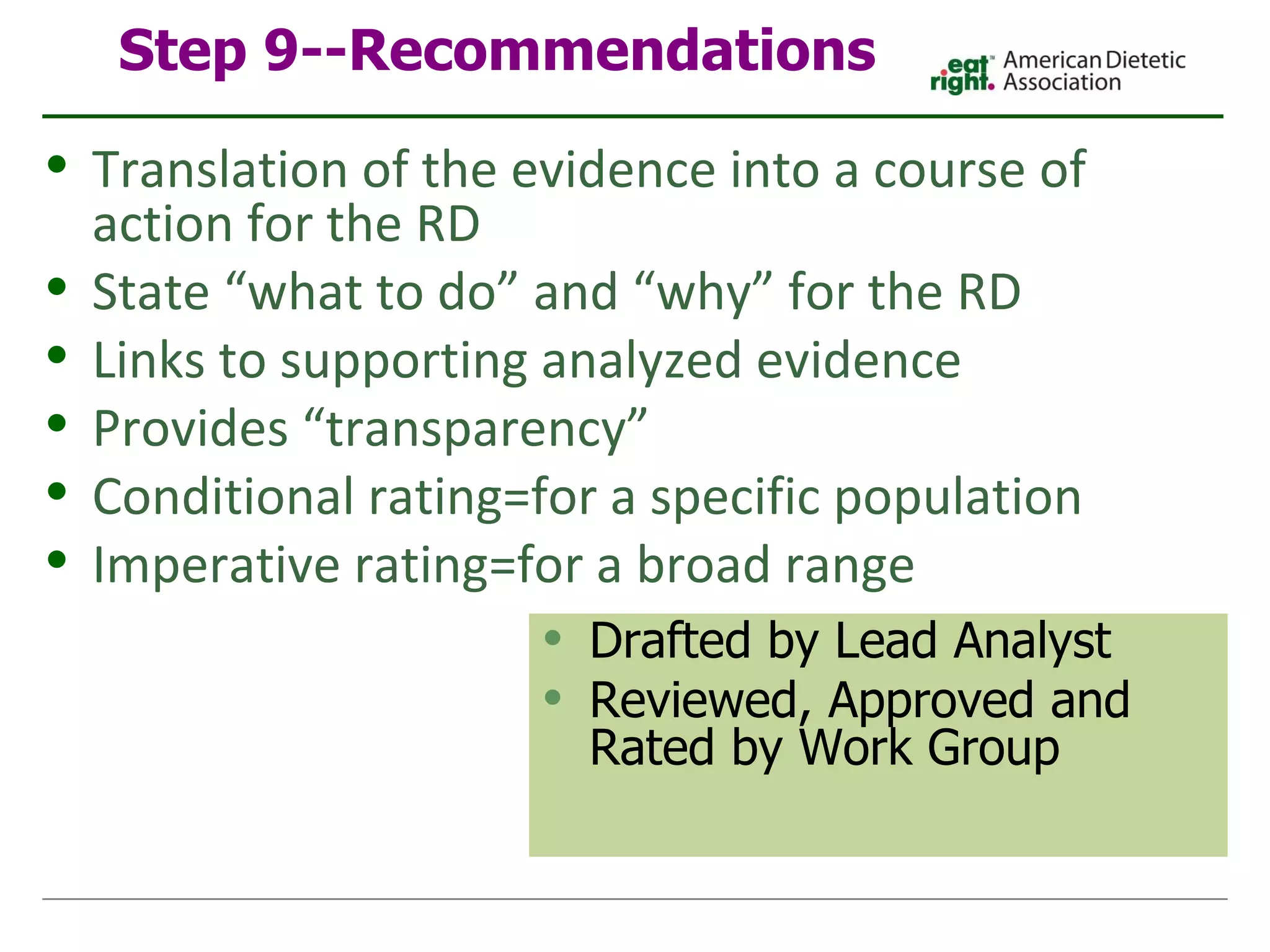
Step 9--Recommendations Drafted by Lead Analyst Reviewed, Approved and Rated by Work Group Translation of the evidence into a course of action for the RD State “what to do” and “why” for the RD Links to supporting analyzed evidence Provides “transparency” Conditional rating=for a specific population Imperative rating=for a broad range
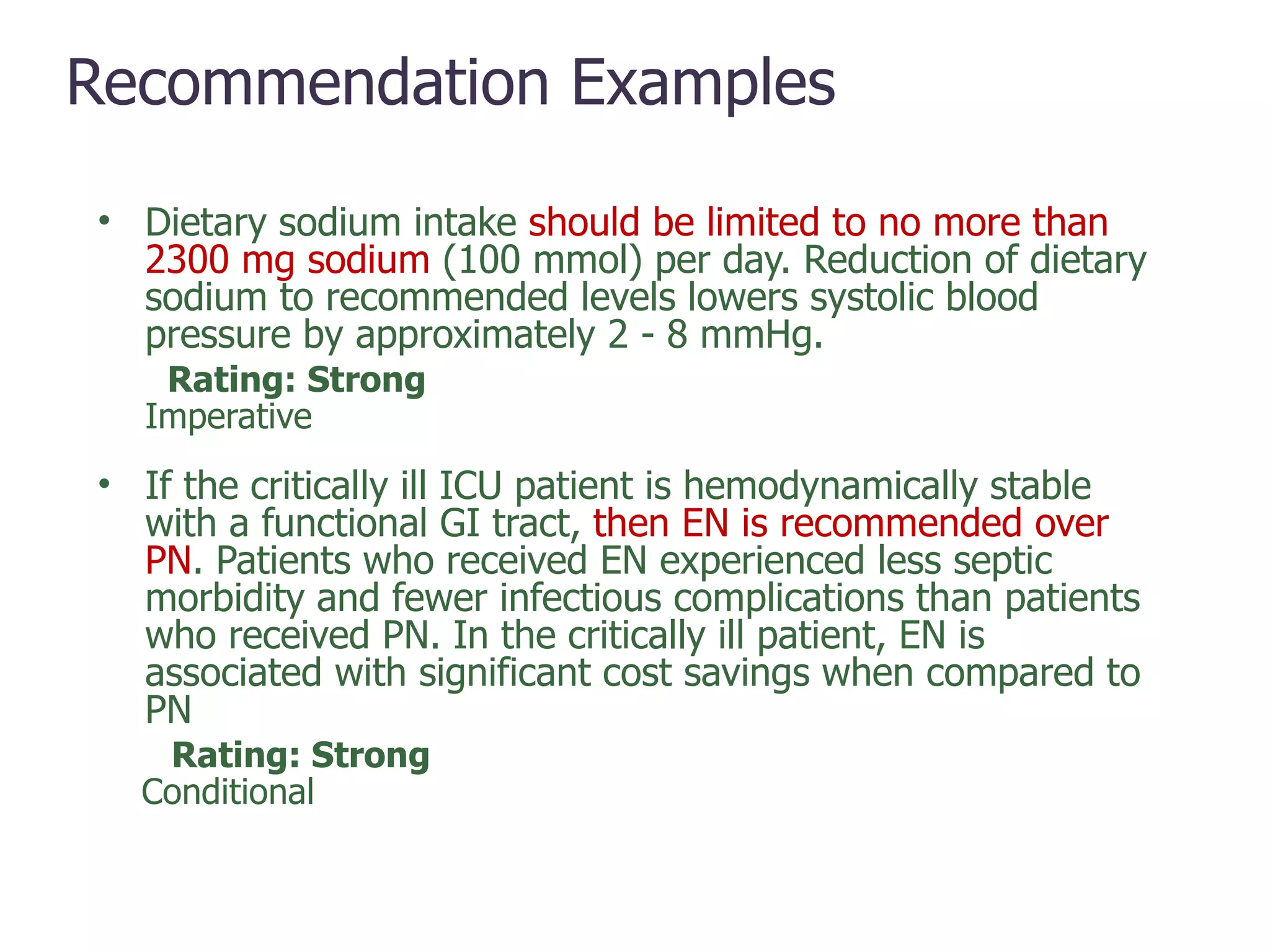
Recommendation   Examples Dietary sodium intake  should be limited to no more than 2300 mg sodium  (100 mmol) per day. Reduction of dietary sodium to recommended levels lowers systolic blood pressure by approximately 2 - 8 mmHg. Rating: Strong Imperative If the critically ill ICU patient is hemodynamically stable with a functional GI tract,  then EN is recommended over PN . Patients who received EN experienced less septic morbidity and fewer infectious complications than patients who received PN. In the critically ill patient, EN is associated with significant cost savings when compared to PN Rating: Strong Conditional Strong,  Imperative
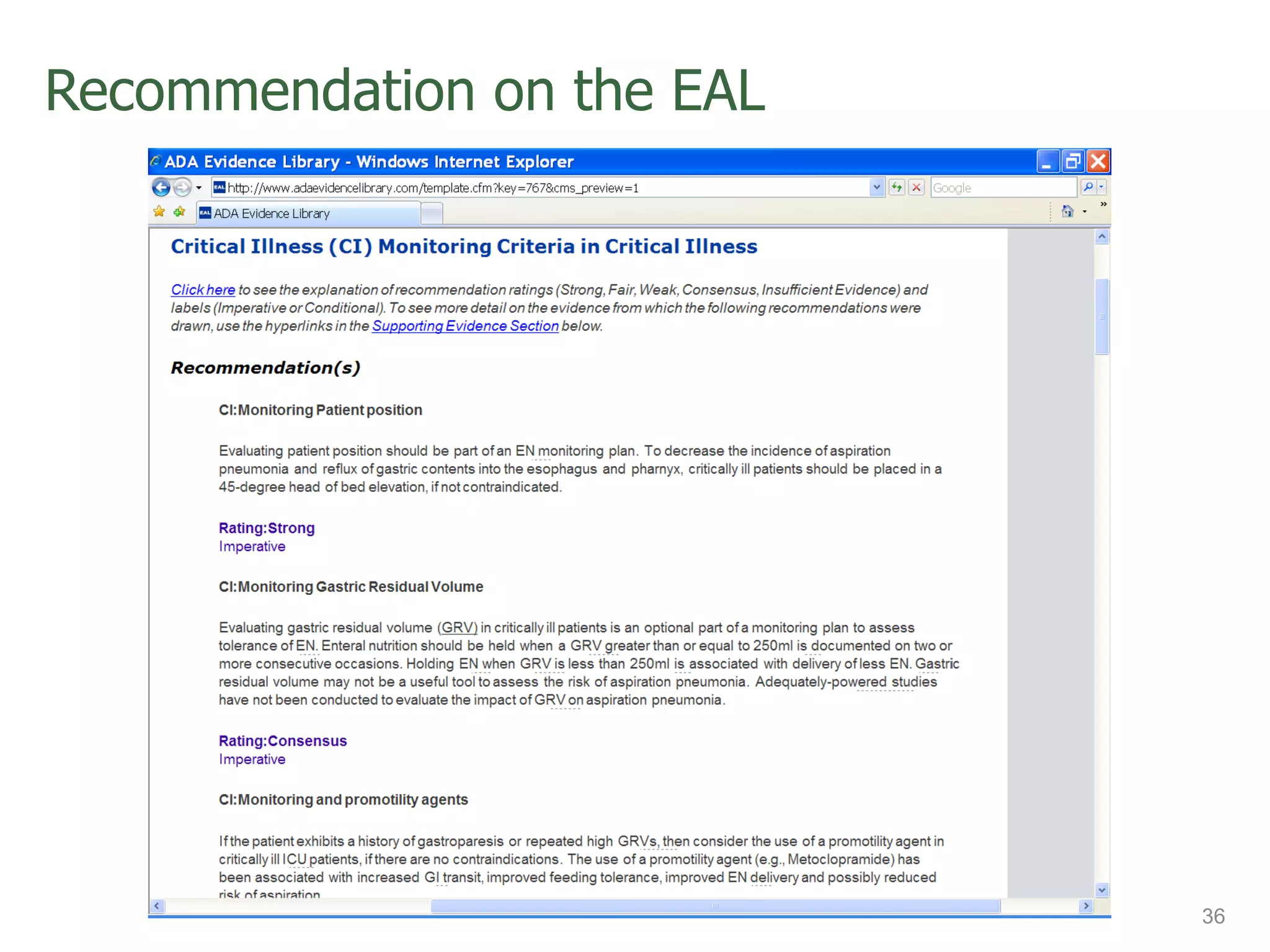
Recommendation on the EAL
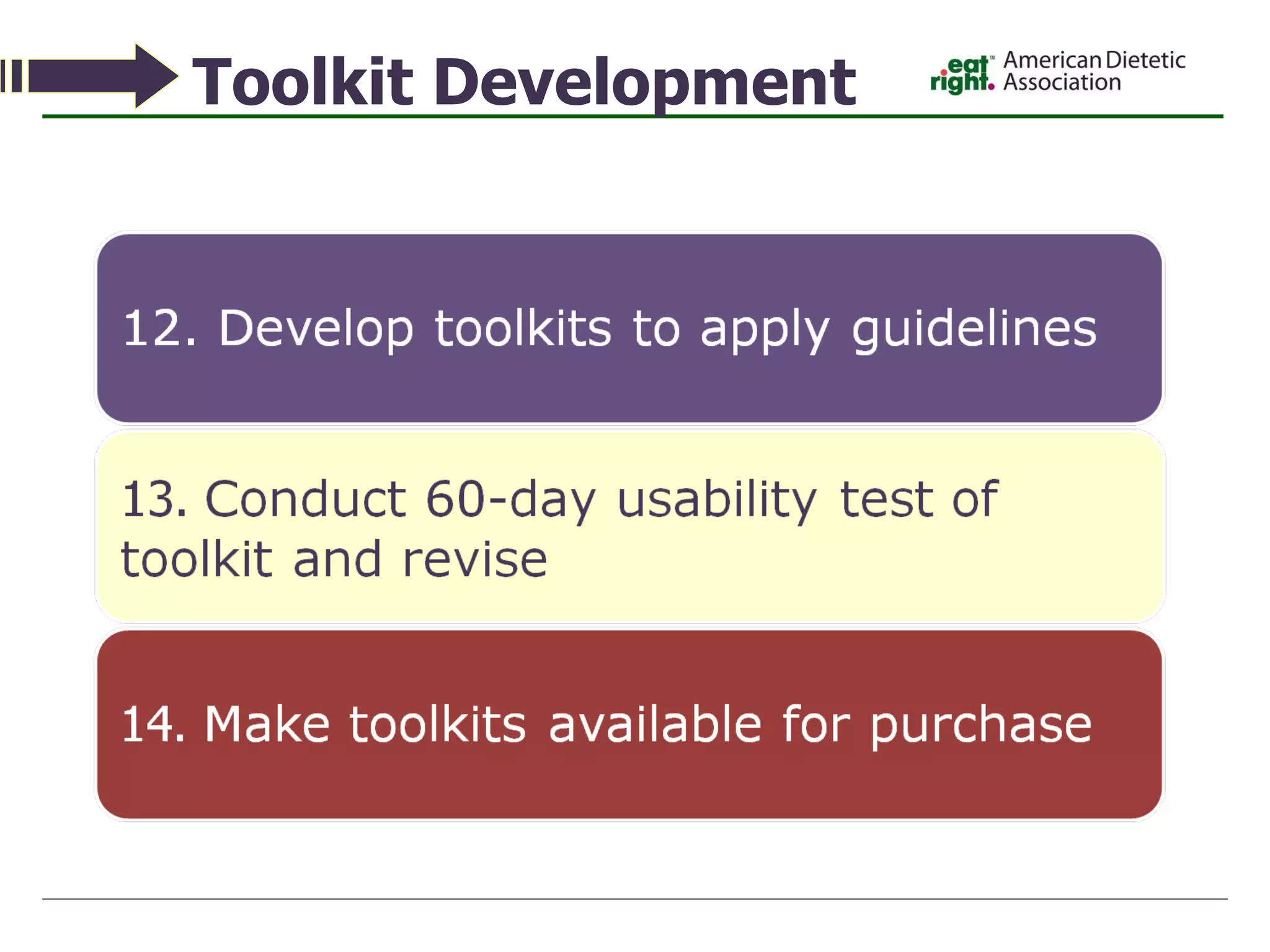
Toolkit   Development
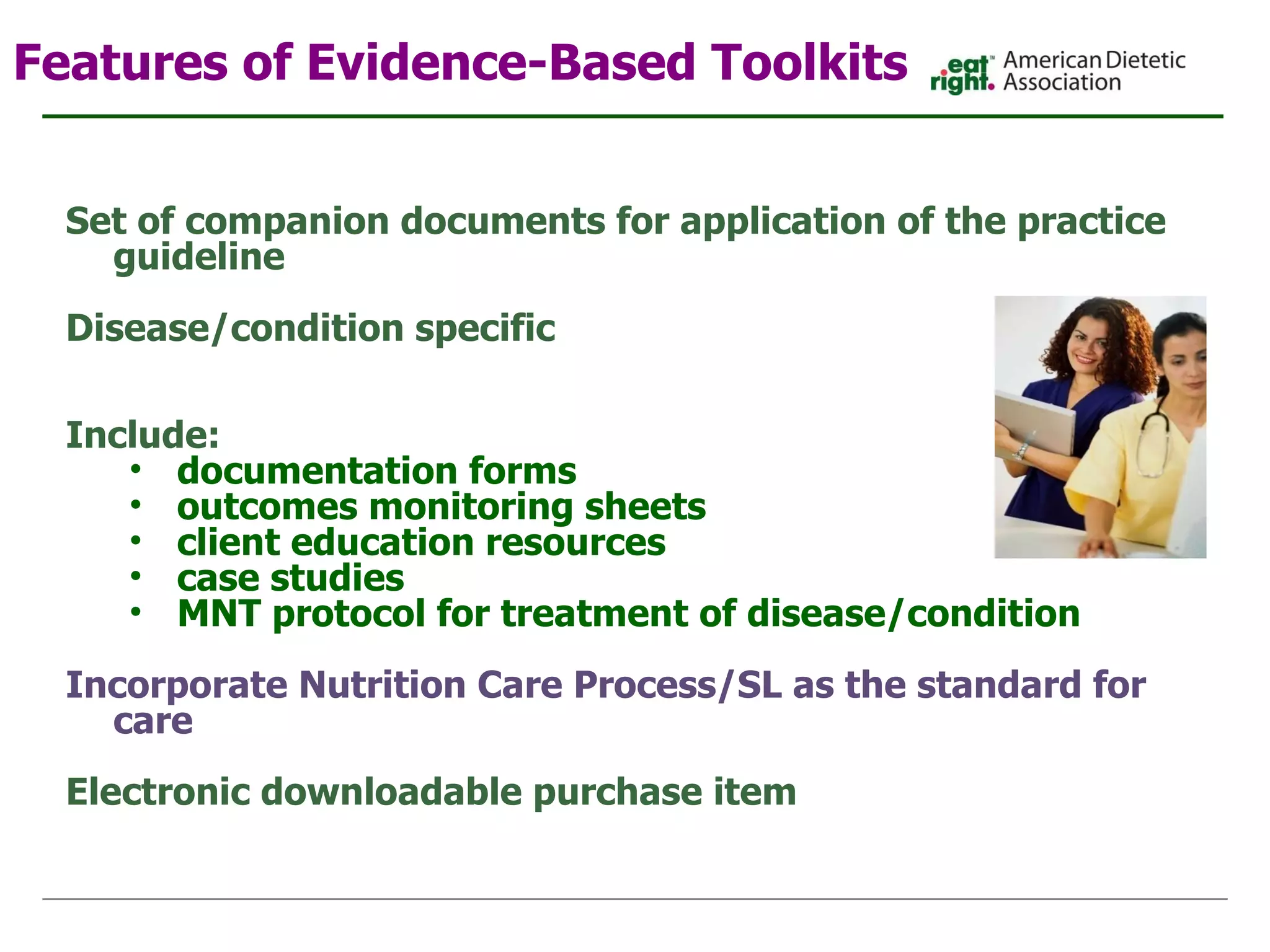
Features of Evidence-Based Toolkits   Set of companion documents for application of the practice guideline Disease/condition specific  Include: documentation forms outcomes monitoring sheets client education resources case studies  MNT protocol for treatment of disease/condition   Incorporate Nutrition Care Process/SL as the standard for care Electronic downloadable purchase item
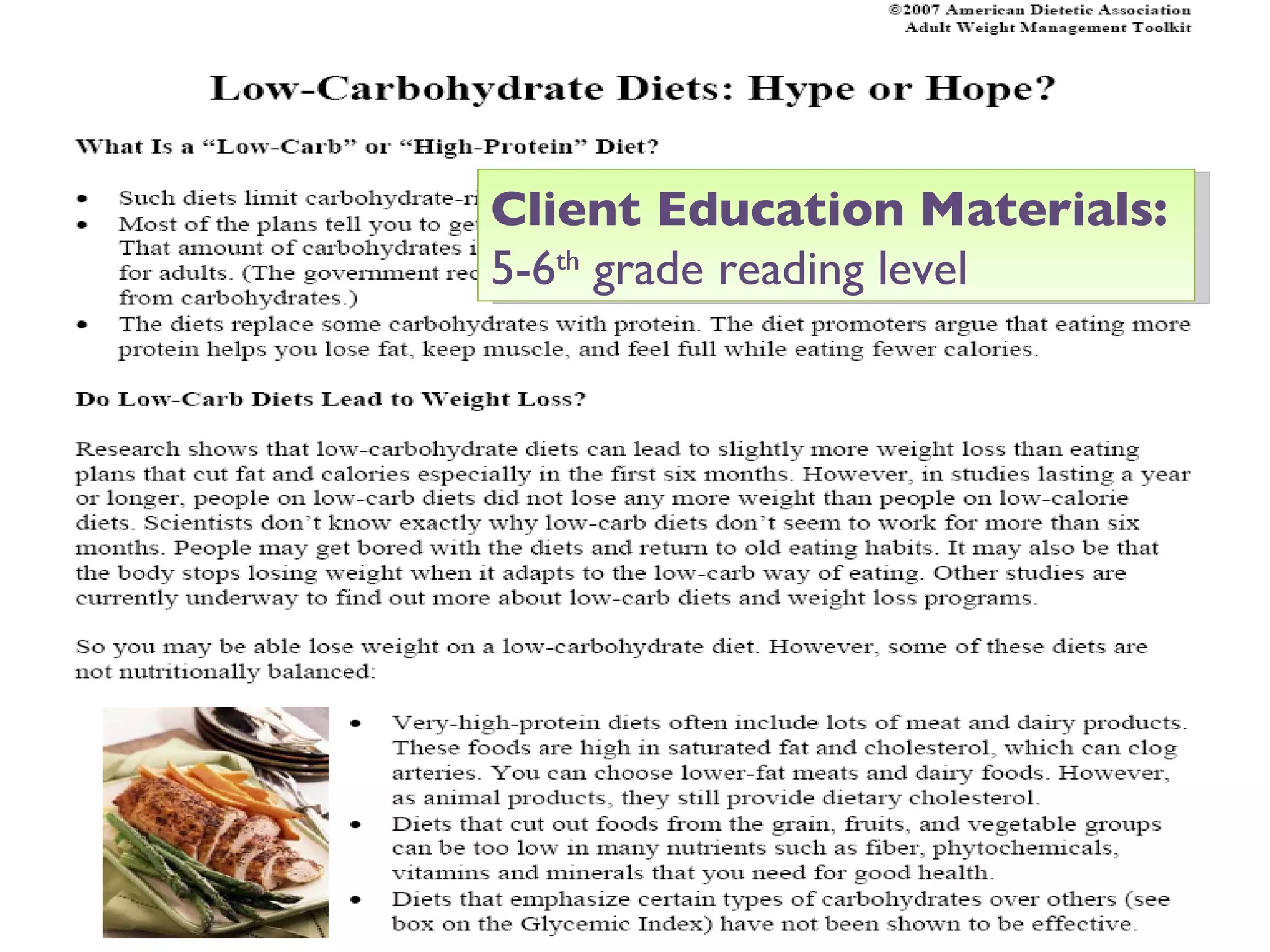
Client Education Materials:  5-6 th  grade reading level
How do I implement  Evidence-Based Practice?
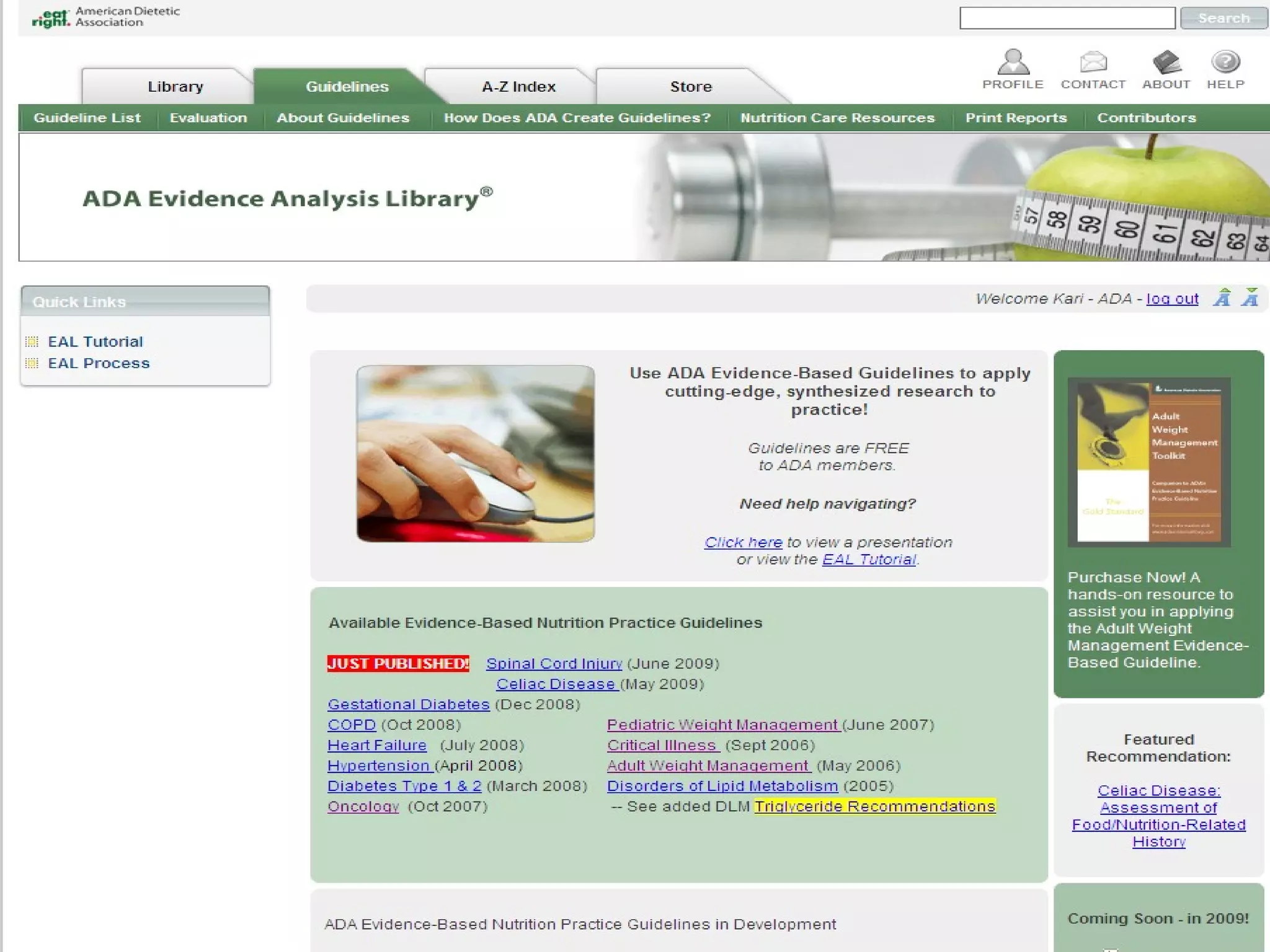
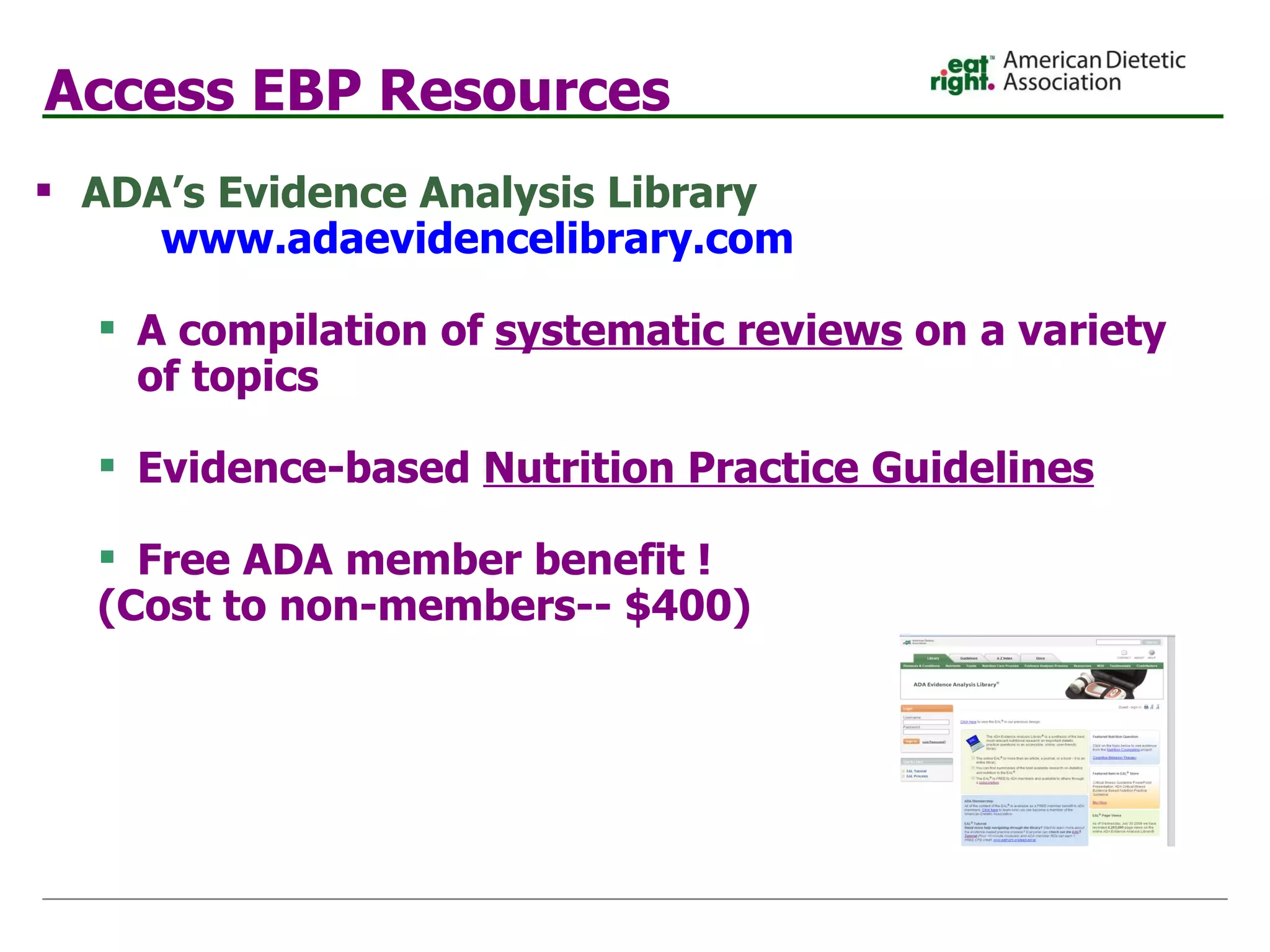
Access EBP Resources ADA’s Evidence Analysis Library   www.adaevidencelibrary.com A compilation of  systematic reviews  on a variety of topics Evidence-based   Nutrition Practice Guidelines Free ADA member benefit !  (Cost to non-members-- $400)
Access Other EBP Resources Society for Critical Care Medicine Clinical Guidelines Canadian Clinical Guidelines UpToDate.com Clinical Reference Cochrane.org Database of Systematic Reviews Zynxhealth.com Evidence NHLBI Clinical Guidelines
How do I practice when there’s no evidence? -- Lack of evidence is NOT the  same as lack of effectiveness
Action Steps-Client Care Settings Use critical thinking skills & clinical expertise Make data-driven decisions Use existing data Collect data when none exist Evaluate programs and services to make improvements  Contribute to the body of evidence through outcomes research Publish and/or present results of outcomes research
Is Evidence-Based Dietetics Practice for all ADA members?
A Role for All Members ADA Code of Ethics – Principles 12 & 13 Understand the importance of EBP to the profession Foundation for our Future Respect from policy makers, payers and other providers   Support other members in implementing & using EBP Role as Delegates - Affiliates and DPGs Mentor Students and Dietetic Interns (CADE standards) Students mentor your preceptor
A Role for All Members Practice based on up-to-date research Use evidence-based methods Use evidence-based resources: ADA Position Papers JADA articles – look for the EAL icon On-line JADA – link to articles with EAL content Promote ADA’s use of EBP to others
Incorporate Research into EBP Develop research policy Create job responsibility requirement Insert research in evaluation process Schedule time to work on research Provide Collaborative Institutional Review Board (IRB) Training Initiative (CITI) training, CITI training program log-on to  www. citiprogram .org   Provide Institutional Review Board support
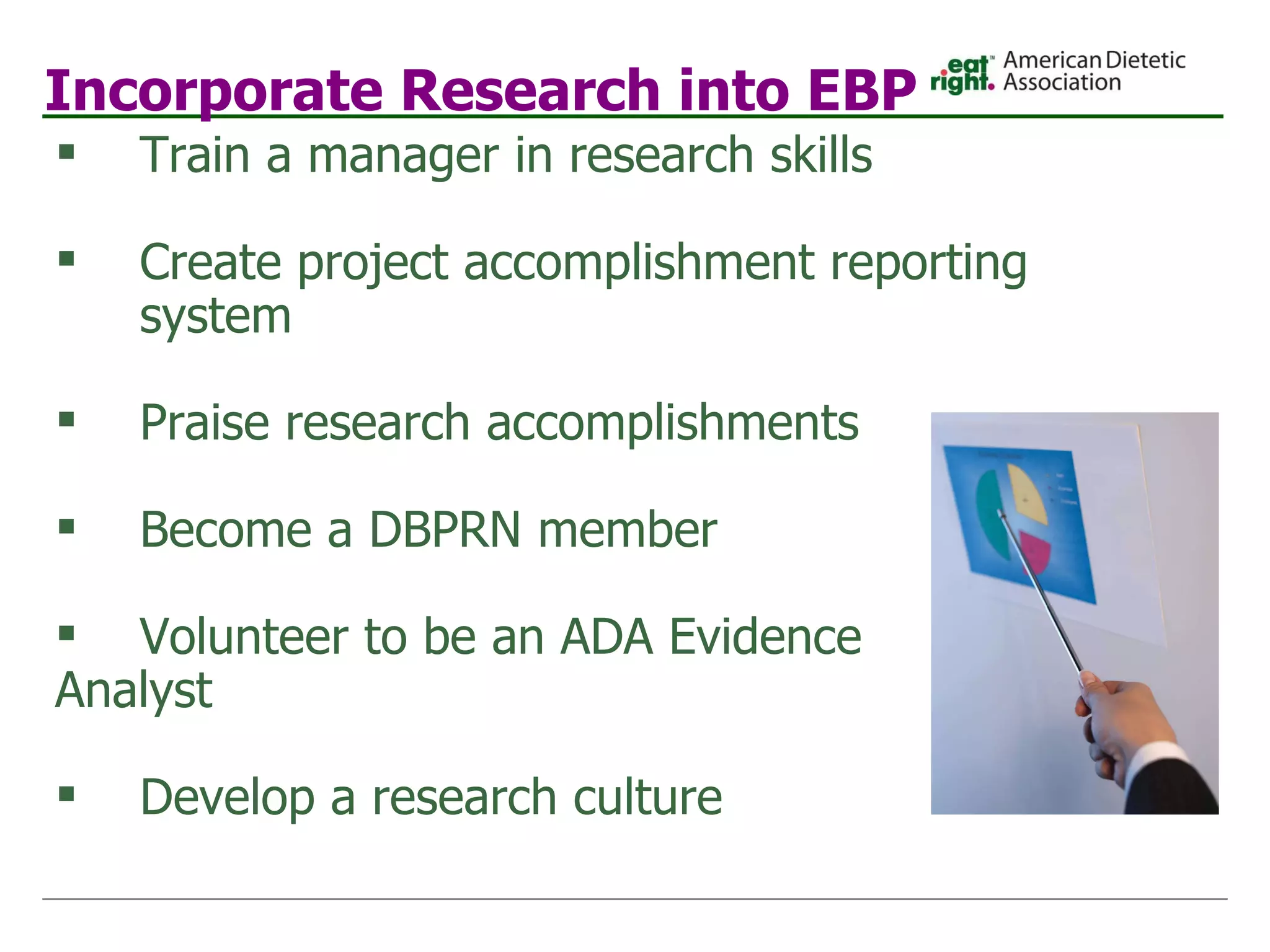
Incorporate Research into EBP Train a manager in research skills Create project accomplishment reporting system Praise research accomplishments Become a DBPRN member Volunteer to be an ADA Evidence  Analyst  Develop a research culture
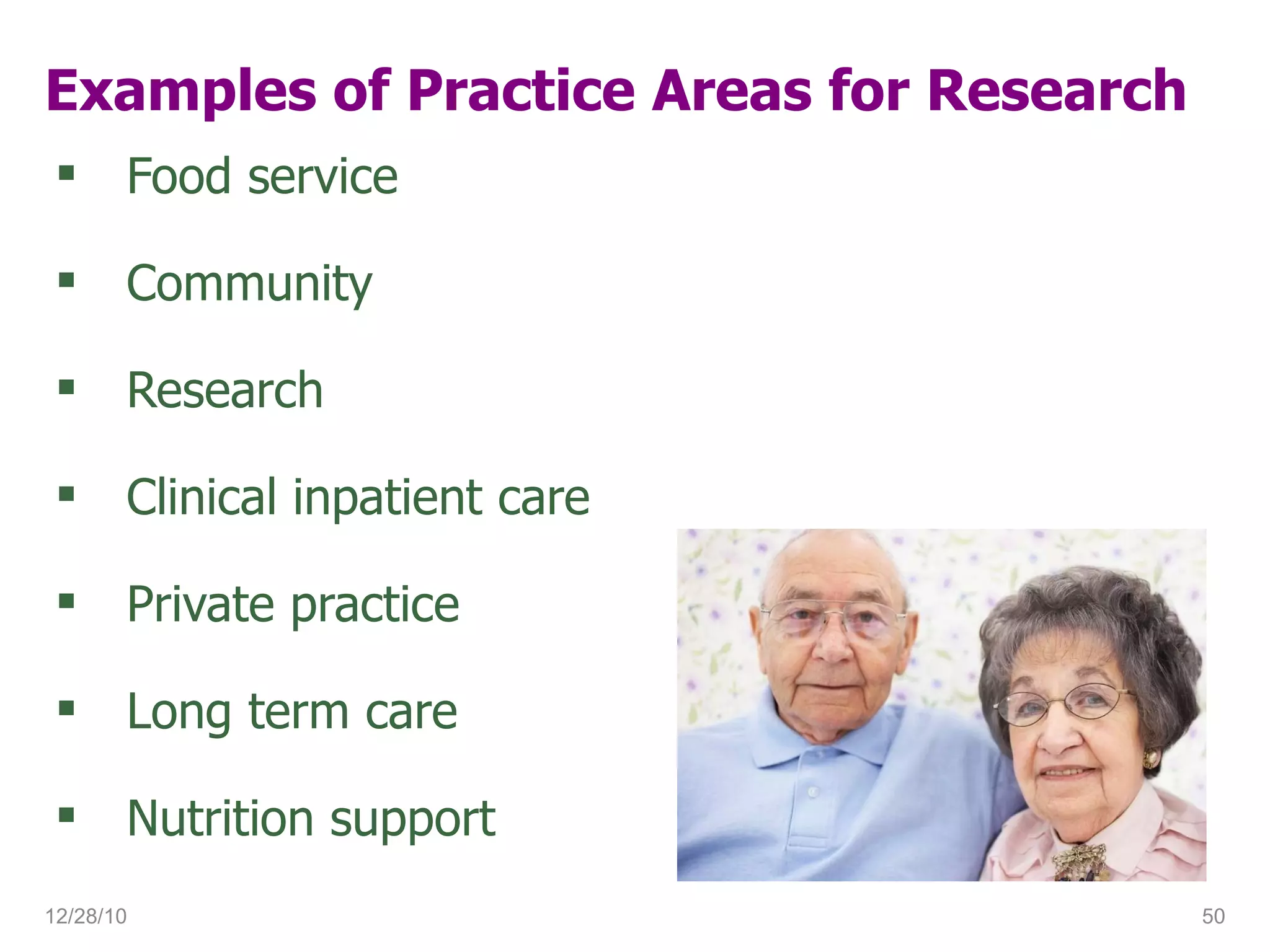
Examples of Practice Areas for Research Food service Community Research  Clinical inpatient care Private practice Long term care Nutrition support 12/28/10
EAL Tutorial   Check out the  EAL TUTORIAL   Complete the four 10-12 minute modules and receive 1 FREE CPE. www. eatright . org/ealtutorial
Evidence Analysis Training Workshops    VOLUNTEERS NEEDED!  If you know someone who is interested in becoming an evidence analyst, please ask them to submit an application.     If you have questions, contact Toni Acosta at  [email_address] .org   Benefits: Professional Development Professional Exposure Continuing Education Hours
Decide to Make a Difference!
Questions? 12/28/10

Evidence Based Practice in All

  • 1.
    Building Evidence-Based Practiceinto All Areas of Dietetics Linda Farr RD/LD TDA Delegate 2007-2012 Owner Nutrition Associates of San Antonio 210-735-2402 [email_address]
  • 2.
    Presentation Objectives DefineEvidence-Based Dietetics Practice Discuss the benefits of using EBP Outline the EBP process Discuss areas for EBP implementation
  • 3.
  • 4.
    Why is EBPimportant? Evidence-based practice will position the profession for improved reimbursement, recognition, and quality services.
  • 5.
  • 6.
    The use of systematically reviewed scientific evidence in making food and nutrition practice decisions Achieved by integrating best available evidence with professional expertise and client values to improve outcomes Source: ADA Scope of Dietetics Framework Definition of Terms 2007 ADA Definition
  • 7.
    Key Considerations EBPis based on the best available evidence including research, national guidelines, policies, consensus statements, expert opinion and quality improvement data. EBP involves continuing evaluation of outcomes . EBP involves complex and conscientious decision-making based not only on the available evidence but also on client/customer/community characteristics, situations, and preferences .
  • 8.
    Clinical Expertise Clientvalues Clinical State Evidence Adapted from: IOM Model for Evidence-Based Clinical Decisions ACP Journal Club, March/April 2002 Clinical Setting
  • 9.
    Code of EthicsSupports EBP Principle 12: The dietetics practitioner practices dietetics based on evidence-based principles and current information. Principle 13: The dietetics practitioner presents reliable and substantiated information and interprets controversial information without personal bias……
  • 10.
    Nutrition Care Processsupports EBP March 2003
  • 11.
    The Nutrition CareProcess Middle Ring: Characteristics of the RD & DTR: Evidence-based Practice Code of Ethics – Principles 12 & 13 Critical Thinking Skills/Competencies Critical thinking
  • 12.
    The Nutrition CareProcess Relationship is based on: Understanding the client’s values and incorporating them into the intervention plan Client’s trust in our competence & our recommendations The NCP Core : Relationship between the RD-DTR & the client
  • 13.
  • 14.
    Explosion of LiteratureOver 10,000 new research articles added to MedLine annually Estimated that clinicians must read ~20 articles a day to keep up!
  • 15.
    Unmet Information NeedsQuestions from clients and other stakeholders are continuously being generated.
  • 16.
    Implementation Delays Researchfindings are often delayed in implementation. It can take 10 to 20 years for original research to be put into clinical practice http://www. ahrq .gov/RESEARCH/trip2fac. htm
  • 17.
    Need for Dataon MNT Effectiveness There is limited data on MNT effectiveness beyond diabetes and lipid disorders. Relatively speaking, there is limited nutrition research; especially that targets the RD.
  • 18.
    Importance of collectingoutcomes/data Ensure progress of profession Reimbursement No data no research No research no evidence No evidence no basis for practice standards Align our profession with other medical fields basing their practice on evidence There is limited nutrition research
  • 19.
    Standardization of PracticeThere is a significant gap between best research evidence and application of evidence to practice. Nutrition support is not always applied effectively or consistently, despite available scientific evidence that could be used to enhance a given treatment protocol.
  • 20.
    Benefits of EBPProvides RDs and DTRs with an overarching foundation for patient care and customer service – a disciplined approach for how we practice Supports the relationship we have with our clients – they trust us & expect us to provide the “best care” Facilitates use of the rapidly expanding body of nutrition knowledge Reduces the gap between research and day-to day practice
  • 21.
    Personal Benefits ofEBP Enhances our status on the health care team Enhances our confidence – the EAL is a great resource to support our recommendations to team members & payers Provides a sense of satisfaction – Measuring outcomes allows us to see that we make a difference Promotes effective time management Promotes compliance with regulations for MNT, e.g. Medicare part B Limits the basis for litigation
  • 22.
    Bottom Line BenefitsEBP leads to: Improved quality of care Increased patient safety Decreased variation in practice Efficient use of resources Increased likelihood of achieving desired patient outcomes Improved client, provider & payer satisfaction Increased likelihood of coverage for MNT
  • 23.
    The Development ofEBP includes…. Five Fundamental Steps.
  • 24.
    Evidence-Analysis Process Steps1. Select topic & appoint expert work group 2. Define questions and determine inclusion/ exclusion criteria 3. Conduct literature review for each question 4. Analyze Articles/ Critical Appraisal 5. Overview Table & Evidence summary Develop conclusion statement & assign grade 7. Publish to online EAL
  • 25.
    Guidelines Methodologies Usedhttp://www.cebm.net/ http://www.nhlbi.nih.gov / http://www.icsi.org/ Whenever possible we don’t “reinvent the wheel.”
  • 26.
    Expert Workgroup Expertsin field Appointed by Evidence-based Practice Committee (oversight group) Balance of researchers and practitioners Assists in question development Review work of analysts and provide final approval
  • 27.
    Evidence Analysts Expertsin critically analyzing articles Must have at least Master’s degree; many have PhD’s Trained at ADA’s EA workshop Mentored by ADA Staff and Lead Analysts Read and analyze articles
  • 28.
    Step 4--Critical Appraisalof Each Article Completes worksheet Completes quality criteria checklist Completes overview tables Completes evidence summaries. Most detailed information on EAL Responsibility of analyst Reviewed by lead analyst Approved by workgroup
  • 29.
    Step 5--Evidence SummarySummarize articles into Overview Table Information synthesized from articles in to narrative evidence summary Responsibility of Evidence Analyst Reviewed by Lead Evidence Analyst Reviewed and Approved by Work Group
  • 30.
    Evidence Summary :narrative summary Evidence Table
  • 31.
    Step 6--Conclusion andGrade Drafted by Analyst Reviewed, Approved and Graded by Work Group Bottom Line – Answer to question based on the science Determined after research analyzed Graded based on quality of supporting evidence
  • 32.
  • 33.
    Guideline Development
  • 34.
    Step 9--Recommendations Draftedby Lead Analyst Reviewed, Approved and Rated by Work Group Translation of the evidence into a course of action for the RD State “what to do” and “why” for the RD Links to supporting analyzed evidence Provides “transparency” Conditional rating=for a specific population Imperative rating=for a broad range
  • 35.
    Recommendation Examples Dietary sodium intake should be limited to no more than 2300 mg sodium (100 mmol) per day. Reduction of dietary sodium to recommended levels lowers systolic blood pressure by approximately 2 - 8 mmHg. Rating: Strong Imperative If the critically ill ICU patient is hemodynamically stable with a functional GI tract, then EN is recommended over PN . Patients who received EN experienced less septic morbidity and fewer infectious complications than patients who received PN. In the critically ill patient, EN is associated with significant cost savings when compared to PN Rating: Strong Conditional Strong, Imperative
  • 36.
  • 37.
    Toolkit Development
  • 38.
    Features of Evidence-BasedToolkits Set of companion documents for application of the practice guideline Disease/condition specific Include: documentation forms outcomes monitoring sheets client education resources case studies MNT protocol for treatment of disease/condition Incorporate Nutrition Care Process/SL as the standard for care Electronic downloadable purchase item
  • 39.
    Client Education Materials: 5-6 th grade reading level
  • 40.
    How do Iimplement Evidence-Based Practice?
  • 41.
    Access EBP ResourcesADA’s Evidence Analysis Library www.adaevidencelibrary.com A compilation of systematic reviews on a variety of topics Evidence-based Nutrition Practice Guidelines Free ADA member benefit ! (Cost to non-members-- $400)
  • 42.
    Access Other EBPResources Society for Critical Care Medicine Clinical Guidelines Canadian Clinical Guidelines UpToDate.com Clinical Reference Cochrane.org Database of Systematic Reviews Zynxhealth.com Evidence NHLBI Clinical Guidelines
  • 43.
    How do Ipractice when there’s no evidence? -- Lack of evidence is NOT the same as lack of effectiveness
  • 44.
    Action Steps-Client CareSettings Use critical thinking skills & clinical expertise Make data-driven decisions Use existing data Collect data when none exist Evaluate programs and services to make improvements Contribute to the body of evidence through outcomes research Publish and/or present results of outcomes research
  • 45.
    Is Evidence-Based DieteticsPractice for all ADA members?
  • 46.
    A Role forAll Members ADA Code of Ethics – Principles 12 & 13 Understand the importance of EBP to the profession Foundation for our Future Respect from policy makers, payers and other providers Support other members in implementing & using EBP Role as Delegates - Affiliates and DPGs Mentor Students and Dietetic Interns (CADE standards) Students mentor your preceptor
  • 47.
    A Role forAll Members Practice based on up-to-date research Use evidence-based methods Use evidence-based resources: ADA Position Papers JADA articles – look for the EAL icon On-line JADA – link to articles with EAL content Promote ADA’s use of EBP to others
  • 48.
    Incorporate Research intoEBP Develop research policy Create job responsibility requirement Insert research in evaluation process Schedule time to work on research Provide Collaborative Institutional Review Board (IRB) Training Initiative (CITI) training, CITI training program log-on to www. citiprogram .org Provide Institutional Review Board support
  • 49.
    Incorporate Research intoEBP Train a manager in research skills Create project accomplishment reporting system Praise research accomplishments Become a DBPRN member Volunteer to be an ADA Evidence Analyst Develop a research culture
  • 50.
    Examples of PracticeAreas for Research Food service Community Research Clinical inpatient care Private practice Long term care Nutrition support 12/28/10
  • 51.
    EAL Tutorial Check out the EAL TUTORIAL   Complete the four 10-12 minute modules and receive 1 FREE CPE. www. eatright . org/ealtutorial
  • 52.
    Evidence Analysis TrainingWorkshops   VOLUNTEERS NEEDED!  If you know someone who is interested in becoming an evidence analyst, please ask them to submit an application.    If you have questions, contact Toni Acosta at [email_address] .org Benefits: Professional Development Professional Exposure Continuing Education Hours
  • 53.
    Decide to Makea Difference!
  • 54.

Editor's Notes

  • #2 Thank you (to whoever did the introduction. Acknowledgements as needed.) Today, I would like to update you on just some of the many, many things that are going on at the American Dietetic Association to expand the leadership role of registered dietitians, DTRs and all ADA members in the wide and growing world of food and nutrition. Under the leadership of the House and the Board and with the hard work of ADA’s Headquarters Team, we have found solutions, taken advantage of opportunities and made progress that is nothing short of amazing by any measure.
  • #7 EBP is an approach to health care where health practitioners use the best evidence possible to make decisions for individual patients. It involves complex and conscientious decision-making based not only on the available evidence but also on client characteristics, situations, and preferences. Emphasis is on systematically reviewed scientific evidence. But note that it must be applied when using professional expertise and knowledge of client values.
  • #11 The Nutrition Care Process developed and published was intended to establish a routine thinking and action process that all RDs used as they provided nutrition services/care regardless of setting and type of patient. It is intended to be applicable to acute care setting, long term care setting, ambulatory setting, community and public health and nutrition education.
  • #12 The Nutrition Care Process developed and published was intended to establish a routine thinking and action process that all RDs used as they provided nutrition services/care regardless of setting and type of patient. It is intended to be applicable to acute care setting, long term care setting, ambulatory setting, community and public health and nutrition education.
  • #13 The Nutrition Care Process developed and published was intended to establish a routine thinking and action process that all RDs used as they provided nutrition services/care regardless of setting and type of patient. It is intended to be applicable to acute care setting, long term care setting, ambulatory setting, community and public health and nutrition education.
  • #15 Explosion of literature--published at a rate individual clinicians can’t keep up with. EBP can be made in a focused and time efficient manner.
  • #21 Quality improved through promoting practices that support the best outcomes
  • #22 Quality improved through promoting practices that support the best outcomes
  • #25 Topics and questions come from a variety of sources inlcuding member requests, practice group suggestions, ADA strategy, etc
  • #31 The evidence summary includes of all the evidence supporting the conclusion statement and recommendation. Each evidence summary has the information presented in a narrative summary and an overview table (see overview table on next slide).
  • #34 After analysis is complete and a set of conclusion statements developed to summarize the research on a topic, then a series of recommendations are formed to help the practitioner understand how to use this information. The series of recommendations, introduction and treatment algorithms make up a “Evidence-Based Nutrition Practice Guideline.” You can see from the rigor of the process that the evidence-based guidelines are more than just “guidelines based on evidence”.
  • #36 This is an example of a recommendation- the structure is “what” the RD should do and “why” to do it. The recommendation is also given a rating, in this case Strong. The next slide shows the rating scale definitions and implications for practice.