Evidence Based Policy Making
By
Christine Mwangi
11
Evidence Cont.
.
• What is evidence based policy making?
• Why bother? Is it necessary?
2
What is Evidence Based Policy ?
An approach to policy that helps people make
well informed decisions about policies,
programmes and projects by putting the best
available evidence from research at the heart
of policy development and implementation.
Any examples?
3
EBP is a set of methods which informs the
processes by which policies are formulated,
rather than aiming to affect the eventual goals
of the policy. It advocates a more rational,
rigorous and systematic approach, and moves
beyond traditional notions of research to adopt
a broader understanding.
4
Why do we need Evidence?
• Understand the policy environment and how it’s
changing.
• Appraise the likely effects of policy changes so we
can choose between different policy options and
subsequently assess their impacts.
• Demonstrate the links between strategic direction,
intended outcomes and policy objectives, to show
that there are clear lines of argument and
evidence between what we are aiming for and
what we are doing now.
5
Need for Evidence Cont..
• Determine what we need to do to meet our
strategic goals or intermediate objectives.
• Influence others so that they help us achieve
our policy goals and take them through to
delivery.
• Communicate the quality (breadth and depth)
of our evidence base to meet the open
government agenda.
6
What is Evidence?
• Evidence is categorized as either ‘hard’ or ‘soft’,
implying objective versus subjective forms. Hard
evidence is said to consist of: primary quantitative
data collected by researchers from experiments;
secondary quantitative social and epidemiological
data collected by government agencies; clinical
trials; and interview or questionnaire-based social
surveys. This is in contrast to ‘soft’ evidence which
is viewed as consisting of qualitative data such as
ethnographic accounts and autobiographical
materials. 7
What Evidence is Useful ?
• Quality / accuracy / objectivity
This refers to the accuracy of the evidence. Is
the evidence correctly describing what it
purports to do? There are arithmetical (are the
numbers added up correctly?), statistical (were
the cause and effect parameter correctly
specified?) and representative (do the quotes from
people really represent what the body of people
felt?)
• 8
Credibility
Credible evidence relies on a strong and clear line of
argument; tried and tested analytical methods;
analytical rigor throughout the processes of data
collection and analysis; and on clear presentation of
the conclusions. This relates to the reliability of the
evidence and therefore whether or not we can
depend on the evidence for monitoring, evaluation
or impact assessments – planning for the lessons
learned approach. In reality, it is very difficult for
policymakers to check evidence; therefore they
often rely on the reputation of the source as a
proxy. 9
Relevance
The key issue here is that evidence is timely,
topical and has policy implications. The type
of evidence one refers to matters greatly
according to the audience it is being
presented to and the likely impact it can
create. For example, policymakers in the
public sector would be more interested in
evidence of action (what has already
happened) rather than opinion
10
Practicalities
This relates to the extent to which the evidence is
accessible to policymakers; whether policymakers
have access to it in a useful form and therefore the
ease with which it can be translated into policy. It
also refers to the cost of the policy implications of
the research, and therefore whether it is feasible
and affordable.
11
Need for Evidence?
• Why would this matter for developing
countries like Kenya?
• What challenges would there be for this policy
design approach?
12
13
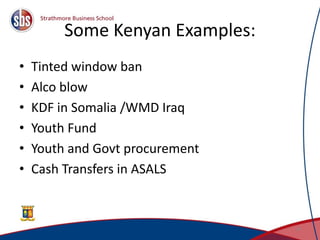
Some Kenyan Examples:
• Tinted window ban
• Alco blow
• KDF in Somalia /WMD Iraq
• Youth Fund
• Youth and Govt procurement
• Cash Transfers in ASALS
14
15
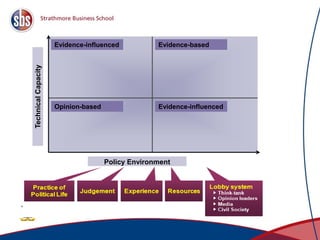
TechnicalCapacity
Policy Environment
Evidence-influenced
Opinion-based
Evidence-based
Evidence-influenced
Evidence-Based Government
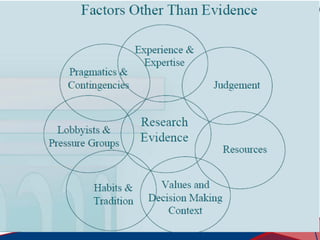
“Evidence-based government means integrating
experience, expertise and judgement etc. with
the best available external evidence from
systematic research.”
(Davies, P.T., 2000)
16
17
18
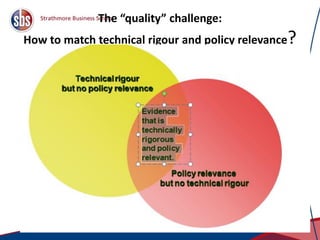
The “quality” challenge:
How to match technical rigour and policy relevance?
19
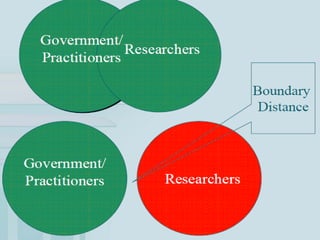
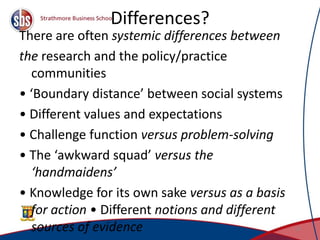
Differences?
There are often systemic differences between
the research and the policy/practice
communities
• ‘Boundary distance’ between social systems
• Different values and expectations
• Challenge function versus problem-solving
• The ‘awkward squad’ versus the
‘handmaidens’
• Knowledge for its own sake versus as a basis
for action • Different notions and different
sources of evidence 20
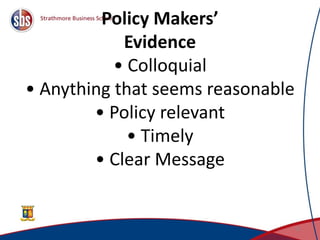
Policy Makers’
Evidence
• Colloquial
• Anything that seems reasonable
• Policy relevant
• Timely
• Clear Message
21
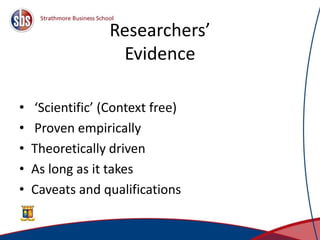
Researchers’
Evidence
• ‘Scientific’ (Context free)
• Proven empirically
• Theoretically driven
• As long as it takes
• Caveats and qualifications
22
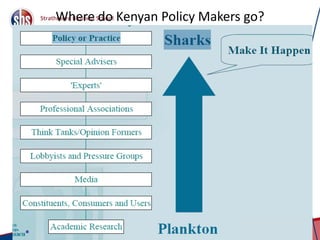
Where do Kenyan Policy Makers go?
23
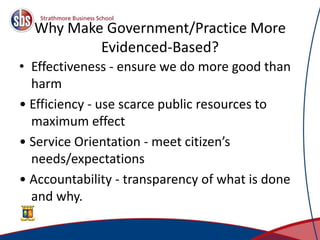
Why Make Government/Practice More
Evidenced-Based?
• Effectiveness - ensure we do more good than
harm
• Efficiency - use scarce public resources to
maximum effect
• Service Orientation - meet citizen’s
needs/expectations
• Accountability - transparency of what is done
and why.
24
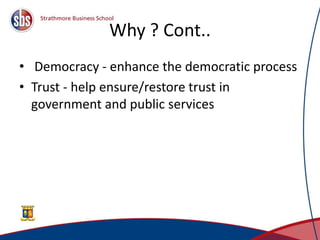
Why ? Cont..
• Democracy - enhance the democratic process
• Trust - help ensure/restore trust in
government and public services
25
THE END
26

Evidence based policy

  • 1.
    Evidence Based PolicyMaking By Christine Mwangi 11
  • 2.
    Evidence Cont. . • Whatis evidence based policy making? • Why bother? Is it necessary? 2
  • 3.
    What is EvidenceBased Policy ? An approach to policy that helps people make well informed decisions about policies, programmes and projects by putting the best available evidence from research at the heart of policy development and implementation. Any examples? 3
  • 4.
    EBP is aset of methods which informs the processes by which policies are formulated, rather than aiming to affect the eventual goals of the policy. It advocates a more rational, rigorous and systematic approach, and moves beyond traditional notions of research to adopt a broader understanding. 4
  • 5.
    Why do weneed Evidence? • Understand the policy environment and how it’s changing. • Appraise the likely effects of policy changes so we can choose between different policy options and subsequently assess their impacts. • Demonstrate the links between strategic direction, intended outcomes and policy objectives, to show that there are clear lines of argument and evidence between what we are aiming for and what we are doing now. 5
  • 6.
    Need for EvidenceCont.. • Determine what we need to do to meet our strategic goals or intermediate objectives. • Influence others so that they help us achieve our policy goals and take them through to delivery. • Communicate the quality (breadth and depth) of our evidence base to meet the open government agenda. 6
  • 7.
    What is Evidence? •Evidence is categorized as either ‘hard’ or ‘soft’, implying objective versus subjective forms. Hard evidence is said to consist of: primary quantitative data collected by researchers from experiments; secondary quantitative social and epidemiological data collected by government agencies; clinical trials; and interview or questionnaire-based social surveys. This is in contrast to ‘soft’ evidence which is viewed as consisting of qualitative data such as ethnographic accounts and autobiographical materials. 7
  • 8.
    What Evidence isUseful ? • Quality / accuracy / objectivity This refers to the accuracy of the evidence. Is the evidence correctly describing what it purports to do? There are arithmetical (are the numbers added up correctly?), statistical (were the cause and effect parameter correctly specified?) and representative (do the quotes from people really represent what the body of people felt?) • 8
  • 9.
    Credibility Credible evidence relieson a strong and clear line of argument; tried and tested analytical methods; analytical rigor throughout the processes of data collection and analysis; and on clear presentation of the conclusions. This relates to the reliability of the evidence and therefore whether or not we can depend on the evidence for monitoring, evaluation or impact assessments – planning for the lessons learned approach. In reality, it is very difficult for policymakers to check evidence; therefore they often rely on the reputation of the source as a proxy. 9
  • 10.
    Relevance The key issuehere is that evidence is timely, topical and has policy implications. The type of evidence one refers to matters greatly according to the audience it is being presented to and the likely impact it can create. For example, policymakers in the public sector would be more interested in evidence of action (what has already happened) rather than opinion 10
  • 11.
    Practicalities This relates tothe extent to which the evidence is accessible to policymakers; whether policymakers have access to it in a useful form and therefore the ease with which it can be translated into policy. It also refers to the cost of the policy implications of the research, and therefore whether it is feasible and affordable. 11
  • 12.
    Need for Evidence? •Why would this matter for developing countries like Kenya? • What challenges would there be for this policy design approach? 12
  • 13.
  • 14.
    Some Kenyan Examples: •Tinted window ban • Alco blow • KDF in Somalia /WMD Iraq • Youth Fund • Youth and Govt procurement • Cash Transfers in ASALS 14
  • 15.
  • 16.
    Evidence-Based Government “Evidence-based governmentmeans integrating experience, expertise and judgement etc. with the best available external evidence from systematic research.” (Davies, P.T., 2000) 16
  • 17.
  • 18.
  • 19.
    The “quality” challenge: Howto match technical rigour and policy relevance? 19
  • 20.
    Differences? There are oftensystemic differences between the research and the policy/practice communities • ‘Boundary distance’ between social systems • Different values and expectations • Challenge function versus problem-solving • The ‘awkward squad’ versus the ‘handmaidens’ • Knowledge for its own sake versus as a basis for action • Different notions and different sources of evidence 20
  • 21.
    Policy Makers’ Evidence • Colloquial •Anything that seems reasonable • Policy relevant • Timely • Clear Message 21
  • 22.
    Researchers’ Evidence • ‘Scientific’ (Contextfree) • Proven empirically • Theoretically driven • As long as it takes • Caveats and qualifications 22
  • 23.
    Where do KenyanPolicy Makers go? 23
  • 24.
    Why Make Government/PracticeMore Evidenced-Based? • Effectiveness - ensure we do more good than harm • Efficiency - use scarce public resources to maximum effect • Service Orientation - meet citizen’s needs/expectations • Accountability - transparency of what is done and why. 24
  • 25.
    Why ? Cont.. •Democracy - enhance the democratic process • Trust - help ensure/restore trust in government and public services 25
  • 26.