Using the Library


       DNP Bound
 Frontier Nursing University
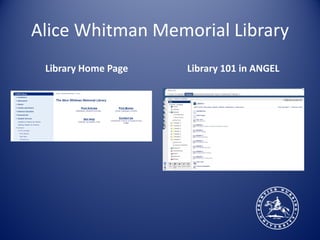
Alice Whitman Memorial Library
 Library Home Page   Library 101 in ANGEL
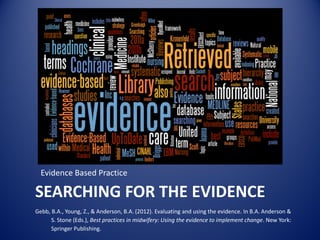
Evidence Based Practice

SEARCHING FOR THE EVIDENCE
Gebb, B.A., Young, Z., & Anderson, B.A. (2012). Evaluating and using the evidence. In B.A. Anderson &
      S. Stone (Eds.), Best practices in midwifery: Using the evidence to implement change. New York:
      Springer Publishing.
Evidence Based Practice
• What is EBP?
  – Most commonly cited definition is “the
    conscientious, explicit, and judicious use of
    current best evidence in making decisions about
    the care of individual patients.”
        – Sackett, D.L., Rosenberg, W.M.C., Gray, J.A.M., Haynes, R.B., &
            Richardson, W.S. (1996, January 13). Evidence-based
            medicine: what it is and what it isn’t. BMJ, 312(71).
            Retrieved from
            http://www.bmj.com/content/312/7023/71.full
Evidence Based Practice
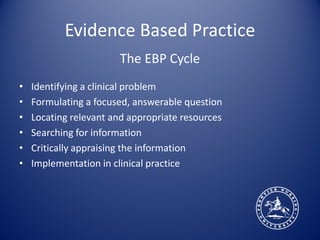
                       The EBP Cycle
•   Identifying a clinical problem
•   Formulating a focused, answerable question
•   Locating relevant and appropriate resources
•   Searching for information
•   Critically appraising the information
•   Implementation in clinical practice
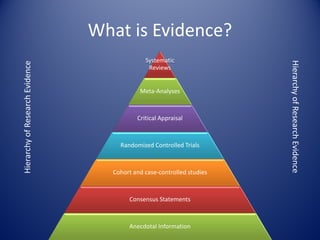
What is Evidence?
                                              Systematic


                                                                        Hierarchy of Research Evidence
Hierarchy of Research Evidence


                                               Reviews


                                            Meta-Analyses


                                           Critical Appraisal


                                     Randomized Controlled Trials


                                   Cohort and case-controlled studies


                                        Consensus Statements


                                        Anecdotal Information
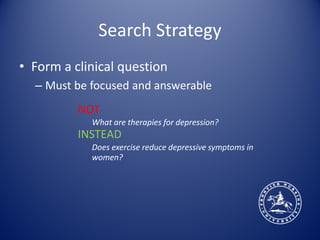
Search Strategy
• Form a clinical question
  – Must be focused and answerable
          NOT
            What are therapies for depression?
          INSTEAD
            Does exercise reduce depressive symptoms in
            women?
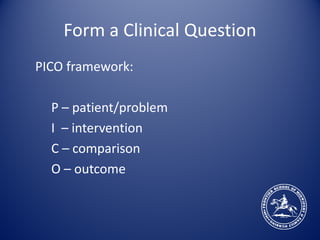
Form a Clinical Question
PICO framework:

  P – patient/problem
  I – intervention
  C – comparison
  O – outcome
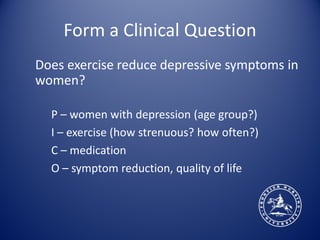
Form a Clinical Question
Does exercise reduce depressive symptoms in
women?

  P – women with depression (age group?)
  I – exercise (how strenuous? how often?)
  C – medication
  O – symptom reduction, quality of life
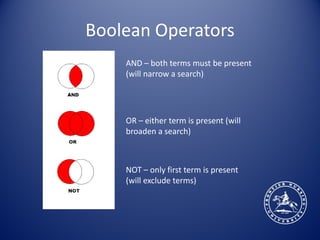
Boolean Operators
    AND – both terms must be present
    (will narrow a search)


    OR – either term is present (will
    broaden a search)


    NOT – only first term is present
    (will exclude terms)
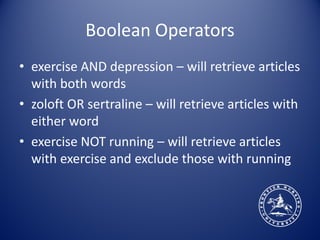
Boolean Operators
• exercise AND depression – will retrieve articles
  with both words
• zoloft OR sertraline – will retrieve articles with
  either word
• exercise NOT running – will retrieve articles
  with exercise and exclude those with running
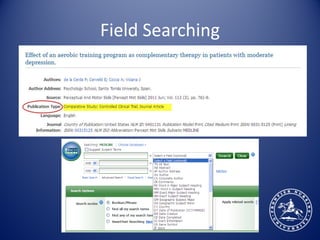
Field Searching
Subject Headings
• Specific words or phrases selected from a
  controlled vocabulary that describe a work
  – MEDLINE = MeSH
  – CINAHL = CINAHL Headings
Limiters
• Parameters for your search
  – MEDLINE limiters include:
     •   Age group
     •   Publication type
     •   Language
     •   Dates
Research Filters
• Research filters are pre-designed search
  strategies
• Clinical Queries
   – PubMed page: http://www.ncbi.nlm.nih.gov/pubmed/clinical
   – Limiter in MEDLINE (EBSCOhost)


   – ((clinical[Title/Abstract] AND trial[Title/Abstract]) OR clinical
     trials[MeSH Terms] OR clinical trial[Publication Type] OR
     random*[Title/Abstract] OR random allocation[MeSH
     Terms] OR therapeutic use[MeSH Subheading])
Where is the Evidence?
• Traditional bibliographic databases
• Meta-search engines
• Point of Care resources
Bibliographic Databases
• MEDLINE
  – via EBSCOhost
  – via PubMed
• CINAHL
• Cochrane Library
• Joanna Briggs Institute
Meta-search Engines

• SUMsearch – http://sumsearch.org
• TRIP database – http://www.tripdatabase.org
Point of Care Tools
•   DynaMed
•   Essential Evidence Plus
•   Natural Standard
•   Lexicomp
Additional Tools
• Search Alerts
  – MyNCBI
  – MyEBSCOhost
  – RSS Feeds
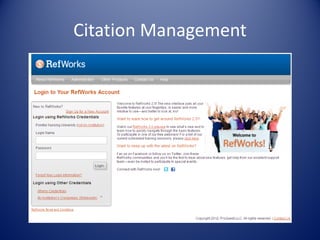
Citation Management
Finally…
• Don’t forget about librarians as a resource!
• Call us before starting your literature review!
Library Staff
• Billie Anne Gebb, Director of Library Services
  – billieanne.gebb@frontier.edu
  – (859) 899-2519
• Zach Young, Information Service Librarian
  – zach.young@frontier.edu
  – (859) 899-2511
• Kristy Nowak, Library Technician
  – kristy.nowak@frontier.edu
  – (859) 899-2526
Stay in Touch!
• Library Information Forum in the Frontier
  Community Connection
• Find us on Facebook
• Follow us on Twitter @FSMFNLibrary
• Read the FNU Library blog:
  http://frontierlibrary.blogspot.com/
• Email
• Phone

Using the Library - DNP Bound PDF

  • 1.
    Using the Library DNP Bound Frontier Nursing University
  • 2.
  • 3.
    Alice Whitman MemorialLibrary Library Home Page Library 101 in ANGEL
  • 4.
    Evidence Based Practice SEARCHINGFOR THE EVIDENCE Gebb, B.A., Young, Z., & Anderson, B.A. (2012). Evaluating and using the evidence. In B.A. Anderson & S. Stone (Eds.), Best practices in midwifery: Using the evidence to implement change. New York: Springer Publishing.
  • 5.
    Evidence Based Practice •What is EBP? – Most commonly cited definition is “the conscientious, explicit, and judicious use of current best evidence in making decisions about the care of individual patients.” – Sackett, D.L., Rosenberg, W.M.C., Gray, J.A.M., Haynes, R.B., & Richardson, W.S. (1996, January 13). Evidence-based medicine: what it is and what it isn’t. BMJ, 312(71). Retrieved from http://www.bmj.com/content/312/7023/71.full
  • 6.
    Evidence Based Practice The EBP Cycle • Identifying a clinical problem • Formulating a focused, answerable question • Locating relevant and appropriate resources • Searching for information • Critically appraising the information • Implementation in clinical practice
  • 7.
    What is Evidence? Systematic Hierarchy of Research Evidence Hierarchy of Research Evidence Reviews Meta-Analyses Critical Appraisal Randomized Controlled Trials Cohort and case-controlled studies Consensus Statements Anecdotal Information
  • 8.
    Search Strategy • Forma clinical question – Must be focused and answerable NOT What are therapies for depression? INSTEAD Does exercise reduce depressive symptoms in women?
  • 9.
    Form a ClinicalQuestion PICO framework: P – patient/problem I – intervention C – comparison O – outcome
  • 10.
    Form a ClinicalQuestion Does exercise reduce depressive symptoms in women? P – women with depression (age group?) I – exercise (how strenuous? how often?) C – medication O – symptom reduction, quality of life
  • 11.
    Boolean Operators AND – both terms must be present (will narrow a search) OR – either term is present (will broaden a search) NOT – only first term is present (will exclude terms)
  • 12.
    Boolean Operators • exerciseAND depression – will retrieve articles with both words • zoloft OR sertraline – will retrieve articles with either word • exercise NOT running – will retrieve articles with exercise and exclude those with running
  • 13.
  • 14.
    Subject Headings • Specificwords or phrases selected from a controlled vocabulary that describe a work – MEDLINE = MeSH – CINAHL = CINAHL Headings
  • 15.
    Limiters • Parameters foryour search – MEDLINE limiters include: • Age group • Publication type • Language • Dates
  • 16.
    Research Filters • Researchfilters are pre-designed search strategies • Clinical Queries – PubMed page: http://www.ncbi.nlm.nih.gov/pubmed/clinical – Limiter in MEDLINE (EBSCOhost) – ((clinical[Title/Abstract] AND trial[Title/Abstract]) OR clinical trials[MeSH Terms] OR clinical trial[Publication Type] OR random*[Title/Abstract] OR random allocation[MeSH Terms] OR therapeutic use[MeSH Subheading])
  • 17.
    Where is theEvidence? • Traditional bibliographic databases • Meta-search engines • Point of Care resources
  • 18.
    Bibliographic Databases • MEDLINE – via EBSCOhost – via PubMed • CINAHL • Cochrane Library • Joanna Briggs Institute
  • 19.
    Meta-search Engines • SUMsearch– http://sumsearch.org • TRIP database – http://www.tripdatabase.org
  • 20.
    Point of CareTools • DynaMed • Essential Evidence Plus • Natural Standard • Lexicomp
  • 21.
    Additional Tools • SearchAlerts – MyNCBI – MyEBSCOhost – RSS Feeds
  • 22.
  • 23.
    Finally… • Don’t forgetabout librarians as a resource! • Call us before starting your literature review!
  • 24.
    Library Staff • BillieAnne Gebb, Director of Library Services – billieanne.gebb@frontier.edu – (859) 899-2519 • Zach Young, Information Service Librarian – zach.young@frontier.edu – (859) 899-2511 • Kristy Nowak, Library Technician – kristy.nowak@frontier.edu – (859) 899-2526
  • 25.
    Stay in Touch! •Library Information Forum in the Frontier Community Connection • Find us on Facebook • Follow us on Twitter @FSMFNLibrary • Read the FNU Library blog: http://frontierlibrary.blogspot.com/ • Email • Phone