A natural phenomenon explained
chemically
Evaporation
TABLE OF
CONTENTS
01
Observations and Definitions
Theoretical and Practical
02
Mechanism
How Evaporation Works? And Difference between it other heat
processes
03
Experiment
Experimentally showcasing evaporation
04
Factors
Factors governing rate of Evaporation
TABLE OF
CONTENTS
05
Purpose of Evaporation
Importance of evaporation
06
Evaporator
What is evaporator and parts & types of evaporator
07
Uses of Evaporation
Showcasing utilization of evaporation in various industries
• Water in a bowl placed over stove disappears
after a while
• Wet clothes hung in open sun tend to dry
quickly
• During summer, lakes and other water bodies
get dry
• Hot tea gradually cools down after a while
• Ice cubes turn into water if left outside
General
Observations
Theoretically;
“A type of phase transition in which
molecules in a liquid state spontaneously
become gaseous”
Practically;
“Evaporation is a process of vaporizing
large quantities of volatile liquid to get a
concentrated product”
Definition
Mechanism
When heat applied in solution the motion of
molecules increase and molecules present in the
surface overcome the surface tension of the
liquid and it evaporates because surface
molecules have less cohesive force than others.
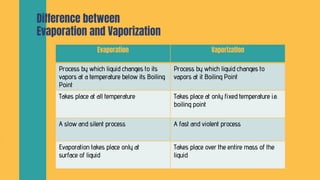
Difference between
Evaporation and Vaporization
Evaporation Vaporization
Process by which liquid changes to its
vapors at a temperature below its Boiling
Point
Process by which liquid changes to
vapors at it Boiling Point
Takes place at all temperature Takes place at only fixed temperature i.e.
boiling point
A slow and silent process A fast and violent process
Evaporation takes place only at
surface of liquid
Takes place over the entire mass of the
liquid
China Dish
Pipette
Electronic
Balance
Stopwatch
Experiment
1. Take a China Dish
2. Using pipette measure 10 ml of acetone and pour it into the china dish
3. Record the weight using an electronic balance
4. Start the Stopwatch
5. After thirty minutes check the weight again
6. Record the observations and compare them
Acetone
Procedure
Apparatus Chemicals
Observations
A decrease in the volume of Acetone is observed
Results
The decrease in the volume of acetone suggests that its molecules by
acquiring heat energy from the atmosphere should have evaporated
leaving us with less volume of liquid than before
Nature of the Liquid
Humidity
Temperature
Surface Area
Factors Affecting the
rate of Evaporation
To concentrate a solution
For Dehydration of various chemical
products
For Purification of minerals
To purify Drinking water
Vital for Water cycle
Purpose of Evaporation
An evaporator is a device used to turn the liquid
form of a chemical substance such as water into
its gaseous-form/vapor.
Evaporator
Parts
• Heat Exchanger
• Vacuum
• Vapor Separator
• Condenser
Types
• Natural circulation evaporators
• Forced circulation evaporators
• Agitated film evaporators
Production of Dyes, Salt,
Glycerin, Sodium Nitraten
paints and pigments
Chemical Industry Food Industry
Pharmaceutical
Industry
In preparation of Bulk
drugs, Yeast extract,
concentration of insulin etc.
Production of pulps, Fruit
juices, Herbal extracts,
Protein, Gelatin etc.
Uses of Evaporation
THANKS
Does anyone have any questions?

Evaporation

  • 1.
    A natural phenomenonexplained chemically Evaporation
  • 2.
    TABLE OF CONTENTS 01 Observations andDefinitions Theoretical and Practical 02 Mechanism How Evaporation Works? And Difference between it other heat processes 03 Experiment Experimentally showcasing evaporation 04 Factors Factors governing rate of Evaporation
  • 3.
    TABLE OF CONTENTS 05 Purpose ofEvaporation Importance of evaporation 06 Evaporator What is evaporator and parts & types of evaporator 07 Uses of Evaporation Showcasing utilization of evaporation in various industries
  • 4.
    • Water ina bowl placed over stove disappears after a while • Wet clothes hung in open sun tend to dry quickly • During summer, lakes and other water bodies get dry • Hot tea gradually cools down after a while • Ice cubes turn into water if left outside General Observations
  • 5.
    Theoretically; “A type ofphase transition in which molecules in a liquid state spontaneously become gaseous” Practically; “Evaporation is a process of vaporizing large quantities of volatile liquid to get a concentrated product” Definition
  • 6.
    Mechanism When heat appliedin solution the motion of molecules increase and molecules present in the surface overcome the surface tension of the liquid and it evaporates because surface molecules have less cohesive force than others.
  • 7.
    Difference between Evaporation andVaporization Evaporation Vaporization Process by which liquid changes to its vapors at a temperature below its Boiling Point Process by which liquid changes to vapors at it Boiling Point Takes place at all temperature Takes place at only fixed temperature i.e. boiling point A slow and silent process A fast and violent process Evaporation takes place only at surface of liquid Takes place over the entire mass of the liquid
  • 8.
    China Dish Pipette Electronic Balance Stopwatch Experiment 1. Takea China Dish 2. Using pipette measure 10 ml of acetone and pour it into the china dish 3. Record the weight using an electronic balance 4. Start the Stopwatch 5. After thirty minutes check the weight again 6. Record the observations and compare them Acetone Procedure Apparatus Chemicals
  • 9.
    Observations A decrease inthe volume of Acetone is observed Results The decrease in the volume of acetone suggests that its molecules by acquiring heat energy from the atmosphere should have evaporated leaving us with less volume of liquid than before
  • 10.
    Nature of theLiquid Humidity Temperature Surface Area Factors Affecting the rate of Evaporation
  • 11.
    To concentrate asolution For Dehydration of various chemical products For Purification of minerals To purify Drinking water Vital for Water cycle Purpose of Evaporation
  • 12.
    An evaporator isa device used to turn the liquid form of a chemical substance such as water into its gaseous-form/vapor. Evaporator
  • 13.
    Parts • Heat Exchanger •Vacuum • Vapor Separator • Condenser Types • Natural circulation evaporators • Forced circulation evaporators • Agitated film evaporators
  • 14.
    Production of Dyes,Salt, Glycerin, Sodium Nitraten paints and pigments Chemical Industry Food Industry Pharmaceutical Industry In preparation of Bulk drugs, Yeast extract, concentration of insulin etc. Production of pulps, Fruit juices, Herbal extracts, Protein, Gelatin etc. Uses of Evaporation
  • 15.