3. What have you learned from
audience feedback?
Izzy Christodoulou
What have you learned from
audience feedback?
Audience feedback is crucial in the process of
creating and I have learnt this over the years that I
have studied media. Audience feedback is a must for
a lot of things, for example, an editing frame,
successful targeted audience ? And gaining feedback
from the audience that will be interested in your work.
Without audience feedback the film may only appeal
to those who created it not fulfilling the needs of the
targeted audience, therefore, targeted audience
feedback is more key than any other feedback such
as from age ranges from 30-60 if your film is a
targeted 13-25.
Why is audience feedback important in
the Media?
In the media a huge amount of audience feedback is conducted
to help a new product before it is published for the public to see.
The audience feedback is highly important as it gives an
overview to the production of what the audience wants and tailor
it to fit the specific target audience, through the weaknesses
spotted to improve. Gathering all of this feedback will not only
help save money from production, however, also help make
MORE money due to the higher improved product.
Gathering feedback from the targeted audience will not only help
with gaining the right attention for the media product, however,
will help devise a successful marketing campaign with the
audiences advice on how to distribute the product to the specific
audience, for example, a teen target audience ranged between
13-20 will most likely absorb media advertisements through
social media and modern tech, such as twitter and YouTube pop
up ads.
Different types of audience feedback
BOX
OFFICE:
Box office sales will
give feedback to the
production once the
product is released and
show success through
the sales and
comparing them to
other successes
CRITICAL
RECEPTION/REVIEWS:
A critical review is key for the
media to find out the weaknesses
to then improve and aim for the
best.
Questionnaires + Surveys
Questionnaires and surveys are the easiest and quickest way to conduct
audience feedback, however, this can come with negatives also.
Strengths:
- Questionnaires conduct easy data to record for audience feedback,
which will save time and money on any other research/feedback
techniques needed to be carried out.
- Questionnaires can be user anonymous, therefore people may be willing
to write their most honest opinion on the media product leaving the end
results more accurate.
Weaknesses:
- Questionnaires may not be successful as not all who the
questionnaire was given too may fill it out and those who do,
may provide quantative data which isn't as valuable as
qualitative data , for example, in the media audience feedback is
needed to be qualitative as it will give the production an insight
to what their targeted audience want to see improved or what
they enjoy.
Website Talley
A Website Talley gathers audience feedback through the majority of
weaknesses or interests of the media product being placed online after the
first couple of audience feedback methods such as questionnaires, test
screenings or focus group responses.
Strengths:
- An easy way to gather data in a orderly form already constructed by
the website.
- It is easy to create a Talley online and one for anyone interested to fill
in.
- Doesn’t over load the audience feedback as it is quantative and a vote
on feedback already given.
Weaknesses:
- May not be accessible to everyone interested in reviewing the film due
to internet access problems.
- Gathers quantative data, which may not be as detailed as the
production of the media product needs.
Box office
The audience feedback gathered from the Box Office shows the after
effect of the media product and whether it is successful or not to the
targeted audience. This is checked through the amount of tickets sold
and to what age rage.
STRENGTHS:
- It will give relevant details to the production company of
the media product, leaving them to reflect and keep note
of successful marketing and distributing techniques.
WEAKNESSES:
- It only gives feedback once the product is released
therefore the box office stats will only reflect and help
the production company with the next or with their
prequel/sequel.
Test Screenings
Test screenings are shown to audiences to
gather feedback on distribution techniques.
These techniques will help to engage an
audience that the production company and
distribution company are aiming to impress.
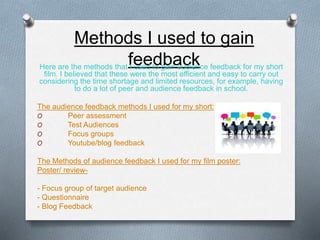
Methods I used to gain
feedbackHere are the methods that I used to gain audience feedback for my short
film. I believed that these were the most efficient and easy to carry out
considering the time shortage and limited resources, for example, having
to do a lot of peer and audience feedback in school.
The audience feedback methods I used for my short:
O Peer assessment
O Test Audiences
O Focus groups
O Youtube/blog feedback
The Methods of audience feedback I used for my film poster:
Poster/ review-
- Focus group of target audience
- Questionnaire
- Blog Feedback
My audience feedback
Over the course of making my short film we gathered a lot of
audience feedback to make sure the conventions of our film suited
the target audience and appealed to the ages between 13-25. The
FIRST feedback my group got was our film pitch. We pitched our
initial ideas to one of our teachers and she gave my group
feedback and ideas that we could include, you can find my groups
film pitch on my blog for more detail on what we pitched.
The feedback given helped us develop the initial ideas of ‘Ugh,
Really?’. After we pitched our ideas, we decided to adjust the
genre and concept of the short film, by making it a sub-genre
mockumentary to add a more comedic effect and appeal to a
bigger audience through comedy, also adding different characters
in montages to take the attention off of the four main characters.
LINK TO FINANCIAL PITCH ON BLOG
FirstDraft Ideas
Researching and gathering short film ideas was a hard process.
Whilst gathering ideas as a group and individually, we would put
them all together in our group meetings and jot them down on
paper. After gathering our first initial three ideas eventually, we
would get peer feedback from other groups in our class. This
feedback would not only trigger new ideas, however, helped with
gaining improvements to entertain our correct target audience,
being 13-25.
From this audience feedback on our three ideas, it helped
improve our film ideas and also amend them to our targeted
audience.
Test audiences
Our test audience was our class which contained around 15
students, each with different interests. My groups short film
was played half way through the process of finishing up our
editing ,however, we gathered audience feedback from the
editing and filming we had done so far.
The verbal feedback given helped us not only want to improve
our editing but to film some more cut away clips to enhance
each of the characters personality and individual interviews.
Here is some of the feedback we were given
from our target audience:
“ I would of definitely watched this as a full feature film I love
chick-flicks! I would say to change the ending soundtrack and
maybe more cut-aways, especially for the boyfriend? However,
I did love the opening scenes and the editing was advanced”
Questionnaire
I used a questionnaire to gather audience feedback on my
three initial film poster ideas as I believe it would of given me
the best, quickest results. When handing out my questionnaire I
made sure that I gave it to those of my target audience.
I was given quantative and qualatative data from my
primary research, which helped me narrow down and
eliminate ideas from the feedback given. My research
collected showed that the third poster was the most liked
out of the three.
Blog feedback
Throughout the short film project, we generated different
sources of course work including the film poster. Whilst in the
process of perfecting my coursework I gathered teacher
feedback off of my teacher. One example would be with my first
drafted poster I posted onto my blog, my teacher commented
and gave me feedback on what to improve to make my poster
the best it can be.

Evaluation question 3

  • 1.
    3. What haveyou learned from audience feedback? Izzy Christodoulou
  • 2.
    What have youlearned from audience feedback? Audience feedback is crucial in the process of creating and I have learnt this over the years that I have studied media. Audience feedback is a must for a lot of things, for example, an editing frame, successful targeted audience ? And gaining feedback from the audience that will be interested in your work. Without audience feedback the film may only appeal to those who created it not fulfilling the needs of the targeted audience, therefore, targeted audience feedback is more key than any other feedback such as from age ranges from 30-60 if your film is a targeted 13-25.
  • 3.
    Why is audiencefeedback important in the Media? In the media a huge amount of audience feedback is conducted to help a new product before it is published for the public to see. The audience feedback is highly important as it gives an overview to the production of what the audience wants and tailor it to fit the specific target audience, through the weaknesses spotted to improve. Gathering all of this feedback will not only help save money from production, however, also help make MORE money due to the higher improved product. Gathering feedback from the targeted audience will not only help with gaining the right attention for the media product, however, will help devise a successful marketing campaign with the audiences advice on how to distribute the product to the specific audience, for example, a teen target audience ranged between 13-20 will most likely absorb media advertisements through social media and modern tech, such as twitter and YouTube pop up ads.
  • 4.
    Different types ofaudience feedback BOX OFFICE: Box office sales will give feedback to the production once the product is released and show success through the sales and comparing them to other successes CRITICAL RECEPTION/REVIEWS: A critical review is key for the media to find out the weaknesses to then improve and aim for the best.
  • 5.
    Questionnaires + Surveys Questionnairesand surveys are the easiest and quickest way to conduct audience feedback, however, this can come with negatives also. Strengths: - Questionnaires conduct easy data to record for audience feedback, which will save time and money on any other research/feedback techniques needed to be carried out. - Questionnaires can be user anonymous, therefore people may be willing to write their most honest opinion on the media product leaving the end results more accurate. Weaknesses: - Questionnaires may not be successful as not all who the questionnaire was given too may fill it out and those who do, may provide quantative data which isn't as valuable as qualitative data , for example, in the media audience feedback is needed to be qualitative as it will give the production an insight to what their targeted audience want to see improved or what they enjoy.
  • 6.
    Website Talley A WebsiteTalley gathers audience feedback through the majority of weaknesses or interests of the media product being placed online after the first couple of audience feedback methods such as questionnaires, test screenings or focus group responses. Strengths: - An easy way to gather data in a orderly form already constructed by the website. - It is easy to create a Talley online and one for anyone interested to fill in. - Doesn’t over load the audience feedback as it is quantative and a vote on feedback already given. Weaknesses: - May not be accessible to everyone interested in reviewing the film due to internet access problems. - Gathers quantative data, which may not be as detailed as the production of the media product needs.
  • 7.
    Box office The audiencefeedback gathered from the Box Office shows the after effect of the media product and whether it is successful or not to the targeted audience. This is checked through the amount of tickets sold and to what age rage. STRENGTHS: - It will give relevant details to the production company of the media product, leaving them to reflect and keep note of successful marketing and distributing techniques. WEAKNESSES: - It only gives feedback once the product is released therefore the box office stats will only reflect and help the production company with the next or with their prequel/sequel.
  • 8.
    Test Screenings Test screeningsare shown to audiences to gather feedback on distribution techniques. These techniques will help to engage an audience that the production company and distribution company are aiming to impress.
  • 9.
    Methods I usedto gain feedbackHere are the methods that I used to gain audience feedback for my short film. I believed that these were the most efficient and easy to carry out considering the time shortage and limited resources, for example, having to do a lot of peer and audience feedback in school. The audience feedback methods I used for my short: O Peer assessment O Test Audiences O Focus groups O Youtube/blog feedback The Methods of audience feedback I used for my film poster: Poster/ review- - Focus group of target audience - Questionnaire - Blog Feedback
  • 10.
    My audience feedback Overthe course of making my short film we gathered a lot of audience feedback to make sure the conventions of our film suited the target audience and appealed to the ages between 13-25. The FIRST feedback my group got was our film pitch. We pitched our initial ideas to one of our teachers and she gave my group feedback and ideas that we could include, you can find my groups film pitch on my blog for more detail on what we pitched. The feedback given helped us develop the initial ideas of ‘Ugh, Really?’. After we pitched our ideas, we decided to adjust the genre and concept of the short film, by making it a sub-genre mockumentary to add a more comedic effect and appeal to a bigger audience through comedy, also adding different characters in montages to take the attention off of the four main characters. LINK TO FINANCIAL PITCH ON BLOG
  • 11.
    FirstDraft Ideas Researching andgathering short film ideas was a hard process. Whilst gathering ideas as a group and individually, we would put them all together in our group meetings and jot them down on paper. After gathering our first initial three ideas eventually, we would get peer feedback from other groups in our class. This feedback would not only trigger new ideas, however, helped with gaining improvements to entertain our correct target audience, being 13-25. From this audience feedback on our three ideas, it helped improve our film ideas and also amend them to our targeted audience.
  • 12.
    Test audiences Our testaudience was our class which contained around 15 students, each with different interests. My groups short film was played half way through the process of finishing up our editing ,however, we gathered audience feedback from the editing and filming we had done so far. The verbal feedback given helped us not only want to improve our editing but to film some more cut away clips to enhance each of the characters personality and individual interviews. Here is some of the feedback we were given from our target audience: “ I would of definitely watched this as a full feature film I love chick-flicks! I would say to change the ending soundtrack and maybe more cut-aways, especially for the boyfriend? However, I did love the opening scenes and the editing was advanced”
  • 13.
    Questionnaire I used aquestionnaire to gather audience feedback on my three initial film poster ideas as I believe it would of given me the best, quickest results. When handing out my questionnaire I made sure that I gave it to those of my target audience. I was given quantative and qualatative data from my primary research, which helped me narrow down and eliminate ideas from the feedback given. My research collected showed that the third poster was the most liked out of the three.
  • 14.
    Blog feedback Throughout theshort film project, we generated different sources of course work including the film poster. Whilst in the process of perfecting my coursework I gathered teacher feedback off of my teacher. One example would be with my first drafted poster I posted onto my blog, my teacher commented and gave me feedback on what to improve to make my poster the best it can be.