EVALUATION –
QUESTION 1
In what ways does your media product
use, develop or challenge forms and
conventions of real media products?
Front Cover
Masthead
Main Image
Barcode
AnchorText
Sell line
Pull Quote
Features
Masthead
Large bold white (contrasts with the black background)
masthead - in san serif font. Simple and at the top of the
page - behind the artists image - eye catching creates
brand awareness. Existing media that use and conform to
this:NME
Kerrang
CLASH
Q magazine
Main Image
Long shot image - direct mode of address (creates personal relationship with the
audience) - mise-en-scene agrees with the colour scheme (black white and navy)-
chiaroscuro lighting (unconventional as I wanted to create binary oppositions which
reflected my genre pop and hip-hop – opposing genres (pop is conventionally
perceived as light whereas hip-hop can have darker connotations)) - woman
(unconventional but my target audience is 16-24 years old - both genders and all
ethnicities), powerful facial expression. Existing media that use and conform to this:
CLASH Q magazine
House Style
Black, white and navy – goes against conventions as the usual house
style is white red and black - but I wanted to create an unconventional
yet still powerful house style to reach niche audiences - gender neutral
colours (conveys my target audience). Existing media that contrasts
with conventional house style (which conforms with my production):
AnchorText
Artists name – bold, eye-catching (stands out against the background) -
just the name fulfils social integrative needs and cognitive needs for my
target audience (uses and gratification theory) - overlaps the image.
Existing media that use and conform to this:
Kerrang
Q magazine CLASH
Pull Quote
Pull quote – powerful statement – conventional amongst music
magazines- creates narrative tension - entices the readers -
contrasts with the background. Existing media that use and
conform to this:
NME
Q magazine
Kerrang
Sell Line
I used the conventional sell line – introduces/informs the reader to
the magazine (uses and gratification theory) - stands out against the
background - unconventionally above the masthead as in Kerrang
(below) to appeal to a younger audience in contrast to Q magazine.
Unconventional sell lines like mine:
Conventional sell lines:
FeaturesInsight into features included – informative (uses and gratification
theory) – entice audience – house style link – contrast to background –
sideways on the right (unconventional) – smaller font – not the main
cover line
Magazines that conform to this:
CLASH:
Magazines that use a conventional style (both sides of the
page): Q magazine: NME:
Contents Page
Masthead
ImagesFeatures
Rows and
columns
Extra features
Masthead
Q magazine:
NME:
Kerrang:
Large bold title, attracts the readers eye, colour agrees with the
colour scheme - lies at the top of the page – conventional. Lower
case title is unconventional is most magazines except Q magazine - I
used this to give a professional appearance.
Existing media that uses and conform to this:
Numbering
Kerrang:
NME:
Q
magazine:
Organises the contents for the reader - makes it
easier to find specific pages - numbers lay on the left
side of the text and it is organised into columns.
Informs the readers (uses and gratification theory)
Existing media that uses and conforms to this:
Rows and Columns
Q magazine:
The contents has been sorted into columns and
rows -
simplistic layout - easier to read and locate
specific pages - bars are unconventionally bigger
as I wanted to use different coloured font
consisting with the colour scheme.
Existing media that uses and conforms to this:
Images
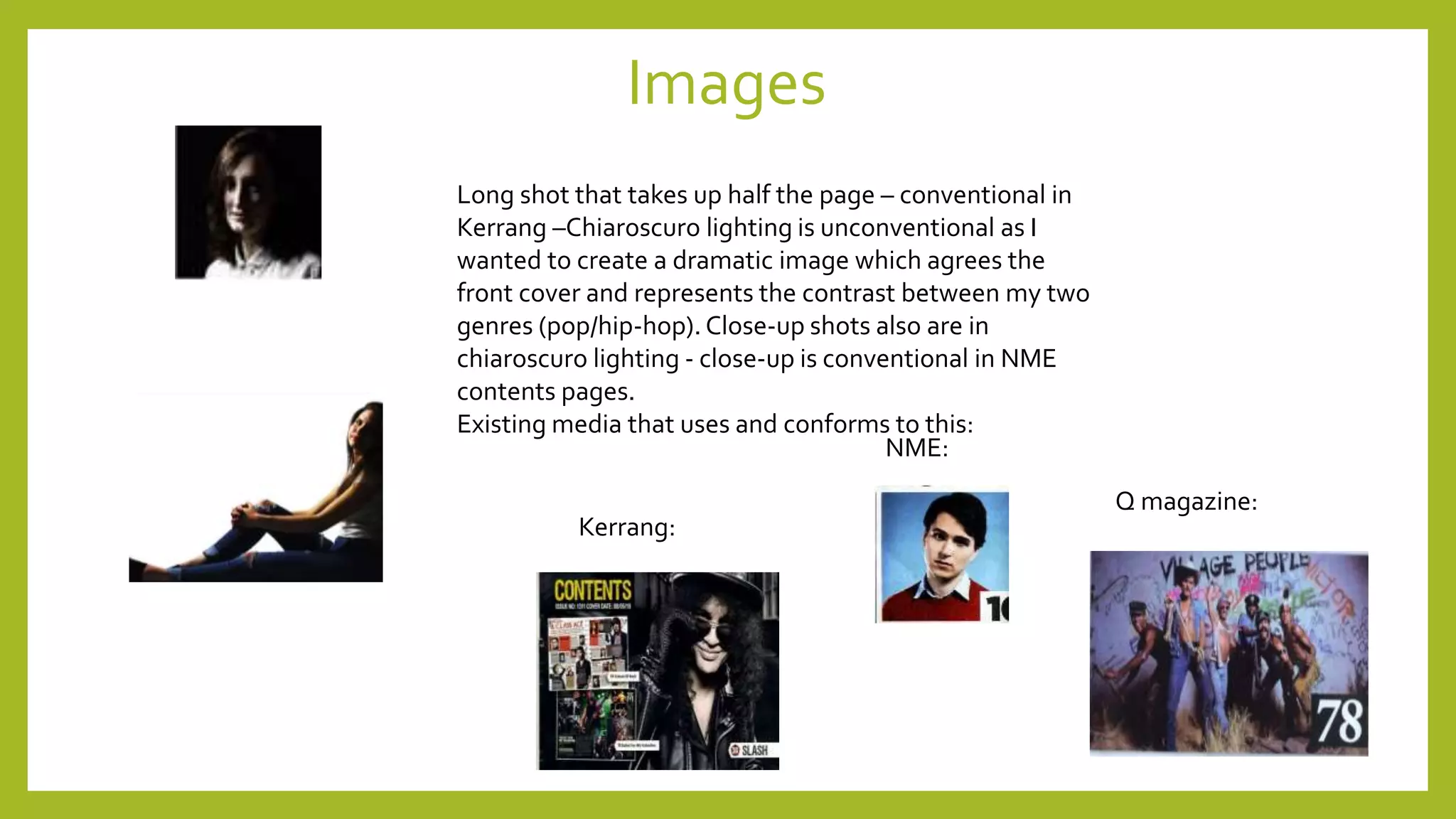
Long shot that takes up half the page – conventional in
Kerrang –Chiaroscuro lighting is unconventional as I
wanted to create a dramatic image which agrees the
front cover and represents the contrast between my two
genres (pop/hip-hop). Close-up shots also are in
chiaroscuro lighting - close-up is conventional in NME
contents pages.
Existing media that uses and conforms to this:
Kerrang:
NME:
Q magazine:
Font and Features
Kerrang:
NME:
Q magazine:
Short description of the information in the magazine -
informing the reader (uses and gratification theory) - breaks
down the magazine, altercation in colours – sans serif font –
for eye-catching and separating needs. Unconventional
social media links - consists with my target audiences
preferences - competitions are also unconventional however
this is a good way to attract regular readers and to sell more
issues (my focus group thought this was a good idea)
Existing media that uses and conforms to this:
Double Page
Spread
AnchorText
Columns of
text
Pull out quote
Main Image
Layout
Page
Numbers
Layout
Q magazine uses a similar layout:
I used the convention of having the
image take up a page on its own -
with the text being on the right.
The image is very powerful -
therefore I wanted it to be large
enough to be eye-catching.The
name of the artist is bold also -
therefore a lot attention is given to
the article just through the image
and title - attracting readers. I used
a large letter behind the text which
conforms with my colour scheme -
looks very eye-catching but faint
enough to read the text.
Image
Q
magazine:
Spin:
NME:
I used the convention of a monochrome medium close-
up of a female artist - the facial expression is very
powerful and the direct mode of address creates
personal relationships with the reader (uses and
gratification theory).
Existing media that uses and conforms to this:
AnchorText andText
Kerrang:
NME:
Q magazine:
Sans serif font – conventional with target
audiences preferences, easier to read, large
bold anchor text of the artist’s name (fulfils
social integrative needs), lies at the top of
the page (informative – uses and
gratification theory), conforms with colour
scheme.
Existing media that uses and conforms to
this:
Pull out quote and Page numbers
Q magazine:
NME:
Kerrang:
Large font – eye-catching to the reader –
informs them of the contents of the article
(uses and gratification theory) – conforms with
the colour scheme – lies outside the columns
of text – conventional
Existing media that uses and conforms to this:

Evaluation – question 1

  • 1.
    EVALUATION – QUESTION 1 Inwhat ways does your media product use, develop or challenge forms and conventions of real media products?
  • 2.
  • 3.
    Masthead Large bold white(contrasts with the black background) masthead - in san serif font. Simple and at the top of the page - behind the artists image - eye catching creates brand awareness. Existing media that use and conform to this:NME Kerrang CLASH Q magazine
  • 4.
    Main Image Long shotimage - direct mode of address (creates personal relationship with the audience) - mise-en-scene agrees with the colour scheme (black white and navy)- chiaroscuro lighting (unconventional as I wanted to create binary oppositions which reflected my genre pop and hip-hop – opposing genres (pop is conventionally perceived as light whereas hip-hop can have darker connotations)) - woman (unconventional but my target audience is 16-24 years old - both genders and all ethnicities), powerful facial expression. Existing media that use and conform to this: CLASH Q magazine
  • 5.
    House Style Black, whiteand navy – goes against conventions as the usual house style is white red and black - but I wanted to create an unconventional yet still powerful house style to reach niche audiences - gender neutral colours (conveys my target audience). Existing media that contrasts with conventional house style (which conforms with my production):
  • 6.
    AnchorText Artists name –bold, eye-catching (stands out against the background) - just the name fulfils social integrative needs and cognitive needs for my target audience (uses and gratification theory) - overlaps the image. Existing media that use and conform to this: Kerrang Q magazine CLASH
  • 7.
    Pull Quote Pull quote– powerful statement – conventional amongst music magazines- creates narrative tension - entices the readers - contrasts with the background. Existing media that use and conform to this: NME Q magazine Kerrang
  • 8.
    Sell Line I usedthe conventional sell line – introduces/informs the reader to the magazine (uses and gratification theory) - stands out against the background - unconventionally above the masthead as in Kerrang (below) to appeal to a younger audience in contrast to Q magazine. Unconventional sell lines like mine: Conventional sell lines:
  • 9.
    FeaturesInsight into featuresincluded – informative (uses and gratification theory) – entice audience – house style link – contrast to background – sideways on the right (unconventional) – smaller font – not the main cover line Magazines that conform to this: CLASH: Magazines that use a conventional style (both sides of the page): Q magazine: NME:
  • 10.
  • 11.
    Masthead Q magazine: NME: Kerrang: Large boldtitle, attracts the readers eye, colour agrees with the colour scheme - lies at the top of the page – conventional. Lower case title is unconventional is most magazines except Q magazine - I used this to give a professional appearance. Existing media that uses and conform to this:
  • 12.
    Numbering Kerrang: NME: Q magazine: Organises the contentsfor the reader - makes it easier to find specific pages - numbers lay on the left side of the text and it is organised into columns. Informs the readers (uses and gratification theory) Existing media that uses and conforms to this:
  • 13.
    Rows and Columns Qmagazine: The contents has been sorted into columns and rows - simplistic layout - easier to read and locate specific pages - bars are unconventionally bigger as I wanted to use different coloured font consisting with the colour scheme. Existing media that uses and conforms to this:
  • 14.
    Images Long shot thattakes up half the page – conventional in Kerrang –Chiaroscuro lighting is unconventional as I wanted to create a dramatic image which agrees the front cover and represents the contrast between my two genres (pop/hip-hop). Close-up shots also are in chiaroscuro lighting - close-up is conventional in NME contents pages. Existing media that uses and conforms to this: Kerrang: NME: Q magazine:
  • 15.
    Font and Features Kerrang: NME: Qmagazine: Short description of the information in the magazine - informing the reader (uses and gratification theory) - breaks down the magazine, altercation in colours – sans serif font – for eye-catching and separating needs. Unconventional social media links - consists with my target audiences preferences - competitions are also unconventional however this is a good way to attract regular readers and to sell more issues (my focus group thought this was a good idea) Existing media that uses and conforms to this:
  • 16.
    Double Page Spread AnchorText Columns of text Pullout quote Main Image Layout Page Numbers
  • 17.
    Layout Q magazine usesa similar layout: I used the convention of having the image take up a page on its own - with the text being on the right. The image is very powerful - therefore I wanted it to be large enough to be eye-catching.The name of the artist is bold also - therefore a lot attention is given to the article just through the image and title - attracting readers. I used a large letter behind the text which conforms with my colour scheme - looks very eye-catching but faint enough to read the text.
  • 18.
    Image Q magazine: Spin: NME: I used theconvention of a monochrome medium close- up of a female artist - the facial expression is very powerful and the direct mode of address creates personal relationships with the reader (uses and gratification theory). Existing media that uses and conforms to this:
  • 19.
    AnchorText andText Kerrang: NME: Q magazine: Sansserif font – conventional with target audiences preferences, easier to read, large bold anchor text of the artist’s name (fulfils social integrative needs), lies at the top of the page (informative – uses and gratification theory), conforms with colour scheme. Existing media that uses and conforms to this:
  • 20.
    Pull out quoteand Page numbers Q magazine: NME: Kerrang: Large font – eye-catching to the reader – informs them of the contents of the article (uses and gratification theory) – conforms with the colour scheme – lies outside the columns of text – conventional Existing media that uses and conforms to this: