EVALUATING WEB
CONTENT AUTHENTICITY:
“THE 5 W’S”*
*Source: Kathy Schrock
http://www.schrockguide.net/
uploads/3/9/2/2/392267/5ws.pdf
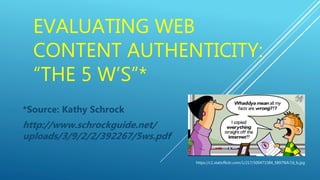
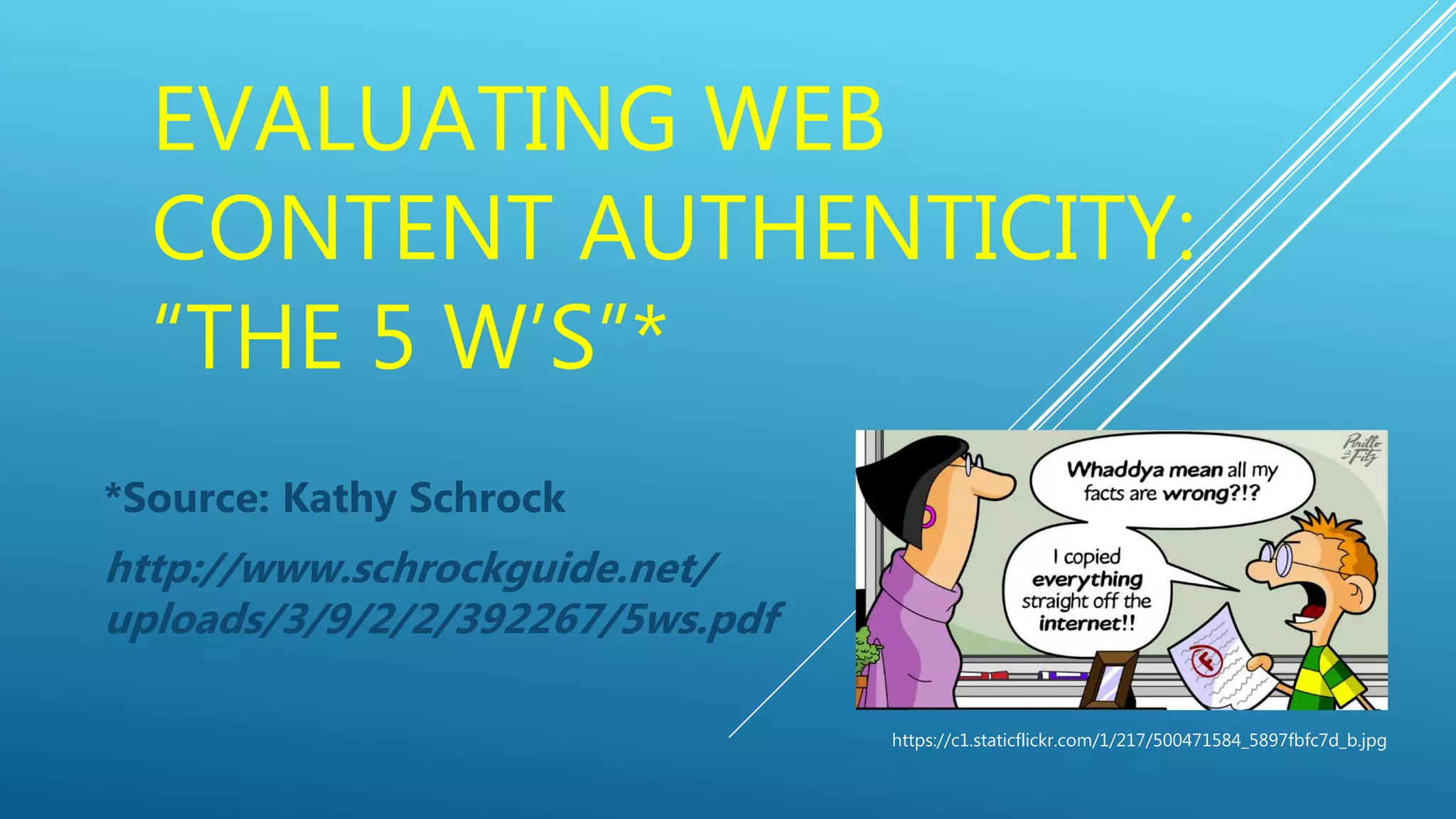
https://c1.staticflickr.com/1/217/500471584_5897fbfc7d_b.jpg
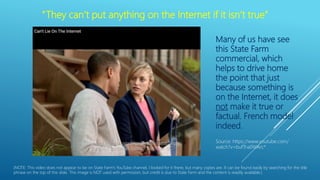
“They can’t put anything on the Internet if it isn’t true”
Many of us have see
this State Farm
commercial, which
helps to drive home
the point that just
because something is
on the Internet, it does
not make it true or
factual. French model
indeed.
(NOTE: This video does not appear to be on State Farm’s YouTube channel, I looked for it there, but many copies are. It can be found easily by searching for the title
phrase on the top of this slide. This image is NOT used with permission, but credit is due to State Farm and the content is readily available.)
Source: https://www.youtube.com/
watch?v=bufTna0WArc*
Evaluating Web Content Authenticity:
“The 5 W’s”*
So just how does one
go about determining
if information
published on the
World Wide Web
is accurate?
Evaluating Web Content Authenticity:
“The 5 W’s”*
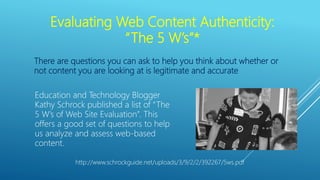
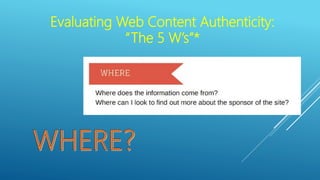
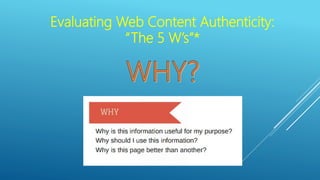
There are questions you can ask to help you think about whether or
not content you are looking at is legitimate and accurate
Education and Technology Blogger
Kathy Schrock published a list of “The
5 W’s of Web Site Evaluation”. This
offers a good set of questions to help
us analyze and assess web-based
content.
http://www.schrockguide.net/uploads/3/9/2/2/392267/5ws.pdf
Evaluating Web Content Authenticity:
“The 5 W’s”*
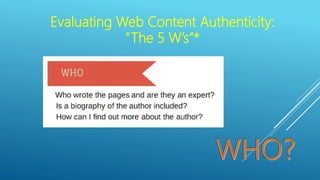
Evaluating Web Content Authenticity:
“The 5 W’s”*
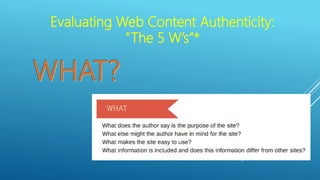
Evaluating Web Content Authenticity:
“The 5 W’s”*
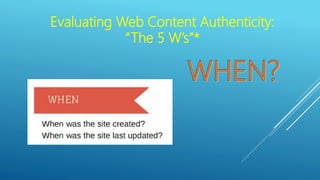
Evaluating Web Content Authenticity:
“The 5 W’s”*
Evaluating Web Content Authenticity:
“The 5 W’s”*
Applying the “The 5 W’s”
Now, let’s use a couple sites as examples, and ask “the
5 W’s” to assess their authority and validity.
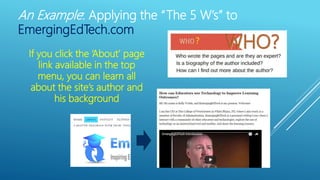
An Example: Applying the “The 5 W’s” to
EmergingEdTech.com
If you click the ‘About’ page
link available in the top
menu, you can learn all
about the site’s author and
his background
?
An Example: Applying the “The 5 W’s” to
EmergingEdTech.com
?
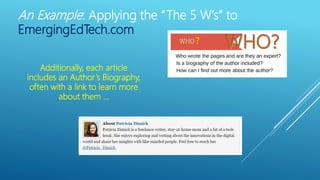
Additionally, each article
includes an Author’s Biography,
often with a link to learn more
about them …
An Example: Applying the “The 5 W’s” to
EmergingEdTech.com
?
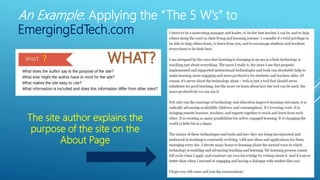
The site author explains the
purpose of the site on the
About Page
An Example: Applying the “The 5 W’s” to
EmergingEdTech.com
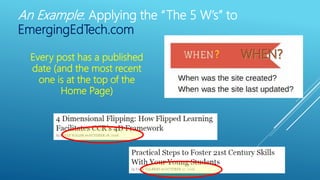
?Every post has a published
date (and the most recent
one is at the top of the
Home Page)
An Example: Applying the “The 5 W’s” to
EmergingEdTech.com
?
We already answered this when examining the question of
“Who”.
This may not always be the case and may sometime
require further exploration.
An Example: Applying the “The 5 W’s” to
EmergingEdTech.com
?
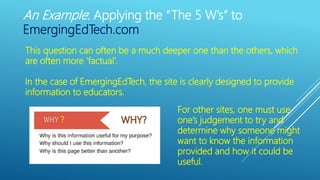
This question can often be a much deeper one than the others, which
are often more ‘factual’.
In the case of EmergingEdTech, the site is clearly designed to provide
information to educators.
For other sites, one must use
one’s judgement to try and
determine why someone might
want to know the information
provided and how it could be
useful.
Applying the “The 5 W’s”
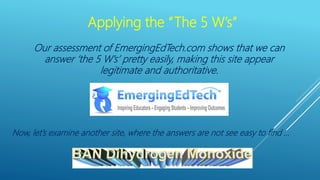
Our assessment of EmergingEdTech.com shows that we can
answer ‘the 5 W’s’ pretty easily, making this site appear
legitimate and authoritative.
Now, let’s examine another site, where the answers are not see easy to find …
An Example: Applying the “The 5 W’s” to
BanDHMO.org
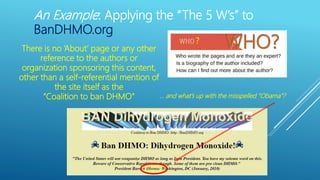
There is no ‘About’ page or any other
reference to the authors or
organization sponsoring this content,
other than a self-referential mention of
the site itself as the
“Coalition to ban DHMO”
?
… and what’s up with the misspelled “Obama“?
?
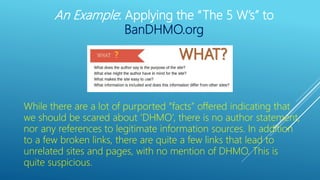
While there are a lot of purported “facts” offered indicating that
we should be scared about ‘DHMO’, there is no author statement,
nor any references to legitimate information sources. In addition
to a few broken links, there are quite a few links that lead to
unrelated sites and pages, with no mention of DHMO. This is
quite suspicious.
An Example: Applying the “The 5 W’s” to
BanDHMO.org
An Example: Applying the “The 5 W’s” to
BanDHMO.org
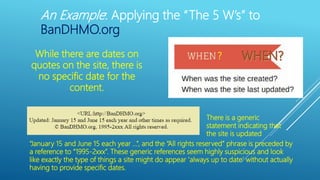
?While there are dates on
quotes on the site, there is
no specific date for the
content.
“January 15 and June 15 each year …”, and the “All rights reserved” phrase is preceded by
a reference to “1995-2xxx”. These generic references seem highly suspicious and look
like exactly the type of things a site might do appear ‘always up to date’ without actually
having to provide specific dates.
There is a generic
statement indicating that
the site is updated
?
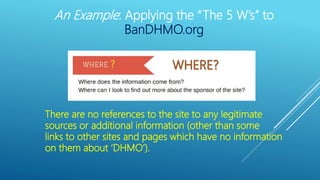
There are no references to the site to any legitimate
sources or additional information (other than some
links to other sites and pages which have no information
on them about ‘DHMO’).
An Example: Applying the “The 5 W’s” to
BanDHMO.org
An Example: Applying the “The 5 W’s” to
BanDHMO.org
?
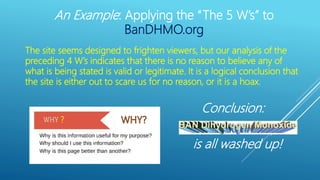
The site seems designed to frighten viewers, but our analysis of the
preceding 4 W’s indicates that there is no reason to believe any of
what is being stated is valid or legitimate. It is a logical conclusion that
the site is either out to scare us for no reason, or it is a hoax.
is all washed up!
Conclusion:
An Example: Applying the “The 5 W’s” to
BanDHMO.org
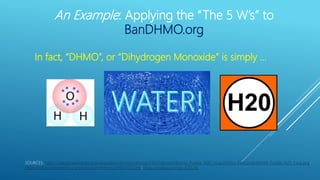
In fact, “DHMO”, or “Dihydrogen Monoxide” is simply …
SOURCES: https://upload.wikimedia.org/wikipedia/commons/thumb/f/f6/Elektronenformel_Punkte_H20_1.svg/2000px-Elektronenformel_Punkte_H20_1.svg.png;
https://upload.wikimedia.org/wikipedia/commons/9/90/H20.png; https://pixabay.com/p-321524/

Evaluating web content authenticity

  • 1.
    EVALUATING WEB CONTENT AUTHENTICITY: “THE5 W’S”* *Source: Kathy Schrock http://www.schrockguide.net/ uploads/3/9/2/2/392267/5ws.pdf https://c1.staticflickr.com/1/217/500471584_5897fbfc7d_b.jpg
  • 2.
    “They can’t putanything on the Internet if it isn’t true” Many of us have see this State Farm commercial, which helps to drive home the point that just because something is on the Internet, it does not make it true or factual. French model indeed. (NOTE: This video does not appear to be on State Farm’s YouTube channel, I looked for it there, but many copies are. It can be found easily by searching for the title phrase on the top of this slide. This image is NOT used with permission, but credit is due to State Farm and the content is readily available.) Source: https://www.youtube.com/ watch?v=bufTna0WArc*
  • 3.
    Evaluating Web ContentAuthenticity: “The 5 W’s”* So just how does one go about determining if information published on the World Wide Web is accurate?
  • 4.
    Evaluating Web ContentAuthenticity: “The 5 W’s”* There are questions you can ask to help you think about whether or not content you are looking at is legitimate and accurate Education and Technology Blogger Kathy Schrock published a list of “The 5 W’s of Web Site Evaluation”. This offers a good set of questions to help us analyze and assess web-based content. http://www.schrockguide.net/uploads/3/9/2/2/392267/5ws.pdf
  • 5.
    Evaluating Web ContentAuthenticity: “The 5 W’s”*
  • 6.
    Evaluating Web ContentAuthenticity: “The 5 W’s”*
  • 7.
    Evaluating Web ContentAuthenticity: “The 5 W’s”*
  • 8.
    Evaluating Web ContentAuthenticity: “The 5 W’s”*
  • 9.
    Evaluating Web ContentAuthenticity: “The 5 W’s”*
  • 10.
    Applying the “The5 W’s” Now, let’s use a couple sites as examples, and ask “the 5 W’s” to assess their authority and validity.
  • 11.
    An Example: Applyingthe “The 5 W’s” to EmergingEdTech.com If you click the ‘About’ page link available in the top menu, you can learn all about the site’s author and his background ?
  • 12.
    An Example: Applyingthe “The 5 W’s” to EmergingEdTech.com ? Additionally, each article includes an Author’s Biography, often with a link to learn more about them …
  • 13.
    An Example: Applyingthe “The 5 W’s” to EmergingEdTech.com ? The site author explains the purpose of the site on the About Page
  • 14.
    An Example: Applyingthe “The 5 W’s” to EmergingEdTech.com ?Every post has a published date (and the most recent one is at the top of the Home Page)
  • 15.
    An Example: Applyingthe “The 5 W’s” to EmergingEdTech.com ? We already answered this when examining the question of “Who”. This may not always be the case and may sometime require further exploration.
  • 16.
    An Example: Applyingthe “The 5 W’s” to EmergingEdTech.com ? This question can often be a much deeper one than the others, which are often more ‘factual’. In the case of EmergingEdTech, the site is clearly designed to provide information to educators. For other sites, one must use one’s judgement to try and determine why someone might want to know the information provided and how it could be useful.
  • 17.
    Applying the “The5 W’s” Our assessment of EmergingEdTech.com shows that we can answer ‘the 5 W’s’ pretty easily, making this site appear legitimate and authoritative. Now, let’s examine another site, where the answers are not see easy to find …
  • 18.
    An Example: Applyingthe “The 5 W’s” to BanDHMO.org There is no ‘About’ page or any other reference to the authors or organization sponsoring this content, other than a self-referential mention of the site itself as the “Coalition to ban DHMO” ? … and what’s up with the misspelled “Obama“?
  • 19.
    ? While there area lot of purported “facts” offered indicating that we should be scared about ‘DHMO’, there is no author statement, nor any references to legitimate information sources. In addition to a few broken links, there are quite a few links that lead to unrelated sites and pages, with no mention of DHMO. This is quite suspicious. An Example: Applying the “The 5 W’s” to BanDHMO.org
  • 20.
    An Example: Applyingthe “The 5 W’s” to BanDHMO.org ?While there are dates on quotes on the site, there is no specific date for the content. “January 15 and June 15 each year …”, and the “All rights reserved” phrase is preceded by a reference to “1995-2xxx”. These generic references seem highly suspicious and look like exactly the type of things a site might do appear ‘always up to date’ without actually having to provide specific dates. There is a generic statement indicating that the site is updated
  • 21.
    ? There are noreferences to the site to any legitimate sources or additional information (other than some links to other sites and pages which have no information on them about ‘DHMO’). An Example: Applying the “The 5 W’s” to BanDHMO.org
  • 22.
    An Example: Applyingthe “The 5 W’s” to BanDHMO.org ? The site seems designed to frighten viewers, but our analysis of the preceding 4 W’s indicates that there is no reason to believe any of what is being stated is valid or legitimate. It is a logical conclusion that the site is either out to scare us for no reason, or it is a hoax. is all washed up! Conclusion:
  • 23.
    An Example: Applyingthe “The 5 W’s” to BanDHMO.org In fact, “DHMO”, or “Dihydrogen Monoxide” is simply … SOURCES: https://upload.wikimedia.org/wikipedia/commons/thumb/f/f6/Elektronenformel_Punkte_H20_1.svg/2000px-Elektronenformel_Punkte_H20_1.svg.png; https://upload.wikimedia.org/wikipedia/commons/9/90/H20.png; https://pixabay.com/p-321524/