Helpful Internet Resources for Allied Health Professionals Webinar by Phillip Kindschi
History of the Internet The internet began in the early 1960’s and was developed to aid in scientific and military fields by allowing computers to share information on research and development Advanced Research Projects Agency (ARPA) initially connected four major computers at universities in the southwestern US (UCLA, Stanford Research Institute, UCSB, and the University of Utah).  In 1972, Electronic mail is introduced by Ray Tomlinson, a Cambridge, Mass. computer scientist. He successfully employs a new program that allows the sending of messages over the net, allowing direct person-to-person communication. The early Internet was used by computer experts, engineers, scientists, and librarians
“ They say a year in the Internet business is like a dog year..  equivalent to seven years in a regular person's life. In other words, it's evolving fast and faster”-    Viton Cerf
Internet History Cont. In 1974 Stanford opened up  Telenet , the first openly accessible public 'packet data service' (a commercial version of ARPANET)  1982 - The word “Internet” is used for the first time.  1984 - Domain Name System (DNS) is established, with network addresses identified by extensions such as .com, .org, and .edu.  In 1990, the first Internet search-engine for finding and retrieving computer files, Archie, was developed at McGill University, Montreal.   Delphi was the first national commercial online service to offer Internet access to its  subscribers in 1992 March 15th, 1985 Symbolics.com is assigned the first registered web address
 
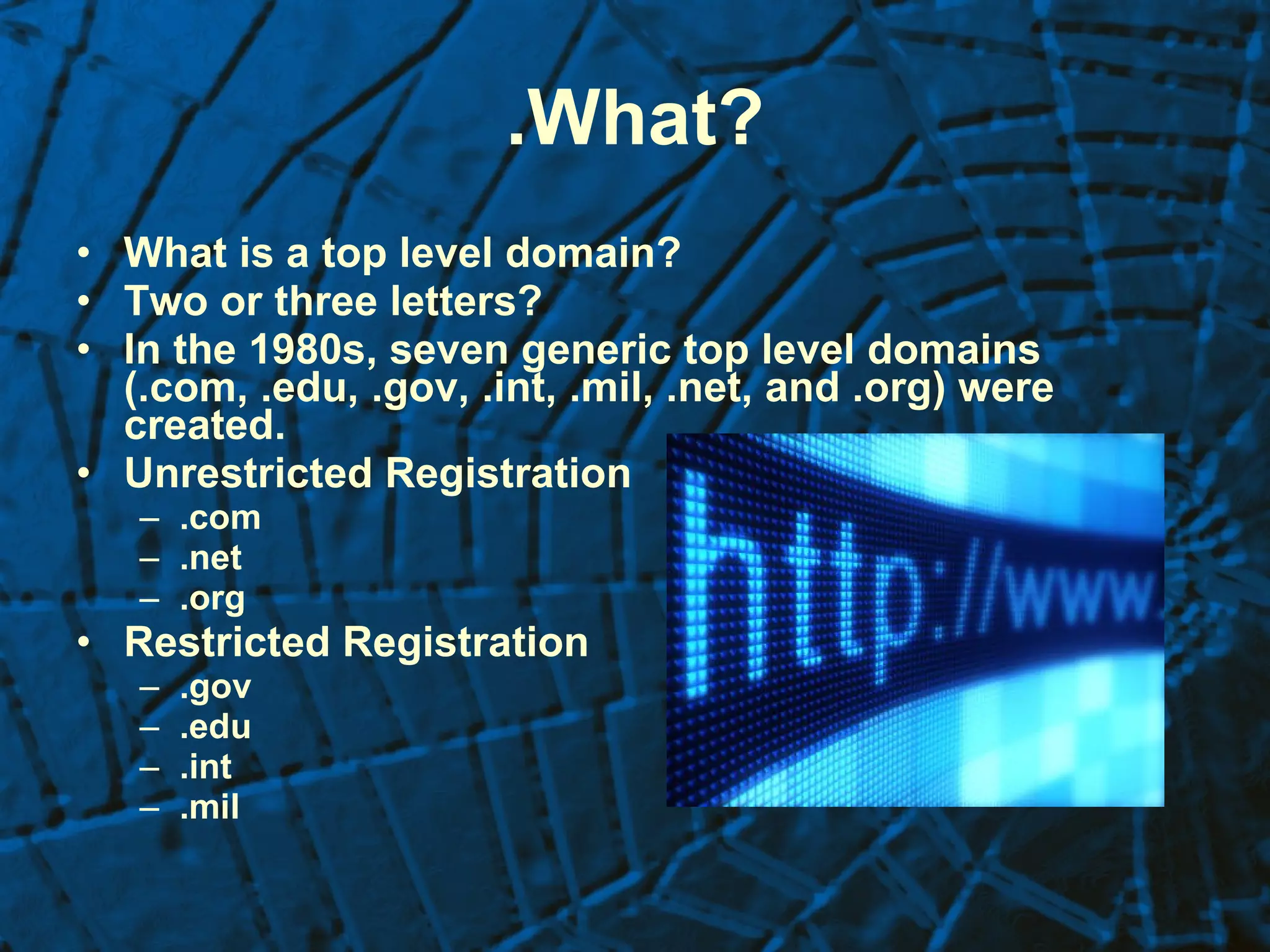
.What? What is a top level domain? Two or three letters? In the 1980s, seven generic top level domains (.com, .edu, .gov, .int, .mil, .net, and .org) were created. Unrestricted Registration .com .net .org Restricted Registration .gov .edu .int .mil
Restricted Domains .gov -   Is used by the government entities in the United States. Federal agencies in the United States use the .fed domain extension.   .edu -   Is widely used by the educational institutions across the United States. Not all websites using the .edu extension are educational institutions. Some of them are museums or research organizations linked with education.  .int -   int gTLD is reserved for international treaty-based organizations   .mil -  The Department of Defense and its subordinate organizations use the .mil domain extension
Unrestricted Domains .com  -  Is by far the largest type of top level domains. There are no restrictions on who can register a .com site but, most are commercial entities. .net -  Initially intended to be used only for the computers of network providers (such as Internet service providers). While still popular with network operators, it is often treated as a second .com. It is currently the third most popular top-level domain, after .com and .de . .org -  Was recommended for and perceived by common public to be of non-commercial entities, however there are no such registry restrictions similar to those with .gov or .edu
Poll Question Do you use the internet for medical research? I do not have internet access I have internet access, but do not feel comfortable enough with the technology or information accuracy to use the internet for medical research I have used the internet to diagnose or look for more information on a personal medical related condition I have used the internet for medical research and referred others to specific sites to do so as well None of the above
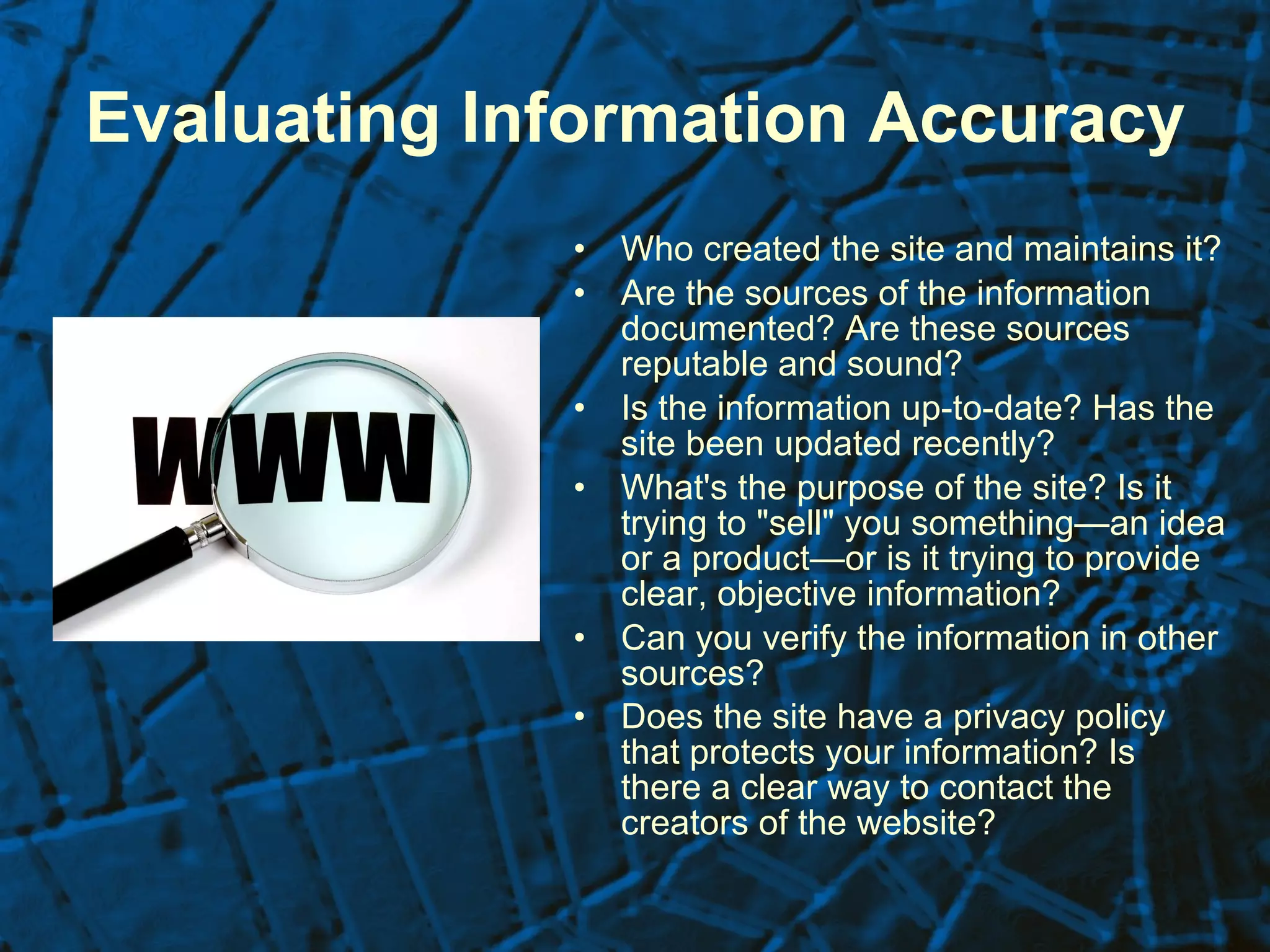
Evaluating Information Accuracy   Who created the site and maintains it?  Are the sources of the information documented? Are these sources reputable and sound?  Is the information up-to-date? Has the site been updated recently?  What's the purpose of the site? Is it trying to "sell" you something—an idea or a product—or is it trying to provide clear, objective information?  Can you verify the information in other sources?  Does the site have a privacy policy that protects your information? Is there a clear way to contact the creators of the website?
“ Getting information off the Internet is like taking a drink from a fire hydrant.”   Mitchell Kapor
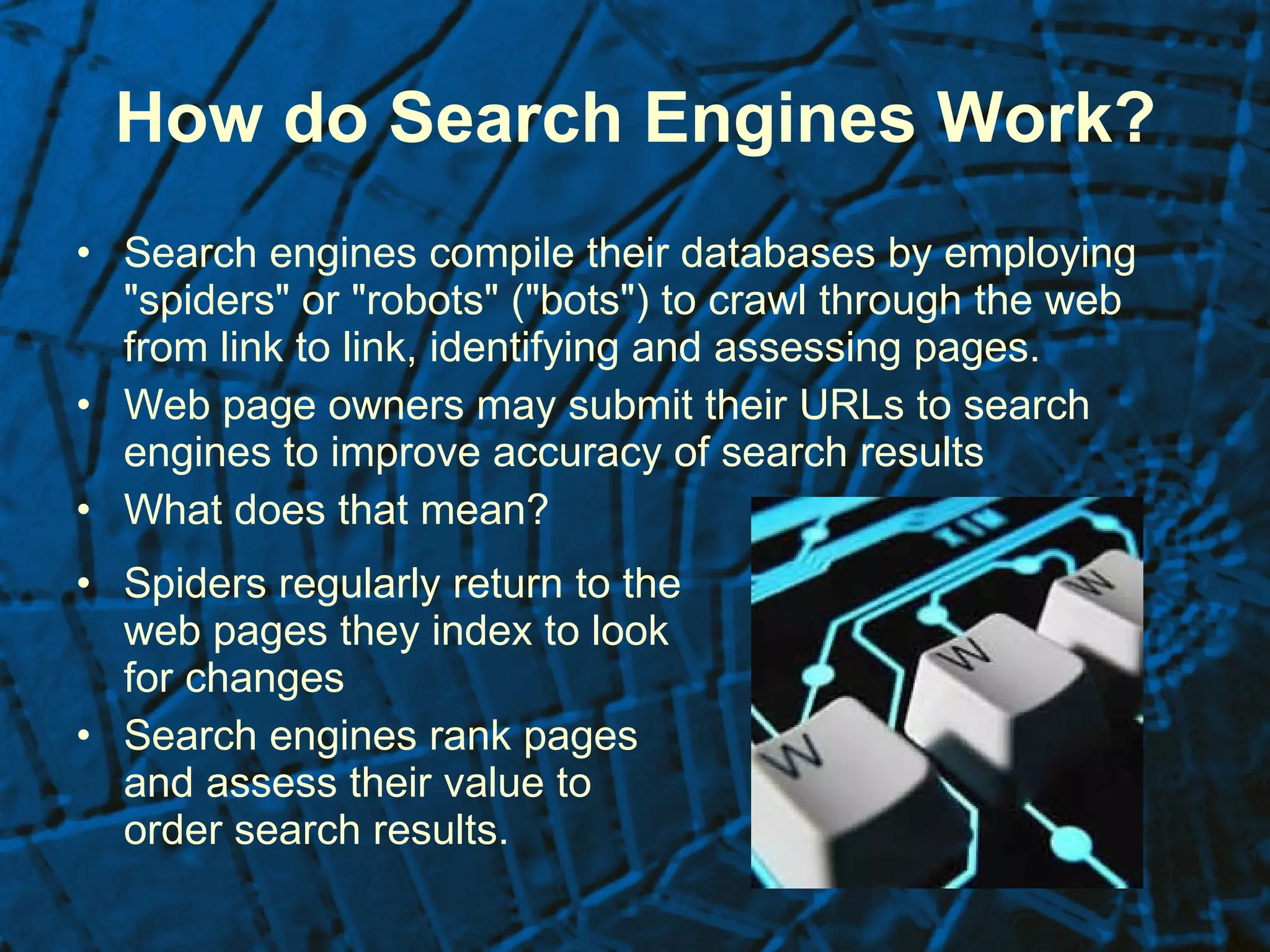
How do Search Engines Work? Search engines compile their databases by employing "spiders" or "robots" ("bots") to crawl through the web from link to link, identifying and assessing pages.  Web page owners may submit their URLs to search engines to improve accuracy of search results What does that mean? Spiders regularly return to the web pages they index to look for changes  Search engines rank pages and assess their value to order search results.
Tips for More Accurate Searches Be specific  Ex. Instead of “Hurricane” try “Hurricane Ike news” Use the plus (+) and minus (-) signs in front of words to force their inclusion and/or exclusion in searches. Use double quotation marks (" ") around phrases to ensure they are searched exactly as is, with the words side by side in the same order   Put your most important keywords first in the string  Think about words you'd expect to find in the body of the page, and use them as keywords  Use truncation (or stemming)  Ex. librar* returns library, libraries, librarian, etc.
Accreditation and Related Links ASPA  (Commission Association of Specialized and Professional Accreditors CAAHEP  (Commission on Accreditation of Allied Health Education Professions)  CHEA  (Council for Higher Education Accreditation)  ASAHP  (The Association of Schools of the Allied Health Professions)
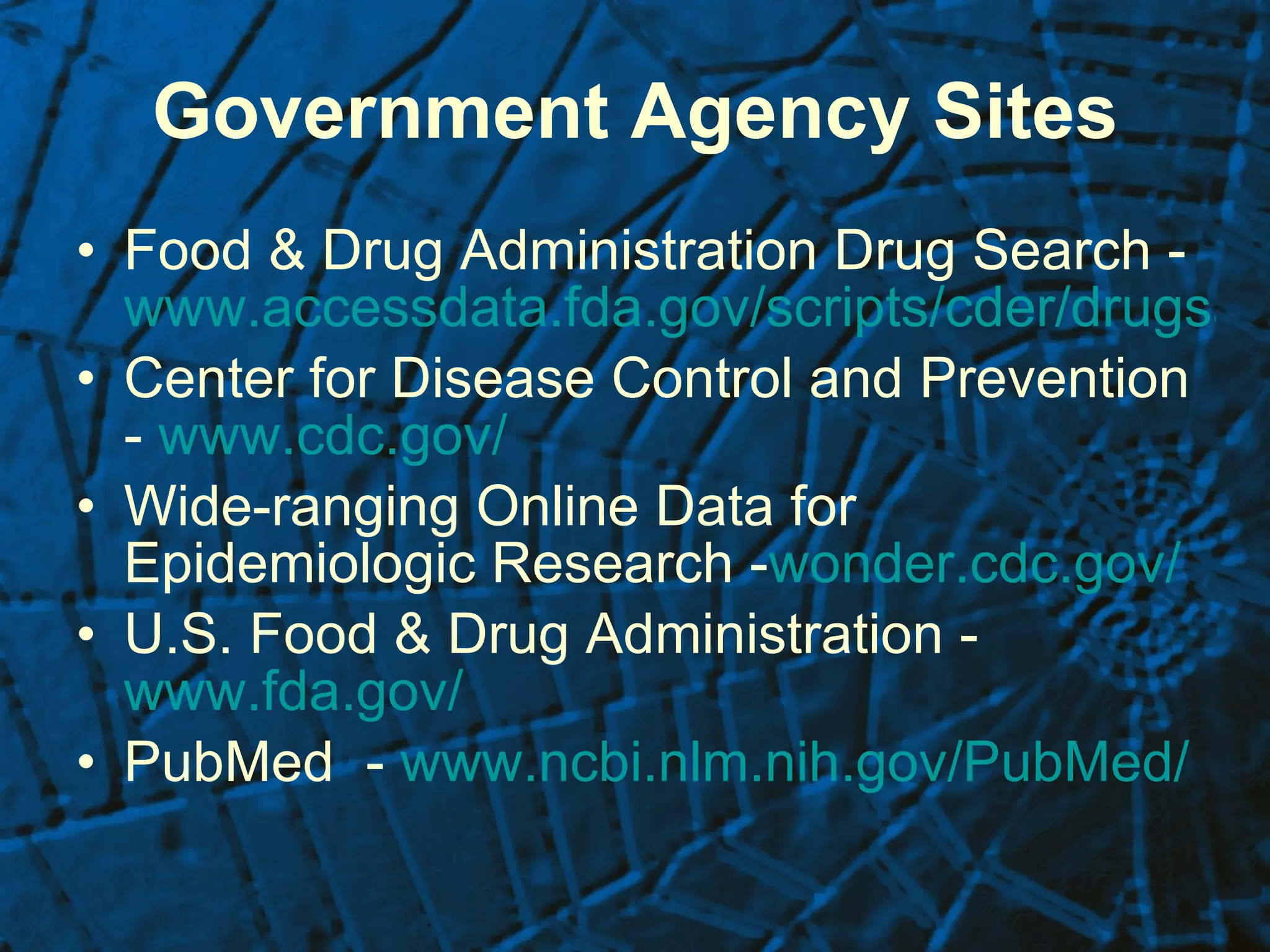
Government Agency Sites Food & Drug Administration Drug Search - www.accessdata.fda.gov/scripts/cder/drugsatfda/ Center for Disease Control and Prevention -  www.cdc.gov/ Wide-ranging Online Data for Epidemiologic Research - wonder.cdc.gov/ U.S. Food & Drug Administration -  www.fda.gov/ PubMed  -  www.ncbi.nlm.nih.gov/PubMed/
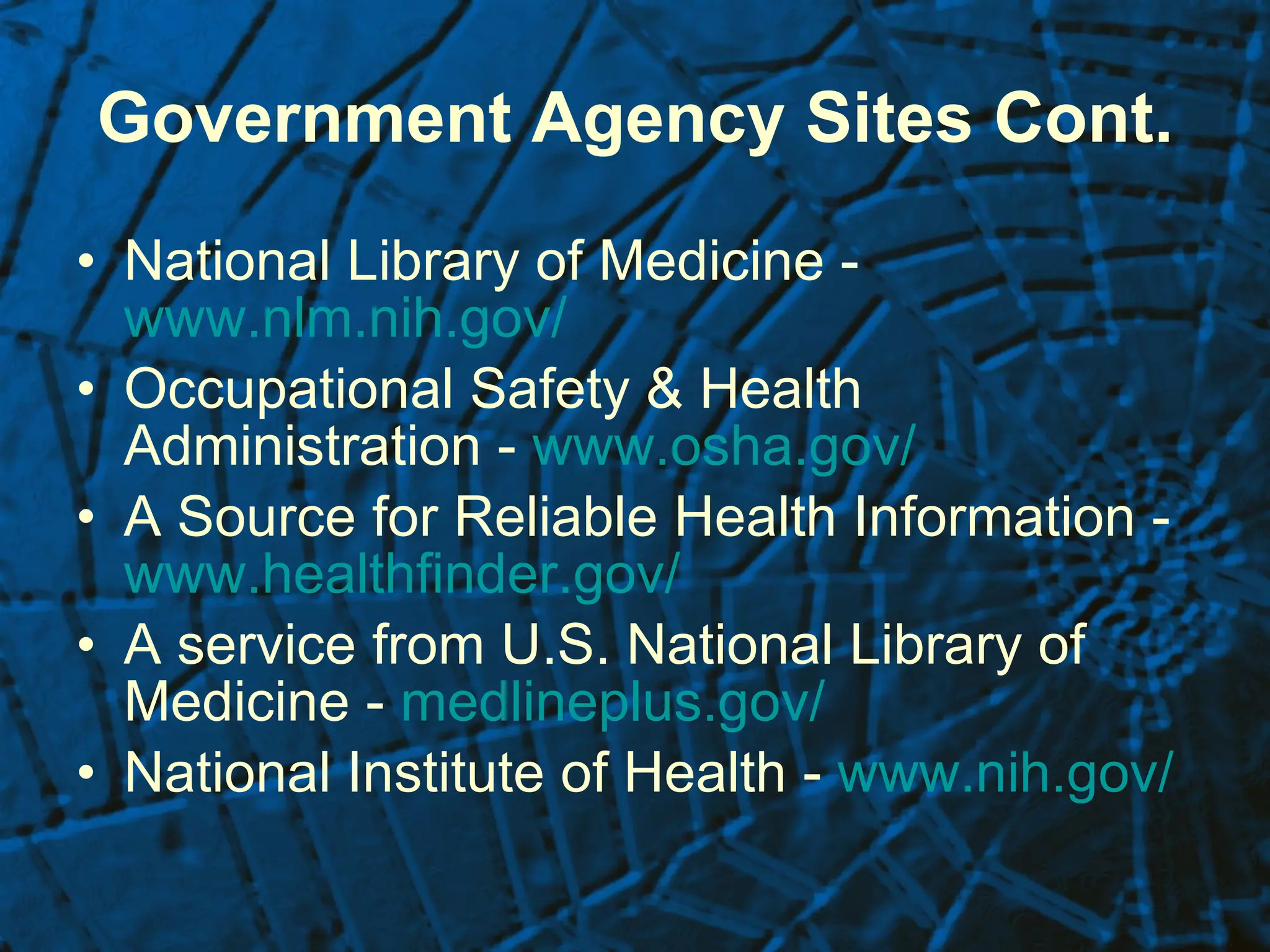
Government Agency Sites Cont. National Library of Medicine -  www.nlm.nih.gov/ Occupational Safety & Health Administration -  www.osha.gov/ A Source for Reliable Health Information -  www.healthfinder.gov/   A service from U.S. National Library of Medicine -  medlineplus.gov/ National Institute of Health -  www.nih.gov/
Privately Sponsored Websites The Mayo Clinic -  mayoclinic.com   Aetna InteliHealth -  intelihealth.com   Web MD -  WebMd.com   The Merck Manuals -  merck.com/mmpe/index.html
Specific Condition Links Diabetes -  diabetes.org Cancer -  aacr.org   Anxiety –  MentalHelp.net HPV –  National Institute of Health Depression -  depression.com   Eating Disorders -  nationaleatingdisorders.org Alzheimer’s –  Federal Citizens Info Center
 
Conclusion Verify Information Accuracy External links MPC Resource Mall Don’t forget to take the CE course exam

Internet Resources Power Point

  • 1.
    Helpful Internet Resourcesfor Allied Health Professionals Webinar by Phillip Kindschi
  • 2.
    History of theInternet The internet began in the early 1960’s and was developed to aid in scientific and military fields by allowing computers to share information on research and development Advanced Research Projects Agency (ARPA) initially connected four major computers at universities in the southwestern US (UCLA, Stanford Research Institute, UCSB, and the University of Utah). In 1972, Electronic mail is introduced by Ray Tomlinson, a Cambridge, Mass. computer scientist. He successfully employs a new program that allows the sending of messages over the net, allowing direct person-to-person communication. The early Internet was used by computer experts, engineers, scientists, and librarians
  • 3.
    “ They saya year in the Internet business is like a dog year.. equivalent to seven years in a regular person's life. In other words, it's evolving fast and faster”- Viton Cerf
  • 4.
    Internet History Cont.In 1974 Stanford opened up Telenet , the first openly accessible public 'packet data service' (a commercial version of ARPANET) 1982 - The word “Internet” is used for the first time. 1984 - Domain Name System (DNS) is established, with network addresses identified by extensions such as .com, .org, and .edu. In 1990, the first Internet search-engine for finding and retrieving computer files, Archie, was developed at McGill University, Montreal. Delphi was the first national commercial online service to offer Internet access to its subscribers in 1992 March 15th, 1985 Symbolics.com is assigned the first registered web address
  • 5.
  • 6.
    .What? What isa top level domain? Two or three letters? In the 1980s, seven generic top level domains (.com, .edu, .gov, .int, .mil, .net, and .org) were created. Unrestricted Registration .com .net .org Restricted Registration .gov .edu .int .mil
  • 7.
    Restricted Domains .gov- Is used by the government entities in the United States. Federal agencies in the United States use the .fed domain extension. .edu - Is widely used by the educational institutions across the United States. Not all websites using the .edu extension are educational institutions. Some of them are museums or research organizations linked with education. .int - int gTLD is reserved for international treaty-based organizations .mil - The Department of Defense and its subordinate organizations use the .mil domain extension
  • 8.
    Unrestricted Domains .com - Is by far the largest type of top level domains. There are no restrictions on who can register a .com site but, most are commercial entities. .net - Initially intended to be used only for the computers of network providers (such as Internet service providers). While still popular with network operators, it is often treated as a second .com. It is currently the third most popular top-level domain, after .com and .de . .org - Was recommended for and perceived by common public to be of non-commercial entities, however there are no such registry restrictions similar to those with .gov or .edu
  • 9.
    Poll Question Doyou use the internet for medical research? I do not have internet access I have internet access, but do not feel comfortable enough with the technology or information accuracy to use the internet for medical research I have used the internet to diagnose or look for more information on a personal medical related condition I have used the internet for medical research and referred others to specific sites to do so as well None of the above
  • 10.
    Evaluating Information Accuracy Who created the site and maintains it? Are the sources of the information documented? Are these sources reputable and sound? Is the information up-to-date? Has the site been updated recently? What's the purpose of the site? Is it trying to "sell" you something—an idea or a product—or is it trying to provide clear, objective information? Can you verify the information in other sources? Does the site have a privacy policy that protects your information? Is there a clear way to contact the creators of the website?
  • 11.
    “ Getting informationoff the Internet is like taking a drink from a fire hydrant.” Mitchell Kapor
  • 12.
    How do SearchEngines Work? Search engines compile their databases by employing "spiders" or "robots" ("bots") to crawl through the web from link to link, identifying and assessing pages. Web page owners may submit their URLs to search engines to improve accuracy of search results What does that mean? Spiders regularly return to the web pages they index to look for changes Search engines rank pages and assess their value to order search results.
  • 13.
    Tips for MoreAccurate Searches Be specific Ex. Instead of “Hurricane” try “Hurricane Ike news” Use the plus (+) and minus (-) signs in front of words to force their inclusion and/or exclusion in searches. Use double quotation marks (" ") around phrases to ensure they are searched exactly as is, with the words side by side in the same order Put your most important keywords first in the string Think about words you'd expect to find in the body of the page, and use them as keywords Use truncation (or stemming) Ex. librar* returns library, libraries, librarian, etc.
  • 14.
    Accreditation and RelatedLinks ASPA (Commission Association of Specialized and Professional Accreditors CAAHEP (Commission on Accreditation of Allied Health Education Professions) CHEA (Council for Higher Education Accreditation) ASAHP (The Association of Schools of the Allied Health Professions)
  • 15.
    Government Agency SitesFood & Drug Administration Drug Search - www.accessdata.fda.gov/scripts/cder/drugsatfda/ Center for Disease Control and Prevention - www.cdc.gov/ Wide-ranging Online Data for Epidemiologic Research - wonder.cdc.gov/ U.S. Food & Drug Administration - www.fda.gov/ PubMed - www.ncbi.nlm.nih.gov/PubMed/
  • 16.
    Government Agency SitesCont. National Library of Medicine - www.nlm.nih.gov/ Occupational Safety & Health Administration - www.osha.gov/ A Source for Reliable Health Information - www.healthfinder.gov/ A service from U.S. National Library of Medicine - medlineplus.gov/ National Institute of Health - www.nih.gov/
  • 17.
    Privately Sponsored WebsitesThe Mayo Clinic - mayoclinic.com Aetna InteliHealth - intelihealth.com Web MD - WebMd.com The Merck Manuals - merck.com/mmpe/index.html
  • 18.
    Specific Condition LinksDiabetes - diabetes.org Cancer - aacr.org Anxiety – MentalHelp.net HPV – National Institute of Health Depression - depression.com Eating Disorders - nationaleatingdisorders.org Alzheimer’s – Federal Citizens Info Center
  • 19.
  • 20.
    Conclusion Verify InformationAccuracy External links MPC Resource Mall Don’t forget to take the CE course exam

Editor's Notes

  • #3 The early Internet was used by computer experts, engineers, scientists, and librarians – The internet was not intended to be used as the commercial hub it is today.
  • #7 There are two types of top-level domains: two-letter country domains, such as .uk (United Kingdom), and three-letter domains, such as .com, .org, and .net. National domain names follow the ISO 3166 standard two-letter codes for each country. The International Standards Organization adds new two-letter codes to the ISO 3166 list when the United Nations publishes an updated bulletin of country and region codes. You can learn more about this on the website of the International Standards Organization
  • #11 Who created the site and maintains it? (Who sponsors the site?) What are their credentials to provide information about the subject?
  • #13 Search engines rank pages and assess their value to order search results. Some of them (such as Google) assess popularity by the number of links that are pointing to sites; the more links, the greater the popularity, i.e., value of the page What does that mean?? Whenever you search the web using a search engine, you're asking the engine to scan site index and match your keywords or phrases with those in the texts of documents within the pages the engine has “crawled”.