The Super3 This is dedicated to all the elementary teachers that feel overwhelmed when conducting research with their students.
What is the Super 3? The Super3 is a simplified version of the Big6 research model.  The Big6 has six steps and the Super3 only contains three. The Super3 is specifically written so younger students can understand how to research (Big 6).
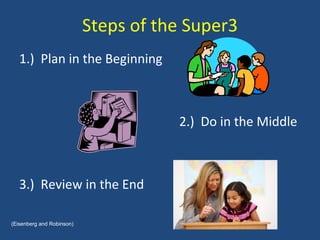
Steps of the Super3 1.)  Plan in the Beginning 2.)  Do in the Middle 3.)  Review in the End (Eisenberg and Robinson)
Step 1 of the Super3 PLAN What is my job? What information do I need to find? Where can I find the information? How will I know if my work is good? What is my plan? (Eisenberg and Robinson) (Little)
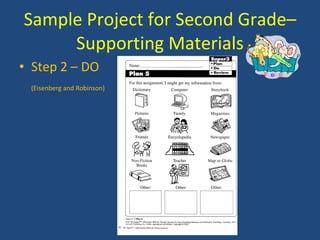
Step 2 of the Super3 DO I will find the information needed for the job. I can put the information together to make sense. I may read from books, use the computer, take notes, and draw pictures. I will cite my sources of information. (Eisenberg and Robinson) (Big 6)
Step 3 of the Super 3 REVIEW Did I complete the job? Do I feel great about my work? Have I proofread to make sure it is correct? Is there anything else that needs to be done? What will I do differently next time? Did I use my own words? (Eisenberg and Robinson) (Walker)
Who can use the Super 3? The Super 3 is most appropriate for preschoolers through third grade students (Eisenberg and Robinson). It can also be chosen for fourth and fifth grade students when the Big 6 is too rigorous for the research task (Walker). A gradual transition from the Super 3 to the Big 6 is recommended. Advanced learners may move quickly from the Super 3 to the Big 6.
Why should I choose the Super 3 for MY classroom? The Super3 is the perfect model for introducing students to the process of researching. Once they feel comfortable with these steps, they can gradually transition to the more rigorous steps of the Big6. The advantage for students is that the Super3 and Big6 models were developed by the same people and are designed to teach children how to research in phases.  When research becomes overwhelming, both students and teachers want to either quit, or simply never begin such projects again. The Super3 allows educators to begin research projects with confidence and guidance.  Implementing the Super3 leads students to become successful researchers.
How will my students remember the steps? The Super3 Song Sung to the tune of “Bingo” Here is a process I can use, Its name is Super3-0! Plan, do, and review; Plan, do, and review; Plan, do, and review; Its name is Super3-0! (All words taken from Big 6)
Advantages of Using the Super3 Students who have a strong foundation in the Super3 will be ready to transition to the Big6. The process of research will be more efficient in the upper grades if teachers and students start with a simplified model in the primary grades. Students in the primary grades will recognize the beginning-middle-end model and/or be able to connect that to other content areas.
Transitioning in Older Grades The steps to the Super3 and Big6 should be reviewed often.   It is imperative that elementary and middle school librarians collaborate to make sure each student makes a smooth transition from the Super3 to the Big6. Each student should be met on their level.  Teachers and librarians may have some students utilizing the Super3 and others using the Big6 at the same time.
For Future Use…The Big6 (Posters taken directly from Big 6)
For Future Use…The Big 6 (Posters taken directly from Big 6)
Project Ideas Science Fair Projects Timelines of Historical Figures  Nonfiction and Historical Fiction Books Compare/Contrast  Author Studies and Biographies  Animal Reports
Sample Project for Second Grade– Animal Reports  Step 1 – Plan Students will select an animal and then complete a thinking web of details they already know about that animal Students will select two  other sources of information  to learn more about  their animal
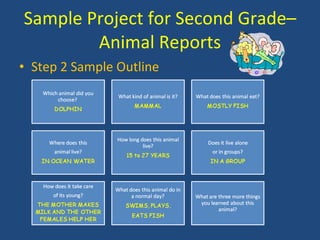
Sample Project for Second Grade– Animal Reports Step 2 – Do Using the resources they have located or the teacher has provided, students complete a draft outline  Students use the draft outline to generate complete sentences, then link sentences to create their report.
Sample Project for Second Grade– Animal Reports Step 2 Sample Outline
Sample Project for Second Grade– Animal Reports Step 3 – REVIEW Students conference with teacher to edit and revise their work Students publish their reports with pictures, diagrams, and/or graphs Students review their work or the work of their peers using the rubric
Sample Project for Second Grade– Supporting Materials Step 1 – PLAN (Eisenberg and Robinson)
Sample Project for Second Grade– Supporting Materials Step 2 – DO (Eisenberg and Robinson)
Sample Project for Second Grade– Supporting Materials Step 3 – REVIEW (Eisenberg and Robinson)
Works Cited Big 6. “The Big 6.”  WordPress, 2008.  Web.  10 October 2010. < http://www.big6.com/ > Little, Tami.  The Super3. &quot;What is the Super3?.&quot; Web.  9 Oct. 2010. < http://academic.wsc.edu/redl/classes/tami/super3.html >. Eisenberg, Michael and Laura Eisenberg Robinson. “Super 3 Webinar 2008.”  Online PowerPoint.  20 October 2010. < https://docs.google.com/present/view?id=df897djd_55dcvhbjcf >. Miller, Pat.  Stretchy Library Lessons: Research Skills : Grades K-5 .  Ft. Atkinson: Upstart Books, 2003. Print. Robinson, Michael B. and Laura Eisenberg Robinson.  The Super3: Information Skills for Young Learners . Worthington: Linworth Publishing, 2007.  Print. Walker, Laura. Super 3 Research Process. Finneytown Local School District. 2009. Web. 20 October 2010. < http://web.mac.com/larawalker/FinneytownLMC/Super3_Research_Process.html >.

super 3 writing

  • 1.
    The Super3 Thisis dedicated to all the elementary teachers that feel overwhelmed when conducting research with their students.
  • 2.
    What is theSuper 3? The Super3 is a simplified version of the Big6 research model. The Big6 has six steps and the Super3 only contains three. The Super3 is specifically written so younger students can understand how to research (Big 6).
  • 3.
    Steps of theSuper3 1.) Plan in the Beginning 2.) Do in the Middle 3.) Review in the End (Eisenberg and Robinson)
  • 4.
    Step 1 ofthe Super3 PLAN What is my job? What information do I need to find? Where can I find the information? How will I know if my work is good? What is my plan? (Eisenberg and Robinson) (Little)
  • 5.
    Step 2 ofthe Super3 DO I will find the information needed for the job. I can put the information together to make sense. I may read from books, use the computer, take notes, and draw pictures. I will cite my sources of information. (Eisenberg and Robinson) (Big 6)
  • 6.
    Step 3 ofthe Super 3 REVIEW Did I complete the job? Do I feel great about my work? Have I proofread to make sure it is correct? Is there anything else that needs to be done? What will I do differently next time? Did I use my own words? (Eisenberg and Robinson) (Walker)
  • 7.
    Who can usethe Super 3? The Super 3 is most appropriate for preschoolers through third grade students (Eisenberg and Robinson). It can also be chosen for fourth and fifth grade students when the Big 6 is too rigorous for the research task (Walker). A gradual transition from the Super 3 to the Big 6 is recommended. Advanced learners may move quickly from the Super 3 to the Big 6.
  • 8.
    Why should Ichoose the Super 3 for MY classroom? The Super3 is the perfect model for introducing students to the process of researching. Once they feel comfortable with these steps, they can gradually transition to the more rigorous steps of the Big6. The advantage for students is that the Super3 and Big6 models were developed by the same people and are designed to teach children how to research in phases. When research becomes overwhelming, both students and teachers want to either quit, or simply never begin such projects again. The Super3 allows educators to begin research projects with confidence and guidance. Implementing the Super3 leads students to become successful researchers.
  • 9.
    How will mystudents remember the steps? The Super3 Song Sung to the tune of “Bingo” Here is a process I can use, Its name is Super3-0! Plan, do, and review; Plan, do, and review; Plan, do, and review; Its name is Super3-0! (All words taken from Big 6)
  • 10.
    Advantages of Usingthe Super3 Students who have a strong foundation in the Super3 will be ready to transition to the Big6. The process of research will be more efficient in the upper grades if teachers and students start with a simplified model in the primary grades. Students in the primary grades will recognize the beginning-middle-end model and/or be able to connect that to other content areas.
  • 11.
    Transitioning in OlderGrades The steps to the Super3 and Big6 should be reviewed often. It is imperative that elementary and middle school librarians collaborate to make sure each student makes a smooth transition from the Super3 to the Big6. Each student should be met on their level. Teachers and librarians may have some students utilizing the Super3 and others using the Big6 at the same time.
  • 12.
    For Future Use…TheBig6 (Posters taken directly from Big 6)
  • 13.
    For Future Use…TheBig 6 (Posters taken directly from Big 6)
  • 14.
    Project Ideas ScienceFair Projects Timelines of Historical Figures Nonfiction and Historical Fiction Books Compare/Contrast Author Studies and Biographies Animal Reports
  • 15.
    Sample Project forSecond Grade– Animal Reports Step 1 – Plan Students will select an animal and then complete a thinking web of details they already know about that animal Students will select two other sources of information to learn more about their animal
  • 16.
    Sample Project forSecond Grade– Animal Reports Step 2 – Do Using the resources they have located or the teacher has provided, students complete a draft outline Students use the draft outline to generate complete sentences, then link sentences to create their report.
  • 17.
    Sample Project forSecond Grade– Animal Reports Step 2 Sample Outline
  • 18.
    Sample Project forSecond Grade– Animal Reports Step 3 – REVIEW Students conference with teacher to edit and revise their work Students publish their reports with pictures, diagrams, and/or graphs Students review their work or the work of their peers using the rubric
  • 19.
    Sample Project forSecond Grade– Supporting Materials Step 1 – PLAN (Eisenberg and Robinson)
  • 20.
    Sample Project forSecond Grade– Supporting Materials Step 2 – DO (Eisenberg and Robinson)
  • 21.
    Sample Project forSecond Grade– Supporting Materials Step 3 – REVIEW (Eisenberg and Robinson)
  • 22.
    Works Cited Big6. “The Big 6.” WordPress, 2008. Web. 10 October 2010. < http://www.big6.com/ > Little, Tami. The Super3. &quot;What is the Super3?.&quot; Web. 9 Oct. 2010. < http://academic.wsc.edu/redl/classes/tami/super3.html >. Eisenberg, Michael and Laura Eisenberg Robinson. “Super 3 Webinar 2008.” Online PowerPoint. 20 October 2010. < https://docs.google.com/present/view?id=df897djd_55dcvhbjcf >. Miller, Pat. Stretchy Library Lessons: Research Skills : Grades K-5 . Ft. Atkinson: Upstart Books, 2003. Print. Robinson, Michael B. and Laura Eisenberg Robinson. The Super3: Information Skills for Young Learners . Worthington: Linworth Publishing, 2007. Print. Walker, Laura. Super 3 Research Process. Finneytown Local School District. 2009. Web. 20 October 2010. < http://web.mac.com/larawalker/FinneytownLMC/Super3_Research_Process.html >.