Essay Writing
Essay structure
An essay should follow this basic structure:


                              Introduction
                              (1 paragraph, 2 at most)


                                Main Body
           (as many paragraphs as you need to cover your points properly)


                               Conclusion
  (1 paragraph, bringing together your points – do not introduce new information!)
Essay structure
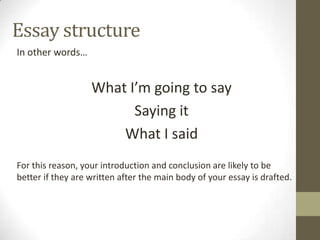
In other words…


                   What I’m going to say
                         Saying it
                       What I said
For this reason, your introduction and conclusion are likely to be
better if they are written after the main body of your essay is drafted.
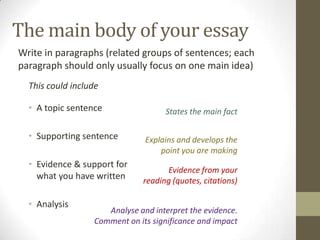
The main body of your essay
Write in paragraphs (related groups of sentences; each
paragraph should only usually focus on one main idea)
  This could include

  • A topic sentence                States the main fact

  • Supporting sentence        Explains and develops the
                                   point you are making
  • Evidence & support for
                                    Evidence from your
    what you have written     reading (quotes, citations)

  • Analysis
                     Analyse and interpret the evidence.
                  Comment on its significance and impact
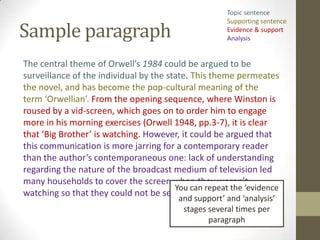
Topic sentence


Sample paragraph
                                                      Supporting sentence
                                                      Evidence & support
                                                      Analysis


The central theme of Orwell’s 1984 could be argued to be
surveillance of the individual by the state. This theme permeates
the novel, and has become the pop-cultural meaning of the
term ‘Orwellian’. From the opening sequence, where Winston is
roused by a vid-screen, which goes on to order him to engage
more in his morning exercises (Orwell 1948, pp.3-7), it is clear
that ‘Big Brother’ is watching. However, it could be argued that
this communication is more jarring for a contemporary reader
than the author’s contemporaneous one: lack of understanding
regarding the nature of the broadcast medium of television led
many households to cover the screen when they weren’t
                                        You can repeat the ‘evidence
watching so that they could not be seen (Deary 1995).
                                         and support’ and ‘analysis’
                                          stages several times per
                                                 paragraph
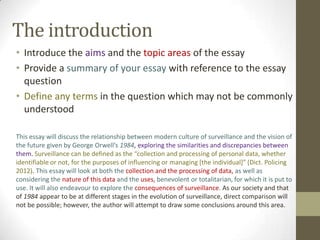
The introduction
• Introduce the aims and the topic areas of the essay
• Provide a summary of your essay with reference to the essay
  question
• Define any terms in the question which may not be commonly
  understood

This essay will discuss the relationship between modern culture of surveillance and the vision of
the future given by George Orwell’s 1984, exploring the similarities and discrepancies between
them. Surveillance can be defined as the “collection and processing of personal data, whether
identifiable or not, for the purposes of influencing or managing *the individual+” (Dict. Policing
2012). This essay will look at both the collection and the processing of data, as well as
considering the nature of this data and the uses, benevolent or totalitarian, for which it is put to
use. It will also endeavour to explore the consequences of surveillance. As our society and that
of 1984 appear to be at different stages in the evolution of surveillance, direct comparison will
not be possible; however, the author will attempt to draw some conclusions around this area.
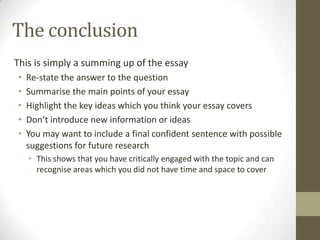
The conclusion
This is simply a summing up of the essay
•   Re-state the answer to the question
•   Summarise the main points of your essay
•   Highlight the key ideas which you think your essay covers
•   Don’t introduce new information or ideas
•   You may want to include a final confident sentence with possible
    suggestions for future research
    • This shows that you have critically engaged with the topic and can
      recognise areas which you did not have time and space to cover
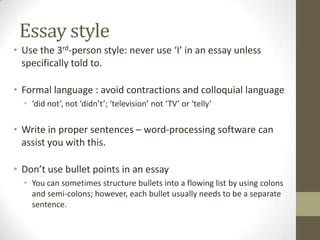
Essay style
• Use the 3rd-person style: never use ‘I’ in an essay unless
  specifically told to.

• Formal language : avoid contractions and colloquial language
  • ‘did not’, not ‘didn’t’; ‘television’ not ‘TV’ or ‘telly’

• Write in proper sentences – word-processing software can
  assist you with this.

• Don’t use bullet points in an essay
  • You can sometimes structure bullets into a flowing list by using colons
    and semi-colons; however, each bullet usually needs to be a separate
    sentence.
Essay style
• Use clear language to communicate your points
  • Avoid obfuscation (obscure language used instead of simple terms)

• Re-write your work at least once, to make it flow better
  • First-drafts often become ‘garbled’ as you pull ideas together – you may
    know what it means, but the marker may not!


• Make sure you are not just describing something. For good
  marks you need to discuss, explain and analyse ideas.
Hints and tips
• Keep within the word count.
  • If you tend to write too much, reduce the number of individual points.
    If you don’t write enough, try to expand the points.


• You should be able to read out your work without struggling
  for breath (unless you smoke 40 a day…)
  • If you can’t, you probably need more clause breaks (commas and
    semi/colons; turning one long sentence into two or more shorter ones).


• Ask a friend or relative to read over your work. Print out your
  work and read your essay out loud to pick up mistakes.
3rd person
                                                    Formal language

Rewriting a first-draft
                                                    Proper sentences
                                                    Clear language
                                                    Discuss/explain/analyse


The central theme of Orwell’s 1984 could be argued to be
surveillance of the individual by the state. This theme permeates
the novel, and has become the pop-cultural meaning of the
term ‘Orwellian’. From the opening sequence, where Winston is
roused by a vid-screen, which goes on to order him to engage
more in his morning exercises (Orwell 1948, pp.3-7), it is clear
that ‘Big Brother’ is watching. However, I reckon this is more of a
WTF moment for modern readers than for a 1940s audience -
some peoples covered the screen when they weren’t watching
so that the TV people could not see them (Deary). The level of
surveillance is also shown when their in the country to hide
from the authority [cit]; even in a rural idyll, it seems, Big
Brother can see, hear and punish dissent.

Writing an Essay

  • 1.
  • 2.
    Essay structure An essayshould follow this basic structure: Introduction (1 paragraph, 2 at most) Main Body (as many paragraphs as you need to cover your points properly) Conclusion (1 paragraph, bringing together your points – do not introduce new information!)
  • 3.
    Essay structure In otherwords… What I’m going to say Saying it What I said For this reason, your introduction and conclusion are likely to be better if they are written after the main body of your essay is drafted.
  • 4.
    The main bodyof your essay Write in paragraphs (related groups of sentences; each paragraph should only usually focus on one main idea) This could include • A topic sentence States the main fact • Supporting sentence Explains and develops the point you are making • Evidence & support for Evidence from your what you have written reading (quotes, citations) • Analysis Analyse and interpret the evidence. Comment on its significance and impact
  • 5.
    Topic sentence Sample paragraph Supporting sentence Evidence & support Analysis The central theme of Orwell’s 1984 could be argued to be surveillance of the individual by the state. This theme permeates the novel, and has become the pop-cultural meaning of the term ‘Orwellian’. From the opening sequence, where Winston is roused by a vid-screen, which goes on to order him to engage more in his morning exercises (Orwell 1948, pp.3-7), it is clear that ‘Big Brother’ is watching. However, it could be argued that this communication is more jarring for a contemporary reader than the author’s contemporaneous one: lack of understanding regarding the nature of the broadcast medium of television led many households to cover the screen when they weren’t You can repeat the ‘evidence watching so that they could not be seen (Deary 1995). and support’ and ‘analysis’ stages several times per paragraph
  • 6.
    The introduction • Introducethe aims and the topic areas of the essay • Provide a summary of your essay with reference to the essay question • Define any terms in the question which may not be commonly understood This essay will discuss the relationship between modern culture of surveillance and the vision of the future given by George Orwell’s 1984, exploring the similarities and discrepancies between them. Surveillance can be defined as the “collection and processing of personal data, whether identifiable or not, for the purposes of influencing or managing *the individual+” (Dict. Policing 2012). This essay will look at both the collection and the processing of data, as well as considering the nature of this data and the uses, benevolent or totalitarian, for which it is put to use. It will also endeavour to explore the consequences of surveillance. As our society and that of 1984 appear to be at different stages in the evolution of surveillance, direct comparison will not be possible; however, the author will attempt to draw some conclusions around this area.
  • 7.
    The conclusion This issimply a summing up of the essay • Re-state the answer to the question • Summarise the main points of your essay • Highlight the key ideas which you think your essay covers • Don’t introduce new information or ideas • You may want to include a final confident sentence with possible suggestions for future research • This shows that you have critically engaged with the topic and can recognise areas which you did not have time and space to cover
  • 8.
    Essay style • Usethe 3rd-person style: never use ‘I’ in an essay unless specifically told to. • Formal language : avoid contractions and colloquial language • ‘did not’, not ‘didn’t’; ‘television’ not ‘TV’ or ‘telly’ • Write in proper sentences – word-processing software can assist you with this. • Don’t use bullet points in an essay • You can sometimes structure bullets into a flowing list by using colons and semi-colons; however, each bullet usually needs to be a separate sentence.
  • 9.
    Essay style • Useclear language to communicate your points • Avoid obfuscation (obscure language used instead of simple terms) • Re-write your work at least once, to make it flow better • First-drafts often become ‘garbled’ as you pull ideas together – you may know what it means, but the marker may not! • Make sure you are not just describing something. For good marks you need to discuss, explain and analyse ideas.
  • 10.
    Hints and tips •Keep within the word count. • If you tend to write too much, reduce the number of individual points. If you don’t write enough, try to expand the points. • You should be able to read out your work without struggling for breath (unless you smoke 40 a day…) • If you can’t, you probably need more clause breaks (commas and semi/colons; turning one long sentence into two or more shorter ones). • Ask a friend or relative to read over your work. Print out your work and read your essay out loud to pick up mistakes.
  • 11.
    3rd person Formal language Rewriting a first-draft Proper sentences Clear language Discuss/explain/analyse The central theme of Orwell’s 1984 could be argued to be surveillance of the individual by the state. This theme permeates the novel, and has become the pop-cultural meaning of the term ‘Orwellian’. From the opening sequence, where Winston is roused by a vid-screen, which goes on to order him to engage more in his morning exercises (Orwell 1948, pp.3-7), it is clear that ‘Big Brother’ is watching. However, I reckon this is more of a WTF moment for modern readers than for a 1940s audience - some peoples covered the screen when they weren’t watching so that the TV people could not see them (Deary). The level of surveillance is also shown when their in the country to hide from the authority [cit]; even in a rural idyll, it seems, Big Brother can see, hear and punish dissent.

Editor's Notes

  • #5 Annotations appear as concepts come up.
  • #11 Ideally, you would finish your essay in plenty of time and then read it ‘fresh’ a few days before the deadline. This enables you to see what you actually wrote, not what you intended to write. – no, I never managed to do that either!