Evaluating Informal
Learning
Presented by
Saul Carliner
Professor
Concordia University (Montreal)
saulcarliner@hotmail.com
http://www.saulcarliner.com
Which best describes yourrole?
a. Instructor
b. Instructional designer
c. Instructor/designer-developer
d. Learning consultant
e. Manager
f. Faculty
g. Student
h. Other
Which best describes your
employer?
a. I work for myself or for an organization
that exclusively specializes in training
(and related) services.
b. For-profit organization.
c. Government
d. Educational institution
e. Nonprofit organization
f. Other
Which best describes yourprimary
motivation forevaluating learning
programs?
a. External: management in my organization
demands it or this is part of the culture of
my organization
b. Internal: I want to know about the
effectiveness of my work
c. I’m just curious about the topic; I don’t
feel any pressure to evaluate
d. Other
Before proceeding, what do you
hope to learn in today’s
session?
Agenda
1. Opening activity
2. Background
a. Definitions of informal, self-directed, and
nonformal training
b. Why informal learning is important to the
workplace
3. Why evaluating informal learning is
important to do
4. Myths and realities about evaluation
5. Framework for evaluating informal
learning
Opening activity: How would
you conduct this requested
evaluation of informal learning?
A manager wants you to collect Level 1
evaluations for on-the-job training.
2. How would you conduct this
requested evaluation of
informal learning?
A training administrator wants enrollment
information for the quick tour of the new
Learning Management System, which the
department uses to “sell” the system to
users.
3. How would you conduct this
requested evaluation of
informal learning?
A product development manager asks
you to report on the extent of learning
from the online help provided with the
software her team develops.
4. How would you conduct this
requested evaluation of
informal learning?
One of your top first-level customer support
representatives seeks a promotion to second-
level support, but needs to demonstrate that he
has the skills and knowledge for the job. Formal
schooling ended after the first year of university
(most reps have a bachelor’s degree) and he
only participated in the 6-week new hire training.
5. How would you conduct this
requested evaluation of
informal learning?
A board member of your nonprofit wants
data on the impact of the confidential
health information site that your agency
publishes.
Based on this discussion, how
easily can you apply methods
used to evaluate formal learning
to informal learning?
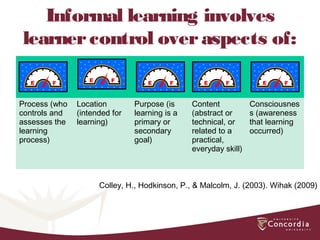
Informal learning involves
learnercontrol overaspects of:
Process (who
controls and
assesses the
learning
process)
Location
(intended for
learning)
Purpose (is
learning is a
primary or
secondary
goal)
Content
(abstract or
technical, or
related to a
practical,
everyday skill)
Consciousnes
s (awareness
that learning
occurred)
Colley, H., Hodkinson, P., & Malcolm, J. (2003). Wihak (2009)
Contrast with these related
terms.
Term Use
Formal learning Instruction in which the instructor or some similar “expert” sets the
objectives and determine the requirements for successful completion
Nonformal
learning
Learning that happens incidentally, accidental learning in non-
learning contexts
Incidental
learning
Same as nonformal learning
Self-directed
learning
Self-study programs aiming towards a goal (usually overseen by a
tutor and formalized with a co ntract)
Informal learning fills the gap
between classroomand workplace.
 Practical applications of concepts
 Tips and tricks that help novices become
journeymen
 According to some studies, the source of
60% of all work-related knowledge.
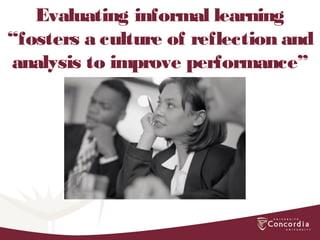
Evaluating informal learning
“fosters a culture of reflection and
analysis to improve performance”
(Laiken et al)
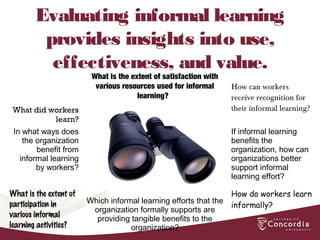
Evaluating informal learning
provides insights into use,
effectiveness, and value.
What did workers
learn?
What is the extent of satisfaction with
various resources used for informal
learning?
How can workers
receive recognition for
their informal learning?
In what ways does
the organization
benefit from
informal learning
by workers?
If informal learning
benefits the
organization, how can
organizations better
support informal
learning effort?
What is the extent of
participation in
various informal
learning activities?
Which informal learning efforts that the
organization formally supports are
providing tangible benefits to the
organization?
How do workers learn
informally?
By nature, informal learning does
not lend itself easily to evaluation.
 All models of training evaluation assume
externally defined objectives, completion,
and evaluation.
 But when learning informally, workers:
– Set their own objectives—and they’re not
always observable and measurable.
– Decide for themselves when they’ve completed
the program—even if their concept of
completion differs from yours.
– Decide for themselves what completion looks
like.
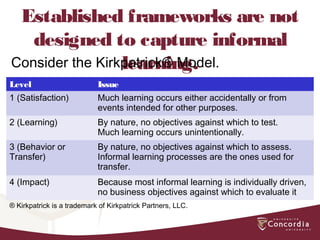
Established frameworks are not
designed to capture informal
learning.
Level Issue
1 (Satisfaction) Much learning occurs either accidentally or from
events intended for other purposes.
2 (Learning) By nature, no objectives against which to test.
Much learning occurs unintentionally.
3 (Behavior or
Transfer)
By nature, no objectives against which to assess.
Informal learning processes are the ones used for
transfer.
4 (Impact) Because most informal learning is individually driven,
no business objectives against which to evaluate it
® Kirkpatrick is a trademark of Kirkpatrick Partners, LLC.
Consider the Kirkpatrick® Model.
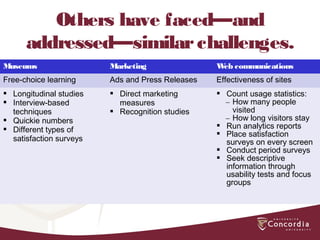
Others have faced—and
addressed—similarchallenges.
Museums Marketing Web communications
Free-choice learning Ads and Press Releases Effectiveness of sites
 Longitudinal studies
 Interview-based
techniques
 Quickie numbers
 Different types of
satisfaction surveys
 Direct marketing
measures
 Recognition studies
 Count usage statistics:
– How many people
visited
– How long visitors stay
 Run analytics reports
 Place satisfaction
surveys on every screen
 Conduct period surveys
 Seek descriptive
information through
usability tests and focus
groups
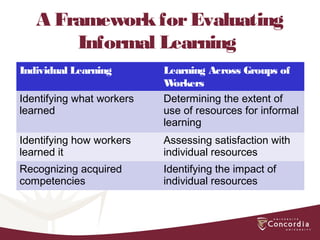
A FrameworkforEvaluating
Informal Learning
Individual Learning Learning Across Groups of
Workers
Identifying what workers
learned
Determining the extent of
use of resources for informal
learning
Identifying how workers
learned it
Assessing satisfaction with
individual resources
Recognizing acquired
competencies
Identifying the impact of
individual resources
IL-1: How would you identify
what workers learned?
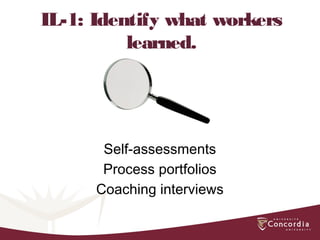
IL-1: Identify what workers
learned.
Self-assessments
Process portfolios
Coaching interviews
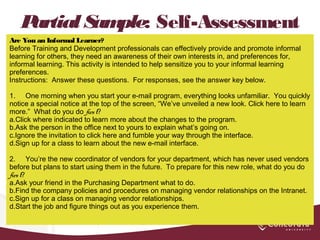
Partial Sample: Self-Assessment
Are You an Informal Learner?
Before Training and Development professionals can effectively provide and promote informal
learning for others, they need an awareness of their own interests in, and preferences for,
informal learning. This activity is intended to help sensitize you to your informal learning
preferences.
Instructions: Answer these questions. For responses, see the answer key below.
 
1. One morning when you start your e-mail program, everything looks unfamiliar. You quickly
notice a special notice at the top of the screen, “We’ve unveiled a new look. Click here to learn
more.” What do you do first?
a.Click where indicated to learn more about the changes to the program.
b.Ask the person in the office next to yours to explain what’s going on.
c.Ignore the invitation to click here and fumble your way through the interface.
d.Sign up for a class to learn about the new e-mail interface.
 
2. You’re the new coordinator of vendors for your department, which has never used vendors
before but plans to start using them in the future. To prepare for this new role, what do you do
first?
a.Ask your friend in the Purchasing Department what to do.
b.Find the company policies and procedures on managing vendor relationships on the Intranet.
c.Sign up for a class on managing vendor relationships.
d.Start the job and figure things out as you experience them.
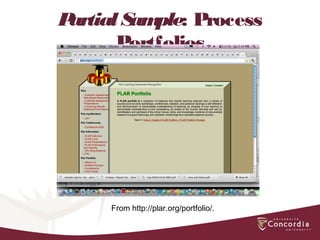
Partial Sample: Process
Portfolios
From http://plar.org/portfolio/.
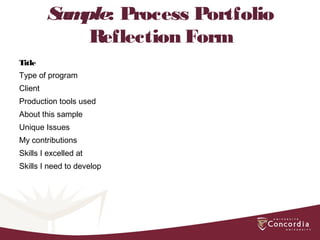
Sample: Process Portfolio
Reflection Form
Title
Type of program
Client
Production tools used
About this sample
Unique Issues
My contributions
Skills I excelled at
Skills I need to develop
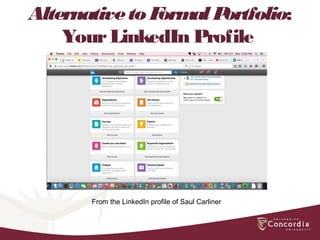
Alternativeto Formal Portfolio:
YourLinkedIn Profile
From the LinkedIn profile of Saul Carliner
IL-2: How would you identify the
means learners used to learn
informally?
IL-2: Identify how workers
learned informally.
Process portfolios
Coaching
IL-3: How can you formally
recognize the competencies workers
have developed through their
informal learning efforts?.
IL-3: Recognize acquired
competencies.
 Employee education records
 Skills assessments
 Certifications
What’s the difference between a
certificateand certification?
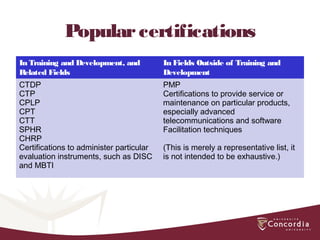
Popularcertifications
In Training and Development, and
Related Fields
In Fields Outside of Training and
Development
CTDP
CTP
CPLP
CPT
CTT
SPHR
CHRP
Certifications to administer particular
evaluation instruments, such as DISC
and MBTI
PMP
Certifications to provide service or
maintenance on particular products,
especially advanced
telecommunications and software
Facilitation techniques
(This is merely a representative list, it
is not intended to be exhaustive.)
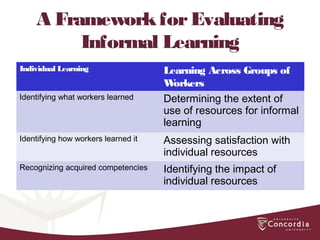
A FrameworkforEvaluating
Informal Learning
Individual Learning Learning Across Groups of
Workers
Identifying what workers learned Determining the extent of
use of resources for informal
learning
Identifying how workers learned it Assessing satisfaction with
individual resources
Recognizing acquired competencies Identifying the impact of
individual resources
LAG-1: Determine the extent of
use of individual resources.
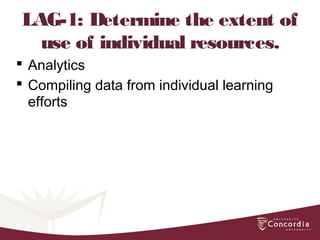
 Analytics
 Compiling data from individual learning
efforts
Example: Analytics
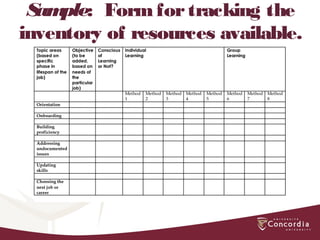
Sample: Formfortracking the
inventory of resources available.
LAG-2: Assess satisfaction with
individual resources.
 Surveys
– Focused on individual resources
– Focused on informal learning processes
 Focus groups
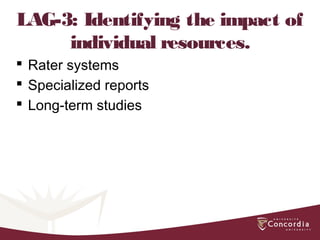
LAG-3: Identifying the impact of
individual resources.
 Rater systems
 Specialized reports
 Long-term studies
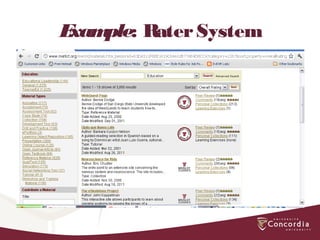
Example: RaterSystem
Use additional means to
evaluate informal learning.
• Embed questions in an employee
survey
• Establish “panels” to assess long-term
learning
– Follow individuals over a long time period
– By well-defined characteristics, such as
(but not limited to) cohort, job class, age,
start date
What challenges do you anticipate
applying these techniques in your
organization?
Educate seniormanagement
 About the unique
– Nature of informal learning
– Challenges in measuring it
– Characteristics of reporting on informal
learning activities
 Evaluation is a rhetorical act
Take-Aways
What insights about
evaluating informal
learning presented
today will you apply
on the job?
Learn more about evaluating
informal learning
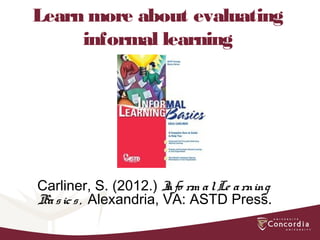
Carliner, S. (2012.) Info rm alLe arning
Basics, Alexandria, VA: ASTD Press.

Evaluating Informal Learning

  • 1.
    Evaluating Informal Learning Presented by SaulCarliner Professor Concordia University (Montreal) saulcarliner@hotmail.com http://www.saulcarliner.com
  • 2.
    Which best describesyourrole? a. Instructor b. Instructional designer c. Instructor/designer-developer d. Learning consultant e. Manager f. Faculty g. Student h. Other
  • 3.
    Which best describesyour employer? a. I work for myself or for an organization that exclusively specializes in training (and related) services. b. For-profit organization. c. Government d. Educational institution e. Nonprofit organization f. Other
  • 4.
    Which best describesyourprimary motivation forevaluating learning programs? a. External: management in my organization demands it or this is part of the culture of my organization b. Internal: I want to know about the effectiveness of my work c. I’m just curious about the topic; I don’t feel any pressure to evaluate d. Other
  • 5.
    Before proceeding, whatdo you hope to learn in today’s session?
  • 6.
    Agenda 1. Opening activity 2.Background a. Definitions of informal, self-directed, and nonformal training b. Why informal learning is important to the workplace 3. Why evaluating informal learning is important to do 4. Myths and realities about evaluation 5. Framework for evaluating informal learning
  • 7.
    Opening activity: Howwould you conduct this requested evaluation of informal learning? A manager wants you to collect Level 1 evaluations for on-the-job training.
  • 8.
    2. How wouldyou conduct this requested evaluation of informal learning? A training administrator wants enrollment information for the quick tour of the new Learning Management System, which the department uses to “sell” the system to users.
  • 9.
    3. How wouldyou conduct this requested evaluation of informal learning? A product development manager asks you to report on the extent of learning from the online help provided with the software her team develops.
  • 10.
    4. How wouldyou conduct this requested evaluation of informal learning? One of your top first-level customer support representatives seeks a promotion to second- level support, but needs to demonstrate that he has the skills and knowledge for the job. Formal schooling ended after the first year of university (most reps have a bachelor’s degree) and he only participated in the 6-week new hire training.
  • 11.
    5. How wouldyou conduct this requested evaluation of informal learning? A board member of your nonprofit wants data on the impact of the confidential health information site that your agency publishes.
  • 12.
    Based on thisdiscussion, how easily can you apply methods used to evaluate formal learning to informal learning?
  • 13.
    Informal learning involves learnercontroloveraspects of: Process (who controls and assesses the learning process) Location (intended for learning) Purpose (is learning is a primary or secondary goal) Content (abstract or technical, or related to a practical, everyday skill) Consciousnes s (awareness that learning occurred) Colley, H., Hodkinson, P., & Malcolm, J. (2003). Wihak (2009)
  • 14.
    Contrast with theserelated terms. Term Use Formal learning Instruction in which the instructor or some similar “expert” sets the objectives and determine the requirements for successful completion Nonformal learning Learning that happens incidentally, accidental learning in non- learning contexts Incidental learning Same as nonformal learning Self-directed learning Self-study programs aiming towards a goal (usually overseen by a tutor and formalized with a co ntract)
  • 15.
    Informal learning fillsthe gap between classroomand workplace.  Practical applications of concepts  Tips and tricks that help novices become journeymen  According to some studies, the source of 60% of all work-related knowledge.
  • 16.
    Evaluating informal learning “fostersa culture of reflection and analysis to improve performance” (Laiken et al)
  • 17.
    Evaluating informal learning providesinsights into use, effectiveness, and value. What did workers learn? What is the extent of satisfaction with various resources used for informal learning? How can workers receive recognition for their informal learning? In what ways does the organization benefit from informal learning by workers? If informal learning benefits the organization, how can organizations better support informal learning effort? What is the extent of participation in various informal learning activities? Which informal learning efforts that the organization formally supports are providing tangible benefits to the organization? How do workers learn informally?
  • 18.
    By nature, informallearning does not lend itself easily to evaluation.  All models of training evaluation assume externally defined objectives, completion, and evaluation.  But when learning informally, workers: – Set their own objectives—and they’re not always observable and measurable. – Decide for themselves when they’ve completed the program—even if their concept of completion differs from yours. – Decide for themselves what completion looks like.
  • 19.
    Established frameworks arenot designed to capture informal learning. Level Issue 1 (Satisfaction) Much learning occurs either accidentally or from events intended for other purposes. 2 (Learning) By nature, no objectives against which to test. Much learning occurs unintentionally. 3 (Behavior or Transfer) By nature, no objectives against which to assess. Informal learning processes are the ones used for transfer. 4 (Impact) Because most informal learning is individually driven, no business objectives against which to evaluate it ® Kirkpatrick is a trademark of Kirkpatrick Partners, LLC. Consider the Kirkpatrick® Model.
  • 20.
    Others have faced—and addressed—similarchallenges. MuseumsMarketing Web communications Free-choice learning Ads and Press Releases Effectiveness of sites  Longitudinal studies  Interview-based techniques  Quickie numbers  Different types of satisfaction surveys  Direct marketing measures  Recognition studies  Count usage statistics: – How many people visited – How long visitors stay  Run analytics reports  Place satisfaction surveys on every screen  Conduct period surveys  Seek descriptive information through usability tests and focus groups
  • 21.
    A FrameworkforEvaluating Informal Learning IndividualLearning Learning Across Groups of Workers Identifying what workers learned Determining the extent of use of resources for informal learning Identifying how workers learned it Assessing satisfaction with individual resources Recognizing acquired competencies Identifying the impact of individual resources
  • 22.
    IL-1: How wouldyou identify what workers learned?
  • 23.
    IL-1: Identify whatworkers learned. Self-assessments Process portfolios Coaching interviews
  • 24.
    Partial Sample: Self-Assessment AreYou an Informal Learner? Before Training and Development professionals can effectively provide and promote informal learning for others, they need an awareness of their own interests in, and preferences for, informal learning. This activity is intended to help sensitize you to your informal learning preferences. Instructions: Answer these questions. For responses, see the answer key below.   1. One morning when you start your e-mail program, everything looks unfamiliar. You quickly notice a special notice at the top of the screen, “We’ve unveiled a new look. Click here to learn more.” What do you do first? a.Click where indicated to learn more about the changes to the program. b.Ask the person in the office next to yours to explain what’s going on. c.Ignore the invitation to click here and fumble your way through the interface. d.Sign up for a class to learn about the new e-mail interface.   2. You’re the new coordinator of vendors for your department, which has never used vendors before but plans to start using them in the future. To prepare for this new role, what do you do first? a.Ask your friend in the Purchasing Department what to do. b.Find the company policies and procedures on managing vendor relationships on the Intranet. c.Sign up for a class on managing vendor relationships. d.Start the job and figure things out as you experience them.
  • 25.
    Partial Sample: Process Portfolios Fromhttp://plar.org/portfolio/.
  • 26.
    Sample: Process Portfolio ReflectionForm Title Type of program Client Production tools used About this sample Unique Issues My contributions Skills I excelled at Skills I need to develop
  • 27.
    Alternativeto Formal Portfolio: YourLinkedInProfile From the LinkedIn profile of Saul Carliner
  • 28.
    IL-2: How wouldyou identify the means learners used to learn informally?
  • 29.
    IL-2: Identify howworkers learned informally. Process portfolios Coaching
  • 30.
    IL-3: How canyou formally recognize the competencies workers have developed through their informal learning efforts?.
  • 31.
    IL-3: Recognize acquired competencies. Employee education records  Skills assessments  Certifications
  • 32.
    What’s the differencebetween a certificateand certification?
  • 33.
    Popularcertifications In Training andDevelopment, and Related Fields In Fields Outside of Training and Development CTDP CTP CPLP CPT CTT SPHR CHRP Certifications to administer particular evaluation instruments, such as DISC and MBTI PMP Certifications to provide service or maintenance on particular products, especially advanced telecommunications and software Facilitation techniques (This is merely a representative list, it is not intended to be exhaustive.)
  • 34.
    A FrameworkforEvaluating Informal Learning IndividualLearning Learning Across Groups of Workers Identifying what workers learned Determining the extent of use of resources for informal learning Identifying how workers learned it Assessing satisfaction with individual resources Recognizing acquired competencies Identifying the impact of individual resources
  • 35.
    LAG-1: Determine theextent of use of individual resources.  Analytics  Compiling data from individual learning efforts
  • 36.
  • 37.
  • 38.
    LAG-2: Assess satisfactionwith individual resources.  Surveys – Focused on individual resources – Focused on informal learning processes  Focus groups
  • 39.
    LAG-3: Identifying theimpact of individual resources.  Rater systems  Specialized reports  Long-term studies
  • 40.
  • 41.
    Use additional meansto evaluate informal learning. • Embed questions in an employee survey • Establish “panels” to assess long-term learning – Follow individuals over a long time period – By well-defined characteristics, such as (but not limited to) cohort, job class, age, start date
  • 42.
    What challenges doyou anticipate applying these techniques in your organization?
  • 43.
    Educate seniormanagement  Aboutthe unique – Nature of informal learning – Challenges in measuring it – Characteristics of reporting on informal learning activities  Evaluation is a rhetorical act
  • 44.
    Take-Aways What insights about evaluatinginformal learning presented today will you apply on the job?
  • 45.
    Learn more aboutevaluating informal learning Carliner, S. (2012.) Info rm alLe arning Basics, Alexandria, VA: ASTD Press.