
Competency models 101: What
are they? How do you develop
them and validate them? How
do HRD professionals apply
them?
Saul Carliner, PhD, CTDP, CFT
Professor, Concordia University (Montreal)
Board Member, International Board of Standards in Training and Performance
Improvement (IBSTPI)
About this Workshop
Through activities:
Explore competency models in the training field
Explore the process of devising and validating these
models
Explore uses of competency models
As a point of reference
High-level overview
Down in the trenches
As a point of reference
High-level overview
Down in the trenches
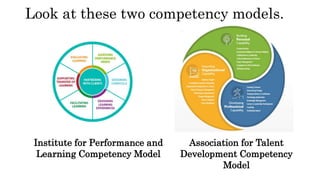
Look at these two competency models.
Institute for Performance and
Learning Competency Model
Association for Talent
Development Competency
Model
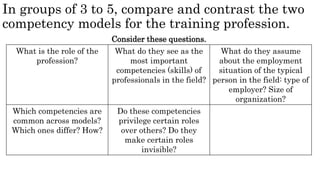
In groups of 3 to 5, compare and contrast the two
competency models for the training profession.
Consider these questions.
What is the role of the
profession?
What do they see as the
most important
competencies (skills) of
professionals in the field?
What do they assume
about the employment
situation of the typical
person in the field: type of
employer? Size of
organization?
Which competencies are
common across models?
Which ones differ? How?
Do these competencies
privilege certain roles
over others? Do they
make certain roles
invisible?
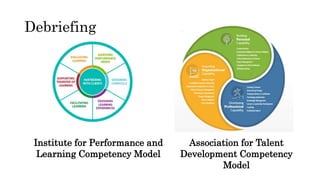
Debriefing
Institute for Performance and
Learning Competency Model
Association for Talent
Development Competency
Model
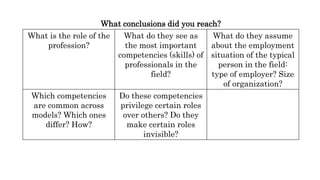
What conclusions did you reach?
What is the role of the
profession?
What do they see as
the most important
competencies (skills) of
professionals in the
field?
What do they assume
about the employment
situation of the typical
person in the field:
type of employer? Size
of organization?
Which competencies
are common across
models? Which ones
differ? How?
Do these competencies
privilege certain roles
over others? Do they
make certain roles
invisible?
How these models are similar.
Profession-focused rather than role-focused.
Learning focus plays a major role
How these models differ.
Differing views of the profession.
Descriptive versus aspirational.
HRD versus learning focused
Capabilities included
Name of the profession
So what is a competency?
The skills, knowledge and attitudes needed to perform
a major job task.
What is a competency model?
A framework of several competencies needed to
perform a particular job or family of jobs.
Basis for a credentialing program.
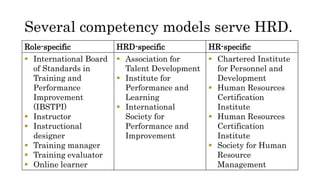
Several competency models serve HRD.
Role-specific HRD-specific HR-specific
 International Board
of Standards in
Training and
Performance
Improvement
(IBSTPI)
 Instructor
 Instructional
designer
 Training manager
 Training evaluator
 Online learner
 Association for
Talent Development
 Institute for
Performance and
Learning
 International
Society for
Performance and
Improvement
 Chartered Institute
for Personnel and
Development
 Human Resources
Certification
Institute
 Human Resources
Certification
Institute
 Society for Human
Resource
Management
HRD professionals have a second type
of interest in competency models.
As a tool to help develop the workforce of our clients.
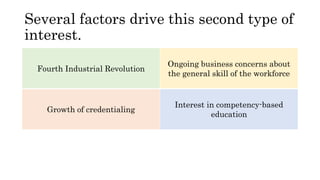
Several factors drive this second type of
interest.
Fourth Industrial Revolution
Ongoing business concerns about
the general skill of the workforce
Growth of credentialing
Interest in competency-based
education
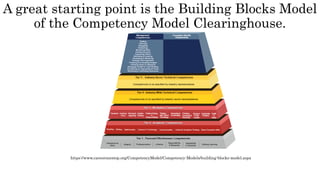
A great starting point is the Building Blocks Model
of the Competency Model Clearinghouse.
https://www.careeronestop.org/CompetencyModel/Competency-Models/building-blocks-model.aspx
Activity 2
Look at the competency model information.
How would you devise and validate something like
this?
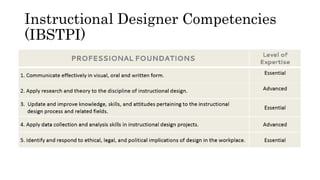
Instructional Designer Competencies
(IBSTPI)
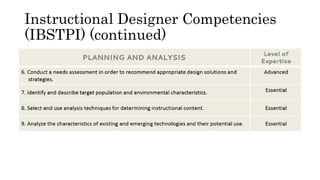
Instructional Designer Competencies
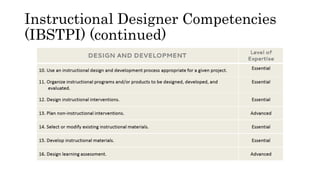
(IBSTPI) (continued)
Instructional Designer Competencies
(IBSTPI) (continued)
Activity 2
Look at the competency model information.
How would you devise and validate something like
this?
Share your responses
Devising a competency model is a
research project.
Systematic collection of data
Transparent and clarified reporting of the
methodology
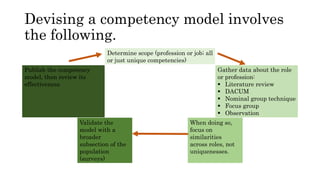
Devising a competency model involves
the following.
Determine scope (profession or job; all
or just unique competencies)
Publish the competency
model, then review its
effectiveness
Gather data about the role
or profession:
 Literature review
 DACUM
 Nominal group technique
 Focus group
 Observation
Validate the
model with a
broader
subsection of the
population
(surveys)
When doing so,
focus on
similarities
across roles, not
uniquenesses.
Note this challenge in writing
competency statements:
They look like objectives
But competencies are as broad as enabling objectives
are narrow.
Activity 3.
Brainstorm uses of competency models in
the work of HRD in the assigned context.
Higher education
Continuing education units of colleges and universities
Internal training departments
Human Resources departments
Private providers of training
Professional associations
Consider these uses of competency
models in higher education.
Program outcomes
—Devising
—Mapping courses to them(called outcome mapping)
—Revising curricula to address the gaps
Competency-based education
—Focuses on learners developing and demonstrating competencies
rather than accumulating credits
—Has attracted the attention of the US Department of Education
and the Bill and Melinda Gates Foundation
—Used in some distance education institutions
—Considered particularly well suited to adult education because it
allows them to tailor programs to address competency gaps
—Tool for recognition of prior learning
Consider these uses of competency
models by Continuing Education Units.
Similar to those of higher education institutions.
Consider these uses of competency
models by internal training departments.
Using the models to:
—Devise curricula, mapping courses to these outcomes
(called outcome mapping)
—Revise curricula to address the gaps
Devising competency-based exams for job-related
purposes
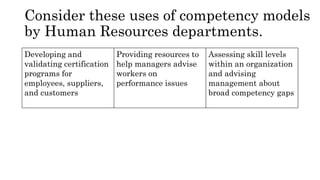
Consider these uses of competency models
by Human Resources departments.
Developing and
validating certification
programs for
employees, suppliers,
and customers
Providing resources to
help managers advise
workers on
performance issues
Assessing skill levels
within an organization
and advising
management about
broad competency gaps
Consider these uses of competency
models by private providers of training.
Developing and validating:
Curricula
Individual courses
Badging programs, certification programs, and
similar credentialing programs
Consider these uses of competency
models by professional associations.
Developing and validating:
—Curricula
—Individual courses
—Badging programs, certification programs, and similar
credentialing programs
Promoting a vision of the profession or trade
Wrap-up
What is the most important
thing learned in the
workshop?
What one question remains?
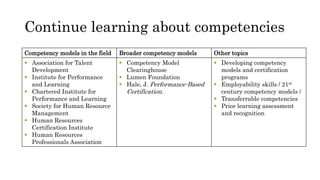
Continue learning about competencies
Competency models in the field Broader competency models Other topics
 Association for Talent
Development
 Institute for Performance
and Learning
 Chartered Institute for
Performance and Learning
 Society for Human Resource
Management
 Human Resources
Certification Institute
 Human Resources
Professionals Association
 Competency Model
Clearinghouse
 Lumen Foundation
 Hale, J. Performance-Based
Certification.
 Developing competency
models and certification
programs
 Employability skills / 21st
century competency models /
 Transferrable competencies
 Prior learning assessment
and recognition
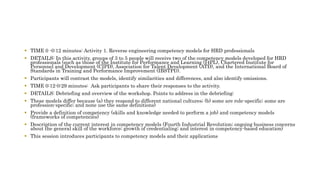
 TIME 0 -0:12 minutes: Activity 1. Reverse engineering competency models for HRD professionals
 DETAILS: In this activity, groups of 3 to 5 people will receive two of the competency models developed for HRD
professionals (such as those of the Institute for Performance and Learning (I4PL), Chartered Institute for
Personnel and Development (CIPD), Association for Talent Development (ATD), and the International Board of
Standards in Training and Performance Improvement (IBSTPI)).
 Participants will contrast the models, identify similarities and differences, and also identify omissions.
 TIME 0:12-0:29 minutes: Ask participants to share their responses to the activity.
 DETAILS: Debriefing and overview of the workshop. Points to address in the debriefing:
 These models differ because (a) they respond to different national cultures; (b) some are role-specific; some are
profession-specific; and none use the same definitions)
 Provide a definition of competency (skills and knowledge needed to perform a job) and competency models
(frameworks of competencies)
 Description of the current interest in competency models (Fourth Industrial Revolution; ongoing business concerns
about the general skill of the workforce; growth of credentialing; and interest in competency-based education)
 This session introduces participants to competency models and their applications
TIME 0:29-0:35 Activity 2. Look at the competency model information to determine how the organization devised and
validated its model
TIME 0:35-0:51 Ask participants to share their responses.
DETAILS: Points to raise—either through participants’ responses or a more formal debriefing:
Like a research methodology, it’s very important to be transparent about how the competency model was devised and validated
Devising a competency model:
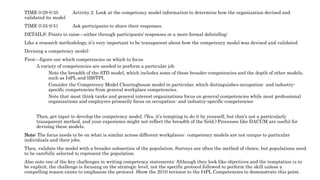
First—figure out which competencies on which to focus
A variety of competencies are needed to perform a particular job
Note the breadth of the ATD model, which includes some of these broader competencies and the depth of other models,
such as I4PL and IBSTPI.
Consider the Competency Model Clearinghouse model in particular, which distinguishes occupation- and industry-
specific competencies from general workplace competencies.
Note that most think tanks and general interest organizations focus on general competencies while most professional
organizations and employers primarily focus on occupation- and industry-specific competencies
Then, get input to develop the competency model. (Yes, it’s tempting to do it by yourself, but that’s not a particularly
transparent method, and your experience might not reflect the breadth of the field.) Processes like DACUM are useful for
devising these models.
Note: The focus needs to be on what is similar across different workplaces; competency models are not unique to particular
individuals and their jobs.
Then, validate the model with a broader subsection of the population. Surveys are often the method of choice, but populations need
to be carefully selected to represent the population.
Also note one of the key challenges in writing competency statements: Although they look like objectives and the temptation is to
be explicit, the challenge is focusing on the strategic level, not the specific protocol followed to perform the skill unless a
compelling reason exists to emphasize the protocol. Show the 2010 revision to the I4PL Competencies to demonstrate this point.
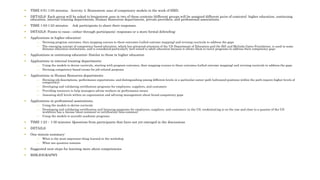
 TIME 0:51-1:03 minutes. Activity 3. Brainstorm uses of competency models in the work of HRD.
 DETAILS: Each group will be asked to brainstorm uses in two of these contexts (different groups will be assigned different pairs of contexts): higher education, continuing
education, internal training departments, Human Resources departments, private providers, and professional associations.
 TIME 1:03-1:23 minutes Ask participants to share their responses.
 DETAILS: Points to raise—either through participants’ responses or a more formal debriefing:
 Applications in higher education:
— Devising program outcomes, then mapping courses to these outcomes (called outcome mapping) and revising curricula to address the gaps
— The emerging concept of competency-based education, which has attracted attention of the US Department of Education and the Bill and Melinda Gates Foundation, is used in some
distance education institutions, and is considered particularly well suited to adult education because it allows them to tailor programs to address their competency gaps
 Applications in continuing education: Similar to those in higher education
 Applications in internal training departments:
— Using the models to devise curricula, starting with program outcomes, then mapping courses to these outcomes (called outcome mapping) and revising curricula to address the gaps
— Devising competency-based exams for job-related purposes
 Applications in Human Resources departments
— Devising job descriptions, performance expectations, and distinguishing among different levels in a particular career path (advanced positions within the path require higher levels of
competency)
— Developing and validating certification programs for employees, suppliers, and customers
— Providing resources to help managers advise workers on performance issues
— Assessing skill levels within an organization and advising management about broad competency gaps
 Applications in professional associations.
— Using the models to devise curricula
— Developing and validating certification and licensing programs for employees, suppliers, and customers; in the US, credentialing is on the rise and close to a quarter of the US
workforce has a license (most common) or certification (less common)
— Using the models to accredit academic programs
 TIME 1:23 – 1:30 minutes: Questions from participants that have not yet emerged in the discussions
 DETAILS
 One-minute summary:
— What is the most important thing learned in the workshop
— What one question remains
 Suggested next steps for learning more about competencies
 BIBLIOGRAPHY
References
Burnett, M., & Dutsch, J. V. (2006). Competency-based training and assessment center: Strategies, technology, process, and issues. Advances
in Developing Human Resources, 8(2), 141-143.
Carliner, S., Castonguay, C., Sheepy, E., Ribeiro, O., Sabri, H., Saylor, C., & Valle, A. (2015). The job of a performance consultant: a qualitative
content analysis of job descriptions. European Journal of Training and Development, 39(6), 458-483.
Carter, S. D. (2005.) The growth of supply and demand of occupational-based training and certification in the United States, 1990–
2003, Human Resource Development Quarterly, 16(1), 33-54.
Chalofsky, N., Ruona, W.E.A., Dooley, L., Hatcher, T., Jacobs, R., Kuchinke, K. P., Swanson, R. A., & Marsick, V. (2008.) Academy of Human
Resource Development Standards for HRD Graduate Program Excellence. Academy of Human Resource Development.
CIPD (2013a) Level 7 Advanced Qualifications Chartered Institute for Personnel and Development website. Viewed at
http://www.cipd.co.uk/qualifications/choose/advance
Visited on May 15, 2013
CIPD (2013b) Professional membership criteria Chartered Institute for Personnel and Development website. Viewed at
http://www.cipd.co.uk/Membership/transformingmembership/Newmembership criteria
Visited on May 15, 2013
CompTIA. (n.d.) CompTIA CTT+ Candidate Handbook of Information Classroom Trainer Certification. Oakbrook Terrace, IL: CompTIA.
Cronen,S., McQuiggan, M., Isenberg, E. & Grady, S. (2018.) Adult Training and Education: Results from the National Household Education
Surveys Program of 2016. Washington, DC: US Department of Education.
Dubois, D. D., & Rothwell, W. J. (2000). The competency toolkit. Human Resource Development Press.
Hale, J. A. (2011). Competencies for professionals in school improvement. Performance Improvement, 50(4), 10-17.
Hoffmann, T. (1999). The meanings of competency. Journal of European Industrial Training, 23(6), 275-286.
Gonczi, A. (1994). Competency based assessment in the professions in Australia. Assessment in Education: Principles, Policy & Practice, 1(1),
27-44.
HR Certification Institute. (2010a.) A history of the HR Certification Institute. Retrieved from http://www.hrci.org/aboutus/history/.
HR Certification Institute. (2010b.) PHR /SPHR Body of Knowledge, Appendix A—PHR/SPHR Test Specifications. Retrieved from
http://www.hrci.org/certification/bok/nbok/.
HR Certification Institute (n.d.). Retrieved from http://www.hrci.org/HRCertification.aspx?id=2147483788. .
Institute for Credentialing Excellence (2013.) What is credentialing. Viewed at http://www.credentialingexcellence.org/p/cm/ld/fid=32.
Visited April 21, 2013.
Institute for Performance and Learning. (2016.) Competencies for Learning and Development Professionals. Toronto, ON: Institute for
Performance and Learning.
Institute of Training & Occupational Learning. (2013) ITOL Development framework for L&D professionals. Viewed at
http://itol.org/uploads/images/PDF/framework%20new.pdf. Visited May 17, 2013.
International Society for Performance Improvement. (2013a.) CPT standards & ethics. Viewed at http://www.ispi.org/content.aspx?id=418.
Visited April 21, 2013.
International Society for Performance Improvement. (2013b.) CPT certification. Viewed at
http://www.ispi.org/content.aspx?id=186&linkidentifier=id&itemid=186. Visited April 25, 2013.
Livingston, S. & Zieke, M. (2006.) Passing Scores: A Manual for Setting Standards of Performance on Educational and Occupational
Tests. Excerpted in Zieke, M. & Piere, M. A Primer on Setting Cut Scores on Tests of Educational Achievement. Princeton, NJ:
Educational Testing Service. Viewed at http://www.ets.org/Media/Research/pdf/Cut_Scores_Primer.pdf. Visited April 21, 2013.
McMullan, M., Endacott, R., Gray, M. A., Jasper, M., Miller, C. M., Scholes, J., & Webb, C. (2003). Portfolios and assessment of competence:
a review of the literature. Journal of advanced nursing, 41(3), 283-294.
Mulder, M., Weigel, T., & Collins, K. (2007). The concept of competence in the development of vocational education and training in selected
EU member states: a critical analysis. Journal of Vocational Education & Training, 59(1), 67-88.
National Qualifications Authority of Ireland. (2009.) National framework of qualifications. Viewed at
http://www.nfq.ie/nfq/en/FanDiagram/nqai_nfq_08.html. Visited April 21, 2013.
Project Management Institute (2013.) What is a Registered Education Provider (R.E.P.)? [Editor: periods in the acronym are exactly as it
appeared on the website]. Viewed at http://www.pmi.org/Professional-Development/REP-What-is-a-Registered-Education-Provider.aspx.
Visited April 21, 2013.
Rothwell, W. J., Arneson, J., & Naughton, J. (2013). ASTD competency study: The training & development profession redefined. American
Society for Training and Development.
Rothwell, W. J., & Lindholm, J. E. (1999). Competency identification, modelling and assessment in the USA. International Journal of
Training and development, 3(2), 90-105.
Young, E. (July 9, 2012.) Another state to assess skills. InsideHigherEd.com, July 9, 2012. Viewed at
http://www.insidehighered.com/news/2012/07/09/wisconsin-seeks-competency-based-degree-program-without-help-western-governors.
Visited December 19, 2012.

Competency Models 101

  • 1.
    Competency models 101:What are they? How do you develop them and validate them? How do HRD professionals apply them? Saul Carliner, PhD, CTDP, CFT Professor, Concordia University (Montreal) Board Member, International Board of Standards in Training and Performance Improvement (IBSTPI)
  • 2.
    About this Workshop Throughactivities: Explore competency models in the training field Explore the process of devising and validating these models Explore uses of competency models
  • 3.
    As a pointof reference High-level overview Down in the trenches
  • 4.
    As a pointof reference High-level overview Down in the trenches
  • 5.
    Look at thesetwo competency models. Institute for Performance and Learning Competency Model Association for Talent Development Competency Model
  • 6.
    In groups of3 to 5, compare and contrast the two competency models for the training profession. Consider these questions. What is the role of the profession? What do they see as the most important competencies (skills) of professionals in the field? What do they assume about the employment situation of the typical person in the field: type of employer? Size of organization? Which competencies are common across models? Which ones differ? How? Do these competencies privilege certain roles over others? Do they make certain roles invisible?
  • 7.
    Debriefing Institute for Performanceand Learning Competency Model Association for Talent Development Competency Model
  • 8.
    What conclusions didyou reach? What is the role of the profession? What do they see as the most important competencies (skills) of professionals in the field? What do they assume about the employment situation of the typical person in the field: type of employer? Size of organization? Which competencies are common across models? Which ones differ? How? Do these competencies privilege certain roles over others? Do they make certain roles invisible?
  • 9.
    How these modelsare similar. Profession-focused rather than role-focused. Learning focus plays a major role
  • 10.
    How these modelsdiffer. Differing views of the profession. Descriptive versus aspirational. HRD versus learning focused Capabilities included Name of the profession
  • 11.
    So what isa competency? The skills, knowledge and attitudes needed to perform a major job task.
  • 12.
    What is acompetency model? A framework of several competencies needed to perform a particular job or family of jobs. Basis for a credentialing program.
  • 13.
    Several competency modelsserve HRD. Role-specific HRD-specific HR-specific  International Board of Standards in Training and Performance Improvement (IBSTPI)  Instructor  Instructional designer  Training manager  Training evaluator  Online learner  Association for Talent Development  Institute for Performance and Learning  International Society for Performance and Improvement  Chartered Institute for Personnel and Development  Human Resources Certification Institute  Human Resources Certification Institute  Society for Human Resource Management
  • 14.
    HRD professionals havea second type of interest in competency models. As a tool to help develop the workforce of our clients.
  • 15.
    Several factors drivethis second type of interest. Fourth Industrial Revolution Ongoing business concerns about the general skill of the workforce Growth of credentialing Interest in competency-based education
  • 16.
    A great startingpoint is the Building Blocks Model of the Competency Model Clearinghouse. https://www.careeronestop.org/CompetencyModel/Competency-Models/building-blocks-model.aspx
  • 17.
    Activity 2 Look atthe competency model information. How would you devise and validate something like this?
  • 18.
  • 19.
  • 20.
  • 21.
    Activity 2 Look atthe competency model information. How would you devise and validate something like this?
  • 22.
  • 23.
    Devising a competencymodel is a research project. Systematic collection of data Transparent and clarified reporting of the methodology
  • 24.
    Devising a competencymodel involves the following. Determine scope (profession or job; all or just unique competencies) Publish the competency model, then review its effectiveness Gather data about the role or profession:  Literature review  DACUM  Nominal group technique  Focus group  Observation Validate the model with a broader subsection of the population (surveys) When doing so, focus on similarities across roles, not uniquenesses.
  • 25.
    Note this challengein writing competency statements: They look like objectives But competencies are as broad as enabling objectives are narrow.
  • 26.
    Activity 3. Brainstorm usesof competency models in the work of HRD in the assigned context. Higher education Continuing education units of colleges and universities Internal training departments Human Resources departments Private providers of training Professional associations
  • 27.
    Consider these usesof competency models in higher education. Program outcomes —Devising —Mapping courses to them(called outcome mapping) —Revising curricula to address the gaps Competency-based education —Focuses on learners developing and demonstrating competencies rather than accumulating credits —Has attracted the attention of the US Department of Education and the Bill and Melinda Gates Foundation —Used in some distance education institutions —Considered particularly well suited to adult education because it allows them to tailor programs to address competency gaps —Tool for recognition of prior learning
  • 28.
    Consider these usesof competency models by Continuing Education Units. Similar to those of higher education institutions.
  • 29.
    Consider these usesof competency models by internal training departments. Using the models to: —Devise curricula, mapping courses to these outcomes (called outcome mapping) —Revise curricula to address the gaps Devising competency-based exams for job-related purposes
  • 30.
    Consider these usesof competency models by Human Resources departments. Developing and validating certification programs for employees, suppliers, and customers Providing resources to help managers advise workers on performance issues Assessing skill levels within an organization and advising management about broad competency gaps
  • 31.
    Consider these usesof competency models by private providers of training. Developing and validating: Curricula Individual courses Badging programs, certification programs, and similar credentialing programs
  • 32.
    Consider these usesof competency models by professional associations. Developing and validating: —Curricula —Individual courses —Badging programs, certification programs, and similar credentialing programs Promoting a vision of the profession or trade
  • 33.
    Wrap-up What is themost important thing learned in the workshop? What one question remains?
  • 34.
    Continue learning aboutcompetencies Competency models in the field Broader competency models Other topics  Association for Talent Development  Institute for Performance and Learning  Chartered Institute for Performance and Learning  Society for Human Resource Management  Human Resources Certification Institute  Human Resources Professionals Association  Competency Model Clearinghouse  Lumen Foundation  Hale, J. Performance-Based Certification.  Developing competency models and certification programs  Employability skills / 21st century competency models /  Transferrable competencies  Prior learning assessment and recognition
  • 36.
     TIME 0-0:12 minutes: Activity 1. Reverse engineering competency models for HRD professionals  DETAILS: In this activity, groups of 3 to 5 people will receive two of the competency models developed for HRD professionals (such as those of the Institute for Performance and Learning (I4PL), Chartered Institute for Personnel and Development (CIPD), Association for Talent Development (ATD), and the International Board of Standards in Training and Performance Improvement (IBSTPI)).  Participants will contrast the models, identify similarities and differences, and also identify omissions.  TIME 0:12-0:29 minutes: Ask participants to share their responses to the activity.  DETAILS: Debriefing and overview of the workshop. Points to address in the debriefing:  These models differ because (a) they respond to different national cultures; (b) some are role-specific; some are profession-specific; and none use the same definitions)  Provide a definition of competency (skills and knowledge needed to perform a job) and competency models (frameworks of competencies)  Description of the current interest in competency models (Fourth Industrial Revolution; ongoing business concerns about the general skill of the workforce; growth of credentialing; and interest in competency-based education)  This session introduces participants to competency models and their applications
  • 37.
    TIME 0:29-0:35 Activity2. Look at the competency model information to determine how the organization devised and validated its model TIME 0:35-0:51 Ask participants to share their responses. DETAILS: Points to raise—either through participants’ responses or a more formal debriefing: Like a research methodology, it’s very important to be transparent about how the competency model was devised and validated Devising a competency model: First—figure out which competencies on which to focus A variety of competencies are needed to perform a particular job Note the breadth of the ATD model, which includes some of these broader competencies and the depth of other models, such as I4PL and IBSTPI. Consider the Competency Model Clearinghouse model in particular, which distinguishes occupation- and industry- specific competencies from general workplace competencies. Note that most think tanks and general interest organizations focus on general competencies while most professional organizations and employers primarily focus on occupation- and industry-specific competencies Then, get input to develop the competency model. (Yes, it’s tempting to do it by yourself, but that’s not a particularly transparent method, and your experience might not reflect the breadth of the field.) Processes like DACUM are useful for devising these models. Note: The focus needs to be on what is similar across different workplaces; competency models are not unique to particular individuals and their jobs. Then, validate the model with a broader subsection of the population. Surveys are often the method of choice, but populations need to be carefully selected to represent the population. Also note one of the key challenges in writing competency statements: Although they look like objectives and the temptation is to be explicit, the challenge is focusing on the strategic level, not the specific protocol followed to perform the skill unless a compelling reason exists to emphasize the protocol. Show the 2010 revision to the I4PL Competencies to demonstrate this point.
  • 38.
     TIME 0:51-1:03minutes. Activity 3. Brainstorm uses of competency models in the work of HRD.  DETAILS: Each group will be asked to brainstorm uses in two of these contexts (different groups will be assigned different pairs of contexts): higher education, continuing education, internal training departments, Human Resources departments, private providers, and professional associations.  TIME 1:03-1:23 minutes Ask participants to share their responses.  DETAILS: Points to raise—either through participants’ responses or a more formal debriefing:  Applications in higher education: — Devising program outcomes, then mapping courses to these outcomes (called outcome mapping) and revising curricula to address the gaps — The emerging concept of competency-based education, which has attracted attention of the US Department of Education and the Bill and Melinda Gates Foundation, is used in some distance education institutions, and is considered particularly well suited to adult education because it allows them to tailor programs to address their competency gaps  Applications in continuing education: Similar to those in higher education  Applications in internal training departments: — Using the models to devise curricula, starting with program outcomes, then mapping courses to these outcomes (called outcome mapping) and revising curricula to address the gaps — Devising competency-based exams for job-related purposes  Applications in Human Resources departments — Devising job descriptions, performance expectations, and distinguishing among different levels in a particular career path (advanced positions within the path require higher levels of competency) — Developing and validating certification programs for employees, suppliers, and customers — Providing resources to help managers advise workers on performance issues — Assessing skill levels within an organization and advising management about broad competency gaps  Applications in professional associations. — Using the models to devise curricula — Developing and validating certification and licensing programs for employees, suppliers, and customers; in the US, credentialing is on the rise and close to a quarter of the US workforce has a license (most common) or certification (less common) — Using the models to accredit academic programs  TIME 1:23 – 1:30 minutes: Questions from participants that have not yet emerged in the discussions  DETAILS  One-minute summary: — What is the most important thing learned in the workshop — What one question remains  Suggested next steps for learning more about competencies  BIBLIOGRAPHY
  • 39.
    References Burnett, M., &Dutsch, J. V. (2006). Competency-based training and assessment center: Strategies, technology, process, and issues. Advances in Developing Human Resources, 8(2), 141-143. Carliner, S., Castonguay, C., Sheepy, E., Ribeiro, O., Sabri, H., Saylor, C., & Valle, A. (2015). The job of a performance consultant: a qualitative content analysis of job descriptions. European Journal of Training and Development, 39(6), 458-483. Carter, S. D. (2005.) The growth of supply and demand of occupational-based training and certification in the United States, 1990– 2003, Human Resource Development Quarterly, 16(1), 33-54. Chalofsky, N., Ruona, W.E.A., Dooley, L., Hatcher, T., Jacobs, R., Kuchinke, K. P., Swanson, R. A., & Marsick, V. (2008.) Academy of Human Resource Development Standards for HRD Graduate Program Excellence. Academy of Human Resource Development. CIPD (2013a) Level 7 Advanced Qualifications Chartered Institute for Personnel and Development website. Viewed at http://www.cipd.co.uk/qualifications/choose/advance Visited on May 15, 2013 CIPD (2013b) Professional membership criteria Chartered Institute for Personnel and Development website. Viewed at http://www.cipd.co.uk/Membership/transformingmembership/Newmembership criteria Visited on May 15, 2013 CompTIA. (n.d.) CompTIA CTT+ Candidate Handbook of Information Classroom Trainer Certification. Oakbrook Terrace, IL: CompTIA. Cronen,S., McQuiggan, M., Isenberg, E. & Grady, S. (2018.) Adult Training and Education: Results from the National Household Education Surveys Program of 2016. Washington, DC: US Department of Education. Dubois, D. D., & Rothwell, W. J. (2000). The competency toolkit. Human Resource Development Press. Hale, J. A. (2011). Competencies for professionals in school improvement. Performance Improvement, 50(4), 10-17. Hoffmann, T. (1999). The meanings of competency. Journal of European Industrial Training, 23(6), 275-286. Gonczi, A. (1994). Competency based assessment in the professions in Australia. Assessment in Education: Principles, Policy & Practice, 1(1), 27-44. HR Certification Institute. (2010a.) A history of the HR Certification Institute. Retrieved from http://www.hrci.org/aboutus/history/. HR Certification Institute. (2010b.) PHR /SPHR Body of Knowledge, Appendix A—PHR/SPHR Test Specifications. Retrieved from http://www.hrci.org/certification/bok/nbok/.
  • 40.
    HR Certification Institute(n.d.). Retrieved from http://www.hrci.org/HRCertification.aspx?id=2147483788. . Institute for Credentialing Excellence (2013.) What is credentialing. Viewed at http://www.credentialingexcellence.org/p/cm/ld/fid=32. Visited April 21, 2013. Institute for Performance and Learning. (2016.) Competencies for Learning and Development Professionals. Toronto, ON: Institute for Performance and Learning. Institute of Training & Occupational Learning. (2013) ITOL Development framework for L&D professionals. Viewed at http://itol.org/uploads/images/PDF/framework%20new.pdf. Visited May 17, 2013. International Society for Performance Improvement. (2013a.) CPT standards & ethics. Viewed at http://www.ispi.org/content.aspx?id=418. Visited April 21, 2013. International Society for Performance Improvement. (2013b.) CPT certification. Viewed at http://www.ispi.org/content.aspx?id=186&linkidentifier=id&itemid=186. Visited April 25, 2013. Livingston, S. & Zieke, M. (2006.) Passing Scores: A Manual for Setting Standards of Performance on Educational and Occupational Tests. Excerpted in Zieke, M. & Piere, M. A Primer on Setting Cut Scores on Tests of Educational Achievement. Princeton, NJ: Educational Testing Service. Viewed at http://www.ets.org/Media/Research/pdf/Cut_Scores_Primer.pdf. Visited April 21, 2013. McMullan, M., Endacott, R., Gray, M. A., Jasper, M., Miller, C. M., Scholes, J., & Webb, C. (2003). Portfolios and assessment of competence: a review of the literature. Journal of advanced nursing, 41(3), 283-294. Mulder, M., Weigel, T., & Collins, K. (2007). The concept of competence in the development of vocational education and training in selected EU member states: a critical analysis. Journal of Vocational Education & Training, 59(1), 67-88. National Qualifications Authority of Ireland. (2009.) National framework of qualifications. Viewed at http://www.nfq.ie/nfq/en/FanDiagram/nqai_nfq_08.html. Visited April 21, 2013. Project Management Institute (2013.) What is a Registered Education Provider (R.E.P.)? [Editor: periods in the acronym are exactly as it appeared on the website]. Viewed at http://www.pmi.org/Professional-Development/REP-What-is-a-Registered-Education-Provider.aspx. Visited April 21, 2013. Rothwell, W. J., Arneson, J., & Naughton, J. (2013). ASTD competency study: The training & development profession redefined. American Society for Training and Development. Rothwell, W. J., & Lindholm, J. E. (1999). Competency identification, modelling and assessment in the USA. International Journal of Training and development, 3(2), 90-105. Young, E. (July 9, 2012.) Another state to assess skills. InsideHigherEd.com, July 9, 2012. Viewed at http://www.insidehighered.com/news/2012/07/09/wisconsin-seeks-competency-based-degree-program-without-help-western-governors. Visited December 19, 2012.

Editor's Notes

  • #25 A variety of competencies are needed to perform a particular job Note the breadth of the ATD model, which includes some of these broader competencies and the depth of other models, such as I4PL and IBSTPI. Consider the Competency Model Clearinghouse model in particular, which distinguishes occupation- and industry-specific competencies from general workplace competencies. Note that most think tanks and general interest organizations focus on general competencies while most professional organizations and employers primarily focus on occupation- and industry-specific competencies
  • #26 Show the 2010 revision to the I4PL Competencies to demonstrate this point.