The Virtue of Failure
Katrin Becker,
Mount Royal University,
Canada
Dana Ruggiero,
Bath Spa University, UK
Designing
Games You
Can’t Win for
Learning
3: Wed. May 14 10:15-11:15
June 17, 2015 © Dana Ruggiero & Katrin Becker 2Plan B
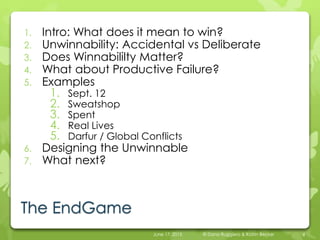
1. Intro: What does it mean to win?
2. Unwinnability: Accidental vs Deliberate
3. Does Winnabililty Matter?
4. What about Productive Failure?
5. Examples
1. Sept. 12
2. Sweatshop
3. Spent
4. Real Lives
5. Darfur / Global Conflicts
6. Designing the Unwinnable
7. What next?
June 17, 2015 © Dana Ruggiero & Katrin Becker 4
The EndGame
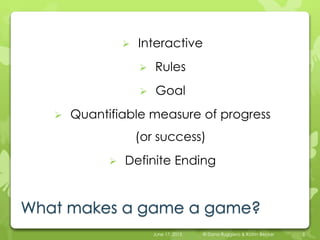
What makes a game a game?
 Interactive
 Rules
 Goal
 Quantifiable measure of progress
(or success)
 Definite Ending
June 17, 2015 © Dana Ruggiero & Katrin Becker 5
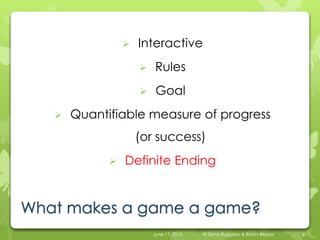
What makes a game a game?
 Interactive
 Rules
 Goal
 Quantifiable measure of progress
(or success)
 Definite Ending
June 17, 2015 © Dana Ruggiero & Katrin Becker 6
Winning?
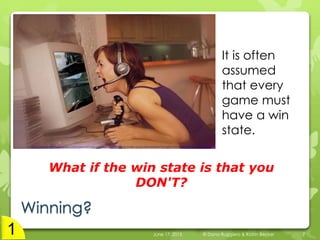
It is often
assumed
that every
game must
have a win
state.
June 17, 2015 © Dana Ruggiero & Katrin Becker 7
What if the win state is that you
DON'T?
Winning?
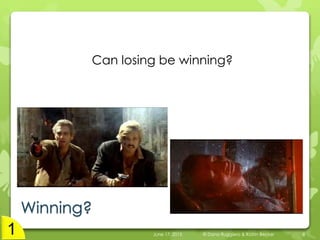
Can losing be winning?
June 17, 2015 © Dana Ruggiero & Katrin Becker 8
What vs How
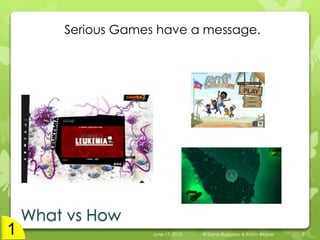
Serious Games have a message.
June 17, 2015 © Dana Ruggiero & Katrin Becker 9
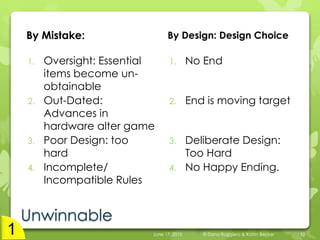
Unwinnable
By Mistake: By Design: Design Choice
1. Oversight: Essential
items become un-
obtainable
2. Out-Dated:
Advances in
hardware alter game
3. Poor Design: too
hard
4. Incomplete/
Incompatible Rules
1. No End
2. End is moving target
3. Deliberate Design:
Too Hard
4. No Happy Ending.
June 17, 2015 © Dana Ruggiero & Katrin Becker 10
Unwinnable by Mistake:
Oversight
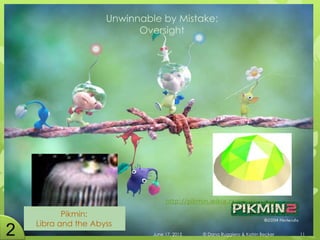
Pikmin:
Libra and the Abyss
June 17, 2015 © Dana Ruggiero & Katrin Becker 11
http://pikmin.wikia.com/wiki/Libra
Unwinnable by Mistake:
Outdated
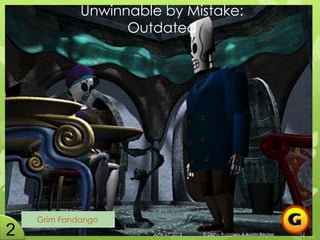
Grim Fandango
June 17, 2015 © Dana Ruggiero & Katrin Becker 12
Unwinnable by Mistake:
Poor Design
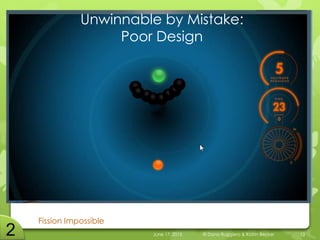
Fission Impossible
June 17, 2015 © Dana Ruggiero & Katrin Becker 13
Unwinnable by Mistake:
Incompatible / Incomplete Rules
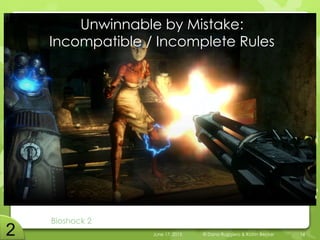
Bioshock 2
June 17, 2015 © Dana Ruggiero & Katrin Becker 14
Unwinnable by Mistake
to be avoided,
serious or not
June 17, 2015 © Dana Ruggiero & Katrin Becker 15
Unwinnable by Design?
1. No End.
2. End is moving target.
3. Too Hard
4. No Happy Ending.
June 17, 2015 © Dana Ruggiero & Katrin Becker 16
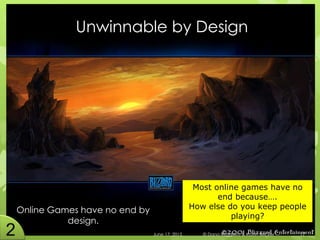
Unwinnable by Design
Online Games have no end by
design.
June 17, 2015 © Dana Ruggiero & Katrin Becker 17
Most online games have no
end because….
How else do you keep people
playing?
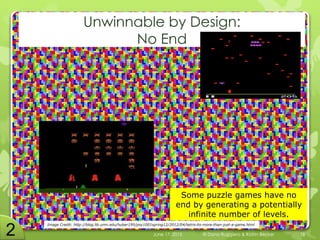
Unwinnable by Design:
No End
June 17, 2015 © Dana Ruggiero & Katrin Becker 18
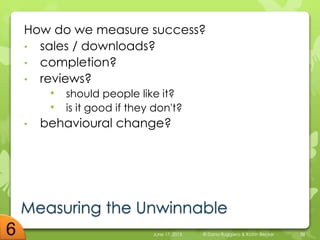
Image Credit: http://blog.lib.umn.edu/huber195/psy1001spring12/2012/04/tetris-its-more-than-just-a-game.html
Some puzzle games have no
end by generating a potentially
infinite number of levels.
Unwinnable by Design:
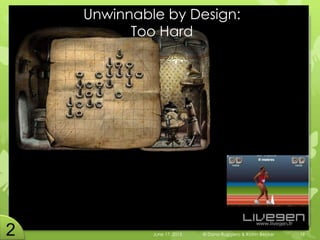
Too Hard
June 17, 2015 © Dana Ruggiero & Katrin Becker 19
Unwinnable by Design:
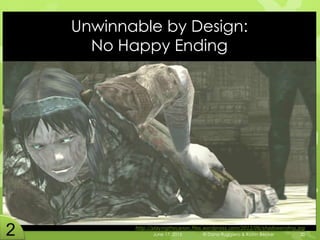
No Happy Ending
June 17, 2015 © Dana Ruggiero & Katrin Becker 20
http://playingthecanon.files.wordpress.com/2012/06/shadowending.jpg
Unwinnable by Design:
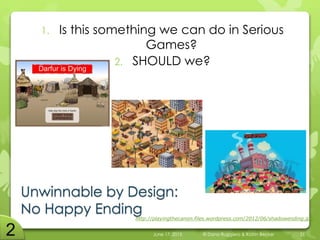
No Happy Ending
1. Is this something we can do in Serious
Games?
2. SHOULD we?
June 17, 2015 © Dana Ruggiero & Katrin Becker 21
http://playingthecanon.files.wordpress.com/2012/06/shadowending.jpg
Does it Matter?
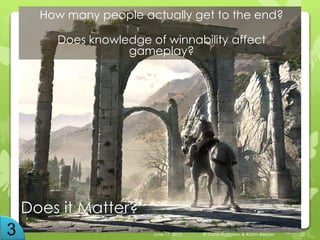
How many people actually get to the end?
Does knowledge of winnability affect
gameplay?
June 17, 2015 © Dana Ruggiero & Katrin Becker 22
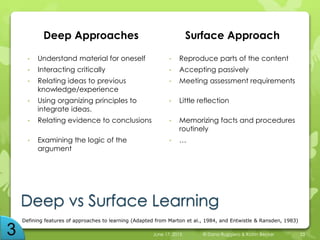
Deep vs Surface Learning
Deep Approaches Surface Approach
• Understand material for oneself
• Interacting critically
• Relating ideas to previous
knowledge/experience
• Using organizing principles to
integrate ideas.
• Relating evidence to conclusions
• Examining the logic of the
argument
• Reproduce parts of the content
• Accepting passively
• Meeting assessment requirements
• Little reflection
• Memorizing facts and procedures
routinely
• …
June 17, 2015 © Dana Ruggiero & Katrin Becker 23
Defining features of approaches to learning (Adapted from Marton et al., 1984, and Entwistle & Ransden, 1983)
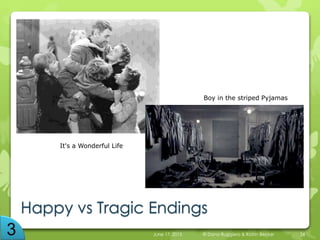
Happy vs Tragic Endings
June 17, 2015 © Dana Ruggiero & Katrin Becker 24
It's a Wonderful Life
Boy in the striped Pyjamas
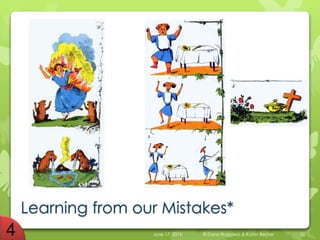
Learning from our Mistakes*
June 17, 2015 © Dana Ruggiero & Katrin Becker 25
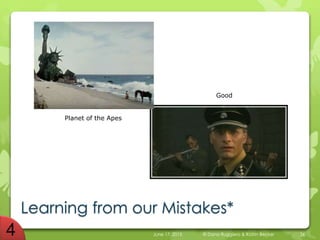
Learning from our Mistakes*
June 17, 2015 © Dana Ruggiero & Katrin Becker 26
Planet of the Apes
Good
Productive Failure
• Productive Failure (PF) better than Direct
Instruction (DI) wrt:
• conceptual understanding
• transfer
• procedural fluency retained
• Teachers consistently underestimate students’
ability to generate Representations and Solution
Methods (RSMs)
• Student ability (PSLE testing) not predictor of
generative capacity (ability to generate theories)
• = Representations and Solution Methods (RSM)
diversity significantly correlated with learning gains
• Productive Failure (PF) teachers learn better too.
June 17, 2015 © Dana Ruggiero & Katrin Becker 27
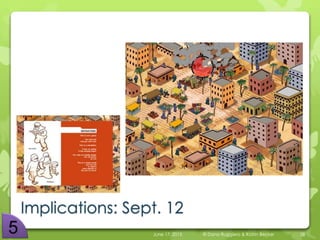
Implications: Sept. 12
June 17, 2015 © Dana Ruggiero & Katrin Becker 28
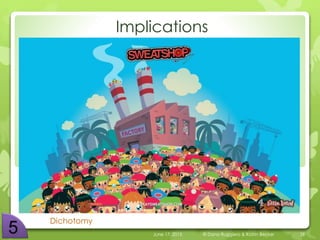
Implications
Dichotomy
June 17, 2015 © Dana Ruggiero & Katrin Becker 29
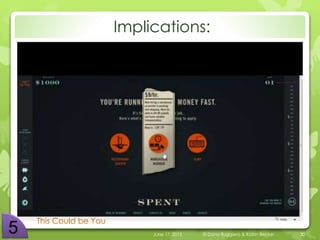
Implications:
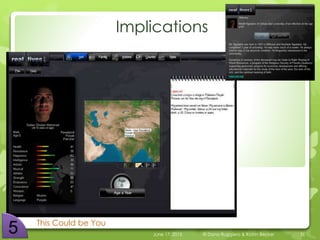
This Could be You
June 17, 2015 © Dana Ruggiero & Katrin Becker 30
Implications
This Could be You
June 17, 2015 © Dana Ruggiero & Katrin Becker 31
Implications
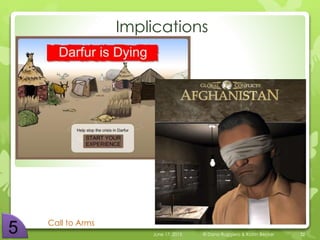
Call to Arms
June 17, 2015 © Dana Ruggiero & Katrin Becker 32
Implications: EndState
• elevates importance of endgame
• especially if that's where the main
message is delivered (endstate drives the
whole design)
• endstate is possible in "normal" game;
endstate is driven in "GYCW" game (i.e.
happy endings must be prevented)
June 17, 2015 © Dana Ruggiero & Katrin Becker 33
Designing the Unwinnable
When could/should a game be unwinnable?
• Kinds of messages?
• Length of game?
• Differences in reflection/debriefing?
• How much of literature/film model can we
use (i.e. large part of film/story designed to
KEEP you from realizing the end)
June 17, 2015 © Dana Ruggiero & Katrin Becker 34
Designing the Unwinnable
When could/should a game be unwinnable?
• Kinds of messages?
• Length of game?
• Differences in reflection/debriefing?
June 17, 2015 © Dana Ruggiero & Katrin Becker 35
Designing the Unwinnable
• Players make up own measure of success
• How to mitigate distress of players
(especially young ones)
June 17, 2015 © Dana Ruggiero & Katrin Becker 36
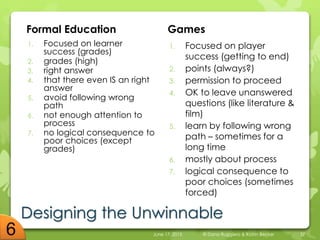
Designing the Unwinnable
Formal Education Games
1. Focused on learner
success (grades)
2. grades (high)
3. right answer
4. that there even IS an right
answer
5. avoid following wrong
path
6. not enough attention to
process
7. no logical consequence to
poor choices (except
grades)
1. Focused on player
success (getting to end)
2. points (always?)
3. permission to proceed
4. OK to leave unanswered
questions (like literature &
film)
5. learn by following wrong
path – sometimes for a
long time
6. mostly about process
7. logical consequence to
poor choices (sometimes
forced)
June 17, 2015 © Dana Ruggiero & Katrin Becker 37
Measuring the Unwinnable
How do we measure success?
• sales / downloads?
• completion?
• reviews?
• should people like it?
• is it good if they don't?
• behavioural change?
June 17, 2015 © Dana Ruggiero & Katrin Becker 38
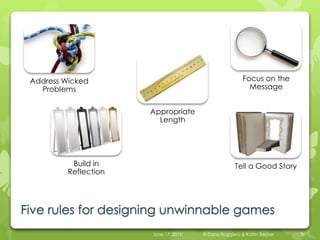
Five rules for designing unwinnable games
June 17, 2015 © Dana Ruggiero & Katrin Becker 39
Address Wicked
Problems
Appropriate
Length
Focus on the
Message
Build in
Reflection
Tell a Good Story
Take-Aways
• Another approach to design.
• One not normally addressed in design
books/ courses.
• Should we establish design principles?
June 17, 2015 © Dana Ruggiero & Katrin Becker 40
Abstract
Just what do we learn from playing serious games?
Especially common in games for learning is the notion that participants need to be
able to win the game, but is it always necessary for the player to win in order to ‘get’
our message? In his studies of productive failure, Kapur (2008) has suggested that
failure can be important to learning. Indeed, when we think back on our most
memorable learning experiences we often find that these lessons are things learned
through failure rather than success. Learning through failure is an effective way to
help people learn how to cope with situations where there is no clear solution
(Dorner, et al., 1990), and for certain kinds of messages negative messages delivered
via games you can’t win may be more powerful than those you can.
This presentation explores a class of games where ‘winning’ doesn’t look the way we
expect it to look. Some games don’t allow players to win at all, in which case the
‘message’ is effectively a cautionary tale. The authors refer to these games as
“games you can’t win”, and they form a distinctly different approach to game
design (examples include: Sweatshop, Darfur is Dying, and September 12th). This
presentation will examine the philosophical background of games in education, the
design of serious games, and look at both accidental and deliberately designed
unwinnable games and how this relates to learning objectives.
June 17, 2015 © Dana Ruggiero & Katrin Becker 41

Virtue of Failure

  • 1.
    The Virtue ofFailure Katrin Becker, Mount Royal University, Canada Dana Ruggiero, Bath Spa University, UK Designing Games You Can’t Win for Learning 3: Wed. May 14 10:15-11:15
  • 2.
    June 17, 2015© Dana Ruggiero & Katrin Becker 2Plan B
  • 3.
    1. Intro: Whatdoes it mean to win? 2. Unwinnability: Accidental vs Deliberate 3. Does Winnabililty Matter? 4. What about Productive Failure? 5. Examples 1. Sept. 12 2. Sweatshop 3. Spent 4. Real Lives 5. Darfur / Global Conflicts 6. Designing the Unwinnable 7. What next? June 17, 2015 © Dana Ruggiero & Katrin Becker 4 The EndGame
  • 4.
    What makes agame a game?  Interactive  Rules  Goal  Quantifiable measure of progress (or success)  Definite Ending June 17, 2015 © Dana Ruggiero & Katrin Becker 5
  • 5.
    What makes agame a game?  Interactive  Rules  Goal  Quantifiable measure of progress (or success)  Definite Ending June 17, 2015 © Dana Ruggiero & Katrin Becker 6
  • 6.
    Winning? It is often assumed thatevery game must have a win state. June 17, 2015 © Dana Ruggiero & Katrin Becker 7 What if the win state is that you DON'T?
  • 7.
    Winning? Can losing bewinning? June 17, 2015 © Dana Ruggiero & Katrin Becker 8
  • 8.
    What vs How SeriousGames have a message. June 17, 2015 © Dana Ruggiero & Katrin Becker 9
  • 9.
    Unwinnable By Mistake: ByDesign: Design Choice 1. Oversight: Essential items become un- obtainable 2. Out-Dated: Advances in hardware alter game 3. Poor Design: too hard 4. Incomplete/ Incompatible Rules 1. No End 2. End is moving target 3. Deliberate Design: Too Hard 4. No Happy Ending. June 17, 2015 © Dana Ruggiero & Katrin Becker 10
  • 10.
    Unwinnable by Mistake: Oversight Pikmin: Libraand the Abyss June 17, 2015 © Dana Ruggiero & Katrin Becker 11 http://pikmin.wikia.com/wiki/Libra
  • 11.
    Unwinnable by Mistake: Outdated GrimFandango June 17, 2015 © Dana Ruggiero & Katrin Becker 12
  • 12.
    Unwinnable by Mistake: PoorDesign Fission Impossible June 17, 2015 © Dana Ruggiero & Katrin Becker 13
  • 13.
    Unwinnable by Mistake: Incompatible/ Incomplete Rules Bioshock 2 June 17, 2015 © Dana Ruggiero & Katrin Becker 14
  • 14.
    Unwinnable by Mistake tobe avoided, serious or not June 17, 2015 © Dana Ruggiero & Katrin Becker 15
  • 15.
    Unwinnable by Design? 1.No End. 2. End is moving target. 3. Too Hard 4. No Happy Ending. June 17, 2015 © Dana Ruggiero & Katrin Becker 16
  • 16.
    Unwinnable by Design OnlineGames have no end by design. June 17, 2015 © Dana Ruggiero & Katrin Becker 17 Most online games have no end because…. How else do you keep people playing?
  • 17.
    Unwinnable by Design: NoEnd June 17, 2015 © Dana Ruggiero & Katrin Becker 18 Image Credit: http://blog.lib.umn.edu/huber195/psy1001spring12/2012/04/tetris-its-more-than-just-a-game.html Some puzzle games have no end by generating a potentially infinite number of levels.
  • 18.
    Unwinnable by Design: TooHard June 17, 2015 © Dana Ruggiero & Katrin Becker 19
  • 19.
    Unwinnable by Design: NoHappy Ending June 17, 2015 © Dana Ruggiero & Katrin Becker 20 http://playingthecanon.files.wordpress.com/2012/06/shadowending.jpg
  • 20.
    Unwinnable by Design: NoHappy Ending 1. Is this something we can do in Serious Games? 2. SHOULD we? June 17, 2015 © Dana Ruggiero & Katrin Becker 21 http://playingthecanon.files.wordpress.com/2012/06/shadowending.jpg
  • 21.
    Does it Matter? Howmany people actually get to the end? Does knowledge of winnability affect gameplay? June 17, 2015 © Dana Ruggiero & Katrin Becker 22
  • 22.
    Deep vs SurfaceLearning Deep Approaches Surface Approach • Understand material for oneself • Interacting critically • Relating ideas to previous knowledge/experience • Using organizing principles to integrate ideas. • Relating evidence to conclusions • Examining the logic of the argument • Reproduce parts of the content • Accepting passively • Meeting assessment requirements • Little reflection • Memorizing facts and procedures routinely • … June 17, 2015 © Dana Ruggiero & Katrin Becker 23 Defining features of approaches to learning (Adapted from Marton et al., 1984, and Entwistle & Ransden, 1983)
  • 23.
    Happy vs TragicEndings June 17, 2015 © Dana Ruggiero & Katrin Becker 24 It's a Wonderful Life Boy in the striped Pyjamas
  • 24.
    Learning from ourMistakes* June 17, 2015 © Dana Ruggiero & Katrin Becker 25
  • 25.
    Learning from ourMistakes* June 17, 2015 © Dana Ruggiero & Katrin Becker 26 Planet of the Apes Good
  • 26.
    Productive Failure • ProductiveFailure (PF) better than Direct Instruction (DI) wrt: • conceptual understanding • transfer • procedural fluency retained • Teachers consistently underestimate students’ ability to generate Representations and Solution Methods (RSMs) • Student ability (PSLE testing) not predictor of generative capacity (ability to generate theories) • = Representations and Solution Methods (RSM) diversity significantly correlated with learning gains • Productive Failure (PF) teachers learn better too. June 17, 2015 © Dana Ruggiero & Katrin Becker 27
  • 27.
    Implications: Sept. 12 June17, 2015 © Dana Ruggiero & Katrin Becker 28
  • 28.
    Implications Dichotomy June 17, 2015© Dana Ruggiero & Katrin Becker 29
  • 29.
    Implications: This Could beYou June 17, 2015 © Dana Ruggiero & Katrin Becker 30
  • 30.
    Implications This Could beYou June 17, 2015 © Dana Ruggiero & Katrin Becker 31
  • 31.
    Implications Call to Arms June17, 2015 © Dana Ruggiero & Katrin Becker 32
  • 32.
    Implications: EndState • elevatesimportance of endgame • especially if that's where the main message is delivered (endstate drives the whole design) • endstate is possible in "normal" game; endstate is driven in "GYCW" game (i.e. happy endings must be prevented) June 17, 2015 © Dana Ruggiero & Katrin Becker 33
  • 33.
    Designing the Unwinnable Whencould/should a game be unwinnable? • Kinds of messages? • Length of game? • Differences in reflection/debriefing? • How much of literature/film model can we use (i.e. large part of film/story designed to KEEP you from realizing the end) June 17, 2015 © Dana Ruggiero & Katrin Becker 34
  • 34.
    Designing the Unwinnable Whencould/should a game be unwinnable? • Kinds of messages? • Length of game? • Differences in reflection/debriefing? June 17, 2015 © Dana Ruggiero & Katrin Becker 35
  • 35.
    Designing the Unwinnable •Players make up own measure of success • How to mitigate distress of players (especially young ones) June 17, 2015 © Dana Ruggiero & Katrin Becker 36
  • 36.
    Designing the Unwinnable FormalEducation Games 1. Focused on learner success (grades) 2. grades (high) 3. right answer 4. that there even IS an right answer 5. avoid following wrong path 6. not enough attention to process 7. no logical consequence to poor choices (except grades) 1. Focused on player success (getting to end) 2. points (always?) 3. permission to proceed 4. OK to leave unanswered questions (like literature & film) 5. learn by following wrong path – sometimes for a long time 6. mostly about process 7. logical consequence to poor choices (sometimes forced) June 17, 2015 © Dana Ruggiero & Katrin Becker 37
  • 37.
    Measuring the Unwinnable Howdo we measure success? • sales / downloads? • completion? • reviews? • should people like it? • is it good if they don't? • behavioural change? June 17, 2015 © Dana Ruggiero & Katrin Becker 38
  • 38.
    Five rules fordesigning unwinnable games June 17, 2015 © Dana Ruggiero & Katrin Becker 39 Address Wicked Problems Appropriate Length Focus on the Message Build in Reflection Tell a Good Story
  • 39.
    Take-Aways • Another approachto design. • One not normally addressed in design books/ courses. • Should we establish design principles? June 17, 2015 © Dana Ruggiero & Katrin Becker 40
  • 40.
    Abstract Just what dowe learn from playing serious games? Especially common in games for learning is the notion that participants need to be able to win the game, but is it always necessary for the player to win in order to ‘get’ our message? In his studies of productive failure, Kapur (2008) has suggested that failure can be important to learning. Indeed, when we think back on our most memorable learning experiences we often find that these lessons are things learned through failure rather than success. Learning through failure is an effective way to help people learn how to cope with situations where there is no clear solution (Dorner, et al., 1990), and for certain kinds of messages negative messages delivered via games you can’t win may be more powerful than those you can. This presentation explores a class of games where ‘winning’ doesn’t look the way we expect it to look. Some games don’t allow players to win at all, in which case the ‘message’ is effectively a cautionary tale. The authors refer to these games as “games you can’t win”, and they form a distinctly different approach to game design (examples include: Sweatshop, Darfur is Dying, and September 12th). This presentation will examine the philosophical background of games in education, the design of serious games, and look at both accidental and deliberately designed unwinnable games and how this relates to learning objectives. June 17, 2015 © Dana Ruggiero & Katrin Becker 41

Editor's Notes

  • #3 Kobiashi Maru montage. Credit: http://www.youtube.com/watch?v=8N-H1lz3OJ4 almstopable Uploaded on Mar 3, 2010 ~ 1min
  • #4 This is a backup slide with the video actually attached in case the online one doesn't work
  • #5 Goal in this talk is to look at the endgame specifically, games you CAN'T win. defining what we mean distinguishing between games that are unwinnable by accident and games that are unwinnable by design what is the effect of designing a game that can't be won? learning through failure why winning is important – or not ~ ½ min
  • #6 INTRO What makes a game a game? w/o interaction it's not a game – it's a show (video, film, cartoon, song,…) must have discernible rules & and a recognizable goal some quantifiable measure of progress – we should know when we are improving should have a definite ending ~ 1 min
  • #7 INTRO This talk takes a look at the ending. ~10 sec.
  • #8 1. INTRO Especially common in games for learning is the notion that participants need to be able to win the game. We tend to assume that players need to be successful in the end – especially in lower elementary grades. WHAT IF THE WIN STATE IS THAT YOU DON'T? ~ ½ min
  • #9 1. INTRO But is it always necessary for the player in an educational game to win in order to ‘get’ the message we are trying to portray? This is something that we see quite commonly in film – there are even a few actors who became known for playing heroes that rarely won. When we think back on our own most memorable learning experiences we find that these lessons are often things we learned through failure rather than success. in games too there is a class of games where ‘winning’ doesn’t look the way we typically expect it to look. Some games do not allow their players to win, in which case the ‘message’ may be more akin to that found in a cautionary tale. We refer to these games as “games you can’t win”, and they form a distinctly different approach to game design. 1/2
  • #10 INTRO ALL SERIOUS GAMES HAVE A MESSAGE Ayiti, OsyOsmosis, Remission 2 In serious games: Primary focus is on the message rather than the experience. BOTH are important, but in serious (vs commercial) games, the message MUST take priority. i.e. it's ALL ABOUT the message, whereas in commercial games it's all about the experience. In a game you can't win WHAT the game teaches is important, to be sure but HOW IT GETS THERE is what makes it different. 1/2
  • #11 INTRO 2 main categories of games you can't win: By Mistake: By Design: Games such as Sweatshop (Littleloud, 2011), Darfur is Dying (MTVu, 2006), and September 12th (Newsgaming, 2005) are games you cannot conceivably win and they are designed that way deliberately
  • #12 2. Accidental vs Deliberate unwinnability Unwinnable by Accident: Pikmin has potential to become unwinnable. Libra is placed high atop a large cliff side in the Forest Naval. You can get it down without problems most of the time, but there is a small chance that your pikmin will misstep on their way back down, taking it and them to the abyss below. Libra won't respawn in its old spot, and you can't win the game if you save this: you need all the vital parts at least to win, let alone all the ship parts, and Libra happens to be vital. 1 min
  • #13 2. Accidental vs Deliberate unwinnability Unwinnable by Accident: Grim Fandango has a bug when you are in the elevator in the High Roller's Lounge in Rubacava. On modern computers the elevator moves too quickly to complete the puzzle, rendering the game unwinnable without patching. It is also possible to leave your scythe behind at certain points, making the game unwinnable if you were to, for example, save and quit after finishing the level. 1/2
  • #14 2. Accidental vs Deliberate unwinnability Unwinnable by Accident: TOO HARD Fission Impossible 1/2
  • #15 2. Accidental vs Deliberate unwinnability Unwinnable by Accident: incompatible / incomplete rules BioShock 2: if you die during a particular boss fight, the Vita-Chamber in which you respawn is on the wrong side of the door that locked you in with the boss. 1/2
  • #16 I think we can all agree that a game that is accidentally unwinnable is frustrating at best, and one to avoid at worst.
  • #17 2. Accidental vs Deliberate unwinnability BY DESIGN: what about games designed to be unwinnable? broken these into 3 categories: No End. End is moving target. Too Hard. No Happy Ending.
  • #18 2. Accidental vs Deliberate unwinnability BY DESIGN: No end: WoW
  • #19 2. Accidental vs Deliberate unwinnability BY DESIGN: End is moving target: Tetris; Space Invaders, Centipede,
  • #20 2. Accidental vs Deliberate unwinnability Unwinnable by Design: TOO HARD Machinarium, Myst w/o help, puzzles are beyond the capability of most people 1/2
  • #21 2. Accidental vs Deliberate unwinnability BY DESIGN: no happy ending : Shadow of the Colossus In Shadow, you set off throughout a forbidden land to track down and defeat sixteen mysterious colossi. Unfortunately, it's revealed that the sixteen colossi were the only things keeping an evil demon named Dormin from reforming. Once you slay them all, your character gets possessed by the restored Dormin and you end up getting slain yourself. http://www.dorkly.com/article/15271/the-dorklyst-the-10-most-depressing-endings-in-videogame-history/page:2
  • #22 2. Accidental vs Deliberate unwinnability BY DESIGN: tend to be social issues Games such as Sweatshop (Littleloud, 2011), Darfur is Dying (MTVu, 2006), and September 12th (Newsgaming, 2005) are games you cannot conceivably win and they are designed that way deliberately Social issues tend to involve extremely complex dynamic systems, and learning through failure is an effective way to help people learn how to cope with situations where there is no clear solution (Dorner, et al., 1990). For certain kinds of messages - particularly social change issues - negative messages delivered via games you can’t win are more powerful than those you can.
  • #23 3. Does it Matter? Hinkle, D. (2010). JoyStats: 40% of players finished Assassin's Creed 2 campaign. Joystick. Retrieved from http://www.joystiq.com/2010/10/19/40-percent-of-players-finished-assassins-creed-2-campaign/. on May 20 2013. Debeauvais, T., Nardi, B., Schiano, D. J., Ducheneaut, N., & Yee, N. (2011). If you build it they might stay: retention mechanisms in World of Warcraft. In Proceedings of the 6th International Conference on Foundations of Digital Games (pp. 180–187). New York, NY, USA: ACM. 
  • #24 3. Does it Matter? Which of these applies better to games? … which strategy help players succeed in the game? … which strategy could withstand a game that couldn't be won?
  • #25 3. Does it Matter? compare these final scenes What do we learn differently?
  • #26 4. Productive Failure learning from our mistakes and from the mistakes of others The concept is not new.... Der Struwelpeter (1845) Heinrich Hoffmann
  • #27 4. Productive Failure learning from our mistakes and from the mistakes of others The concept is not new.... Planet of the Apes (1968) Franklin J. Schaffner (Director) http://www.imdb.com/title/tt0063442/combined Good, 2008, Vicente Amorim (director), C.P. Taylor (stage play) John Wrathall (screenplay) http://www.imdb.com/title/tt0436364/combined
  • #28 4. Productive Failure - Manu Kapur learning from our mistakes and from the mistakes of others In some sense, ALL games use this strategy... the difference is whether or not they use it AS the end. Summary of Key Findings PF outperformed DI on conceptual understanding and transfer without compromising procedural fluency (Kapur, 2010,2012; Kapur& Bielaczyc, 2012) The marginal gain of providing cognitive support for PF groups during the generation phase was not significant(Kapur, 2011) Teachers consistently underestimate students’ ability to generate RSMs Students that seem strikingly dissimilar on general and math ability (PSLE) appear strikingly similar in terms of their generative capacity (Kapur & Bielaczyc, 2012) RSM diversity significantly correlated with learning gains (Kapur, 2012; Kapur & Bielaczyc, 2012) PF teachers consistently report that they are stressed and stretched to work with students’ ideas... BUT, they themselves understood the math better.
  • #29 5. Implications: Example 1 How long are we willing to play once we figure out it is unwinnable? How long should it take to get there? this one is short WORKS scenario: kids walk in – game is up on the screens don't say a word let them play 3-5 minutes discuss leave 3-5 minutes at the end of the lesson to play again September 12th, Newsgaming, Online, 2005 http://www.newsgaming.com/games/index12.htm
  • #30 5. Implications: Example 2 Sweatshop Littleloud, Online, 2011 http://www.playsweatshop.com/sweatshop.html personally – didn't like this game – too cutsie – tends to divert attention from the message fails the Becker Lazy test – I can get through the game by managing without actually getting the message … and the pressures of the game tend to encourage that approach
  • #31 5. Implications: Example 3 by Durham, NC-based advertising firm, McKinney, for pro bono client, Urban Ministries of Durham in February 2011. Spent- www.playspent.org cleaner – more "mature" in apearance
  • #32 5. Implications: Example 4 RealLives, 2010, http://www.educationalsimulations.com/index.php
  • #33 5. Implications: Example 5 Darfur is Dying Global Conflicts
  • #34 5. Implications:
  • #35 6. Designing the Unwinnable When could/should a game be unwinnable? Kinds of messages? are there certain kinds of messages we CAN deliver this way? are there certain messages that we SHOULD deliver this way? are there ones better done this way? are there ones we definitely should NOT do this way (certain subjects; audiences)? Length of game? is it fair to say these games are better if they are short? I can't imagine investing 35 hours in a game only to find out I can't win... Differences in reflection/debriefing? what differences are there in the after game? my sense would be that we often ponder unhappy endings longer than happy ones happy endings make you feel good but also provide closure unhappy endings do not
  • #36 6. Designing the Unwinnable what if re-mission had let the player die? can the Shadow of the Colossus scenario be used in education or would it be counterproductive?
  • #37 6. Designing the Unwinnable
  • #38 6. Designing the Unwinnable
  • #39 6. Designing the Unwinnable