PRESTIGE INSTITUTE OF MANAGEMENT
AND RESEARCH
INTERNATIONAL TRADING BLOCK AND AGREEMENTS
SUBMITTED TO:
Prof. Ankit Gupta
SUBMITTED BY:
Aman Parmar
Muskan Pahwa
Muskan Raheja
Siddharth Sahu
Yashi Pachauri
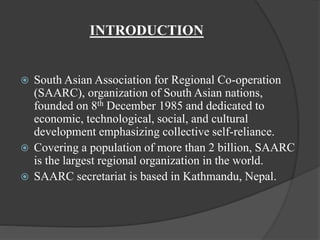
SAARC
South Asian Association for Regional Cooperation
INTRODUCTION
 South Asian Association for Regional Co-operation
(SAARC), organization of South Asian nations,
founded on 8th December 1985 and dedicated to
economic, technological, social, and cultural
development emphasizing collective self-reliance.
 Covering a population of more than 2 billion, SAARC
is the largest regional organization in the world.
 SAARC secretariat is based in Kathmandu, Nepal.
SAARC HISTORY
 The concept of SAARC was first adopted by Bangladesh in
1977, under the administration of President Ziaur Rahman.
 In the late 1970s, SAARC nations agreed upon the creation of
trade block consisting South Asian Countries.
 The idea of regional cooperation was again raised in May 1980.
 The foreign secretaries of seven countries met for the first time
in Colombo in April 1981.
 The committee of the whole which met in Colombo in August
1985 identified five broad areas for regional cooperation.
 Afghanistan was added in the regional group in November 2005.
With addition of Afghanistan the total number of member
countries was raised to eight.
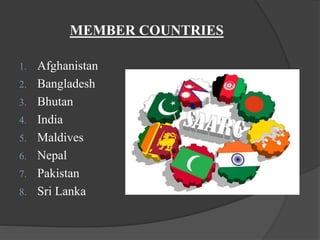
MEMBER COUNTRIES
1. Afghanistan
2. Bangladesh
3. Bhutan
4. India
5. Maldives
6. Nepal
7. Pakistan
8. Sri Lanka
ORGANISATIONAL STRUCTURE OF
SAARC
SAARC comprises five layers of organizational structure:-
1.Council: At the top, there is the Council represented by the heads of
the government of the member countries. The council the apex
policy making body. It meets once in 2 years time.
2.Council of Minister: It is to assist the council. It is represented by the
foreign minister of the member countries.
3.Standing Committee: It is comprised by the foreign secretarial of the
member government.
4.Programming Committee: It consist of the senior official of the
member governments.
5.Technical Committee: It consist of the represented of the member
nations. Its function are:
To formulate project and programmer
To monitor and execute the projects
To submit reports.
PRINCIPLES
 Respect of sovereignty, territorial integrity, political
equity and independence of all member countries.
 Cooperation of mutual benefit.
 All decisions to be taken unanimously and need a
quorum of all member countries.
 All bilateral issue to be kept aside and only multi lateral
issues to be discussed.
 Non interference in internal affairs of others state and
mutual benefits.
OBJECTIVES
 Promote the welfare of the peoples of South Asia and improve their
quality of life.
 Accelerate economic growth, social progress and cultural
development in the region by providing all individuals the
opportunity to live in dignity and realize their full potential.
 Promote and strengthen collective self-reliance among the countries
of South Asia.
 Contribute to mutual trust, understanding and appreciation of one
another’s problems.
 Promote active collaboration and mutual assistance in the economic,
social, cultural, technical and scientific fields.
 Strengthen co-operation with other developing countries.
 Strengthen co-operation among themselves in international forms on
matters of common interest.
 Cooperate with international and regional organization with similar
aims and purposes.
REASONS FOR FORMATION OF
SAARC
 Central location of Asia.
 Common features of the Indian subcontinent.
 All countries gained independence after the second
world war.
 This region is poor and overpopulated.
 Predominance of agriculture.
 All countries have some cultural and background
history.
 Dependence of the economy on southwest monsoon.
SAARC AGREEMENTS
 Agreement for establishment of SAARC Arbitration
Council
 Final Agreement on Avoidance of Double Taxation
 Final Agreement on Customs Matters
 Charter of SAARC Development Fund
 Agreement on establishing the SAARC food bank
 Agreement on south Asian Free Trade Area (SAFTA)
 Agreement on the Establishment of South Asian
Regional Standards Organization (SARSO)
 Agreement on Avoidance of Double Taxation
AREAS OF COOPERATION
 Agricultural and Rural
development
 Investment and commercial
disputes settlement
 Biotechnology
 Culture
 Economic and Trade
 Education
 Energy
 Environment
 Finance
 Information and
communication technology
 Poverty alleviation
 Science and technology
 Terrorism
 Social development
 Security aspects:-
Drug and related
crimes
Terrorism
Police matters
CONVENTIONS
 SAARC Convention on Combating and Prevention of
Trafficking in Women and Children for Prostitution
 Convention on Promotion of Welfare of Children
 Convention on Mutual Assistance on Criminal Matters,
July 2008
 SAARC Convention Narcotics Drugs
 SAARC Regional Convention on Suppression of
Terrorism
 Additional Protocol on Terrorism, Jan 2004
SIGNIFICANCE FOR INDIA
 Neighborhood first
 Geostrategic significance
 Regional stability
 Global Leadership role
 Game changer for India’s Act East policy
 Economical importance
ACHIEVEMENTS OF SAARC
 SAFTA
A free trade agreement confined to goods, but excluding all
services like information technology. Agreement was signed to
reduce custom duties on all traded goods to zero by the year
2016.
 SAPTA
South Asian Preferential Trading Agreement for promoting
trade amongst the members countries, came into effect in
1995.
 SAARC visa exemption: decided that certain categories of
dignitaries should be entitled to a special travel document, which
would exempt from the visas within the region.
 Greater cultural cooperation.
 Advantages to least developed countries. It has provided forum for
bilateral and regional agreements to the small and poor nations for
collaborating among themselves for development.
CHALLENGES
 Conflict and mistrust among
member countries.
 Internal conflict.
 Geopolitical imbalance/
imbalance of power.
 Lack of unity among member
countries.
 Disputes: border, natural
resources.
 Lack of effective implication
of SAARC programme.
 SAARC connectivity.
 SAFTA/SAPTA.
 Poverty
 Unemployment
 Literacy
 Governance
 Education
 Development
 Defense expenditure
CONCLUSION
 Regional integration has the potential to promote economic
development. This potential can be exploited only through
deeper cooperation.
 The SAARC’s balance sheet of success is very limited to
adoption of several countries.
 There also have been breakthrough in the form of SAPTA
and SAFTA but their success at operational level is also
expected.
 Special economic zone and export promotion zone zones
should be created in all member countries to make trading
easier and smooth.
 SAARC totally exclude all political issues within two
countries from its summits.
THANKYOU

SAARC

  • 1.
    PRESTIGE INSTITUTE OFMANAGEMENT AND RESEARCH INTERNATIONAL TRADING BLOCK AND AGREEMENTS SUBMITTED TO: Prof. Ankit Gupta SUBMITTED BY: Aman Parmar Muskan Pahwa Muskan Raheja Siddharth Sahu Yashi Pachauri
  • 2.
    SAARC South Asian Associationfor Regional Cooperation
  • 3.
    INTRODUCTION  South AsianAssociation for Regional Co-operation (SAARC), organization of South Asian nations, founded on 8th December 1985 and dedicated to economic, technological, social, and cultural development emphasizing collective self-reliance.  Covering a population of more than 2 billion, SAARC is the largest regional organization in the world.  SAARC secretariat is based in Kathmandu, Nepal.
  • 4.
    SAARC HISTORY  Theconcept of SAARC was first adopted by Bangladesh in 1977, under the administration of President Ziaur Rahman.  In the late 1970s, SAARC nations agreed upon the creation of trade block consisting South Asian Countries.  The idea of regional cooperation was again raised in May 1980.  The foreign secretaries of seven countries met for the first time in Colombo in April 1981.  The committee of the whole which met in Colombo in August 1985 identified five broad areas for regional cooperation.  Afghanistan was added in the regional group in November 2005. With addition of Afghanistan the total number of member countries was raised to eight.
  • 5.
    MEMBER COUNTRIES 1. Afghanistan 2.Bangladesh 3. Bhutan 4. India 5. Maldives 6. Nepal 7. Pakistan 8. Sri Lanka
  • 6.
    ORGANISATIONAL STRUCTURE OF SAARC SAARCcomprises five layers of organizational structure:- 1.Council: At the top, there is the Council represented by the heads of the government of the member countries. The council the apex policy making body. It meets once in 2 years time. 2.Council of Minister: It is to assist the council. It is represented by the foreign minister of the member countries. 3.Standing Committee: It is comprised by the foreign secretarial of the member government. 4.Programming Committee: It consist of the senior official of the member governments. 5.Technical Committee: It consist of the represented of the member nations. Its function are: To formulate project and programmer To monitor and execute the projects To submit reports.
  • 7.
    PRINCIPLES  Respect ofsovereignty, territorial integrity, political equity and independence of all member countries.  Cooperation of mutual benefit.  All decisions to be taken unanimously and need a quorum of all member countries.  All bilateral issue to be kept aside and only multi lateral issues to be discussed.  Non interference in internal affairs of others state and mutual benefits.
  • 8.
    OBJECTIVES  Promote thewelfare of the peoples of South Asia and improve their quality of life.  Accelerate economic growth, social progress and cultural development in the region by providing all individuals the opportunity to live in dignity and realize their full potential.  Promote and strengthen collective self-reliance among the countries of South Asia.  Contribute to mutual trust, understanding and appreciation of one another’s problems.  Promote active collaboration and mutual assistance in the economic, social, cultural, technical and scientific fields.  Strengthen co-operation with other developing countries.  Strengthen co-operation among themselves in international forms on matters of common interest.  Cooperate with international and regional organization with similar aims and purposes.
  • 9.
    REASONS FOR FORMATIONOF SAARC  Central location of Asia.  Common features of the Indian subcontinent.  All countries gained independence after the second world war.  This region is poor and overpopulated.  Predominance of agriculture.  All countries have some cultural and background history.  Dependence of the economy on southwest monsoon.
  • 10.
    SAARC AGREEMENTS  Agreementfor establishment of SAARC Arbitration Council  Final Agreement on Avoidance of Double Taxation  Final Agreement on Customs Matters  Charter of SAARC Development Fund  Agreement on establishing the SAARC food bank  Agreement on south Asian Free Trade Area (SAFTA)  Agreement on the Establishment of South Asian Regional Standards Organization (SARSO)  Agreement on Avoidance of Double Taxation
  • 11.
    AREAS OF COOPERATION Agricultural and Rural development  Investment and commercial disputes settlement  Biotechnology  Culture  Economic and Trade  Education  Energy  Environment  Finance  Information and communication technology  Poverty alleviation  Science and technology  Terrorism  Social development  Security aspects:- Drug and related crimes Terrorism Police matters
  • 12.
    CONVENTIONS  SAARC Conventionon Combating and Prevention of Trafficking in Women and Children for Prostitution  Convention on Promotion of Welfare of Children  Convention on Mutual Assistance on Criminal Matters, July 2008  SAARC Convention Narcotics Drugs  SAARC Regional Convention on Suppression of Terrorism  Additional Protocol on Terrorism, Jan 2004
  • 13.
    SIGNIFICANCE FOR INDIA Neighborhood first  Geostrategic significance  Regional stability  Global Leadership role  Game changer for India’s Act East policy  Economical importance
  • 14.
    ACHIEVEMENTS OF SAARC SAFTA A free trade agreement confined to goods, but excluding all services like information technology. Agreement was signed to reduce custom duties on all traded goods to zero by the year 2016.  SAPTA South Asian Preferential Trading Agreement for promoting trade amongst the members countries, came into effect in 1995.  SAARC visa exemption: decided that certain categories of dignitaries should be entitled to a special travel document, which would exempt from the visas within the region.  Greater cultural cooperation.  Advantages to least developed countries. It has provided forum for bilateral and regional agreements to the small and poor nations for collaborating among themselves for development.
  • 15.
    CHALLENGES  Conflict andmistrust among member countries.  Internal conflict.  Geopolitical imbalance/ imbalance of power.  Lack of unity among member countries.  Disputes: border, natural resources.  Lack of effective implication of SAARC programme.  SAARC connectivity.  SAFTA/SAPTA.  Poverty  Unemployment  Literacy  Governance  Education  Development  Defense expenditure
  • 16.
    CONCLUSION  Regional integrationhas the potential to promote economic development. This potential can be exploited only through deeper cooperation.  The SAARC’s balance sheet of success is very limited to adoption of several countries.  There also have been breakthrough in the form of SAPTA and SAFTA but their success at operational level is also expected.  Special economic zone and export promotion zone zones should be created in all member countries to make trading easier and smooth.  SAARC totally exclude all political issues within two countries from its summits.
  • 17.