
XRF Based
Multi-Metals
Continuous
Water Analyzer
Roger van uden
EuropeanTech Serv nv
Power PlantWaterTreatment
Presentation
Outline
2
Potential
Applications
1
Analyzer
operation
2
Instrument
Capabilities
3
Testing and
Performance
•Laboratory
•Field
4
Why
Measure
Metals in
RealTime in
Water
Treatment
Processes
3
• Process monitoring – feedback for water
treatment may improve the efficiency of the
treatment process – use fewer chemicals to
achieve require effluent emission limits
• Measurement of Se, As for compliance with
Steam Electric Generating Effluent
Guidelines
• Monitoring of treatment of wastewater
by biological based treatment systems
• Measurement of Corrosion Products (e.g. Fe,
Ni, Cr and Mn) to improve operating
efficiency
• Measurement of Elements in Nuclear Power
Plant Applications (e.g. Pb, Cu, Fe)
• Reduce laboratory analysis costs
XRF BasedWater
Analyzer Basics
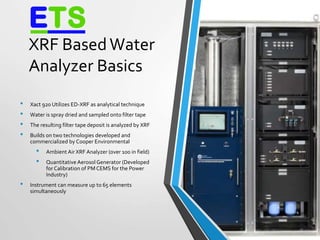
• Xact 920 Utilizes ED-XRF as analytical technique
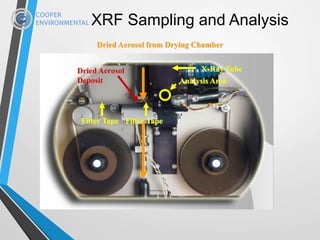
• Water is spray dried and sampled onto filter tape
• The resulting filter tape deposit is analyzed by XRF
• Builds on two technologies developed and
commercialized by Cooper Environmental
• Ambient Air XRF Analyzer (over 100 in field)
• Quantitative AerosolGenerator (Developed
for Calibration of PM CEMS for the Power
Industry)
• Instrument can measure up to 65 elements
simultaneously
4
XRFTheory
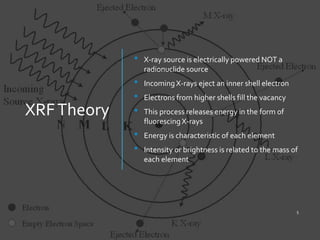
• X-ray source is electrically powered NOT a
radionuclide source
• Incoming X-rays eject an inner shell electron
• Electrons from higher shells fill the vacancy
• This process releases energy in the form of
fluorescingX-rays
• Energy is characteristic of each element
• Intensity or brightness is related to the mass of
each element
5
Strengths of
XRF
• XRF utilizes inner shell electron transitions so
the response is not dependent on what the
element is chemically bound to
• Can measure a wide range of elements
simultaneously
• XRF is non-destructive – so samples can be
reanalyzed later
• XRF is very stable – calibrations can last for
years
• XRF response is linear over the a wide
concentration range (over 5 orders of
magnitude) – this means no additional
standards required depending on concentration
range
6
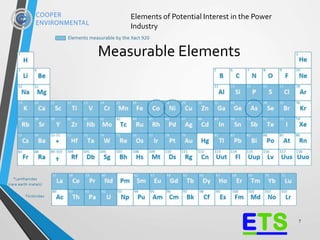
Measurable Elements
7
Elements of Potential Interest in the Power
Industry
General Operation Schematic - Xact 920
LBM
Pre-filter Sterilizer
Pump
Drying
Chamber
Internal
Standard
Carbon Trap
Flow Meter
Pump
Exhaust
Filters
Modified
Xact 625
Software Data
Processing/
reporting
Sample
Source
Sample pre-treatment
and transport
Sample
Analysis
Quantitative liquid
blending and sample
pre-concentration
DAP
Data acquisition
and processing
Xact 295
8
Sample is
aerosolized and
dried
Sampled onto filter tape and analyzed by XRF
LBM: Liquid Blending Module – this is where we combine the liquid sample flow with
the a liquid flow containing an internal standard
Instrument Systems
9
Drying
Chamber
XRF
Analyzer
Heater
Controls
Air Flow
Controls
Liquid
Blending
module
Exhaust Gas
Treatment
Main Power
panel
XRF Sampling and Analysis
X-Ray Tube
Filter Tape
Dried Aerosol
Deposit
Dried Aerosol from Drying Chamber
Analysis Area
Filter Tape
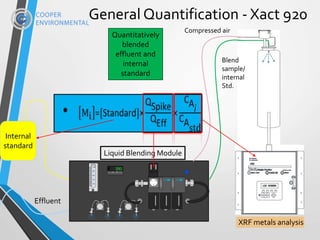
General Quantification - Xact 920
11
Internal
standard
Effluent
Quantitatively
blended
effluent and
internal
standard
Liquid Blending Module
XRF metals analysis
Compressed air
Blend
sample/
internal
Std.
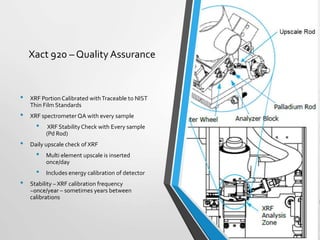
Xact 920 – Quality Assurance
• XRF Portion Calibrated withTraceable to NIST
Thin Film Standards
• XRF spectrometer QA with every sample
• XRF StabilityCheck with Every sample
(Pd Rod)
• Daily upscale check of XRF
• Multi element upscale is inserted
once/day
• Includes energy calibration of detector
• Stability – XRF calibration frequency
~once/year – sometimes years between
calibrations
12
Xact 920 Capabilities
13
Xact 920 Detection Limits
14
15 30 60 120
S 3.8 3.7 1.3 0.47
Cl 2.0 2.0 0.72 0.25
K 1.4 1.4 0.49 0.17
Ca 0.36 0.35 0.12 0.044
Ti 0.19 0.19 0.066 0.023
V 0.14 0.14 0.050 0.018
Cr 0.14 0.14 0.048 0.017
Mn 0.17 0.17 0.059 0.021
Fe 0.20 0.20 0.070 0.025
Co 0.16 0.16 0.056 0.020
Ni 0.11 0.11 0.039 0.014
Cu 0.092 0.091 0.032 0.011
Zn 0.077 0.077 0.027 0.010
As 0.073 0.073 0.026 0.0091
Se 0.094 0.093 0.033 0.012
Br 0.12 0.12 0.042 0.015
Cd 2.9 2.9 1.0 0.36
Pb 0.15 0.15 0.052 0.018
Element
Sample time (minutes)
Detection Limit in ppb
68% Confidence, less then 50 ppm ofTDS
• 30 minute DL’s are less than
1ppb for most elements
• Detection Limit is a function of…
• Sampling time – more time
better detection limits
• Total Dissolved Solids (TDS)
• HighTDS can limit the
amount of preconcentration
that takes place – too much
material on tape can limit air
flow
Minimum Detection Limits (ppb)
(Standard Configuration)
0.0
1.0
2.0
3.0
4.0
0 5000 10000 15000 20000
DetectionLimit(ppb)
Dissolved Solid Conc. (ppm)
Xact 920 Detection Limits
60 minute Sample & AnalysisTime
C
r
C
u
A
s
15
*One sigma interference free detection limits
*Detection limits based off standardXact setup. Detection limits can be optimized based off elements of interest
Detection Limit Increases as
TDS increases
Limited by amount of flow
that can pass through the
tape at high aerosol
concentrations
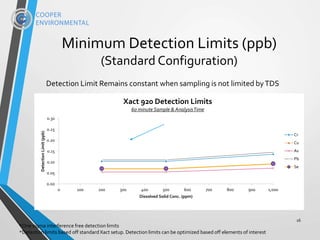
Minimum Detection Limits (ppb)
(Standard Configuration)
0.00
0.05
0.10
0.15
0.20
0.25
0.30
0 100 200 300 400 500 600 700 800 900 1,000
DetectionLimit(ppb)
Dissolved Solid Conc. (ppm)
Xact 920 Detection Limits
60 minute Sample & AnalysisTime
Cr
Cu
As
Pb
Se
16
*One sigma interference free detection limits
*Detection limits based off standardXact setup. Detection limits can be optimized based off elements of interest
Detection Limit Remains constant when sampling is not limited byTDS
Xact 920 laboratory
testing
17
Laboratory Results
Low Concentration Drift
400
420
440
460
480
500
520
540
560
580
600
9/59:36
9/512:00
9/514:24
9/516:48
9/519:12
9/521:36
9/60:00
9/62:24
9/64:48
9/67:12
9/69:36
9/612:00
9/614:24
9/616:48
9/619:12
9/621:36
9/70:00
9/72:24
9/74:48
9/77:12
MeasuredConcentration(ng/g)
Ni (ppb)
Cu (ppb)
Zn (ppb)
As (ppb)
Cd (ppb)
Pb (ppb)
18
Metal Zero Drift
Average
Measured
Value (ng/g)
Standard
Deviation
(ng/g)
N % RSD
Actual Value
(ng/g)
RPE
Ni 0.3% 525.6 3.6
75
0.7% 501.8 -5%
Cu -0.5% 463.3 4.0 0.9% 508.1 9%
Zn -0.2% 483.4 3.5 0.7% 501.8 4%
As 0.1% 506.5 3.4 0.7% 505.7 0%
Cd 0.8% 550.7 9.3 1.7% 497.7 -11%
Pb 0.3% 521.7 4.7 0.9% 509.4 -2%
30
MINUTE
MODE
%RSD= Percent relative standard deviation – it is the standard deviation divided by the average
RPE= Relative percent error
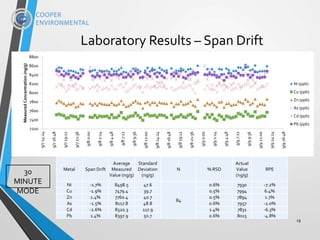
Laboratory Results – Span Drift
19
Metal Span Drift
Average
Measured
Value (ng/g)
Standard
Deviation
(ng/g)
N % RSD
Actual
Value
(ng/g)
RPE
Ni -1.7% 8498.5 47.6
84
0.6% 7930 -7.2%
Cu -1.9% 7479.4 39.7 0.5% 7994 6.4%
Zn 1.4% 7760.4 40.7 0.5% 7894 1.7%
As -1.5% 8117.8 48.8 0.6% 7957 -2.0%
Cd -2.6% 8320.3 117.9 1.4% 7831 -6.3%
Pb 1.4% 8397.9 50.7 0.6% 8015 -4.8%
7200
7400
7600
7800
8000
8200
8400
8600
8800
9/714:24
9/716:48
9/719:12
9/721:36
9/80:00
9/82:24
9/84:48
9/87:12
9/89:36
9/812:00
9/814:24
9/816:48
9/819:12
9/821:36
9/90:00
9/92:24
9/94:48
9/97:12
9/99:36
9/912:00
9/914:24
9/916:48
MeasuredConcentration(ng/g)
Ni (ppb)
Cu (ppb)
Zn (ppb)
As (ppb)
Cd (ppb)
Pb (ppb)
30
MINUTE
MODE
20
1
10
100
1,000
10,000
100,000
1 10 100 1,000 10,000 100,000
MeasuredConcentration(ng/g)
Actual Concentration (ng/g)
Ni
1
10
100
1,000
10,000
1 10 100 1,000 10,000 100,000
MeasuredConcentration(ng/g)
Actual Concentration (ng/g)
Cu
1
10
100
1,000
10,000
100,000
1 10 100 1,000 10,000 100,000
MeasuredConcentration(ng/g)
Actual Concentration (ng/g)
Zn
1
10
100
1,000
10,000
100,000
1 10 100 1,000 10,000 100,000
MeasuredConcentration(ng/g)
Actual Concentration (ng/g)
As
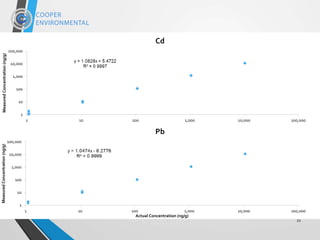
Laboratory Results – Linearity
NO Change In Calibration Over Solution
Concentration Range
Xact Shows Linearity Over a Range
Spanning 5 Orders of Magnitude
More Linearity
21
1
10
100
1,000
10,000
100,000
1 10 100 1,000 10,000 100,000
MeasuredConcentration(ng/g)
Actual Concentration (ng/g)
Cd
1
10
100
1,000
10,000
100,000
1 10 100 1,000 10,000 100,000
MeasuredConcentration(ng/g)
Actual Concentration (ng/g)
Pb
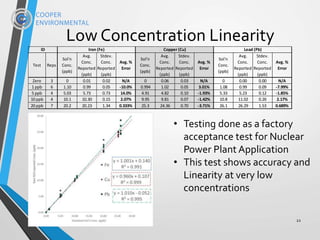
Low Concentration Linearity
22
Test Reps
Sol'n
Conc.
(ppb)
Avg.
Conc.
Reported
(ppb)
Stdev.
Conc.
Reported
(ppb)
Avg. %
Error
Sol'n
Conc.
(ppb)
Avg.
Conc.
Reported
(ppb)
Stdev.
Conc.
Reported
(ppb)
Avg. %
Error
Sol'n
Conc.
(ppb)
Avg.
Conc.
Reported
(ppb)
Stdev.
Conc.
Reported
(ppb)
Avg. %
Error
Zero 3 0 0.01 0.02 N/A 0 0.06 0.03 N/A 0 0.00 0.00 N/A
1 ppb 6 1.10 0.99 0.05 -10.0% 0.994 1.02 0.05 3.01% 1.08 0.99 0.09 -7.99%
5 ppb 4 5.03 5.73 0.73 14.0% 4.91 4.82 0.10 -1.93% 5.33 5.23 0.12 -1.85%
10 ppb 4 10.1 10.30 0.15 2.07% 9.95 9.81 0.07 -1.42% 10.8 11.02 0.26 2.17%
20 ppb 7 20.2 20.23 1.34 0.333% 25.3 24.36 0.70 -3.71% 26.1 26.29 1.53 0.689%
Iron (Fe) Copper (Cu) Lead (Pb)ID
• Testing done as a factory
acceptance test for Nuclear
Power Plant Application
• This test shows accuracy and
Linearity at very low
concentrations
Laboratory Results – Accuracy in High
TDS
23
[As]Meas = 50.8±4 ng/g (1, N= 435); [As]actual = 52.5±0.3 ng/g; RPE = 3.2 ± 0.2%
TDS=1,619 ppm (1.6 mg/g, 0.16% w/w)
CaSO4
0
10
20
30
40
50
60
70
10/20:00
10/212:00
10/30:00
10/312:00
10/40:00
10/412:00
10/50:00
10/512:00
10/60:00
10/612:00
10/70:00
10/712:00
10/80:00
10/812:00
10/90:00
10/912:00
10/100:00
10/1012:00
10/110:00
10/1112:00
10/120:00
10/1212:00
10/130:00
MeasuredConcentration(ng/g)
Actual As (ppb)
Measured As (ppb)
30
MINUTE
MODE Results show good stability at higherTDS
For Umicore: levels ofTDS are low enough to not be an issue
24
Laboratory Results – Accuracy in
HighTDS
[Pb]Meas = 92.8±6.8 ng/g (1, N= 435); [Pb]actual = 96.2±0.3 ng/g; RPE = 3.5 ± 0.3%
0
20
40
60
80
100
120
10/20:00
10/212:00
10/30:00
10/312:00
10/40:00
10/412:00
10/50:00
10/512:00
10/60:00
10/612:00
10/70:00
10/712:00
10/80:00
10/812:00
10/90:00
10/912:00
10/100:00
10/1012:00
10/110:00
10/1112:00
10/120:00
10/1212:00
10/130:00
MeasuredConcentration(ng/g)
Actual Pb (ppb)
Measured Pb (ppb)
TDS=1,619 ppm (1.6 mg/g, 0.16% w/w) CaSO4
30
MINUTE
MODE
For Umicore: levels ofTDS are low enough to not be an issue
Xact 920 field
demonstration
25
Field Demonstration
• Field test done at one of the world’s largest metal melting
facilities
• Water from several plant processes and run-off from
snowmelt and water sprayed to reduce fugitive emissions
• MetalsTreatment included adding lime slurry to raise PH
(~10.5) and a flocculant to precipitate metals
• Sampling done downstream of clarifier
• Instrument operated at facility for over four months
26
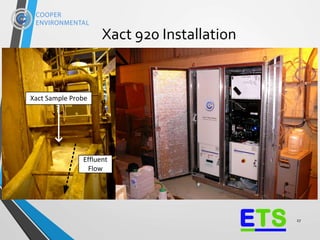
Xact 920 Installation
27
Xact Sample Probe
Effluent
Flow
Xact 920-ICP-MS Comparison
Multi-Element Standard
28
• After instrument installed in the field the instrument was tested using
a multi element standard
• Gravimetric Results – how the Xact compared with the known
concentration of the solution
• ICP-MS – How the Xact compared with analysis off line by Inductively
Couple Plasma Mass Spectroscopy
Xact 920-ICP-MS Comparison
“As Found” Grab Sample
29
• Average percent difference less than 20% for all elements exceptTl
• Good agreement between ICP-MS and the Xact
• In generally good stability in the analysis results from the Xact –
the relative percent standard deviation is less than 20% for all
elements except copper
• …. Indicates values lower than the LOQ for the Xact
LOQ= Limit of Quantitation
Measurement
of Spiked
Samples
30
• Effluent samples were spiked with several
elements of interest at two concentration
levels (30, and 300 ppb)
• The resulting solutions were measured by
the Xact 920 and by ICP-MS
• The percent difference between the Xact
and ICP-MS was determined
• Percent recovery for the Xact was calculated
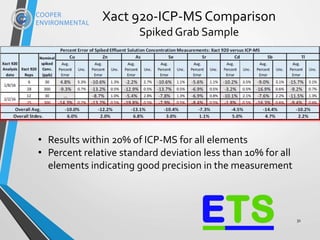
Xact 920-ICP-MS Comparison
Spiked Grab Sample
31
• Results within 20% of ICP-MS for all elements
• Percent relative standard deviation less than 10% for all
elements indicating good precision in the measurement
Xact 920 Spike Recovery Results
32
• Percent recovery calculated for all elements – a value of 100% would
represent a perfect result
• EPA 200.8 Criteria for spiked recovery is 100% +/- 30% - All of the elements
met this criteria
Measuring Se
in Coal Mine
Water Effluent
33
Coal Mine
Grab Sample
Experimental
Setup
34
ANALYZED GRAB
SAMPLE FOR TOTAL SE
ANALYZED SPIKED
GRAB SAMPLE FOR
TOTAL SE
SUBMIT RESULTS TO
CLIENT
CLIENT SENDS US
REGULAR LABORATORY
TOTAL SE ANALYSIS
RESULTS
COMPARE RESULTS
Coal Mine Grab Sample – Xact
920 vs Lab Analysis
35
Conc. (ppb) σ (ppb) Conc. (ppb) σ (ppb) *
% σ*
Grab sample (sampled 11/7/2016) 25.6 4.3 31 2 -17 15
*
CES assumed an uncertainty of 5% for TRL analysis
Sample Info
Avg. Xact 920 Analysis Lab. Analysis Percent Error
• Xact 920 and Laboratory result agree within 20%
Se Spiked Conc.* Measured Se Conc. σ Se Conc. Spike Recovery Stdev Spike recovery RPD
ng/g ng/g ng/g % % %
022317_48 Grab sample as received 30.3 3.1
022317_49 Grab sample as received 21.9 2.3
022317_50 Grab sample as received 24.6 2.5
Average Grab sample as received 25.6 4.3**
021717_40 Grab+50 ng/g Se spike 51.3 87.2 9.0 120.3
021717_41 Grab+50 ng/g Se spike 51.3 80.7 8.3 107.5
022017_44 Grab+200 ng/g Se spike 197.6 201.0 6.5 88.9
022017_45 Grab+200 ng/g Se spike 197.6 208.9 6.8 93.0
Note:
* Total Se (solution consists of 89.03% Se6+ and 10.97% Se4+)
** Standard deviation of three measured replicates
9.0 11.2
2.9 4.4
Sample Information Xact 920
Run ID Sample Description
N/A N/A N/A N/A
• Spiked recovery results well within EPA recommended range of 70% to
130%
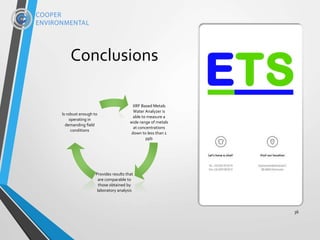
Conclusions
36
XRF Based Metals
Water Analyzer is
able to measure a
wide range of metals
at concentrations
down to less than 1
ppb
Provides results that
are comparable to
those obtained by
laboratory analysis
Is robust enough to
operating in
demanding field
conditions

XRF Based Multi-Metals Continuous Water Analyzer

  • 1.
    XRF Based Multi-Metals Continuous Water Analyzer Rogervan uden EuropeanTech Serv nv Power PlantWaterTreatment
  • 2.
  • 3.
    Why Measure Metals in RealTime in Water Treatment Processes 3 •Process monitoring – feedback for water treatment may improve the efficiency of the treatment process – use fewer chemicals to achieve require effluent emission limits • Measurement of Se, As for compliance with Steam Electric Generating Effluent Guidelines • Monitoring of treatment of wastewater by biological based treatment systems • Measurement of Corrosion Products (e.g. Fe, Ni, Cr and Mn) to improve operating efficiency • Measurement of Elements in Nuclear Power Plant Applications (e.g. Pb, Cu, Fe) • Reduce laboratory analysis costs
  • 4.
    XRF BasedWater Analyzer Basics •Xact 920 Utilizes ED-XRF as analytical technique • Water is spray dried and sampled onto filter tape • The resulting filter tape deposit is analyzed by XRF • Builds on two technologies developed and commercialized by Cooper Environmental • Ambient Air XRF Analyzer (over 100 in field) • Quantitative AerosolGenerator (Developed for Calibration of PM CEMS for the Power Industry) • Instrument can measure up to 65 elements simultaneously 4
  • 5.
    XRFTheory • X-ray sourceis electrically powered NOT a radionuclide source • Incoming X-rays eject an inner shell electron • Electrons from higher shells fill the vacancy • This process releases energy in the form of fluorescingX-rays • Energy is characteristic of each element • Intensity or brightness is related to the mass of each element 5
  • 6.
    Strengths of XRF • XRFutilizes inner shell electron transitions so the response is not dependent on what the element is chemically bound to • Can measure a wide range of elements simultaneously • XRF is non-destructive – so samples can be reanalyzed later • XRF is very stable – calibrations can last for years • XRF response is linear over the a wide concentration range (over 5 orders of magnitude) – this means no additional standards required depending on concentration range 6
  • 7.
    Measurable Elements 7 Elements ofPotential Interest in the Power Industry
  • 8.
    General Operation Schematic- Xact 920 LBM Pre-filter Sterilizer Pump Drying Chamber Internal Standard Carbon Trap Flow Meter Pump Exhaust Filters Modified Xact 625 Software Data Processing/ reporting Sample Source Sample pre-treatment and transport Sample Analysis Quantitative liquid blending and sample pre-concentration DAP Data acquisition and processing Xact 295 8 Sample is aerosolized and dried Sampled onto filter tape and analyzed by XRF LBM: Liquid Blending Module – this is where we combine the liquid sample flow with the a liquid flow containing an internal standard
  • 9.
  • 10.
    XRF Sampling andAnalysis X-Ray Tube Filter Tape Dried Aerosol Deposit Dried Aerosol from Drying Chamber Analysis Area Filter Tape
  • 11.
    General Quantification -Xact 920 11 Internal standard Effluent Quantitatively blended effluent and internal standard Liquid Blending Module XRF metals analysis Compressed air Blend sample/ internal Std.
  • 12.
    Xact 920 –Quality Assurance • XRF Portion Calibrated withTraceable to NIST Thin Film Standards • XRF spectrometer QA with every sample • XRF StabilityCheck with Every sample (Pd Rod) • Daily upscale check of XRF • Multi element upscale is inserted once/day • Includes energy calibration of detector • Stability – XRF calibration frequency ~once/year – sometimes years between calibrations 12
  • 13.
  • 14.
    Xact 920 DetectionLimits 14 15 30 60 120 S 3.8 3.7 1.3 0.47 Cl 2.0 2.0 0.72 0.25 K 1.4 1.4 0.49 0.17 Ca 0.36 0.35 0.12 0.044 Ti 0.19 0.19 0.066 0.023 V 0.14 0.14 0.050 0.018 Cr 0.14 0.14 0.048 0.017 Mn 0.17 0.17 0.059 0.021 Fe 0.20 0.20 0.070 0.025 Co 0.16 0.16 0.056 0.020 Ni 0.11 0.11 0.039 0.014 Cu 0.092 0.091 0.032 0.011 Zn 0.077 0.077 0.027 0.010 As 0.073 0.073 0.026 0.0091 Se 0.094 0.093 0.033 0.012 Br 0.12 0.12 0.042 0.015 Cd 2.9 2.9 1.0 0.36 Pb 0.15 0.15 0.052 0.018 Element Sample time (minutes) Detection Limit in ppb 68% Confidence, less then 50 ppm ofTDS • 30 minute DL’s are less than 1ppb for most elements • Detection Limit is a function of… • Sampling time – more time better detection limits • Total Dissolved Solids (TDS) • HighTDS can limit the amount of preconcentration that takes place – too much material on tape can limit air flow
  • 15.
    Minimum Detection Limits(ppb) (Standard Configuration) 0.0 1.0 2.0 3.0 4.0 0 5000 10000 15000 20000 DetectionLimit(ppb) Dissolved Solid Conc. (ppm) Xact 920 Detection Limits 60 minute Sample & AnalysisTime C r C u A s 15 *One sigma interference free detection limits *Detection limits based off standardXact setup. Detection limits can be optimized based off elements of interest Detection Limit Increases as TDS increases Limited by amount of flow that can pass through the tape at high aerosol concentrations
  • 16.
    Minimum Detection Limits(ppb) (Standard Configuration) 0.00 0.05 0.10 0.15 0.20 0.25 0.30 0 100 200 300 400 500 600 700 800 900 1,000 DetectionLimit(ppb) Dissolved Solid Conc. (ppm) Xact 920 Detection Limits 60 minute Sample & AnalysisTime Cr Cu As Pb Se 16 *One sigma interference free detection limits *Detection limits based off standardXact setup. Detection limits can be optimized based off elements of interest Detection Limit Remains constant when sampling is not limited byTDS
  • 17.
  • 18.
    Laboratory Results Low ConcentrationDrift 400 420 440 460 480 500 520 540 560 580 600 9/59:36 9/512:00 9/514:24 9/516:48 9/519:12 9/521:36 9/60:00 9/62:24 9/64:48 9/67:12 9/69:36 9/612:00 9/614:24 9/616:48 9/619:12 9/621:36 9/70:00 9/72:24 9/74:48 9/77:12 MeasuredConcentration(ng/g) Ni (ppb) Cu (ppb) Zn (ppb) As (ppb) Cd (ppb) Pb (ppb) 18 Metal Zero Drift Average Measured Value (ng/g) Standard Deviation (ng/g) N % RSD Actual Value (ng/g) RPE Ni 0.3% 525.6 3.6 75 0.7% 501.8 -5% Cu -0.5% 463.3 4.0 0.9% 508.1 9% Zn -0.2% 483.4 3.5 0.7% 501.8 4% As 0.1% 506.5 3.4 0.7% 505.7 0% Cd 0.8% 550.7 9.3 1.7% 497.7 -11% Pb 0.3% 521.7 4.7 0.9% 509.4 -2% 30 MINUTE MODE %RSD= Percent relative standard deviation – it is the standard deviation divided by the average RPE= Relative percent error
  • 19.
    Laboratory Results –Span Drift 19 Metal Span Drift Average Measured Value (ng/g) Standard Deviation (ng/g) N % RSD Actual Value (ng/g) RPE Ni -1.7% 8498.5 47.6 84 0.6% 7930 -7.2% Cu -1.9% 7479.4 39.7 0.5% 7994 6.4% Zn 1.4% 7760.4 40.7 0.5% 7894 1.7% As -1.5% 8117.8 48.8 0.6% 7957 -2.0% Cd -2.6% 8320.3 117.9 1.4% 7831 -6.3% Pb 1.4% 8397.9 50.7 0.6% 8015 -4.8% 7200 7400 7600 7800 8000 8200 8400 8600 8800 9/714:24 9/716:48 9/719:12 9/721:36 9/80:00 9/82:24 9/84:48 9/87:12 9/89:36 9/812:00 9/814:24 9/816:48 9/819:12 9/821:36 9/90:00 9/92:24 9/94:48 9/97:12 9/99:36 9/912:00 9/914:24 9/916:48 MeasuredConcentration(ng/g) Ni (ppb) Cu (ppb) Zn (ppb) As (ppb) Cd (ppb) Pb (ppb) 30 MINUTE MODE
  • 20.
    20 1 10 100 1,000 10,000 100,000 1 10 1001,000 10,000 100,000 MeasuredConcentration(ng/g) Actual Concentration (ng/g) Ni 1 10 100 1,000 10,000 1 10 100 1,000 10,000 100,000 MeasuredConcentration(ng/g) Actual Concentration (ng/g) Cu 1 10 100 1,000 10,000 100,000 1 10 100 1,000 10,000 100,000 MeasuredConcentration(ng/g) Actual Concentration (ng/g) Zn 1 10 100 1,000 10,000 100,000 1 10 100 1,000 10,000 100,000 MeasuredConcentration(ng/g) Actual Concentration (ng/g) As Laboratory Results – Linearity NO Change In Calibration Over Solution Concentration Range Xact Shows Linearity Over a Range Spanning 5 Orders of Magnitude
  • 21.
    More Linearity 21 1 10 100 1,000 10,000 100,000 1 10100 1,000 10,000 100,000 MeasuredConcentration(ng/g) Actual Concentration (ng/g) Cd 1 10 100 1,000 10,000 100,000 1 10 100 1,000 10,000 100,000 MeasuredConcentration(ng/g) Actual Concentration (ng/g) Pb
  • 22.
    Low Concentration Linearity 22 TestReps Sol'n Conc. (ppb) Avg. Conc. Reported (ppb) Stdev. Conc. Reported (ppb) Avg. % Error Sol'n Conc. (ppb) Avg. Conc. Reported (ppb) Stdev. Conc. Reported (ppb) Avg. % Error Sol'n Conc. (ppb) Avg. Conc. Reported (ppb) Stdev. Conc. Reported (ppb) Avg. % Error Zero 3 0 0.01 0.02 N/A 0 0.06 0.03 N/A 0 0.00 0.00 N/A 1 ppb 6 1.10 0.99 0.05 -10.0% 0.994 1.02 0.05 3.01% 1.08 0.99 0.09 -7.99% 5 ppb 4 5.03 5.73 0.73 14.0% 4.91 4.82 0.10 -1.93% 5.33 5.23 0.12 -1.85% 10 ppb 4 10.1 10.30 0.15 2.07% 9.95 9.81 0.07 -1.42% 10.8 11.02 0.26 2.17% 20 ppb 7 20.2 20.23 1.34 0.333% 25.3 24.36 0.70 -3.71% 26.1 26.29 1.53 0.689% Iron (Fe) Copper (Cu) Lead (Pb)ID • Testing done as a factory acceptance test for Nuclear Power Plant Application • This test shows accuracy and Linearity at very low concentrations
  • 23.
    Laboratory Results –Accuracy in High TDS 23 [As]Meas = 50.8±4 ng/g (1, N= 435); [As]actual = 52.5±0.3 ng/g; RPE = 3.2 ± 0.2% TDS=1,619 ppm (1.6 mg/g, 0.16% w/w) CaSO4 0 10 20 30 40 50 60 70 10/20:00 10/212:00 10/30:00 10/312:00 10/40:00 10/412:00 10/50:00 10/512:00 10/60:00 10/612:00 10/70:00 10/712:00 10/80:00 10/812:00 10/90:00 10/912:00 10/100:00 10/1012:00 10/110:00 10/1112:00 10/120:00 10/1212:00 10/130:00 MeasuredConcentration(ng/g) Actual As (ppb) Measured As (ppb) 30 MINUTE MODE Results show good stability at higherTDS For Umicore: levels ofTDS are low enough to not be an issue
  • 24.
    24 Laboratory Results –Accuracy in HighTDS [Pb]Meas = 92.8±6.8 ng/g (1, N= 435); [Pb]actual = 96.2±0.3 ng/g; RPE = 3.5 ± 0.3% 0 20 40 60 80 100 120 10/20:00 10/212:00 10/30:00 10/312:00 10/40:00 10/412:00 10/50:00 10/512:00 10/60:00 10/612:00 10/70:00 10/712:00 10/80:00 10/812:00 10/90:00 10/912:00 10/100:00 10/1012:00 10/110:00 10/1112:00 10/120:00 10/1212:00 10/130:00 MeasuredConcentration(ng/g) Actual Pb (ppb) Measured Pb (ppb) TDS=1,619 ppm (1.6 mg/g, 0.16% w/w) CaSO4 30 MINUTE MODE For Umicore: levels ofTDS are low enough to not be an issue
  • 25.
  • 26.
    Field Demonstration • Fieldtest done at one of the world’s largest metal melting facilities • Water from several plant processes and run-off from snowmelt and water sprayed to reduce fugitive emissions • MetalsTreatment included adding lime slurry to raise PH (~10.5) and a flocculant to precipitate metals • Sampling done downstream of clarifier • Instrument operated at facility for over four months 26
  • 27.
    Xact 920 Installation 27 XactSample Probe Effluent Flow
  • 28.
    Xact 920-ICP-MS Comparison Multi-ElementStandard 28 • After instrument installed in the field the instrument was tested using a multi element standard • Gravimetric Results – how the Xact compared with the known concentration of the solution • ICP-MS – How the Xact compared with analysis off line by Inductively Couple Plasma Mass Spectroscopy
  • 29.
    Xact 920-ICP-MS Comparison “AsFound” Grab Sample 29 • Average percent difference less than 20% for all elements exceptTl • Good agreement between ICP-MS and the Xact • In generally good stability in the analysis results from the Xact – the relative percent standard deviation is less than 20% for all elements except copper • …. Indicates values lower than the LOQ for the Xact LOQ= Limit of Quantitation
  • 30.
    Measurement of Spiked Samples 30 • Effluentsamples were spiked with several elements of interest at two concentration levels (30, and 300 ppb) • The resulting solutions were measured by the Xact 920 and by ICP-MS • The percent difference between the Xact and ICP-MS was determined • Percent recovery for the Xact was calculated
  • 31.
    Xact 920-ICP-MS Comparison SpikedGrab Sample 31 • Results within 20% of ICP-MS for all elements • Percent relative standard deviation less than 10% for all elements indicating good precision in the measurement
  • 32.
    Xact 920 SpikeRecovery Results 32 • Percent recovery calculated for all elements – a value of 100% would represent a perfect result • EPA 200.8 Criteria for spiked recovery is 100% +/- 30% - All of the elements met this criteria
  • 33.
    Measuring Se in CoalMine Water Effluent 33
  • 34.
    Coal Mine Grab Sample Experimental Setup 34 ANALYZEDGRAB SAMPLE FOR TOTAL SE ANALYZED SPIKED GRAB SAMPLE FOR TOTAL SE SUBMIT RESULTS TO CLIENT CLIENT SENDS US REGULAR LABORATORY TOTAL SE ANALYSIS RESULTS COMPARE RESULTS
  • 35.
    Coal Mine GrabSample – Xact 920 vs Lab Analysis 35 Conc. (ppb) σ (ppb) Conc. (ppb) σ (ppb) * % σ* Grab sample (sampled 11/7/2016) 25.6 4.3 31 2 -17 15 * CES assumed an uncertainty of 5% for TRL analysis Sample Info Avg. Xact 920 Analysis Lab. Analysis Percent Error • Xact 920 and Laboratory result agree within 20% Se Spiked Conc.* Measured Se Conc. σ Se Conc. Spike Recovery Stdev Spike recovery RPD ng/g ng/g ng/g % % % 022317_48 Grab sample as received 30.3 3.1 022317_49 Grab sample as received 21.9 2.3 022317_50 Grab sample as received 24.6 2.5 Average Grab sample as received 25.6 4.3** 021717_40 Grab+50 ng/g Se spike 51.3 87.2 9.0 120.3 021717_41 Grab+50 ng/g Se spike 51.3 80.7 8.3 107.5 022017_44 Grab+200 ng/g Se spike 197.6 201.0 6.5 88.9 022017_45 Grab+200 ng/g Se spike 197.6 208.9 6.8 93.0 Note: * Total Se (solution consists of 89.03% Se6+ and 10.97% Se4+) ** Standard deviation of three measured replicates 9.0 11.2 2.9 4.4 Sample Information Xact 920 Run ID Sample Description N/A N/A N/A N/A • Spiked recovery results well within EPA recommended range of 70% to 130%
  • 36.
    Conclusions 36 XRF Based Metals WaterAnalyzer is able to measure a wide range of metals at concentrations down to less than 1 ppb Provides results that are comparable to those obtained by laboratory analysis Is robust enough to operating in demanding field conditions

Editor's Notes

  • #19 Zero drift = abs(measured value – initial measurement)/Full scale range, largest drift over period of time equals zero drift percentage
  • #20 Range drift = abs(measured value – initial measurement)/Full scale range, largest drift over period of time equals zero drift percentage
  • #21 All elements present in same solution
  • #25 Same solution as Arsenic