

CCAARRBBOONN CCRREEDDIITTSS
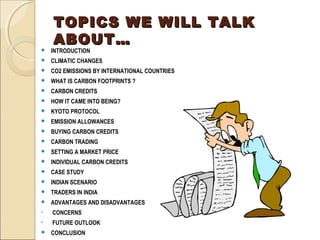
TTOOPPIICCSS WWEE WWIILLLL TTAALLKK 
AABBOOUUTT…… 
 INTRODUCTION 
 CLIMATIC CHANGES 
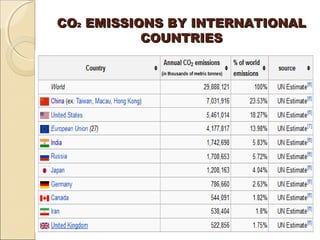
 CO2 EMISSIONS BY INTERNATIONAL COUNTRIES 
 WHAT IS CARBON FOOTPRINTS ? 
 CARBON CREDITS 
 HOW IT CAME INTO BEING? 
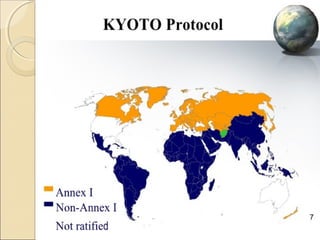
 KYOTO PROTOCOL 
 EMISSION ALLOWANCES 
 BUYING CARBON CREDITS 
 CARBON TRADING 
 SETTING A MARKET PRICE 
 INDIVIDUAL CARBON CREDITS 
 CASE STUDY 
 INDIAN SCENARIO 
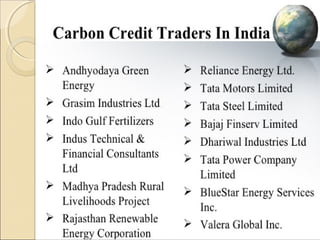
 TRADERS IN INDIA 
 ADVANTAGES AND DISADVANTAGES 
• CONCERNS 
• FUTURE OUTLOOK 
 CONCLUSION
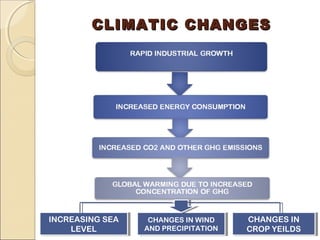
CCLLIIMMAATTIICC CCHHAANNGGEESS 
INCREASING SEA 
INCREASING SEA 
LEVEL 
LEVEL 
CHANGES IN WIND 
AND PRECIPITATION 
CHANGES IN WIND 
AND PRECIPITATION 
CHANGES IN 
CROP YEILDS 
CHANGES IN 
CROP YEILDS
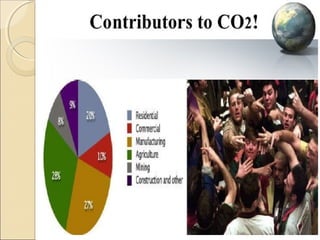
CCOO22 EEMMIISSSSIIOONNSS BBYY IINNTTEERRNNAATTIIOONNAALL 
CCOOUUNNTTRRIIEESS
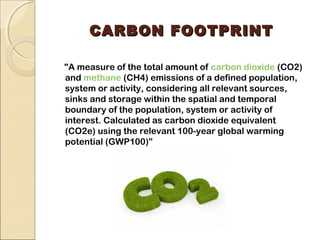
CCAARRBBOONN FFOOOOTTPPRRIINNTT 
"A measure of the total amount of carbon dioxide (CO2) 
and methane (CH4) emissions of a defined population, 
system or activity, considering all relevant sources, 
sinks and storage within the spatial and temporal 
boundary of the population, system or activity of 
interest. Calculated as carbon dioxide equivalent 
(CO2e) using the relevant 100-year global warming 
potential (GWP100)”
DDEEFFIINNIITTIIOONN 
A carbon credit is a generic term for any 
tradable certificate or permit representing the 
right to emit one tonne of carbon dioxide or the 
mass of another greenhouse gas with a carbon 
dioxide equivalent (tCO2e) equivalent to one 
tonne of carbon dioxide.
In short… 
1 Carbon Credit = 1 ton of carbon dioxide
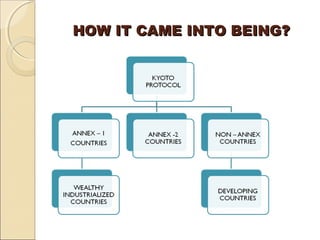
HHOOWW IITT CCAAMMEE IINNTTOO BBEEIINNGG??
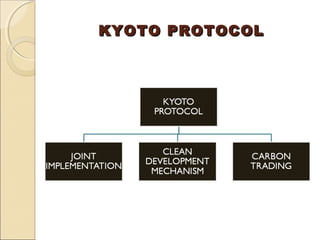
KKYYOOTTOO PPRROOTTOOCCOOLL
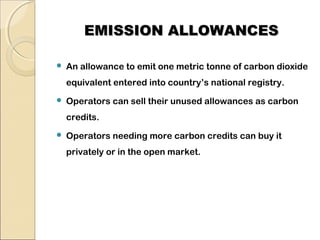
EEMMIISSSSIIOONN AALLLLOOWWAANNCCEESS 
 An allowance to emit one metric tonne of carbon dioxide 
equivalent entered into country’s national registry. 
 Operators can sell their unused allowances as carbon 
credits. 
 Operators needing more carbon credits can buy it 
privately or in the open market.
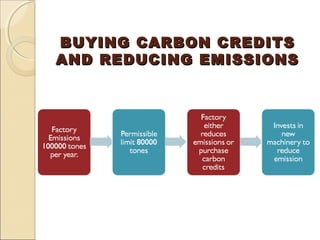
BUYING CCAARRBBOONN CCRREEDDIITTSS 
AANNDD RREEDDUUCCIINNGG EEMMIISSSSIIOONNSS
CCAARRBBOONN TTRRAADDIINNGG 
 Carbon trading is an administrative approach used to 
control pollution by providing incentives for achieving 
reductions in emissions of pollutants. 
 Overall goal of an carbon emission trading plan is to 
minimize the cost of meeting a set emissions target.
SETTING AA MMAARRKKEETT PPRRIICCEE FFOORR 
CCAARRBBOONN.... 
 Optimal carbon price is the market price on carbon 
emissions that balance the incremental costs of reducing 
carbon emissions with the incremental benefits of reducing 
climate change. 
 Price of carbon in market is raised. It can achieve four 
goals. 
 Carbon Credits are traded at CO2 exchange in UK, CDM 
exchange in Europe and the Chicago climate exchange. 
 Current carbon credit price was Rs 752.5 as traded on 
16/3/11.
IINNDDIIVVIIDDUUAALL CCAARRBBOONN CCRREEDDIITTSS 
 Individual credits for public transport. 
 Individuals who exceed their allocation would be able to 
purchase additional credits from those who use less. 
 Personal carbon trading has been criticized for its high 
implementation costs. 
 Personal carbon trading would be a progressive policy, 
redistributing money from the rich to the poor - as the 
rich use more energy than the poor.
CCAASSEE SSTTUUDDYY 
 A green stealth tax is a tax levied in such a way that is 
largely unnoticed, or not recognized as a tax. 
 Large public and private sector organizations forces 
hospitals, fire brigade, etc. to register for the scheme to 
buy the credits for their emissions. 
 Crossing the limits of carbon credit leads to heavy 
penalization. 
 Rewarding credits are awarded for staying within the 
prescribed limits.
CCAASSEE SSTTUUDDYY 
 An efficient mechanism to reduce green house gas 
emissions in rural India. 
 A proposal of mathematical model based household 
biogas plant project for energy self sufficiency in rural 
India. 
 A research study carried out in 10 villages of Jhunjhunu 
district of Rajasthan. 
 Main aim was to make the project economically feasible 
by earning income from the sales of carbon credits 
through the project.
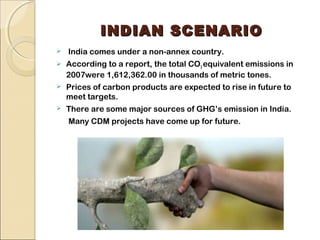
IINNDDIIAANN SSCCEENNAARRIIOO 
 India comes under a non-annex country. 
 According to a report, the total CO2 equivalent emissions in 
2007were 1,612,362.00 in thousands of metric tones. 
 Prices of carbon products are expected to rise in future to 
meet targets. 
 There are some major sources of GHG’s emission in India. 
Many CDM projects have come up for future.
AADDVVAANNTTAAGGEESS AANNDD 
DDIISSAADDVVAANNTTAAGGEESS 
ADVANTAGES 
 Better technologies for the company which is benefiting from 
generation of CERs. 
 Technology transfer from developed to developing countries 
(Due to low cost structure in developing countries). 
 Additional source of foreign investment in developing 
countries which act as a catalyst in developing cleaner 
technologies. 
 Channel CDM funds to investment priorities – The CDM funds 
can be channelized into building or improving projects, thus 
reinvesting it for higher growth. 
 Development of cleaner technologies leading to sustainable 
development where countries have a strategic advantage 
from now in terms of pollution. 
 Environmental benefits due to lesser GHG emissions.
DISADVANTAGES 
 Provision of cheapest way of purchasing climate 
destroying right. 
 Due to nature and process of complexity involved, 
foreign players may dominate domestic industries for 
the incentive if CERs. 
 CDM investment could affect national development 
strategies, possibly adversely affecting national 
decision-making processes. Until future commitment 
periods are agreed, the CDM may not provide incentives 
for financing long-term development projects and 
strategies.
CCOONNCCEERRNNSS 
Projects take approximately 2 years to be 
issued. 
India is still not counted among the top three 
carbon credit nations because of its project 
rejection rate. 
The projects show shortfall in the techniques 
and methodology.
FFUUTTUURREE OOUUTTLLOOOOKK 
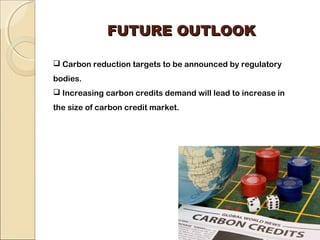
 Carbon reduction targets to be announced by regulatory 
bodies. 
 Increasing carbon credits demand will lead to increase in 
the size of carbon credit market.
CCOONNCCLLUUSSIIOONN 
The world must take action to cut carbon dioxide 
emissions. And this action needs to be reconciled with 
increasing energy demand from a rising population and 
economic growth.
RREEFFEERREENNCCEESS 
www.google.com 
www.studygalaxy.com 
www.authorstream.com 
www.scibd.com
TTHHAANNKK YYOOUU

Carbon credits

  • 1.
  • 2.
    TTOOPPIICCSS WWEE WWIILLLLTTAALLKK AABBOOUUTT……  INTRODUCTION  CLIMATIC CHANGES  CO2 EMISSIONS BY INTERNATIONAL COUNTRIES  WHAT IS CARBON FOOTPRINTS ?  CARBON CREDITS  HOW IT CAME INTO BEING?  KYOTO PROTOCOL  EMISSION ALLOWANCES  BUYING CARBON CREDITS  CARBON TRADING  SETTING A MARKET PRICE  INDIVIDUAL CARBON CREDITS  CASE STUDY  INDIAN SCENARIO  TRADERS IN INDIA  ADVANTAGES AND DISADVANTAGES • CONCERNS • FUTURE OUTLOOK  CONCLUSION
  • 3.
    CCLLIIMMAATTIICC CCHHAANNGGEESS INCREASINGSEA INCREASING SEA LEVEL LEVEL CHANGES IN WIND AND PRECIPITATION CHANGES IN WIND AND PRECIPITATION CHANGES IN CROP YEILDS CHANGES IN CROP YEILDS
  • 5.
    CCOO22 EEMMIISSSSIIOONNSS BBYYIINNTTEERRNNAATTIIOONNAALL CCOOUUNNTTRRIIEESS
  • 8.
    CCAARRBBOONN FFOOOOTTPPRRIINNTT "Ameasure of the total amount of carbon dioxide (CO2) and methane (CH4) emissions of a defined population, system or activity, considering all relevant sources, sinks and storage within the spatial and temporal boundary of the population, system or activity of interest. Calculated as carbon dioxide equivalent (CO2e) using the relevant 100-year global warming potential (GWP100)”
  • 9.
    DDEEFFIINNIITTIIOONN A carboncredit is a generic term for any tradable certificate or permit representing the right to emit one tonne of carbon dioxide or the mass of another greenhouse gas with a carbon dioxide equivalent (tCO2e) equivalent to one tonne of carbon dioxide.
  • 10.
    In short… 1Carbon Credit = 1 ton of carbon dioxide
  • 11.
    HHOOWW IITT CCAAMMEEIINNTTOO BBEEIINNGG??
  • 12.
  • 14.
    EEMMIISSSSIIOONN AALLLLOOWWAANNCCEESS An allowance to emit one metric tonne of carbon dioxide equivalent entered into country’s national registry.  Operators can sell their unused allowances as carbon credits.  Operators needing more carbon credits can buy it privately or in the open market.
  • 15.
    BUYING CCAARRBBOONN CCRREEDDIITTSS AANNDD RREEDDUUCCIINNGG EEMMIISSSSIIOONNSS
  • 16.
    CCAARRBBOONN TTRRAADDIINNGG Carbon trading is an administrative approach used to control pollution by providing incentives for achieving reductions in emissions of pollutants.  Overall goal of an carbon emission trading plan is to minimize the cost of meeting a set emissions target.
  • 18.
    SETTING AA MMAARRKKEETTPPRRIICCEE FFOORR CCAARRBBOONN....  Optimal carbon price is the market price on carbon emissions that balance the incremental costs of reducing carbon emissions with the incremental benefits of reducing climate change.  Price of carbon in market is raised. It can achieve four goals.  Carbon Credits are traded at CO2 exchange in UK, CDM exchange in Europe and the Chicago climate exchange.  Current carbon credit price was Rs 752.5 as traded on 16/3/11.
  • 19.
    IINNDDIIVVIIDDUUAALL CCAARRBBOONN CCRREEDDIITTSS  Individual credits for public transport.  Individuals who exceed their allocation would be able to purchase additional credits from those who use less.  Personal carbon trading has been criticized for its high implementation costs.  Personal carbon trading would be a progressive policy, redistributing money from the rich to the poor - as the rich use more energy than the poor.
  • 20.
    CCAASSEE SSTTUUDDYY A green stealth tax is a tax levied in such a way that is largely unnoticed, or not recognized as a tax.  Large public and private sector organizations forces hospitals, fire brigade, etc. to register for the scheme to buy the credits for their emissions.  Crossing the limits of carbon credit leads to heavy penalization.  Rewarding credits are awarded for staying within the prescribed limits.
  • 21.
    CCAASSEE SSTTUUDDYY An efficient mechanism to reduce green house gas emissions in rural India.  A proposal of mathematical model based household biogas plant project for energy self sufficiency in rural India.  A research study carried out in 10 villages of Jhunjhunu district of Rajasthan.  Main aim was to make the project economically feasible by earning income from the sales of carbon credits through the project.
  • 22.
    IINNDDIIAANN SSCCEENNAARRIIOO India comes under a non-annex country.  According to a report, the total CO2 equivalent emissions in 2007were 1,612,362.00 in thousands of metric tones.  Prices of carbon products are expected to rise in future to meet targets.  There are some major sources of GHG’s emission in India. Many CDM projects have come up for future.
  • 24.
    AADDVVAANNTTAAGGEESS AANNDD DDIISSAADDVVAANNTTAAGGEESS ADVANTAGES  Better technologies for the company which is benefiting from generation of CERs.  Technology transfer from developed to developing countries (Due to low cost structure in developing countries).  Additional source of foreign investment in developing countries which act as a catalyst in developing cleaner technologies.  Channel CDM funds to investment priorities – The CDM funds can be channelized into building or improving projects, thus reinvesting it for higher growth.  Development of cleaner technologies leading to sustainable development where countries have a strategic advantage from now in terms of pollution.  Environmental benefits due to lesser GHG emissions.
  • 25.
    DISADVANTAGES  Provisionof cheapest way of purchasing climate destroying right.  Due to nature and process of complexity involved, foreign players may dominate domestic industries for the incentive if CERs.  CDM investment could affect national development strategies, possibly adversely affecting national decision-making processes. Until future commitment periods are agreed, the CDM may not provide incentives for financing long-term development projects and strategies.
  • 26.
    CCOONNCCEERRNNSS Projects takeapproximately 2 years to be issued. India is still not counted among the top three carbon credit nations because of its project rejection rate. The projects show shortfall in the techniques and methodology.
  • 27.
    FFUUTTUURREE OOUUTTLLOOOOKK Carbon reduction targets to be announced by regulatory bodies.  Increasing carbon credits demand will lead to increase in the size of carbon credit market.
  • 28.
    CCOONNCCLLUUSSIIOONN The worldmust take action to cut carbon dioxide emissions. And this action needs to be reconciled with increasing energy demand from a rising population and economic growth.
  • 29.
  • 30.

Editor's Notes

  • #21 http://www.stuff.co.nz/manawatu-standard/news/7022015/Carbon-credit-penalty-waived
  • #22 http://discovery.bits-pilani.ac.in/~bvbabu/EEST%20Part%20A%2022%20%282%29%20187-197.pdf
  • #27 http://www.som.iitb.ac.in/live/carboncredits.html
  • #28 http://www.som.iitb.ac.in/live/carboncredits.html