ENVIRONMENTALLY
SENSITIVE AREAS
CH. LAVANYA
2140200152
B.PLANNNING, III YEAR
DEPARTMENT OF PLANNING
CONTENTS:
• DEFINITION
• FEATURES OF ECO SENSITIVE AREAS
• CONTENTS OF ESAs
• CRITERIA FOR DEMARCATING ESAs
• CASE STUDY: THE TAJ TRAPEZIUM
TAJ TRAPEZIUM ZONE POLLUTION AUTHORITY (TTZPA)
PRESENT STATUSAND FUTURE COURSE
DEFINITION:
Eco sensitive areas are ecologically and economically important, but vulnerable
even to mild disturbances, and hence demand careful management. These areas are
critical to the maintenance of productive and diverse plant and wildlife populations.
FEATURES OF ECO SENSITIVE AREAS:
Biologically and ecologically
rich, valuable or unique
Largely irreplaceable if
destroyed
High value to human societies
Maintain the ecological
stability of the area
Conserves biological diversity
CONTENTS OF ESA:
• Sacred forests protecting
origins of rivers (e.g.
Bhimashankar in Pune
District)
• Important breeding
habitats (e.g. Kokkre –
Bellur Pelicanry in Mandya
District, Karnataka)
Source: wildtrails.in
CRITERIA FOR DEMARCATING ESA:
There are three important categories of attributes that need to be considered in
defining the ecological sensitivity of an area:
• Physico-climatic features (geo-climatic features),
• Biological features and
• Social relevance (including cultural, economic and historical importance)
Demarcation of an ESA shall consider the following components:
Biodiversity
richness
Productivity
Habitat
richness
Climatic
features
Species rarity
Stakeholder’s
valuation
Topographic
features
Hazard
vulnerability
Cultural and
historical
significance
ESAs IN INDIA:
• Murud-Janjira, Maharastra
• Doon Valley, Uttarakhand
• Dahanu, Western coast of Maharastra
• The Aravallis, Western India
• Numaligarh, Assam
• The Taj Trapezium
• Mahabaleshwar-Panchgani, Maharastra
• Matheran, Maharastra
• Mount Abu, Rajasthan
• Sultanpur
• Pachmarhi, Madhya Pradesh
• The Himalayas
• Hill Stations
• Sahyadri
Source: trekearth.com
CASE STUDY: THE TAJ TRAPEZIUM
BASIC DETAILS:
• A 10,400 sq. km area around the Taj Mahal,
comprising Agra, Mathura, Hathras and Ferozabad
districts and also parts of Mainpuri and Bharatapur
districts of Uttar Pradesh, has been declared as the
Taj Trapezium Zone (TTZ).
• The TTZ comprises over 40 protected monuments
including three World Heritage Sites - The Taj
Mahal, Agra Fort and Fatehpur Sikri.
BACKGROUND:
• Brick kilns, Mathura Refinery, iron foundries, glass
and other chemical industries were posing serious
threat for the Taj Mahal.
CHRONOLOGY OF EVENTS: Source: famouswonders.com
CASE STUDY: THE TAJ TRAPEZIUM - TTZPA
The MoEF by its order dated May 13, 1998 constituted an authority to be known
as the Taj Trapezium Pollution (Prevention and Control) Authority with the
following powers:
i. To monitor progress of the implementation of various schemes for protection
of the Taj Mahal and programmes for the protection and improvement of the
environment in the said area;
ii. To exercise powers under section 5 of the EPA. This section includes the
power to:
Direct the closure, prohibition or regulation of any industry, operation or
process; or
Stoppage or regulation of the supply of electricity or water or any other
service;
iii. To take all necessary steps to ensure compliance of specified emission
standards by motor vehicles and ensuring compliance of fuel quality
standards;
iv. To deal with any environmental issue which may be referred to it by the
central government or the state government of Uttar Pradesh relating to the
said area.
CASE STUDY: THE TAJ TRAPEZIUM
THE CONSTITUTION OF THE TTZPA:
There is a constitution which is set up for the purpose of monitoring the pollution
levels around Taj Mahal. The TTZPAconstitution includes:
Commissioner, Agra Division (Chairman)
Chairman, Utter Pradesh State Pollution Control Board
Deputy Inspector General of Police, Agra Range
Member-Secretary, Central Pollution Control Board
A representative of the Ministry of Petroleum and Natural Gas
A representative of the Ministry of Environment and Forests
A representative of the Archaeological Survey of India
Vice-Chairman, Agra Development Authority (Member-Convener)
CASE STUDY: PRESENT STATUS AND FUTURE COURSE:
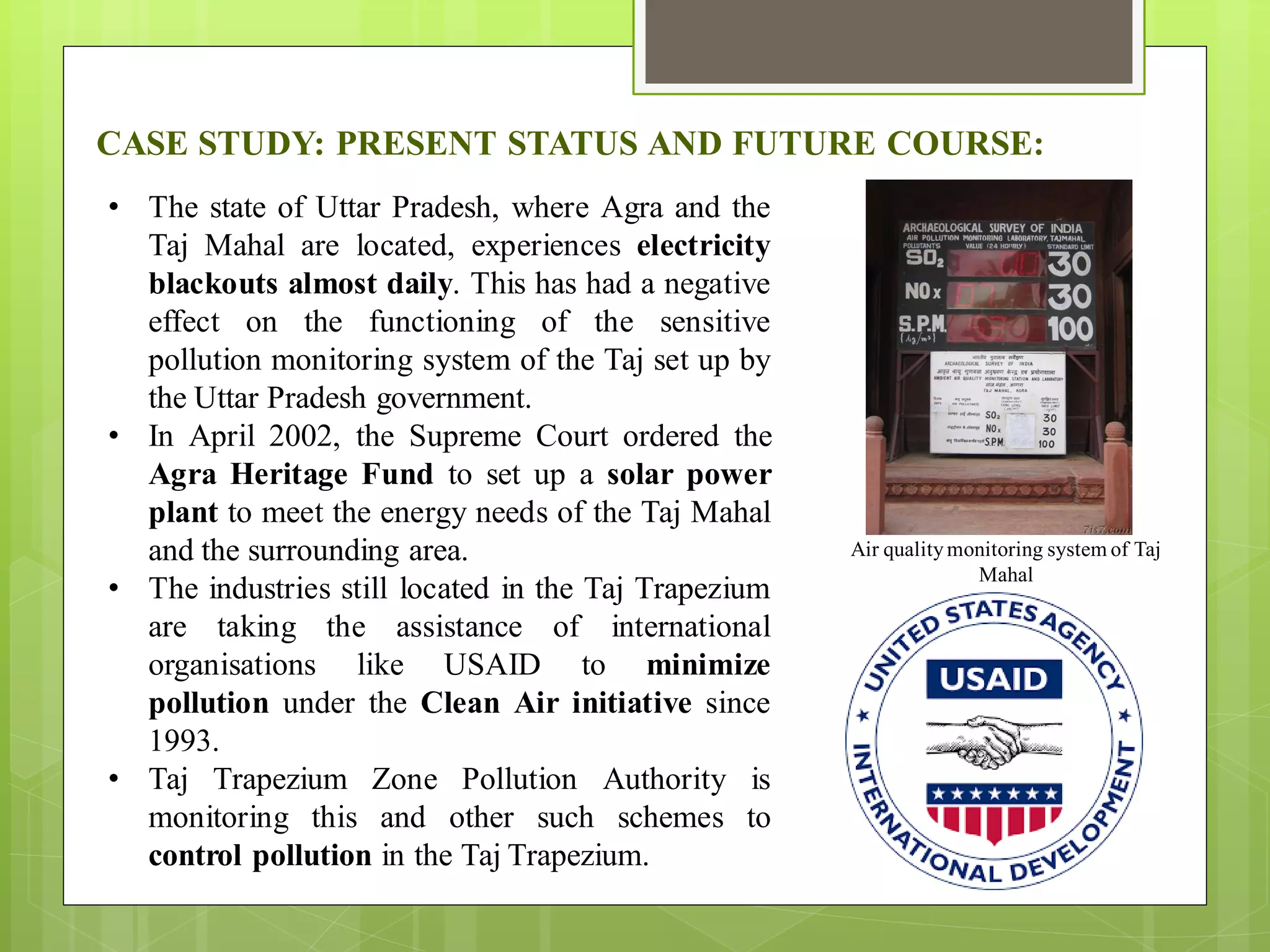
• The state of Uttar Pradesh, where Agra and the
Taj Mahal are located, experiences electricity
blackouts almost daily. This has had a negative
effect on the functioning of the sensitive
pollution monitoring system of the Taj set up by
the Uttar Pradesh government.
• In April 2002, the Supreme Court ordered the
Agra Heritage Fund to set up a solar power
plant to meet the energy needs of the Taj Mahal
and the surrounding area.
• The industries still located in the Taj Trapezium
are taking the assistance of international
organisations like USAID to minimize
pollution under the Clean Air initiative since
1993.
• Taj Trapezium Zone Pollution Authority is
monitoring this and other such schemes to
control pollution in the Taj Trapezium.
Air qualitymonitoring system of Taj
Mahal
CASE STUDY: CONCLUSION:
• ESAs need to be protected from development
• Local governments and the development community should meet the
environmental objectives during urban and rural development
• Directing development away from ESAs
• Protecting the ecological values of environmentally sensitive areas
• Connecting environmentally sensitive areas to nearby habitats
• Preventing the spread of invasive species in ESAs
• Identify and implement restoration opportunities for disturbed ESAs.
REFERENCES:
• http://www.currentscience.ac.in/Volumes/100/02/0175.pdf
• http://www.env.gov.bc.ca/wld/documents/bmp/urban_ebmp/
EBMP%20PDF%204.pdf
• https://indiankanoon.org/doc/191236316/
• http://www.indiaenvironmentportal.org.in/files/file/Neeri%20Taj%
202013.pdf
• http://assets.wwfindia.org/downloads/indias_notified_ecologica
llysensitive_areas.pdf

Environmentally sensitive areas

  • 1.
  • 2.
    CONTENTS: • DEFINITION • FEATURESOF ECO SENSITIVE AREAS • CONTENTS OF ESAs • CRITERIA FOR DEMARCATING ESAs • CASE STUDY: THE TAJ TRAPEZIUM TAJ TRAPEZIUM ZONE POLLUTION AUTHORITY (TTZPA) PRESENT STATUSAND FUTURE COURSE
  • 3.
    DEFINITION: Eco sensitive areasare ecologically and economically important, but vulnerable even to mild disturbances, and hence demand careful management. These areas are critical to the maintenance of productive and diverse plant and wildlife populations. FEATURES OF ECO SENSITIVE AREAS: Biologically and ecologically rich, valuable or unique Largely irreplaceable if destroyed High value to human societies Maintain the ecological stability of the area Conserves biological diversity CONTENTS OF ESA: • Sacred forests protecting origins of rivers (e.g. Bhimashankar in Pune District) • Important breeding habitats (e.g. Kokkre – Bellur Pelicanry in Mandya District, Karnataka) Source: wildtrails.in
  • 4.
    CRITERIA FOR DEMARCATINGESA: There are three important categories of attributes that need to be considered in defining the ecological sensitivity of an area: • Physico-climatic features (geo-climatic features), • Biological features and • Social relevance (including cultural, economic and historical importance) Demarcation of an ESA shall consider the following components: Biodiversity richness Productivity Habitat richness Climatic features Species rarity Stakeholder’s valuation Topographic features Hazard vulnerability Cultural and historical significance
  • 5.
    ESAs IN INDIA: •Murud-Janjira, Maharastra • Doon Valley, Uttarakhand • Dahanu, Western coast of Maharastra • The Aravallis, Western India • Numaligarh, Assam • The Taj Trapezium • Mahabaleshwar-Panchgani, Maharastra • Matheran, Maharastra • Mount Abu, Rajasthan • Sultanpur • Pachmarhi, Madhya Pradesh • The Himalayas • Hill Stations • Sahyadri Source: trekearth.com
  • 6.
    CASE STUDY: THETAJ TRAPEZIUM BASIC DETAILS: • A 10,400 sq. km area around the Taj Mahal, comprising Agra, Mathura, Hathras and Ferozabad districts and also parts of Mainpuri and Bharatapur districts of Uttar Pradesh, has been declared as the Taj Trapezium Zone (TTZ). • The TTZ comprises over 40 protected monuments including three World Heritage Sites - The Taj Mahal, Agra Fort and Fatehpur Sikri. BACKGROUND: • Brick kilns, Mathura Refinery, iron foundries, glass and other chemical industries were posing serious threat for the Taj Mahal. CHRONOLOGY OF EVENTS: Source: famouswonders.com
  • 7.
    CASE STUDY: THETAJ TRAPEZIUM - TTZPA The MoEF by its order dated May 13, 1998 constituted an authority to be known as the Taj Trapezium Pollution (Prevention and Control) Authority with the following powers: i. To monitor progress of the implementation of various schemes for protection of the Taj Mahal and programmes for the protection and improvement of the environment in the said area; ii. To exercise powers under section 5 of the EPA. This section includes the power to: Direct the closure, prohibition or regulation of any industry, operation or process; or Stoppage or regulation of the supply of electricity or water or any other service; iii. To take all necessary steps to ensure compliance of specified emission standards by motor vehicles and ensuring compliance of fuel quality standards; iv. To deal with any environmental issue which may be referred to it by the central government or the state government of Uttar Pradesh relating to the said area.
  • 8.
    CASE STUDY: THETAJ TRAPEZIUM THE CONSTITUTION OF THE TTZPA: There is a constitution which is set up for the purpose of monitoring the pollution levels around Taj Mahal. The TTZPAconstitution includes: Commissioner, Agra Division (Chairman) Chairman, Utter Pradesh State Pollution Control Board Deputy Inspector General of Police, Agra Range Member-Secretary, Central Pollution Control Board A representative of the Ministry of Petroleum and Natural Gas A representative of the Ministry of Environment and Forests A representative of the Archaeological Survey of India Vice-Chairman, Agra Development Authority (Member-Convener)
  • 9.
    CASE STUDY: PRESENTSTATUS AND FUTURE COURSE: • The state of Uttar Pradesh, where Agra and the Taj Mahal are located, experiences electricity blackouts almost daily. This has had a negative effect on the functioning of the sensitive pollution monitoring system of the Taj set up by the Uttar Pradesh government. • In April 2002, the Supreme Court ordered the Agra Heritage Fund to set up a solar power plant to meet the energy needs of the Taj Mahal and the surrounding area. • The industries still located in the Taj Trapezium are taking the assistance of international organisations like USAID to minimize pollution under the Clean Air initiative since 1993. • Taj Trapezium Zone Pollution Authority is monitoring this and other such schemes to control pollution in the Taj Trapezium. Air qualitymonitoring system of Taj Mahal
  • 10.
    CASE STUDY: CONCLUSION: •ESAs need to be protected from development • Local governments and the development community should meet the environmental objectives during urban and rural development • Directing development away from ESAs • Protecting the ecological values of environmentally sensitive areas • Connecting environmentally sensitive areas to nearby habitats • Preventing the spread of invasive species in ESAs • Identify and implement restoration opportunities for disturbed ESAs.
  • 11.
    REFERENCES: • http://www.currentscience.ac.in/Volumes/100/02/0175.pdf • http://www.env.gov.bc.ca/wld/documents/bmp/urban_ebmp/ EBMP%20PDF%204.pdf •https://indiankanoon.org/doc/191236316/ • http://www.indiaenvironmentportal.org.in/files/file/Neeri%20Taj% 202013.pdf • http://assets.wwfindia.org/downloads/indias_notified_ecologica llysensitive_areas.pdf