Information Systems in the
Digital Age
CS 101 – Session 1
Wed, Sep 21, 2022
G Krishnamurthy
AGENDA
1. Recap
2. Trends In Information Technology
• Latest Trends in IT
• Case studies
• Internet of Things
• Big Data Analytics
• To cover:
• Virtual and Augmented Reality (Focus on SANAS Corp)
• Cloud Computing
• 5G Wireless
Ice-Breaker Review
• Great to see people solve the different
problems
– Question 1: Just missed the best approach
– Question 2: solved completely
– Question 3: more statistical knowledge needed,
especially clarity on inter-arrival times
Information Technology
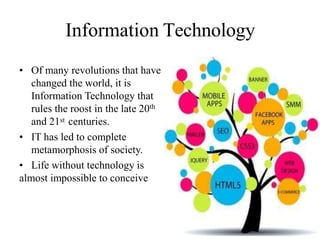
• Of many revolutions that have
changed the world, it is
Information Technology that
rules the roost in the late 20th
and 21st centuries.
• IT has led to complete
metamorphosis of society.
• Life without technology is
almost impossible to conceive
Key Players
• The key players in these areas are:
– First-level Users
– User Management
– Technology Consultants
– Developers
– Database Managers
– Infrastructure Support
Session Goals
• Today: We look at the use of information
technology for
– First-level users, and
– User Management
• Next Week: Introduction to MIS Frameworks
• Wed, Oct 12: We look at the approaches for
– Developers
– Technology Consultants
Schedule for Wed, 21-Sep-2022
• Economic Framework For IT
• Case Studies on different aspects of technology
applications
• IOT, and an overview of storage
• Summary
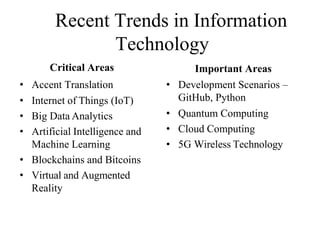
Recent Trends in Information
Technology
Critical Areas
• Accent Translation
• Internet of Things (IoT)
• Big Data Analytics
• Artificial Intelligence and
Machine Learning
• Blockchains and Bitcoins
• Virtual and Augmented
Reality
Important Areas
• Development Scenarios –
GitHub, Python
• Quantum Computing
• Cloud Computing
• 5G Wireless Technology
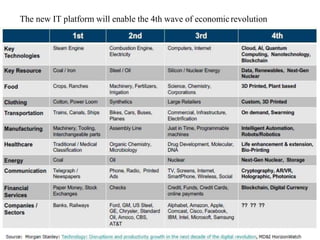
The new IT platform will enable the 4th wave of economicrevolution
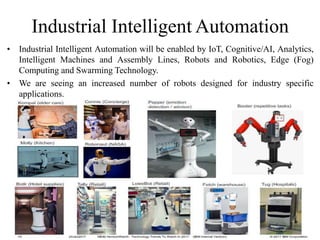
Industrial Intelligent Automation
• Industrial Intelligent Automation will be enabled by IoT, Cognitive/AI, Analytics,
Intelligent Machines and Assembly Lines, Robots and Robotics, Edge (Fog)
Computing and Swarming Technology.
• We are seeing an increased number of robots designed for industry specific
applications.
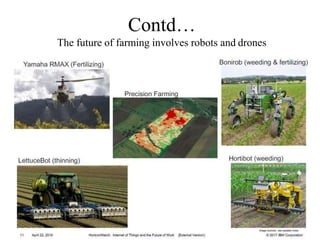
Contd…
The future of farming involves robots and drones
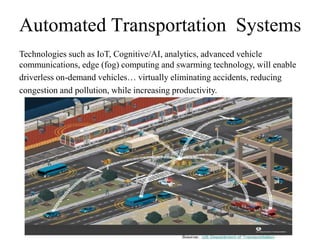
Automated Transportation Systems
Technologies such as IoT, Cognitive/AI, analytics, advanced vehicle
communications, edge (fog) computing and swarming technology, will enable
driverless on-demand vehicles… virtually eliminating accidents, reducing
congestion and pollution, while increasing productivity.
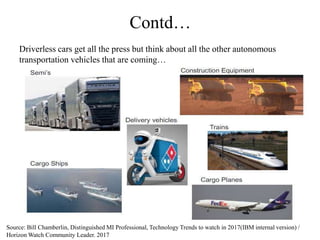
Contd…
Driverless cars get all the press but think about all the other autonomous
transportation vehicles that are coming…
Source: Bill Chamberlin, Distinguished MI Professional, Technology Trends to watch in 2017(IBM internal version) /
Horizon Watch Community Leader. 2017
What Will Come??
What will come??
The Future of Work will involve a partnership between
humans and cognitive systems technology.
Where are we headed
The future (2040-50) IT platform will be very fast and optimized for
distributed cloud-based cognitive applications.
Characteristics:
•Distributed / Edge Computing
•Secure
•Data as an Asset
•Blockchain
•Analytics
•Cognitive
•User Experience (UX) by Design
•Very Fast Zettascale computing (1021)
Case Studies
• Case Study 1 – Using IBM Watson to capture
experience
• Case Study 2 – Increasing the productivity of
the Sales and Customer Support team at
Yamaha Musical Instruments Division
• Case Study 3 – Improving the quality of
municipal services
• Case Study 4 – Improving banking processes
Case Study 1 – IBM Watson
• In which Indian industries do you think this
kind of experience will be useful?
• Can you suggest areas where expert systems
and artificial intelligence could be of great
help?
Case Study 2 – Yamaha-Deloitte
• In which industries would you suggest this
kind of approach be used?
• Can you suggest functional areas in a
company where Salesforce could be of great
help?
• Have you come across Salesforce being
used anywhere? How effective has it been?
What are the critical success factors?
Case Study 3 – Accenture-Paris
• Would it be possible to use IT in key
municipal services in Delhi? Which would
be the key areas that you would
recommend?
• What do you think is preventing the
deployment of IT by the MCD?
• Can you suggest areas where IT is already
being used effectively in Delhi?
Case Study 4 – Microsoft-Nedbank
• Have you come across this kind of Bot
approach in Indian banks? Where?
• How helpful do you find these bots in
banking transactions?
• What are the critical success factors in
deploying bots?
Internet of Things
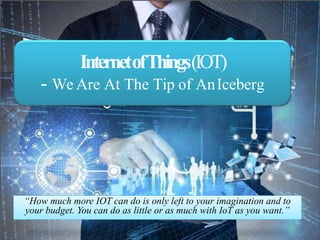
“How much more IOT can do is only left to your imagination and to
your budget. You can do as little or as much with IoT as you want.”
InternetofThings(IOT)
- We Are At The Tip of AnIceberg
The Internet Of Things
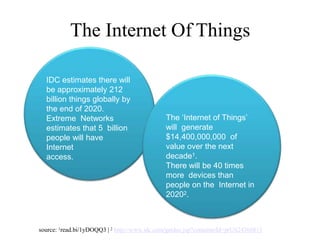
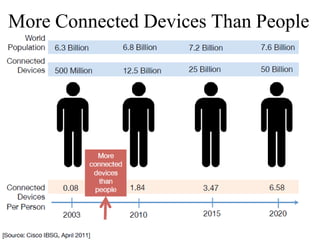
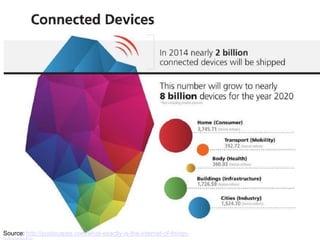
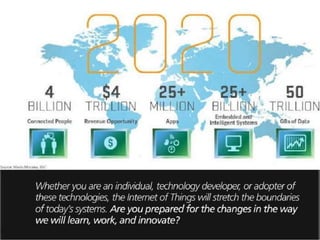
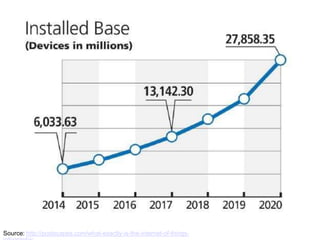
IDC estimates there will
be approximately 212
billion things globally by
the end of 2020.
Extreme Networks
estimates that 5 billion
people will have
Internet
access.
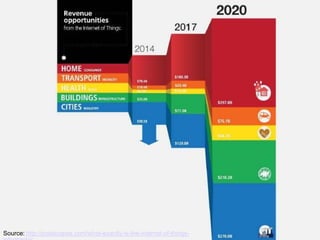
The ‘Internet of Things’
will generate
$14,400,000,000 of
value over the next
decade1.
There will be 40 times
more devices than
people on the Internet in
20202.
source: 1read.bi/1yDOQQ3 | 2 http://www.idc.com/getdoc.jsp?containerId=prUS24366813
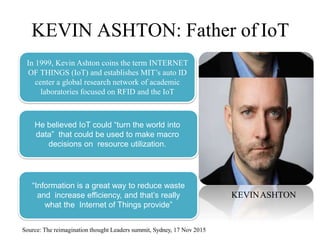
KEVIN ASHTON: Father of IoT
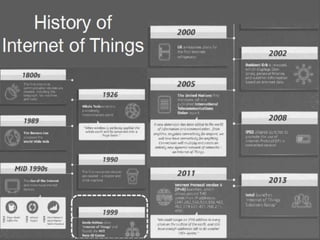
In 1999, Kevin Ashton coins the term INTERNET
OF THINGS (IoT) and establishes MIT’s auto ID
center a global research network of academic
laboratories focused on RFID and the IoT
He believed IoT could “turn the world into
data” that could be used to make macro
decisions on resource utilization.
“Information is a great way to reduce waste
and increase efficiency, and that’s really
what the Internet of Things provide”
Source: The reimagination thought Leaders summit, Sydney, 17 Nov 2015
KEVINASHTON
More Connected Devices Than People
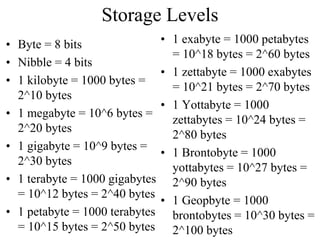
Storage Levels
• Byte = 8 bits
• Nibble = 4 bits
• 1 kilobyte = 1000 bytes =
2^10 bytes
• 1 megabyte = 10^6 bytes =
2^20 bytes
• 1 gigabyte = 10^9 bytes =
2^30 bytes
• 1 terabyte = 1000 gigabytes
= 10^12 bytes = 2^40 bytes
• 1 petabyte = 1000 terabytes
= 10^15 bytes = 2^50 bytes
• 1 exabyte = 1000 petabytes
= 10^18 bytes = 2^60 bytes
• 1 zettabyte = 1000 exabytes
= 10^21 bytes = 2^70 bytes
• 1 Yottabyte = 1000
zettabytes = 10^24 bytes =
2^80 bytes
• 1 Brontobyte = 1000
yottabytes = 10^27 bytes =
2^90 bytes
• 1 Geopbyte = 1000
brontobytes = 10^30 bytes =
2^100 bytes
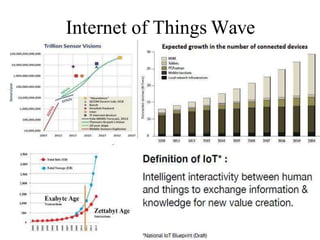
Internet of Things Wave
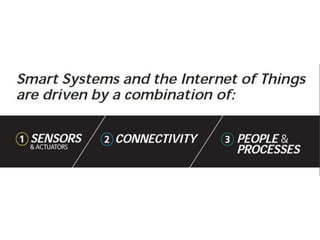
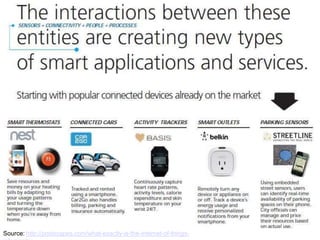
1. SENSORS and Actuators
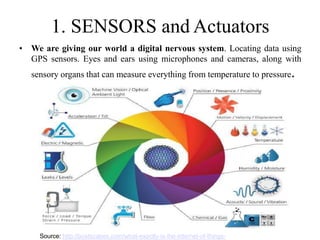
• We are giving our world a digital nervous system. Locating data using
GPS sensors. Eyes and ears using microphones and cameras, along with
sensory organs that can measure everything from temperature to pressure.
Source: http://postscapes.com/what-exactly-is-the-internet-of-things-
2. CONNECTIVITY
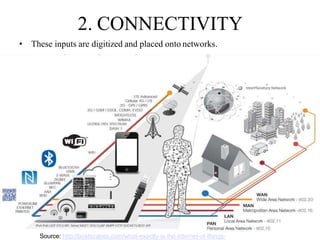
• These inputs are digitized and placed onto networks.
Source: http://postscapes.com/what-exactly-is-the-internet-of-things-
3. PEOPLE and Processes
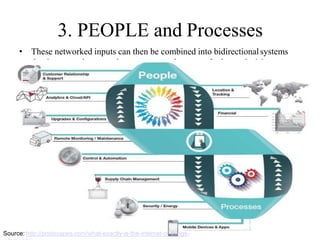
• These networked inputs can then be combined into bidirectionalsystems
that integrate data, people, processes and systems for betterdecision
making.
Source: http://postscapes.com/what-exactly-is-the-internet-of-things-
Big Data Analytics
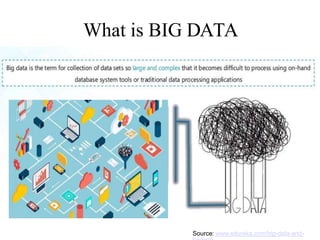
What is BIG DATA
Source: www.edureka.com/big-data-and-
Astonishing Growth of BIG DATA
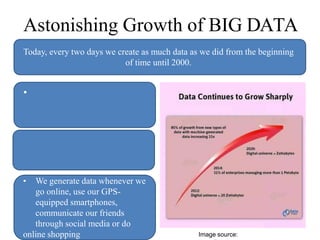
Today, every two days we create as much data as we did from the beginning
of time until 2000.
•
• We generate data whenever we
go online, use our GPS-
equipped smartphones,
communicate our friends
through social media or do
online shopping Image source:
5 V’s of BIG DATA
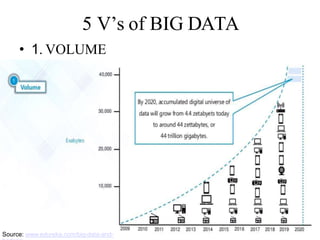
• 1. VOLUME
Source: www.edureka.com/big-data-and-
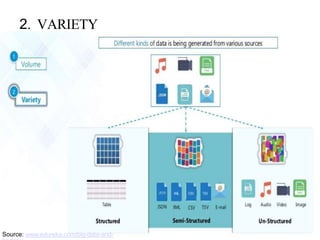
2. VARIETY
Source: www.edureka.com/big-data-and-
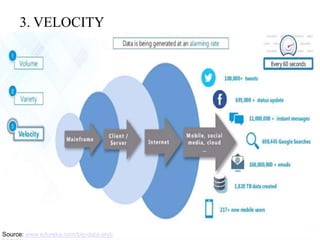
3. VELOCITY
Source: www.edureka.com/big-data-and-
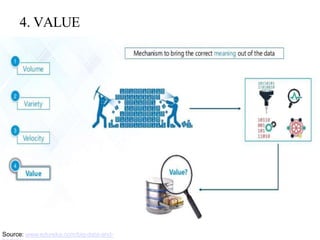
4. VALUE
Source: www.edureka.com/big-data-and-
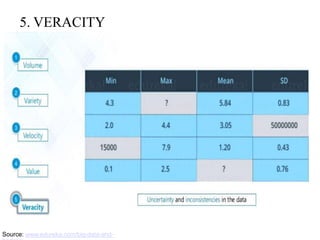
5. VERACITY
Source: www.edureka.com/big-data-and-
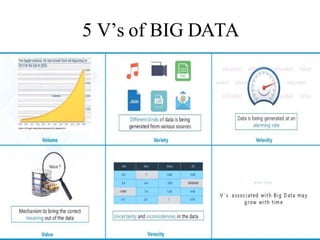
5 V’s of BIG DATA
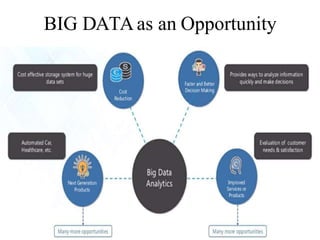
BIG DATAas an Opportunity
Summary
• IT today refers to artificial intelligence and
machine learning, machine smart devices,
big data, and social media.
• One of the biggest action areas in technology
these days is Big Data
• IT and computer network technology are
continuing to develop in interesting ways.
Summary
• Key developments over the past several years
include:
• The growing popularity of cloud computing and
cloud storage
• Improvements to mobile network infrastructure:
Thank You

GK NU CS 101 Session 1B (1).ppt

  • 1.
    Information Systems inthe Digital Age CS 101 – Session 1 Wed, Sep 21, 2022 G Krishnamurthy
  • 2.
    AGENDA 1. Recap 2. TrendsIn Information Technology • Latest Trends in IT • Case studies • Internet of Things • Big Data Analytics • To cover: • Virtual and Augmented Reality (Focus on SANAS Corp) • Cloud Computing • 5G Wireless
  • 3.
    Ice-Breaker Review • Greatto see people solve the different problems – Question 1: Just missed the best approach – Question 2: solved completely – Question 3: more statistical knowledge needed, especially clarity on inter-arrival times
  • 4.
    Information Technology • Ofmany revolutions that have changed the world, it is Information Technology that rules the roost in the late 20th and 21st centuries. • IT has led to complete metamorphosis of society. • Life without technology is almost impossible to conceive
  • 5.
    Key Players • Thekey players in these areas are: – First-level Users – User Management – Technology Consultants – Developers – Database Managers – Infrastructure Support
  • 6.
    Session Goals • Today:We look at the use of information technology for – First-level users, and – User Management • Next Week: Introduction to MIS Frameworks • Wed, Oct 12: We look at the approaches for – Developers – Technology Consultants
  • 7.
    Schedule for Wed,21-Sep-2022 • Economic Framework For IT • Case Studies on different aspects of technology applications • IOT, and an overview of storage • Summary
  • 8.
    Recent Trends inInformation Technology Critical Areas • Accent Translation • Internet of Things (IoT) • Big Data Analytics • Artificial Intelligence and Machine Learning • Blockchains and Bitcoins • Virtual and Augmented Reality Important Areas • Development Scenarios – GitHub, Python • Quantum Computing • Cloud Computing • 5G Wireless Technology
  • 9.
    The new ITplatform will enable the 4th wave of economicrevolution
  • 10.
    Industrial Intelligent Automation •Industrial Intelligent Automation will be enabled by IoT, Cognitive/AI, Analytics, Intelligent Machines and Assembly Lines, Robots and Robotics, Edge (Fog) Computing and Swarming Technology. • We are seeing an increased number of robots designed for industry specific applications.
  • 11.
    Contd… The future offarming involves robots and drones
  • 12.
    Automated Transportation Systems Technologiessuch as IoT, Cognitive/AI, analytics, advanced vehicle communications, edge (fog) computing and swarming technology, will enable driverless on-demand vehicles… virtually eliminating accidents, reducing congestion and pollution, while increasing productivity.
  • 13.
    Contd… Driverless cars getall the press but think about all the other autonomous transportation vehicles that are coming… Source: Bill Chamberlin, Distinguished MI Professional, Technology Trends to watch in 2017(IBM internal version) / Horizon Watch Community Leader. 2017
  • 14.
  • 15.
    What will come?? TheFuture of Work will involve a partnership between humans and cognitive systems technology.
  • 16.
    Where are weheaded The future (2040-50) IT platform will be very fast and optimized for distributed cloud-based cognitive applications. Characteristics: •Distributed / Edge Computing •Secure •Data as an Asset •Blockchain •Analytics •Cognitive •User Experience (UX) by Design •Very Fast Zettascale computing (1021)
  • 17.
    Case Studies • CaseStudy 1 – Using IBM Watson to capture experience • Case Study 2 – Increasing the productivity of the Sales and Customer Support team at Yamaha Musical Instruments Division • Case Study 3 – Improving the quality of municipal services • Case Study 4 – Improving banking processes
  • 18.
    Case Study 1– IBM Watson • In which Indian industries do you think this kind of experience will be useful? • Can you suggest areas where expert systems and artificial intelligence could be of great help?
  • 19.
    Case Study 2– Yamaha-Deloitte • In which industries would you suggest this kind of approach be used? • Can you suggest functional areas in a company where Salesforce could be of great help? • Have you come across Salesforce being used anywhere? How effective has it been? What are the critical success factors?
  • 20.
    Case Study 3– Accenture-Paris • Would it be possible to use IT in key municipal services in Delhi? Which would be the key areas that you would recommend? • What do you think is preventing the deployment of IT by the MCD? • Can you suggest areas where IT is already being used effectively in Delhi?
  • 21.
    Case Study 4– Microsoft-Nedbank • Have you come across this kind of Bot approach in Indian banks? Where? • How helpful do you find these bots in banking transactions? • What are the critical success factors in deploying bots?
  • 22.
  • 23.
    “How much moreIOT can do is only left to your imagination and to your budget. You can do as little or as much with IoT as you want.” InternetofThings(IOT) - We Are At The Tip of AnIceberg
  • 24.
    The Internet OfThings IDC estimates there will be approximately 212 billion things globally by the end of 2020. Extreme Networks estimates that 5 billion people will have Internet access. The ‘Internet of Things’ will generate $14,400,000,000 of value over the next decade1. There will be 40 times more devices than people on the Internet in 20202. source: 1read.bi/1yDOQQ3 | 2 http://www.idc.com/getdoc.jsp?containerId=prUS24366813
  • 26.
    KEVIN ASHTON: Fatherof IoT In 1999, Kevin Ashton coins the term INTERNET OF THINGS (IoT) and establishes MIT’s auto ID center a global research network of academic laboratories focused on RFID and the IoT He believed IoT could “turn the world into data” that could be used to make macro decisions on resource utilization. “Information is a great way to reduce waste and increase efficiency, and that’s really what the Internet of Things provide” Source: The reimagination thought Leaders summit, Sydney, 17 Nov 2015 KEVINASHTON
  • 27.
  • 28.
    Storage Levels • Byte= 8 bits • Nibble = 4 bits • 1 kilobyte = 1000 bytes = 2^10 bytes • 1 megabyte = 10^6 bytes = 2^20 bytes • 1 gigabyte = 10^9 bytes = 2^30 bytes • 1 terabyte = 1000 gigabytes = 10^12 bytes = 2^40 bytes • 1 petabyte = 1000 terabytes = 10^15 bytes = 2^50 bytes • 1 exabyte = 1000 petabytes = 10^18 bytes = 2^60 bytes • 1 zettabyte = 1000 exabytes = 10^21 bytes = 2^70 bytes • 1 Yottabyte = 1000 zettabytes = 10^24 bytes = 2^80 bytes • 1 Brontobyte = 1000 yottabytes = 10^27 bytes = 2^90 bytes • 1 Geopbyte = 1000 brontobytes = 10^30 bytes = 2^100 bytes
  • 29.
  • 31.
    1. SENSORS andActuators • We are giving our world a digital nervous system. Locating data using GPS sensors. Eyes and ears using microphones and cameras, along with sensory organs that can measure everything from temperature to pressure. Source: http://postscapes.com/what-exactly-is-the-internet-of-things-
  • 32.
    2. CONNECTIVITY • Theseinputs are digitized and placed onto networks. Source: http://postscapes.com/what-exactly-is-the-internet-of-things-
  • 33.
    3. PEOPLE andProcesses • These networked inputs can then be combined into bidirectionalsystems that integrate data, people, processes and systems for betterdecision making. Source: http://postscapes.com/what-exactly-is-the-internet-of-things-
  • 35.
  • 37.
  • 38.
  • 39.
  • 41.
  • 42.
    What is BIGDATA Source: www.edureka.com/big-data-and-
  • 44.
    Astonishing Growth ofBIG DATA Today, every two days we create as much data as we did from the beginning of time until 2000. • • We generate data whenever we go online, use our GPS- equipped smartphones, communicate our friends through social media or do online shopping Image source:
  • 45.
    5 V’s ofBIG DATA • 1. VOLUME Source: www.edureka.com/big-data-and-
  • 46.
  • 47.
  • 48.
  • 49.
  • 50.
    5 V’s ofBIG DATA
  • 51.
    BIG DATAas anOpportunity
  • 52.
    Summary • IT todayrefers to artificial intelligence and machine learning, machine smart devices, big data, and social media. • One of the biggest action areas in technology these days is Big Data • IT and computer network technology are continuing to develop in interesting ways.
  • 53.
    Summary • Key developmentsover the past several years include: • The growing popularity of cloud computing and cloud storage • Improvements to mobile network infrastructure:
  • 54.