
ALCOHOL BASICS
PROF.DR .ELANGOVAN’S UNIT
       D.SUBBURAJ
EPIDEMIOLOGY
• MC substance abuse in INDIA -ALCOHOL
  – NEXT MC- CANNABIS
• South india prevalance -33—55%
• Highest alcohol consumption -- KERALA
  – 8 L / CAPITA
• WORLD WIDE—LUXEMBOURG (15.5 L)
ALCOHOL
1 unit=10gm=12.5 ml absolute alcohol=1 drink
• Can’t be stored in the body
• Energy -7 kcal gm
• Some amount of other nutrients
  – some potassium ; no sodium
  – Riboflavin & niacin
  – Possible antioxidant benefits from
    polyphenols(?)
  – sometimes VIT C
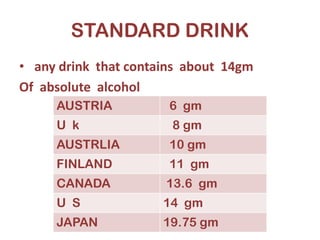
STANDARD DRINK
• any drink that contains about 14gm
Of absolute alcohol
     AUSTRIA           6 gm
     U k               8 gm
     AUSTRLIA          10 gm
     FINLAND           11 gm
     CANADA           13.6 gm
     U S              14 gm
     JAPAN            19.75 gm
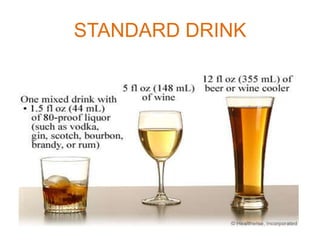
STANDARD DRINK
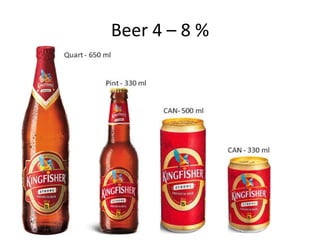
Beer 4 – 8 %
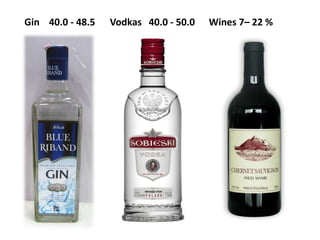
Gin 40.0 - 48.5   Vodkas 40.0 - 50.0   Wines 7– 22 %
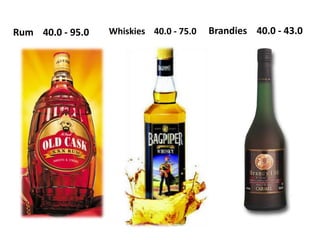
Rum 40.0 - 95.0   Whiskies 40.0 - 75.0   Brandies 40.0 - 43.0
BINGE DRINK
• U S DEFINITION
  – Consumption of five or more standard drink by
    males , four or more by females in about 2 hrs
• U K DEFINITION
  – Drinking more than twice the daily limit (>8 men, >6
    women)
• NIAAA DEFINITION
  – Any time one reaches a peak BAC of 0.08% or
    higher
SAFE DRINK
•    no uniform guidelines
•   UK– 2-3 standard drink daily or 14 per week
•   USA– 1 standard drink daily or 7 per week
•   Not more than 3 drinks on any one occasion
•   Don’t drive or engage in hazardous activities
•   Don’t drink if an interacting drug has been
    taken
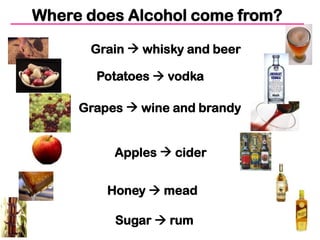
Where does Alcohol come from?

      Grain  whisky and beer

       Potatoes  vodka

     Grapes  wine and brandy


          Apples  cider


         Honey  mead

          Sugar  rum
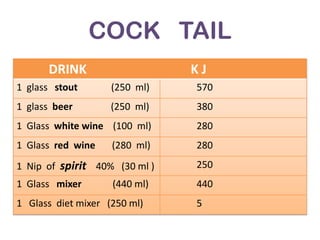
COCK TAIL
      DRINK                    KJ
1 glass stout       (250 ml)   570
1 glass beer        (250 ml)   380
1 Glass white wine (100 ml)    280
1 Glass red wine    (280 ml)   280
1 Nip of spirit 40% (30 ml )   250
1 Glass mixer       (440 ml)   440
1 Glass diet mixer (250 ml)    5
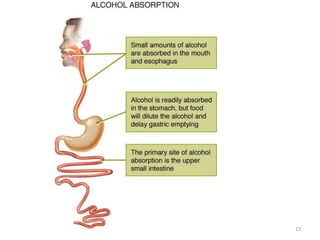
13
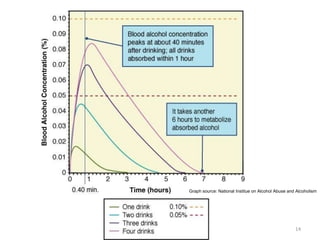
Graph source: National Institue on Alcohol Abuse and Alcoholism


                                                    14
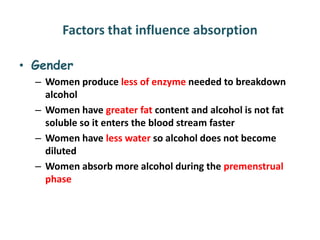
Factors that influence absorption

• Gender
  – Women produce less of enzyme needed to breakdown
    alcohol
  – Women have greater fat content and alcohol is not fat
    soluble so it enters the blood stream faster
  – Women have less water so alcohol does not become
    diluted
  – Women absorb more alcohol during the premenstrual
    phase
• Absorption increased by
  – Rapid gastric emptying ( carbonated beverages)
  – Absence of meal
  – Absence of congener
  – Dilution
• Tissue distribution - blood flow & water
  content
• Obese persons & women- higher BAC
• Follows zero – order kinetics
• So metabolism doesn’t vary widely in the
  population
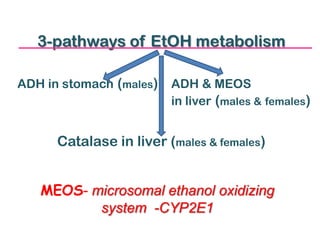
3-pathways of EtOH metabolism

ADH in stomach (males)   ADH & MEOS
                         in liver (males & females)


      Catalase in liver (males & females)


   MEOS- microsomal ethanol oxidizing
          system -CYP2E1
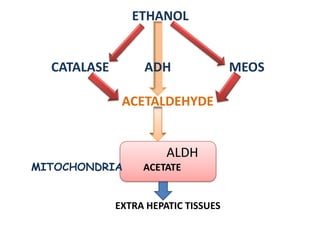
ETHANOL


  CATALASE        ADH                MEOS

              ACETALDEHYDE


                       ALDH
MITOCHONDRIA      ACETATE


             EXTRA HEPATIC TISSUES
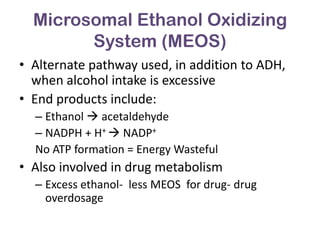
Microsomal Ethanol Oxidizing
        System (MEOS)
• Alternate pathway used, in addition to ADH,
  when alcohol intake is excessive
• End products include:
  – Ethanol  acetaldehyde
  – NADPH + H+  NADP+
  No ATP formation = Energy Wasteful
• Also involved in drug metabolism
  – Excess ethanol- less MEOS for drug- drug
    overdosage
Genetic Variation


•50% of Asians have inactive ALDH
•Develop flushing reaction
•Acetaldehyde Dehydrogenase (ALDH) varies in
Caucasians, Blacks and Asians.
• poly morphism TNF PROMOTER - susceptible
to alcoholic steatohepatitis
•Alcoholism -inherited ; specific gene not
identified
Metabolic effects
• High NADH/NAD RATIO
  – Prevents pyruvate entering in to
    gluconeogenesis- HYPOGLYCEMIA
  – Converts pyruvate to lactate - acidosis-
    uricacidaemia- GOUT
  – Increase TG - FATTY LIVER
• INDUCES DRUG METABOLISM
• FREE RADICAL FORMATION
• ACCUMALATION OF ACETALDEHYDE
POSSIBLE HEPATO TOXIC
 EFFECTS OF ACETALDEHYDE
• Increase lipid peroxidation
• Binds plasma membrane
• Interferes with mitochondrial electron
  transport chain
• Inhibits nuclear repair
• Interferes with microtubule formation
• Activates complement
• Increases collagen synthesis
DRUG INTERACTIONS
• Synergies with anxiolytics, antidepressants,
  antihistamines, hypnotics, opioids-- marked CNS
  depression with motor impairment -- chances of
  accidents increase
• Insulin & sulfonylureas: enhances
  hypoglycaemia
• Aspirin & other NSAID –gastric bleeding
• Parcetamol toxicity
• Acute alcohol ingestion inhibits , chronic
  alcoholism enhances phenytoin metabolism
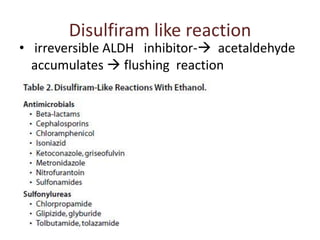
Disulfiram like reaction
• irreversible ALDH inhibitor- acetaldehyde
  accumulates  flushing reaction
DIAGNOSIS OF ALCOLISM
• TOLERANCE
 – A state of adaptation in which increasing amounts of
   alcohol are needed to produce desired effects
• PHYSICAL DEPENDENCE
 – A typical withdrawal syn appears on interruption of
   drinking , which is relieved by alcohol itself or other
   drugs
• IMPAIRED CONTROL
 – Total alcohol intake cannot invariably be regulated , once
   drinking has begun at any drinking occasion
• CRAVING
 – A dysphoria of abstinence that leads to relapse
Causes of Alcoholism

• Genetics
   – Strong family link
   – 50% of fathers, sons, brothers of alcoholics are likely to
     become alcoholics
   – Children of alcoholics are more then 3-4 times more likely
     to become alcoholics
• Personality types
   – Low self esteem
   – Chronic anxiety
   – Antisocial personalities
QUESTONNAIRES
• CAGE ( cut down , annoyed ,guilty, eye-
  opener)
• MAST (michigan alcoholism screening test)
• AUDIT ( alcohol use disorder identification
  test)
• RAPS4 (rapid alcohol problems screen 4)
• QFS ( quantity frequency score)
CAGE QUESTIONARE
•   Have you ever felt to cut down?
•   Have people annoyed you by criticizing ?
•   Have you ever felt guilty or bad ?
•   Have you ever had a drink first thing in the
    morning to steady your nerves or to get ride
    of hang over? (eye opener)
One ‘yes’ – suspicion
More than one-alcohol abuse or dependance
CLINICAL COURSE

• Age at first drink             13—15 yrs

•   Age at first intoxication     15—17 yrs
•   Age at first problem          16—22 yrs
•   Age at onset of dependence    23---40 yrs
•   Age at death                  60 yrs

• Spontaneous remission in 20% Same as general
  population.
DSM-IV CRITERIAS
• ALCOHOL ABUSE
• Recurrent use of alcohol associated with any
  one of the following with in 12mns
  1.   Failure to fulfill major role at work
  2.   Physically hazardous
  3.   Related legal problems
  4.   Despite of having persistent social problems
ALCOHOL DEPENDENCE
• Any one of following in 12 mns
• Increased amount of alcohol needed to achieve
  desired effect & continued use of same amount
• Withdrawal symptoms
• Persistent desire to cut down
• Important social /recreational activities given up
• Increased time spent to obtain/to use /to recover
  from the effects alcohol
Collection of blood for alcohol
• Spirit - not used to clean skin
• Preservative –sod fluoride(100mg)+potassium
  oxalate(30 mg)
• Refrigerated, should not be freezed
• WIDMARK FORMULA
  – Wt of alcohol(gm) in body= BWT X BAC X 0.6
    (men) 0.5(women)
Breath analysis
• Alcohol absorbs infra red rays
• Amount of infra red rays absorbed is
  proportional to alcohol contents
• 60—100ml of air is receieved in a plastic
  balloon
• End portion of forced expiration gives correct
  results
• Conc in exhaled air is about 0.05% of blood
  content
thank you

Alcohol basics

  • 1.
  • 2.
    EPIDEMIOLOGY • MC substanceabuse in INDIA -ALCOHOL – NEXT MC- CANNABIS • South india prevalance -33—55% • Highest alcohol consumption -- KERALA – 8 L / CAPITA • WORLD WIDE—LUXEMBOURG (15.5 L)
  • 3.
    ALCOHOL 1 unit=10gm=12.5 mlabsolute alcohol=1 drink • Can’t be stored in the body • Energy -7 kcal gm • Some amount of other nutrients – some potassium ; no sodium – Riboflavin & niacin – Possible antioxidant benefits from polyphenols(?) – sometimes VIT C
  • 4.
    STANDARD DRINK • anydrink that contains about 14gm Of absolute alcohol AUSTRIA 6 gm U k 8 gm AUSTRLIA 10 gm FINLAND 11 gm CANADA 13.6 gm U S 14 gm JAPAN 19.75 gm
  • 5.
  • 6.
  • 7.
    Gin 40.0 -48.5 Vodkas 40.0 - 50.0 Wines 7– 22 %
  • 8.
    Rum 40.0 -95.0 Whiskies 40.0 - 75.0 Brandies 40.0 - 43.0
  • 9.
    BINGE DRINK • US DEFINITION – Consumption of five or more standard drink by males , four or more by females in about 2 hrs • U K DEFINITION – Drinking more than twice the daily limit (>8 men, >6 women) • NIAAA DEFINITION – Any time one reaches a peak BAC of 0.08% or higher
  • 10.
    SAFE DRINK • no uniform guidelines • UK– 2-3 standard drink daily or 14 per week • USA– 1 standard drink daily or 7 per week • Not more than 3 drinks on any one occasion • Don’t drive or engage in hazardous activities • Don’t drink if an interacting drug has been taken
  • 11.
    Where does Alcoholcome from? Grain  whisky and beer Potatoes  vodka Grapes  wine and brandy Apples  cider Honey  mead Sugar  rum
  • 12.
    COCK TAIL DRINK KJ 1 glass stout (250 ml) 570 1 glass beer (250 ml) 380 1 Glass white wine (100 ml) 280 1 Glass red wine (280 ml) 280 1 Nip of spirit 40% (30 ml ) 250 1 Glass mixer (440 ml) 440 1 Glass diet mixer (250 ml) 5
  • 13.
  • 14.
    Graph source: NationalInstitue on Alcohol Abuse and Alcoholism 14
  • 15.
    Factors that influenceabsorption • Gender – Women produce less of enzyme needed to breakdown alcohol – Women have greater fat content and alcohol is not fat soluble so it enters the blood stream faster – Women have less water so alcohol does not become diluted – Women absorb more alcohol during the premenstrual phase
  • 16.
    • Absorption increasedby – Rapid gastric emptying ( carbonated beverages) – Absence of meal – Absence of congener – Dilution • Tissue distribution - blood flow & water content • Obese persons & women- higher BAC • Follows zero – order kinetics • So metabolism doesn’t vary widely in the population
  • 17.
    3-pathways of EtOHmetabolism ADH in stomach (males) ADH & MEOS in liver (males & females) Catalase in liver (males & females) MEOS- microsomal ethanol oxidizing system -CYP2E1
  • 18.
    ETHANOL CATALASE ADH MEOS ACETALDEHYDE ALDH MITOCHONDRIA ACETATE EXTRA HEPATIC TISSUES
  • 19.
    Microsomal Ethanol Oxidizing System (MEOS) • Alternate pathway used, in addition to ADH, when alcohol intake is excessive • End products include: – Ethanol  acetaldehyde – NADPH + H+  NADP+ No ATP formation = Energy Wasteful • Also involved in drug metabolism – Excess ethanol- less MEOS for drug- drug overdosage
  • 20.
    Genetic Variation •50% ofAsians have inactive ALDH •Develop flushing reaction •Acetaldehyde Dehydrogenase (ALDH) varies in Caucasians, Blacks and Asians. • poly morphism TNF PROMOTER - susceptible to alcoholic steatohepatitis •Alcoholism -inherited ; specific gene not identified
  • 21.
    Metabolic effects • HighNADH/NAD RATIO – Prevents pyruvate entering in to gluconeogenesis- HYPOGLYCEMIA – Converts pyruvate to lactate - acidosis- uricacidaemia- GOUT – Increase TG - FATTY LIVER • INDUCES DRUG METABOLISM • FREE RADICAL FORMATION • ACCUMALATION OF ACETALDEHYDE
  • 22.
    POSSIBLE HEPATO TOXIC EFFECTS OF ACETALDEHYDE • Increase lipid peroxidation • Binds plasma membrane • Interferes with mitochondrial electron transport chain • Inhibits nuclear repair • Interferes with microtubule formation • Activates complement • Increases collagen synthesis
  • 23.
    DRUG INTERACTIONS • Synergieswith anxiolytics, antidepressants, antihistamines, hypnotics, opioids-- marked CNS depression with motor impairment -- chances of accidents increase • Insulin & sulfonylureas: enhances hypoglycaemia • Aspirin & other NSAID –gastric bleeding • Parcetamol toxicity • Acute alcohol ingestion inhibits , chronic alcoholism enhances phenytoin metabolism
  • 24.
    Disulfiram like reaction •irreversible ALDH inhibitor- acetaldehyde accumulates  flushing reaction
  • 25.
    DIAGNOSIS OF ALCOLISM •TOLERANCE – A state of adaptation in which increasing amounts of alcohol are needed to produce desired effects • PHYSICAL DEPENDENCE – A typical withdrawal syn appears on interruption of drinking , which is relieved by alcohol itself or other drugs • IMPAIRED CONTROL – Total alcohol intake cannot invariably be regulated , once drinking has begun at any drinking occasion • CRAVING – A dysphoria of abstinence that leads to relapse
  • 26.
    Causes of Alcoholism •Genetics – Strong family link – 50% of fathers, sons, brothers of alcoholics are likely to become alcoholics – Children of alcoholics are more then 3-4 times more likely to become alcoholics • Personality types – Low self esteem – Chronic anxiety – Antisocial personalities
  • 27.
    QUESTONNAIRES • CAGE (cut down , annoyed ,guilty, eye- opener) • MAST (michigan alcoholism screening test) • AUDIT ( alcohol use disorder identification test) • RAPS4 (rapid alcohol problems screen 4) • QFS ( quantity frequency score)
  • 28.
    CAGE QUESTIONARE • Have you ever felt to cut down? • Have people annoyed you by criticizing ? • Have you ever felt guilty or bad ? • Have you ever had a drink first thing in the morning to steady your nerves or to get ride of hang over? (eye opener) One ‘yes’ – suspicion More than one-alcohol abuse or dependance
  • 29.
    CLINICAL COURSE • Ageat first drink 13—15 yrs • Age at first intoxication 15—17 yrs • Age at first problem 16—22 yrs • Age at onset of dependence 23---40 yrs • Age at death 60 yrs • Spontaneous remission in 20% Same as general population.
  • 30.
    DSM-IV CRITERIAS • ALCOHOLABUSE • Recurrent use of alcohol associated with any one of the following with in 12mns 1. Failure to fulfill major role at work 2. Physically hazardous 3. Related legal problems 4. Despite of having persistent social problems
  • 31.
    ALCOHOL DEPENDENCE • Anyone of following in 12 mns • Increased amount of alcohol needed to achieve desired effect & continued use of same amount • Withdrawal symptoms • Persistent desire to cut down • Important social /recreational activities given up • Increased time spent to obtain/to use /to recover from the effects alcohol
  • 32.
    Collection of bloodfor alcohol • Spirit - not used to clean skin • Preservative –sod fluoride(100mg)+potassium oxalate(30 mg) • Refrigerated, should not be freezed • WIDMARK FORMULA – Wt of alcohol(gm) in body= BWT X BAC X 0.6 (men) 0.5(women)
  • 33.
    Breath analysis • Alcoholabsorbs infra red rays • Amount of infra red rays absorbed is proportional to alcohol contents • 60—100ml of air is receieved in a plastic balloon • End portion of forced expiration gives correct results • Conc in exhaled air is about 0.05% of blood content
  • 35.