Academic text
structure
Lesson 1
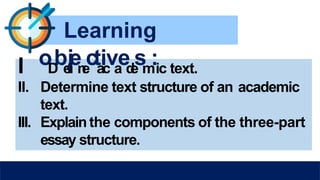
Learning
I
. oD
be
f
ji
en
e
cta
ic
va
ed
e
sm
:ic text.
II. Determine text structure of an academic
text.
III. Explainthe components of the three-part
essay structure.
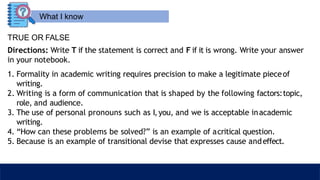
What I know
TRUE OR FALSE
Directions: Write T if the statement is correct and F if it is wrong. Write your answer
in your notebook.
1. Formality in academic writing requires precision to make a legitimate pieceof
writing.
2. Writing is a form of communication that is shaped by the following factors:topic,
role, and audience.
3. The use of personal pronouns such as I,you, and we is acceptable inacademic
writing.
4. “How can these problems be solved?” is an example of acritical question.
5. Because is an example of transitional devise that expresses cause andeffect.
What I know
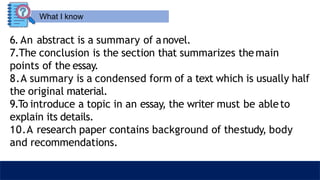
6. An abstract is a summary of anovel.
7.The conclusion is the section that summarizes themain
points of the essay.
8.A summary is a condensed form of a text which is usually half
the original material.
9.To introduce a topic in an essay, the writer must be ableto
explain its details.
10.A research paper contains background of thestudy, body
and recommendations.
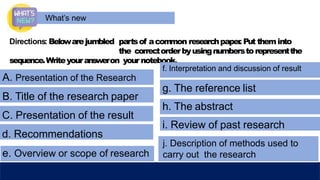
What’s new
Directions: Belowarejumbled partsof acommon researchpaper
. Put theminto
the correctorderbyusingnumberstorepresentthe
sequence.Writeyouransweron your notebook.
A. Presentation of the Research
B. Title of the research paper
C. Presentation of the result
d. Recommendations
e. Overview or scope of research
f. Interpretation and discussion of result
g. The reference list
h. The abstract
i. Review of past research
j. Description of methods used to
carry out the research
What is it
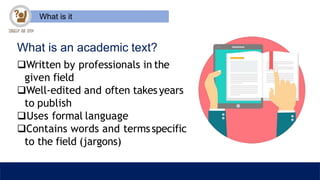
What is an academic text?
Written by professionals in the
given field
Well-edited and often takesyears
to publish
Uses formal language
Contains words and termsspecific
to the field (jargons)
What is it
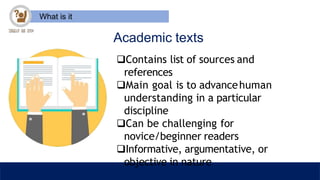
Academic texts
Contains list of sources and
references
Main goal is to advancehuman
understanding in a particular
discipline
Can be challenging for
novice/beginner readers
Informative, argumentative, or
objective in nature
What is it
Examples of Academic texts
• School books and textbooks
• Journal articles
• Research proposals and
papers
• Some newspaper and
magazine articles
• Thesis and dissertations
What is it
Literary analysis
• Examines, evaluates and makes
an argument about a literary
works
• It goes beyond mere
summarization
• It requires careful close reading
of one or multiple texts and
often focuses on a specific
characteristic, theme or motif.
What is it
Research paper
• It uses outside information to support a thesis
or make an argument.
• Written in all disciplines and may be
evaluative, analytical, or critical in nature.
• Common research sources include data,
primary sources (e.g.,historical records) and
secondary sources (e.g.,peer-reviewed
scholarly articles.
• It involves synthesizing this external
information with your own ideas.
What is it
dissertation
• It is a document submitted atthe
conclusion of a Ph.D. program.
• A book-length summarization ofthe
doctoral candidate’s research.
• Academic papers may be done as a part
of a class, in a program of study, or for
publication in an academic journal or
scholarly book of articles around atheme
by different authors.
What is it
Text structure
• A well-structured
text enables the
readers to follow
arguments and
navigate the text.
What is it
Two common structures of
academic text:
• The three-part essay
structure
• IMRaD structure
What is it
The three-part essay structure
• A basic structure that
consist of
INTRODUCTION, BODY
and CONCLUSION.
What is it
INTRODUCTION
• Its purpose is to clearly tell
the reader the topic,
purpose and structure of the
paper.
• It might be between 10-20
percent of the length of the
whole paper.
What is it
Three main parts of introduction
A. The most general
information
B. The core of the
introduction
C. The most specific
information.
What is it
Note:
• You should write your
introduction after you know
both your overall point of
view (if it is persuasive paper)
and the whole structure of
your paper.
• Revise the introduction when
you completed the main
body.
What is it
The body
• Develops the question, “What is the topic about?”
• It may elaborate directly on the topic sentenceby
giving definitions, classifications, explanations,
contrasts, examples and evidence.
• The heart of the essay because it expounds the
specific ideas for the readers to have a better
understanding of the topic.
• It is the largest part of the essay.
What is it
conclusion
• ‘Mirror image’ of the introduction.
• If the introduction begins with general information and
ends with specific information, the conclusion moves inthe
opposite direction
• Begins by briefly summarizing the main scope or structure
of the paper.
• Confirms the topic that was given in the introduction, ends
the more general statement about how this topic relates to
its context.
What is it
conclusion
• This may take the form
of an evaluation of the
importance of the topic,
implications for future
research or a
recommendation about
theory or practice.
What is it
Note:
• The introduction and the
conclusion should be shorter
than the body of the text.
• For shorter essays one or two
paragraphs for each of these
sections can be appropriate.
• For longer text or thesis, they
may be several pages long.
What is it
The imrad structure
•Forthesisand
dissertation
What is it
Sections of the imrad structure
•Introductions
•Methods
•Results and
•Discussion
What is it
Sections of the imrad structure
• the METHODOLOGY
let your readers know
your data collection
methods, research
instrument employed,
sample size and so on.
• the INTRODUCTIONS
usually depicts the
background of the
topic and the central
focus of the study.
What is it
Sections of the imrad structure
• the RESULTS AND
DISCUSSION states
the brief summary of
the key findings of the
result of your study.
What’s more
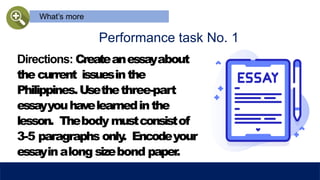
Performance task No. 1
Directions: Createanessayabout
the current issuesinthe
Philippines.Usethethree-part
essayyouhavelearnedinthe
lesson. Thebody mustconsistof
3-5 paragraphs only
. Encodeyour
essayinalong sizebond paper
.
Academic
language
Lesson 2
Learning Objectives
I. Determine language style in academic writing.
II.
III.
Differentiate language style used in academic texts
from various discipline; and
Construct paragraphs using academic language.
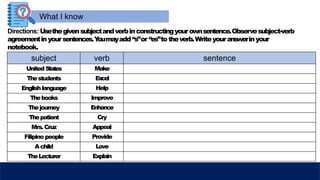
What I know
Directions: Usethegivensubjectandverbinconstructingyourownsentence.Observesubject-verb
agreementinyoursentences.Y
oumayadd“s”or “es”totheverb.Writeyouranswerinyour
notebook.
subject verb sentence
United States Make
Thestudents Excel
Englishlanguage Help
Thebooks Improve
Thejourney Enhance
Thepatient Cry
Mrs.Cruz Appeal
Filipino people Provide
Achild Love
TheLecturer Explain
What’s new
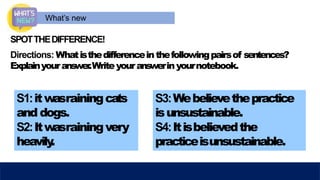
SPOTTHEDIFFERENCE!
Directions: Whatisthedifferenceinthefollowingpairsof sentences?
Explainyouranswer
.Writeyouranswerinyournotebook.
S1:itw
asrainingcats
and dogs.
S2:Itw
asrainingvery
heavily
.
S3:Webelievethepractice
isunsustainable.
S4:Itisbelievedthe
practiceisunsustainable.
What is it
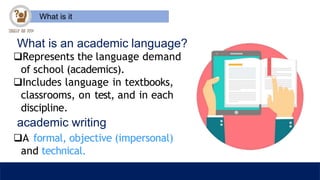
What is an academic language?
Represents the language demand
of school (academics).
Includes language in textbooks,
classrooms, on test, and in each
discipline.
academic writing
A formal, objective (impersonal)
and technical.
What is it
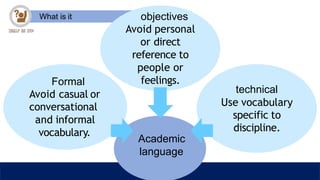
Academic
language
Formal
Avoid casual or
conversational
and informal
vocabulary.
technical
Use vocabulary
specific to
discipline.
objectives
Avoid personal
or direct
reference to
people or
feelings.
What is it
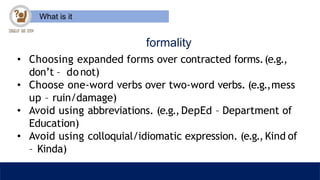
formality
• Choosing expanded forms over contracted forms.(e.g.,
don’t – donot)
• Choose one-word verbs over two-word verbs. (e.g.,mess
up – ruin/damage)
• Avoid using abbreviations. (e.g., DepEd – Department of
Education)
• Avoid using colloquial/idiomatic expression. (e.g.,Kind of
– Kinda)
What is it
objectivity
• The focus of the information is on the topic ratherthan
the writer him/herself. (Third person point-of-view)
• Avoid using personal pronouns. (e.g., We need tofollow
instructions. – The researchers need to follow
instructions.)
• Avoid rhetorical questions.
• Avoid emotive language. (e.g.,The police investigators
were shocked to see the results of the tests. – The police
investigators did not expect the results.)
What is it
technicality
• Contains words and
terms specific to the
field (jargons)
• Use vocabulary specific
to discipline.
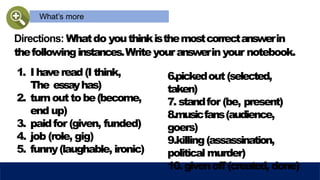
What’s more
Directions: Whatdo youthinkisthemostcorrectanswerin
thefollowinginstances.Writeyouranswerinyour notebook.
1. I haveread(I think,
The essayhas)
2. turnouttobe(become,
end up)
3. paidfor (given, funded)
4. job (role, gig)
5. funny(laughable, ironic)
6.pickedout(selected,
taken)
7. standfor (be, present)
8.musicfans(audience,
goers)
9.killing(assassination,
political murder)
10.givenoff (created, done)
eapp-lesson1-copy-221120025408-56457dc1.pptx

eapp-lesson1-copy-221120025408-56457dc1.pptx

  • 2.
  • 3.
    Learning I . oD be f ji en e cta ic va ed e sm :ic text. II.Determine text structure of an academic text. III. Explainthe components of the three-part essay structure.
  • 4.
    What I know TRUEOR FALSE Directions: Write T if the statement is correct and F if it is wrong. Write your answer in your notebook. 1. Formality in academic writing requires precision to make a legitimate pieceof writing. 2. Writing is a form of communication that is shaped by the following factors:topic, role, and audience. 3. The use of personal pronouns such as I,you, and we is acceptable inacademic writing. 4. “How can these problems be solved?” is an example of acritical question. 5. Because is an example of transitional devise that expresses cause andeffect.
  • 5.
    What I know 6.An abstract is a summary of anovel. 7.The conclusion is the section that summarizes themain points of the essay. 8.A summary is a condensed form of a text which is usually half the original material. 9.To introduce a topic in an essay, the writer must be ableto explain its details. 10.A research paper contains background of thestudy, body and recommendations.
  • 6.
    What’s new Directions: Belowarejumbledpartsof acommon researchpaper . Put theminto the correctorderbyusingnumberstorepresentthe sequence.Writeyouransweron your notebook. A. Presentation of the Research B. Title of the research paper C. Presentation of the result d. Recommendations e. Overview or scope of research f. Interpretation and discussion of result g. The reference list h. The abstract i. Review of past research j. Description of methods used to carry out the research
  • 7.
    What is it Whatis an academic text? Written by professionals in the given field Well-edited and often takesyears to publish Uses formal language Contains words and termsspecific to the field (jargons)
  • 8.
    What is it Academictexts Contains list of sources and references Main goal is to advancehuman understanding in a particular discipline Can be challenging for novice/beginner readers Informative, argumentative, or objective in nature
  • 9.
    What is it Examplesof Academic texts • School books and textbooks • Journal articles • Research proposals and papers • Some newspaper and magazine articles • Thesis and dissertations
  • 10.
    What is it Literaryanalysis • Examines, evaluates and makes an argument about a literary works • It goes beyond mere summarization • It requires careful close reading of one or multiple texts and often focuses on a specific characteristic, theme or motif.
  • 11.
    What is it Researchpaper • It uses outside information to support a thesis or make an argument. • Written in all disciplines and may be evaluative, analytical, or critical in nature. • Common research sources include data, primary sources (e.g.,historical records) and secondary sources (e.g.,peer-reviewed scholarly articles. • It involves synthesizing this external information with your own ideas.
  • 12.
    What is it dissertation •It is a document submitted atthe conclusion of a Ph.D. program. • A book-length summarization ofthe doctoral candidate’s research. • Academic papers may be done as a part of a class, in a program of study, or for publication in an academic journal or scholarly book of articles around atheme by different authors.
  • 13.
    What is it Textstructure • A well-structured text enables the readers to follow arguments and navigate the text.
  • 14.
    What is it Twocommon structures of academic text: • The three-part essay structure • IMRaD structure
  • 15.
    What is it Thethree-part essay structure • A basic structure that consist of INTRODUCTION, BODY and CONCLUSION.
  • 16.
    What is it INTRODUCTION •Its purpose is to clearly tell the reader the topic, purpose and structure of the paper. • It might be between 10-20 percent of the length of the whole paper.
  • 17.
    What is it Threemain parts of introduction A. The most general information B. The core of the introduction C. The most specific information.
  • 18.
    What is it Note: •You should write your introduction after you know both your overall point of view (if it is persuasive paper) and the whole structure of your paper. • Revise the introduction when you completed the main body.
  • 19.
    What is it Thebody • Develops the question, “What is the topic about?” • It may elaborate directly on the topic sentenceby giving definitions, classifications, explanations, contrasts, examples and evidence. • The heart of the essay because it expounds the specific ideas for the readers to have a better understanding of the topic. • It is the largest part of the essay.
  • 20.
    What is it conclusion •‘Mirror image’ of the introduction. • If the introduction begins with general information and ends with specific information, the conclusion moves inthe opposite direction • Begins by briefly summarizing the main scope or structure of the paper. • Confirms the topic that was given in the introduction, ends the more general statement about how this topic relates to its context.
  • 21.
    What is it conclusion •This may take the form of an evaluation of the importance of the topic, implications for future research or a recommendation about theory or practice.
  • 22.
    What is it Note: •The introduction and the conclusion should be shorter than the body of the text. • For shorter essays one or two paragraphs for each of these sections can be appropriate. • For longer text or thesis, they may be several pages long.
  • 23.
    What is it Theimrad structure •Forthesisand dissertation
  • 24.
    What is it Sectionsof the imrad structure •Introductions •Methods •Results and •Discussion
  • 25.
    What is it Sectionsof the imrad structure • the METHODOLOGY let your readers know your data collection methods, research instrument employed, sample size and so on. • the INTRODUCTIONS usually depicts the background of the topic and the central focus of the study.
  • 26.
    What is it Sectionsof the imrad structure • the RESULTS AND DISCUSSION states the brief summary of the key findings of the result of your study.
  • 27.
    What’s more Performance taskNo. 1 Directions: Createanessayabout the current issuesinthe Philippines.Usethethree-part essayyouhavelearnedinthe lesson. Thebody mustconsistof 3-5 paragraphs only . Encodeyour essayinalong sizebond paper .
  • 28.
  • 29.
    Learning Objectives I. Determinelanguage style in academic writing. II. III. Differentiate language style used in academic texts from various discipline; and Construct paragraphs using academic language.
  • 30.
    What I know Directions:Usethegivensubjectandverbinconstructingyourownsentence.Observesubject-verb agreementinyoursentences.Y oumayadd“s”or “es”totheverb.Writeyouranswerinyour notebook. subject verb sentence United States Make Thestudents Excel Englishlanguage Help Thebooks Improve Thejourney Enhance Thepatient Cry Mrs.Cruz Appeal Filipino people Provide Achild Love TheLecturer Explain
  • 31.
    What’s new SPOTTHEDIFFERENCE! Directions: Whatisthedifferenceinthefollowingpairsofsentences? Explainyouranswer .Writeyouranswerinyournotebook. S1:itw asrainingcats and dogs. S2:Itw asrainingvery heavily . S3:Webelievethepractice isunsustainable. S4:Itisbelievedthe practiceisunsustainable.
  • 32.
    What is it Whatis an academic language? Represents the language demand of school (academics). Includes language in textbooks, classrooms, on test, and in each discipline. academic writing A formal, objective (impersonal) and technical.
  • 33.
    What is it Academic language Formal Avoidcasual or conversational and informal vocabulary. technical Use vocabulary specific to discipline. objectives Avoid personal or direct reference to people or feelings.
  • 34.
    What is it formality •Choosing expanded forms over contracted forms.(e.g., don’t – donot) • Choose one-word verbs over two-word verbs. (e.g.,mess up – ruin/damage) • Avoid using abbreviations. (e.g., DepEd – Department of Education) • Avoid using colloquial/idiomatic expression. (e.g.,Kind of – Kinda)
  • 35.
    What is it objectivity •The focus of the information is on the topic ratherthan the writer him/herself. (Third person point-of-view) • Avoid using personal pronouns. (e.g., We need tofollow instructions. – The researchers need to follow instructions.) • Avoid rhetorical questions. • Avoid emotive language. (e.g.,The police investigators were shocked to see the results of the tests. – The police investigators did not expect the results.)
  • 36.
    What is it technicality •Contains words and terms specific to the field (jargons) • Use vocabulary specific to discipline.
  • 37.

    What’s more Directions: Whatdoyouthinkisthemostcorrectanswerin thefollowinginstances.Writeyouranswerinyour notebook. 1. I haveread(I think, The essayhas) 2. turnouttobe(become, end up) 3. paidfor (given, funded) 4. job (role, gig) 5. funny(laughable, ironic) 6.pickedout(selected, taken) 7. standfor (be, present) 8.musicfans(audience, goers) 9.killing(assassination, political murder) 10.givenoff (created, done)