






PAPER
ETHNOGRAPHY
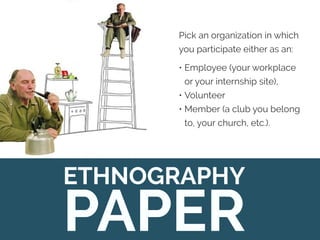
Pick an organization in which
you participate either as an:
• Employee (your workplace
or your internship site),
• Volunteer
• Member (a club you belong
to, your church, etc.).
PAPER
ETHNOGRAPHY
The idea behind it:
• Designed to help you integrate course material into ‘‘real world’’
experiences by analyzing an actual organization.
The challenge:
• Participate and observe the organization and keep field notes
• Conduct interviews with members AND/OR collect documents
the organization produces
• Write an analysis of the organizational culture and
communication observed at that organization
PAPER
ETHNOGRAPHY
Expectations (6-7 pages, researched):
full grading criteria on back of syllabus
• Clearly conveys a sense of the organization’s culture
• Clearly points out BOTH positives and negatives
• Covers a minimum of 5 course topics, and for each topic:
• Shows a conceptual understanding
• Cites specific examples
• Offers critical advice based on course
theories and concepts
• Well written (spelling, grammar, flow)
• Knock our socks off!!!
ETHNOGRAPHIC RESEARCH
Intro to Participant Observation
How do you study
Inner-city Gangs
?
• survey research • experiments •
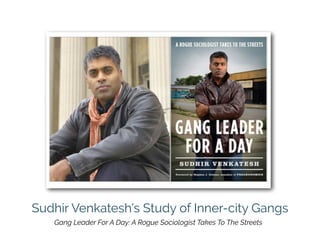
Sudhir Venkatesh’s Study of Inner-city Gangs
Gang Leader For A Day: A Rogue Sociologist Takes To The Streets
How do you feel about being
poor and Black in America?
A) Very Good
B) Good
C) Bad
D) Very Bad
LIMITATIONS
of survey research
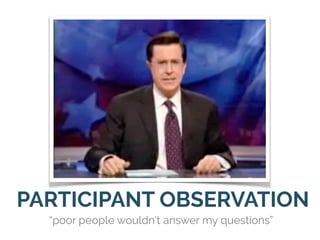
PARTICIPANT OBSERVATION
“poor people wouldn’t answer my questions”
What to do with the
NOTEBOOK?
Black Kings
Financial Data
Steven Levitt: Author of Freakonomics
Ethnographer:
Qualitative Research
Economist:
Quantitative Research
Mixed Methods
• Like dance, researchers must be flexible
and adaptive to the dynamic process
• There are three stages to participant
observation:
•The “warm-up” period
•The “floor exercise” stage
•The “cool-down” stage
CHOREOGRAPHY OF
PARTICIPANT OBSERVATION
• Begin with general questions of interest – questions
will evolve throughout the research process
• Do research to achieve theoretical sensitivity. Enter
field open-minded but not empty-headed
• Keep a reflexive journal and a journal for field notes
• Select the field site
• Decide on your type of role
• Gain access to the site
THE WARM-UP
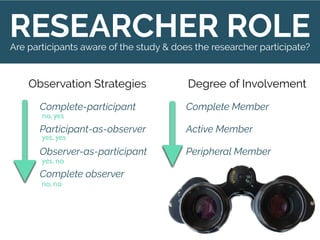
Observation Strategies
Complete-participant
Participant-as-observer
Observer-as-participant
Complete observer
Degree of Involvement
Complete Member
Active Member
Peripheral Member
RESEARCHER ROLE
Are participants aware of the study & does the researcher participate?
no, yes
yes, yes
yes, no
no, no
GAINING ACCESS
• Assess nature of informed consent given
goals, desired role, & community
• Gatekeeper: key to gaining access – can
often offer consent to study the org.
• Sponsors: help establish relationships
with other community members by taking
an interest in your project
• Informants: community members you go to
for info about the community & for
conducting “member checks”
Who would JT be?
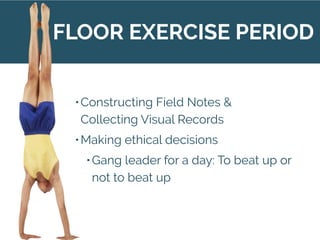
•Constructing Field Notes &
Collecting Visual Records
•Making ethical decisions
•Gang leader for a day: To beat up or
not to beat up
FLOOR EXERCISE PERIOD
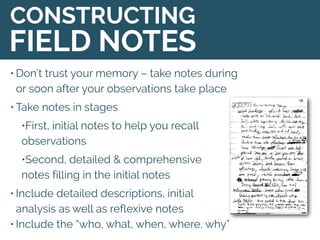
• Don’t trust your memory – take notes during
or soon after your observations take place
• Take notes in stages
•First, initial notes to help you recall
observations
•Second, detailed & comprehensive
notes filling in the initial notes
• Include detailed descriptions, initial
analysis as well as reflexive notes
• Include the “who, what, when, where, why”
CONSTRUCTING
FIELD NOTES
COOL DOWN PERIOD
• Data gathering is complete when “saturated”
• Saturation: when data are repetitive
• In order to determine saturation, data must be
analyzed as it is collected
• Additional member checks
may be needed as you
continue to write the report

Ethnography

  • 1.
    PAPER ETHNOGRAPHY Pick an organizationin which you participate either as an: • Employee (your workplace or your internship site), • Volunteer • Member (a club you belong to, your church, etc.).
  • 2.
    PAPER ETHNOGRAPHY The idea behindit: • Designed to help you integrate course material into ‘‘real world’’ experiences by analyzing an actual organization. The challenge: • Participate and observe the organization and keep field notes • Conduct interviews with members AND/OR collect documents the organization produces • Write an analysis of the organizational culture and communication observed at that organization
  • 3.
    PAPER ETHNOGRAPHY Expectations (6-7 pages,researched): full grading criteria on back of syllabus • Clearly conveys a sense of the organization’s culture • Clearly points out BOTH positives and negatives • Covers a minimum of 5 course topics, and for each topic: • Shows a conceptual understanding • Cites specific examples • Offers critical advice based on course theories and concepts • Well written (spelling, grammar, flow) • Knock our socks off!!!
  • 4.
    ETHNOGRAPHIC RESEARCH Intro toParticipant Observation
  • 5.
    How do youstudy Inner-city Gangs ? • survey research • experiments •
  • 6.
    Sudhir Venkatesh’s Studyof Inner-city Gangs Gang Leader For A Day: A Rogue Sociologist Takes To The Streets
  • 7.
    How do youfeel about being poor and Black in America? A) Very Good B) Good C) Bad D) Very Bad LIMITATIONS of survey research
  • 8.
    PARTICIPANT OBSERVATION “poor peoplewouldn’t answer my questions”
  • 9.
    What to dowith the NOTEBOOK? Black Kings Financial Data
  • 10.
    Steven Levitt: Authorof Freakonomics
  • 11.
  • 12.
    • Like dance,researchers must be flexible and adaptive to the dynamic process • There are three stages to participant observation: •The “warm-up” period •The “floor exercise” stage •The “cool-down” stage CHOREOGRAPHY OF PARTICIPANT OBSERVATION
  • 13.
    • Begin withgeneral questions of interest – questions will evolve throughout the research process • Do research to achieve theoretical sensitivity. Enter field open-minded but not empty-headed • Keep a reflexive journal and a journal for field notes • Select the field site • Decide on your type of role • Gain access to the site THE WARM-UP
  • 14.
    Observation Strategies Complete-participant Participant-as-observer Observer-as-participant Complete observer Degreeof Involvement Complete Member Active Member Peripheral Member RESEARCHER ROLE Are participants aware of the study & does the researcher participate? no, yes yes, yes yes, no no, no
  • 15.
    GAINING ACCESS • Assessnature of informed consent given goals, desired role, & community • Gatekeeper: key to gaining access – can often offer consent to study the org. • Sponsors: help establish relationships with other community members by taking an interest in your project • Informants: community members you go to for info about the community & for conducting “member checks” Who would JT be?
  • 16.
    •Constructing Field Notes& Collecting Visual Records •Making ethical decisions •Gang leader for a day: To beat up or not to beat up FLOOR EXERCISE PERIOD
  • 17.
    • Don’t trustyour memory – take notes during or soon after your observations take place • Take notes in stages •First, initial notes to help you recall observations •Second, detailed & comprehensive notes filling in the initial notes • Include detailed descriptions, initial analysis as well as reflexive notes • Include the “who, what, when, where, why” CONSTRUCTING FIELD NOTES
  • 18.
    COOL DOWN PERIOD •Data gathering is complete when “saturated” • Saturation: when data are repetitive • In order to determine saturation, data must be analyzed as it is collected • Additional member checks may be needed as you continue to write the report