Ethical Issues
               Re: you as students
• Informed consent (prior general consent)
• Deception (you will be deceived at times)
• Debriefing (always debriefed as will link to learning)
• Right to withdraw (you do not have the right to
  withdraw as is course requirement)
• Confidentiality (I cannot promise you confidentiality
  so you have the right to lie)
• Protection (I will DEFINITELY protect you from physical
  harm or emotional harm – embarrassment)
My aunt’s bathroom scales

• Reliability = consistency, can it be
  replicated?
e.g. the scales say every day that my 15 stone aunt is 8 stone.
FULLY RELIABLE.

• Validity = accurate, does it truly test
  what is being studied?
e.g. she is actually 15 stone. COMPLETELY INVALID.
Sampling
    L/O: To be able to differentiate between
RANDOM, OPPORTUNITY and VOLUNTEER sampling
      Starter:     methods.
      You are conducting a research project where you hope
      to prove (hypothesise) that there is a difference in
      intelligence between men and women.

      Who do you need to take part? How will you recruit?
Participants = the people who take
part in research.
Population = the group of people
your participants come from.

Sample = the selection of
participants, from the
population, who take part in your
SAMPLING
 Participant sampling is important in psychological
                     research.

• Typical
• Representative
• Cross-section of people

= can generalise findings to general population.

IF NOT: Sample bias *a criticism you can often use in
evaluating studies so check the sampling method*
Which question from your homework could have been answered using ‘SAMPLE BIAS’?
L/O: To be able to differentiate between
RANDOM, OPPORTUNITY and VOLUNTEER sampling
methods.
  Random: every one in the population has equal
  chance of taking part. e.g. names from a hat or
  random selector computer programs.

 Opportunity: use anyone you can get hold of. e.g.
 waiting for people to pass by you.

 Volunteer: requesting for people to take part. e.g.
 poster, advert, maybe a small payment.
RANDOM, OPPORTUNITY or
         VOLUNTEER sampling?
1. You wait by the sixth form centre entrance
   and approach people as they enter to take
   part.
2. You put an advert on the sixth form notice
   board asking people to contact you if they
   would take part.

Create and write a situation for the remaining
one.
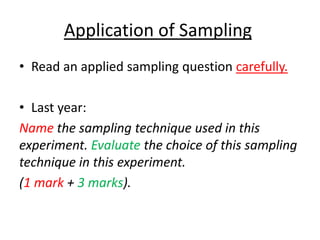
Application of Sampling
• Read an applied sampling question carefully.

• Last year:
Name the sampling technique used in this
experiment. Evaluate the choice of this sampling
technique in this experiment.
(1 mark + 3 marks).
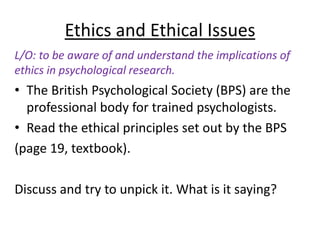
Ethics and Ethical Issues
L/O: to be aware of and understand the implications of
ethics in psychological research.
• The British Psychological Society (BPS) are the
  professional body for trained psychologists.
• Read the ethical principles set out by the BPS
(page 19, textbook).

Discuss and try to unpick it. What is it saying?
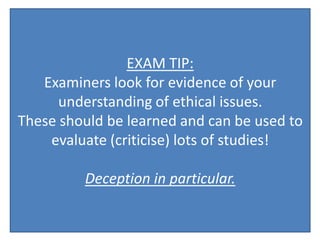
EXAM TIP:
   Examiners look for evidence of your
      understanding of ethical issues.
These should be learned and can be used to
    evaluate (criticise) lots of studies!

         Deception in particular.
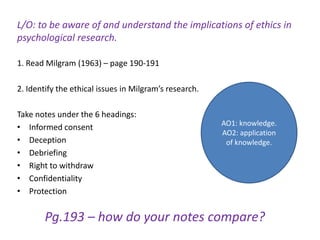
L/O: to be aware of and understand the implications of ethics in
psychological research.

1. Read Milgram (1963) – page 190-191

2. Identify the ethical issues in Milgram’s research.

Take notes under the 6 headings:
                                                        AO1: knowledge.
• Informed consent
                                                        AO2: application
• Deception                                              of knowledge.
• Debriefing
• Right to withdraw
• Confidentiality
• Protection


        Pg.193 – how do your notes compare?
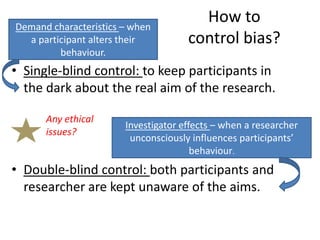
Demand characteristics – when
                                       How to
  a participant alters their         control bias?
         behaviour.
• Single-blind control: to keep participants in
  the dark about the real aim of the research.

      Any ethical
                       Investigator effects – when a researcher
      issues?
                        unconsciously influences participants’
                                       behaviour.
• Double-blind control: both participants and
  researcher are kept unaware of the aims.
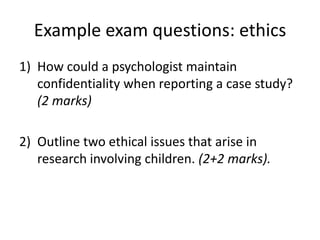
Example exam questions: ethics
1) How could a psychologist maintain
   confidentiality when reporting a case study?
   (2 marks)

2) Outline two ethical issues that arise in
   research involving children. (2+2 marks).

Ethics, reliability, validity, sampling

  • 1.
    Ethical Issues Re: you as students • Informed consent (prior general consent) • Deception (you will be deceived at times) • Debriefing (always debriefed as will link to learning) • Right to withdraw (you do not have the right to withdraw as is course requirement) • Confidentiality (I cannot promise you confidentiality so you have the right to lie) • Protection (I will DEFINITELY protect you from physical harm or emotional harm – embarrassment)
  • 2.
    My aunt’s bathroomscales • Reliability = consistency, can it be replicated? e.g. the scales say every day that my 15 stone aunt is 8 stone. FULLY RELIABLE. • Validity = accurate, does it truly test what is being studied? e.g. she is actually 15 stone. COMPLETELY INVALID.
  • 3.
    Sampling L/O: To be able to differentiate between RANDOM, OPPORTUNITY and VOLUNTEER sampling Starter: methods. You are conducting a research project where you hope to prove (hypothesise) that there is a difference in intelligence between men and women. Who do you need to take part? How will you recruit?
  • 4.
    Participants = thepeople who take part in research. Population = the group of people your participants come from. Sample = the selection of participants, from the population, who take part in your
  • 5.
    SAMPLING Participant samplingis important in psychological research. • Typical • Representative • Cross-section of people = can generalise findings to general population. IF NOT: Sample bias *a criticism you can often use in evaluating studies so check the sampling method* Which question from your homework could have been answered using ‘SAMPLE BIAS’?
  • 6.
    L/O: To beable to differentiate between RANDOM, OPPORTUNITY and VOLUNTEER sampling methods. Random: every one in the population has equal chance of taking part. e.g. names from a hat or random selector computer programs. Opportunity: use anyone you can get hold of. e.g. waiting for people to pass by you. Volunteer: requesting for people to take part. e.g. poster, advert, maybe a small payment.
  • 7.
    RANDOM, OPPORTUNITY or VOLUNTEER sampling? 1. You wait by the sixth form centre entrance and approach people as they enter to take part. 2. You put an advert on the sixth form notice board asking people to contact you if they would take part. Create and write a situation for the remaining one.
  • 8.
    Application of Sampling •Read an applied sampling question carefully. • Last year: Name the sampling technique used in this experiment. Evaluate the choice of this sampling technique in this experiment. (1 mark + 3 marks).
  • 9.
    Ethics and EthicalIssues L/O: to be aware of and understand the implications of ethics in psychological research. • The British Psychological Society (BPS) are the professional body for trained psychologists. • Read the ethical principles set out by the BPS (page 19, textbook). Discuss and try to unpick it. What is it saying?
  • 10.
    EXAM TIP: Examiners look for evidence of your understanding of ethical issues. These should be learned and can be used to evaluate (criticise) lots of studies! Deception in particular.
  • 11.
    L/O: to beaware of and understand the implications of ethics in psychological research. 1. Read Milgram (1963) – page 190-191 2. Identify the ethical issues in Milgram’s research. Take notes under the 6 headings: AO1: knowledge. • Informed consent AO2: application • Deception of knowledge. • Debriefing • Right to withdraw • Confidentiality • Protection Pg.193 – how do your notes compare?
  • 12.
    Demand characteristics –when How to a participant alters their control bias? behaviour. • Single-blind control: to keep participants in the dark about the real aim of the research. Any ethical Investigator effects – when a researcher issues? unconsciously influences participants’ behaviour. • Double-blind control: both participants and researcher are kept unaware of the aims.
  • 13.
    Example exam questions:ethics 1) How could a psychologist maintain confidentiality when reporting a case study? (2 marks) 2) Outline two ethical issues that arise in research involving children. (2+2 marks).